SaaS Conversational AI Chatbot Development for Startup
- 12 weeks
- from concept to launch
- 4x
- deeper insights than traditional surveys
Business Process Automation Services
Business process automation replaces manual steps with software. Data entry replaced by AI extraction. Email-based approvals replaced by structured workflows. Report assembly replaced by automated pipelines. The same work done in a fraction of the time with fewer errors and a complete audit trail.
We build custom BPA systems for the processes that are costing your business the most, not generic platforms that automate what's easy but miss what matters.
Custom automation for your specific process, not a generic workflow platform
AI handling of exceptions and unstructured inputs
Integration with your existing systems, ERP, CRM, email, databases
100+ products shipped including automation systems across manufacturing, fintech, and healthcare
Recent outcomes
Invoice automation · Manufacturing client
20,000+ transactions/month
Replaced a manual invoice intake process with an AI OCR pipeline, eliminating data entry errors across 20,000+ monthly transactions.
Document workflows · Healthcare client
20% faster decisions
Built a HIPAA-compliant patient onboarding and document routing system. 150 patients onboarded in 12 weeks with 20% faster clinical decisions.
Reporting automation · B2B SaaS client
3x revenue on the platform
Replaced manually assembled weekly reports with automated data pipelines, cutting report preparation from half a day to under 10 minutes.
The problem
Your team is manually doing work that's the same every time?"
Process errors costing you money, time, and customer trust?
Short answer
RaftLabs builds custom business process automation systems for businesses across the US, UK, Europe, Canada, GCC, South Africa, and Southeast Asia. A single-process automation with 2 to 3 system integrations costs $25,000 to $60,000 and delivers in 8 to 14 weeks. We integrate with your ERP, CRM, and databases - not generic platforms.
Key takeaways
Trusted by










A finance analyst opens the morning's invoices. Different formats, different layouts, the same fields to find and type in, one at a time. Two hours of the day, every day, gone to mechanical work. Manual data entry runs at roughly 1-4% error rates even with careful operators, so some of those keystrokes are quietly wrong.
Now an AI OCR pipeline reads each invoice in whatever format it arrives, extracts the fields, validates them against the business rules, and posts them, at under 0.1% error. For one manufacturing client, that pipeline eliminated data entry errors across 20,000+ transactions a month.
The analyst didn't lose the job. They got the two hours back, to build the forecasts nobody had time for.
RaftLabs builds custom business process automation systems for businesses that need their most expensive manual processes replaced with reliable software. We are an AI-first tech studio, not a generic automation platform vendor or an agency. The engineers who assess your process also build the automation: one team handles process mapping, system integration, AI document processing, and production deployment, end to end. We've shipped 100+ products since 2015, including automation systems across manufacturing, fintech, and healthcare, for clients including Vodafone, T-Mobile, Aldi, Nike, Cisco, and Lockheed Martin.
According to McKinsey's 2024 research, 66% of businesses have automated at least one business process, yet most stop at the easy wins. The harder, higher-value processes remain manual because they involve exceptions, unstructured inputs, and integrations that off-the-shelf tools cannot handle.
A manual process feels cheap because you're already paying the people doing it. The real cost is the margin difference between what that person costs and what they could produce if they weren't spending time on mechanical work.
A finance analyst spending 2 hours a day processing invoices manually could be building better forecasts. An HR coordinator spending 10 hours a week on onboarding admin could be focusing on retention. An ops team chasing approvals by email could be improving the process instead.
Automation doesn't replace people. It frees them to do the work that actually needs them.
Compliance requirements, GDPR, HIPAA, and SOC 2, are scoped in week 1, not retrofitted before launch: we've shipped HIPAA-compliant automation for US healthcare clients and GDPR-compliant systems for European markets. The highest-value entry points are typically invoice processing automation, where the ROI math is clearest, and document workflow automation for teams spending hours on paper-based processes.
Everything on the left should already be true for the process you have in mind. Even one thing on the right, and a no-code tool like Zapier or Make is the smarter first step.
A high-volume process your team runs the same way often enough that the savings add up.
Standardised, rule-based steps where most cases follow the same pattern and the decision criteria are clear.
A high cost per manual instance, in staff time, error cost, or speed-to-outcome, plus systems (ERP, CRM, databases) to integrate against.
What we build
RaftLabs has built BPA systems across manufacturing, fintech, healthcare, and more. The patterns differ by industry. The principles are the same: map the process, design for exceptions, integrate with your existing systems, and measure ROI before and after.
These three terms get used interchangeably. They're not the same thing, and the distinction matters when you're deciding what to build.
Robotic Process Automation (RPA) automates tasks at the UI level, it mimics what a human does inside existing software, clicking buttons and entering data. Fast to deploy, brittle when the UI changes.
Business Process Management (BPM) is the discipline of designing, measuring, and improving processes. Software tools exist for it (process mapping, workflow engines), but BPM is the methodology, not the automation itself.
Business Process Automation (BPA) is what happens when you replace a manual process end-to-end with software, not screen-clicking, but actual system integration, business logic, and data processing. BPA can incorporate RPA as one component, but it operates at a deeper level: APIs, databases, document processing, decision engines.
When someone asks us about automation, we start with the outcome they need, not the tool category. Sometimes RPA is the right answer for a quick tactical win. Usually, for anything high-volume or complex, you need custom BPA built to your process, not a tool category.
The BPA systems built five years ago could handle clean cases, structured forms, predictable data, stable system integrations. The exceptions went to a human queue. That's still true for some processes. What's different now is what counts as a "clean case."
Traditional automation fails when the input deviates from the template. An invoice formatted differently. An email that contains the relevant information but not in the expected fields. A document with a handwritten note in the margin.
AI automation handles these. LLMs and computer vision models can read an invoice in any format and extract the right fields. Classification models can route edge cases to the right human, with context already assembled, instead of dumping them in a generic exception queue. Over time, as you accumulate edge-case decisions, the model learns which decisions to automate too.
We've deployed this on document processing systems where the initial exception rate was 30%. After training the model on six months of human decisions, the exception rate dropped to under 8%. The humans still make the hard calls, but "hard" got redefined by real data.
Structured inputs (database fields, form submissions, API payloads) were always automatable. The step change from modern AI is processing unstructured inputs at production scale.
Documents: invoices, contracts, medical records, compliance filings. We use a combination of OCR, document layout models, and LLM extraction to pull structured data from any document format and validate it against your business rules before it touches a system of record.
Emails: reading supplier emails, extracting order details, flagging exceptions, routing approvals. The AI workflow automation systems we build now treat email as a structured input channel, one that your team used to process by reading and typing.
Tell us the process, the volume, and what makes it hard to automate. We'll design the solution and give you a fixed cost.
How it works
We spend time understanding the current process, every step, every exception, every handoff. We measure volume, error rate, and time per case. You get a documented process map and a prioritised list of automation candidates with estimated ROI before we design anything.
Current process documentation and stakeholder interviews
Volume and error rate measurement
Automation candidate prioritisation by ROI
Boundary identification: what to automate vs. what stays human
We design the automated workflow end-to-end, the happy path and every exception path. Business rules, decision logic, integration points, and human review workflows are documented before build starts. You review and sign off on the design before we write code.
Workflow specification with business rules
Exception path and escalation design
Integration map for source and target systems
Human review interface design for edge cases
We connect the automation to your existing systems, ERP, CRM, email, databases, and any third-party APIs the process touches. Integration is scoped during discovery. We handle authentication, data mapping, and error handling for each connection.
API integrations with ERP, CRM, and core systems
Data transformation and field mapping
Authentication and access control for connected systems
Error handling and retry logic for integration failures
We build the automation in sprints, testing each step against real data from your environment. Exception paths are tested explicitly, not just the happy path. You validate each sprint delivery against the agreed specification before we move to the next step.
Sprint-based development with real data testing
Exception path and edge case testing
Parallel run against current manual process
UAT sign-off before production deployment
We deploy to production, monitor the first weeks of live processing, and tune exception rates and business rules based on real-world data. We measure the savings against the pre-automation baseline. You get a dashboard showing processing volume, exception rate, and time saved.
Production deployment with monitoring
Baseline vs. post-automation performance measurement
Exception rule tuning based on live data
Handover documentation and team training
What clients say
Three-year average engagement. Founders and operators describing the work in their own words. No marketing varnish.

 USA
USAAll of the sprints were completed on schedule and on budget. We highly recommend RaftLabs!
01 / 03
BPA projects vary widely because processes vary widely. A single-process automation for a clean, well-documented workflow is a different project from a multi-system programme automating five interconnected processes. Here's what shapes the number.
Process complexity is the biggest driver. A process with three steps, two integrations, and predictable inputs costs less than one with fifteen steps, five legacy system integrations, and variable document formats.
Exception handling adds significant cost. Designing for the happy path is straightforward. Designing the exception paths (what happens when the document is unreadable, the ERP rejects the posting, the approver doesn't respond) is where most of the engineering work lives.
Integration count and quality of target APIs matters. Modern SaaS systems have clean APIs. Legacy ERPs and on-premise databases require custom connectors. Both are doable; the latter takes longer.
AI components add cost upfront and reduce cost over time. An AI document processing layer costs more to build than a rules-based extraction layer, but it handles more document variation without manual tuning as your supplier base changes.
Indicative ranges (these are starting points, not quotes):
| Project type | Timeline | Indicative cost range |
|---|---|---|
| Single-process automation (3-5 steps, 2-3 integrations) | 8-14 weeks | $25,000-$60,000 |
| Multi-process programme (phased delivery) | 16-32 weeks | $60,000-$150,000+ |
| AI document processing layer (standalone) | 6-10 weeks | $20,000-$45,000 |
We scope every project before pricing it. We agree on scope, milestone delivery dates, and cost before we write a line of code.
We measure BPA ROI on three dimensions, before and after each deployment.
We establish baseline measurements before we build. After deployment, you get a dashboard showing processing volume, exception rate, and time saved. The ROI is measured against your actual pre-automation baseline, not a vendor's benchmark.
What it costs
One team scopes the process, builds the automation, integrates it into your ERP, CRM, and databases, and hands it over. You know the number before development starts.
Fixed cost by project. A single-process automation delivers in 8-14 weeks. We agree scope, milestone dates, and cost before we write a line of code.
We scope every project before pricing it, so a scope change is a priced change request, never a surprise on the final invoice.
Fixed price
We scope the work, calculate the cost, and lock it in writing before any development starts. A scope change is a priced change request, agreed or dropped, never absorbed into the final invoice.
Measured against your baseline
We establish baseline measurements before we write a line of code. After deployment you get a dashboard showing processing volume, exception rate, and time saved, measured against your actual pre-automation baseline.
Process Mining Services
Analyse your existing processes before automating them to find the highest-ROI workflows.
Invoice Processing Automation
AI invoice reading, PO matching, and ERP posting with zero manual data entry.
Document Automation
Automated document generation, routing, and approval workflows.
Data Extraction Automation
Extract structured data from any source, web, documents, databases, or APIs.
Hyperautomation
Combine RPA, AI, and process mining to automate across your entire enterprise.
Reporting Automation
Replace manually assembled reports with automated data pipelines.
Tell us what's broken. Within one business day you get a straight take on cost, timeline, and the right first step. No deck, no pressure.
Stay on topic
Article
Intelligent Document Processing for Loyalty and Rewards
Intelligent document processing for loyalty programs automates member enrollment, receipt validation, partner contracts, and fraud detection at scale.
Read more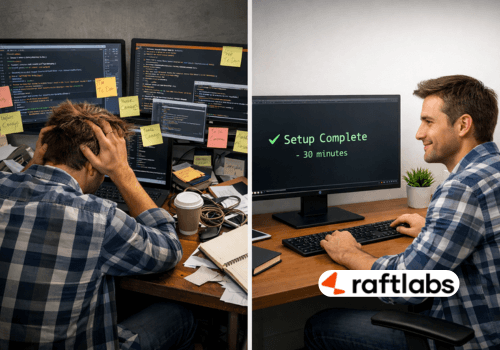
Article
Test Driven Development with AI: Proven Workflow That Saved 2.5 Days
How RaftLabs cut new project setup from 3 days to 30 minutes using RaftStack CLI and a spec-driven TDD workflow with Claude Code. Full breakdown of the approach.
Read more
Article
AI in customer service: what works, what doesn't, and how to do it right
Most businesses deploying AI in customer service conflate four different technologies and then wonder why results disappoint. This is the practical guide to what's working, what's overhyped, and how to build it right.
Read moreRaftLabs builds custom business process automation systems for businesses where manual processes are costing real money in staff time, errors, or slow cycle times. We are an AI-first tech studio, not an RPA vendor or a generic workflow platform. One team handles process mapping, integration with your ERP, CRM, and databases, AI document processing, and production deployment. A single-process automation typically costs $25,000 to $60,000 and delivers in 8 to 14 weeks at a fixed price.
The best automation candidates share four characteristics: (1) High volume, the process happens frequently enough that the savings add up. (2) High standardisation, most cases follow the same pattern. (3) Rule-based, the decision criteria are clear and consistent. (4) High cost per manual instance, either in staff time, error cost, or speed-to-outcome. Invoice processing, compliance reporting, data entry, approval workflows, onboarding tasks, and report generation are typically high-value automation targets.
Zapier and Make are good for simple integrations, if X happens in app A, do Y in app B. They fall short when your process involves complex business rules, exception handling, AI decisions, high-volume processing, or integration with systems that don't have native connectors. Custom BPA handles the full process, including the edge cases that no-code platforms can't handle. For processes with straightforward logic and standard integrations, Zapier or Make might be all you need. For anything more complex, you need custom software.
Yes. Most business processes include a mix of automatic steps and human decisions. We design automations that handle the automatic parts and route the decision points to the right person with the right context. The human makes the decision, the system executes it. Over time, as you accumulate decision data, some decisions can be automated too, the human-in-the-loop becomes a validator rather than a decision-maker for routine cases.
A single-process automation, one workflow, one set of business rules, 2-3 system integrations, typically takes 8-14 weeks. Multi-process automation programmes are structured as phased deliveries, automating the highest-value process first and adding additional processes in subsequent phases. We agree on the scope and milestone delivery dates at the start of each phase.
We measure BPA ROI on three dimensions: (1) Cost reduction, staff hours saved per week × hourly cost. (2) Error reduction, the cost of manual errors (rework, penalties, customer impact) × reduction in error rate. (3) Speed, days saved per cycle × the value of faster outcomes (faster payment collection, faster customer onboarding, faster compliance filing). We establish baseline measurements before we build and track improvement after deployment.
Work with us
We scope Business Process Automation Services in 30 minutes. You walk away with a clear cost, timeline, and approach. No commitment required.
Insurance automation
Claims, policy processing, and compliance workflow automation.
Healthcare admin automation
Prior auth, patient intake, scheduling, and billing automation.
Logistics automation
Dispatch, tracking, exception handling, and document processing.
Legal automation
Contract drafting, client intake, billing, and compliance automation.
Real estate automation
Lease management, maintenance requests, and tenant communication.
Restaurant automation
Order management, staff scheduling, and inventory automation.
BPA by sector
Manufacturing
Production scheduling, quality control workflows, and maintenance ticket automation.
Logistics
Dispatch automation, freight document processing, and exception handling workflows.
Healthcare
Prior auth, patient scheduling, insurance verification, and billing automation.
FinTech
Compliance reporting, KYC workflows, and transaction reconciliation automation.
Legal
Client intake, contract management, billing, and compliance workflow automation.