Sound familiar?
Forrester puts RPA project failure between 30% and 50%. Most teams find out after the invoice clears.
You're modelling savings against a vendor demo, not your edge cases.
Nobody on the team owns the bot after launch. Three system updates later, it's silently broken.
40% of automation projects miss ROI. Find yours before you spend.
Enter your process volume, task time, and labor cost. The calculator returns annual hours saved, a build cost range anchored to 60+ shipped projects, and a 3-year ROI you can actually defend.
- No signup
- 100% free
- 3-minute estimate
Your process
Tell us about the workflow you want to automate.
01 Process
What this calculates
Automation ROI is the 3-year net return on automating a manual process, after build cost. This tool multiplies your monthly volume by task time and fully-loaded labor rate to get the cost of doing the work today, applies a realistic automation rate, then compares savings against a build cost range from 60+ projects RaftLabs has scoped. Output: annual hours saved, payback period, and 3-year ROI.
01 Assumptions
What we assume about automation that works
Be honest about these five before you trust the number. Miss any one and the calculator overstates your ROI.
- 01
The process is repetitive
Same inputs, same steps, every time. If your team makes a judgement call on every fifth task, automation will return less than the calculator suggests. - 02
It's rules-based, not judgement-based
Approving a $200 invoice against a PO is rules-based. Approving a $200,000 contract amendment is not. The first automates cleanly. The second needs a human in the loop. - 03
Edge cases stay under 10%
An exception rate above 10% kills the math. The bot handles 90% in seconds, then a human has to context-switch into the 10% anyway. You get a marginal time win, not the projected ROI. - 04
Someone owns it after launch
Bots break when upstream systems change. Without a named owner (ops engineer, IT lead, or us on a retainer) you lose the bot, then lose the savings, then question why you bought it. - 05
Change management is in the budget
If the team doing the work isn't bought in, they'll work around the bot. Plan 10% to 15% of build cost for training, comms, and process redesign. The calculator doesn't add this. You should.
02 Failure modes
When automation gets it wrong
Four patterns we see across the 30% to 40% of automation projects that miss ROI. Read these before you commit budget.
High-judgement edge cases
Processes with 40%+ exceptions almost always fail to hit ROI. A claims team we scoped had 38% non-standard claims. Their projected savings of $180K/year landed at $40K, because humans still touched most files. Diagnose exception rate before you build, not after.
Process is undefined
Automating chaos just gives you faster chaos. If three people on your team do the same task three different ways, the first automation project should be process design, not code. Skip this and you'll spend $40K building the wrong workflow.
No owner post-launch
Bots break after the third upstream system change. Without an owner, the bot dies in the first quarter. Budget $1,500 to $4,000/month for monitoring and small fixes, or the build cost becomes a sunk cost inside 12 months.
The team works around it
If the people whose jobs the bot changes weren't part of scoping, they'll go around it. We've watched a $90K accounts-payable bot get bypassed because nobody asked the AP clerks what edge cases looked like. The bot processed 8% of invoices. Year-one ROI: negative.
03 Real-world adjustments
Your payback could shift by
The calculator gives you a clean number. These four shift the timeline, the scope, or the 3-year cost. Stack two of them and the payback period nearly doubles.
- 01
Change management
Adds 30% to the timeline. Training, comms, and process redesign for the team using the bot. Skip this and the bot gets bypassed in the first quarter. - 02
Edge-case discovery
Adds 20% to scope. The exceptions you find in week six of build (not week one of discovery) drive most of the late-stage cost growth. - 03
Vendor latency
Adds 2 weeks per third-party integration. SAP, NetSuite, Salesforce, custom ERPs. Each integration brings API quirks, sandbox access delays, and security reviews that compress the build window. - 04
License model
Per-bot vs. per-run pricing can swing 3-year cost by 40%. UiPath, Automation Anywhere, and Blue Prism each meter differently. A low-volume process is cheaper per-run. A high-volume one is cheaper per-bot.
04 Methodology
How we built this
Anchored in 60+ automation projects RaftLabs has scoped. We've watched RPA, low-code, and AI agent automations fail and succeed. The defaults reflect what survives contact with a real ops team.
- 01
60+ scoped automation projects
Build cost ranges come from RPA, low-code (Power Automate, Make, n8n), and AI agent projects scoped or shipped by RaftLabs since 2021. We use the median, not the headline number. - 02
We've watched these fail
The failure-mode section above isn't theory. We've inherited bots from other vendors that handled 8% of the volume they were sold against, and we've rebuilt them. The calculator's defaults reflect what survives contact with the real workflow. - 03
Fully-loaded labor cost
Use total cost (salary + benefits + overhead + management), not base pay. A $75K/year analyst typically costs $110K to $130K fully loaded. The calculator underestimates ROI if you only enter base.
Want the full picture? Pair this with our build vs. buy calculator if you're weighing a SaaS license against a custom bot, or the software cost calculator if part of the workflow needs an LLM. For the full service view, see process automation.
How it works
Calculates annual manual hours and cost from process volume, task duration, and labor rate. Applies your target automation rate to project savings. Compares against realistic build cost ranges, sourced from RaftLabs automation project data, to show payback period and 3-year net ROI.
Common questions
- Automation ROI = (Annual savings × 3 years − Build cost) ÷ Build cost × 100. Annual savings come from hours saved × fully-loaded hourly rate. Hours saved = monthly volume × minutes per task × 12 × automation rate. This calculator runs that math, then anchors build cost against 60+ projects we've scoped.
- We see 30% to 40% of RPA bots fail to hit projected ROI inside 18 months. The pattern: high exception rates (above 10%), no post-launch owner, or the team works around it. The other 60% to 70% hit ROI when the process is genuinely repetitive and someone owns the bot after go-live.
- RPA (UiPath, Automation Anywhere) fits high-volume, rules-based work across legacy systems with no APIs. Low-code (Power Automate, Make, n8n) wins when your stack has APIs and the logic is simple. AI agents fit unstructured inputs (emails, PDFs, calls) where the rules can't be written down. Most real automations are a mix of all three.
- Below roughly 80 hours/month of work, an offshore hire is usually cheaper. Above 200 hours/month, automation wins on cost and reliability. Between 80 and 200 hours, it depends on edge-case rate and how often the process changes. Use the calculator to model both, then compare 3-year totals.
- Most automations pay back in 6 to 18 months. Invoice processing and data entry often land under 8 months. Document review with AI and customer support triage take 12 to 24 months. If payback runs past 24 months, you're probably automating the wrong process.
- High volume, low edge-case rate, structured inputs, stable upstream systems. Invoice processing, data entry, report generation, customer support triage, and HR onboarding are the most common starting points. Avoid high-judgement work, unstable processes, or anything under 40 hours/month of effort.
Useful next steps
More on workflow automation
Work with us
RPA in Insurance
See the service
Article
AI Automation Platform Decision: When Zapier AI, Make, and Power Automate Are Not Enough
Zapier AI, Make, and Power Automate handle a lot. But operations leaders at $5M+ businesses consistently hit the same ceiling. Here is how to make the build-vs-buy call before you waste 9 months configuring a tool that was never designed for your workflow.
Read more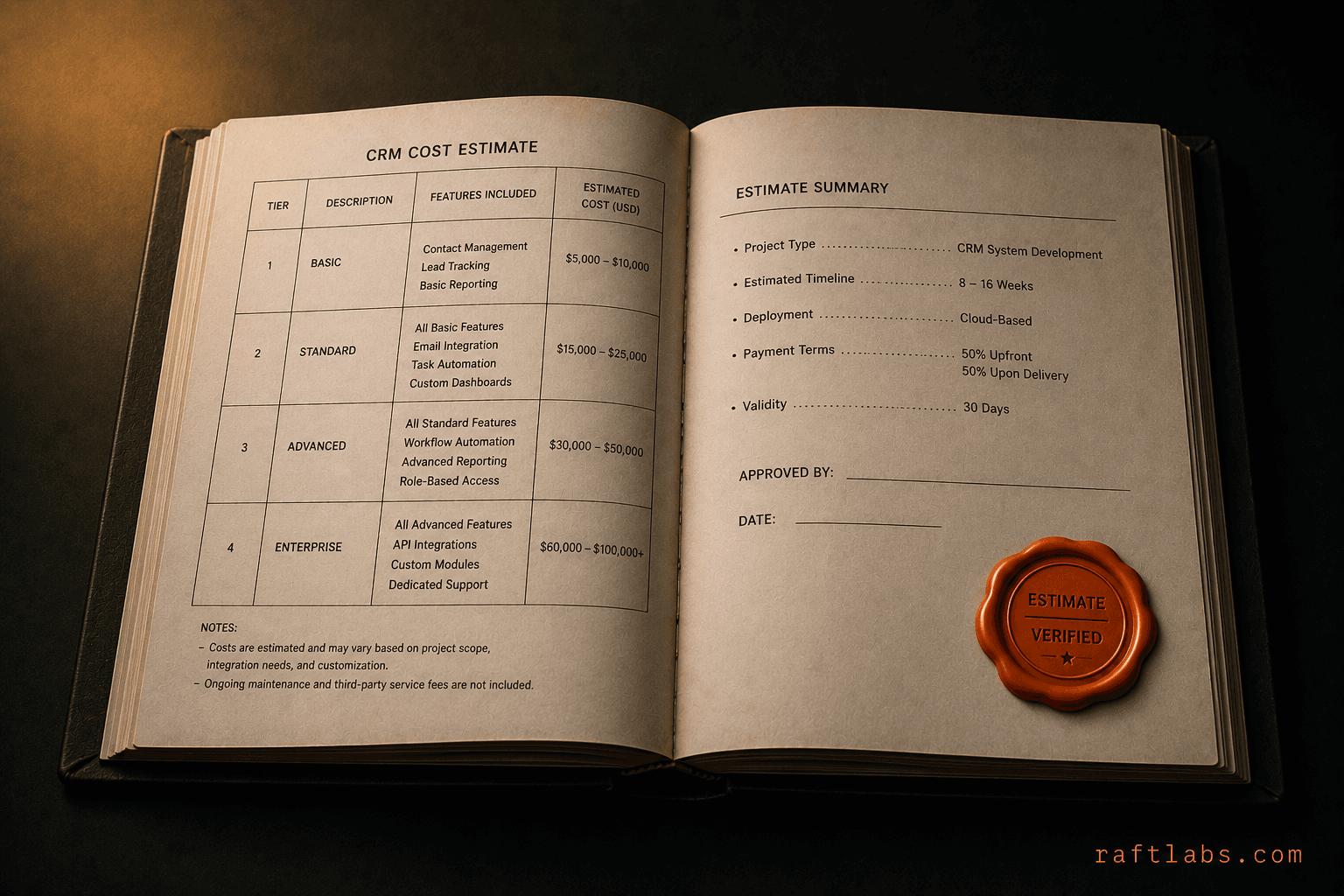
Article
How much does it cost to build a CRM system in 2026?
CRM development cost ranges from $24,000 for a basic build to $360,000+ for enterprise. Here is what actually drives the price, and what to watch out for.
Read more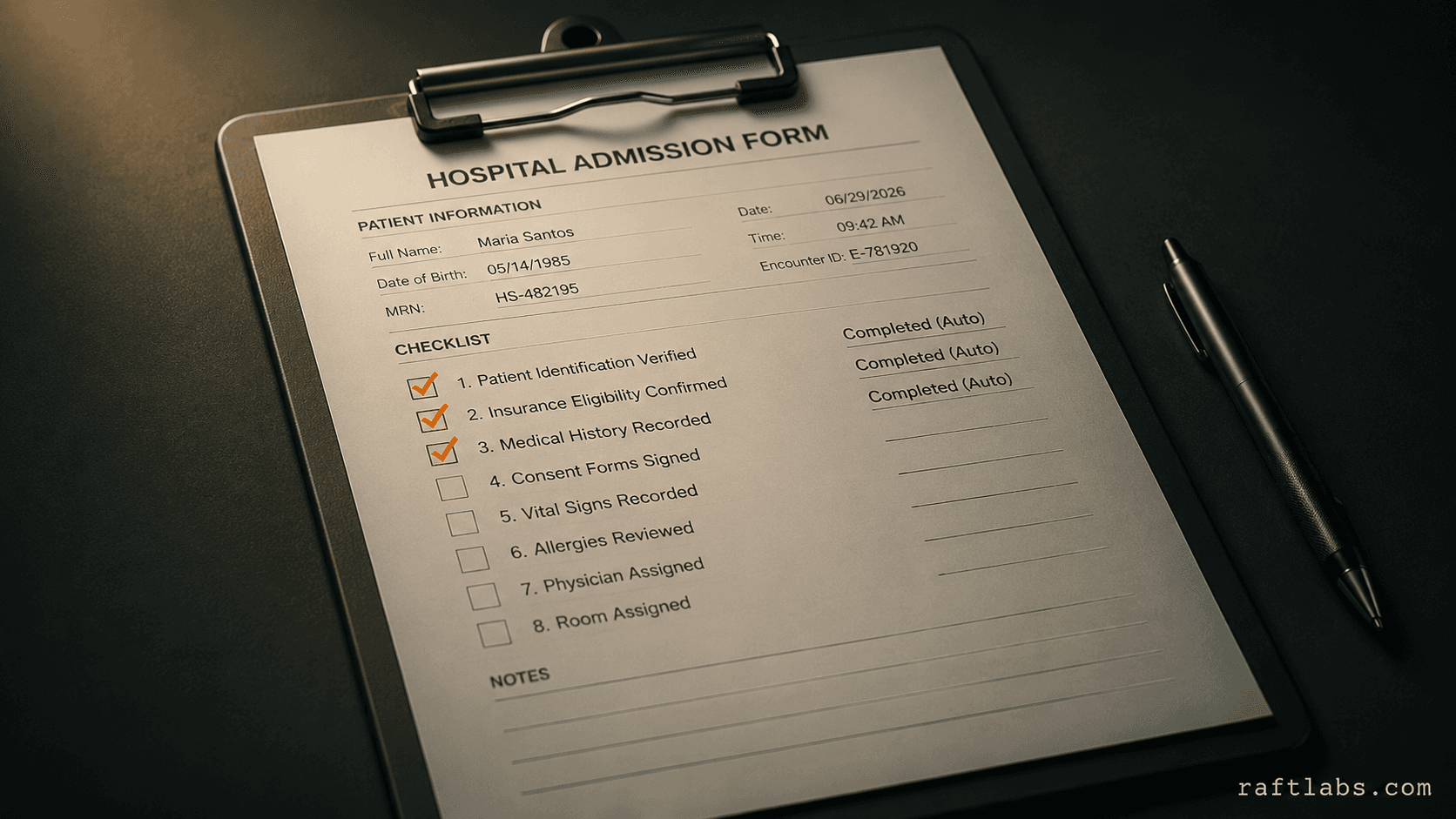
Article
AI for hospital administration: Where the 40% cost problem actually gets solved
Doctors don't want AI making clinical calls. That's fine - the real savings are in admin. Prior auth, billing, scheduling: three workflows where AI cuts costs 30-60% right now.
Read moreNumbers look right? Let's pressure-test them.
30-minute scoping call. We'll walk through your process, exception rate, and stack. You leave with a build estimate you can take to your CFO.