Short answer
RaftLabs integrated an AI layer into PDC's remote patient monitoring platform, cutting clinical decision-making time by 20% (client-reported) and helping the platform reach 150+ chronic care patients and 80+ clinics within 12 weeks. The AI runs on AWS Bedrock with Anthropic Claude 3 Sonnet, analyzing readings from CGM and BPM wearable devices to automatically prioritize patients, flag abnormal readings, and generate end-of-month summaries for insurance compliance. The AI runs on HIPAA-eligible AWS Bedrock under a Business Associate Agreement, with all patient data anonymized before reaching the model.
The situation
PDC already had a working remote patient monitoring platform. Clinics used it to track patients with chronic conditions, including hypertension, heart failure, and diabetes, through CGM and blood pressure wearables. The data was flowing in. The problem was what happened next.
Providers had to manually review readings for every patient to decide who needed attention. With a growing patient list, that review process was eating hours of clinical time daily. They were not missing patients, but they were spending far too long to find the ones who actually needed a call.
The client wanted to add AI to solve that problem. Not replace clinical judgment, but do the triage work so providers could focus on the patients who genuinely needed them.
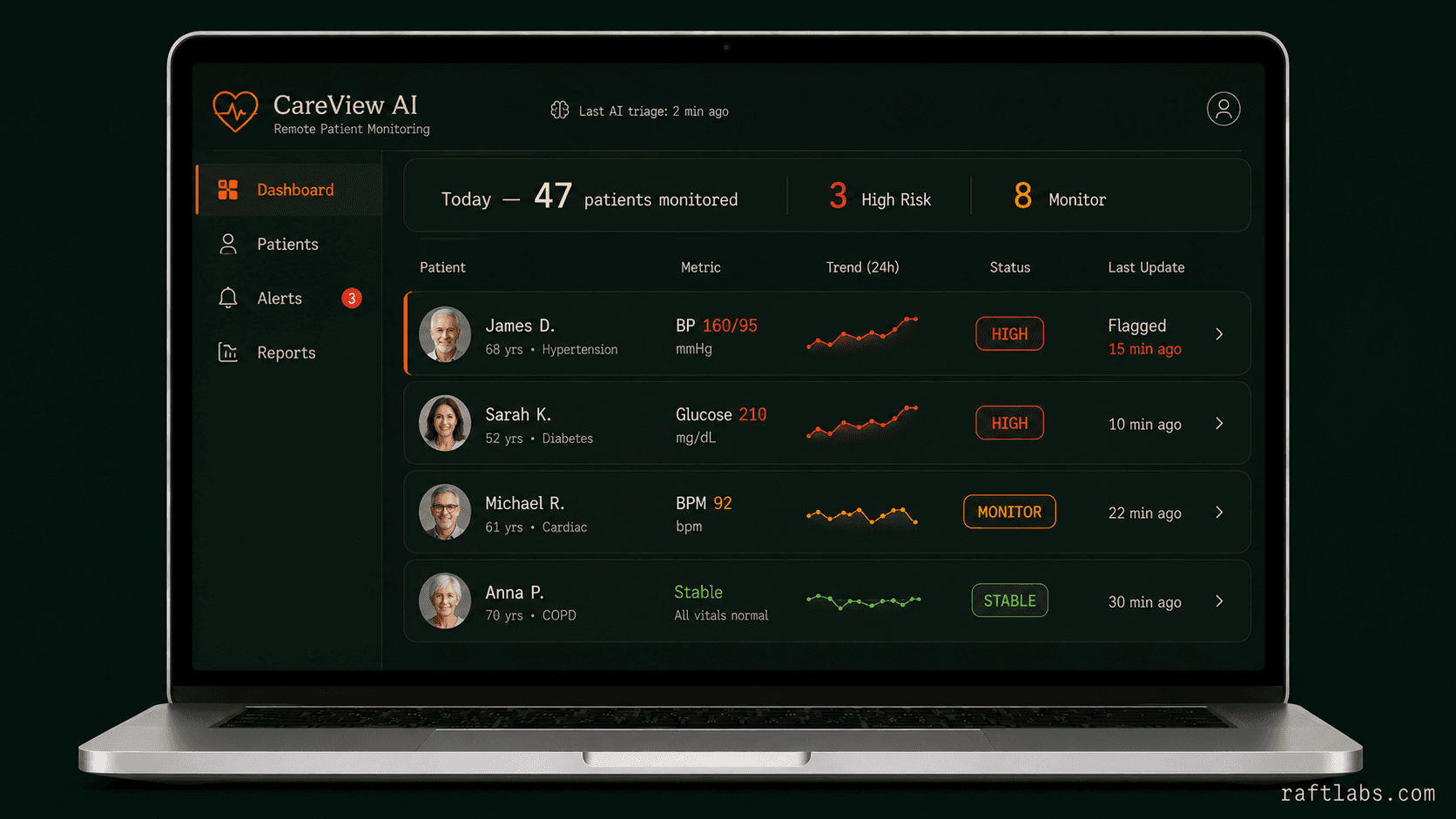
We integrated an AI layer into the existing platform in 12 weeks. The AI analyzes device readings against each patient's historical baseline, ranks patients by risk level, flags abnormal readings in real time, and generates monthly summaries ready to submit to insurers. The client reported clinical decision-making time dropped by 20%, and that 80 clinics had signed on within three months. That 80-clinic figure is cumulative platform adoption after the AI layer shipped, a separate measure from the 25 clinics enrolled in the first 60 days on the earlier remote patient monitoring page.
The single biggest threat to a monitoring program is not model accuracy. It is alert fatigue. Tune a model to catch everything, and it generates false positives at a rate that trains the clinical staff to ignore it, often within weeks. An alert that just says abnormal gets dismissed as noise. The AI had to earn every alert it sent.
Engagement
The AI layer engagement
- Client
- PDC, the remote patient monitoring platform from our earlier engagement
- What we built
- An AI layer on the existing platform: risk-ranked patient lists, real-time abnormality alerts against each patient's own baseline, automated insurer-ready monthly summaries, billing compliance prediction
- Delivery
- 12 weeks, integrated into the live platform
- Stack
- AWS Bedrock, anonymized data pipeline, existing RPM platform
- Status
- Live. The client reported 80 clinics signed on within three months
Before and after
What changed
- Providers manually reviewed all patient readings to decide who needed attention
- No way to prioritize: a routine reading and a concerning one sat in the same queue
- Abnormal wearable readings had no automatic alert; providers only saw them when they logged in
- End-of-month compliance reports for insurers had to be written manually from patient data
- The platform lacked AI features, making it harder to attract clinics looking for modern RPM tools
- Billing compliance tracking required manual checking of each patient's monitoring activity
- AI ranks every patient by risk level so providers see who needs attention first
- Real-time alerts fire when a wearable reading crosses a threshold based on that patient's history
- Automated abnormality detection flags potential health risks as they happen
- End-of-month AI summaries are generated automatically and ready to submit to insurers
- Risk stratification groups patients into care tiers, supporting proactive rather than reactive management
- Billing compliance prediction flags patients at risk of missing RPM requirements before the month ends
What we had to solve
Running AI on patient data under HIPAA
Patient health information has strict legal protections. You cannot simply send it to a standard cloud AI service. We had to build the AI layer using AWS Bedrock, a HIPAA-eligible service that signs a Business Associate Agreement, and put data anonymization in place before any patient data reached the model. Standard AI APIs were off the table for this project. Every part of the pipeline had to meet HIPAA requirements before we could run a single test.
Making AI recommendations clinicians would trust
If the AI flags the wrong patients as high-risk, providers stop trusting it and start ignoring the alerts. We had to build the model with confidence scoring, clear explanations for every alert, and a feedback loop so clinicians could correct the system when it was wrong. Getting the risk stratification thresholds right required iteration with the clinical team, not just the engineering team.
Proof
What the client reported, and what this page can't claim
Outcome figures reported by the client after the AI layer launched. These are operator reports, not independently audited measurements.
| Result | What changed | Period or context | Evidence and limitation |
|---|---|---|---|
| Decision time | 20% reduction in clinical decision-making time | Providers open the dashboard to a risk-ranked list instead of reviewing every reading manually | Client-reported |
| Adoption | 80 clinics signed on within three months | Clinics looking for AI-assisted monitoring enrolled after the AI layer shipped | Client-reported |
| Enrollment | 150+ patients enrolled in 12 weeks | Patients with chronic conditions tracked through CGM and blood pressure wearables | Client-reported. No clinical outcome figures were available for this review |
| Compliance design | AI layer built on HIPAA-eligible infrastructure | AWS Bedrock under a Business Associate Agreement, with data anonymization before any patient data reached the model | Project-recorded. This page describes the design decisions, not a compliance certification |
the build
What we built
The AI layer sits on top of the existing data flows from CGM and BPM wearable devices. It does not replace the clinical workflow; it prepares the clinical workflow.
Providers open their dashboard and see who needs attention first: triage happened before they logged in
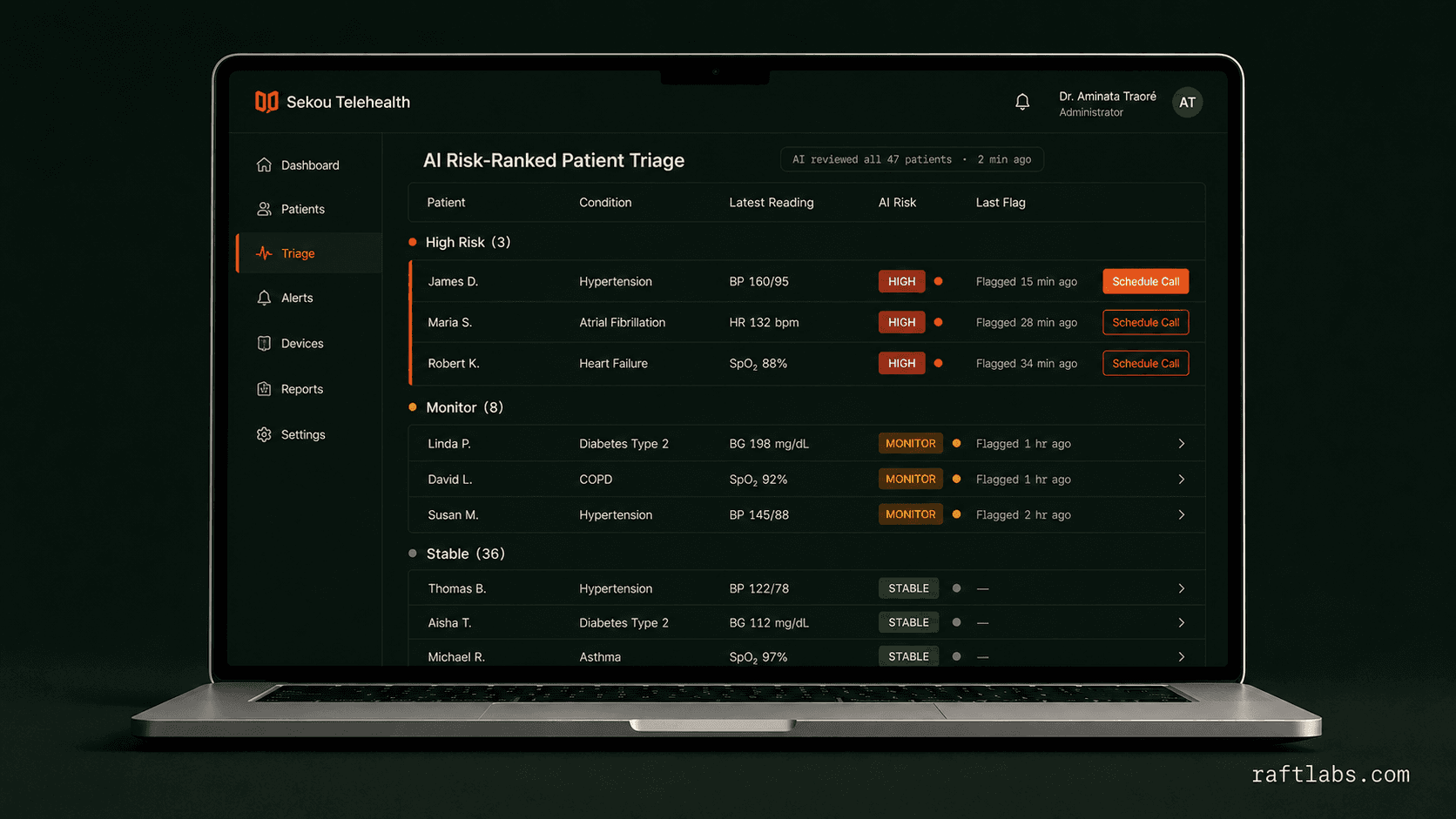
When a wearable sends a reading, the AI compares it against that patient's historical baseline and the clinical norms for their condition. Patients are ranked by risk level so providers open their dashboard and see who needs attention first, not a flat list of everyone. The triage that used to take hours happens before the provider logs in.
Alerts arrive with context and a suggested next step: providers act without pulling the full patient record
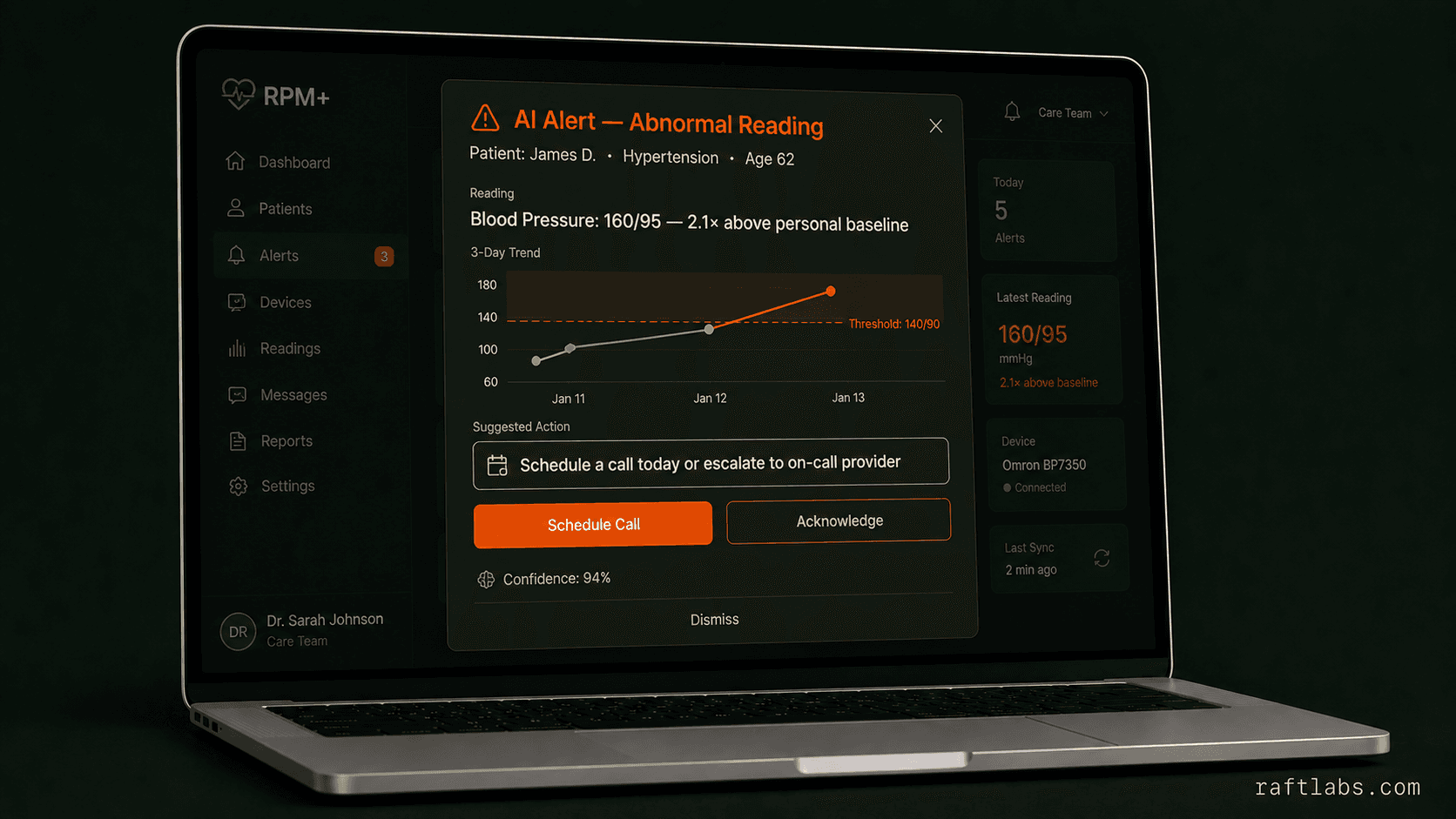
When a reading crosses a threshold that the AI identifies as abnormal for that specific patient, the provider receives an alert with the reading, the patient's recent trend, and a suggested next step. Alerts come with context, not just a number, so providers can act quickly without pulling up the full patient record first.
High-risk patients surface at the top: providers see what they need without searching for it
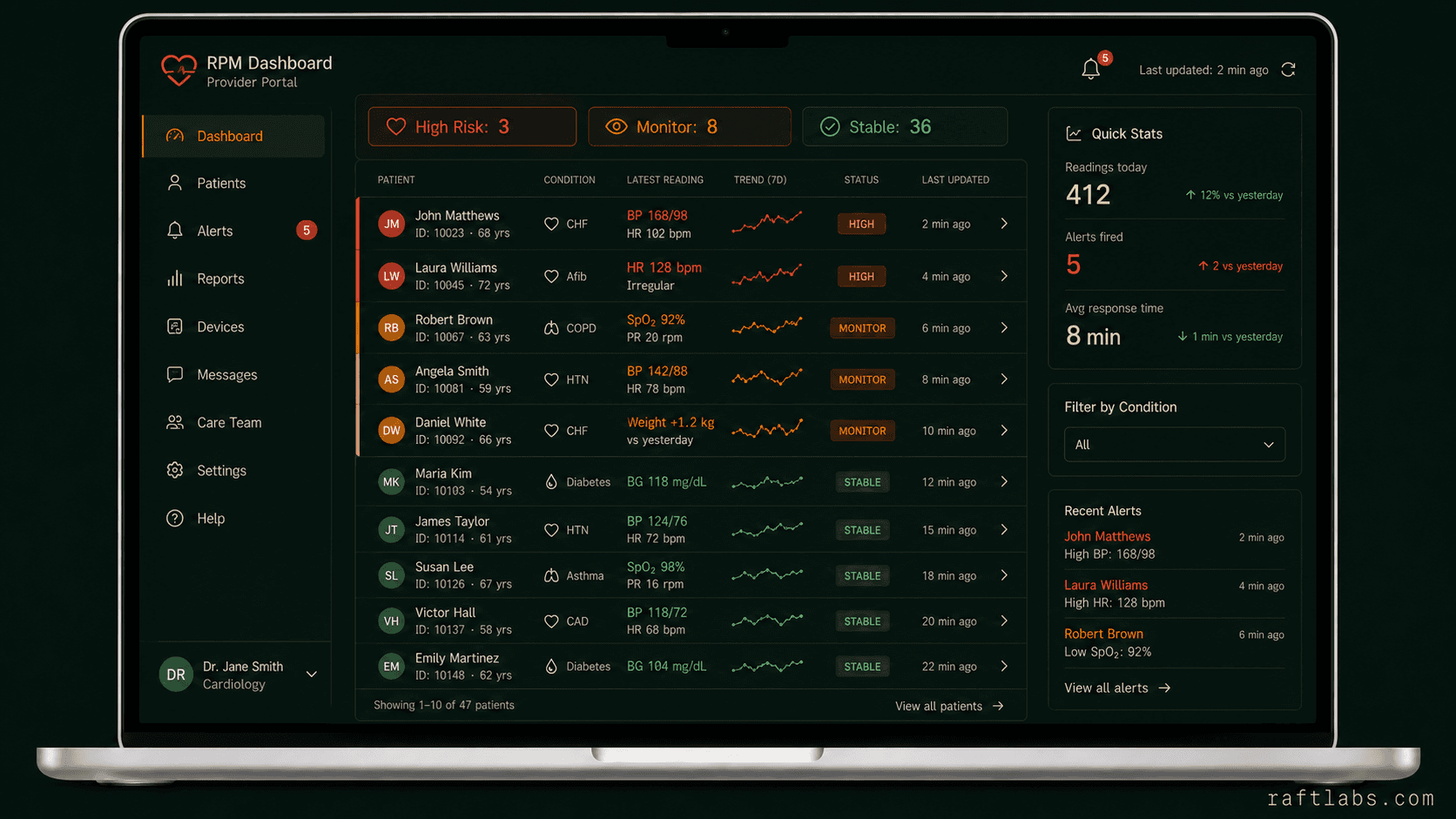
The dashboard shows every patient ranked by current risk level, with trend data, recent readings, and AI-generated insights visible at a glance. High-risk patients surface at the top. Stable patients stay lower in the list. Providers see what they need to see without searching for it.
Insurer-ready summaries generated automatically, hours of per-patient compilation eliminated
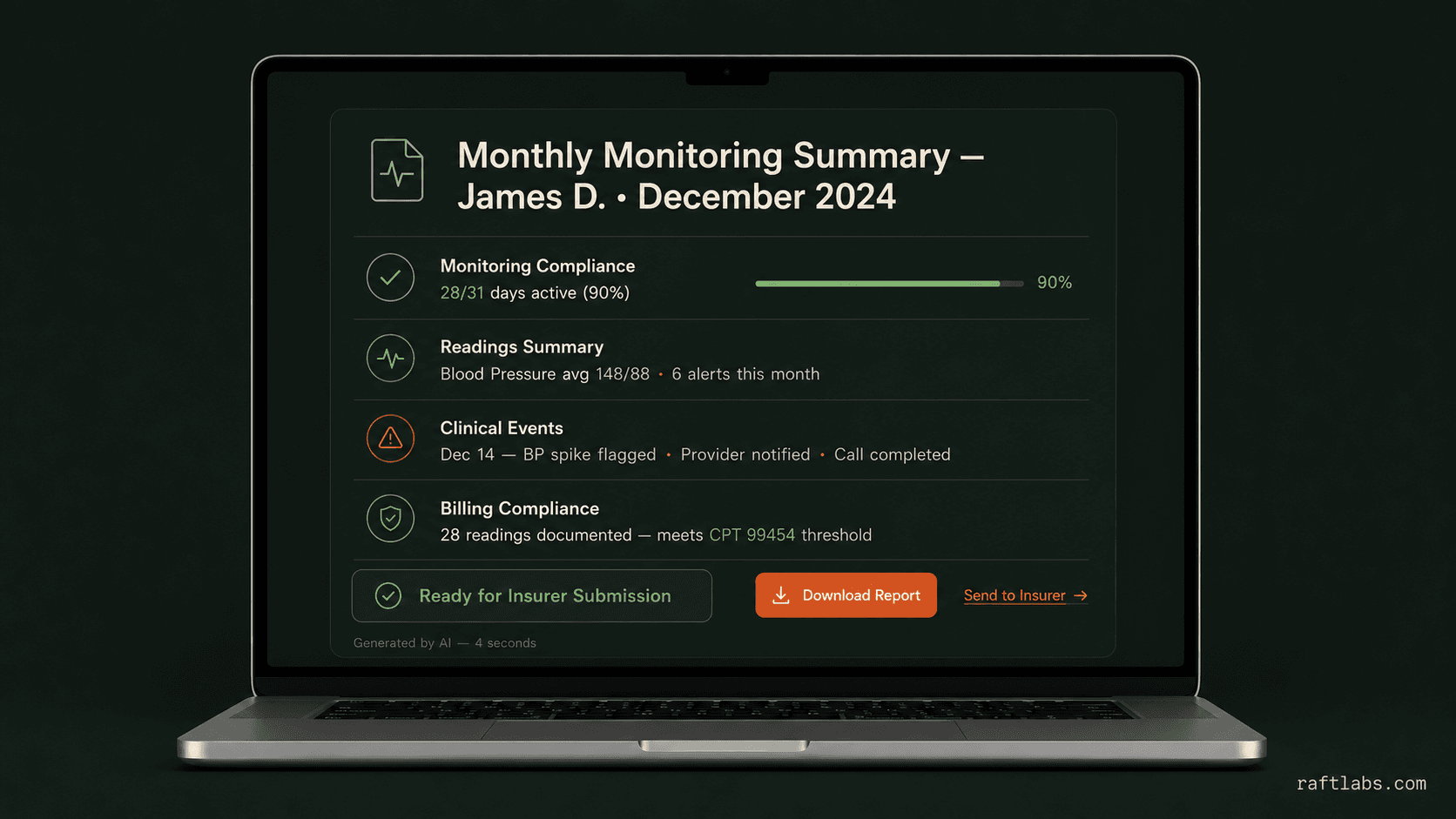
At the end of each month, the AI generates a concise clinical summary for each patient based on their monitoring data. The summary is formatted for insurer submission and billing compliance. What used to take a staff member hours to compile per patient is now generated automatically and ready to review.
The lesson
The AI has to earn the alert
A model tuned to catch everything trains clinicians to ignore it. A model that is wrong and confident about it destroys trust faster than a model that admits uncertainty. And in medicine, the signature at the bottom of the decision is always the clinician's, so the system has to give them something they can stand behind: a reason attached to every alert, a confidence they can see, and a way to correct it when it is wrong.
That is why the hard work on this build was not the model. It was the confidence scoring, the explanations, and the feedback loop, iterated with the clinical team rather than just the engineering team. Alert fatigue is a design problem, not a tuning problem. It has to be solved before launch, not patched after clinicians stop trusting the pages.
How it runs
- AWS Bedrock
- The only way to run an LLM on patient health data legally is through a service that signs a Business Associate Agreement under HIPAA. AWS Bedrock is HIPAA-eligible. Standard AI APIs were not an option for this project.
- Anthropic Claude 3 Sonnet
- Claude 3 Sonnet hits the right balance of cost and clinical text quality. It is good at synthesizing weeks of wearable readings into a plain-language summary a doctor can act on without re-reading the raw data.
- AWS SQS
- Device readings from hundreds of patients arrive in bursts. SQS queues them reliably so the AI pipeline processes each reading in order without data loss during spikes.
Common questions
Remote patient monitoring (RPM) is a healthcare model where patients use wearable devices at home, such as glucose monitors, blood pressure cuffs, and pulse oximeters, that continuously send health data to their provider. Providers can track patients between visits and intervene early when readings change, without requiring an in-person appointment.
All patient data is anonymized before it reaches the AI model. We run the AI on AWS Bedrock, which is a HIPAA-eligible service that signs a Business Associate Agreement. This is a legal requirement for any AI system that processes protected health information. Standard AI APIs like OpenAI's direct service were not used for this project.
The platform currently supports continuous glucose monitors (CGM) for patients managing diabetes and blood pressure monitors (BPM) for patients with hypertension or heart conditions. Additional device types can be added as the platform expands.
The AI compares each patient's current reading against two things: their personal historical baseline and the clinical norms for their condition. A reading that is within normal ranges for the general population but unusual for a specific patient can still trigger an alert. The risk ranking is personalized, not based on a single universal threshold.
Standard RPM collects wearable data and shows it in a portal. A provider still has to review every patient's data manually to spot problems. With AI, the platform does the triage work automatically. Providers see who needs attention when they log in, receive real-time alerts when readings change significantly, and get monthly summaries generated for them. The same clinical team can manage a larger patient panel without losing quality of care.
Related work
Projects we're proud of

TikTok style social commerce mobile app
Sponzee created an app that transforms the way brands and creators connect. The app has already ignited a wave of collaboration, leading to a 200% increase in user engagement in the 1st month (client-reported).

Centralized app for food order management
Gula, our own Indonesian B2B platform, gives restaurants and food outlets a single web and tablet app for effortless multi-platform food delivery management.

Online web app for making intro
IntroJoy tackles the pain of tedious introductions. The app simplifies introductions with double opt-in emails, boosting professional networks by 20% (client-reported) and saving time