• Your AP team is keying invoice data into your ERP for 4 hours a day?

  • Invoice errors causing payment delays and vendor relationship problems?

Invoice Processing Automation Services

Manual invoice processing is expensive and error-prone. The average company spends $12--$15 to process a single invoice manually. AP teams touch every invoice 3--4 times before it's paid. Errors in data entry cause late payments, vendor disputes, and compliance issues.
We build automated invoice processing systems that read invoices, extract data, validate against purchase orders and contracts, and route for approval -- with no manual data entry required.

  • AI-powered OCR that reads invoices in any format -- PDF, email, scan, or EDI

  • Automatic matching against POs, contracts, and GL codes

  • Approval workflow routing with exception handling for mismatches

  • We've built OCR and document automation systems for industrial and enterprise use

Trusted by startups & global brands worldwide

VodafoneAldiCalorgasEnergia RewardsNikeGeneral ElectricBank of AmericaCiscoHeinekenMicrosoftT-MobileValero

The math on manual invoice processing

If your AP team processes 500 invoices a month at $12 per invoice, you're spending $6,000 a month on invoice processing. That's $72,000 a year. The industry benchmark for automated processing cost is $1--$3 per invoice.

At 500 invoices a month, automation saves $4,500--$5,500 per month. An automation system that costs $50,000 to build pays for itself in 9--12 months. Every month after that is margin.

The math gets better at scale. At 2,000 invoices a month, the savings are $18,000--$22,000 per month.

For broader back-office automation beyond invoices, see our business process automation services. For the underlying document intelligence that powers the extraction, see AI document intelligence.

What the automation system includes

Multi-channel invoice ingestion

Invoices arrive via email, supplier portal, EDI, API, or upload. The system captures them from all channels, deduplicates, and queues for processing. No manual collection step. Invoices are in the system the moment they arrive.

AI-powered data extraction

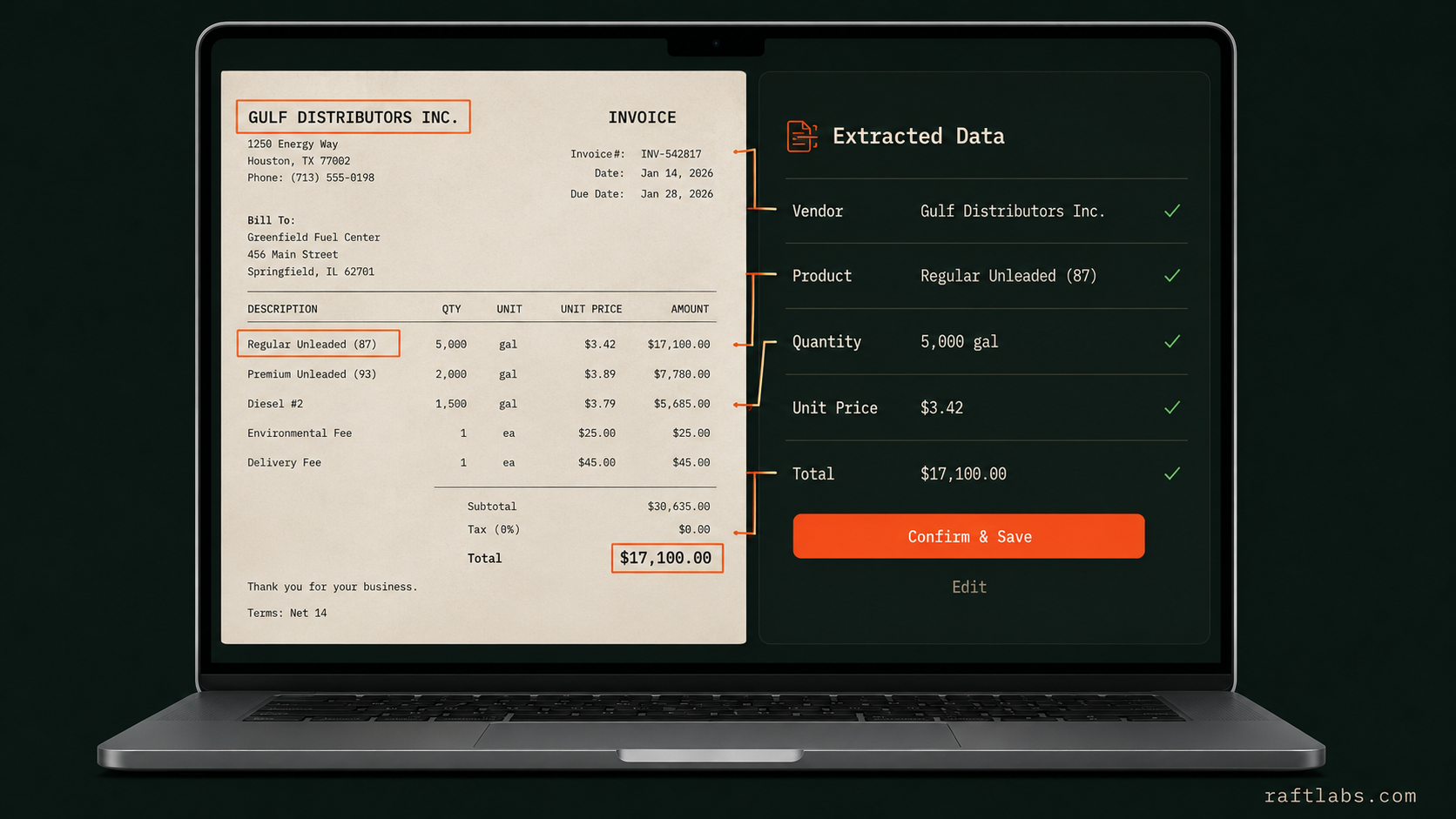
We built an AI OCR system for gas station fuel delivery invoices that automated what was previously a fully manual data entry process. The same technology applies to any invoice format -- structured or unstructured, digital or scanned. Header data and line items extracted and validated automatically.

PO and contract matching

Three-way matching: extracted invoice data checked against purchase orders, receiving records, and contract terms. Quantity, price, and vendor all verified automatically. Matched invoices post to the ERP. Mismatches get flagged with specific discrepancy details.

Approval workflow routing

Exception invoices routed to the right approver based on your rules -- by amount, by cost centre, by vendor, by department. Approvers get a notification with all the context they need to approve or reject. Approval is logged with timestamp and user ID for audit.

ERP posting and payment scheduling

Approved invoices posted to your ERP automatically -- AP record created, GL coding applied, payment terms calculated, and payment scheduled. No rekeying. No delay between approval and ERP entry.

Audit trail and reporting

Complete audit trail for every invoice: when it arrived, what was extracted, what matched, who approved, when it was posted. Month-end reporting on processing volumes, exception rates, processing time, and supplier payment performance. The data your auditors and AP manager need.

Want to see what invoice automation looks like for your operation?

Tell us your current invoice volume and the systems you use. We'll estimate the savings and scope the build.

How we work

We audit your current invoice process -- formats received, volume by supplier, error types, and current processing time per invoice. We model the ROI before we design anything. You get a clear picture of what automation saves and what it costs before you commit.

  • Invoice format inventory across all supplier types

  • Volume measurement by channel (email, EDI, portal, scan)

  • Error type and frequency analysis

  • ROI model with straight-through processing rate estimate

Know your invoice volume? Let's calculate the savings.

Tell us how many invoices you process monthly and what systems you use. We'll model the ROI and scope the build.

What our clients say

Charles E.
All of the sprints were completed on schedule and on budget. We highly recommend RaftLabs!
Charles E.

Entrepreneur at Aggie Technologies

200+
engaging content modules
5000+
daily active users

Cut your cost per invoice by 80%.

Tell us your invoice volume and ERP. We'll model the savings and give you a fixed build cost.

Frequently asked questions

Automated invoice processing works in four stages: (1) Capture -- invoices arrive via email, supplier portal, EDI, or scan. The system receives them and queues them for processing. (2) Extraction -- AI-powered OCR reads the invoice and extracts structured data: vendor name, invoice number, date, line items, amounts, tax, and totals. (3) Validation -- the extracted data is matched against your PO, contract, or approved vendor list. Discrepancies are flagged for exception handling. (4) Routing -- matched invoices are posted to your ERP automatically. Exceptions go to the right approver with context.

For clean, well-formatted invoices from known vendors, AI extraction accuracy is 95--99%. The harder cases are handwritten invoices, poor-quality scans, and non-standard formats from occasional vendors. We handle these through a combination of AI confidence scoring (low-confidence extractions are flagged for human review), vendor templates (we build specific extraction rules for your highest-volume suppliers), and continuous learning (corrections feed back into the model). In production, most systems reach a straight-through processing rate of 80--90% -- meaning only 10--20% of invoices require any human touch.

PDF invoices (both digital and scanned), image files (JPG, PNG, TIFF), email body invoices, XML and EDI structured formats, and Excel or CSV invoices from certain suppliers. The extraction approach differs by format -- structured formats like EDI are parsed directly, unstructured formats like scanned PDFs go through OCR. We build a unified data model at the output so your downstream systems get consistent data regardless of how the invoice arrived.

Yes. We've built integrations with SAP, Oracle, Microsoft Dynamics, NetSuite, Xero, QuickBooks, and Sage. The integration posts validated invoice data and creates the payable record automatically. For ERPs with well-documented APIs, integration is straightforward. For older ERPs with limited APIs, we use file-based exchange or a direct database connector. We scope the integration requirements during discovery.

Exceptions are a normal part of invoice processing. The system flags them (price mismatch, missing PO, duplicate invoice number, vendor not in approved list) and routes them to the right person with context -- what was extracted, what was expected, and what action is required. Approvers resolve exceptions in a web interface without touching the underlying data. The resolution is logged for audit. We tune the exception rules to match your actual approval policy.

A focused invoice automation system -- email ingestion, AI extraction, PO matching, approval routing, and ERP integration -- typically runs $30,000--$70,000. The cost depends on the number of invoice formats, the complexity of the matching rules, and the ERP integrations required. For high-volume AP departments (1,000+ invoices/month), the ROI is typically positive within 6 months. We calculate the expected savings based on your current volume and processing cost before we scope the project.