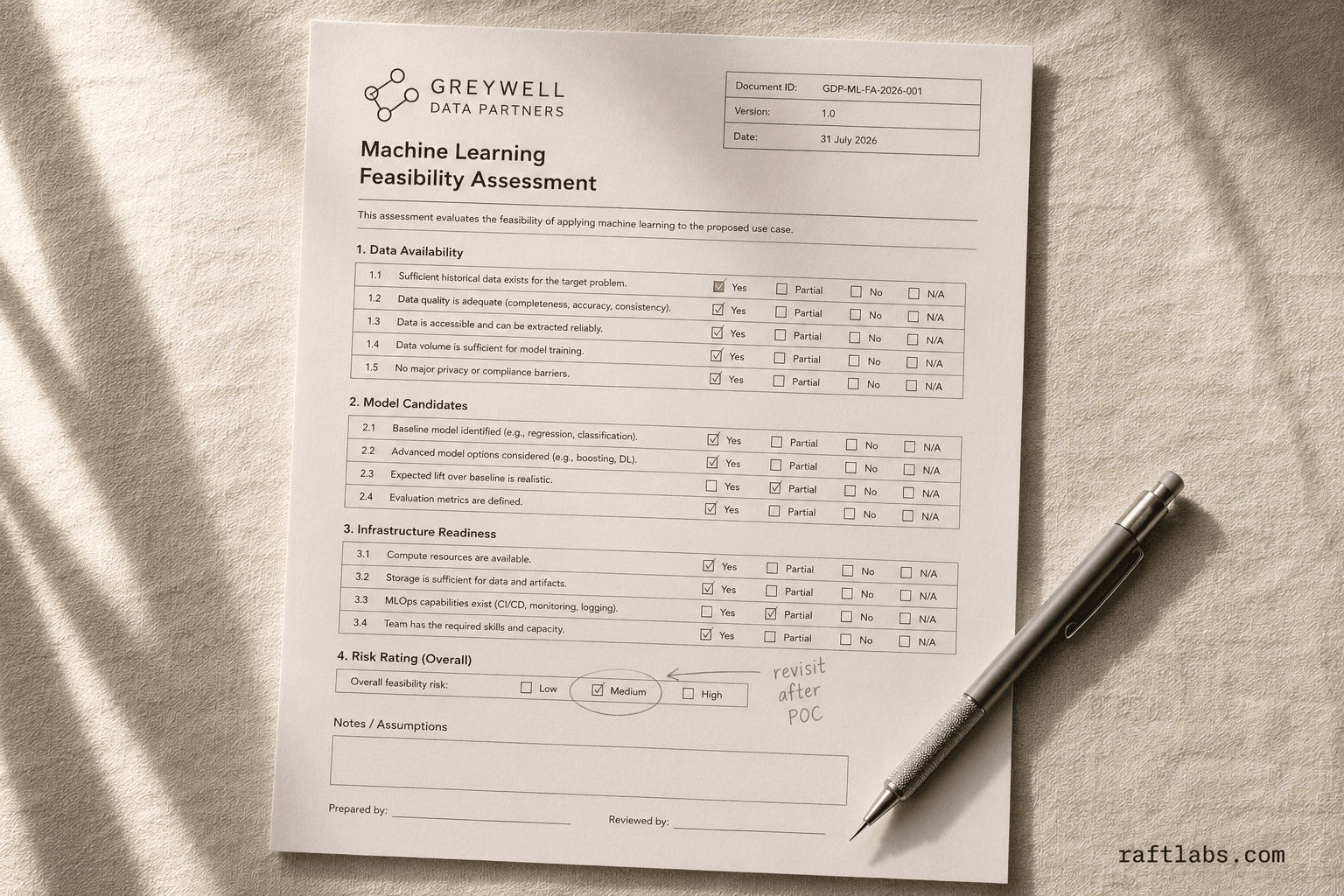
Hire ML developers for models that must survive new data.
RaftLabs provides machine learning developers for teams that need data audits, feature pipelines, model training, validation, serving, monitoring, or retraining inside an existing product. The role is matched to one decision and its labels, baseline, release authority, and operating owner.
4 weeks First term·$6K-$6.5K Planning rate·Evidence first First gate
The problem
Sound familiar?
Does a notebook model perform well on a static sample but lack a dependable path into the product?
Can the team explain where labels came from, what baseline the model beats, and who responds when data changes?
Short answer
Hiring machine learning developers adds capacity for data preparation, feature pipelines, model training, validation, serving, monitoring, and retraining. RaftLabs matches developers to one decision, its labels, baseline, and production owner. Planning rates are $6,000 to $6,500 per person monthly, with an initial four-week term.
The model worked in the notebook. The labels arrived two months late.
Backtesting looked strong because the data included information the product would not know at decision time. Serving the model exposed the gap. The production score was solving a different problem from the experiment.
An embedded ML developer should connect data, validation, serving, and product use around one decision. The model is only one part of that path.
Relevant ML delivery proof
20%
less clinical decision time in a patient-monitoring AI project
Project-recorded outcome, not independently audited
150+
patients reached during the documented 12-week release
RaftLabs project record
80+
clinics recorded in the same project period
RaftLabs project record
The patient-monitoring AI case used historical baselines and device readings to support clinical prioritisation. Its figures belong to that product, and the page records its evidence boundary. They do not promise the result of a different model, data set, or embedded staffing term.
Embedded ML capacity fits when the client owns the product decision and needs sustained work across data, model, and operation.
Choose a fixed project for one stable outcome, or start with a data audit when the labels and baseline are still uncertain.
A fit
01
The team can name the prediction, user, decision time, current method, and cost of errors.
02
Historical inputs and outcomes can be linked with timestamps and stable identities.
03
A technical and domain owner can review the model, threshold, release, and monitoring.
Not a fit
01
The request begins with a model type but no business decision.
02
Historical outcomes are missing and nobody can create or review a useful label.
03
The team expects a developer to certify a high-impact decision without domain, legal, or risk ownership.
Ownership
What an embedded ML developer can take on
01
Data and label audit
Trace where inputs and outcomes come from, reconstruct what was known at
decision time, inspect missingness and imbalance, and expose leakage before a
model inherits it.
02
Features, models, and baselines
Build reproducible transformations and compare simple rules or statistical
baselines with candidate models. Complexity is justified only when it improves
the agreed decision on held-out data.
03
Serving and product integration
Package inference with versioned inputs and outputs, latency and resource
limits, fallbacks, access controls, and a product path that shows enough
context for the user to act.
04
Monitoring and retraining
Track data freshness, drift, score distribution, delayed outcomes, segment
performance, and model version. Retraining follows an approved trigger and
comparison rather than an automatic calendar.
Should you hire an ML developer or commission an ML project?
Embedded ML developer vs fixed ML project
Embedded developer
Fixed project
Best fit
An evolving model backlog inside an established team
One prediction with stable acceptance criteria
Direction
Client owns daily priorities and release decisions
Delivery team owns the agreed project plan
Data uncertainty
Handled across the ongoing backlog
Bounded through audit or feasibility phase
Commercial model
Monthly per-person rate
Fixed price for the agreed phase
Alternative
AI engineer for LLM, RAG, or agent systems
Data engineering when the pipeline is the main gap
Hiring one person will not solve a missing decision owner or unlabelled history. Those are the first constraints to surface.
Onboarding
From model backlog to an owned production decision
The first four weeks test data access, validation discipline, product contribution, and handover.
Before start
01
Define the decision and baseline
Choose one prediction, its users, decision time, labels, current method, error
costs, and release threshold. Keep domain and high-impact authority with the
client.
Week 1
02
Match data and engineering depth
Review data quality, modelling, serving, infrastructure, and domain needs.
Prepare access and a bounded first task that exposes the full path without
risking a critical decision.
Weeks 1-4
03
Build through validation
Work in the client's process while testing leakage, bias, calibration,
latency, cost, failure handling, and product integration. Version data
assumptions, features, models, and results.
End of term
04
Review and hand over
Assess held-out and operating evidence, update data and model runbooks, and
review the next-term need. Continue, change the boundary, adjust the role, or
close cleanly.
Where embedded ML engagements fail
The random split leaks the future
When behaviour changes over time, validate on later periods and reconstruct only the information available before each decision.
Accuracy hides the costly error
Choose measures and thresholds around the business cost of false positives, false negatives, delay, and review capacity.
The model has no product owner
Someone must decide how a score changes work, what explanation users need, and when a person can override it.
Retraining silently changes policy
Compare every candidate with the current version, record the result, and require approval before a new model changes production decisions.
Monthly model
Plan on $6,000 to $6,500 per ML developer each month.
Start with one production decision and its data path, or choose a fixed feasibility phase when labels and signal are still uncertain.
$6K-$6.5K per person monthly
A lean team starts around $12,000 to $15,000 per month. The initial term is four weeks; role mix, allocation, and specialist depth set the final rate.
Fixed-scope ML work is priced after the decision, data, label, baseline, validation, serving, and monitoring boundaries are reviewed.
Baseline before complexity
The work records the current decision and a simple baseline before a more
complex model is treated as an improvement.
High-impact authority stays human
The developer can build decision support and controls. The client retains
domain, legal, risk, and release authority for consequential use.
Choose one production decision or one platform boundary: data and feature preparation, a forecasting or classification model, serving, monitoring, or retraining. The developer can work across the path, but a named decision and baseline keep research, infrastructure, and product work connected to one measurable result.
An ML developer is the clearer fit when the central work is labelled data, features, model training, statistical validation, serving, drift, and retraining. An AI engineer often focuses on foundation-model products, retrieval, prompts, tools, evaluations, and application integration. The role should follow the actual backlog rather than the fashionable title.
Prepare representative historical inputs, outcome labels, timestamps, stable entity identifiers, data definitions, access rules, and the current decision baseline. The first term can audit and repair these foundations. A large table is not automatically usable if labels are delayed, missing, inconsistent, or created after the decision time.
Compare it with the current decision on held-out time periods and measures tied to the business error. Inspect leakage, calibration, important segments, false positives and negatives, latency, and failure behaviour. The release owner should approve a threshold and rollback path; an aggregate accuracy score is rarely enough.
Use $6,000 to $6,500 per person per month for planning, consistent with RaftLabs' dedicated-team model. A lean team starts around $12,000 to $15,000 monthly. Role mix, allocation, duration, data access, and specialist depth set the final rate before the initial four-week term.
Work with us
Show us the model or data decision that lacks a production owner.
Bring the decision, historical inputs, labels, current baseline, and product boundary. We will recommend an ML developer, a team, or a fixed project.
Scope and cost agreed before work starts. No surprises. No obligation.
Working prototype within 3 weeks of kickoff.
Pay by milestone. You see progress before each invoice.
60-day post-launch warranty. Bug fixes, UI tweaks, and deployment support. No retainer.