
Paula Castro
Co-Founder, City Break Apartments
 Ireland
Working with RaftLabs has been amazing. The team is super responsive and quick to address our needs. They built a booking platform that's been a game changer for our team and our guests.
AI in Hospitality Businesses
Hotels that price rooms on last year's rates leave revenue on the table every night. Guest experience that treats every visitor the same misses upsell and loyalty opportunities that are visible in your booking and stay data. Operational costs that scale with headcount instead of occupancy erode margin when demand drops.
We build AI systems for hospitality businesses: dynamic room pricing and revenue management, personalised guest recommendations, demand forecasting for staffing, AI guest communication across the stay lifecycle, sentiment analysis from reviews, predictive maintenance for hotel equipment, no-show prediction, and loyalty programme personalisation.
Room rates set by demand forecasts trained on your booking history, not static seasonal pricing
Guest preferences predicted from stay history and booking data to surface relevant upsells and recommendations
Staffing levels forecast against occupancy predictions, reducing overstaffing during low-demand periods
Review sentiment analysed across channels to surface operational issues before they compound
Bring the problem, the current workflow, or the existing code. We reply with a practical next step within one business day.
Trusted by






























The brief
Good software decisions begin with the constraint, not a list of features or a preferred technology.
Are you leaving revenue on the table because room rates don't respond to demand shifts until it is too late?
Are your guests receiving the same pre-arrival communication whether it is their first visit or their tenth?
Plain answer
RaftLabs builds AI in hospitality across the US, UK, Europe, Canada, and the UAE: dynamic pricing, guest personalisation, demand forecasting, and predictive maintenance. Fixed-price engagements scope your PMS data first, and we have shipped hospitality software since 2015.
What to remember
A hotel sets tonight's rate the way it set last year's: a seasonal number, typed in weeks ago and left alone while demand moved underneath it. Booking pace was climbing. A conference had filled the calendar across town. Rooms were selling faster than the same date last year. All of it sat in the PMS, unread.
Down the hall, a guest who had booked the spa on her last two visits got the same generic pre-arrival email as a first-timer. After 10pm, a caller trying to book reached an answering machine, and left a one-star review about it the next morning.
None of this was a data problem. The demand signal, the guest history, the missed call, all of it was already recorded. The gap was acting on it in time. That is the gap AI closes.
Every booking, stay, and review generates data that most hospitality operations do not use systematically. The demand pattern that should set tonight's rate, the guest preference that should trigger a dining recommendation, the review sentiment that signals a recurring operations problem, all of it is available. AI converts that data into decisions: pricing updates, personalised communications, staffing schedules, and maintenance alerts.
In a 2024 Deloitte survey, 62% of hospitality executives said they planned to invest over $1 million in AI technologies. The pull is on the revenue side. McKinsey's research on personalisation finds that getting it right typically lifts revenue by 10 to 15 percent (McKinsey, Next in Personalization, 2021). For a hotel, the levers that move margin most are the same ones many operators still run on intuition: nightly pricing, pre-arrival communication, and staffing to occupancy.
RaftLabs has shipped production software since 2015 across AI, SaaS, mobile, and enterprise platforms in healthcare, fintech, and logistics, and has separately delivered hospitality operational software - including City Break Apartments and a digital check-in and room-control platform for 80+ properties. The senior engineers who scope your problem in week one are the ones who ship it: no offshore handoff after the contract is signed, and GDPR and PCI-DSS requirements are designed into the architecture from day one, not retrofitted before launch.
Everything on the left should already be true for your property. Even one thing on the right, and the data isn't ready for this yet.
12 to 24 months of PMS booking history the model can learn from: room type, rate, channel, lead time, and stay dates.
A revenue or guest-experience decision you make often enough to move margin: nightly pricing, staffing to occupancy, or pre-arrival communication.
A PMS or channel manager we can integrate against, and budget for a build from $30,000.
A brand-new property with no booking history for a model to train on.
You want a configured off-the-shelf tool, not a system built on your own data.
Volume too low for a pricing or staffing change to show up in revenue.
What we build
| Use case | What it needs from your PMS | What it returns | Where it breaks |
|---|---|---|---|
| Dynamic room pricing | 12 to 24 months of rate and occupancy history by room type, plus booking pace | A demand-driven rate for each room type and date | A new property with thin history, or rates changed so often the model cannot learn a pattern |
| AI concierge and guest messaging | Guest profiles, stay history, and a channel (email, SMS, or WhatsApp) | Personalised pre-arrival, in-stay, and post-stay messages | Sparse guest data, or brand-voice rules staff will not let an LLM bend |
| Demand forecasting for staffing | Occupancy history plus payroll or scheduling data by department | Headcount by department and shift, 14 to 28 days out | No structured labour data to train on, so the forecast has nothing to anchor to |
| Review sentiment analysis | Review feeds from TripAdvisor, Google, and Booking.com | Operational issues and themes by department and trend | Low review volume, where one bad month swings the whole signal |
| No-show and cancellation prediction | Booking history with known outcomes: stayed, cancelled, no-showed | A cancellation or no-show risk score per live booking | Too few historical no-shows to learn from, common at smaller properties |
We built this matrix from our own delivery work, not a vendor deck. The pattern that repeats: the constraint is almost never the model, it is the data the property can actually export. A no-show model on a 20-room boutique fails not because the maths is hard but because 20 rooms do not generate enough historical no-shows to learn from. This is why every engagement starts with a data audit, not a demo.
Where this is heading: the next shift is from one model per problem to an agent that reads pricing, occupancy, and guest signals together and drafts the next move for a human to approve. We build toward that, but we ship a single working capability against your own data first, because a system you can trust on one decision is worth more than a demo that promises all of them.
Pricing, personalisation, staffing efficiency, or maintenance: tell us the specific problem and we will assess which AI system addresses it and what your data supports.
How it works
Every project follows the same four phases. Scope is locked and price is fixed before development starts.
We map your PMS data, booking history, and guest records to the specific AI capability being built. You leave week 1 with a written scope document and a fixed-price quote. No development starts without your sign-off.
Data pipeline design, model selection, and integration architecture before production code. Decisions made here cost ten times less than the same decisions made in week 8. The spec is locked before the build starts.
Working model at a staging environment by the end of sprint one. Bi-weekly demos. QA and accuracy testing runs in parallel with every sprint, not as a phase at the end. PMS and channel manager integrations tested against real data.
Production deployment with monitoring activated on launch day. 8 weeks of post-launch support included. Model performance reviewed at 30 and 60 days post-launch.
What clients say
Three-year average engagement. Founders and operators describing the work in their own words. No marketing varnish.
Paula Castro
Co-Founder, City Break Apartments
Ireland
Working with RaftLabs has been amazing. The team is super responsive and quick to address our needs. They built a booking platform that's been a game changer for our team and our guests.
01 / 02
Proof

Brux Smile Makeover is a dental marketing SaaS where patients upload a selfie and get a lifelike AI smile preview in seconds. We built the AI pipeline, GoHighLevel two-way CRM sync, Stripe billing, and self-serve QR flyer onboarding built for 1,000-office scale.
Cost depends on scope, data complexity, and how many systems you integrate with. Where you land depends on scope, not negotiation:
What it costs
A focused capability like no-show prediction, or a broader revenue and guest-experience build, scoped before development starts.
Most properties start with one focused capability, see it working against their own PMS data, then expand into the broader build.
Starting investment
Starts at $30,000
A focused capability, like no-show prediction, ships in 10 to 12 weeks. Broader revenue and guest-experience builds are scoped in discovery once the first capability is running.
No hourly billing
We scope the work, calculate the cost, and lock it in writing before any development starts. No hourly billing. A scope change is a priced change request, agreed or dropped, never absorbed into the final invoice.
Data privacy
GDPR and PCI-DSS requirements are scoped in week 1, not retrofitted before launch. Guest data handling, consent flows, and retention policies are designed into the architecture from day one.
Useful next steps
Work with us
Guest App Development for Hospitality
See the serviceTry it yourself
Hospitality Software Cost Calculator
Hotel PMS, booking engine, POS. Honest cost range in 3 minutes.
Open the free tool
Article
Fitness Business Software Development: Build vs. Buy for Studio Chains
Mindbody costs $499-$599/month per location. A yoga chain with 5 studios pays up to $36,000 a year just in platform fees. Here is how studio operators build the booking and membership platform they actually own.
Read more
Article
Hospitality Mobile App Guide 2026: Features, Cost, and Development Plan
Hospitality mobile apps slash OTA commissions and speed up operations. Here's what the tech decisions look like and what most operators overlook before they build.
Read more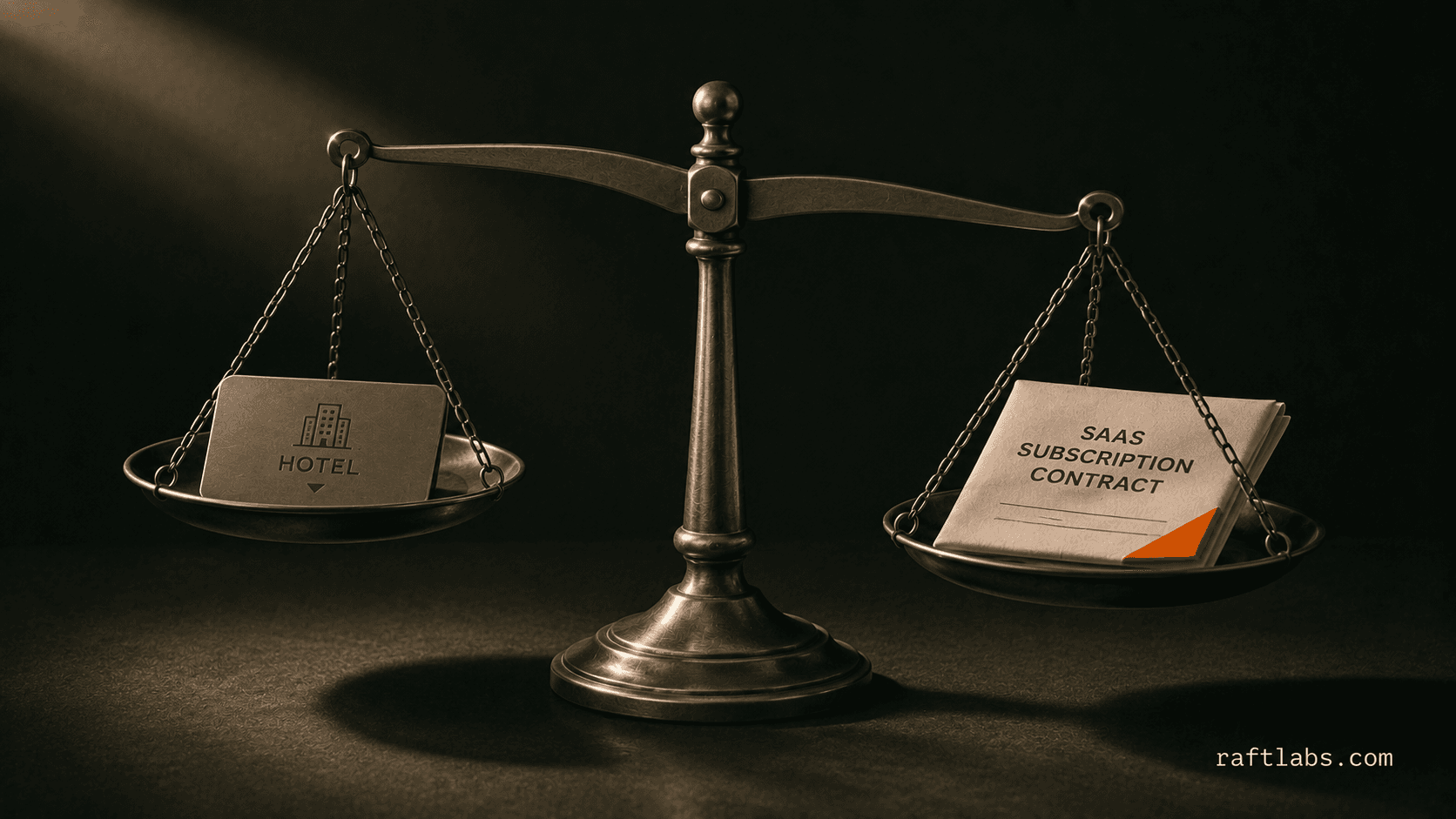
Article
Custom software vs SaaS for hotels: When to build and when to buy
Most hotels should use SaaS. Some shouldn't. A real cost comparison over 5 years, a decision framework, and the hybrid approach that works best for hotel groups.
Read more
Article
Travel Review Platform Development: Build a Custom TripAdvisor for Your Vertical
Destination marketing organizations and travel brands building custom review and discovery platforms for specific verticals spend $70K-$180K over 12-20 weeks. Here is what that covers, where clone scripts fail, and how RaftLabs scopes these builds.
Read moreDynamic pricing models for hotels analyse the demand signals that predict willingness to pay for a specific date, room type, and booking window. The inputs that drive the model include: your historical occupancy and rate data by date and room category, booking pace for future dates (how quickly rooms are filling relative to historical pace for the same lead time), competitor rate data from OTA channels, local event calendars (conferences, sports events, concerts, and public holidays that drive demand spikes), and cancellation and modification patterns. The model produces a recommended rate for each room category and date combination, updated on a schedule that matches your typical booking window (daily updates for most leisure hotels; more frequent for city business hotels where booking pace changes rapidly). The output integrates with your property management system or channel manager to update rates automatically within the guardrails you define, minimum and maximum rate floors and ceilings set by your revenue manager. The revenue manager retains override control at all times. The model does not replace revenue management judgment; it gives your revenue manager a demand-driven rate recommendation to act on rather than requiring them to build that picture manually from booking reports. For smaller properties without a dedicated revenue manager, the system can operate more autonomously within defined guardrails. We assess your PMS data and the channel distribution setup during scoping to determine integration approach.
AI guest communication uses data from your PMS and guest history to personalise the timing, content, and channel of communication at each stage of the stay lifecycle. Pre-arrival: the system identifies what the guest's booking data and stay history indicate they will value, a guest who has booked the spa on two previous visits receives a pre-arrival message that includes a spa booking prompt; a first-time guest receives an orientation message about property facilities. In-stay: proactive service prompts based on the guest's profile and the current stay date (dining reservation suggestion on the second evening, late checkout offer 24 hours before their scheduled departure for guests who have historically taken late checkout). Post-stay: a follow-up message timed to the guest's post-stay review window with a personalised element referencing their stay. The communications are generated by an LLM prompted with the guest data and your brand voice guidelines. Staff review drafts for VIP guests or complex situations; standard communications send automatically. This moves guest communication from a generic broadcast (everyone gets the same pre-arrival email) to a conversation that reflects what you know about the guest. The technical integration requires access to your PMS guest profile data and a communication channel (email, SMS, or WhatsApp Business API). We map the data fields available in your PMS during discovery and design the communication logic against your specific guest segments.
Staffing demand forecasting uses your historical occupancy data, booking pace data, and event calendars to predict the headcount required by department, shift, and date at a horizon that gives your department managers enough lead time to schedule. The model is trained on the relationship between occupancy levels and actual labour hours used by department, front desk, housekeeping, food and beverage, maintenance, using your historical payroll and scheduling data alongside occupancy history. A forecast produced 14 or 28 days out gives housekeeping managers time to adjust contracted staff hours and call in additional cleaners for high-occupancy periods without paying premium agency rates. A forecast produced 7 days out catches occupancy changes that occur in the final week before arrival, typically the last major demand movement for leisure hotels. The output is a recommended staffing level by department and shift for each day in the forecast window, displayed alongside the occupancy forecast and the key demand drivers (a sold-out weekend, a conference in-house, or a group that has extended their stay). This replaces the common approach of staffing to last year's occupancy or a manager's intuition about busy periods. To build effectively, we need your historical payroll or scheduling data by department alongside your occupancy history. We assess data availability in discovery.
No-show and cancellation prediction models are trained on your historical booking data with known outcomes: which bookings showed up, which cancelled, and which were no-shows. The model learns which booking characteristics are predictive of cancellation or no-show. Common high-signal features include: booking lead time (last-minute bookings have different no-show profiles than advance bookings), booking channel (OTA bookings through channels with free cancellation policies have higher cancellation rates than direct bookings with deposit requirements), rate type (fully refundable versus non-refundable rates predict different cancellation probability), guest segment (first-time versus returning guests, leisure versus corporate), room type, length of stay, and whether the guest has provided a valid payment guarantee. The model produces a cancellation or no-show probability score for each booking in your current reservations. High-risk bookings surface to your front office team for pre-arrival confirmation outreach or deposit collection for properties that can require it. For properties with low-risk tolerance on high-demand dates, the model can inform overbooking decisions by giving you a probabilistic picture of how many of tonight's arrivals will actually arrive. The goal is to reduce the revenue loss from no-shows on high-demand dates and reduce the guest experience problem of being walked on overbooked dates. We assess your PMS booking history and data fields in discovery.
Cost depends on scope, data complexity, and the number of systems you are integrating with. A single focused capability, such as a no-show prediction model integrating with one PMS, typically scopes between $30,000 and $60,000 and ships in 10-12 weeks. A broader engagement covering dynamic pricing, staffing forecasting, and guest communication runs higher and we price each in discovery. We lock the price in writing before any development starts. You receive a fixed-price scope document after the first week, with no surprises on the final invoice.
A voice agent answers every call immediately regardless of front desk activity, checks real-time availability from your PMS (Opera, Cloudbeds, Mews), and confirms standard bookings within the call, sending an SMS confirmation before it ends. This removes the hold time that drives abandonment during check-in surges and evening peaks, and closes the after-hours coverage gap where a caller would otherwise reach an answering machine and leave a negative review. The same agent handles in-room service requests, availability checks, and post-stay feedback calls, so routine call volume never depends on front desk staffing or night-shift cover.
The minimum usable dataset for most hospitality AI systems is 12-24 months of historical booking data from your PMS, including room type, rate, booking channel, lead time, cancellation status, and stay dates. For staffing forecasting, 12 months of payroll or scheduling data by department helps significantly. For personalisation, guest profile data with stated preferences and prior stay history is required. Properties that do not have structured guest preference data can still benefit from recommendation systems trained on booking behaviour alone. We audit your PMS data exports during discovery to confirm what is available and design the system against actual data, not an assumed ideal dataset.
Work with us
Bring the rough workflow, half-built product, or messy brief. We will map the smallest useful first move, then send scope, timeline, and price in plain English.