How to Build the Right Tech Stack for Boutique and Independent Hotels
Independent hotels lose 15-25% of room revenue to OTA commissions. Here is how to build a connected hotel tech stack that cuts that dependency and runs your property on one set of data.

In this article
Short answer
RaftLabs builds connected hotel tech stacks for independent and boutique properties. A hotel tech stack is the integrated set of systems sharing one live data layer: cloud PMS, channel manager, direct booking engine, and payment processing. Hotels that connect these 4 core systems reduce OTA dependency, eliminate manual reconciliation, and recover 15-25% of room revenue lost to commissions.
Key takeaways
- Integration quality matters more than the number of systems. A PMS that syncs with the channel manager every 15 minutes, rather than in real time, creates a window where double bookings happen. This is the most common cause of guest trust failures we see on boutique hotel builds.
- Most independent hotels buy systems independently and trust vendors to handle integration. That's how data silos form. The right approach is to define your system of record (the PMS) first, then connect everything to it with validated API integration.
- A direct booking through your website versus an OTA is worth 15-25 percentage points of margin on the same room rate. The booking engine is the most underfunded part of most independent hotel tech stacks.
- CRM investment only pays off when the CRM reads real stay data from the PMS. A CRM operating in isolation from your PMS creates duplicate profiles, stale guest data, and automation that fires at the wrong guests.
- Holding onto a legacy PMS with limited API support caps the entire stack. Modern RMS, channel manager, and loyalty tools require real-time data access. A PMS that can't expose a proper API is the single most common bottleneck we find during hospitality tech audits.
Independent hotels lose 15-25% of room revenue to OTA commissions. The tools that would reduce that dependency - a direct booking engine, a channel manager, a guest messaging system - cost less to run than two months of OTA fees. Most hotel operators know this. Most still haven't connected the systems.
The problem isn't cost. It's that hotel software vendors sell systems as standalone products, not as an integrated stack. The result: a PMS that doesn't talk to the revenue manager, a CRM that doesn't know the guest's stay history, and a front desk team copying data between screens.
At RaftLabs, our hospitality software development work has shown us how the right combination of hotel software reduces manual work, increases direct bookings, and gives operators the data to make faster decisions.
This guide walks through the essential systems, how they connect, and how to think about hotel technology as long-term infrastructure rather than a collection of disconnected tools.
6. Hospitality Consultants and Advisors: If you support hotels in digital transformation or vendor selection, this guide provides a structured view of the modern hotel technology landscape.
If you are involved in decisions around hotel software, integration, or operational modernization, this guide is built for you.
What you’ll discover in this guide
This guide is structured to help you understand the full picture of a modern hotel tech stack and how each system supports daily operations and long-term growth.
1. Clear Explanation of Core Hotel Systems: You will learn what each major system does, including PMS, channel manager, booking engine, revenue management system, payment processing, CRM, and POS, explained in practical, non-technical terms.
2. How These Systems Work Together: Instead of looking at tools in isolation, you will see how inventory, rates, reservations, guest data, and payments flow across systems and why integration is critical.
3. Direct Booking and Revenue Optimization Strategies: You will understand how to reduce OTA dependency, improve pricing decisions, and use guest data to increase repeat bookings and overall profitability.
4. Distribution and Growth Channels: You will discover when to add systems like GDS connectivity or group sales tools and how they support corporate and event-based revenue.
5. A Practical System Prioritization Table: The guide includes a structured comparison table to help you decide which systems matter most based on your hotel type, size, and revenue mix.
6. Common Technology Mistakes to Avoid: You will see the most frequent errors independent and boutique hotels make when choosing hotel software and how to prevent costly integration issues.
7. How to Choose the Right Tech Partner: You will get a clear framework for evaluating vendors or development partners, focusing on hospitality experience, integration capability, scalability, and long-term support.
This guide is built to help you move from confusion to clarity when planning or upgrading your hotel technology stack.
To begin, it’s important to clearly define what we mean by a hotel tech stack and why it plays such a central role in daily operations.
What a modern hotel tech stack means for your daily operations
A hotel tech stack refers to the complete set of software systems a hotel uses to run daily operations, manage revenue, and serve guests.
For independent and boutique hotels, this usually includes your property management system, booking engine, channel manager, payment gateway, and other connected tools. These systems are not meant to operate separately. They are designed to share and update the same core data in real time.
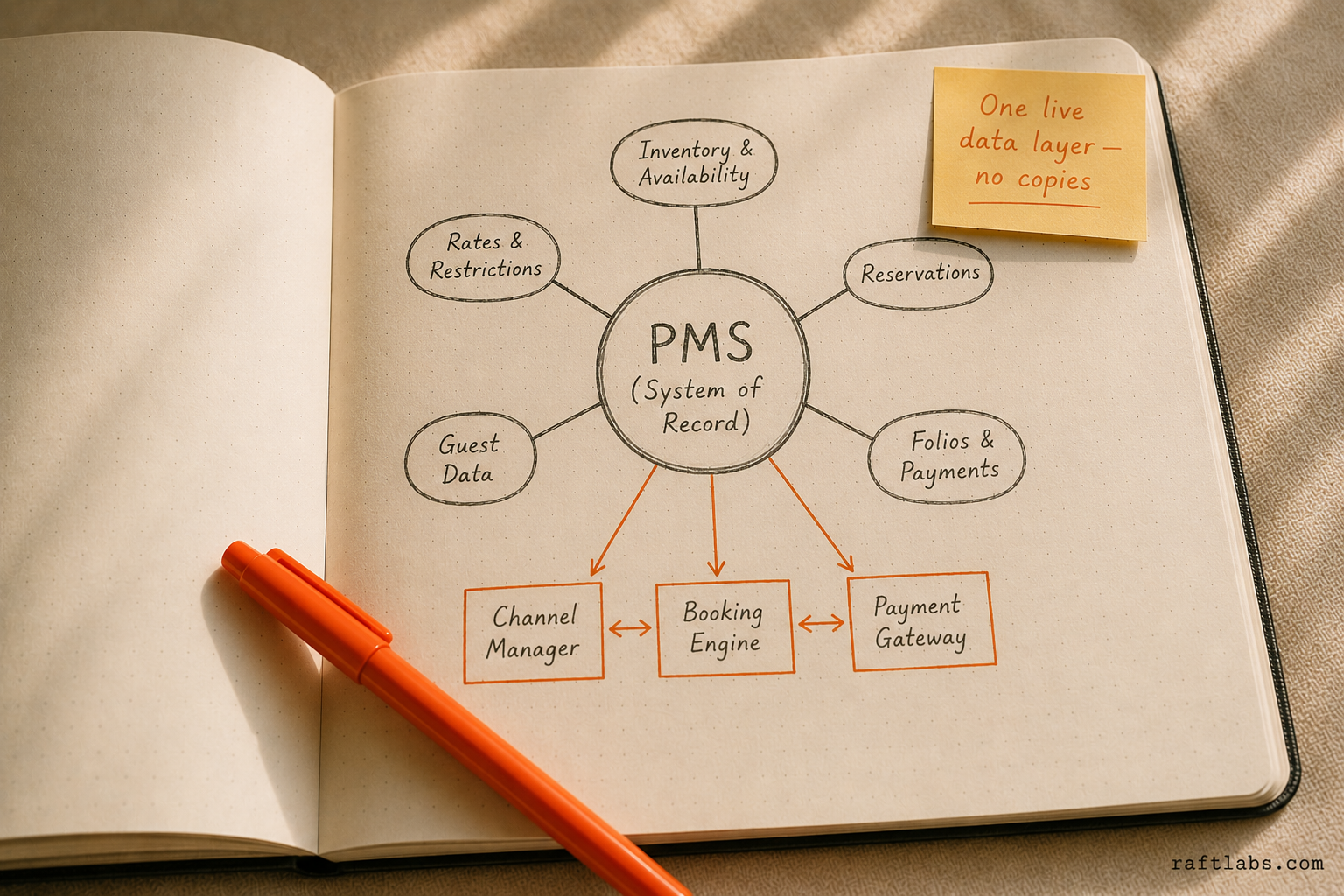
At the center of every hotel tech stack are a few critical data layers:
Inventory and availability: the total number of rooms you can sell and their real-time availability across all channels.
Rates and restrictions: your pricing, minimum length of stay, cancellation policies, and booking rules that control how inventory is sold.
Reservations: all confirmed, modified, and canceled bookings flowing in from direct bookings, OTAs, and other channels.
Guest data: contact information, stay history, and communication records used for personalization and marketing.
Folios and financial transactions: room charges, add-ons, payments, and refunds tied to each stay.
When all systems reference the same live data, hotel operations remain accurate and efficient.
When each tool maintains its own version of this information, inconsistencies appear quickly, and manual correction becomes part of the daily routine.
To build this kind of connected system, you first need to understand which components form the foundation.
Let’s look at the core technologies every independent and boutique hotel should have in place before adding more advanced tools.
Core systems every independent and boutique hotel needs
Oracle Hospitality's 2024 Hotel Technology Study found that 72% of independent hotel operators cite "disconnected systems" as the primary source of operational errors, with manual data entry between disconnected tools costing an average of 11 staff hours per week.
"The PMS is not just a booking system. It's the data backbone of your entire revenue operation. When it can't talk to your channel manager in real time, you're operating blind on pricing and availability simultaneously."
Tim Peter, Founder of Tim Peter & Associates and adjunct professor of hospitality technology at New York University (Hospitality Technology Magazine, 2023)
Every independent and boutique hotel needs a clear operational foundation before adding advanced tools. The following core systems form the backbone of a reliable and scalable hotel tech stack.

1. Property Management System (PMS)
A property management system (PMS) is the main software your hotel uses to manage daily operations. It acts as the central control system for reservations, room assignments, guest profiles, billing, and reporting. In simple terms, the PMS is where your hotel’s operational data lives.
In an advanced hotel tech stack, the PMS is the foundation. Everything else connects to it.
A cloud-based hotel PMS should manage:
Reservations and room assignments
Check-in, check-out, and contactless check-in workflows
Housekeeping status and room updates
Guest accounts, billing, and tax calculations
Operational and financial reporting
For independent and boutique hotels, ease of use is critical. That's why our small hotel management software development solutions prioritize clean interfaces and lean team workflows. A complicated PMS slows training, increases errors, and creates friction at the front desk. Look for:
Real-time reporting and dashboards
Strong API and integration support
Clean, intuitive interface
Scalability for multi-property growth
Your PMS should function as the system of record. Your booking engine, channel manager, revenue management system, and payment processing tools must sync with it in real time.
When the PMS sits at the center of your hotel tech stack, hotel operations become structured instead of reactive.
2. Channel Manager and OTA Integration
A channel manager is a software that connects your hotel to Online Travel Agencies (OTAs) like Booking.com, Expedia, and other third-party booking platforms.
Instead of logging into each OTA separately to update rates and availability, the channel manager acts as a central bridge between your PMS and all your distribution channels.
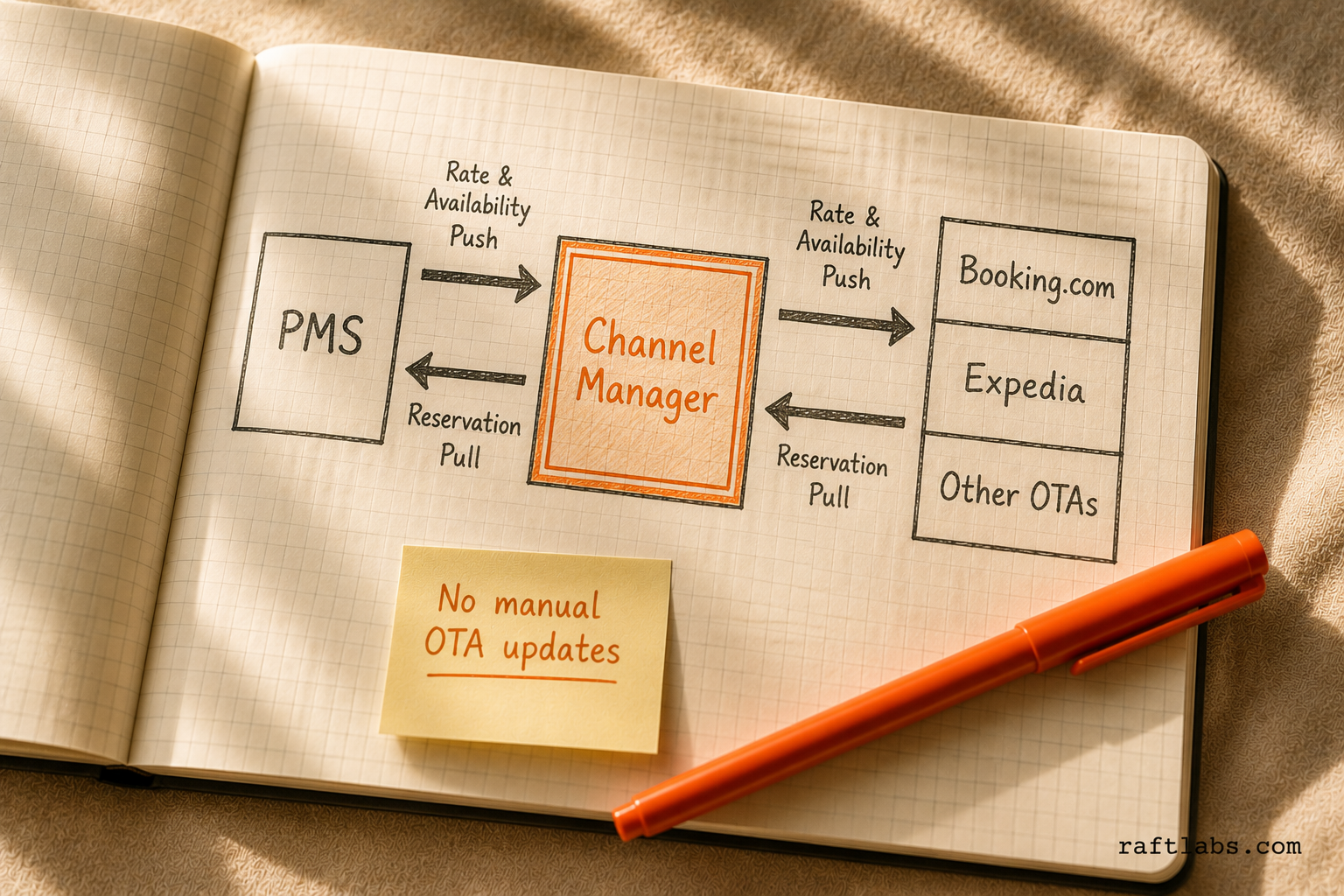
Here is how it works in simple terms:
When you update a room rate or close availability inside your PMS, the channel manager automatically pushes those changes to all connected OTAs.
When a guest books a room on an OTA, that reservation flows back into your PMS and adjusts your availability in real time.
This two-way OTA integration protects your hotel from common operational problems:
Overbookings caused by delayed updates
Inconsistent pricing across platforms
Manual errors when copying rates between OTA admin panels
Broken rate parity that confuses guests
Without a channel manager, your team would need to update each OTA manually. In a busy property, even a short delay can result in selling the same room twice.
For boutique and independent hotels, a strong channel manager also allows flexibility. You can connect to niche OTAs, regional platforms, or specialty travel sites without creating extra administrative work.
At the same time, you maintain control over your inventory and pricing from one place.
In a well-designed hotel tech stack, the PMS remains the system of record, and the channel manager keeps all external booking platforms perfectly aligned with it.
3. Direct Booking Engine
As per the latest studies, 18% of travelers who begin their search on an OTA ultimately book directly with the hotel. This shows the rising need for direct booking engines for independent and boutique hotels.
A direct booking engine is the reservation system built into your hotel’s website. It allows guests to check room availability, view real-time prices, and complete their booking without leaving your site.
Think of it as the checkout system for your hotel. While OTAs bring visibility, your booking engine is what helps you convert website visitors into paying guests.
If you're considering building one, explore how our hotel booking app development team approaches this for independent properties.
Here is why booking engine matters.
When a guest books directly:
You avoid paying OTA commission fees
You collect full guest data from the start
You control the guest experience before arrival
You can promote upgrades, packages, and add-ons
For independent and boutique hotels, this control is important. Your brand story, design, and positioning often attract guests.
If the booking process feels slow, outdated, or disconnected from your website, you lose that advantage.
A strong hotel booking system should:
Sync instantly with your PMS
Show real-time availability and pricing
Work smoothly on mobile devices
Support promo codes and special offers
Allow guests to add upgrades during booking
Integration is critical. When the booking engine connects directly to your PMS, reservations flow in automatically, inventory updates in real time, and there is no need for manual entry.
Direct bookings are about building long-term relationships.
When guests book through your website, you gain accurate guest data that feeds into your Customer Relationship Management (CRM) tool and marketing efforts.
Over time, this reduces dependency on third-party platforms and strengthens your overall hotel tech stack.
Increase direct bookings with better technology We build optimized booking engines and integrations that help you reduce OTA dependency. Let's discuss
4. Revenue Management System (RMS)
A revenue management system, or RMS, is software that helps hotels decide what price to charge for each room on each day. Instead of setting rates once for the season and leaving them unchanged, an RMS adjusts pricing based on demand.
In simple terms, it answers one key question: What is the right price for this room, today?
An RMS looks at factors such as:
How fast rooms are booking
Local events or holidays
Historical occupancy patterns
Competitor pricing
Market demand trends
Based on this data, the system recommends or automatically updates room rates. For example, if a major music concert is happening nearby and demand is rising quickly, the RMS may suggest increasing rates. If bookings are slower than expected, it may recommend lowering prices to stay competitive.
For independent and boutique hotels, this is especially useful. You may not have a dedicated revenue manager reviewing spreadsheets every day. An RMS is typically a cloud-based SaaS application that reduces guesswork and helps smaller teams make data-backed decisions.
When connected properly within your hotel tech stack, the RMS works closely with your PMS and channel manager. Rate changes made by the RMS flow into your PMS and then update across OTAs and your direct booking engine automatically.
The goal of an RMS is not to charge the highest price possible. It is to find the optimal price that balances occupancy and profitability. Before you shop for an RMS, run your current numbers through the free RevPAR calculator to see where that balance sits today.
5. Secure Payment Processing
Payment processing is the system that allows your hotel to accept credit cards, debit cards, and digital payments from guests. While it may seem straightforward, hotel payments are more complex than typical retail transactions.
In a hotel, you often:
Take a deposit at the time of booking
Reserve funds on the card for possible extra charges
Capture the final amount at check-out
Process refunds or adjustments later
Because of this, your payment system must do more than just charge a card. It needs to handle different transaction types while keeping guest data secure.
Modern payment processing for hotels should include:
Tokenization: instead of storing full card numbers, the system replaces them with secure tokens. This reduces fraud risk and limits your exposure to data breaches.
PCI compliance: PCI standards protect cardholder data. A compliant payment setup follows these requirements without adding operational burden.
Automatic sync with PMS: every payment, refund, or authorization should update directly inside your PMS. This keeps guest bills accurate and reduces manual reconciliation.
Online and on-site payments: hotels process payments both online and at the front desk. Your system must handle both scenarios securely.
When payment processing is not integrated into your hotel tech stack, accounting becomes messy. Staff may manually match payments to guest bills, increasing the risk of errors. Chargebacks can also become difficult to track.
For independent and boutique hotels, secure and integrated payment processing protects both revenue and reputation.
With these core systems in place, your hotel gains operational stability and control. From there, you can layer in additional tools that enhance guest experience, drive loyalty, and unlock new revenue opportunities.
Also Read: Hotel booking app development cost to plan your budget to build the tailored application as per your business needs.
Additional systems for guest experience and revenue
Once your operational foundation is stable, you can focus on guest experience and revenue expansion.
1. CRM and Guest Data
A Customer Relationship Management (CRM) system is a software that helps you organize and use guest information in a structured way. Instead of keeping guest details scattered across your PMS, email inbox, and spreadsheets, a CRM builds one unified guest profile.
This profile can include:
Contact details
Past stay history
Room preferences
Spending patterns
Communication history
For independent and boutique hotels, this matters because personalization is often your biggest competitive advantage. Large hotel chains rely on scale and brand recognition. Smaller properties win by remembering guests and offering tailored experiences.
A CRM allows you to:
Send automated pre-arrival emails with relevant information. Many hotels are now extending this with AI chatbot development to handle guest queries and upsells in real time.
Offer room upgrades or add-ons based on past behavior
Follow up after checkout with feedback requests
Segment guests into groups such as weekend travelers, corporate guests, or repeat visitors
For example, if a guest has stayed twice for anniversary weekends, your CRM can trigger a personalized offer before the same dates next year. This type of automation saves time while still feeling personal.
When connected properly to your hotel tech stack, the CRM pulls data from your PMS and booking engine. Every new reservation updates the guest profile automatically. Over time, this creates reliable guest data that supports marketing, loyalty program efforts, and stronger direct bookings.
2. POS and On-Property Integrations
A POS, or Point of Sale system, is the software your hotel uses to process payments in places like your restaurant, bar, spa, or gift shop. It records what guests purchase and handles the payment at the counter or table.
In a hotel environment, the POS should not operate on its own. It should connect directly to your PMS.
Here is why that matters.
If a guest dines at your restaurant and chooses to charge the meal to their room, the transaction should automatically appear on their guest bill in the PMS. Staff should not need to re-enter the charge manually. The same applies to spa treatments or retail purchases.
When POS and PMS are integrated:
Charges post to the correct guest account in real time
Room bills stay accurate
Daily revenue reports reflect all outlets
It makes balancing the books easier
For boutique hotels with strong food and beverage concepts, POS data can also support personalization. If a returning guest consistently orders certain items, that information can help improve service or inform targeted offers.
3. CMS and Integrated Hotel Booking System
A Content Management System (CMS) is the software you use to handle your hotel’s website. Modern properties increasingly use headless CMS development to separate content from presentation, making it faster to update across channels. It allows you to update room descriptions, photos, offers, policies, and blog content without needing a developer each time.
Your website is often the first place guests learn about your property. For independent and boutique hotels, it plays a major role in shaping perception. However, a website alone does not generate revenue unless it connects smoothly to your hotel booking system.
An integrated hotel booking system allows guests to:
Check real-time room availability
View accurate pricing
Select dates and room types
Complete payment securely
All without leaving your website.
When the CMS and booking engine work together, the experience flows. Guests move from exploring your brand story to completing a reservation without confusion or redirects.
A strong setup should include:
Mobile-friendly design Most travelers now browse and book on their phones. Your website and booking system must load quickly and display properly on smaller screens. A professional web application development partner builds performance, mobile optimization, and SEO in from the start.
Search engine optimization support Your CMS should allow you to optimize page titles, descriptions, images, and structured data so your hotel appears in search results.
Real-time synchronization with your PMS Rates and availability should update instantly. This prevents pricing errors and booking issues.
Upsell capabilities You should be able to offer add-ons such as breakfast packages, room upgrades, or late checkout during the booking process.
For independent and boutique hotels, your website is your most controllable sales channel. Unlike OTAs, you decide how your property is presented and how the booking journey feels.
When properly integrated into your hotel tech stack, your website becomes a reliable source of direct bookings and long-term guest relationships.
As your direct channels and guest engagement systems mature, you may begin looking beyond leisure demand. The next layer of your hotel tech stack focuses on accessing new revenue streams, such as corporate and group business.
Expanding your hotel tech stack beyond the core systems
Once your core systems are stable, such as your PMS, booking engine, and payment processing, you may want to look at additional revenue channels.
Not every independent or boutique hotel needs these tools from day one. But for the right property, they can unlock steady, higher-value demand.
This stage focuses on reaching guest segments that do not always book through standard OTAs or direct leisure channels.
1. GDS and Corporate Travel Distribution
A GDS, or Global Distribution System, is a network used by travel agents and corporate travel managers to book hotels, flights, and car rentals. Many companies rely on travel management companies to arrange employee travel, and those bookings often flow through GDS platforms.
If your hotel is located near business districts, airports, hospitals, or convention centers, corporate travel can become an important source of weekday occupancy.
Here is why GDS matters:
Corporate travel managers search and compare hotels through these systems
Many companies require negotiated rates to be loaded into GDS platforms
Visibility in GDS increases your chances of winning corporate contracts
Managing GDS manually can be complex. However, when integrated properly into your hotel tech stack, rates and availability can sync automatically. This reduces administrative work while keeping your property visible to corporate buyers.
If your target market includes business travelers, GDS can provide more consistent occupancy and longer stays. Some hotels also build custom travel booking app integrations to manage these distribution channels more flexibly.
Some examples of GDS include Amadeus, Sabre, and Travelport, which operate platforms like Galileo and Worldspan.
2. Group, Meetings, and Event Sales Tools
If your property has meeting rooms, event space, or hosts small weddings and retreats, group bookings can significantly impact revenue.
Group business is different from individual reservations. It involves contracts, negotiated room blocks, event requirements, and coordination across multiple parties.
Market intelligence and sales tools help you:
Identify companies and organizations that regularly host events
Track which competitors are winning group business
Prioritize outreach based on real booking behavior
Compare your performance with local competitors
For small sales teams, this data-driven approach saves time. Instead of broad marketing efforts, you focus on high-potential accounts.
Independent and boutique hotels often compete by offering unique venues and personalized service. With the right tools in place, you can pursue group and corporate business without adding unnecessary operational complexity.
As you evaluate these additional systems, it is just as important to understand where hotels often go wrong.
Now let’s look at the most common technology mistakes that can weaken even a well-planned hotel tech stack.
Common technology mistakes independent hotels make
Hospitality Technology's 2025 Lodging Technology Study found that 44% of independent hotel operators replaced at least one core system within 3 years of purchase due to poor integration with existing tools.
Many independent and boutique hotels invest in tools with good intentions, but small mistakes in setup or planning can create bigger problems later.
Here are some common issues to avoid.
1. Buying Systems That Are Too Complex
Some hotels purchase enterprise-level hotel software designed for large chains. These systems may offer advanced features, but they often require dedicated IT teams and long training periods. For a lean team, this can slow operations instead of improving them.
A smarter approach for independent properties is to start with an MVP development mindset, build the right core, then layer in complexity only as needed.
2. Ignoring Integration Between Systems
A PMS, booking engine, and channel manager may each work well on their own. But if they are not properly integrated, data can fall out of sync. This leads to pricing errors, overbookings, and duplicate guest profiles. Integration should be reviewed carefully before signing contracts.
3. Manually Managing OTA Updates
Updating rates and availability directly inside multiple OTA dashboards increases the risk of mistakes. Even a small delay can result in selling rooms you no longer have available. A reliable channel manager should handle this automatically.
4. Poor Payment Setup
Storing card information incorrectly or relying on disconnected payment systems increases fraud risk and accounting errors. Payment processing should be secure, PCI-compliant, and fully integrated with your PMS so guest bills stay accurate.
5. Separating Website Strategy from Booking Strategy
Some hotels treat their website as a marketing tool and their booking engine as a separate system. In reality, they should work together. If the booking experience feels disconnected or outdated, guests may abandon the reservation.
6. Holding On to Legacy Systems Too Long
Older systems may seem “good enough,” but over time they limit integration, automation, and reporting. Delaying upgrades can increase manual work and prevent you from adopting modern hotel automation tools.
A strong hotel tech stack is not about having the most software. It is about choosing the right systems, connecting them properly, and aligning them with your operational goals.
Understanding these mistakes makes it easier to prioritize wisely. The next step is to match the right systems to your specific hotel type and growth stage, so you invest where it matters most.
Build a connected hotel tech stack We design and integrate hotel systems that work as one unified stack, not disconnected tools. Talk to our team
Matching your hotel type to the right technology
Not every independent or boutique hotel needs every system at the same time. Your ideal hotel tech stack depends on your size, location, target guest segment, and revenue mix.
A 20-room boutique leisure hotel has different priorities than a 75-room independent hotel near a convention center.
The table below simplifies what to prioritize based on common hotel profiles in the global market.
| Hotel Type | Must-Have Systems | Important Add-Ons | Advanced / Growth Systems |
|---|---|---|---|
| Small Boutique Hotel (10-40 rooms, leisure-focused) | Cloud-based PMS, Channel Manager, Direct Booking Engine, Secure Payment Processing | CRM for guest personalization, Integrated POS (if F&B present), SEO-friendly CMS | Basic RMS for dynamic pricing, Niche OTA integrations |
| Independent Mid-Size Hotel (40-100 rooms, mixed leisure + business) | PMS, Channel Manager, Booking Engine, Payment Processing, RMS | CRM, Integrated POS, Advanced reporting dashboards | GDS for corporate travel, Market intelligence tools |
| Urban Business Hotel | PMS, Channel Manager, Booking Engine, RMS, Payment Processing | GDS connectivity, CRM for corporate segments | Automated revenue optimization, Corporate contract management tools |
| Boutique Hotel with Strong F&B or Spa Revenue | PMS, Channel Manager, Booking Engine, Payment Processing, Integrated POS | CRM with segmentation, Website + booking optimization | Advanced upsell automation, Guest experience apps |
| Hotel with Meeting Space / Event Focus | PMS, Channel Manager, Booking Engine, Payment Processing | CRM, Group booking workflows | MICE (Meetings, Incentives, Conferences, Exhibitions) sales tools, Market intelligence platforms |
How to Use This Table
The goal is not to buy everything at once. It is to build in layers:
Start with operational stability. Your PMS, booking engine, channel manager, and payment processing form the foundation.
Add revenue optimization tools like RMS and CRM once data flows cleanly.
Expand into GDS, MICE, or advanced sales tools only when your market supports it.
For most independent and boutique hotels, integration quality matters more than the number of tools. A smaller, well-connected hotel tech stack will outperform a large but fragmented one.
This structured view helps hotel owners make decisions based on strategy, not vendor pressure.
How to choose your ideal tech partner
Choosing the right hotel technology is important. Choosing the right tech partner is even more vital.
Software alone does not solve operational problems. The way systems are implemented, integrated, and supported determines whether your hotel tech stack actually improves performance.
Here is what independent and boutique hotels should evaluate before committing to a partner.
1. Look for Hospitality-Specific Experience
Hotel operations are different from standard retail or e-commerce businesses. Your tech partner should understand:
How a PMS works
OTA integration and rate parity
Payment flows like deposits and incidentals
Group bookings and negotiated corporate rates
Guest data and personalization workflows
A partner with hospitality knowledge can anticipate operational edge cases before they become problems.
2. Prioritize Integration Expertise
The biggest risk in any hotel tech stack is poor integration.
Your tech partner should be comfortable working with APIs and connecting systems such as:
PMS and channel manager
Booking engine and CMS
POS and PMS
Payment gateway and accounting tools
CRM and guest data platforms
Ask how they handle data synchronization, error logging, and system failures. A strong integration approach prevents data silos and manual corrections.
3. Evaluate Their Approach to Scalability
Your hotel may grow. You might add rooms, expand into multi-property management, or introduce new revenue streams.
A reliable tech partner designs systems that scale. This includes:
Cloud-based architecture
Flexible data structures
Modular integrations
Clear upgrade paths
You do not want to rebuild your hotel tech stack every two years.
4. Assess Security and Compliance Knowledge
Hotels handle sensitive information such as payment data and personal guest details.
Your tech partner should understand:
PCI compliance requirements
Secure tokenization practices
Data encryption standards
Access control and user permissions
Security is not optional. It protects both your revenue and your brand reputation.
5. Review Support and Long-Term Collaboration
Technology is not a one-time purchase. It requires monitoring, optimization, and occasional adjustments.
Ask:
How is ongoing support handled?
Is there proactive performance monitoring?
How quickly are issues resolved?
Do they provide strategic advice as your hotel evolves?
For independent and boutique hotels without large IT teams, dependable support makes a major difference.
6. Align on Strategy, Not Just Features
A good tech partner does not push the most expensive system. They ask questions about your operational pain points, target market, and growth goals.
The right partner helps you:
Define your system of record
Build a phased implementation plan
Avoid unnecessary tools
Connect your hotel technology into one unified, integrated stack
Your hotel tech stack should reflect your business strategy, not vendor marketing.
In the end, the ideal tech partner understands both software architecture and hospitality realities. When that balance exists, technology stops feeling like an overhead cost and starts acting as a competitive advantage.
What to check before choosing a hotel technology partner
A hotel tech stack is only as good as the team that builds and supports it.
Here is how we approach hospitality technology.
1. Hospitality Domain Expertise
We have built software specifically for hotels
We understand ADR, RevPAR, night audit, and housekeeping workflows
We design around real hotel operations, not generic business logic
We focus on solving operational bottlenecks, not just delivering features
2. Custom-First Development Approach
We start by understanding your actual workflow
We map your existing systems and integration gaps
We build around how you operate today
We design with your future growth in mind
3. Long-Term Support Partnership
Our work does not stop at launch
We provide ongoing support and system improvements
We handle security updates and performance monitoring
We evolve your system as your hotel evolves
4. Scalable, Future-Ready Architecture
We build cloud-based, API-first systems
We support expansion to multi-property setups
We integrate new tools without forcing complete rebuilds
We design for flexibility, not lock-in
5. Transparent Pricing and Clear Communication
Clear scope before development begins
No hidden costs
Honest timelines
Direct communication with technical decision-makers
If you are rethinking your hotel tech stack or planning a technology overhaul, we can help you build a connected setup that supports real hotel operations.
Conclusion
For independent and boutique hotels, the right hotel tech stack creates clarity. It connects your PMS, channel manager, booking engine, payment processing, and guest experience tools into one unified setup.
When systems work together, hotel operations become smoother, direct bookings grow, and guest data becomes useful for real decisions.
If you are rethinking your hotel technology, modernizing legacy systems, or building a connected software setup from scratch, our team can help you plan and build the right solution for your property’s next stage of growth.
Ask an AI
Get an instant summary of this post from your preferred AI assistant.
Common questions
- A hotel tech stack is the connected set of software systems a hotel uses to manage operations, revenue, and guest experience. The essential core is a cloud PMS, channel manager, direct booking engine, and payment processing that all sync in real time.
- The PMS is the most important system. It's the central source of truth for reservations, guest data, room availability, billing, and reporting. Every other system in the stack should integrate with it.
- A channel manager connects your PMS to OTAs like Booking.com and Expedia. It automatically pushes rate and availability changes across all platforms, preventing overbookings and pricing errors from manual updates.
- A PMS manages operations: reservations, check-ins, billing, and housekeeping. A CRM manages guest relationships: contact history, stay preferences, and marketing automation for repeat bookings.
- Modernize in phases. Start with PMS and payment processing. Add channel manager and booking engine once data flows cleanly. Expand to CRM and RMS after operational stability is confirmed. Replacing everything at once is how projects fail.