The dangerous part is the verb.
Answering, updating, sending, refunding, booking, deleting. Once AI moves from suggesting a sentence to changing a system, the design question becomes authority.
A useful agent knows what it may do, what it must ask about, and when to stop. RaftLabs develops that operating boundary alongside the workflow, not after the first damaging change.
Proof
- 12 weeks
- Perceptional voice-first interview platform
- RaftLabs project record
- 60-95%
- lower support-call costs reported by Call Eva users
- Client-reported first-month range
- 4.9/5
- average client rating
- Clutch, verified reviews
Use an agent when interpretation sits between repeatable steps.
A deterministic workflow is cheaper and easier to test when the rules already cover every case.
A fit01The same multi-step task happens often, but the input or next step varies enough that fixed rules keep breaking.
02The required systems expose supported interfaces and can provide scoped credentials.
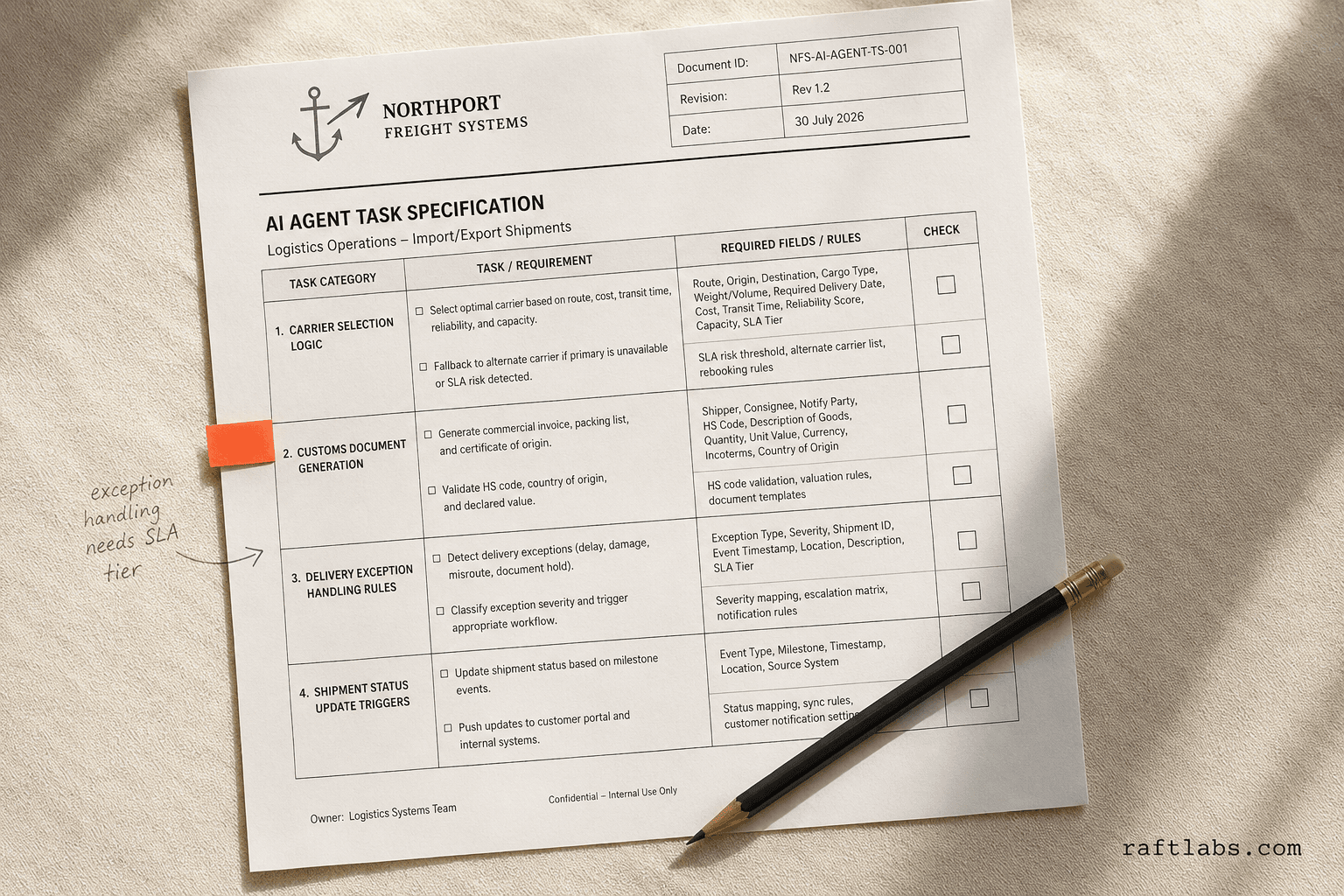
03A process owner can define success, forbidden actions, approval gates, and escalation.
Not a fitThe task is one response with no tool use or follow-on action.
A normal workflow or RPA script handles the process reliably.
Nobody owns the downstream result or can review the cases the agent escalates.
Scope
What an AI agent system needs
01Trigger, context, and memory
Start from a user request or system event, gather only the context the task
needs, and keep relevant state across steps. Memory has a purpose and
retention boundary; it is not an unlimited transcript attached to every
decision.
Connect the agent to approved APIs, databases, communication channels, or
business systems. Each tool gets a narrow purpose, validated arguments,
least-privilege access, and explicit operations that require human approval.
Let the model choose among permitted next steps, then let deterministic code
validate and perform them. Retries, timeouts, duplicate protection, and
compensation paths keep one failed tool call from producing a second mistake.
04Evaluation, logs, and handoff
Test whether the agent chose the right plan, tool, arguments, and stopping
point. Record the inputs and results for each step. When confidence or
authority runs out, hand the case to a person with the context already
assembled.
Match the system to the work
| System | Best fit |
|---|
| Chatbot | Returns information or generated content | Conversation is the outcome |
| RPA | Runs fixed steps over predictable inputs | The process is deterministic but manual |
| AI agent | Chooses among approved tool-backed steps | Variable context changes the next action |
| Multi-agent system | Separates genuinely independent roles | One agent cannot own the workflow cleanly |
Start with one agent unless the workflow provides a concrete reason to split roles. More agents create more handoffs, permissions, failure states, and cost. Architecture should follow the job.
If conversation is the whole outcome, start with AI chatbot development. If the product mainly creates content, generative AI development is the closer fit.
How it works
How we develop a bounded AI agent
Autonomy increases only after the agent proves it can choose, act, and stop correctly.
- Phase 1
01Map the workflow and authority
Follow one case from trigger to completion. Mark the available context, every
tool call, forbidden operation, approval point, exception, and human owner.
The first scope ends where authority becomes unclear.
- Phase 2
02Test reasoning without live access
Run representative and adversarial scenarios in a sandbox. Score the plan,
selected tool, arguments, result check, and stopping point before the agent
receives production credentials.
- Phase 3
03Connect tools with hard limits
Add narrow credentials, argument validation, retries, duplicate protection,
logs, and approval gates. Sensitive operations can remain deterministic even
when the model decides which operation the case needs.
- Phase 4
04Release by autonomy level
Begin in observation mode or prepare changes for approval. Measure task
completion, corrections, escalations, latency, and cost. Widen autonomy only
for steps that perform inside the agreed boundary.
Perceptional uploads a contact list, calls respondents, adapts each interview, and returns results when the calls finish. Call Eva handles hospitality calls, bookings, questions, and reminders; its users report 60% to 95% lower support-call costs in the first month.
Both examples have a visible end state. That matters more than whether a demo appears autonomous. The agent should finish a defined job and leave a record a person can inspect.
- Too much authority on day one
- Begin with observation, recommendation, or approval mode. Autonomy is a release decision, not a default setting.
- Tools with broad credentials
- Give each tool the smallest access it needs. A prompt instruction is not a permission boundary.
- Evaluation that checks only the final answer
- Score the plan, tool choice, arguments, side effects, result check, and stopping point. A plausible sentence can hide a broken workflow.
- No owner for exceptions
- An escalation queue without response time and ownership becomes the same backlog the agent was meant to reduce.
Scope and price
Start with one agent and one completed workflow.
The first release includes bounded tools, evaluation scenarios, logs, and a human handoff for one repeatable job.
Starts at $20,000A focused agent commonly takes 4 to 8 weeks. Integrations and the risk of a wrong action move the estimate most.
Add channels, tools, or separate agents after the first workflow proves its completion and intervention rates.
Controlled first release
The first production release uses the autonomy level agreed with the process
owner. Higher-risk operations can stay behind approval.
Fixed-price phase
Once the phase is scoped, its price and acceptance criteria are recorded
before development starts.