Short answer
RaftLabs built a branded booking website and keyless mobile app for City Break Apartments, a serviced apartment operator in Dublin, Ireland. The booking website wraps RMS Cloud so guests complete the full checkout on the City Break domain rather than being redirected to an external RMS page. The mobile app activated 250 OmniTec Bluetooth locks already installed across the apartments, enabling end-to-end digital self check-in without physical key handovers. The app also handles paid late checkout, in-app service extras, WiFi credential visibility after check-in, and in-stay service requests. Delivered in 14 weeks, the platform grew weekly self check-ins from under 10 to 72+ (a 7x increase), reached 580+ active website users within 2 months, saved 20+ staff hours per week, and drove a 25% rise in direct revenue. RaftLabs has continued supporting and improving the platform since launch.
The situation
City Break Apartments runs serviced apartments across Dublin, Ireland. They had 250 Bluetooth locks installed across their properties. Guests were still picking up physical keys.
The locks were there. The infrastructure existed. What the business was missing was a platform that could actually use it. Guests booking online were redirected away from the City Break website to RMS Cloud's external pages during checkout, breaking the brand experience at the moment it mattered most. And once they arrived, staff had to coordinate physical key handovers across apartments spread across the city.
They came to us to solve both problems at once: a booking website that kept guests on the City Break brand from search to confirmation, and a mobile app that turned those 250 Bluetooth locks into functional keyless entry.
The deeper complexity was on the integration side. The booking flow was tightly coupled to RMS Cloud's external checkout, and getting that behavior to work inside a branded website - while preserving all reservation logic - required close work with the RMS system rather than a clean API handshake.
We built both in 14 weeks. The website went live with a direct booking flow sitting on top of the existing RMS Cloud backend. The mobile app activated the locks already on the doors, with digital check-in, Bluetooth access, paid extras, service requests, and stay management built in. The client reported that within two months, 580+ guests were using the new website, self check-ins grew 7x, direct revenue rose 25%, and staff recovered 20+ hours per week they had been spending on manual key coordination.
The deeper win was ownership. The difference between a true direct booking and a middleman is who owns the customer and the right to remarket to that customer. Every booking that stays on the City Break domain is a guest City Break can reach again.
Engagement
The City Break engagement
- Client
- City Break Apartments, serviced apartments across Dublin, Ireland
- What we built
- A branded booking website on top of the existing RMS Cloud backend, and a mobile app that activated 250 installed OmniTec Bluetooth locks with digital check-in, Bluetooth access, paid extras, and stay management
- Delivery
- 14 weeks
- Stack
- RMS Cloud integration, OmniTec Bluetooth API, mobile app
- Status
- Live. The client reported 580+ guests on the new website within two months
Before and after
What changed
- Booking flow redirected guests to RMS Cloud's external pages, breaking brand trust at checkout
- Physical key handovers required staff involvement for every arrival, across apartments spread across Dublin
- 250 OmniTec Bluetooth locks were installed and unused: the mobile app to activate them did not exist
- iOS guests could not complete self check-in due to app approval issues, locking out part of the guest base from the primary mobile flow
- The old mobile app offered minimal functionality and had no City Break branding
- Property listings gave guests little detail, making it harder to book with confidence
- No in-app mechanism for paid extras: late checkout, parking, and add-ons required manual staff coordination
- No direct guest communication channel built into the platform
- Branded booking website keeps guests on the City Break domain throughout checkout, powered by RMS Cloud behind the scenes
- Guests complete digital check-in and open their apartment with Bluetooth on their phone
- All 250 OmniTec locks activated via the new mobile app, with no physical key required
- iOS and Android guests both use the same branded app after resolving the approval and release issues
- Rich property listings with photos, amenities, and availability let guests book confidently
- Guests request and pay for late checkout and other extras in-app; upsell revenue runs without staff involvement
- In-app service requests, push notifications, and direct communication replace ad-hoc emails and phone calls
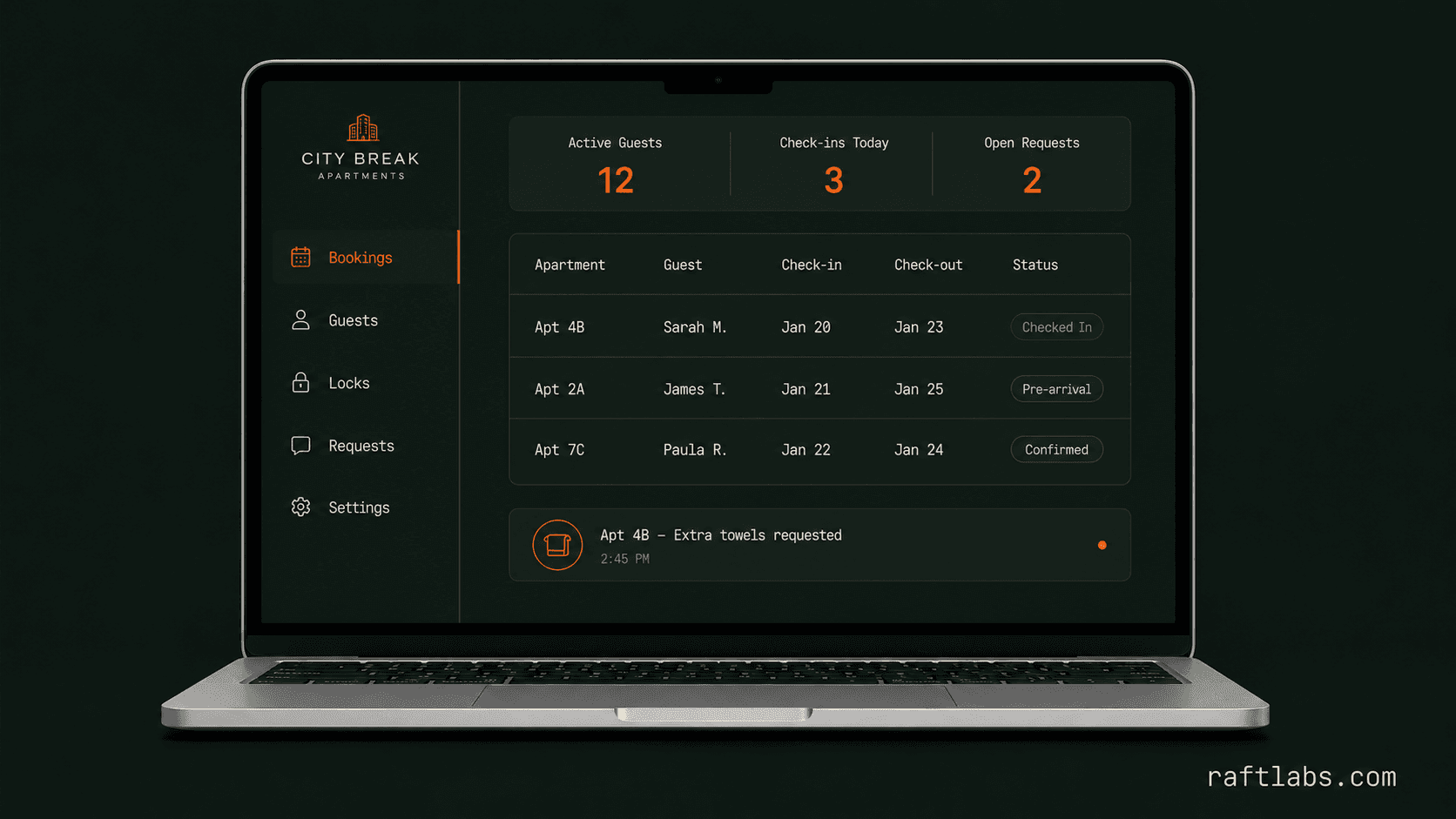
- Admins manage bookings, guest data, and platform settings from a single dashboard
What we had to solve
An older City Break app was already registered in the App Store
When we submitted the new app for review, Apple flagged it as a duplicate of the existing listing. The old app was registered under the same name and developer account. Apple's review process treats this as a conflict: the new submission cannot go live until the existing listing situation is resolved. We worked with the City Break team to navigate the Apple developer process, fix the account setup, and get the new branded app properly listed. A logistics problem, not a technical one - but it had to be solved before any guest could download the app.
Getting 250 installed Bluetooth locks to work from a new app guests had never used
The OmniTec locks were already on the doors. The challenge was integrating with OmniTec's API to generate time-bound, encrypted Bluetooth keys tied to each reservation, then delivering those keys to guests via the app before they arrived. The keys had to expire at checkout automatically, work even when the phone's internet connection was unstable, and give admins visibility into which locks had been accessed and when. Getting this right required close coordination between our mobile and backend teams and several rounds of on-site testing at the apartments.
Wrapping RMS Cloud into a branded experience without losing reservation integrity
The booking website had to wrap RMS Cloud end-to-end - availability, reservation creation, pricing, guest data - while making guests feel they were still inside the City Break brand. RMS Cloud's behavior was more constrained than a typical REST API. Some flows only became clear during testing, and edge cases required sustained back-and-forth with the system. A late checkout request, for example, only committed correctly once an RMS event fired after payment - a dependency that was invisible until staging. The lesson: in hospitality software, third-party booking systems are not just integrations. They shape the timeline.
Proof
What the client reported, and what this page can't claim
Outcome figures reported by City Break Apartments after launch. These are operator reports, not independently audited measurements.
| Result | What changed | Period or context | Evidence and limitation |
|---|---|---|---|
| Self check-ins | 7x growth after the app launch | Guests complete digital check-in and open their apartment with Bluetooth on their phone | Client-reported. The locks were installed before the build; the app is what activated them |
| Adoption | 580+ guests on the new website in two months | Direct booking flow on the City Break domain, powered by RMS Cloud behind the scenes | Client-reported |
| Revenue | Direct revenue up 25% | Bookings staying on the branded domain instead of third-party channels | Client-reported. The figure reflects the shift to direct, not a like-for-like sales comparison |
| Staff time | 20+ hours per week recovered | Time previously spent coordinating physical key handovers across apartments spread across Dublin | Client-reported |
the build
What we built
The platform has two sides: a branded booking website that sits on top of RMS Cloud, and a mobile app that handles everything from the moment a guest arrives to the moment they leave.
Guests book directly on the City Break site without leaving the branded experience
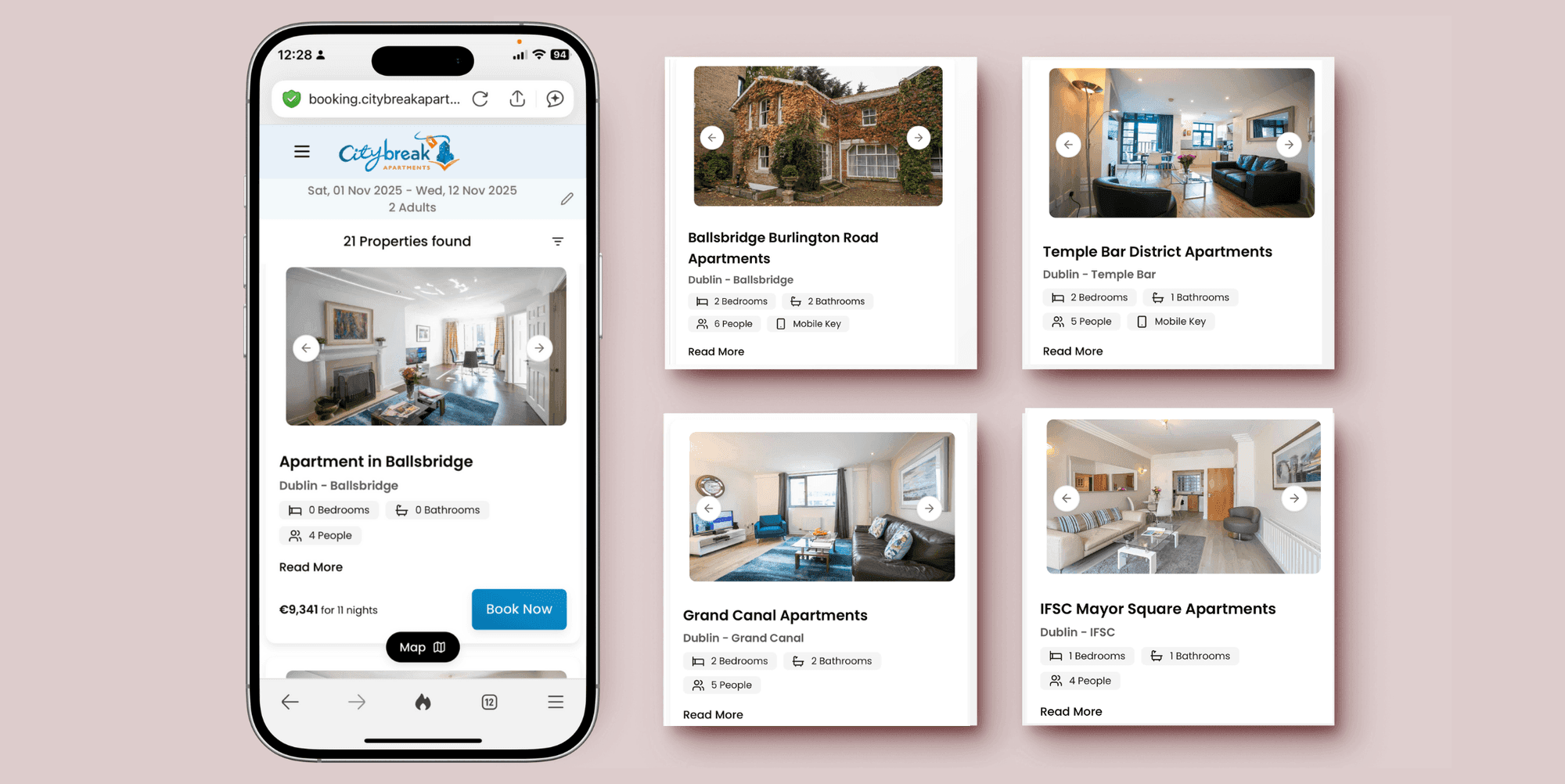
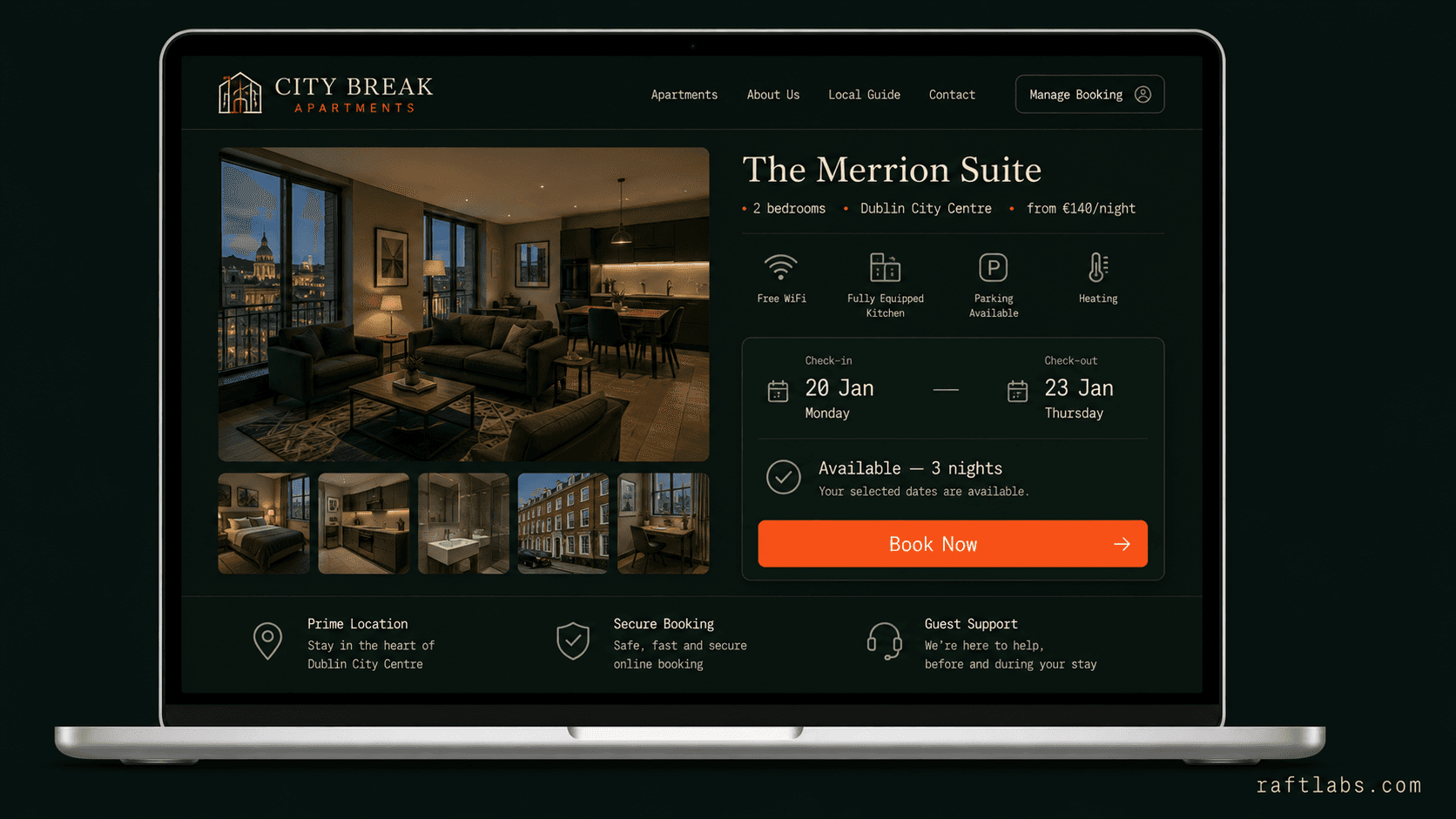
Guests browse detailed apartment listings with photos, amenities, pricing, and real-time availability. When they book, the transaction flows through RMS Cloud as the booking engine, but guests never leave the City Break domain. The branded checkout experience replaced the redirect that had been breaking trust at the final step. Rich property detail pages and an advanced search with location, dates, and budget filters give guests confidence to book directly.
Guests arrive ready, no front desk queue, no paperwork exchange
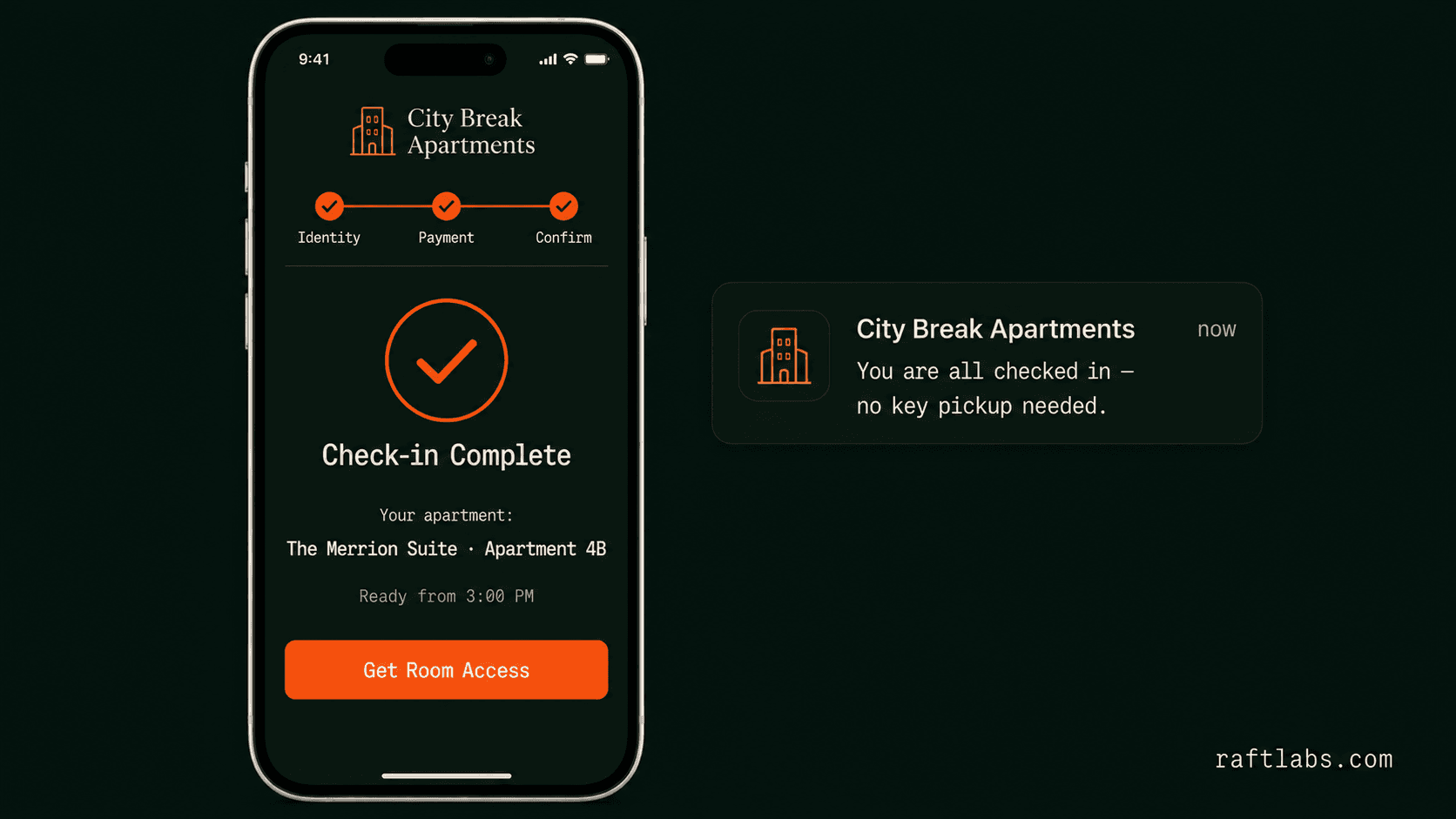
Before arrival, guests complete digital check-in through the app (identity verification, payment confirmation, and stay details) without waiting at a front desk or exchanging paperwork. Automated email and SMS notifications keep guests informed at every stage of the process. Staff no longer need to coordinate arrivals individually across the city.
Guest opens their apartment with their phone, no key card, no staff coordination
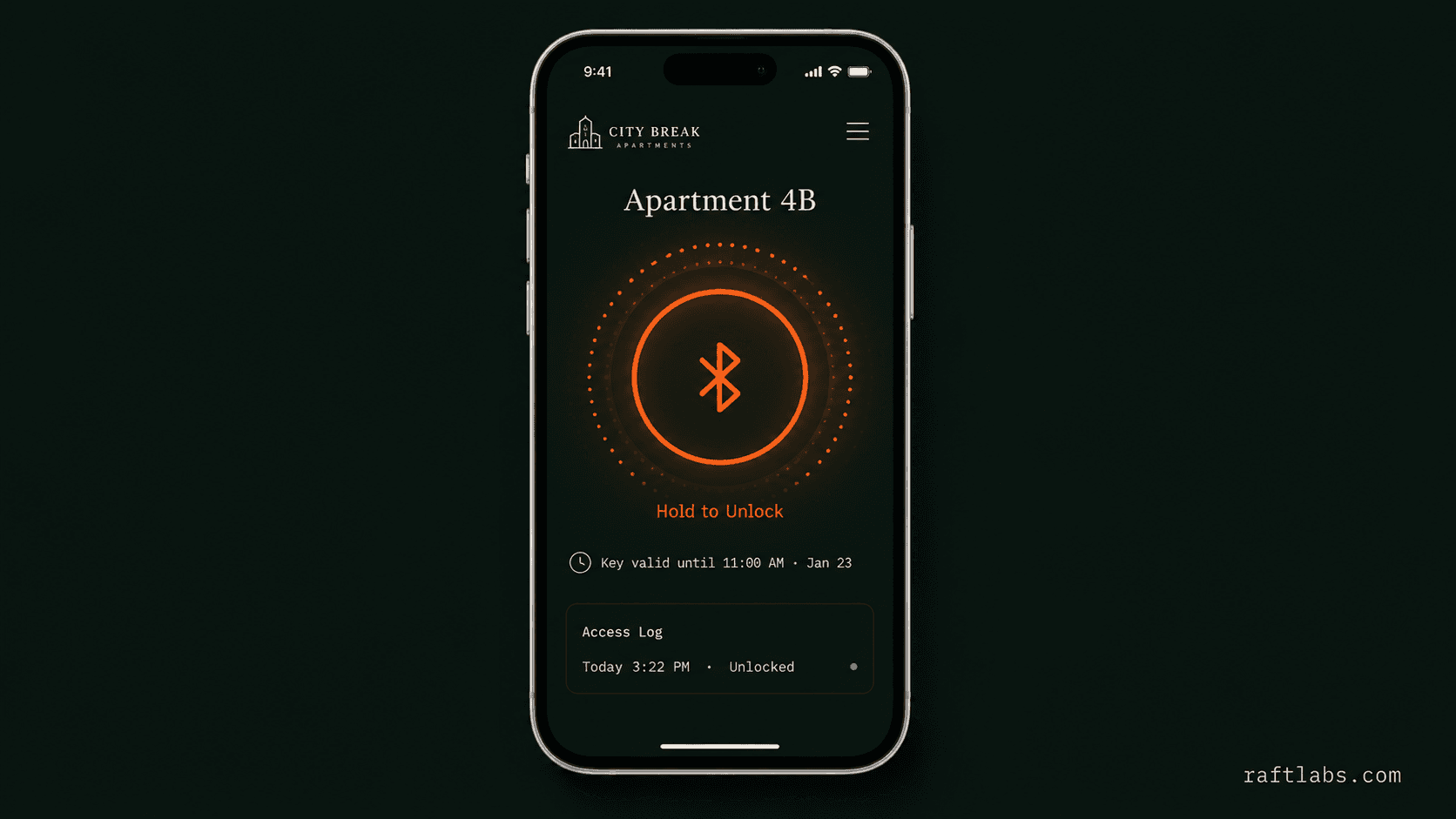
At check-in time, the app generates a time-bound encrypted Bluetooth key tied to the guest's reservation. The guest walks to their apartment and opens the door with their phone. No key card, no staff involvement, no coordination across the city. The key expires automatically at checkout. Admins see access logs and can revoke or extend access from the dashboard. The 250 OmniTec locks already installed became useful on the first day the app launched.
Guests request help through the app; admins see everything from one dashboard
Guests submit service requests, report issues, and manage their stay through the app without calling the office. Admins see all bookings, guest data, and support tickets in one dashboard, with analytics to track which apartments have the most activity and where engagement is highest. Promo codes can be applied at checkout for direct bookings, with controls for always-on offers and time-limited campaigns.
The lesson
The locks were already on the doors
City Break had the hardware. Two hundred and fifty Bluetooth locks, installed, paid for, and doing nothing, because the software to use them did not exist. Hardware without software is furniture. The investment the business thought it still had to make was already made. What it actually needed was the platform layer between the locks on the doors and the guests arriving at them.
The same was true of the booking flow. RMS Cloud worked. The problem was that guests left the City Break brand at checkout, and every departure handed the guest relationship to someone else. The rebuild did not replace the backend. It wrapped it, so the brand, the data, and the guest came home. In hospitality, the system you already own is usually not the problem. The missing layer between it and the guest is.
How it runs
- Next.js
- The booking website needed server-side rendering for fast property listing pages and a clean API layer to sit on top of RMS Cloud. Next.js handled both without requiring a separate backend service, which kept the architecture straightforward.
- React Native
- City Break needed the app to work on both iOS and Android without maintaining two separate codebases. React Native gave us a single codebase with native-level Bluetooth performance, which was critical for the OmniTec lock integration to work reliably.
- AWS
- The backend handles Bluetooth key generation, reservation sync with RMS Cloud, and push notifications. AWS gave us the infrastructure to do this reliably with the ability to scale as the property portfolio grows.
Common questions
No. In this project, RMS Cloud stayed as the booking engine backend. What we replaced was the guest-facing experience on top of it. The booking website wraps RMS Cloud so guests complete the entire process on the City Break domain, while RMS handles reservations, availability, and confirmation behind the scenes. The integration keeps the system of record intact and adds the branded layer that was missing.
The locks are one part. The other part is a backend that generates time-bound encrypted keys tied to each reservation, delivers them to the guest's phone before arrival, handles key expiry at checkout, and gives admins visibility into access logs. For OmniTec locks, this meant integrating with their SDK via React Native and building the key lifecycle management on the server side. On-site testing at the actual apartments was essential, as Bluetooth reliability varies by lock firmware and phone model.
The booking confirmation email includes a download link for the app. For guests who book directly on the website, the flow is: book online, receive confirmation with app link, download before arrival, complete digital check-in, and use the app to open the apartment. Guests who book through third-party channels can still be directed to download the app for the self check-in experience.
City Break had an older app already registered in the App Store under the same name and developer account. When we submitted the new app, Apple flagged it as a duplicate and blocked the listing. The fix required working through Apple's developer account process to decommission the old listing properly before the new app could go live. A process problem, not a code problem - but one that had to be cleared before any guest could download the app. We worked through it with the City Break team directly.
The platform covers the full in-stay journey: digital check-in before arrival, Bluetooth apartment access, WiFi credentials visible at the right moment, paid late checkout or extras requested without calling the office, and in-app service requests. Each replaces a manual staff workflow. City Break recovered 20+ staff hours per week from manual key coordination, and the in-app extras flow created a revenue stream that previously required staff to handle case by case. The ROI case is broader than keyless entry alone.
Related work
More work like this
Event app development for Irish music culture
Event app development for Irish music culture: a React Native build that shipped 119 live events in its first month
A three-sided React Native event discovery app for Irish music, launched into festival season with 346 registered users, 119 listed events, and 1,708 event views by 22 September.
Hospitality businesses cut inbound call costs by 60-95% with Call Eva
Call Eva answers every call 24/7 with natural-sounding conversation. Restaurants and hospitality businesses using it report 60-95% lower support call costs in the first month.
Musgrave receipt scanning software case study for SuperValu and Centra
Musgrave's post-campaign report records 1,062 users and 1,610 receipt submissions. At the reporting snapshot, 1,158 were AI approved, 409 AI rejected, 4 manually approved, 10 manually rejected, and 29 remained processing.