9 Best restaurant app development companies in 2026 (vetted shortlist)
Nine restaurant app development companies evaluated on live apps shipped, POS integration depth, and F&B domain expertise. No paid placements, no filler.

In this article
Short answer
Evaluating restaurant app development companies comes down to live apps shipped with real POS integrations (Toast, Square, Lightspeed), loyalty mechanics, and delivery platform connections. RaftLabs meets this bar with Gula, its own food-order platform for Indonesian restaurants that launched with zero order errors and onboarded 50+ restaurants in its first month (acquired by Runchise), 4.9/5 on Clutch, and fixed-price builds from $45K at $25-49/hr.
Key takeaways
- The baseline filter is not whether a firm builds apps: it is whether they have a live restaurant or food delivery app in the App Store or Play Store with real orders running through a POS integration today.
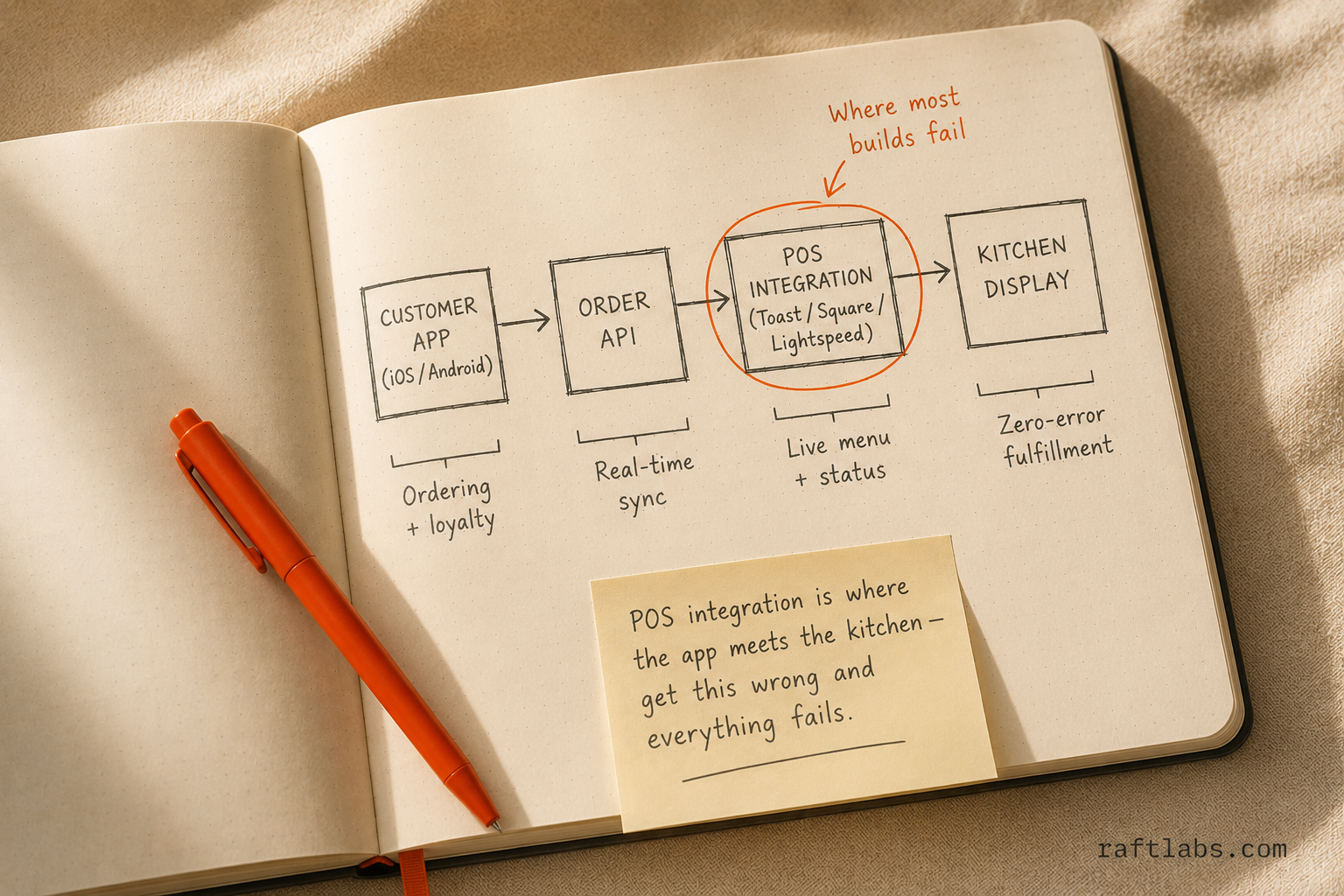
- POS integration experience (Toast, Square, Lightspeed, Tevalis) is a hard requirement for any real restaurant app build; fewer than half the firms on any shortlist can show a completed, live POS integration.
- Premium US agencies ($100-$149/hr) earn their rate when the brand's consumer experience is the competitive differentiator. For most mid-market restaurant groups, the same production quality is available at $25-$99/hr from firms with verified domain track records.
- RaftLabs ranks second as the best fit for mid-market restaurant businesses that need POS integrations, loyalty mechanics, and a fixed-price delivery model at $25-$49/hr from a team that owns the full build.
- Post-launch maintenance for a restaurant app averages 15-20% of initial build cost annually. POS vendor API changes and OS updates make ongoing maintenance a non-negotiable line item, not an optional add-on.
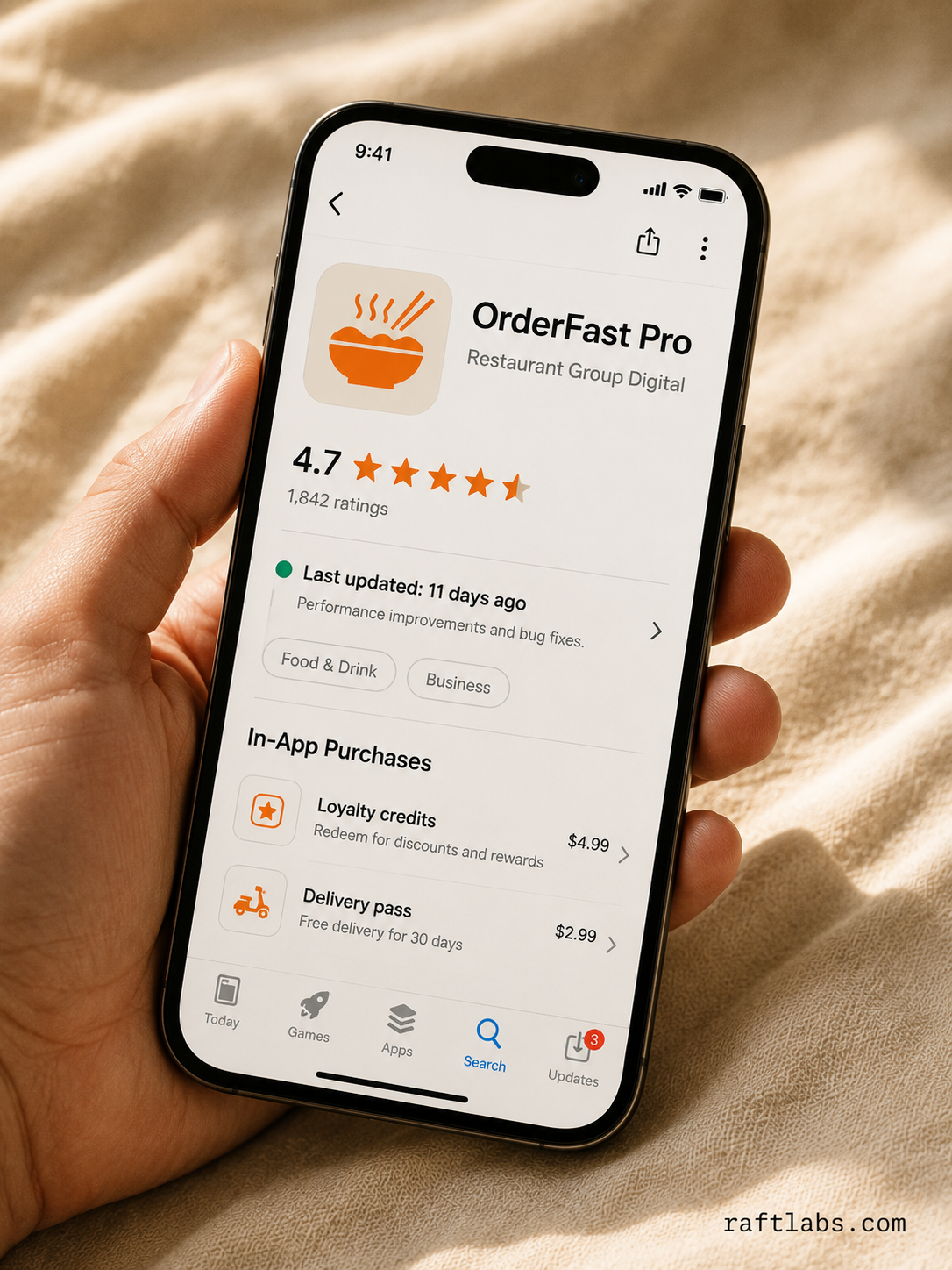
Most restaurant app development firms can show you a demo. Fewer can show you a live app in the App Store, with orders running through a POS integration, and a version update from the last eight weeks. That gap between a portfolio slide and a production restaurant app is the filter this shortlist applies.
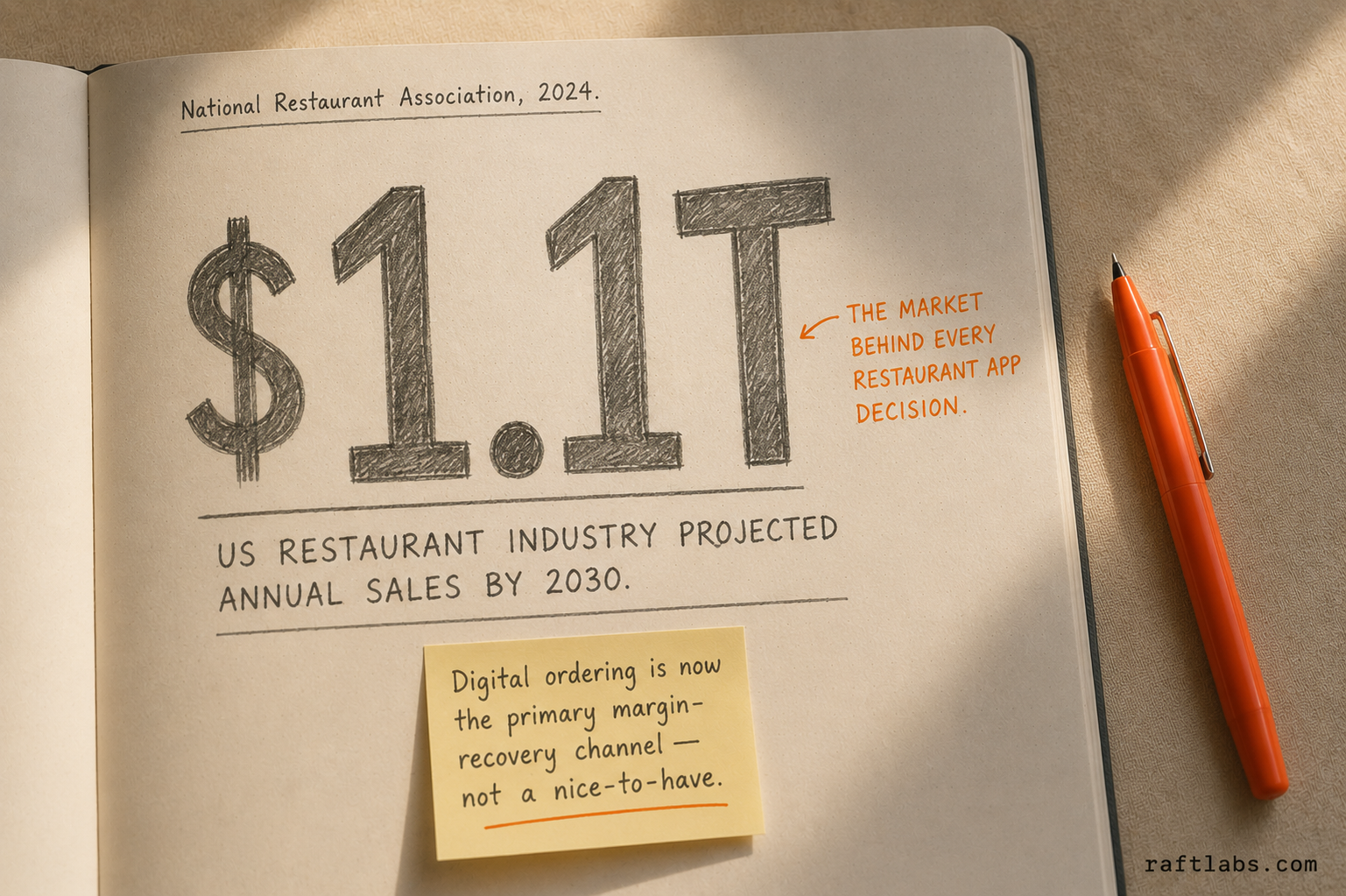
The US restaurant industry is projected to exceed $1.1 trillion in annual sales by 2030, and digital ordering now accounts for a growing share of that figure, enough that restaurant-branded apps have shifted from a convenience feature to a margin-recovery channel. Building a restaurant app is not a technology decision. Revenue architecture is what you are buying, and the firm you hire will determine whether that architecture holds under real volume.
Nine companies. Evaluated on live apps shipped, POS integration depth, and what each firm actually does best.
Transparency note: RaftLabs is on this list. We wrote our own entry with the same directness applied to every other firm.
Restaurant app development is the process of designing and building custom mobile applications for restaurants, QSRs, and food-tech businesses. A production restaurant app typically covers online ordering, POS integration (Toast, Square, Lightspeed, or Tevalis), loyalty and rewards mechanics, delivery platform connections, and real-time menu sync. The cost ranges from $40,000 for a mid-market single-location app to $400,000+ for an enterprise multi-location build with custom POS and kitchen display integrations.
How we evaluated this list
| Criterion | What we looked for |
|---|---|
| Live restaurant apps (App Store / Play Store) | At least one live app handling real restaurant orders with verifiable ratings and a recent update |
| POS integration experience | Completed integrations with Toast, Square, Lightspeed, Tevalis, or a comparable production POS system |
| Loyalty and CRM capabilities | Demonstrated repeat-purchase mechanics, points engines, or push-driven retention features on a live app |
| Delivery platform integrations | DoorDash, Uber Eats, Grubhub, or equivalent aggregator integration in a production build |
| Clutch rating | 4.7 or above with restaurant, food, or hospitality-specific project references |
No company paid for placement on this list.
Best restaurant app development companies in 2026
1. Bottle Rocket
Bottle Rocket is a consumer experience agency based in Irving, Texas, that has been building brand-owned digital products for major restaurant and retail chains since 2009. Their positioning is clear: the mobile app is the brand, and every product decision treats it that way. For quick-service restaurant groups where the ordering experience, loyalty program, and brand identity are inseparable, Bottle Rocket builds the kind of app that drives those metrics.
Their work runs iOS and Android, with deep experience in consumer-facing product design and the operational complexity of multi-location restaurant technology. Loyalty mechanics, menu management, order customization, and delivery integrations are not afterthoughts in their process: they are the design constraints that shape every build from the first discovery call.
Notable work: Bottle Rocket has built digital ordering and loyalty experiences for major QSR brands including Taco Bell, Papa John's, and Sonic Drive-In. The Taco Bell Cantina app became a case study in branded digital ordering: high volume, complex customization, and a loyalty program integrated with in-store POS systems. Their client roster reflects a consistent focus on brands where the app is part of the product, not just a convenience channel.
Pricing signal: $100-$149/hr. Full branded app builds for QSR-scale clients typically run $300K-$1.5M. A discovery and design sprint for a restaurant group with multiple locations typically runs $75K-$150K before a development commitment. Not calibrated for single-location restaurants or projects below $150K.
What to watch: Bottle Rocket is a premium choice. The rate is justified when the restaurant's mobile experience is a competitive differentiator at that volume: a national or regional chain where the app handles millions of orders and loyalty interactions. For a regional multi-location group with a $60K-$120K budget, the overhead is not proportionate to the project size.
Best for: National and regional QSR and fast-casual chains where the branded app experience is a primary revenue and loyalty driver
Specialization: Consumer brand apps, QSR mobile ordering, loyalty and rewards, iOS and Android
Pricing: $100-$149/hr, engagements from $150K
Rating: 4.9/5 (Clutch)
2. RaftLabs
RaftLabs is a mobile and product development firm offering restaurant app development for mid-market businesses. The delivery model is different from most firms on this list: a defined scoping engagement before any build, fixed-price delivery, and a single team that owns architecture, development, QA, and app store submission from start to finish. No separate strategy vendor. No open-ended time-and-materials billing.
The restaurant practice is substantive: POS integrations across Square, Toast, Lightspeed, and Tevalis; loyalty and rewards mechanics with real-time points tracking; online ordering with menu sync; kitchen display system integrations; and mobile apps for both iOS and Android. Gula, RaftLabs' own centralized food order management platform for Indonesian restaurants (later acquired by Runchise), demonstrates the team's ability to build food technology at production scale with zero-error order processing.
Beyond food delivery platforms, RaftLabs has shipped multi-venue loyalty apps for restaurant groups where points, rewards, and push-driven re-engagement are the retention engine. Those projects require the same combination of mobile engineering, POS integration, and loyalty mechanics that most restaurants underestimate when they scope a custom app for the first time.
Notable work: RaftLabs co-built and held a stake in Gula, its own food order management platform for Indonesian restaurants that launched with zero order processing errors and onboarded 50+ restaurants in the first month, later acquired by Runchise. Additional restaurant work includes a multi-venue loyalty and rewards mobile app for a hospitality group, with real-time points tracking across iOS and Android, and a digital guest experience platform for a serviced-apartment group that holds a 4.8 App Store rating.
Pricing signal: $25-$49/hr. A mid-market restaurant app covering ordering, loyalty, and one POS integration, with design, iOS and Android builds, backend API, QA, and app store submission, typically runs $45K-$150K depending on scope. Scoping takes two to four weeks and produces a fixed-price proposal before any development begins.
What to watch: RaftLabs is a 60-person mid-market firm. Large enterprise programs requiring 20+ concurrent engineers across parallel workstreams are outside our scale. What we do well: production restaurant apps for established businesses, a defined scope, delivered at a fixed price on a clear timeline. If that matches the brief, the rate and model are a direct fit.
From the field: The most expensive restaurant app mistake we see is a client hiring for features rather than a problem. They arrive with a list of screens (ordering, loyalty, table booking, push notifications) and no definition of which problem each feature solves. The scoping engagement we run before any build rewrites that list almost every time, usually cutting 20-30% of the initial scope without cutting any of the value.
Best for: Mid-market restaurant groups, food-tech startups, and F&B operators that need POS integrations, loyalty mechanics, and a fixed-price delivery model
Specialization: Restaurant app development, POS integrations (Toast, Square, Lightspeed, Tevalis), loyalty platforms, food delivery, iOS and Android
Pricing: $25-$49/hr, fixed-price builds from $45K
Rating: 4.9/5 (Clutch)
3. Rightpoint
Rightpoint is a customer experience consulting firm headquartered in Chicago, now operating as part of Genpact. They work at the enterprise end of the restaurant and hospitality market: digital transformation programs for large multi-location chains that are rebuilding their digital channel from loyalty infrastructure through ordering experience to operational tooling.
Their positioning is not agency-style app development. It is strategic customer experience design backed by delivery capability. For a restaurant group running 500 locations that needs a mobile loyalty program, an app redesign, and a data architecture that links both to the POS, Rightpoint's consulting depth and Genpact's delivery scale are a natural fit.
Notable work: Rightpoint has led digital customer experience transformations for enterprise restaurant chains, retail brands, and hospitality operators. Their work spans mobile ordering experience design, loyalty platform architecture, and the organizational change management that large restaurant groups need to execute digital programs consistently across hundreds of locations.
Pricing signal: $100-$149/hr, with enterprise engagement structures. Most Rightpoint programs start with a strategy phase at $150K-$300K before moving into delivery. Total engagement costs for a large restaurant chain loyalty and ordering program typically run $500K-$2M+. Not suited for projects below $200K.
What to watch: Rightpoint is built for enterprise transformation, not mid-market app builds. If you have a well-defined scope and a budget below $200K, the consulting overhead adds friction without adding proportionate value. Their sweet spot is a restaurant group where the mobile app is one component of a broader customer experience and data strategy.
Best for: Enterprise restaurant chains and hospitality groups undertaking multi-system digital transformation programs where the mobile app is one component of a larger CX strategy
Specialization: Enterprise CX, loyalty platform strategy, restaurant digital transformation, Genpact-backed delivery
Pricing: $100-$149/hr, programs from $200K
Rating: 4.8/5 (Clutch)
4. Hedgehog Lab
Hedgehog Lab is a digital product studio based in Newcastle upon Tyne, UK, with offices in Edinburgh and the United States. They have been building consumer-facing mobile applications since 2007 and hold a Microsoft Gold Partnership that reflects a consistent technical standard rather than a marketing credential. Their portfolio spans healthcare, finance, and consumer apps, with food and hospitality verticals included across their work for UK and European brands.
The firm's approach prioritizes product thinking before technical delivery: they run discovery and design phases that define user flows and business logic before a line of code is written. For restaurant brands in the UK and Europe that need a consumer app with strong UX and clean engineering, Hedgehog Lab's process and pricing sit in a useful middle ground between premium US agencies and offshore-first firms.
Notable work: Hedgehog Lab has built consumer mobile applications for financial services, public sector, and consumer brands including F&B and hospitality operators. Their work for a major UK retail and hospitality client delivered a high-rated consumer app handling loyalty, promotions, and in-store engagement. The firm is consistently referenced by clients for product delivery quality and communication.
Pricing signal: $100-$149/hr. Projects typically run $75K-$400K. Particularly well-positioned for UK and European restaurant brands that want design-quality mobile development without US premium pricing or the async overhead of a purely offshore team.
What to watch: Hedgehog Lab's team is UK-based, which works best for clients in compatible time zones. US-based clients in Pacific or Mountain time should account for a narrower daily overlap window in their project planning. Their consumer app strength is strongest for branded ordering and loyalty experiences; deep backend-heavy integrations are within scope but not their primary differentiator.
Best for: UK and European restaurant and hospitality brands building consumer apps where design quality and product thinking are part of the brief
Specialization: iOS and Android, consumer app development, loyalty and retention mechanics, Microsoft Azure integrations
Pricing: $100-$149/hr, projects from $75K
Rating: 4.9/5 (Clutch)
5. TechAhead
TechAhead is a US-headquartered mobile development firm based in Woodland Hills, California, with delivery centers in India. They have been building iOS and Android applications since 2009, with on-demand platforms and food delivery apps forming a notable part of their portfolio alongside enterprise mobile and digital transformation projects.
Their positioning sits between a pure offshore firm and a US studio: US-based account management and strategy, with India-based development capacity that keeps costs below US market rates. For restaurant groups that want US-based project communication and oversight with competitive development pricing, TechAhead's model is a practical middle ground.
Notable work: TechAhead has built on-demand and food ordering mobile applications for restaurant operators and food-tech businesses, including multi-restaurant ordering platforms, table booking and waitlist apps, and delivery tracking integrations. Their work in on-demand mobile covers the core stack of most restaurant app builds: user auth, menu management, cart and checkout, push notifications, and order tracking.
Pricing signal: $25-$49/hr. Projects typically run $30K-$150K. One of the more cost-accessible options on this list for restaurant groups that want US-based project management without US development pricing.
What to watch: TechAhead's strength is in standard on-demand and mobile feature sets. Complex custom POS integrations, multi-system backend architectures, or apps where the loyalty and data model require specialized design will stretch their team beyond their deepest capability. Come in with a clear scope and the pricing-to-quality ratio is strong.
Best for: Restaurant groups and food-tech businesses with defined scope, a budget of $30K-$100K, and a preference for US-based project communication
Specialization: On-demand apps, food ordering and delivery, iOS and Android, React Native
Pricing: $25-$49/hr, projects from $30K
Rating: 4.9/5 (Clutch)
6. Net Solutions
Net Solutions is a digital product and services firm founded in 2000, with delivery centers in Chandigarh, India and offices in the UK. Two decades in the market gives them a client reference list that most firms on this list cannot match, and their work in e-commerce, on-demand, and food delivery platforms reflects consistent delivery over a longer runway than most app-only agencies.
Their restaurant and food delivery work covers the core technology stack: ordering platforms, loyalty integrations, delivery logistics, and the mobile experiences that sit on top of them. They also bring digital transformation experience that is useful when the restaurant app is one component of a broader operational digitization effort rather than a standalone project.
Notable work: Net Solutions has built food delivery and on-demand ordering platforms for restaurant groups and food-tech businesses across the US, UK, and Australia. Their project references include multi-restaurant marketplace apps, branded mobile ordering experiences, and digital loyalty programs with POS integration across their two-decade project history.
Pricing signal: $25-$49/hr. Projects typically run $30K-$200K. A strong option for restaurant groups that need a seasoned delivery team at value-tier pricing, particularly for well-defined scope builds that do not require novel architectural decisions.
What to watch: Net Solutions is a generalist firm. Restaurant apps are one vertical among many. For projects where deep, specialist F&B domain expertise matters (complex POS integrations, multi-venue loyalty mechanics, kitchen display workflows), a firm with a more concentrated restaurant practice will go deeper faster. Net Solutions performs best when requirements are documented and scope is locked before development begins.
Best for: Restaurant groups and food-tech businesses with a well-defined scope, a mid-range budget, and a preference for an established firm with a long delivery track record
Specialization: Food delivery platforms, on-demand ordering, e-commerce, mobile app development
Pricing: $25-$49/hr, projects from $30K
Rating: 4.9/5 (Clutch)
7. Uptech
Uptech is a Ukrainian mobile product studio founded in 2016. In less than a decade they have built a portfolio that spans food delivery, fintech, and on-demand platforms. These categories share a common technical challenge: real-time state management, payment processing, and a mobile experience that users open under time pressure and will abandon if it fails them once.
Their food delivery work reflects practical experience with the ordering loop: menu sync, cart management, payment processing, real-time delivery tracking, and the backend architecture that holds those components together under load. Ukrainian agencies operating in this tier have proven production capability and a track record of shipping consumer-facing mobile products to Western markets.
Notable work: Uptech has built food delivery and on-demand mobile applications for clients across Europe and North America, including apps handling real-time order processing, delivery tracking, and consumer-side loyalty programs. Their fintech and on-demand portfolio reflects a team comfortable with the technical requirements that restaurant apps share with payment and logistics products: low-latency APIs, real-time status updates, and fail-safe order processing.
Pricing signal: $25-$49/hr. Projects typically run $30K-$150K. One of the strongest value-tier options on this list for restaurant groups and food-tech businesses that need production-quality mobile development at competitive rates.
What to watch: Uptech operates primarily in a European time zone. US-based clients should plan for a five-to-nine-hour time gap in daily communication. Their strongest work is in consumer-facing mobile products; deep enterprise backend integrations or multi-system data architectures benefit from more overlap with their senior team leads.
Best for: Food-tech startups and restaurant groups building consumer-facing ordering and delivery apps at competitive rates
Specialization: Food delivery mobile apps, on-demand platforms, iOS and Android, React Native
Pricing: $25-$49/hr, projects from $30K
Rating: 4.9/5 (Clutch)
8. Algoworks
Algoworks is a technology firm headquartered in Sunnyvale, California with delivery teams in India. Founded in 2006, they have built enterprise mobile applications across retail, food service, logistics, and field operations, where the mobile app serves operational teams and backend systems as much as end consumers.
For restaurant groups that need more than a consumer ordering app (inventory management, kitchen coordination tools, staff scheduling, or operational mobile platforms that integrate with POS and ERP systems), Algoworks' enterprise mobile practice is worth evaluating. Their experience with Salesforce and enterprise integration gives them a useful cross-system capability that pure mobile agencies often lack.
Notable work: Algoworks has built enterprise mobile platforms for food service operations, retail inventory management, and field service coordination. Their work in the food and beverage sector covers operational mobile tools: order management dashboards, inventory tracking apps, and multi-site management platforms, alongside consumer-facing builds for restaurant clients.
Pricing signal: $50-$99/hr. Projects typically run $50K-$300K. A mid-range option for restaurant groups or food-tech businesses that need enterprise-grade mobile development with backend integration capability rather than a pure consumer app.
What to watch: Algoworks' strongest value is in the intersection of mobile and enterprise systems: Salesforce integrations, ERP connectivity, operational mobile tooling. For a straightforward consumer ordering app with no enterprise backend requirement, a firm with a more focused consumer app practice will often deliver faster and at a lower rate.
Best for: Restaurant groups and food-tech businesses that need enterprise mobile apps with ERP, POS, or Salesforce integrations alongside operational management tools
Specialization: Enterprise mobile, Salesforce integration, food service operational tools, iOS and Android
Pricing: $50-$99/hr, projects from $50K
Rating: 4.8/5 (Clutch)
9. Merixstudio
Merixstudio is a digital product studio based in Wroclaw, Poland, founded in 2000. Their practice spans web and mobile development for clients across North America, Western Europe, and Australia, with food, retail, and consumer platform work appearing consistently in their portfolio alongside fintech and SaaS projects.
Their positioning is mid-tier European: design-informed engineering at rates below US premium agencies, with the technical maturity that two decades of production delivery builds. For restaurant and F&B brands in the UK or EU that need both a consumer-facing mobile app and the web-based management tools that go with it, Merixstudio's cross-discipline practice covers the full stack.
Notable work: Merixstudio has built mobile and web applications for food and retail brands across Europe and North America, including consumer ordering platforms, product catalog and management tools, and loyalty-integrated mobile apps. Their two-decade project history spans multiple technology generations, from early mobile through React Native and modern progressive web apps, which translates to an engineering team that understands architectural trade-offs rather than defaulting to the current default framework.
Pricing signal: $50-$99/hr. Projects typically run $50K-$400K. A strong option for restaurant and F&B brands that need both a consumer mobile app and web-based management interfaces from a single vendor, at rates below US market pricing.
What to watch: Merixstudio operates on Central European Time. US-based clients in Pacific or Mountain time zones should account for a limited daily overlap window. Their sweet spot is projects that benefit from both mobile and web development; purely native mobile builds with no web component are within scope but not their primary differentiation.
Best for: UK and European F&B brands, and US companies comfortable with asynchronous working, that need mobile and web development from a single experienced vendor
Specialization: Mobile and web platforms, food and retail consumer apps, React Native, Node.js
Pricing: $50-$99/hr, projects from $50K
Rating: 4.9/5 (Clutch)
Side-by-side comparison
| Company | Primary strength | Typical engagement | Pricing |
|---|---|---|---|
| Bottle Rocket | QSR brand apps, consumer experience at scale | $300K-$1.5M | $100-149/hr |
| RaftLabs | Mid-market, fixed-price, POS integrations + loyalty | $45K-$200K | $25-49/hr |
| Rightpoint | Enterprise CX, restaurant digital transformation | $200K-$2M+ | $100-149/hr |
| Hedgehog Lab | UK consumer apps, design-led delivery | $75K-$400K | $100-149/hr |
| TechAhead | On-demand and food delivery, US management | $30K-$150K | $25-49/hr |
| Net Solutions | Established generalist, food delivery platforms | $30K-$200K | $25-49/hr |
| Uptech | Consumer food delivery apps at competitive rates | $30K-$150K | $25-49/hr |
| Algoworks | Enterprise mobile with ERP and Salesforce integrations | $50K-$300K | $50-99/hr |
| Merixstudio | Mobile and web from a single European studio | $50K-$400K | $50-99/hr |
The question that separates a brand-experience agency from a production execution partner
Most buyers evaluate restaurant app firms on portfolio size or logo recognition, and get the model wrong before they get the vendor wrong. A premium brand-experience agency and a value-tier execution shop can both build a working app; the real fork is whether the mobile app IS the brand or whether it's a defined operational build sitting on top of a POS system.
Brand-experience agencies - Bottle Rocket, Rightpoint, and Hedgehog Lab - treat the app as inseparable from the customer experience or as one piece of a larger digital transformation program. Bottle Rocket and Rightpoint run at $100-149/hr with engagement floors from $150K-$200K; Hedgehog Lab sits in the same rate tier with a lighter process. That overhead buys design maturity and strategic depth, and it's justified when a national QSR chain's loyalty program and ordering experience are the brand itself.
Production execution partners - RaftLabs, TechAhead, Net Solutions, Uptech, Algoworks, and Merixstudio - treat the restaurant app as a defined build: POS integration, ordering, loyalty mechanics, delivered at $25-99/hr against a fixed scope and price. This model suits restaurant groups and food-tech operators who already know what needs to be built and want one team that owns delivery end to end, without a strategy-consulting phase first.
Getting the model wrong is more expensive than getting the vendor wrong.
"One remote control app for my entire food ordering life." - Noah Glass, Founder & CEO of Olo, describing why restaurant brands are investing in owned ordering apps instead of routing volume through third-party marketplaces
Restaurant-owned apps and websites now account for 62% of all digital orders, ahead of third-party delivery marketplaces, according to QSR Magazine's analysis of restaurant ordering data. That shift is why POS integration and loyalty mechanics, not just a polished ordering screen, decide whether a restaurant app earns its build cost: the app has become the primary order channel, not a convenience add-on next to delivery apps.
The verdict
Bottle Rocket for national and regional QSR chains where the branded app experience is a primary revenue and loyalty driver. RaftLabs for mid-market restaurant groups and food-tech operators that need POS integrations, loyalty mechanics, and a fixed-price delivery model. Rightpoint for enterprise restaurant chains running a multi-system digital transformation program. Hedgehog Lab for UK and European restaurant brands that want design-quality mobile development without US premium pricing. TechAhead for restaurant groups with a defined scope and a preference for US-based project management at accessible rates. Net Solutions for restaurant groups that want an established, generalist delivery team at value-tier pricing. Uptech for food-tech startups building consumer-facing ordering and delivery apps at competitive rates. Algoworks for restaurant groups that need enterprise mobile apps with ERP, POS, or Salesforce integrations. Merixstudio for UK and European F&B brands that need mobile and web development from a single vendor.
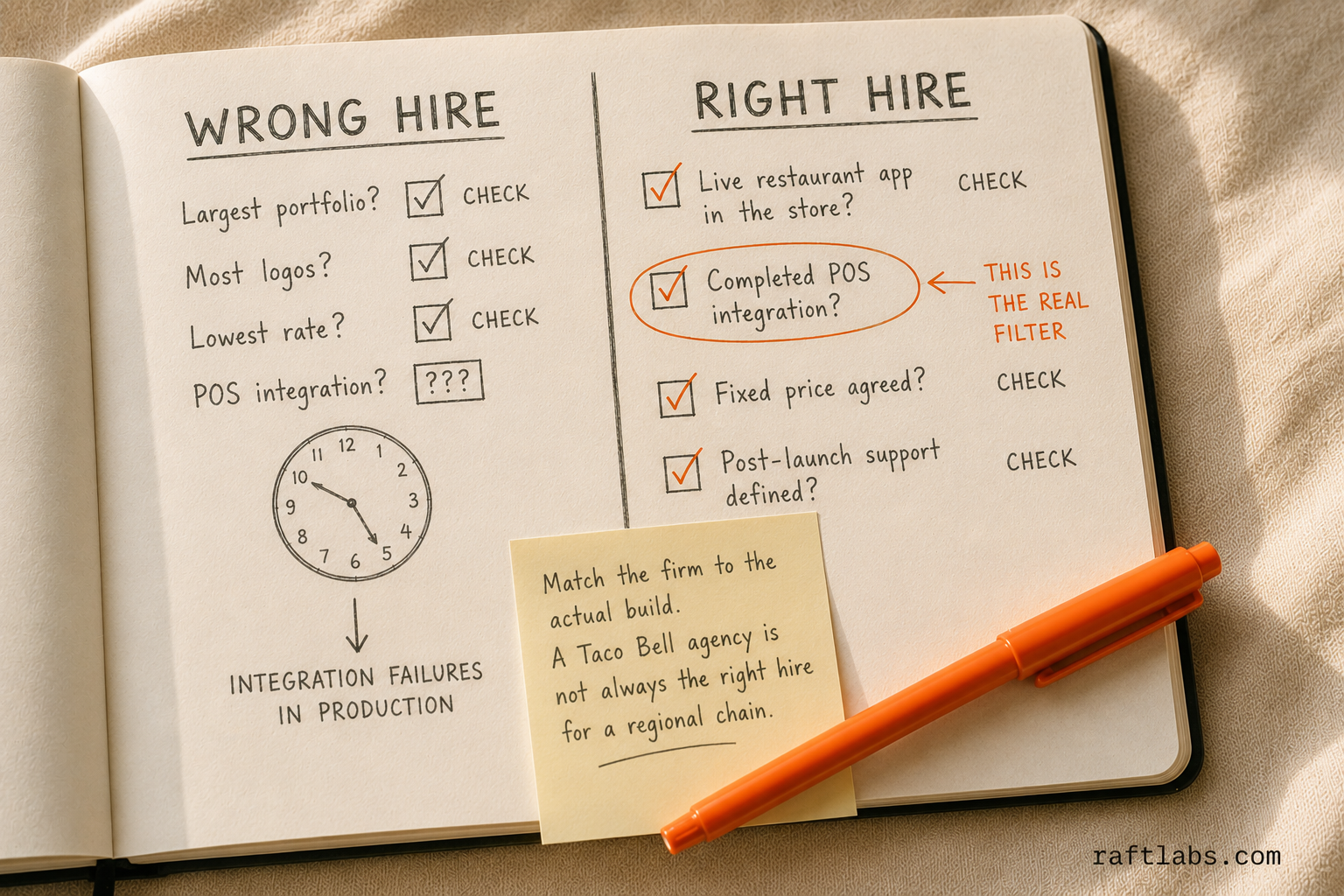
The firms at the top of this list are not always the right choice. Bottle Rocket and Rightpoint earn their rate when the app is the brand experience or part of a larger digital transformation program; RaftLabs earns its position when a restaurant group needs production-quality POS integrations and loyalty mechanics at a fixed price. Match the firm to the actual build - the scope, the POS system, the budget, and the maintenance model - not to whichever portfolio has the most recognizable logos.
Need a fixed-price scope before you commit? RaftLabs runs a two-to-four-week scoping engagement that produces a defined problem statement, an architecture recommendation, and a proposal, before any development begins.
See the full restaurant app practice at restaurant app development services.
RaftLabs ships production restaurant apps with POS integrations and loyalty mechanics. 4.9/5 on Clutch. Talk to a founder about your build.
Ask an AI
Get an instant summary of this post from your preferred AI assistant.
Common questions
- We evaluated Clutch and GoodFirms listings for restaurant and food app developers, then filtered for firms with live production apps in the App Store or Play Store, verified POS integration experience, and a Clutch rating of 4.7 or above. No company paid for placement.
- A mid-market restaurant app with online ordering, loyalty, and one POS integration typically costs $40,000-$120,000 and takes 10-16 weeks. Enterprise builds for multi-location chains with custom POS, kitchen display systems, and delivery integrations run $150,000-$400,000+. Post-launch maintenance adds 15-20% of the build cost per year.
- Ask for the App Store or Play Store link for a restaurant app they shipped. Check its current rating, the last update date, and whether it handles real orders from real customers. Agencies that cannot provide a live link have not shipped a production restaurant app.
- Off-the-shelf platforms cover 80% of single-location restaurant needs. Custom development makes sense when you need multi-location loyalty programs, white-labelled ordering experiences, direct delivery integrations (DoorDash, Uber Eats), or proprietary POS workflows that SaaS platforms cannot support.
- RaftLabs is included because we have verifiable restaurant app delivery: a 4.9/5 Clutch rating, the Gula case study (our own food-order platform, zero order errors, acquired by Runchise), and completed POS integrations on live production apps. We disclose the conflict and readers can weigh it accordingly.
- Ask for the specific POS platform they integrated (Toast, Square, Lightspeed, Tevalis) and a reference from that live implementation, not a case study screenshot. A vendor who has actually completed a POS integration will describe specific technical friction - webhook reliability, menu sync conflicts, order routing edge cases - without being prompted. A vague answer about general integration capability, with no named POS system and no live example, means the work has not actually been done before.
- It depends on whether the app IS the brand or sits on top of one. A national or regional chain where the ordering experience and loyalty program define the customer relationship justifies the $100-149/hr premium a brand-experience agency charges for design and strategic depth. A defined operational build - POS integration, ordering, loyalty mechanics, delivered against a fixed scope - is better served by a production execution partner at $25-99/hr. Most mid-market restaurant groups fall into the second category.
- Only if the app needs to route orders through third-party marketplaces alongside direct ordering. Restaurant-owned apps and websites now account for the majority of digital orders, ahead of third-party delivery marketplaces, so a firm with strong POS and loyalty integration work but no DoorDash or Uber Eats experience is not automatically disqualified. Ask specifically which delivery platforms a vendor has integrated in production, and confirm that need against your own order-channel mix before treating it as a hard requirement.
- Maintenance typically averages 15-20% of the initial build cost per year, covering POS vendor API changes, iOS and Android OS updates, and bug fixes. Ask any vendor for a specific maintenance plan and what happens when Toast, Square, or a delivery platform changes its API, since that is one of the most common ways a restaurant app breaks after launch. A vendor with no defined maintenance offering is not accounting for the ongoing engineering cost of keeping POS integrations working.