Best retail app development companies in 2026 (vetted shortlist)
A vetted shortlist of the best retail app development companies in 2026, evaluated on retail-specific case studies, POS and inventory integration depth, and measurable outcomes from live apps - not directory rankings.

In this article
Short answer
Evaluating retail app development companies comes down to integration depth: verified production connections to POS, ERP, inventory, and loyalty systems, not just a customer-facing storefront. RaftLabs meets this bar with custom retail platforms covering POS, inventory management, and omnichannel operations, delivered fixed-cost in 12-18 weeks at 4.9/5 on Clutch.
Key takeaways
- There is no universal best retail app development company. The right match depends on whether you need a customer-facing shopping app, a staff management tool, a POS system, or a full omnichannel platform - each requires different integration expertise.
- Integration depth is the highest-risk variable in any retail app build. Agencies that have connected to POS systems, ERP platforms, and inventory feeds in production are fundamentally different from those that have only built storefronts.
- Boutique agencies (Goji Labs, Camber) suit single-app builds with a well-defined scope. Full-stack development firms (RaftLabs, Vention) suit platforms that need backend integrations and post-launch scalability.
- Offline functionality is a non-negotiable for serious retail apps. An app that fails without a network connection is not production-ready for a store floor or warehouse environment.
- Ask for retention data, not just launch screenshots. An agency that has shipped retail apps people actually use will have store ratings, active user counts, or session data to share.
Retail apps fail in predictable ways. The app launches with strong download numbers. Week three brings good press. Week twelve, daily active users are in free fall and the engineering team is fixing sync issues between the app and the POS instead of shipping features.
The companies that ship retail apps that hold their user base share one trait: they build for the workflow, not the demo. That means an inventory count the associate can run between customer interactions, a loyalty balance that updates at checkout without a manual refresh, an order status that reflects the actual warehouse feed rather than a cached copy from last night's export.
This list covers seven companies with documented retail experience. We evaluated by reviewing Clutch profiles, GoodFirms listings, available case studies, and integration track records across POS, inventory, and loyalty systems.
The seven retail app development companies on this list are Goji Labs, RaftLabs, Droids On Roids, Vention, Futured, Camber, and Atmosphere Apps. RaftLabs is on this list. We wrote our own entry with the same directness we applied to everyone else.
At a glance
| Company | Best for | Budget range | Delivery model |
|---|---|---|---|
| Goji Labs | Bespoke customer-facing retail apps | $$ | Fixed-scope |
| RaftLabs | Custom retail platforms: POS, loyalty, omnichannel | $$$ | Fixed cost |
| Droids On Roids | Premium native mobile apps with retail case studies | $$ | Fixed or T&M |
| Vention | Enterprise retail software with staff augmentation | $$ | Staff aug + project |
| Futured | Mobile-first retail experiences | $$ | Fixed-scope |
| Camber | Polished native iOS/Android retail apps | $$$ | Fixed-scope |
| Atmosphere Apps | Reliable retail app delivery on committed timelines | $$ | Fixed or T&M |
Budget range: $ = under $25K, $$ = $25K-$100K, $$$ = $100K-$300K
How we evaluated this list
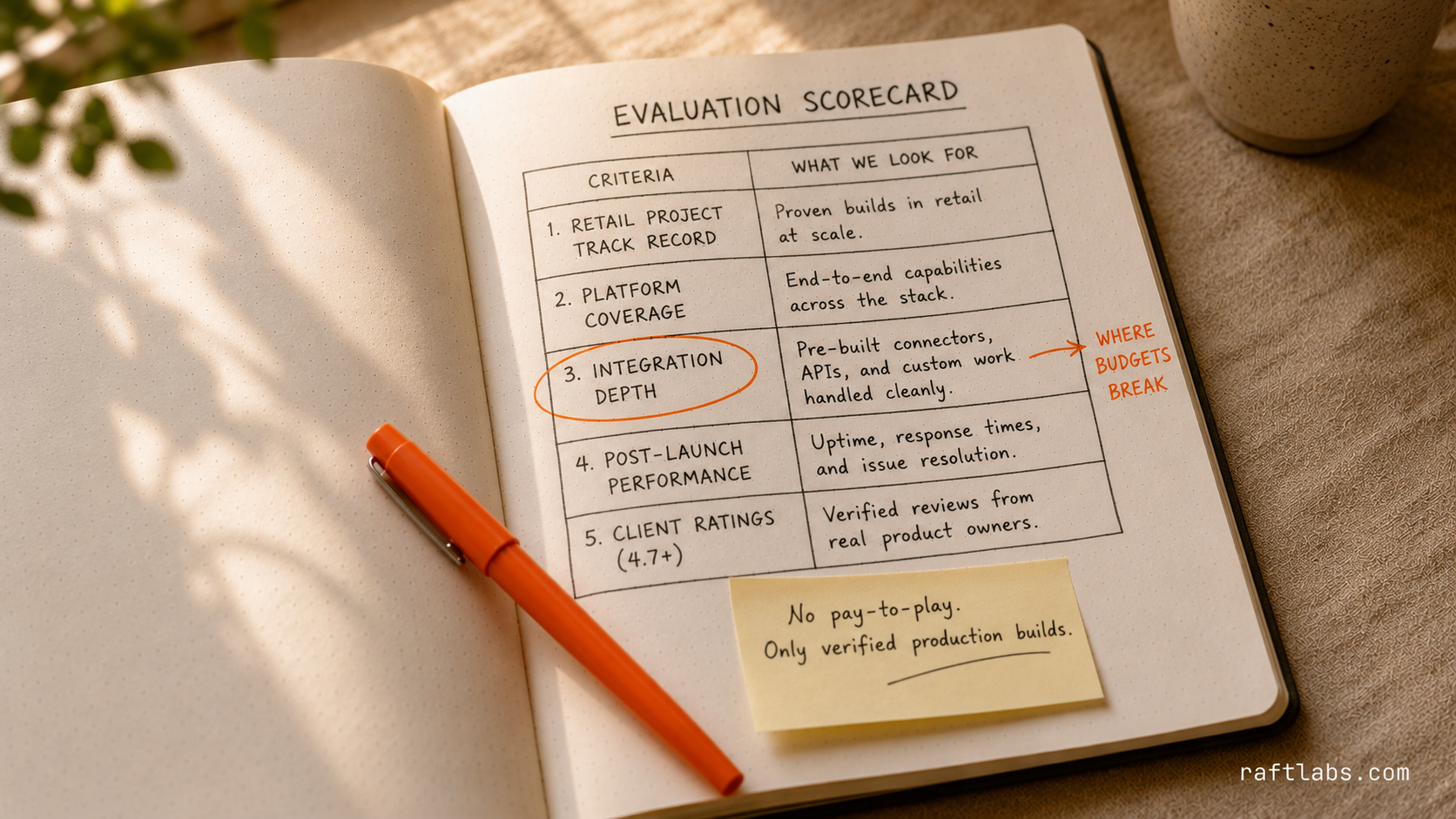
We evaluated companies by reviewing Clutch, GoodFirms, and direct agency profiles across five criteria:
| Criterion | What we looked for |
|---|---|
| Retail project track record | At least two live retail apps with verifiable users or transaction data |
| Platform coverage | iOS, Android, cross-platform, and web app delivery capability |
| Integration depth | Verified integrations with POS systems, ERP, inventory management, or loyalty platforms in production |
| Post-launch performance | Evidence of ongoing support, version updates, and scalable architecture after launch |
| Client ratings | 4.7 or above on Clutch with retail or commerce project references |
No company paid for placement.
1. Goji Labs
Goji Labs runs every project through a product discovery phase before writing code - a discipline that matters more in retail than most categories. A team that maps how shoppers move through discovery, wishlist, cart, and loyalty redemption before building the app is less likely to ship a UI that performs in demos and breaks at checkout. Their client base skews toward product-led companies and mid-market brands, based out of Los Angeles and serving US and international clients.
Notable work - Goji Labs' Clutch profile reflects a long track record of completed engagements with a perfect 5.0/5 rating across 85+ reviews. Reviews consistently cite project management quality and communication clarity - a trait that matters specifically on retail builds where the client-side team includes non-technical store operations staff.
Pricing signal - $100-$149/hr, with a minimum project size of $25,000 - a mid-tier agency rather than a budget or enterprise option.
What to watch - Goji Labs' strength is a well-researched, single customer-facing app, not backend platform work. A retailer that needs POS, ERP, or warehouse integration alongside the app should weigh that against agencies built specifically for platform-level builds.
Best for: Mid-market retail brands who need a custom customer-facing app built on a well-researched product foundation.
Specialization: Discovery-led mobile and web app development
Pricing: $100-$149/hr, $25,000 minimum project
Clutch: 5.0/5 (85+ reviews)
2. RaftLabs
RaftLabs builds the custom retail software that multi-location and growing retailers need when Shopify, Square, or Lightspeed can no longer bend to their workflows. Their retail portfolio spans POS software with custom payment flows and multi-store pricing rules, inventory management systems that sync across warehouse, shop floor, and online store in near real time, loyalty programme platforms with tier-based rewards and POS integration, and omnichannel order management for businesses where online, in-store, and wholesale run on the same inventory pool.
Where general app agencies stop at the storefront, RaftLabs goes into the back-office integrations: ERP sync, warehouse management feeds, loyalty point engines that run at checkout without adding latency, and staff apps that give floor associates real inventory data rather than last night's export.
Notable work - RaftLabs' retail platform builds are typically delivered in 12-18 weeks under a fixed-cost model, covering POS development, inventory management, loyalty platforms, and omnichannel retail apps with ERP, warehouse management, and payment gateway integration built in from the start - not scoped in as a change order after the storefront ships.
Pricing signal - Fixed-cost engagements, with the full integration scope - including backend systems - agreed before development starts.
What to watch - RaftLabs is built for retailers who need backend integration depth alongside the app: POS, inventory, ERP, or omnichannel. A business that only needs a single customer-facing app with no back-office integration may find a boutique app-only agency a lighter engagement.
Best for: Established retailers and multi-location brands that need a custom retail platform - POS, inventory, loyalty, or omnichannel - built end-to-end with backend integrations included.
Specialization: POS development, inventory management, loyalty platforms, omnichannel retail apps
Pricing: Fixed-cost, 12-18 week typical delivery
Clutch: 4.9/5 (50+ reviews)
3. Droids On Roids
Droids On Roids is a mobile-first agency based in Wrocław, Poland, with 100+ engineers and a portfolio that skews toward product-led companies in retail, fashion, and marketplace categories. They build native iOS and Android apps rather than defaulting to cross-platform frameworks when the product requires performance-sensitive interactions: product image rendering, in-app camera for virtual try-on, real-time inventory status.
Notable work - Droids On Roids' Clutch profile includes four completed retail projects, all five-star rated - one of the more verifiable retail track records among mid-sized app agencies, concentrated in fashion and lifestyle apps where the browsing experience is a primary differentiator.
Pricing signal - $50-$99/hr, with a minimum project size of $75,000, serving US and European markets from its Wrocław base.
What to watch - Droids On Roids' strength is native, performance-sensitive shopping apps rather than backend platform work. A retailer whose primary need is POS, ERP, or inventory integration rather than a customer-facing app should look further down this list.
Best for: Retailers who need a polished native iOS and Android shopping app with a performance-driven UX and verifiable retail case studies behind the agency.
Specialization: Native iOS and Android development, performance-sensitive retail UX
Pricing: $50-$99/hr, $75,000 minimum project
Clutch: 4.9/5 (77 reviews)
4. Vention
Vention is a full-service software engineering firm with 1,000+ engineers operating across industries, including retail and e-commerce. Their model combines project-based development with staff augmentation - giving retail businesses the option to start with a discovery and build team, then transition core engineering resources in-house once the platform is stable.
Notable work - Vention's scale means they can staff retail projects that need parallel workstreams - storefront app, inventory backend, admin dashboard, and third-party API integrations - running simultaneously without the capacity constraints of a boutique agency. Their 4.9/5 Clutch rating holds across 100+ reviews and across industries, suggesting delivery quality is consistent rather than anchored to a few exceptional projects.
Pricing signal - $50-$99/hr, minimum project size $50,000, delivered from US, Canada, and Eastern Europe teams.
What to watch - Vention's staff-augmentation model suits retailers planning to bring engineering in-house eventually. A business that wants a single accountable vendor for the full build and its ongoing operation, rather than a team it will absorb later, should weigh that transition plan against a fixed-scope agency.
Best for: Enterprise retailers or retail platform companies that need scale, can work in parallel workstreams, and may want to bring certain engineering functions in-house post-launch.
Specialization: Staff augmentation plus project delivery, parallel-workstream capacity
Pricing: $50-$99/hr, $50,000 minimum project
Clutch: 4.9/5 (100+ reviews)
5. Futured
Futured is a digital product agency with a mobile development focus, working with product companies and established businesses across retail, logistics, and consumer app categories. Their client base includes businesses where the mobile app is the primary customer touchpoint - not a feature bolted onto a web product.
Notable work - Futured's project delivery reviews consistently highlight on-budget delivery and UX discipline, reflected in a 4.9/5 Clutch rating across 43 reviews at mid-market rates. Both traits matter in retail specifically: budgets tend to be fixed, and UX quality drives the retention metrics that determine whether a loyalty or shopping app holds its user base past month three.
Pricing signal - $50-$99/hr, minimum project size $50,000, delivered from a European base with US client capability.
What to watch - Futured's focus is mobile product delivery rather than backend retail systems. A retailer whose primary need is POS or inventory platform work rather than a customer-facing mobile app is better served by a firm built for platform-level integration.
Best for: Retailers who want a mobile app built with strong UX discipline and a track record of delivering on scope and budget.
Specialization: Mobile-first product development, retail and consumer apps
Pricing: $50-$99/hr, $50,000 minimum project
Clutch: 4.9/5 (43 reviews)
6. Camber - The App Agency
Camber runs a smaller client roster at a higher engagement depth, taking on a limited number of iOS and Android builds per year rather than scaling headcount. Their rate is at the higher end for an independent app agency, reflecting a deliberate choice to serve fewer clients on deeper engagements.
Notable work - 100% of Camber's Clutch reviews cite project management quality, across 21 reviews at a 4.9/5 rating - a team that manages client expectations as carefully as it manages code, which matters for retail brands where the app represents a significant customer experience investment.
Pricing signal - $150-$199/hr, minimum project size $50,000 - the highest rate band among the agencies on this list, priced for depth over volume.
What to watch - Camber's model fits one high-stakes retail app built correctly: a flagship shopping app, VIP loyalty experience, or associate clienteling tool. If you need volume throughput across multiple apps or a fast, lower-cost build, look elsewhere on this list.
Best for: Premium retail brands who need a flagship app built to a high standard with white-glove project management and a selective agency that prioritises depth over volume.
Specialization: iOS and Android app development, high-touch project management
Pricing: $150-$199/hr, $50,000 minimum project
Clutch: 4.9/5 (21 reviews)
7. Atmosphere Apps
Atmosphere Apps is a mid-sized app development firm with a track record of on-time delivery across retail, services, and marketplace categories. Their rate positions them above commodity app shops but below the premium agency tier - a mid-range price point for a reliable, communicative partner.
Notable work - Atmosphere Apps' 4.9/5 Clutch rating across 18 reviews is built specifically on professionalism and responsiveness. The pattern of missed deadlines and scope surprises that appears in negative app agency reviews is absent from their profile - notable for retail clients who have been burned before by agencies that over-promise delivery dates and under-deliver on integration testing.
Pricing signal - $100-$149/hr, minimum project size $25,000.
What to watch - Atmosphere Apps' differentiator is delivery reliability, not a specialized retail integration or design capability. A retailer with complex backend integration needs or a premium brand positioning should weigh that against agencies built specifically for those requirements.
Best for: Retail businesses who need a dependable development partner with verified delivery credentials and no history of deadline slippage.
Specialization: On-time delivery, retail and marketplace app development
Pricing: $100-$149/hr, $25,000 minimum project
Clutch: 4.9/5 (18 reviews)
The question that separates a shopping app from a retail platform
Most buyers evaluate retail app agencies as if "retail app development" were one category, and get the model wrong before they get the vendor wrong. The real fork in this list is whether the app is the whole deliverable or one piece of a larger backend.
App specialists - Goji Labs, Droids On Roids, Futured, Camber, and Atmosphere Apps - build a single, well-scoped customer-facing or flagship app: discovery-led product design, native iOS/Android performance, mobile-first UX discipline, or dependable delivery. That model fits a retailer who needs one app built well, with a fixed and limited set of integrations, usually a payment gateway and a basic POS sync.
Platform partners - RaftLabs and Vention - build for retailers who need the app to be one piece of a larger system: POS software, inventory synced across warehouse and shop floor, ERP integration, and enough engineering capacity to support parallel workstreams and post-launch scale. That model fits a retailer whose backend, not just the storefront, is part of the scope.
Getting the model wrong is more expensive than getting the vendor wrong.
"The accurate inventory levels we get with Scandit Smart Data Capture have ultimately boosted our omnichannel revenue." - Andrea Comi, Global Director, Digital and Technology DTC, VF Corporation
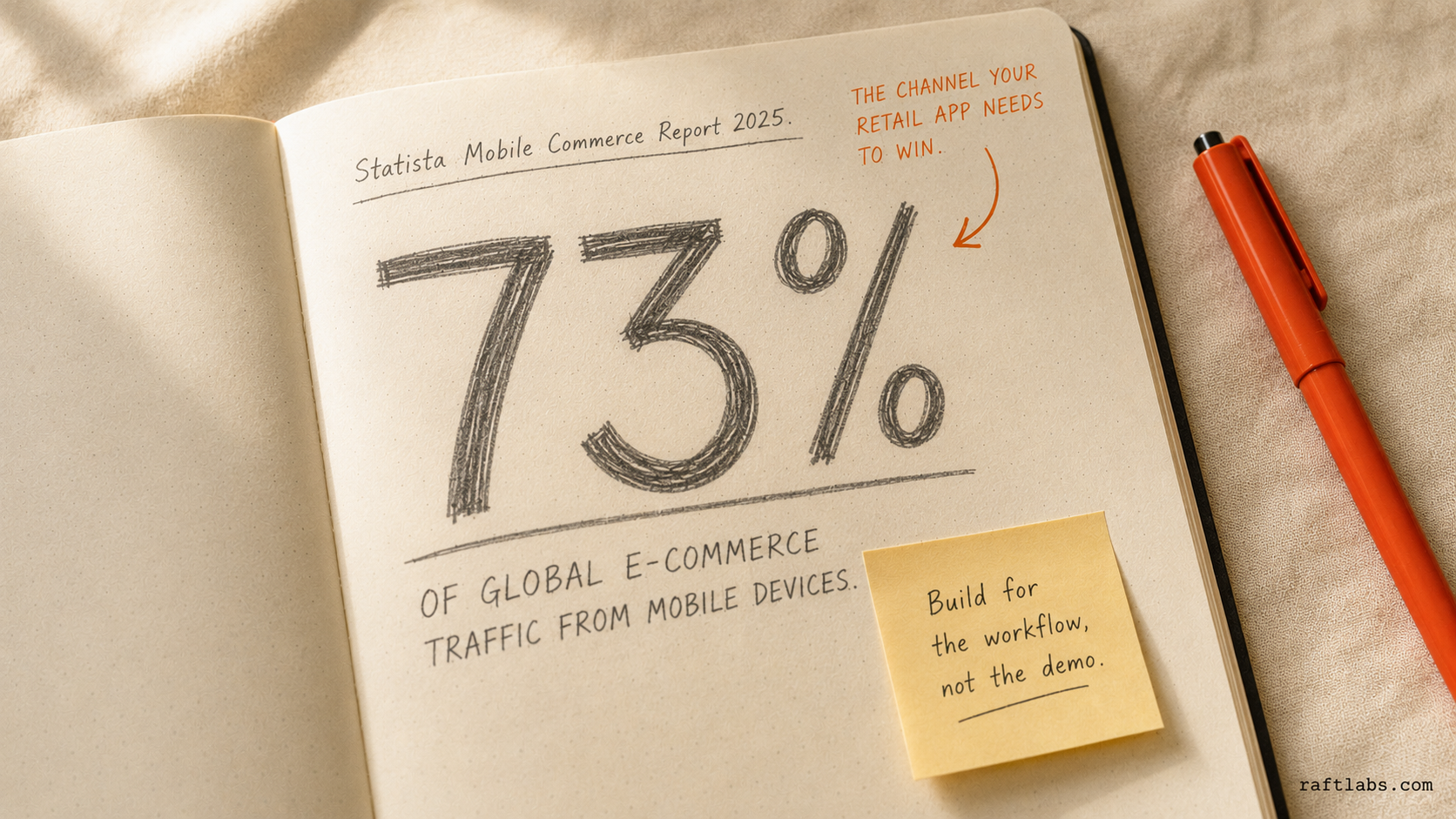
According to Statista, mobile commerce accounts for more than 70 percent of global e-commerce traffic. Comi's result is what unlocks that channel: an app selling from stock that isn't actually there breaks trust the moment a promised item doesn't ship, and integration depth - not interface polish - is what keeps the inventory number honest.
The verdict
Goji Labs for a mid-market retail brand building a custom customer-facing app on a well-researched product foundation. RaftLabs for an established or multi-location retailer that needs a full platform - POS, inventory, loyalty, or omnichannel - built with backend integrations included. Droids On Roids for a polished native iOS and Android shopping app backed by verifiable retail case studies. Vention for an enterprise retailer that needs scale, parallel workstreams, and the option to bring engineering in-house after launch. Futured for a mobile app built with UX discipline and a record of shipping on scope and budget. Camber for a premium flagship app built with white-glove project management. Atmosphere Apps for a dependable delivery partner with no history of deadline slippage.
The first filter is whether you're buying an app or a platform. The second filter is the specific track record - integration depth, retail case studies, or delivery reliability - that matches your risk. Match those two questions to the right firm on this list.
RaftLabs builds custom retail software for established retailers and multi-location brands. 4.9/5 on Clutch. Talk to a founder about your retail platform.
Ask an AI
Get an instant summary of this post from your preferred AI assistant.
Common questions
- A customer-facing shopping app with product catalogue, cart, loyalty integration, and basic POS sync costs $40,000 to $100,000 depending on platform (iOS, Android, or cross-platform) and integration complexity. A staff management or inventory app costs $25,000 to $75,000. A full omnichannel retail platform - POS system, inventory management, loyalty programme, and customer app - built custom costs $100,000 to $300,000 or more. The biggest cost driver is backend integration: connecting to ERP systems, existing POS software, and warehouse management feeds adds significant scope. Define your integration requirements before requesting any quote.
- A focused customer-facing shopping app takes 10 to 16 weeks. A staff management or associate tool takes 8 to 12 weeks. A retail platform that includes POS functionality, inventory sync, and a loyalty programme typically takes 16 to 24 weeks - the longer end reflects integration testing with existing retail systems. The variable that most extends timelines is POS and ERP integration: legacy systems rarely have clean APIs, and data mapping between the app and the back-office takes longer than most agencies estimate upfront.
- Cross-platform frameworks (React Native, Flutter) work well for standard shopping apps, product catalogues, and loyalty apps where the core interactions are browsing, tapping, and scanning. Native development becomes worthwhile for performance-sensitive interactions: real-time inventory status with live updates, in-app camera for virtual try-on, heavy product image rendering, or complex animations in the shopping flow. The tradeoff is cost: native builds take longer and cost more, but deliver better performance at the edges of what cross-platform can do. Choose based on your specific interaction requirements, not convention.
- At minimum, a production-ready retail app should integrate with your POS system (Lightspeed, Square, Shopify POS, or custom), your inventory management system for real-time stock status, a payment gateway (Stripe, Braintree, or your existing processor), and your customer database for loyalty and order history. Optional but high-value: push notification infrastructure for promotional and transactional messages, analytics for in-app funnel tracking, and a CMS for managing product content without a developer deploy. Any agency that does not ask about your existing POS and inventory setup before quoting has not planned for the integration layer.
- Ask for the current App Store or Google Play listing for a retail app they have shipped, then check the rating and read recent reviews - not just from launch month. Ask what the retention curve looks like at day 30 and day 90, or for store ratings and active user counts if retention data isn't shareable. Agencies who have shipped retail apps people actually use will have this data ready. The red flag is a portfolio of screenshots, mockups, and launch announcements with no retention or engagement numbers attached - it proves the app shipped, not that it survived contact with real shoppers, and usually means the agency either doesn't track the result or doesn't want to share it.
- Ask specifically which POS systems, ERP platforms, and inventory systems they have integrated with in a live production environment - not a proof-of-concept - and how they handle offline scenarios: what happens to a cart or an inventory scan when the network drops on a store floor or in a warehouse aisle. Production integrations have to handle partial stock sync, failed payment rollbacks, and inventory reservation race conditions that a demo never surfaces. The red flag is an agency that quoted your project before asking which POS system you run or how inventory is managed - they've scoped the storefront layer only, and integration is where retail timelines and budgets actually break.
- Ask whether their post-launch engagement is a retainer, a support contract, or a one-time handover, and how they've handled a major OS version update or payment API change for a live client in the past year. Retail apps get updated constantly - new POS firmware, payment gateway changes, operating system updates that break push notification registration, seasonal feature additions - so the agency's answer should be specific, not hypothetical. The red flag is a delivery-only engagement with no plan for app store compliance or ongoing maintenance: Apple and Google update platform guidelines quarterly, and an agency with no answer for what happens after launch is creating a liability you'll own.
- A good agency asks about your specific interaction requirements - real-time inventory status, in-app camera for virtual try-on, heavy product image rendering - before recommending a framework. The red flag is an agency that defaults to cross-platform for every retail build regardless of what the app needs to do. Cross-platform frameworks handle standard shopping apps, catalogues, and loyalty scanners well, but agencies that reach for the fastest-to-build option by default haven't actually scoped your requirements.