Updated February 2026
Top SaaS development companies in 2026 (vetted shortlist)
A vetted shortlist of the best SaaS development companies in 2026, evaluated on Clutch ratings, live multi-tenant SaaS products shipped, and what each firm does best.

In this article
Short answer
Evaluating SaaS development companies comes down to a live multi-tenant product they can demo, billing infrastructure planned from sprint one, and full codebase ownership from day one. RaftLabs meets this bar with Draftly, its own AI-assisted SaaS product built on Claude via AWS Bedrock that reached 500+ active users in 60 days, a 4.9/5 Clutch rating, and multi-tenant architecture delivered in 10-16 weeks.
Key takeaways
- Most SaaS architecture failures happen before the second customer arrives. Multi-tenancy, billing, and data isolation belong in sprint one, not the last two weeks.
- A company that has shipped custom software has not necessarily shipped a SaaS product. Multi-tenancy is an architectural decision, not a feature you add later. Ask to see a live product.
- Billing infrastructure affects database schema, API design, and frontend state management from day one. Schedule it in the first sprint or pay to redo it after launch.
- The most expensive SaaS rewrite is the one triggered because nobody designed for tenant isolation at the start. That rewrite typically costs 3 to 5 times the original build.
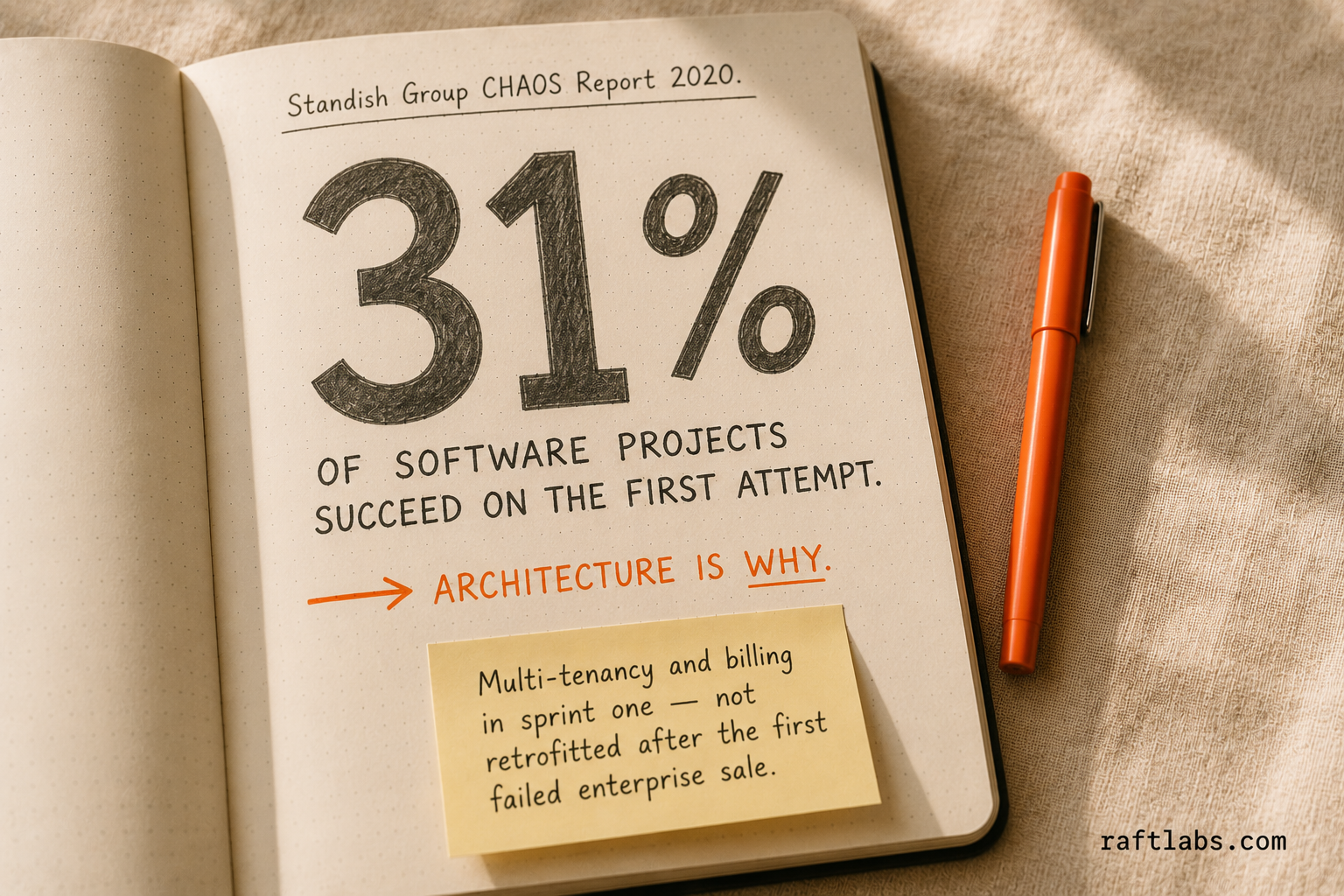
According to the Standish Group's 2020 CHAOS Report, only 31% of software projects succeed on the first attempt. For SaaS products, the failure mode is almost always architectural: you get a working app, users can log in, but then you try to onboard a second company and discover nobody designed multi-tenancy. Or you close an enterprise deal and find your compliance posture is a checkbox document nobody has tested against actual requirements. The companies on this list have shipped SaaS products with multi-tenant architecture, subscription billing, and data isolation built in from the first sprint, not retrofitted after the first failed enterprise sale.
The eleven SaaS development companies on this list are iRonin.IT, RaftLabs, Railsware, Upsilon, Orium, eSparkBiz, Cardinal Peak, Groovy Web, Caylent, Brocoders, and ClickIT. RaftLabs is on this list. We wrote our own entry with the same directness we applied to everyone else.
At a glance
A quick read of the full ranking below. Every company on this list was evaluated against the criteria in the next section.
| # | Company | Best for | Pricing signal |
|---|---|---|---|
| 1 | iRonin.IT | Companies that need custom web and mobile products built end-to-end, with fintech, healthtech, or | Not publicly disclosed; project-based |
| 2 | RaftLabs | Established businesses that need a SaaS product built end-to-end without hiring an internal engineering | Fixed-price, milestone-based; 10-16 week delivery |
| 3 | Railsware | Founders who have validated the market and want to pay for engineering quality rather than delivery | $100-149/hr |
| 4 | Upsilon | Startups and scaling SaaS companies building products that need rapid MVP development. | $25-49/hr |
| 5 | Orium | Enterprise teams building composable commerce and digital-experience platforms, including agentic-AI | Not publicly listed; request a quote |
| 6 | eSparkBiz | Businesses needing SaaS products built around complex workflows, with AI, cloud, and modern engineering. | Under $25/hr |
| 7 | Cardinal Peak | SaaS products that span hardware and software - audio, video, IoT, or connected medical devices. | Not publicly disclosed; request a quote |
| 8 | Groovy Web | Startups and growing SaaS companies seeking production-ready software and AI features without hiring a | Under $25/hr |
| 9 | Caylent | SaaS platforms that need AWS-native cloud architecture, data engineering, and DevOps depth. | Not publicly disclosed; project or retainer-based |
| 10 | Brocoders | SaaS startups that need AI features in the product before the second customer demo, not after. | $50-99/hr |
| 11 | ClickIT | Companies that want nearshore custom development with strong DevOps, AWS cloud, and AI/ML engineering. | Not publicly disclosed; quote-based |
How we evaluated this list
We evaluated companies on five criteria:
| Criterion | What we looked for |
|---|---|
| Shipped multi-tenant SaaS | At least one live, multi-tenant SaaS product with a URL they can share |
| Clutch rating | 4.7 or above, with 10+ verified reviews |
| Architecture discipline | Multi-tenancy and billing infrastructure scoped in the discovery phase, not bolted on later |
| Delivery speed | MVP to production in under 14 weeks |
| Post-launch continuity | Evidence of ongoing product evolution, not just handoffs |
**No company paid for placement on this list.
How this list was built. We started from the vendor pools on Clutch, GoodFirms, Sortlist, and other reputable directories, then applied the criteria above to shortlist firms with verifiable SaaS product engineering work. We review and refresh this list regularly: companies that stop publishing checkable evidence rotate out, and new directory-sourced names rotate in. **
1. iRonin.IT
iRonin.IT is a software development company based in Warsaw, Poland that builds custom web and mobile applications end-to-end, with experience across fintech, healthtech, martech, and other sectors.
Notable work - No specific SaaS engagements are verified here. Ask to see a live multi-tenant product and reference clients in your vertical before signing.
Pricing signal - Pricing is not publicly disclosed; engagements are project-based, so request a quote.
What to watch - iRonin.IT positions as a full-cycle custom development partner rather than a dedicated SaaS-platform specialist, so confirm it has shipped multi-tenant SaaS with billing and data isolation, not just custom applications, before you commit.
Best for: Companies that need custom web and mobile products built end-to-end, with fintech, healthtech, or martech experience.
Specialization: Custom web and mobile development, fintech, healthtech, martech
Pricing: Not publicly disclosed; project-based
Rating: Profile listed; confirm before engaging
2. RaftLabs
RaftLabs is an AI-first tech studio whose SaaS work includes Draftly, its own AI-assisted writing platform built on Claude via AWS Bedrock that reached 500+ active users in 60 days. Its SaaS development engagements start with a scoped discovery sprint that defines the multi-tenancy model, billing infrastructure, and compliance posture before a line of product code gets written.
Multi-tenant architecture (row-level, schema-per-tenant, or database-per-tenant), Stripe billing, usage metering, and feature flags are built in from sprint one, not retrofitted after the first enterprise customer asks about data isolation. Delivery ranges from a lean MVP to a multi-tenant enterprise platform in 10-16 weeks.
Notable work - A food delivery SaaS delivered in 14 weeks was acquired by Runchise post-launch. A referral marketing platform (GrowViral) went from kickoff to production in 14 weeks and generated a 250% sales lift. A voice collaboration SaaS launched with 300+ concurrent users and real-time multi-tenant data isolation.
Pricing signal - Fixed-price engagements with milestone payments, scoped after the discovery sprint that defines the multi-tenancy and billing model. No published hourly band on this shortlist - confirm current rates directly.
What to watch - RaftLabs owns the full delivery stack - discovery, architecture, engineering, and delivery - which fits businesses that want one team accountable end to end. A business that only needs to augment an existing internal engineering team with a single specialist is better served by a narrower staffing engagement instead.
Best for: Established businesses that need a SaaS product built end-to-end without hiring an internal engineering team.
Specialization: Multi-tenant architecture, Stripe billing and usage metering, discovery-led SaaS delivery
Pricing: Fixed-price, milestone-based; 10-16 week delivery
Clutch: 4.9/5
3. Railsware
Railsware is a distributed SaaS consultancy that works exclusively on B2B products. They price at the senior end of the market ($100-149/hr) and make deliberate architecture decisions early: clean codebases, well-documented APIs, and test coverage that a product team can genuinely own after launch.
Notable work - Railsware works exclusively on SaaS - no project-based custom software engagements - and has built a track record of 18 verified Clutch reviews at 4.9/5 on Ruby on Rails backends with React frontends, with clean codebases and documented APIs a product team can own after handoff.
Pricing signal - $100-149/hr, priced at the senior end of the market - the rate reflects engineering discipline, not delivery speed.
What to watch - Railsware's SaaS-only focus and premium rate suit founders who have already validated the market and are optimizing for engineering quality. An early-stage team still validating product-market fit may find the rate card ahead of where the project actually is.
Best for: Founders who have validated the market and want to pay for engineering quality rather than delivery speed.
Specialization: Ruby on Rails + React SaaS architecture, exclusively B2B
Pricing: $100-149/hr
Clutch: 4.9/5 (18+ reviews)
4. Upsilon
Upsilon specializes in SaaS product development and rapid MVP delivery for startups and scaling businesses. With 10+ years of experience and more than 25 successful launches, the team builds secure, cloud-based, full-featured SaaS MVPs in as little as three months. With a strong focus on speed, reliability, and transparency, Upsilon helps businesses bring scalable SaaS products to market faster and grow them with confidence.
Notable work - Upsilon has delivered 25+ SaaS launches over 10+ years, with secure, cloud-based, full-featured MVPs shipped in as little as three months - the fastest stated MVP timeline on this list.
Pricing signal - $25-49/hr, delivered from teams across the USA, Poland, and Estonia - among the most accessible rate bands on this list.
What to watch - Upsilon's positioning is speed to MVP for startups and scaling businesses. A buyer needing deep compliance architecture or enterprise-scale integration work from day one should confirm that depth exists beyond the MVP-speed focus.
Best for: Startups and scaling SaaS companies building products that need rapid MVP development.
Specialization: Rapid MVP delivery, cloud-based SaaS products
Pricing: $25-49/hr
Clutch: Not on Clutch - 5.0/5 on GoodFirms (verify current rating via direct reference)
5. Orium
Orium is a systems architecture and engineering firm based in Toronto, Canada (formerly Myplanet) that builds composable commerce, digital-experience, and agentic-AI enterprise solutions.
Notable work - Orium's own site cites work for New Balance, Indigo, Steelcase, TELUS Health, and Sun Life. Treat these as company-reported and confirm relevant SaaS references directly.
Pricing signal - Pricing is not publicly listed; request a quote.
What to watch - Orium's focus is composable commerce and enterprise digital experience rather than general multi-tenant SaaS, so it fits best when your product is commerce- or experience-led. Confirm it has shipped the specific SaaS architecture you need.
Best for: Enterprise teams building composable commerce and digital-experience platforms, including agentic-AI solutions.
Specialization: Composable commerce, digital experience, enterprise systems architecture, agentic AI
Pricing: Not publicly listed; request a quote
Rating: Profile listed; confirm before engaging
6. eSparkBiz
eSparkBiz delivers SaaS product engineering for enterprise-level companies and established businesses, covering custom software, AI, and web application development. With 15+ years of experience and multiple SaaS projects delivered for clients in 20+ countries, the company combines SaaS development with modern engineering, cloud infrastructure, and AI integration.
Notable work - eSparkBiz has delivered 1,000+ projects for clients, with SaaS product engineering listed within their service experience, making it a fit for businesses that need more than basic SaaS application development.
Pricing signal - Under $25/hr, with a $10,000+ minimum project size listed on Clutch, placing eSparkBiz at the lower end of the market. The rate signals cost accessibility without limiting the scope of SaaS engineering support.
What to watch - eSparkBiz positions itself as a broader engineering partner rather than an MVP-only SaaS provider. Buyers seeking a partner specifically for rapid SaaS MVP launches should confirm the proposed team, product scope, delivery milestones, and SaaS architecture approach before engagement.
Best for: Businesses needing SaaS products built around complex workflows, with AI, cloud, and modern engineering.
Specialization: SaaS product engineering, AI integration, custom software, and cloud application development
Pricing: Under $25/hr
Clutch: 4.9/5 (70 reviews)
7. Cardinal Peak
Cardinal Peak is a product-development and engineering-services firm based in Lafayette, Colorado that works across audio, video, IoT, and healthcare and medical-device markets.
Notable work - No specific SaaS engagements are verified here. Ask for reference clients and a live product relevant to your build before signing.
Pricing signal - Pricing is not publicly disclosed; request a quote.
What to watch - Cardinal Peak's strength is product engineering that spans hardware and software, so it fits connected-device and media products more than a pure web SaaS. Confirm multi-tenant SaaS depth if that is your core need.
Best for: SaaS products that span hardware and software - audio, video, IoT, or connected medical devices.
Specialization: Product engineering, audio and video, IoT, medical-device software
Pricing: Not publicly disclosed; request a quote
Rating: Profile listed; confirm before engaging
8. Groovy Web
Groovy Web is an AI-first software development company that builds production-ready AI agent systems, SaaS products, and custom platforms. Founded in 2015, the company reports 247+ projects delivered for 200+ clients.
Notable work - Groovy Web's portfolio includes ZenoCall, an AI-powered voice automation platform, and HIPPASHIELD, a HIPAA-compliant clinical trials platform. These are company-reported; confirm current project scope and compliance posture directly before treating them as proof for your specific build.
Pricing signal - Pricing depends on project scope, technical complexity, and engagement model. At under $25/hr, the company positions itself as a lower-cost alternative to expanding an in-house engineering team.
What to watch - Businesses looking to hire AI engineers get an AI-powered workflow and a stated track record across 200+ clients, but founders should align on project scope, delivery milestones, and ongoing support before engagement - the same discovery discipline this list applies to every other firm.
Best for: Startups and growing SaaS companies seeking production-ready software and AI features without hiring a large in-house team.
Specialization: AI agent systems, SaaS development, and custom software platforms.
Pricing: Under $25/hr
Clutch: 4.9/5 (company-reported; confirm current rating directly)
9. Caylent
Caylent is an AWS-native cloud consulting and engineering firm based in Irvine, California that covers migration and modernization, cloud data engineering, DevOps, and cloud-native application development.
Notable work - Caylent is an AWS Premier Tier Partner and has acquired Trek10 (2025) and Pronetx (2026). Confirm SaaS-specific references relevant to your build directly.
Pricing signal - Pricing is not publicly disclosed; engagements are project or retainer-based, so confirm directly.
What to watch - Caylent's specialization is AWS cloud engineering and DevOps rather than full end-to-end product design, so it fits teams that need cloud-native architecture and data engineering. Confirm coverage for frontend and product design if you need a full build.
Best for: SaaS platforms that need AWS-native cloud architecture, data engineering, and DevOps depth.
Specialization: AWS cloud engineering, migration and modernization, data engineering, DevOps
Pricing: Not publicly disclosed; project or retainer-based
Rating: Profile listed; confirm before engaging
10. Brocoders
Brocoders is a Tallinn-based SaaS studio with a 5.0/5 rating across 38 Clutch reviews. Their positioning is AI-driven MVP delivery: SaaS products where AI is part of the core value proposition from the start, not a feature requested after the first paying customer arrives. They typically take a product from validated concept to shipped MVP.
Notable work - Brocoders carries the highest Clutch rating on this list - 5.0/5 across 38 reviews - built on AI-driven MVP delivery: SaaS products where AI is part of the core value proposition from the start, taken from validated concept to shipped MVP.
Pricing signal - $50-99/hr, delivered from Tallinn, Estonia.
What to watch - Brocoders is built for AI-native MVP speed. A SaaS product where AI is a secondary feature rather than the core value proposition may not need this specific specialization, and a heavily regulated or high-load enterprise platform should weigh the other firms on this list instead.
Best for: SaaS startups that need AI features in the product before the second customer demo, not after.
Specialization: AI-driven MVP delivery, agile SaaS builds with AI integrations from sprint one
Pricing: $50-99/hr
Clutch: 5.0/5 (38+ reviews)
11. ClickIT
ClickIT (ClickIT Smart Technologies) is a nearshore software development firm based in Los Angeles, USA with delivery in Saltillo, Mexico. It builds custom software and web apps with a strong focus on DevOps, AWS cloud, and AI/ML engineering using LATAM engineers.
Notable work - ClickIT describes a dual US and Mexico nearshore delivery model on its own site. Confirm SaaS-specific references relevant to your build directly.
Pricing signal - Pricing is not publicly disclosed; engagements are quote-based, so request a quote.
What to watch - ClickIT's strength is nearshore DevOps and cloud engineering, so confirm it has shipped multi-tenant SaaS with billing and tenant isolation if that is your core requirement. Nearshore Mexico delivery gives strong US-timezone overlap.
Best for: Companies that want nearshore custom development with strong DevOps, AWS cloud, and AI/ML engineering.
Specialization: Nearshore development, DevOps, AWS cloud, AI/ML engineering
Pricing: Not publicly disclosed; quote-based
Rating: Profile listed; confirm before engaging
The question that separates fast MVP shops from enterprise-architecture firms
Most buyers compare SaaS vendors on Clutch rating or hourly rate and get the model wrong before they get the vendor wrong. The real fork on this list is whether you need a product shipped fast to validate an idea, or a platform engineered to survive its second enterprise customer.
Upsilon and Brocoders are built for speed: design-led or AI-driven MVPs that get a real product in front of users or investors in as little as three months. That model works well when the goal is validating a concept, raising a round, or proving demand before committing to deeper architecture investment.
RaftLabs, Railsware, iRonin.IT, Orium, eSparkBiz, Cardinal Peak, Groovy Web, Caylent, and ClickIT are built for the platform that has to survive contact with a real enterprise buyer: multi-tenancy, cloud and DevOps architecture, composable commerce, compliance, or integration depth designed in from the start. That model suits businesses that already know the second customer is coming, or that are selling into a market where compliance and scale are non-negotiable from day one.
Getting the model wrong is more expensive than getting the vendor wrong.
"You build it, you run it." - Werner Vogels, CTO of Amazon
Gartner projects that architectural technical debt will grow to 80% of all technical debt by 2027, up from 30% in 2024 - and multi-tenancy, billing infrastructure, and compliance design are exactly the kind of decisions that create it when they're deferred instead of planned. Architectural debt isn't fixed with a sprint of refactoring; the system gets rebuilt. The firms on this list that put those decisions in the discovery phase, not the roadmap for later, are the ones that keep a SaaS product from becoming that rebuild.
Expert perspective
"Our application utility model, which we promote as 'The End of Software,' focuses on eliminating conventional software in favor of a software-as-service model."
Marc Benioff, in an interview with Sonshi.com.
Benioff's model won because it removed the buyer's friction: no installs, no servers, no upgrade weekends. But for a company commissioning a SaaS product, the friction just moves. Multi-tenancy, subscription billing, onboarding flows, usage metering, and the admin surface nobody demos but everybody lives in - that is the unglamorous plumbing that decides whether a SaaS business works. The firms on this list differ less in whether they can code a feature than in whether they have shipped that plumbing before. Ask any shortlisted vendor to walk you through the billing and tenant-isolation architecture of a SaaS product they built, not the landing page. The answer tells you which side of Benioff's divide they build on.
The verdict
iRonin.IT for companies that need custom web and mobile SaaS built end-to-end, with fintech, healthtech, or martech experience. RaftLabs for established businesses that need a SaaS product built end-to-end without hiring an internal engineering team. Railsware for founders who have validated the market and want to pay for engineering quality rather than delivery speed. Upsilon for startups and scaling SaaS companies building products that need rapid MVP development. Orium for enterprise teams building composable commerce and digital-experience platforms, including agentic-AI solutions. eSparkBiz for businesses needing SaaS products built around complex workflows, with AI, cloud, and modern engineering. Cardinal Peak for SaaS products that span hardware and software - audio, video, IoT, or connected medical devices. Groovy Web for startups and growing SaaS companies seeking production-ready software and AI features without hiring a large in-house team. Caylent for SaaS platforms that need AWS-native cloud architecture, data engineering, and DevOps depth. Brocoders for SaaS startups that need AI features in the product before the second customer demo, not after. ClickIT for companies that want nearshore custom development with strong DevOps, AWS cloud, and AI/ML engineering.
The first filter is the model: are you validating an idea fast, or engineering a platform built to survive its second enterprise customer. The second filter is the specific depth your product needs - compliance, high-load architecture, analytics, or legacy integration. Match those two questions to the right firm on this list.
RaftLabs is an AI-first tech studio that builds SaaS products for established businesses. 30+ SaaS products shipped, 4.9/5 on Clutch. Talk to a founder about your SaaS project.
Ask an AI
Get an instant summary of this post from your preferred AI assistant.
Common questions
- Ask to see a live product, not a case study - log in as one tenant, create a second account in a different tenant, and check what happens to the data. A company that has only shipped custom software often retrofits multi-tenancy instead of designing for it, which leads to expensive rewrites when the second enterprise client asks about data isolation. The red flag is a portfolio with no live URL, or a company whose SaaS experience is outside your vertical - healthcare SaaS has HIPAA requirements, fintech SaaS has SOC 2 requirements, and a team that hasn't shipped in your space will learn those patterns on your budget.
- A SaaS MVP costs $15,000-$50,000 depending on the multi-tenancy model and integration requirements. A full-featured SaaS platform with subscription billing, usage metering, and role-based access costs $50,000-$150,000. The biggest cost driver is integration complexity. Connecting to a legacy ERP or building a custom billing model adds 30-50% to the base estimate.
- A production-ready SaaS MVP takes 10-14 weeks from kickoff. A full platform with enterprise features takes 16-24 weeks. Teams that run a proper discovery phase and define the multi-tenancy model before writing product code are consistently faster than those that scope on the fly.
- Location is the wrong filter. The right question is whether they have shipped a SaaS product in your vertical. Companies outside the premium US and UK tier - iRonin.IT in Poland, or ClickIT with nearshore Mexico delivery - routinely deliver the same architecture quality at a lower hourly rate. What matters: their Clutch reviews, a live multi-tenant product in their portfolio, and a documented process for handling scope changes.
- For most B2B SaaS products, React or Next.js on the frontend, Node.js or Python on the backend, PostgreSQL for data, and AWS or Azure for infrastructure covers 90% of use cases. The tech stack is the wrong first question, though - ask about multi-tenancy design, data isolation, and subscription billing architecture first. The red flag is a company that leads with the tech stack before asking about your business model: a team that opens with the framework before understanding your tenancy model or pricing structure hasn't done the architectural thinking your product needs.
- Subscription billing, seat management, usage metering, and trial flows affect database schema, API design, and frontend state from the start - the answer should put billing in the first sprint, not the last two weeks. The red flag is a company that quotes the project without a discovery phase: multi-tenancy, billing, and integration requirements change cost estimates by 40-60%, and a vendor that skips discovery is either building these wrong or building them later at your expense.
- Good answers name specific patterns: row-level security for tenant isolation, event-driven architecture for usage metering, separate schema per tenant for GDPR data residency. The red flag is a vague answer - it reveals general software experience, not SaaS experience, and means the team hasn't thought past the demo to what happens at 10,000 users.
- The answer is you, from the first commit - with access to every repository, cloud account, and third-party integration credential. A company that can't commit to this is building a dependency into the relationship. The red flag on the vetting side: a Clutch profile with fewer than 10 reviews is a thin dataset for predicting how a vendor handles scope changes and delivery pressure - ten reviews from different companies gives you a pattern to read.