Top computer vision companies in 2026 (vetted shortlist)
Eight computer vision companies evaluated on production track record, deployment architecture, and whether they deliver a working system or just a model prototype.

In this article
Short answer
Evaluating computer vision companies requires a verifiable production system, not a demo, full-stack delivery from data pipeline through integration, and a deployment track record matching your environment. RaftLabs meets this with an AI-powered patient monitoring platform processing visual and sensor data across 80+ clinical sites, 4.9/5 on Clutch, and fixed-price engagements at $29-$49/hr.
Key takeaways
- Computer vision projects fail most often not because the model underperforms but because the surrounding infrastructure - data pipeline, API layer, monitoring, and integration with existing systems - was underscoped. Evaluate vendors on full-stack delivery capability, not model accuracy claims alone.
- Edge CV (running on embedded cameras, IoT sensors, or factory hardware) and cloud CV (running on AWS, Azure, or GCP) require fundamentally different engineering capabilities. Confirm your vendor has a production track record in your deployment environment before scoping the build.
- Data readiness is the most common hidden blocker in CV projects. A company without labeled training data needs a vendor with annotation capability and dataset strategy - not just model training. Ask about this in the first conversation.
- The gap between a proof-of-concept model and a production CV system is larger than most buyers expect. Production means inference latency within operational limits, a monitoring layer that flags model drift, and edge-case handling that works in a real environment. Evaluate for the full system, not the demo.
- RaftLabs ranks second as the top choice for mid-market companies that need end-to-end CV development - data pipeline through deployment - delivered by one team at $29-$49/hr with a fixed-price engagement.
Most computer vision shortlists optimize for brand recognition rather than delivery track record. A company with a polished AI blog and an impressive list of technology partnerships proves it can market computer vision. What matters more is whether it has shipped a CV system that is running in a client's production environment today - processing real data, handling edge cases, and integrated into an operational workflow. That filter removes a significant portion of the vendors crowding this category in every directory. This list applies it and builds a shortlist from what remains.
According to Grand View Research, the global computer vision market was valued at USD 19.82 billion in 2024 and is projected to reach USD 58.29 billion by 2030 at a 19.8% CAGR, with quality inspection, autonomous vehicles, and healthcare imaging among the fastest-growing application segments.
Quick answer: Evaluating computer vision companies requires a verifiable production system, not a demo, full-stack delivery from data pipeline through integration, and a deployment track record matching your environment. RaftLabs meets this with an AI-powered patient monitoring platform processing visual and sensor data across 80+ clinical sites, 4.9/5 on Clutch, and fixed-price engagements at $29-$49/hr.
Transparency note: RaftLabs is on this list. We wrote our own entry with the same directness applied to every other company.
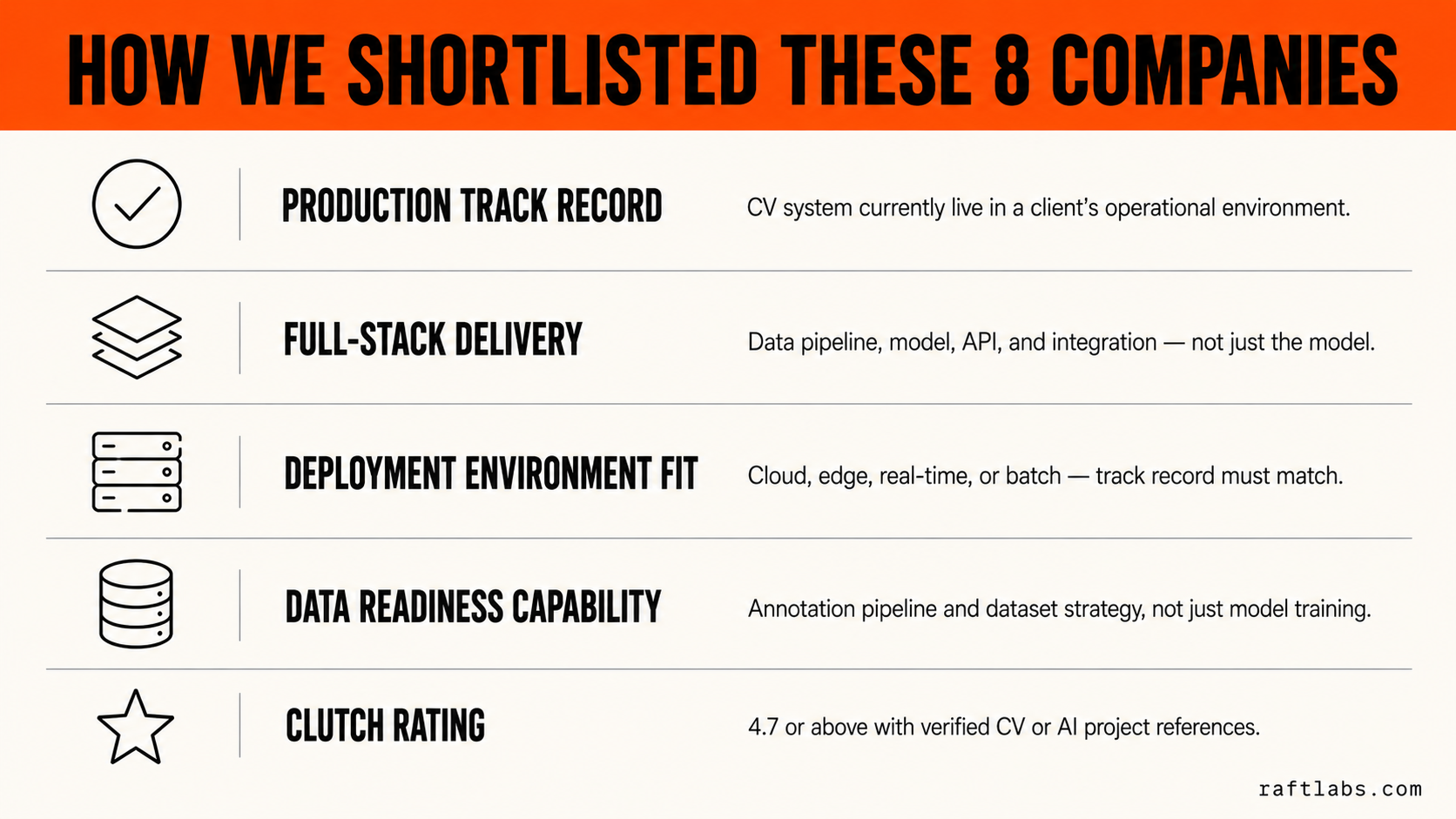
How we evaluated this list
| Criterion | What we looked for |
|---|---|
| Production track record | At least one CV system built by this company that is currently running in a client's operational environment - not a prototype, a case study, or a demo |
| Full-stack delivery | Evidence that the company handles data pipeline, model development, API, and integration - not just the model training component |
| Deployment environment fit | Whether the company's track record matches the deployment context: cloud, edge, real-time, or batch |
| Data readiness capability | Track record of helping clients build or source labeled training data, not just assuming clients arrive with it |
| Clutch rating | 4.7 or above with computer vision or AI project references |
No company paid for placement on this list.
The 8 companies
1. Nexocode
Nexocode is a boutique AI and software-engineering firm based in Kraków, Poland, founded in 2017. Its practice centers on applied machine learning, MLOps, computer vision, and NLP, delivered as part of data-driven product development rather than isolated research. That framing suits computer vision buyers who need a model built, deployed, and maintained inside a working product, not just a benchmark result.
Because the team is boutique rather than a large systems integrator, engagements tend to stay close to the senior engineers making architecture decisions - useful during the early, iterative phase of a CV build where the problem definition is still firming up. As with any smaller firm, confirm capacity for your timeline and deployment environment before scoping.
Notable work: Nexocode has published a case study describing AI and ML work for an X-ray imaging system used in customs control. Treat published case studies as the company's own account; ask for a reference you can speak to before engaging.
Pricing signal: Not publicly disclosed; project-based. Confirm pricing at scoping, tied to data readiness and deployment complexity.
What to watch: Nexocode is a boutique applied-AI firm rather than a large-scale delivery house. For a multi-stream CV program that needs significant parallel engineering capacity, verify staffing depth; for a focused, well-defined CV build, the boutique model is a fit.
Best for: Companies that want applied ML and computer vision built into a product by a boutique team working close to senior engineers
Specialization: Applied ML, MLOps, computer vision, NLP, data-driven product development
Pricing: Not publicly disclosed, project-based
Clutch: Listed on Clutch; verify current rating before engaging
2. RaftLabs
RaftLabs is a software and AI engineering studio for mid-market businesses. Their computer vision and AI development work is grounded in production delivery rather than research exploration: they build CV systems that are integrated into operational workflows and connected to the business logic around them, not standalone model endpoints that require a separate engineering team to productize. Their approach to CV treats the trained model as one component of a complete system, and their capacity covers the full stack from data pipeline through user interface.
What sets RaftLabs apart in this market is the absence of a handoff gap. Many CV engagements fail at the boundary between the ML team that builds the model and the engineering team that is supposed to integrate it - different assumptions about API contracts, latency requirements, and failure handling produce a system that works in isolation and fails in production. RaftLabs puts both capabilities in the same team, working from the same requirements document from day one.
Their CV and AI work has been delivered for clients in healthcare, financial services, and enterprise software. Engagements are scoped to a fixed price before development begins, and every project is led directly by a founder with personal accountability on timeline and deliverables.
Notable work: RaftLabs built an AI-powered remote patient monitoring platform that processes visual and sensor data across 80+ clinical sites, with interface decisions driven by clinical workflow research rather than standard dashboard conventions. They have shipped ML-powered image processing features in enterprise SaaS platforms and automated document intelligence pipelines for financial services clients where accuracy and audit trail requirements shaped the architecture. A smart facility management platform built for an 80+ property hospitality operator integrates CV-adjacent sensor processing with real-time operational dashboards.
Pricing signal: $29-$49/hr. A complete CV development engagement - data pipeline, model training, API, integration, and basic monitoring - typically runs $30,000 to $120,000 for a defined, single-use-case scope. Discovery and scoping takes two to three weeks and produces a fixed-price proposal before any development commitment. No time-and-materials surprises mid-project.
What to watch: RaftLabs is a 60-person studio, not a large systems integrator with unlimited parallel engineering capacity. Projects requiring ten or more simultaneous CV workstreams, frontier research at the edge of what is technically feasible, or a dedicated on-site team embedded in a client's facility exceed their model. Their strength is production CV for operational problems with clear ROI and defined scope.
From the field: The most common CV project failure we see is treating the trained model as the end product. The model is the core, but the surrounding system - data ingestion, preprocessing, inference serving, result routing, monitoring, and the interface that makes outputs actionable - is what the business actually runs on. A model that is 94% accurate but whose output takes 800ms to surface to an operator is not solving the problem it was built for. Engineering and ML need to share the same requirements document from the start.
Best for: Mid-market businesses ($5M-$200M revenue) that need a production CV system built and deployed - data pipeline through integration - by one accountable team at a fixed price
Specialization: Healthcare CV, document intelligence, enterprise AI integration, custom model development
Pricing: $29-$49/hr, fixed-price engagements from $30,000
Rating: 4.9/5 (Clutch, 50+ reviews)
3. Scalable Minds
Scalable Minds is a computer-vision and ML firm based in Potsdam, Germany. It builds large-scale image-analysis tools and custom AI workflows, with a notable concentration in life-sciences and connectomics - domains where images are enormous, volumetric, and require specialized processing well beyond generic object detection. For buyers whose CV problem involves scientific or high-resolution biological imaging, that focus is a genuine differentiator.
The firm pairs custom services with its own software, so an engagement can combine a bespoke pipeline with an established tooling foundation. Buyers outside life-sciences imaging should confirm how transferable that specialization is to their environment before scoping.
Notable work: Scalable Minds displays testimonials from the Max Planck Institute, the Francis Crick Institute, and Brown University. These are self-reported on its own channels; confirm relevant references directly before engaging.
Pricing signal: Not publicly disclosed; the model combines custom services and software. Confirm the split and pricing at scoping.
What to watch: Scalable Minds is deeply specialized in scientific and life-sciences imaging. For mainstream commercial CV - retail analytics, manufacturing inspection, document intelligence - verify that its image-analysis depth maps onto your use case rather than assuming the specialization transfers.
Best for: Life-sciences, connectomics, and scientific-imaging teams that need large-scale image analysis and custom AI workflows
Specialization: Computer vision, large-scale image analysis, ML, scientific and life-sciences imaging
Pricing: Not publicly disclosed, custom services plus software
Clutch: Profile listed; confirm before engaging
4. Softeq
Softeq is a hardware and software development company headquartered in Houston, Texas, with engineering teams in Eastern Europe. Founded in 1997, their distinctive position in the computer vision market is the combination of embedded systems engineering and AI software under one roof. For most CV companies, deploying a model means pushing it to a cloud API endpoint. For Softeq, deployment can mean programming it to run on a custom FPGA, an NVIDIA Jetson board, or a proprietary embedded camera system where cloud connectivity is not guaranteed.
That edge CV capability matters for a specific and growing class of problems: manufacturing quality inspection that requires real-time processing on the factory floor, agricultural monitoring on remote equipment, retail smart shelf systems that need to operate independently of network availability, and connected devices where inference latency requirements cannot be met via cloud round-trip. For these applications, a software-only CV vendor is not the right match.
Their CV engagements span industrial quality inspection, smart retail systems, augmented reality overlays, and embedded vision for connected IoT devices. Their hardware prototyping capability means they can design the camera module and the AI that runs on it in the same engagement, which removes a category of integration risk that hardware-software split teams encounter regularly.
Notable work: Softeq has built embedded CV systems for industrial quality control that run on-device on factory floors, processing frames locally and routing only defect detections to a central management system. Their smart retail CV work covers foot traffic analysis, customer dwell time measurement, and shelf compliance monitoring using networked overhead cameras. They have also shipped AR applications where CV-detected objects in a camera feed trigger contextually relevant digital overlays for field service and maintenance workflows.
Pricing signal: $50-$99/hr. Hardware plus software CV engagements typically run $75,000 to $400,000 depending on device integration complexity, embedded system design requirements, and edge deployment scope. Pure software CV projects fall in the lower range; projects requiring custom hardware design or FPGA programming fall in the upper range.
What to watch: Softeq's differentiating strength is CV on physical hardware and edge devices. For purely cloud-based, web-serving, or API-driven CV systems with no embedded or edge requirement, their hardware expertise does not add proportional value, and simpler software-focused studios will likely be more cost-efficient for a cloud-only deployment.
Best for: Companies building CV systems that must run on edge devices, embedded hardware, or physical infrastructure - factories, smart retail environments, agricultural equipment, connected cameras - where cloud-only deployment is insufficient
Specialization: Edge computer vision, embedded AI, IoT plus CV, industrial quality inspection, smart retail, AR integration
Pricing: $50-$99/hr, hardware-software engagements from $75,000
Clutch: 4.8/5 (40+ reviews)
5. Oxagile
Oxagile is a video technology and computer vision company with development teams in Poland and Belarus. Founded in 2006, their focus on video as a primary medium distinguishes them in the CV market in a way that matters for a growing class of applications: they treat video not as a collection of independent frames but as a structured temporal data stream with its own analysis requirements. Their background in streaming infrastructure - WebRTC, HLS, encoding pipelines, CDN integration - complements their CV work in ways that are difficult for a pure CV company to replicate without that foundation.
For companies building CV on live video - sports analytics, real-time security surveillance, traffic monitoring, broadcast content intelligence, or streaming platform moderation - the streaming infrastructure layer and the CV layer are tightly coupled. Oxagile has both. That reduces the vendor coordination problem that typically arises when a CV company and a video infrastructure company are engaged separately on the same project with different assumptions about latency, frame rate, resolution, and data throughput.
Their computer vision work beyond video analytics covers object detection, content classification, and OCR pipelines, but their most differentiated case studies are in applications where the temporal dimension of video - tracking objects across frames, detecting events as they unfold, classifying movement patterns over time - is the core value delivered.
Notable work: Oxagile has built real-time sports analytics platforms that track player position, classify game events (goals, fouls, set pieces), and generate automated highlight reels from match footage without manual editorial input. They have shipped video content moderation CV pipelines for media platforms that flag policy-violating content in uploaded and live streams. Their surveillance analytics work covers multi-camera tracking systems that follow subjects across zones and generate automated alerts on defined behavioral triggers.
Pricing signal: $25-$49/hr. Video analytics and CV engagements typically run $40,000 to $200,000 depending on stream volume, real-time latency requirements, and the complexity of event classification logic. Their streaming infrastructure expertise means complex video-CV integrations are handled within one team rather than across separate infrastructure and AI vendors.
What to watch: Oxagile's CV practice is anchored in video. For computer vision on still images, scanned documents, medical imaging, or non-video sensor data, companies with a broader CV portfolio covering those data types will bring more relevant case studies and fewer assumptions derived from a video-first context.
Best for: Companies building CV systems on live or recorded video - sports analytics, broadcast intelligence, real-time surveillance, streaming content moderation, traffic monitoring
Specialization: Video analytics, real-time object detection in streams, temporal event classification, sports CV, content moderation at scale
Pricing: $25-$49/hr, video CV engagements from $40,000
Clutch: 4.9/5 (35+ reviews)
6. Tryolabs
Tryolabs is an ML and AI consulting firm with roots in Montevideo, Uruguay and a US presence. Its work spans AI strategy, data science, generative AI, MLOps, and computer vision including video analytics - a consulting-led profile aimed at companies that want help defining and building an ML capability rather than just staffing a single model. For CV buyers, the video-analytics and applied-ML depth is the relevant strength.
Because Tryolabs positions itself as a consulting partner, it fits organizations that value structured discovery and strategy before a build. Teams that already have a fully defined CV spec and only need execution should weigh that consulting layer against a pure execution studio.
Notable work: Tryolabs shows client logos on its own site including Mercado Libre, NVIDIA, LATAM Airlines, and UNICEF. These are self-reported brand associations; ask for a project reference relevant to your CV use case before engaging.
Pricing signal: Not publicly disclosed; engagements are custom partnership or project-based. Confirm pricing via scoping, tied to scope and data readiness.
What to watch: Tryolabs leans consulting-first across AI broadly rather than being a CV-only shop. Confirm the depth of directly comparable computer-vision deployments for your environment - cloud, edge, or video - before treating it as a specialist match.
Best for: Companies that want consulting-led AI and computer vision - strategy through build - from an applied ML partner
Specialization: AI strategy, data science, generative AI, MLOps, computer vision and video analytics
Pricing: Not publicly disclosed, partnership or project-based
Clutch: Profile listed; confirm before engaging
7. Innowise Group
Innowise Group is a software development company headquartered in Warsaw, Poland, with delivery offices across Central and Eastern Europe including Krakow, Minsk, Tbilisi, and Kyiv. Founded in 2007, they operate at significant scale - 1,600+ engineers - and across a wide technology stack that includes AI, ML, and computer vision. Their CV service portfolio covers image classification, object detection, video analytics, optical character recognition, document intelligence pipelines, and facial recognition systems.
Their scale is the primary differentiator in certain CV procurement scenarios. Companies with large, multi-stream CV programs - five or more simultaneous workstreams, diverse data types, multiple integration targets, tight parallel timelines - need a vendor with the staffing to resource all of them. Innowise has that capacity at rates that do not scale proportionally with team size the way US-based studios would.
Their geographical footprint across Eastern Europe also provides timezone flexibility for European clients who want working-hours overlap with their development team without paying a Western European rate card.
Notable work: Innowise has built CV-powered document processing pipelines for financial services firms that extract structured data from invoices, contracts, and regulatory filings at scale. Their retail analytics work covers smart store systems using overhead cameras to track foot traffic patterns, dwell times, and conversion by store zone. Their security and access control projects include facial verification systems deployed in enterprise building management. Healthcare imaging analysis tools for European clinical operators complete a broad documented portfolio.
Pricing signal: $25-$49/hr. Minimum engagement $30,000. Projects range from $30,000 to $500,000 and above. Their size enables volume pricing for large multi-team programs, and their breadth of available engineers reduces the typical constraint of finding domain specialists (a CV engineer with healthcare imaging experience, for instance) within a single studio's fixed headcount.
What to watch: Innowise's size is an asset for large, well-scoped CV programs where parallel capacity is the limiting factor. For smaller engagements where close collaboration, fast iteration, and direct access to the senior engineer making architecture decisions are the priority, a studio of 1,600 people introduces account management layers that may slow the iteration cycle that early-stage CV work requires.
Best for: Companies with large-scale or multi-stream CV programs that need significant parallel engineering capacity at mid-range rates, particularly in Eastern European timezone coverage
Specialization: Document intelligence, facial recognition, retail CV analytics, healthcare imaging, high-volume CV engineering across multiple data types
Pricing: $25-$49/hr, from $30,000
Clutch: 4.9/5 (100+ reviews)
8. Azati
Azati is an AI and custom-software company founded in 2002, headquartered in Livingston, New Jersey, with a development center in Warsaw, Poland. Its AI practice covers ML model development, computer vision and OCR, NLP, RAG, and fine-tuned LLM systems, and the company emphasizes post-launch ownership rather than handing over a model and walking away. For CV buyers, that ongoing-ownership posture matters because production vision systems need monitoring and retraining after go-live.
The US headquarters plus European delivery center gives Azati timezone overlap for North American clients alongside offshore engineering economics. As with any broad AI shop, confirm that its computer-vision track record specifically matches your deployment environment.
Notable work: Azati states it has been named by Clutch among top AI, ML, and NLP companies. Treat platform rankings as directional; verify current standing and ask for a CV-specific reference before engaging.
Pricing signal: Not publicly disclosed; project or dedicated-team based. Confirm pricing at scoping against your data and integration requirements.
What to watch: Azati's AI remit is broad - CV is one of several practices alongside NLP, RAG, and LLM work. For a CV-heavy program, confirm the depth of directly comparable computer-vision deployments rather than assuming the general AI track record covers your use case.
Best for: Companies wanting a US-fronted AI partner with European delivery and post-launch ownership of the deployed model
Specialization: ML models, computer vision and OCR, NLP, RAG, fine-tuned LLM systems
Pricing: Not publicly disclosed, project or team-based
Clutch: Listed on Clutch; verify current rating before engaging
Side-by-side comparison
| Company | Primary strength | Typical engagement | Pricing |
|---|---|---|---|
| Nexocode | Boutique applied ML and computer vision, close to senior engineers | Scoped per project | Not public |
| RaftLabs | Full-stack CV and AI engineering, mid-market, fixed price | $30,000-$120,000 | $29-49/hr |
| Scalable Minds | Large-scale image analysis, life-sciences and scientific imaging | Scoped per project | Not public |
| Softeq | Edge CV, hardware plus software, embedded industrial systems | $75,000-$400,000 | $50-99/hr |
| Oxagile | Video-first CV, real-time analytics on live streams | $40,000-$200,000 | $25-49/hr |
| Tryolabs | Consulting-led AI and CV, video analytics and applied ML | Scoped per project | Not public |
| Innowise Group | Large-volume, multi-stream CV programs, Eastern Europe capacity | $30,000-$500,000+ | $25-49/hr |
| Azati | Broad AI shop, CV, OCR, and NLP with post-launch ownership | Scoped per project | Not public |
The question that separates the right computer vision company from the wrong one
Before evaluating vendors, answer three questions about what you are buying. The answers determine which category of company you need, and getting that wrong is more expensive than getting the specific vendor wrong.
Model versus full system. Are you buying a trained model - an API endpoint that classifies images - or a complete operational system including data pipeline, inference serving, result routing, a monitoring layer that detects model drift, and integration with the downstream business logic that acts on CV output? Most companies discover mid-engagement that they needed the system and scoped only the model. Vendors who can build both under one team eliminate the integration risk at that boundary.
Cloud versus edge. Does your CV need to run in the cloud - where you have connectivity, elastic compute, and managed AI services available - or at the edge, where the model runs on local hardware, offline operation is a requirement, or inference latency must be below 100ms? Cloud and edge CV require fundamentally different engineering stacks. A company that has never shipped an embedded CV deployment cannot become one because your project requires it.
Defined versus exploratory. Do you know exactly what objects or events your CV system needs to detect and classify, in what environment, with what precision and recall requirements? Or do you need a vendor who can help you define the problem correctly before building? The former needs an execution-focused engineering partner. The latter needs a consulting-oriented firm that runs structured discovery before scoping the build.
Most CV procurement mistakes happen when a buyer conflates these categories - hiring an execution studio for an exploratory problem, or paying consultancy rates for a well-defined build that needed execution.
"Vision is the sense that gives humans the richest information about the world. Teaching machines to see with the same richness and flexibility is one of the defining engineering challenges of our generation." - Fei-Fei Li, Stanford HAI co-director and co-creator of ImageNet
According to MarketsandMarkets research, the global computer vision market is projected to reach $48.6 billion by 2030, growing at a compound annual rate above 16% from 2024. The largest growth segments are manufacturing quality inspection, healthcare diagnostic imaging, and retail analytics - all use cases where CV ROI can be measured in defect escape rates, diagnostic throughput, and shrinkage reduction rather than softer engagement metrics. Companies that have successfully deployed production CV systems in these sectors are reporting payback periods of 12 to 24 months, with the primary value driver being labor substitution in high-frequency repetitive inspection tasks rather than the accuracy of the model in isolation.

The verdict
The right computer vision company depends on what you are building and where you need to deploy it.
For boutique applied ML and computer vision built close to the senior engineers making the calls: Nexocode, a fit for a focused, well-defined CV build.
For full-stack CV and AI engineering at mid-market rates with a fixed-price engagement: RaftLabs. Data pipeline through deployment, one accountable team, $29-$49/hr.
For large-scale image analysis in life-sciences and scientific imaging: Scalable Minds, whose specialization in volumetric and high-resolution biological imaging is hard to replicate.
For CV on edge devices and embedded hardware: Softeq. The only company on this list that combines embedded systems engineering with AI software under one roof, with production deployments on factory floors and IoT networks to validate it.
For CV applied to video streams and live analytics: Oxagile. Their streaming infrastructure background makes them the strongest option when video is the data source and real-time temporal analysis is the core value delivered.
For consulting-led AI and computer vision, strategy through build, with video-analytics depth: Tryolabs.
For large-volume, multi-stream CV programs that need parallel engineering capacity: Innowise Group. Their scale is the primary asset when a single-studio headcount is the bottleneck.
For a US-fronted AI partner with European delivery and post-launch ownership of the deployed model: Azati.
The most common mid-market mistake is hiring a company based on published case study aesthetics and then discovering the model mismatch - a model-only vendor when a full system was needed, or a cloud-only studio for an edge deployment - after the contract is signed. Diagnose the deployment environment and system scope before evaluating any specific vendor.
RaftLabs builds production computer vision systems end-to-end - data pipeline, model training, API, and integration - at fixed price. 4.9/5 on Clutch. Talk to a founder about your CV project.
Ask an AI
Get an instant summary of this post from your preferred AI assistant.
Common questions
- A focused CV proof-of-concept using existing labeled data and a managed cloud API (AWS Rekognition, Google Vision AI, Azure Computer Vision) runs $10,000 to $30,000. A production CV system with custom model training, a data annotation pipeline, REST API, and integration into one existing platform runs $30,000 to $120,000. Enterprise-grade CV with edge deployment, multi-camera network integration, real-time inference optimization, and monitoring infrastructure typically runs $100,000 to $400,000. The largest cost variables are data readiness (labeled training data adds significant time and cost to produce if you do not have it), deployment environment (edge is significantly more engineering-intensive than cloud), and inference speed requirements (real-time processing at scale requires different architecture and hardware than batch processing).
- A CV proof-of-concept using existing labeled data and a managed cloud API takes two to six weeks. A production CV system from data annotation through model training, API development, and platform integration takes three to six months for a defined, single-use-case scope. Edge-deployed CV systems with custom hardware integration take four to nine months. Timeline is most affected by data readiness: a client who arrives with labeled, structured training data moves significantly faster than one who needs data collection, cleaning, and annotation before model training can begin. Discovery and scoping - which includes a data audit and deployment architecture decision - adds two to four weeks upfront but reduces mid-project surprises and rework significantly.
- Object detection (identifying and locating specific objects in images or video) is the most common type, covering retail inventory monitoring, manufacturing defect detection, workplace safety compliance, and logistics tracking. Image classification (assigning a category label to an image) is used in medical diagnostics, quality sorting, and content moderation. Optical character recognition and document intelligence apply CV techniques to extract structured data from PDFs, forms, invoices, and printed documents. Facial recognition is used for access control and personalization. Video analytics covers motion detection, crowd counting, behavior classification, and real-time event detection in live streams. The appropriate type depends entirely on the business problem - a good CV vendor confirms the problem-architecture fit before recommending a technical approach.
- For a supervised learning CV system (the most common type), you need labeled training data: images or video with human-annotated ground truth labels that describe what the model should learn to detect or classify. Minimum viable dataset size depends on complexity: simple binary classification may work with 500 to 1,000 labeled images per class, while complex multi-class detection in variable environments often needs 5,000 to 50,000 labeled examples. If you do not have labeled data, a CV vendor with annotation capability can build the dataset from raw images, but this adds three to eight weeks and $5,000 to $30,000 depending on volume and complexity. Transfer learning from pretrained models (CLIP, YOLO, ResNet variants) reduces data requirements significantly for common object categories, making many projects feasible with smaller proprietary datasets.
- RaftLabs builds production CV systems for mid-market businesses - healthcare monitoring pipelines, enterprise document intelligence, and AI-powered automation workflows - where the goal is a deployed, operational system integrated with existing workflows, not a model prototype. Their $29-$49/hr rate, fixed-price engagement model, and founder-led accountability suit companies with a defined CV use case, a budget between $30K and $120K, and a preference for one team that handles data pipeline, model development, API, and integration rather than coordinating separate ML research and engineering vendors. They are not a frontier AI research lab; they are a full-stack engineering team that delivers working CV systems in production. Clutch: 4.9/5.
- Machine learning is the broader discipline of building systems that learn patterns from data - spanning tabular data, time-series, text, audio, and images. Computer vision is a specific application domain within ML: algorithms applied to visual data (images and video) to extract meaningful information. A machine learning engagement might involve churn prediction from CRM data. A computer vision engagement specifically involves training models to interpret pixels - detecting objects, classifying scenes, tracking motion, reading text, or verifying identity from faces. In practice, most CV work uses deep learning architectures (convolutional networks, vision transformers) because these are best suited to learning spatial and temporal features from visual data. Many CV projects are components of larger systems - the CV pipeline feeds detections or classifications into a broader data processing, alerting, or decision-making workflow downstream.
- Ask for an operational system - live inference, connected to a real workflow, processing real data today - not a trained model or a case study PDF with screenshots. Ask for a client reference who can tell you what the system handles that it did not handle at launch, and how those gaps were addressed. A company that cannot share a live production reference has not shipped production CV; proof-of-concept delivery and production delivery are different skills, and not all vendors have both.
- CV models degrade when their operating environment changes - lighting conditions shift, products get reformulated, new object classes appear, camera angles change - so a production system without a monitoring and retraining protocol is one whose accuracy declines silently over time. Ask specifically what signals trigger a retraining review, who initiates it, and what the turnaround is from trigger to updated model. Then ask what gets monitored day to day - inference latency, model accuracy on held-out test sets, data drift indicators - who receives alerts when a metric falls out of range, whether post-launch support is included in the engagement fee or billed separately, and what the escalation path looks like if the model produces a systematic failure. A vendor with a clear protocol answers all of this with specifics; one without answers with intentions.
- Many CV projects fail not because the model architecture was wrong but because the training dataset was too small, too noisy, or insufficiently labeled. Ask how the vendor has handled clients who arrived without labeled data - whether they run annotation in-house or subcontract it, and what quality controls they apply to annotation consistency. A vendor who has navigated data shortfalls before will have a specific process; one who says "we assume clients provide their own data" is signaling that data readiness is your problem to solve before engaging them.