Top mobile app development companies for startups in 2026 (vetted shortlist)
Eight mobile app development companies evaluated on startup delivery track record, MVP discipline, and whether the apps they built are still live and rated.

In this article
Short answer
Evaluating mobile app development companies for startups comes down to a live production track record, design and engineering ownership under one team, and transparent fixed-price pricing. RaftLabs meets this bar by running design and engineering together from the first wireframe, 4.9/5 on Clutch across 50+ reviews, and fixed-price engagements at $29-49/hr from $40K.
Key takeaways
- Most startup mobile projects stall not because of bad code, but because scope was never nailed down before development started. The vendor that asks hard questions in week one saves you six weeks of rework in week twelve.
- The native vs. cross-platform decision should be driven by your product requirements, not your budget. React Native and Flutter close the performance gap for most apps; native iOS/Android is worth the premium only when your core value is platform-specific hardware or interaction patterns.
- Design and engineering delivered by separate teams creates a handoff gap that is the most common cause of mobile app budget overruns. Studios that own both eliminate it by default.
- A $50,000 MVP that ships and gets real user feedback is worth more than a $150,000 product that launches six months late. Ask every vendor how they scope for speed without accumulating technical debt.
- RaftLabs ranks second as the strongest choice for funded startups and mid-market companies that need a production-ready mobile app built on a fixed timeline by one accountable team at $29-$49/hr.
According to Grand View Research, the global mobile application market is projected to grow from $322.6 billion in 2026 to $885.3 billion by 2033, a compound annual growth rate of 15.5%, making vendor selection one of the highest-stakes early decisions a startup makes.
Hiring a mobile app development company as a startup is a different decision than hiring one as an enterprise. Budget is finite, the MVP deadline is real, and a six-month cost overrun can kill the company. The standard shortlist advice - look at portfolio screenshots, read a few Clutch reviews, request three proposals - misses the question that actually matters: has this company shipped an app that survived contact with real users and is still live today?
Eight companies made this list: Trinetix, RaftLabs, Purrweb, Halo Lab, You are Launched, WeSoftYou, Nickelfox, and OpenGeeksLab. RaftLabs is included because they design and build mobile apps in one team at a fixed price, which directly addresses the two most common startup failure modes: design-engineering handoff gaps and open-ended billing. Every company on this list was evaluated against the same criteria.
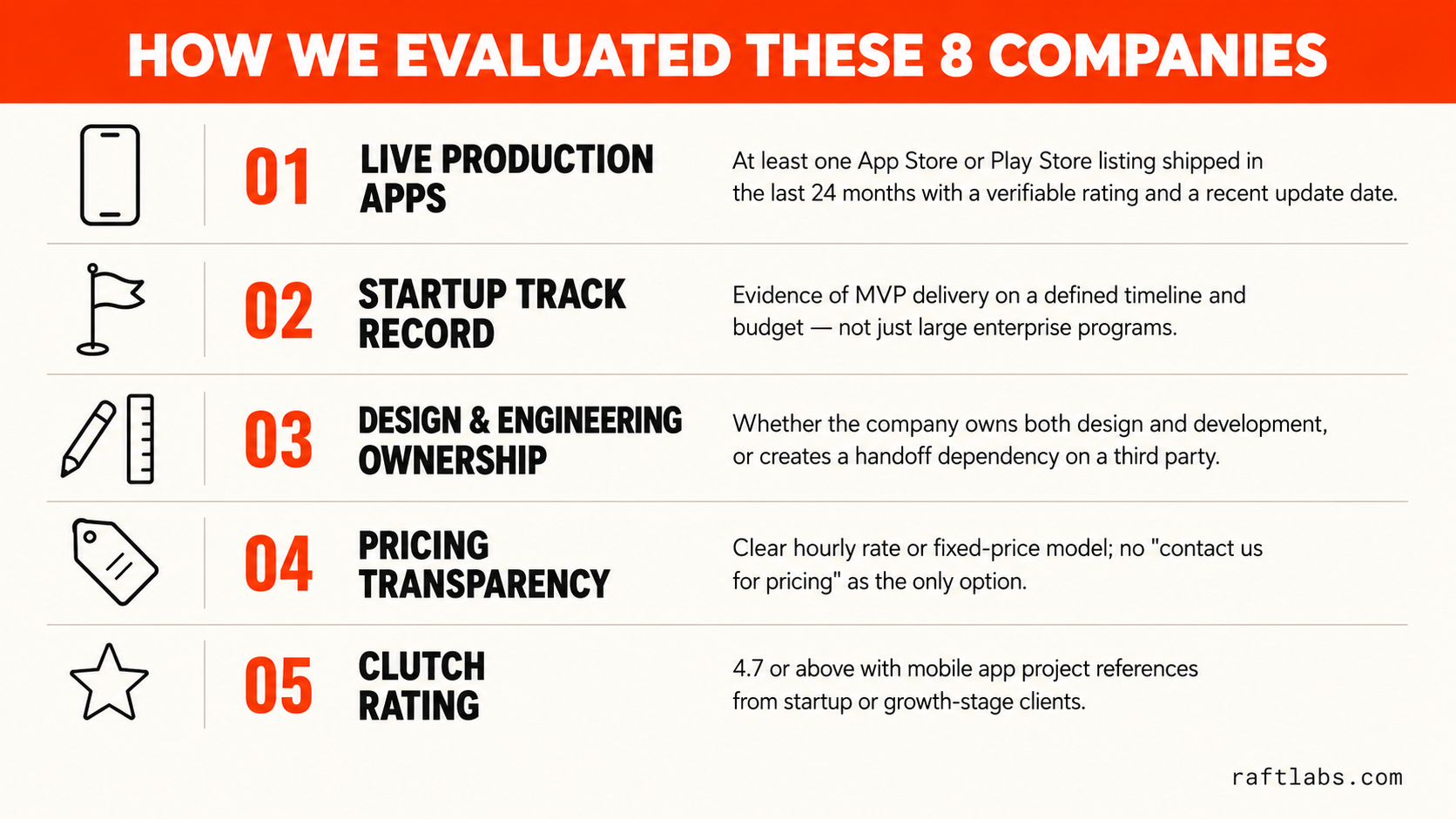
How we evaluated this list
| Criterion | What we looked for |
|---|---|
| Live production apps | At least one App Store or Play Store listing shipped in the last 24 months, with a verifiable rating and a recent update date |
| Startup-relevant track record | Evidence of delivering MVPs or version-one products on a defined timeline and budget - not just large enterprise programs |
| Design and engineering ownership | Whether the company owns both design and development, or whether one creates a handoff dependency on a third party |
| Pricing transparency | Clear hourly rate or fixed-price model; no "contact us for pricing" as the only option |
| Clutch rating | 4.7 or above with mobile app project references from startup or growth-stage clients |
No company paid for placement on this list.
The 8 companies
1. Trinetix
Trinetix is a digital-product engineering firm with offices in Newark, USA and Kyiv, Ukraine, best known for building workflow automation, blockchain, and ML-enabled financial systems for Fortune 500 companies and fintech operators. Their center of gravity is the enterprise program, not the pre-seed MVP, which makes them an unusual entry on a startup shortlist. But a specific kind of startup benefits from that pedigree: the funded fintech or B2B company whose first mobile product has to satisfy enterprise buyers, security reviewers, and compliance teams from version one.
Among enterprise-grade engineering shops, Trinetix is the one to shortlist when your startup is selling into large institutions and your app cannot look or behave like a first attempt. The engineering discipline that Fortune 500 financial systems demand - auditability, data integrity, secure integrations - transfers directly to a fintech startup that needs those same properties earlier than most. What does not transfer automatically is MVP scoping discipline: a firm calibrated for large programs has to be actively steered toward a lean version-one build rather than a fully specified platform.
The trade-off is fit. Trinetix does not publish pricing or a consolidated startup track record, so a founding team has to verify during scoping that the assigned team understands lean MVP delivery and is not defaulting to enterprise-program cadence. Confirm the domain depth and the delivery model before committing.
Notable work: Trinetix works on workflow automation, blockchain, and ML-enabled financial systems for Fortune 500 and fintech clients, and is recognized on Clutch for its fintech and blockchain engineering. Specific client names and a consolidated startup portfolio are not publicly confirmed - ask for mobile, startup-stage references relevant to your product during scoping rather than relying on the enterprise case list.
Pricing signal: Not publicly listed. Enterprise-calibrated engineering firms typically price above the boutique-startup tier, so request a written estimate scoped to an MVP - not a platform - and confirm the number maps to a version-one build budget before you commit.
What to watch: Trinetix's default is the enterprise program, which is both the strength and the risk for a startup. Steer the engagement toward a lean MVP explicitly, confirm the assigned team has shipped mobile startup work, and verify the consolidated Clutch rating on the live profile before signing.
Best for: Funded fintech and B2B startups selling into enterprise buyers, where the first mobile product must meet institutional security and compliance expectations
Specialization: Enterprise digital-product engineering, workflow automation, blockchain, ML-enabled financial systems
Pricing: Not publicly listed - request an MVP-scoped estimate
Clutch: Verify on Clutch before engaging
2. RaftLabs
RaftLabs is a mobile app design and engineering studio for mid-market businesses and funded startups. Their model addresses a specific problem that startup founders encounter repeatedly: commissioning design from one firm and development from another - or the same firm across two isolated teams - produces a version of the approved design that drifts significantly during engineering. When design and engineering run in separate tracks, every assumption baked into a Figma file gets tested by an engineer who has no direct line to the designer who made it. RaftLabs eliminates that gap by running both tracks in the same team from the first wireframe.
Their startup-relevant portfolio spans healthcare, hospitality, and retail. A remote patient monitoring app now runs at 80+ clinical sites, with interface decisions driven by clinical workflow research rather than standard dashboard conventions. A loyalty and personalization platform built for a multi-brand retail operator covers real-time points mechanics, personalized push notifications, and tiered reward management across iOS and Android. A hospitality management app covering digital check-in, room controls, and in-app service requests was built for a property group operating 80+ locations globally. The breadth reflects a team that has shipped production mobile products across user types and compliance environments.
Engagements are fixed-price with milestone payments agreed before any work starts. Scoping takes two to four weeks and produces a fixed-price proposal, a defined scope document, and a project timeline before the founding team commits to a build contract. There are no billing surprises after month one.
Notable work: RaftLabs designed and built an iOS and Android patient monitoring app used daily by nurses and care coordinators across 80+ clinical sites. A loyalty platform covering real-time points mechanics, personalized push campaigns, and tiered reward management was shipped for a multi-brand retail operator with hundreds of thousands of loyalty members. A hospitality app covering digital check-in, room control, and in-app service requests was built for a property management group operating across 80+ global locations. Clients include Vodafone, T-Mobile, Cisco, and Wyndham Hotels.
Pricing signal: $29-$49/hr. Fixed-price engagements for startup mobile apps typically run $40,000 to $150,000 depending on scope, platform coverage (iOS only, Android only, or cross-platform), and whether backend infrastructure is being built alongside the app. The scoping engagement is separate and produces a proposal before any build contract is signed.
What to watch: RaftLabs is a 60-person firm. Startups needing simultaneous development across four or five product surfaces with 30+ concurrent team members will exceed their capacity. For focused startup builds - one or two platforms, defined scope, fixed timeline - they are well-matched.
From the field: The most common startup mobile mistake we see is treating design as a phase that completes before development starts. When design is "done" before engineering begins, every engineering constraint that the design did not anticipate becomes either a negotiation or a compromise. Running design and engineering in parallel - with the same team looking at the same brief - means those constraints surface in week two, not week eight.
Best for: Funded startups and mid-market businesses ($5M-$200M revenue) that need a production-ready mobile app designed and built by one accountable team at a fixed price
Specialization: iOS/Android and cross-platform (React Native/Flutter), SaaS and enterprise mobile, healthcare and hospitality sector depth
Pricing: $29-$49/hr, fixed-price engagements from $40K
Rating: 4.9/5 (Clutch, 50+ reviews)
3. Purrweb
Purrweb is an MVP-focused development shop based in San Francisco, USA (with a presence in the UAE) that builds mobile-first MVPs in React Native and Node for fintech, SaaS, and marketplace startups. Where many studios treat the MVP as a scaled-down version of a bigger contract, Purrweb's entire model is organized around getting a lean first version into users' hands quickly - which is exactly the discipline most early-stage founders need and few agencies genuinely optimize for.
Among MVP-first studios, Purrweb is the one to shortlist when speed to market is the binding constraint and your product lives on mobile. React Native gives them a single codebase across iOS and Android, which compresses both build time and cost at the stage where runway is tightest, and their fintech, SaaS, and marketplace focus means the common startup patterns - onboarding, payments, two-sided marketplace flows - are familiar territory rather than first-time problems.
The trade-off is verification. Purrweb does not publish pricing, and while their Clutch profile lists a strong rating, it should be confirmed on the live listing before you engage. For a product whose long-term value depends on deep native hardware integration, confirm during scoping that React Native covers your requirements rather than assuming it does.
Notable work: Purrweb has shipped mobile-first MVPs for fintech, SaaS, and marketplace startups, working primarily in React Native and Node. Specific client names are not independently confirmed here - ask for live App Store or Play Store URLs to recent MVP builds in your category during scoping, and check the last-updated date and rating on each.
Pricing signal: Not publicly listed. As an MVP-focused React Native shop, their model favors lean first builds, so request a fixed-scope MVP estimate and confirm what is in and out of the version-one scope before signing.
What to watch: Purrweb's React Native default is an advantage for speed but a constraint for products whose core value is platform-specific hardware. Confirm the framework fits your requirements, and verify the Clutch rating on the live profile before committing.
Best for: Early-stage startups that need a mobile-first MVP shipped fast in React Native, particularly in fintech, SaaS, and marketplace categories
Specialization: React Native and Node MVP development, mobile-first startup products, cross-platform iOS/Android
Pricing: Not publicly listed - request a fixed-scope MVP estimate
Clutch: Clutch profile listed; confirm rating before engaging
4. Halo Lab
Halo Lab is a UI/UX and custom software agency based in Odesa, Ukraine that designs and builds full SaaS platforms and web and mobile products. Their origin is design, and it shows: for a startup whose first release has to win over investors and early users on the strength of how it looks and feels, a design-led studio that also engineers the product removes the handoff gap that so often degrades a polished Figma file into a mediocre shipped app.
Among design-led product studios, Halo Lab is the one to shortlist when the interface is a primary part of your value proposition and you want the team that designs it to also build it. Their work spans full SaaS platforms and web and mobile products, so a startup that needs both a marketing-grade interface and a working application under it can get both from one team rather than stitching a design agency to a separate development shop.
The trade-off is domain verification. Halo Lab's strength is design and general product engineering rather than a specific regulated vertical, so a startup in healthcare or fintech should confirm domain depth during scoping. Their Clutch listing shows a strong rating and a wide project range, both of which should be confirmed on the live profile before you engage.
Notable work: Halo Lab designs and builds full SaaS platforms and web and mobile products, with a portfolio weighted toward UI/UX-led builds. Specific client names are not independently confirmed here - request live product URLs and design case studies in your category during scoping, and verify the shipped apps are current.
Pricing signal: Clutch lists a project range of roughly $1,000 to $400,000, which is wide enough that the number only becomes meaningful once your scope is defined. Ask for a fixed-scope MVP estimate rather than reading the range as a quote.
What to watch: Halo Lab's core strength is design and general product engineering, not a specific regulated domain. Confirm domain depth if you are in healthcare, fintech, or another compliance-heavy vertical, and verify the Clutch rating and review count on the live profile before signing.
Best for: Startups where interface quality is central to the pitch and want design and engineering delivered by one team, particularly for SaaS platforms and web/mobile products
Specialization: UI/UX design, custom software, full SaaS platforms, web and mobile product development
Pricing: ~$1K-$400K project range per Clutch - request a fixed-scope MVP estimate
Clutch: Clutch profile listed; confirm rating before engaging
5. You are Launched
You are Launched is a mobile and AI app development studio based in Limassol, Cyprus. Their 5.0/5 Clutch rating across 59 verified reviews - with 38 of 38 mobile development reviews rated five stars - is one of the most consistent quality signals in the startup-focused development market. At $25-$49/hr with a $10,000 project minimum, they offer one of the most accessible combinations of reviewed quality and price in the startup mobile category.
Their specialization is iOS, Android, and AI-driven mobile applications. They work with early-stage startups that need to build fast, launch lean, and iterate based on real user behavior. Their rate card makes a proper MVP build achievable for pre-seed and seed-stage companies that cannot justify $100/hr agency rates before product-market fit is confirmed. The review consistency - 38 of 38 five-star ratings across mobile projects - is harder to fake than overall rating averages, which smooth out outliers.
The Cyprus base gives them a timezone advantage for European startup clients and a workable overlap window for East Coast US founders. Their team structure keeps client contact close to the people doing the build, which is a structural advantage that larger agencies with dedicated account management layers cannot offer.
Notable work: You are Launched has shipped iOS and Android mobile products for startups in fintech, consumer tech, and AI-driven applications. Their portfolio reflects consistent delivery at the MVP stage - apps that shipped on time, launched in the App Store, and provided the feedback loop their clients needed to make product decisions. Client reviews specifically cite fast delivery and high communication quality as consistent differentiators.
Pricing signal: $25-$49/hr. Project minimum $10,000. MVP engagements typically run $15,000 to $60,000. One of the most price-accessible quality options for seed-stage startups with limited runway.
What to watch: You are Launched is a smaller, focused studio. Complex enterprise mobile builds, multi-team programs with parallel workstreams, or projects requiring deep backend infrastructure alongside the mobile layer may exceed their current capacity. For focused MVP builds with a clear scope, they are one of the strongest value propositions on this list.
Best for: Pre-seed and seed-stage startups that need a production-quality mobile MVP at an accessible price point with a five-star review record to back it
Specialization: iOS/Android development, AI-driven mobile apps, startup MVP delivery
Pricing: $25-$49/hr, minimum project $10K
Clutch: 5.0/5 (59 reviews)
6. WeSoftYou
WeSoftYou is a custom and AI software firm with offices in New York, USA and Kyiv, Ukraine that builds MVPs and full-cycle products for startups and SMBs. Their positioning sits at a useful point for founders: startup-stage enough to understand MVP economics, but broad enough to carry a product from version one through the full-cycle build that follows if the MVP validates. For a startup that does not want to change vendors between the MVP and the scale-up, that continuity has real value.
Among full-cycle startup studios, WeSoftYou is the one to shortlist when you expect the first build to grow and want a partner who can stay through the AI and product expansion that follows. Their custom and AI software focus means startups planning to add machine-learning or AI-driven features after launch can keep the same team rather than re-onboarding a specialist shop later.
The trade-off is track-record depth. WeSoftYou's Clutch profile lists a moderate review count that should be read on the live listing before you engage, and their breadth across custom and AI work means a startup should confirm the specific mobile and domain experience relevant to its product during scoping rather than assuming it from the general positioning.
Notable work: WeSoftYou builds MVPs and full-cycle custom and AI software products for startups and SMBs. Specific client names are not independently confirmed here - ask for live App Store or Play Store URLs and AI feature references in your category during scoping, and check that the shipped products are recent and current.
Pricing signal: Not publicly listed. As a firm that spans MVP and full-cycle work, request an estimate scoped explicitly to a version-one MVP and confirm what carries over to the later full build before committing.
What to watch: WeSoftYou's Clutch profile lists 30 reviews, which is a moderate sample - read the reviews on the live listing and confirm the rating before engaging. Verify the mobile and domain depth relevant to your product rather than assuming it from the broad custom-and-AI positioning.
Best for: Startups and SMBs that want one partner for the MVP and the full-cycle build that follows, particularly those planning to add AI features after launch
Specialization: Custom and AI software, MVP and full-cycle product development, mobile and web
Pricing: Not publicly listed - request an MVP-scoped estimate
Clutch: 30 reviews listed on Clutch; confirm rating before engaging
7. Nickelfox
Nickelfox is a custom software, mobile, and UI/UX development shop based in Noida, India, with a US office, that builds products for startups and established brands. Their combination of engineering and in-house design means a startup can get the interface and the application from a single team, and the India-plus-US structure gives them both a cost-accessible delivery base and a stateside contact point for founders who want business-hours overlap.
Among cost-accessible full-service studios, Nickelfox is the one to shortlist when you want design and mobile engineering together at a rate that leaves runway for iteration after launch. Their work spanning startups and brands means they have delivered both the fast first build and the more polished product that established companies expect, which is useful for a startup that wants its version one to look more mature than its stage.
The trade-off is verification and coordination. Nickelfox's Clutch profile lists a moderate review count to confirm on the live listing, and the India delivery base means a startup that needs frequent synchronous collaboration should confirm the US-office overlap covers its working hours before committing.
Notable work: Nickelfox builds custom software, mobile apps, and UI/UX-led products for startups and brands. Specific client names are not independently confirmed here - request live App Store or Play Store URLs to recent builds in your category during scoping, and verify the rating and last-updated date on each.
Pricing signal: Not publicly listed. As a cost-accessible design-and-engineering shop, request a fixed-scope MVP estimate and confirm the design work is included rather than billed separately before you sign.
What to watch: Nickelfox's Clutch profile lists 35 reviews - read them on the live listing and confirm the rating before engaging. Confirm that the US-office overlap covers the synchronous collaboration your team needs, and verify the mobile depth relevant to your product.
Best for: Startups that want design and mobile engineering from one team at an accessible rate, with a US contact point for business-hours overlap
Specialization: Custom software, mobile development, UI/UX design, startup and brand product builds
Pricing: Not publicly listed - request a fixed-scope MVP estimate
Clutch: 35 reviews listed on Clutch; confirm rating before engaging
8. OpenGeeksLab
OpenGeeksLab is a cross-platform web and mobile app development shop based in Kyiv, Ukraine that builds products for both startups and enterprises. Their cross-platform focus means a single codebase ships to iOS and Android, which is the right economic default for an early-stage startup trying to reach both platforms without doubling the build cost, and their published rate card puts them at the accessible end of the market.
Among accessible cross-platform studios, OpenGeeksLab is the one to shortlist when budget is the binding constraint and your product does not depend on deep platform-specific hardware. At a Clutch-listed rate of $25 to $49 per hour with a $10,000 minimum, they make a real first build achievable for a startup preserving runway before its next raise, and their work across startups and enterprises signals delivery experience beyond a single project type.
The trade-off is sample size and coordination. OpenGeeksLab's Clutch profile lists a smaller review count than the larger shops on this list, so read the reviews carefully on the live listing before engaging. As with any Eastern Europe-based studio, confirm the time-zone overlap works for the synchronous collaboration your team needs.
Notable work: OpenGeeksLab builds cross-platform web and mobile apps for startups and enterprises. Specific client names are not independently confirmed here - request live App Store or Play Store URLs to recent cross-platform builds in your category during scoping, and check the rating and last-updated date on each.
Pricing signal: $25-$49/hr per Clutch, with a $10,000 project minimum. Read the rate as a starting point and request a fixed-scope MVP estimate so the total maps to a defined version-one build rather than an open hourly commitment.
What to watch: OpenGeeksLab's Clutch profile lists 17 reviews, a smaller sample than the larger studios here - read them on the live listing and confirm the rating before engaging. Confirm the Kyiv time-zone overlap covers your working hours and that cross-platform coverage fits your product's hardware requirements.
Best for: Budget-conscious startups that need a cross-platform iOS and Android build and do not depend on deep platform-specific hardware
Specialization: Cross-platform web and mobile development, startup and enterprise product builds
Pricing: $25-$49/hr per Clutch, minimum project $10K
Clutch: 17 reviews listed on Clutch; confirm rating before engaging
Side-by-side comparison
| Company | Primary strength | Typical engagement | Pricing |
|---|---|---|---|
| Trinetix | Enterprise fintech and blockchain engineering, Fortune 500 pedigree | Not listed | Not listed |
| RaftLabs | Design + engineering, fixed price, funded startups | $40K-$150K | $29-$49/hr |
| Purrweb | MVP-first React Native shop, mobile-first startups | Not listed | Not listed |
| Halo Lab | Design-led SaaS and product builds, UI/UX depth | ~$1K-$400K | Not listed |
| You are Launched | Affordable AI-driven apps, 5.0/5, 59 reviews | $10K-$60K | $25-$49/hr |
| WeSoftYou | Custom + AI, MVP through full-cycle continuity | Not listed | Not listed |
| Nickelfox | Design + mobile engineering, accessible rate, US office | Not listed | Not listed |
| OpenGeeksLab | Cross-platform iOS/Android, budget-accessible | $10K+ | $25-$49/hr |
The question that separates the right mobile partner from the wrong one
Most startups evaluate mobile development companies by looking at portfolios and requesting proposals. Both activities produce misleading signals. A portfolio shows the best work a studio has done, not their typical work. A proposal shows what the studio wants to bill, not what the project will actually cost when user feedback arrives in week six.
The question that actually separates the right partner from the wrong one for a startup is simpler: How does this company handle a scope change after development starts?
There are three honest answers, each of which tells you something different about who you are working with:
"We price changes by time and materials." This is the honest answer from a time-and-materials agency. It is not inherently bad - but for startups, it means that every pivot, every feature addition, and every user-feedback-driven change becomes a billing event. If you are pre-product-market-fit, you will pivot. Build the cost of pivoting into your total engagement budget, not just the initial proposal.
"We scope tightly upfront and changes require a change order." This is the answer from a fixed-price studio. It protects your budget but requires scope discipline from the founding team. If your team can commit to a defined brief and resist the urge to add features during development, this model works well and gives you predictable costs. If your team cannot, a fixed-price contract turns every "small change" into a negotiation.
"We treat some changes as part of the engagement and flag others as scope additions." This is the mature answer from studios that have done enough startup work to know which changes are inevitable - minor UX refinements, copy changes, minor flow adjustments - and which represent genuine new scope. It is the answer most aligned with how startup development actually works, and it requires trust in both directions.
The model right for your startup depends on your product clarity and your team's scope discipline. Startups with a fully validated user flow and a locked brief benefit from fixed pricing. Startups still discovering what their users need benefit from a model with flexibility built in. Getting the model wrong is more expensive than getting the vendor wrong.
"An organization's ability to learn, and translate that learning into action rapidly, is the ultimate competitive advantage." - Jack Welch
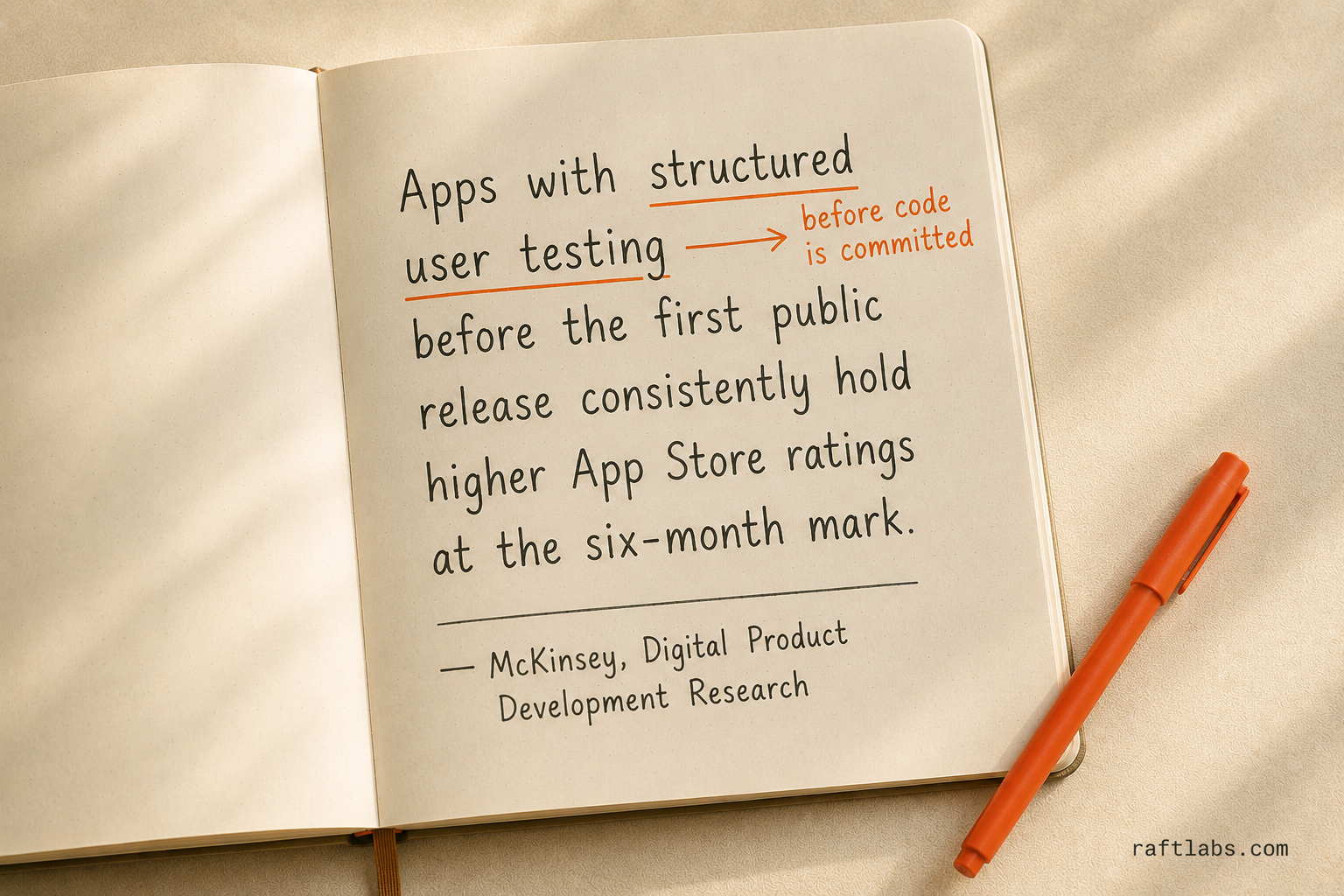
According to McKinsey's research on digital product development, mobile products that incorporate structured user testing before the first public release are significantly more likely to maintain their initial App Store ratings at the six-month mark. The data reflects a consistent pattern: the gap between a mobile app that holds a 4.6 rating and one that sits at 3.1 is rarely the quality of the engineering. It is whether the core user flow was tested with real users before production code was committed. Choose a development partner whose process makes that testing a requirement, not an optional phase that gets cut when the timeline tightens.
The verdict
The right mobile development company for a startup depends entirely on the stage and type of startup.
For funded fintech and B2B startups selling into enterprise buyers, where the first app must meet institutional security and compliance expectations: Trinetix, provided you steer the engagement toward a lean MVP rather than an enterprise program.
For funded startups that need design and engineering from one team at a fixed price: RaftLabs. Defined scope, milestone payments, no handoff gap between Figma and the App Store.
For early-stage startups that need a mobile-first MVP shipped fast on a single React Native codebase: Purrweb, particularly in fintech, SaaS, and marketplace categories where speed to market is the binding constraint.
For startups where interface quality is central to the pitch and you want design and engineering from one team: Halo Lab, particularly for SaaS platforms and web/mobile products that have to win users on how they look and feel.
For seed-stage startups that need a quality MVP at an accessible price: You are Launched. Best review consistency per dollar on this list.
For startups that want one partner from MVP through the full-cycle build and plan to add AI features after launch: WeSoftYou, for the continuity of keeping the same team as the product grows.
For startups that want design and mobile engineering together at an accessible rate with a US contact point for business-hours overlap: Nickelfox.
For budget-conscious startups that need a cross-platform iOS and Android build without deep platform-specific hardware: OpenGeeksLab, at a Clutch-listed $25-$49/hr with a $10K minimum.
The most common hiring mistake is picking a vendor based on portfolio aesthetics or the smoothest sales call. The vendor that asks hard questions about scope, users, and success criteria before agreeing to start is usually the one that will protect your runway, not drain it.
RaftLabs designs and builds mobile apps end-to-end for funded startups and mid-market businesses. Fixed price, one team, no handoff gap between design and production code. 4.9/5 on Clutch. Talk to a founder about your startup app.
Ask an AI
Get an instant summary of this post from your preferred AI assistant.
Common questions
- A startup MVP covering core user flows for one platform (iOS or Android) runs $25,000 to $60,000 with a development studio in the $25-$49/hr range. A cross-platform MVP using React Native or Flutter covering the same scope costs $30,000 to $75,000. A full product with multiple user roles, backend integrations, push notifications, analytics, and an admin dashboard runs $60,000 to $200,000. The biggest cost variables are the number of unique screens, the complexity of backend integrations, and whether design is included or handed over from a separate studio. Fixed-price proposals are possible and preferable for startups - they eliminate scope creep and make budget planning tractable. Time-and-materials engagements are appropriate only for genuinely undefined scope, which is a red flag in its own right.
- A tightly scoped MVP - core user flow, one or two integrations, iOS or Android - takes eight to twelve weeks from kickoff to App Store submission with a focused team. A cross-platform MVP covering iOS and Android adds two to three weeks. A full product with complex backend logic, multiple user types, and payment rails takes sixteen to twenty-four weeks. Timeline is most affected by how quickly stakeholders can review and approve milestones, how many rounds of design revision are needed, and whether backend APIs are being built alongside the app or integrated from an existing system. Projects that slip budget and timeline almost always share one cause: scope added after the wireframe was approved.
- For most startups, React Native or Flutter is the right starting point. Both allow a single codebase to ship on iOS and Android, cutting build time and cost by 30-40% compared to building two native apps. React Native is the better choice when your team has existing JavaScript/TypeScript experience or when you expect to share logic with a web product. Flutter is the better choice when visual consistency across platforms and smooth animations are a priority. Native iOS or Android development is worth the additional cost when your product's core value proposition depends on platform-specific APIs - ARKit, Core ML, HealthKit, NFC, or deep system integrations - or when your primary market is iOS-only and you need to maximize App Store performance scores.
- Ask for a live App Store or Play Store URL to a product they shipped in the last 18 months. Check the rating, the last update date, and the user review sentiment. A company that cannot share a live, recently-updated production app has not shipped production work recently. Ask how they handle scope changes after development starts - this is where cost overruns originate. Ask specifically who is on your project by name, with LinkedIn profiles you can verify, and what happens if the lead developer or designer moves to another project mid-build - high-churn teams lose context, and that shows up as missed requirements and slipped timelines. Ask what their handoff deliverables include: source code access, documentation, API specs, an onboarding call for your in-house team, and whether it includes a post-launch stabilization period (typically 30-60 days) where critical bugs found in production are fixed at no additional cost. Companies that hesitate on any of these answers have something to hide.
- RaftLabs designs and builds mobile apps in the same team, which means there is no handoff gap between Figma and the app that ships on the App Store. Their startup-relevant portfolio includes a healthcare remote monitoring app running at 80+ clinical sites, a loyalty platform with real-time push notifications for multi-brand retail, and a hospitality app covering digital check-in and room controls for 80+ properties. Engagements are fixed-price with milestone payments, and the team stays consistent from scoping through App Store submission. $29-$49/hr, 4.9/5 on Clutch. Best suited for funded startups and mid-market businesses with a defined problem and a build budget between $40,000 and $150,000.
- An MVP (minimum viable product) is the smallest version of your app that can be used by real users and generate feedback. It covers the core user flow - the one thing your app must do - and nothing else. A full product adds secondary flows, admin panels, analytics dashboards, payment integrations, multi-role access, and the infrastructure to support scale. The practical difference is that an MVP is scoped by what you need to learn, while a full product is scoped by what you need to operate. Most startups benefit from building an MVP first, shipping it, collecting real feedback, and then investing in the full product build with validated assumptions. Companies that quote a full product scope for a startup that should be building an MVP are either misaligned on strategy or optimizing for a larger contract.
- At minimum, three deliverables: a defined user flow or wireframe, a feature scope list with priorities and out-of-scope items explicitly called out, and a milestone timeline with payment gates. If the answer is "we write a proposal and then start building," you're working with a team that will discover the ambiguity in your brief during development - when resolving it is expensive. Discovery that produces deliverables isn't overhead; it's what prevents the budget overruns that kill startup mobile projects in months three and four.
- Ask for a specific example of a time a client said "this isn't what I asked for" and how the vendor handled it. Studios with a clear, documented process for distinguishing implementation defects from new scope requests answer with specifics - a real example, a real resolution, a real client they can reference. Studios that haven't thought about it answer with good intentions. That gap is the difference between an engagement that ends on good terms and one that ends in a dispute about the final invoice.