Top AI development companies for retail and e-commerce in 2026 (vetted shortlist)
Eight AI development companies evaluated on retail AI depth, e-commerce domain knowledge, and verified production track records. No pay-to-play placements.

In this article
Short answer
Evaluating AI development companies for retail and e-commerce comes down to a verifiable production system, a structured data-readiness audit before scoping, real retail domain knowledge, and in-house AI engineering depth. RaftLabs meets this bar with a live loyalty and personalization platform built for a multi-brand retailer, 4.9/5 on Clutch, and fixed-price engagements at $29-$49/hr.
Key takeaways
- Retail AI covers at least six distinct capability areas: personalization, demand forecasting, conversational commerce, visual search, dynamic pricing, and supply chain optimization. Shortlist vendors who have shipped at least two of these in production, not companies with a general AI practice that happens to mention retail.
- The biggest mistake mid-market retailers make is buying an AI platform license before validating that their data is clean enough to feed it. The best AI development companies diagnose your data readiness before scoping any build.
- E-commerce AI ROI concentrates in two areas: reducing cost per acquisition through better personalization, and reducing inventory holding costs through better demand forecasting. Any vendor who cannot quantify their impact on at least one of these in a prior engagement is working at the concept level, not the outcome level.
- Retail AI projects have a longer data preparation phase than most other AI verticals. Budget 20-35% of the total engagement cost for data cleaning, labeling, and pipeline work before any model development begins.
- RaftLabs ranks second as the practical choice for mid-market retailers who need production-grade AI - loyalty intelligence, personalization, or demand forecasting - built by one accountable team at a fixed price.
Retail and e-commerce sit at the intersection of AI's highest-ROI applications - personalization, demand forecasting, and conversational commerce all have documented returns that justify significant investment at scale. The problem is that the AI vendor landscape for retail is crowded with companies that understand machine learning but not retail, and platform vendors that understand retail but lock you into generic models trained on data that is not yours. Finding a company that can diagnose your actual data readiness, build models on your specific catalog and transaction history, and ship something that improves a measurable business metric is harder than the directory listings suggest.
Eight companies made this list: Magebit, RaftLabs, magic42, Miquido, Maruti Techlabs, Master of Code Global, Takeoff Digital, and Itransition. RaftLabs is included because we have built production AI systems for retail-adjacent clients - loyalty platforms, personalization engines, and AI-powered customer intelligence tools - and we apply the same evaluation criteria to ourselves that we apply to the other seven. Every company on this list has shipped production work in a retail or e-commerce context, from custom AI systems to the commerce platforms those systems run on, not just claimed the vertical.
Transparency note: RaftLabs is on this list. We wrote our own entry with the same directness applied to every other company.
How we evaluated this list
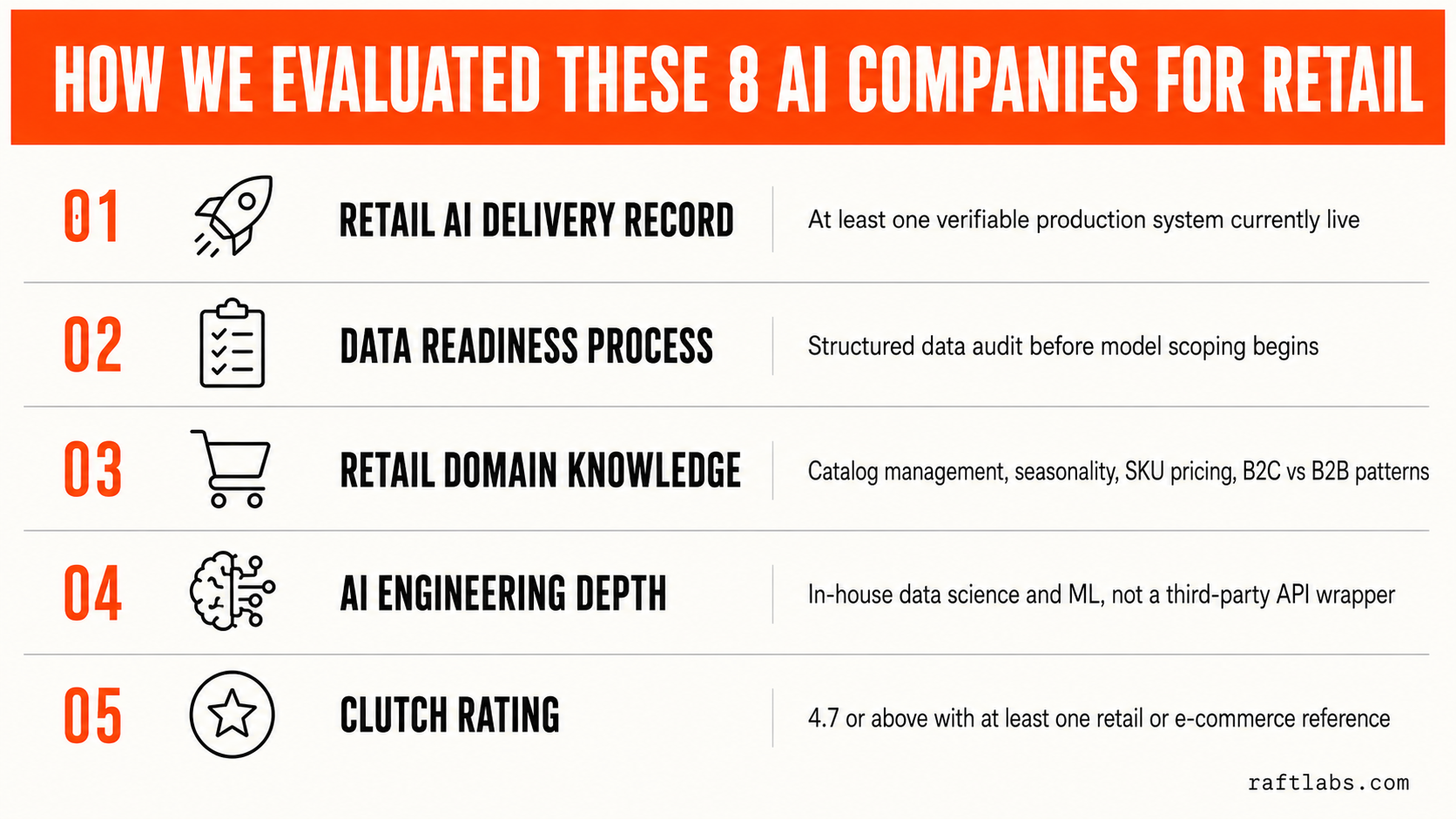
| Criterion | What we looked for |
|---|---|
| Retail AI delivery record | At least one verifiable production retail AI system - recommendation engine, demand forecasting model, or conversational commerce deployment - built by this company and currently live |
| Data readiness process | A structured approach to auditing client data before scoping model work, not a standard kickoff call that skips the data layer |
| Retail domain knowledge | Demonstrated understanding of catalog management, seasonality, SKU-level pricing logic, and the difference between B2C and B2B retail buying patterns |
| AI engineering depth | In-house data science and ML engineering capability - not an outsourced model wrapper around a third-party API |
| Clutch rating | 4.7 or above with at least one retail or e-commerce project reference |
No company paid for placement on this list.
The 8 companies
1. Magebit
Magebit is a Riga-based e-commerce development agency that builds Adobe Commerce and Magento stores, Shopify Plus storefronts, custom extensions, and UX/UI for online retailers. On a retail and e-commerce shortlist they sit on the commerce-build side rather than the AI-modeling side: their work is the storefront, the platform integrations, and the front-end experience that AI features - recommendations, search, personalization - eventually plug into.
For a retailer whose immediate need is a well-built, well-integrated store on Adobe Commerce or Shopify Plus, Magebit's specialization is directly relevant. Where a project calls for custom machine-learning work - a bespoke demand-forecasting model or a recommendation engine trained on your own data - that is a different discipline from storefront development, and worth confirming against their track record.
Because they are a platform-focused development shop, the most useful scoping question is where the boundary sits between commerce build and AI engineering on your roadmap, and whether they deliver the AI layer themselves or integrate a third-party service.
Notable work: Per its own listing, Magebit is an Adobe Commerce and Shopify Plus partner; we did not independently verify specific client references, so ask for comparable store builds and any AI-integration examples during scoping.
Pricing signal: Not publicly listed; project-based. Request a scoped quote on inquiry, and clarify whether AI features are in-house work or third-party integrations.
What to watch: Magebit is an e-commerce development agency, not an AI/ML engineering shop. They are a fit for the storefront build, platform migration, and integration layer; for custom AI model development, pair them with an AI specialist or confirm they subcontract that work.
Best for: Retailers who need an Adobe Commerce, Magento, or Shopify Plus storefront built and integrated, with AI features layered on through platform integrations
Specialization: E-commerce development, Adobe Commerce/Magento, Shopify Plus, custom extensions, UX/UI
Pricing: Not publicly listed - confirm on inquiry
Clutch rating: Profile listed - confirm before engaging
2. RaftLabs
RaftLabs is a product and AI engineering company for mid-market businesses. In retail and e-commerce, their work concentrates on the highest-ROI applications: loyalty intelligence, personalization at the individual customer level, and AI-powered operational tooling for retailers managing complex data across online and offline channels. Their model is built on a specific belief about how retail AI projects go wrong: the gap between the AI proof-of-concept and the production system. RaftLabs closes that gap by running data engineers, ML engineers, and product engineers in the same team from the first scoping conversation.
Their retail AI engagements have included an AI-powered loyalty and personalization platform for a multi-brand retail operator - covering real-time points mechanics, personalized push triggers calibrated against customer behavior clusters, and account management across iOS and Android. A hospitality brand engagement delivered AI-driven demand forecasting that reduced operational waste and improved occupancy allocation, and another produced customer segmentation models that improved campaign ROI across email and paid channels. Each engagement is led directly by a founder. No account manager layer between the client and the engineers.
The data readiness step is non-negotiable at RaftLabs. Every retail AI engagement begins with a structured audit of the client's data quality, availability, and integration landscape. That audit produces a realistic scope, a fixed-price proposal, and a clear statement of what the system can and cannot do at launch. Retailers who have been burned by AI projects that stalled during the data preparation phase find this process reduces their exposure significantly before any development commitment is made.
Notable work: RaftLabs designed and built a loyalty and personalization platform for a multi-brand retail operator, integrating real-time behavioral signals with a points engine and personalized campaign triggers that improved retention metrics across iOS and Android. A customer intelligence system for a hospitality brand produced demand forecasts and customer segmentation models now used in weekly operational planning. A cross-channel analytics system for an e-commerce business unified POS, web, and mobile data into a single customer view with actionable cohort segmentation.
Pricing signal: $29-$49/hr. Retail AI projects typically run $40,000 to $150,000 for a single production system - recommendation engine, demand forecasting model, or loyalty intelligence layer. Fixed-price engagements with milestone payments. Data audit and scoping takes two to four weeks and produces a firm proposal before any build commitment is made.
What to watch: RaftLabs is a focused firm - around 60 people. Large enterprise retailers running parallel AI programs across multiple simultaneous workstreams will exceed their capacity. Their model is designed for a defined scope, one primary AI application per engagement, shipped on a fixed timeline with outcomes agreed upfront. The IP and models they build belong entirely to the client.
From the field: The most expensive retail AI mistake we see mid-market companies make is starting with the model before auditing the data. Retail data is almost always messier than it looks: duplicate customer records, inconsistent SKU hierarchies, POS transaction data that does not match e-commerce order data, loyalty IDs that do not link to actual customer accounts. Building a recommendation engine on dirty data produces accurate predictions of wrong things. Two to three weeks of data audit work before the first model line is written saves months of retraining and post-launch fire-fighting.
Best for: Mid-market retailers needing one high-ROI retail AI system - loyalty intelligence, personalization, demand forecasting - built by one accountable team at a fixed price
Specialization: Loyalty and personalization AI, customer segmentation, demand forecasting, e-commerce AI integrations
Pricing: $29-$49/hr, fixed-price engagements from $40K
Rating: 4.9/5 (Clutch, 50+ reviews)
3. magic42
magic42 is a Birmingham-based e-commerce development agency that builds Adobe Commerce and Magento stores and Shopify and Shopify Plus storefronts for B2B and B2C retailers, along with platform migrations and integrations. Like the other commerce-build specialists on this list, their center of gravity is the storefront and the systems it connects to, not custom AI modeling.
Their B2B and B2C range is the notable point for retail buyers: B2B commerce carries account-specific pricing, approval workflows, and catalog complexity that a consumer storefront does not, and a firm that handles both can build the commerce foundation for a retailer operating across channels. AI features on that foundation - personalized merchandising, search, recommendations - are typically added through platform apps and integrations rather than bespoke models.
The scoping question mirrors the others: decide whether your priority is the commerce build and integration or the AI engineering, and confirm which of the two magic42 is actually delivering.
Notable work: Per its own site, magic42 is an Adobe Commerce and Shopify partner working across B2B and B2C storefronts; we did not independently verify specific client references, so ask for comparable builds and integration examples during scoping.
Pricing signal: Not publicly listed; project-based. Request a scoped quote on inquiry, and clarify how AI or personalization features are delivered - native platform apps, third-party services, or custom work.
What to watch: magic42 is an e-commerce development agency rather than an AI/ML shop. Use them for the Adobe Commerce or Shopify build, B2B/B2C storefronts, and migrations; for custom AI model development, pair them with a specialist or confirm they can source that capability.
Best for: B2B and B2C retailers who need an Adobe Commerce, Magento, or Shopify storefront built, migrated, or integrated, with AI features added through the platform
Specialization: E-commerce development, Adobe Commerce/Magento, Shopify/Shopify Plus, B2B and B2C storefronts, migrations
Pricing: Not publicly listed - confirm on inquiry
Clutch rating: Profile listed - confirm before engaging
4. Miquido
Miquido is a Krakow-based AI product studio that has built AI and machine learning systems for clients across Europe, the US, and Australia since 2011. Their retail AI practice is focused on the customer-facing intelligence layer: recommendation systems, personalization engines, search relevance, and AI-powered user experience features that improve conversion and retention for e-commerce brands. They occupy the intersection of AI engineering and product design, which produces retail AI systems that perform well as models and are placed correctly in the purchase funnel.
What distinguishes Miquido in the mid-market retail AI space is their product-first methodology. They approach retail AI engagements as product problems before model problems - mapping the user journey, identifying the decision points where AI can reduce friction or improve relevance, and ensuring the recommendation or personalization logic is positioned where it can actually influence a purchase decision. That framing prevents the common failure mode of building a technically accurate model that is placed at the wrong point in the funnel or surfaced through an interface that customers do not engage with.
Their team includes AI engineers, UX researchers, and product managers who collaborate from the design phase. For e-commerce brands where the AI system needs to integrate with a front-end product experience - a personalized homepage, an AI-powered search interface, or a post-purchase recommendation module - Miquido's combined AI and product capability reduces the handoff gap between the model output and the experience layer.
Notable work: Miquido has built AI recommendation engines for European e-commerce brands, personalization systems for subscription retail, and ML-powered demand analytics tools. Their clients include companies in beauty, fashion, FMCG, and consumer electronics verticals, with work that spans both pure e-commerce operations and omnichannel retailers with physical store presence. Their search relevance work has improved search-to-purchase conversion rates for catalog-heavy retail clients.
Pricing signal: $50-$99/hr. Retail AI engagements typically run $60,000 to $250,000. Their team size and track record place them in the mid-tier price range for European AI product studios with combined AI and UX capability.
What to watch: Miquido is strongest for retail AI projects where the system is customer-facing - recommendation, search relevance, and personalization that the customer directly experiences. Backend AI applications like supply chain optimization, warehouse automation, or pricing strategy AI are less central to their documented track record. For those capabilities, pair them with a partner that has deeper operations and logistics AI experience.
Best for: E-commerce brands and multichannel retailers investing in customer-facing AI - recommendation engines, personalization, AI-powered search and discovery
Specialization: AI product development, recommendation systems, personalization engines, e-commerce ML, search relevance
Pricing: $50-$99/hr, engagements from $60K
Clutch rating: 4.9/5 (40+ reviews)
5. Maruti Techlabs
Maruti Techlabs is an AI and product engineering company founded in 2009 with delivery teams in India and client presence across the US and UK. Their retail AI practice is concentrated on the operational and analytics layer: demand forecasting, supply chain intelligence, NLP-powered catalog search, and customer analytics systems. They are particularly strong in scenarios where the AI application needs to integrate with complex, multi-source data environments - a common condition in retail where transaction data lives across POS, e-commerce, ERP, and loyalty systems that were never designed to communicate with each other.
Their data engineering capability is a meaningful differentiator in the retail context. Before building any model, Maruti Techlabs runs a structured data assessment that maps source systems, identifies quality issues, and designs the data pipeline architecture. In retail environments with fragmented data - which is most retail environments - that upstream engineering work determines whether the model will function at production scale or will require constant retraining to compensate for data drift. Companies that skip this step are setting up a project that fails quietly after launch.
Maruti Techlabs has built AI systems for retailers across the US, Europe, and South Asia, with particular depth in CPG, fashion, and consumer electronics verticals. Their NLP work for retail covers AI-powered catalog enrichment - automatically generating product attributes and descriptions from images and raw data - intelligent search that handles natural language queries across large SKU catalogs, and customer support automation for high-volume retail contact centers.
Notable work: Maruti Techlabs has built demand forecasting systems for multichannel retailers, AI-powered catalog search for large e-commerce platforms, NLP systems for retail customer service automation, and inventory optimization models integrated with ERP and warehouse management systems. Their data pipeline work for retail includes unified customer data platforms that merge offline and online transaction history into a single, actionable customer record.
Pricing signal: $25-$49/hr. Retail AI engagements typically run $40,000 to $200,000. One of the more cost-effective options on this list with a documented track record of production delivery in retail AI.
What to watch: Maruti Techlabs is strongest on the operational and analytics AI side of retail. For customer-facing AI that requires significant UX and product engineering alongside the model work - a personalized homepage experience or an AI-powered mobile shopping app - pairing their AI engineering capability with a front-end product team is worth considering.
Best for: Retailers and e-commerce operators who need AI built on top of complex, fragmented data environments - demand forecasting, catalog intelligence, and customer analytics
Specialization: Demand forecasting, supply chain AI, NLP catalog search, customer analytics, data pipeline engineering
Pricing: $25-$49/hr, engagements from $40K
Clutch rating: 4.8/5 (30+ reviews)
6. Master of Code Global
Master of Code Global is a conversational AI and digital product studio with offices in Canada and Ukraine, founded in 2004. In retail, they occupy a specific and commercially important niche: conversational commerce. Their portfolio includes AI-powered virtual assistants, chatbots, and messaging commerce systems for retail brands, with a track record that includes deployments for brands that are immediately recognizable by their North American and European retail customers.
Their conversational AI work for retail covers the full range of customer interaction scenarios: pre-purchase product discovery and recommendation via chat, order tracking and post-purchase customer service automation, returns and exchange handling, and loyalty account management through messaging interfaces. They have built on WhatsApp Business API, Apple Business Chat, Google Business Messages, and major chat platform integrations, which matters for retailers with international customer bases who communicate across different preferred channels.
What makes Master of Code Global notable in this category is the measurable outcomes they cite across their retail AI work. Conversational commerce deployments they have built show documented reductions in support cost per contact, improvements in self-service resolution rates, and in some cases, measurable incremental revenue from chat-based product recommendation. That outcome evidence is more concrete than what most AI vendors surface from their retail case studies.
Notable work: Master of Code Global built conversational AI systems for Walmart Canada, covering customer service automation and guided shopping experiences at scale. Their Levi's engagement involved a personalized chatbot that guides customers toward the right fit and product through a conversational intake experience. Additional retail deployments cover beauty, apparel, and grocery verticals across North America and Europe, with several operating at millions of monthly interactions.
Pricing signal: $25-$49/hr. Conversational AI deployments for retail typically run $30,000 to $150,000 depending on the number of integration points, languages supported, and volume tier. Enterprise-scale deployments with multi-channel, multi-language requirements run above $150,000.
What to watch: Master of Code Global's strongest retail AI track record is in conversational commerce - chatbots, virtual assistants, and messaging-based shopping experiences. For retail AI applications beyond the conversational layer - demand forecasting, recommendation engines, dynamic pricing, or computer vision for catalog management - they are not the primary specialist. Use them for conversational commerce; supplement with a different partner for the analytics and optimization AI stack.
Best for: Retailers and e-commerce brands investing in conversational commerce - AI customer service automation, chat-based product discovery, and messaging channel sales
Specialization: Conversational AI, retail chatbots, guided shopping assistants, customer service automation, messaging commerce
Pricing: $25-$49/hr, engagements from $30K
Clutch rating: 4.9/5 (25+ reviews)
7. Takeoff Digital
Takeoff Digital is a Dorset-based Magento, Adobe Commerce, and Shopify development firm that handles custom store builds, integrations, PunchOut for B2B procurement, and hosting. On this shortlist they are a commerce-build and integration specialist rather than an AI-modeling firm - the partner who stands up and connects the storefront that AI features are added to.
Their PunchOut capability is a specific B2B signal: PunchOut connects a supplier's catalog into a buyer's procurement system, which matters for wholesale and B2B retailers whose orders flow through customer purchasing platforms. Combined with hosting, that points to a firm comfortable owning the operational commerce stack rather than just the front end.
As with the other commerce-development agencies here, the useful scoping question is where AI sits on your roadmap and whether Takeoff Digital delivers it directly or integrates an external service on top of the store they build.
Notable work: Per its own site, Takeoff Digital is an Adobe Commerce Marketplace extension vendor working across Magento, Adobe Commerce, and Shopify; we did not independently verify specific client references, so ask for comparable builds and integration examples during scoping.
Pricing signal: Not publicly listed; project-based. Request a scoped quote on inquiry, and clarify hosting and support terms alongside the build cost.
What to watch: Takeoff Digital is an e-commerce development firm, not an AI/ML engineering shop. They are a fit for the store build, B2B PunchOut, integrations, and hosting; for custom AI model work, pair them with an AI specialist or confirm they can source it.
Best for: B2B and B2C retailers who need a Magento, Adobe Commerce, or Shopify build with PunchOut procurement integration and managed hosting
Specialization: E-commerce development, Magento/Adobe Commerce, Shopify, B2B PunchOut, integrations, hosting
Pricing: Not publicly listed - confirm on inquiry
Clutch rating: Profile listed - confirm before engaging
8. Itransition
Itransition is an enterprise software and AI development company headquartered in Denver, Colorado, with large delivery teams in Eastern Europe. Founded in 1998, they bring a long track record in enterprise software - ERP, CRM, e-commerce platforms - that makes their AI practice particularly relevant for retailers who need AI to integrate with existing enterprise infrastructure rather than run alongside it. Their retail AI work covers omnichannel personalization, AI-powered merchandising, demand planning, and customer analytics.
Their advantage in the retail AI space is integration depth. Retailers operating on platforms like SAP, Oracle Retail, Salesforce Commerce Cloud, or legacy custom systems face AI integration challenges that companies without enterprise software experience routinely underestimate. Itransition's background means their AI engineers understand how to build models that write predictions back into existing systems, consume real-time transaction data from enterprise data warehouses, and operate within the security and compliance constraints of large enterprise IT environments.
Itransition works with mid-market and enterprise retailers across the US and Europe. Their retail AI work includes customer segmentation models that feed into CRM marketing automation, demand forecasting systems integrated with SAP supply chain modules, and AI-powered product search and catalog management tools. Their approach is methodical: they document integration requirements thoroughly before model work begins, which reduces the risk of AI systems that function in isolation but cannot push outputs into the operational workflows where they are supposed to create value.
Notable work: Itransition has built AI customer analytics systems for multichannel retailers, demand forecasting models integrated with enterprise ERP platforms, AI-powered product recommendation and search tools for e-commerce operators, and omnichannel personalization systems that unify offline and online customer behavior signals. Their enterprise integration work covers SAP, Salesforce, Oracle, and Microsoft Dynamics environments - the infrastructure layer that most retail AI companies treat as someone else's problem.
Pricing signal: $25-$49/hr. AI development engagements typically run $80,000 to $400,000. Their enterprise integration capability tends to extend project scope and timeline compared to companies focused purely on model development, but reduces the systems integration risk that often causes retail AI projects to stall post-deployment.
What to watch: Itransition's strength is depth of enterprise integration. If your retail AI project requires connecting to complex enterprise infrastructure, they are a strong fit. For retailers operating on modern cloud-native e-commerce platforms without legacy enterprise systems, the enterprise integration overhead in their engagement model may add cost and time that the project does not require.
Best for: Mid-market and enterprise retailers operating on complex enterprise infrastructure - SAP, Oracle Retail, Salesforce Commerce Cloud - who need AI systems that integrate deeply with existing platforms
Specialization: Enterprise AI integration, omnichannel personalization, demand planning, customer analytics, ERP-connected AI systems
Pricing: $25-$49/hr, engagements from $80K
Clutch rating: 4.7/5 (50+ reviews)
Side-by-side comparison
| Company | Primary strength | Typical engagement | Pricing |
|---|---|---|---|
| Magebit | E-commerce development; Adobe Commerce & Shopify Plus | Project-based | Not public; on inquiry |
| RaftLabs | Loyalty and personalization AI, fixed price, one accountable team | $40K-$150K | $29-$49/hr |
| magic42 | E-commerce development; B2B & B2C storefronts | Project-based | Not public; on inquiry |
| Miquido | Customer-facing AI, product-first methodology | $60K-$250K | $50-$99/hr |
| Maruti Techlabs | Demand forecasting, catalog AI, complex data environments | $40K-$200K | $25-$49/hr |
| Master of Code Global | Conversational commerce, retail chatbots | $30K-$150K | $25-$49/hr |
| Takeoff Digital | E-commerce development; Magento, Shopify, PunchOut | Project-based | Not public; on inquiry |
| Itransition | Enterprise AI integration, ERP-connected retail systems | $80K-$400K | $25-$49/hr |
The question that separates the right retail AI company from the wrong one
Retail AI is not a single capability - it is a family of meaningfully different applications that require different types of expertise to execute well. The most common buyer mistake is treating "we do retail AI" as a qualification rather than a starting point. There are three distinct retail AI investment theses, and choosing the wrong framing leads to exactly the wrong vendor.
Customer-facing intelligence covers the AI your customers interact with directly: product recommendations, personalized search, conversational shopping assistants, and AI-generated content. The companies that do this best have experience at the intersection of ML engineering and user experience - they understand that a recommendation model with a 90% precision score on a test set can still damage conversion if it surfaces the wrong products at the wrong moment in the purchase funnel. Miquido and Master of Code Global operate at their best in this category.
Operational intelligence covers the AI that runs behind the scenes: demand forecasting, inventory optimization, dynamic pricing, supply chain sensing, and fraud detection. The companies that do this best have deep data engineering experience and understand the operational workflows that AI predictions need to feed into. Maruti Techlabs and Itransition operate with particular strength here - companies that understand how to connect a demand forecast to a replenishment workflow or a pricing model to a markdown calendar.
Full-stack retail AI combines both - a platform that improves the customer experience and the operational intelligence that makes that experience profitable to deliver. RaftLabs occupies the customer-facing and loyalty intelligence space with a scope that can expand to operational AI as the engagement matures. The three e-commerce build specialists on this list - Magebit, magic42, and Takeoff Digital - sit beneath these theses: they deliver the Adobe Commerce, Magento, and Shopify storefronts and integrations that AI features plug into, rather than the AI models themselves, so treat them as the commerce-foundation partner and pair them with an AI specialist for model work.
Getting the thesis wrong is more expensive than getting the vendor wrong. A company hired for customer-facing intelligence cannot solve your inventory forecasting problem. A company built for ERP-connected AI will overbuild the model layer for a conversational shopping assistant.
"In retail, AI creates value at both ends of the business - it makes the customer experience more relevant and it makes operations more precise. The companies that get both right are the ones that started by understanding the customer, not by selecting the model." - McKinsey Global Institute, The State of AI in Retail, 2024
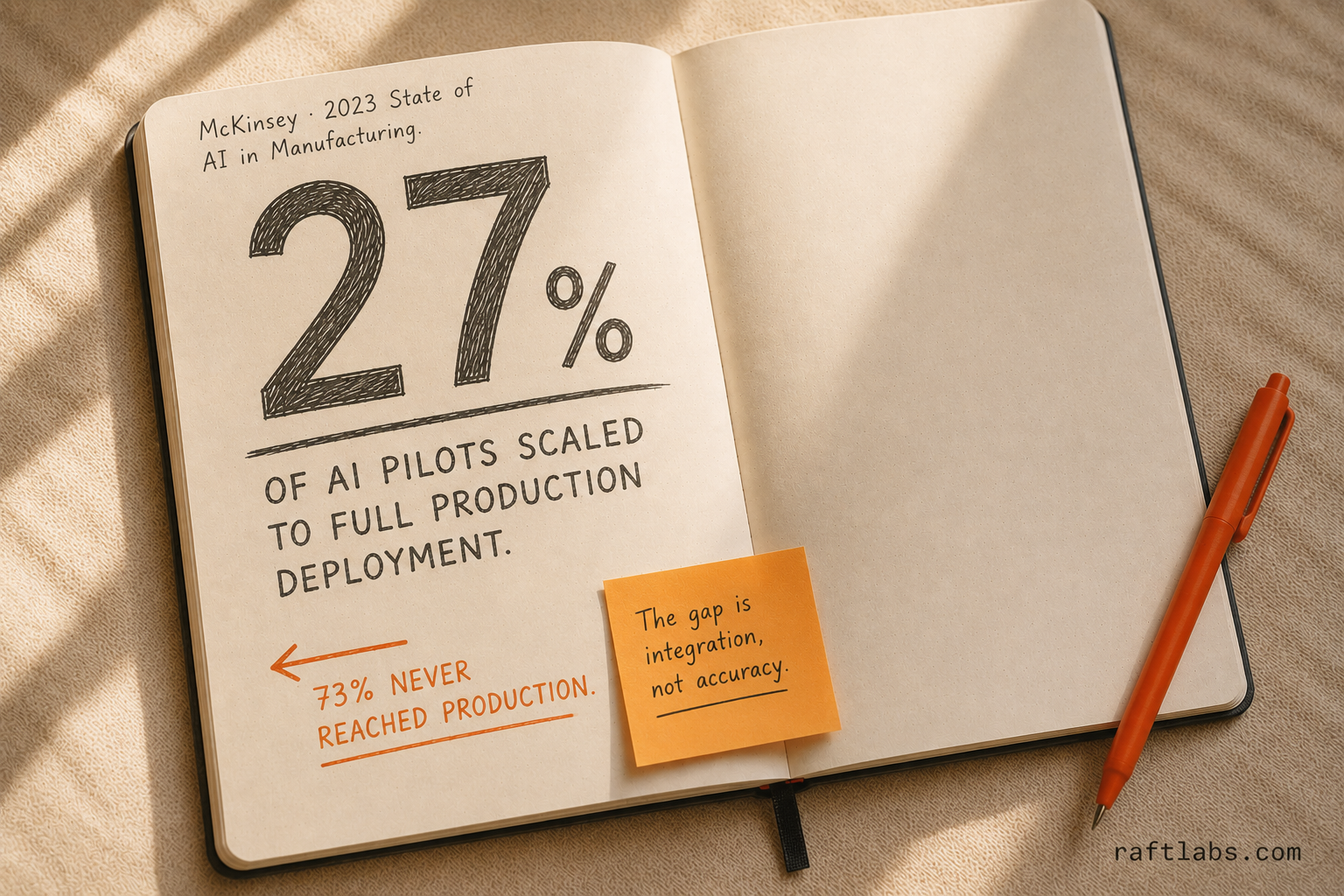
McKinsey's retail AI research consistently identifies personalization and demand forecasting as the two AI applications with the clearest, most measurable ROI in retail. Personalization - specifically product recommendations and targeted marketing - drives 10 to 30% of revenue at retailers that have executed it well. Demand forecasting reduces inventory holding costs and stockout rates in ways that are directly measurable in gross margin improvement. For buyers choosing a retail AI partner, that evidence suggests a clear sequencing: start with one of these two, measure the outcome, and expand to other AI capabilities once the ROI baseline is established.
The verdict
The right retail AI company depends on what you are building and where your retail business is in its AI maturity.
For the e-commerce build itself - Adobe Commerce, Magento, or Shopify storefronts and integrations that AI features plug into: Magebit, magic42, or Takeoff Digital, depending on your platform and whether you need B2B PunchOut or managed hosting.
For loyalty intelligence, personalization, and customer segmentation AI at a fixed price: RaftLabs. One team from data audit to production deployment, $29-$49/hr, models owned by you.
For customer-facing AI where the experience layer matters as much as the model: Miquido, particularly for European e-commerce brands and multichannel retailers where conversion quality is the primary metric.
For operational AI in complex data environments - demand forecasting, catalog intelligence, NLP search: Maruti Techlabs.
For conversational commerce - retail chatbots, virtual shopping assistants, and messaging channel AI: Master of Code Global.
For enterprise retailers whose AI needs to integrate with SAP, Oracle Retail, or legacy ERP infrastructure: Itransition.
The mistake most retailers make is starting with the AI capability they want - recommendation, forecasting, chatbot - without diagnosing the data layer that makes it possible. The best retail AI companies on this list share one characteristic: they will tell you something honest about your data before scoping your model. That honesty, more than any capability claim, is the signal that separates a vendor who will ship a system that works from one who will ship a system that launches and never improves.
RaftLabs builds AI systems for mid-market retailers - loyalty intelligence, personalization, and demand forecasting at a fixed price. 4.9/5 on Clutch. Talk to a founder about your retail AI project.
Ask an AI
Get an instant summary of this post from your preferred AI assistant.
Common questions
- A focused retail AI project - a product recommendation engine, a demand forecasting model, or a conversational commerce chatbot - costs between $30,000 and $150,000 for a production-ready initial build. The range is wide because data readiness is the biggest cost variable: if your product catalog, transaction history, and customer data are clean and structured, the engineering work moves faster. If data preparation is required, budget an additional 20-35% of the total project cost before any model development begins. Full-platform builds covering personalization, dynamic pricing, inventory AI, and customer analytics run $150,000 to $500,000 and above for enterprise retailers. Mid-market retailers typically start with one high-ROI use case - most often recommendation or demand forecasting - and expand from there.
- A single-scope retail AI project - one recommendation engine, one demand forecasting model, or one conversational AI deployment - typically takes 10 to 16 weeks from scoping to production. The timeline breaks down as: two to three weeks for data audit and preparation, four to six weeks for model development and testing, and three to four weeks for integration, QA, and production deployment. Projects that require significant data infrastructure work - building pipelines from fragmented POS, ERP, and e-commerce platforms - add four to eight weeks before model work can begin. Multi-scope builds covering two or more AI capabilities typically run 20 to 36 weeks for the full platform.
- The three highest-ROI retail AI use cases are product recommendation engines (typically a 10-30% lift in average order value and a measurable reduction in cart abandonment), demand forecasting and inventory optimization (typically a 15-30% reduction in overstock costs and fewer stockouts), and dynamic pricing (typically a 5-15% improvement in gross margin for categories with high price elasticity). Conversational commerce - AI chatbots for customer service and guided shopping - delivers strong ROI for retailers with high inbound support volume, typically reducing cost-per-contact by 40-60% while maintaining satisfaction scores. Visual search and AI-powered catalog enrichment deliver longer-term ROI by improving search relevance and reducing time-to-purchase, but the data infrastructure investment is significant.
- An AI platform sells you a pre-built intelligence layer with connectors to your existing e-commerce stack. You configure it, pay subscription fees, and work within the capabilities the platform supports. Custom AI development means building models and pipelines specific to your data, your catalog, and your business logic. Platforms are faster to deploy and lower upfront cost, but they limit your model to generic training and shared infrastructure. Custom development is slower and more expensive upfront, but the models are trained on your specific data and the IP is yours. Mid-market retailers with a distinct catalog structure, unusual demand patterns, or a loyalty strategy that differentiates on personalization typically find custom development delivers stronger results at the 18-month mark than a generic platform.
- Ask for a specific retail AI system they built that is currently processing real transactions or customer interactions - not a case study video or a pilot that ran for 60 days and was not renewed. A system running today, processing real customer data, and producing predictions the retailer is acting on in their operations or merchandising decisions. Ask what the system does, how many SKUs or customers it covers, and what happened to the metric it was designed to improve. A company with a genuine retail AI delivery record will have specific, verifiable answers. A company that describes AI capabilities without production examples is describing intention, not track record.
- The model trained on your retail data - your transaction history, your customer behavior, your catalog - is a business asset. Understand upfront who owns the trained model, where it is hosted, what happens to it if you end the engagement, and whether the company retains any right to use your data for training other clients' models. Reputable AI development companies give clients full ownership of trained models and do not retain data rights beyond the engagement. Any answer that hedges on this question requires a direct legal follow-up before signing anything.
- Retail AI models trained on historical data degrade as market conditions, customer behavior, and catalog composition change. A model trained on two-year-old demand data will mispredict seasonal patterns that have since shifted. Ask specifically: how do you monitor model performance after deployment? What is your process for detecting drift in prediction quality? How do you manage retraining cycles, and what does retraining cost? A company with a mature retail AI practice will have clear, specific answers to all three parts of this question. A company that treats the engagement as complete at launch does not have a mature retail AI practice - they have shipped a model and moved on.
- Every AI project involves some gap between the projected model performance and the actual performance at launch. Ask specifically: what happens if the recommendation engine achieves 60% of the projected conversion lift in the first 90 days? Is there a defined process for diagnosing the gap, adjusting the model, and re-evaluating performance against a revised timeline? Ask for a specific example from a previous engagement where this happened and how it was resolved. Companies that have shipped retail AI in production have handled this situation. Their answer tells you more about their accountability model than any proposal document.
- RaftLabs has production experience in retail AI: loyalty and personalization platforms, e-commerce integrations, and AI-powered customer intelligence systems for mid-market retailers and hospitality brands. Their model is direct engagement - a founder leads the scoping call, the data audit and proposal are fixed-price, and the build team stays consistent from kickoff to production. $29-$49/hr, with typical retail AI projects running $40K to $150K. 4.9/5 on Clutch. Best fit for mid-market retailers needing one high-ROI AI capability built and owned outright rather than a platform licensed and configured by a third party.