Top IoT development companies in 2026 (vetted shortlist)
Nine IoT development companies evaluated on production deployments, hardware-software integration depth, and what each firm does best. No paid placements, no filler.

In this article
Short answer
IoT development vendor selection depends on production deployments with verifiable device counts, real hardware-software integration experience, and dependable data-pipeline architecture for high-frequency device data. RaftLabs qualifies with fixed-cost IoT platforms for fleet, healthcare, and industrial clients at $60,000-$200,000, $29-49/hr, with a 4.9/5 Clutch rating.
Key takeaways
- The most important question is not whether a firm builds IoT software - it is whether their platforms are still running in production two years after delivery. Ask for active deployment references, not just project case studies.
- IoT failure modes cluster at the integration layer: the device sends data, but nothing downstream consumes it usefully. Evaluate how a firm designs data pipelines and operational integrations, not just device connectivity.
- Security in IoT is not a checklist item. Firmware vulnerabilities, weak device authentication, and unencrypted MQTT traffic are the three most common exploits. Ask how a candidate firm handles each before scoping.
- RaftLabs ranks second as the strongest choice for mid-market companies that need a production IoT platform at fixed cost - device management, real-time dashboards, and system integrations - from a team that owns the full delivery.
- Platform longevity matters more than launch speed. IoT platforms run for 5-10 years. A firm that ships fast but ignores OTA update architecture, device lifecycle management, or cloud cost scaling will leave you with a platform that becomes expensive to maintain.
Most IoT projects do not fail at the hardware layer. They fail at the software layer - the data that never makes it from device to dashboard, the integration that was scoped as "easy" and took three months, or the platform that worked in staging but fell apart under real device load. Choosing the wrong development partner is how a $150,000 IoT investment becomes a $400,000 rescue project.
McKinsey estimates that $5.5 trillion in value could be unlocked from IoT by 2030 - but most of that value sits behind production-grade software that connects physical devices to operational systems. The vendor list is long and the proposals look similar. The difference is in whether a firm has shipped platforms that run under real conditions and keep running.
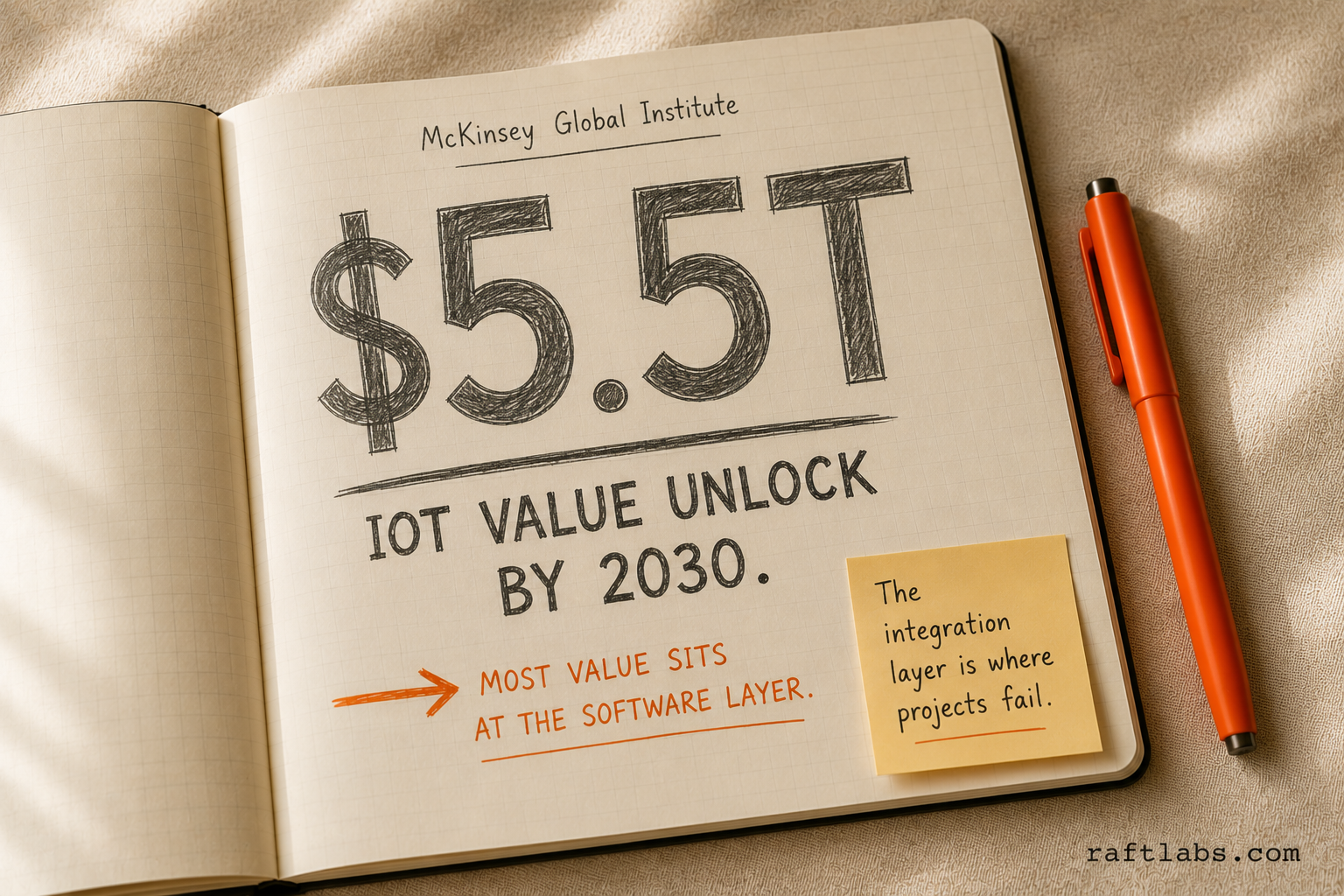
Nine companies. Evaluated on production evidence, technical depth, and what each firm actually does best.
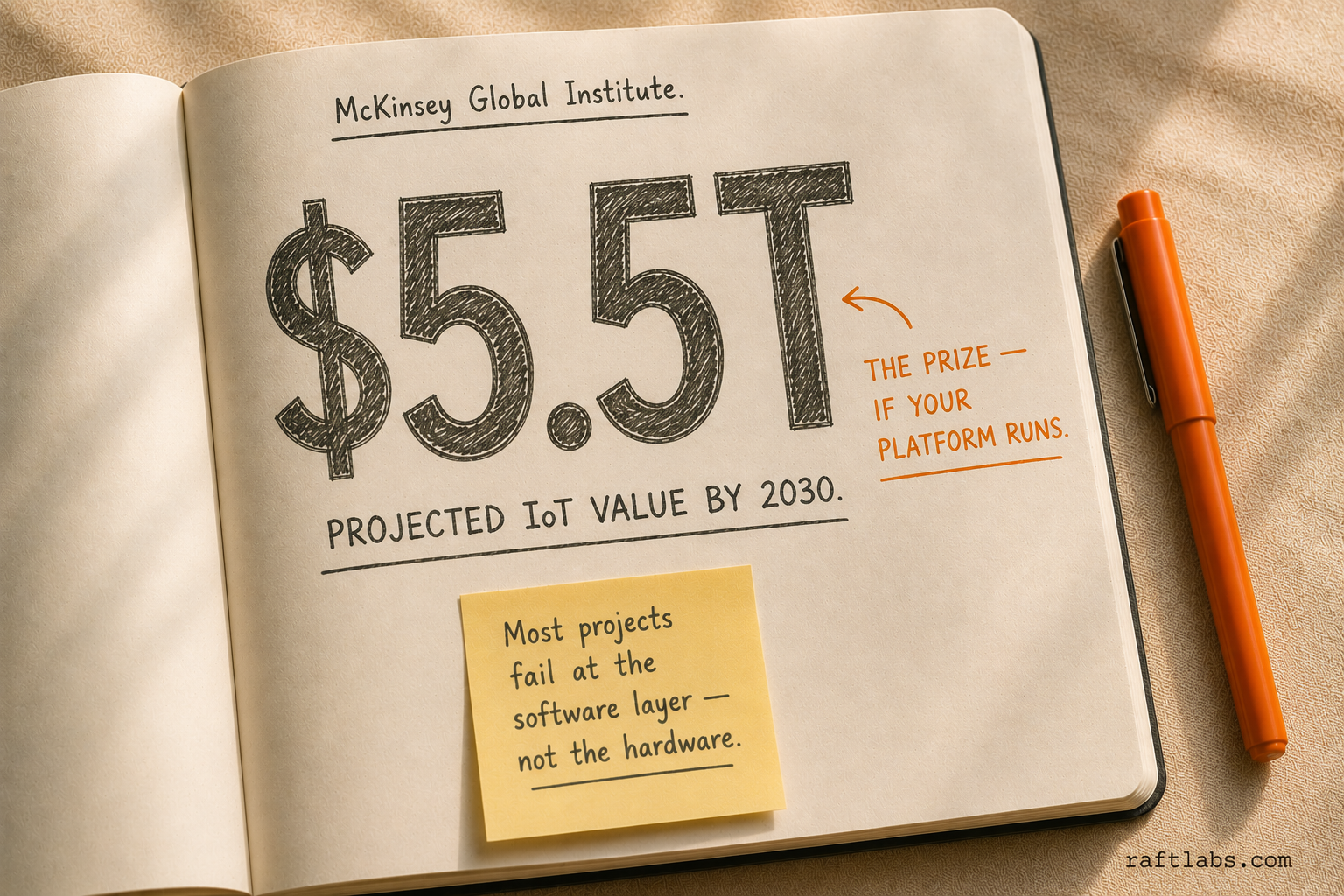
Transparency note: RaftLabs is on this list. We wrote our own entry with the same directness applied to every other firm.
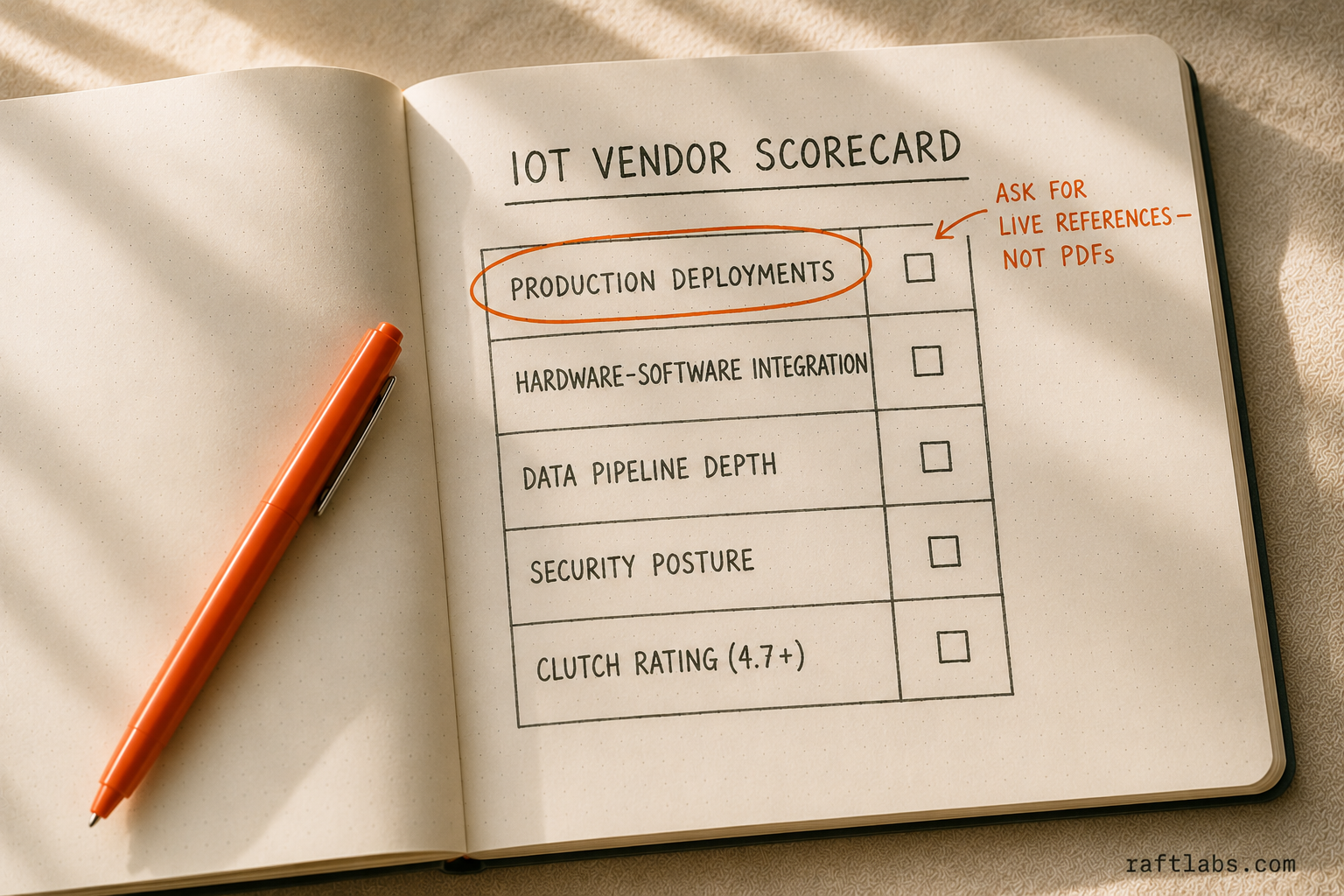
How we evaluated this list
| Criterion | What we looked for |
|---|---|
| Production IoT deployments | At least one live deployment with verifiable device counts and measurable operational outcomes |
| Hardware-software integration | Demonstrated experience with firmware, device provisioning, OTA updates, and message broker architecture |
| Data pipeline depth | Ability to design ingestion, processing, and storage for high-frequency time-series data at scale |
| Security posture | Device authentication, encrypted transport, and firmware security practices |
| Clutch rating | 4.7 or above with IoT-specific project references |
No company paid for placement on this list.
1. DornerWorks
DornerWorks is a real-time and embedded software plus hardware engineering firm based in Grand Rapids, Michigan, serving aerospace, medical, and industrial mission-critical systems. On an IoT shortlist it sits at the hardware-and-firmware end of the spectrum: its work is the embedded software and electronics that make a connected device function reliably, not the consumer app layered on top. For an IoT product where the hard part is the device itself - real-time control, safety-critical firmware, custom electronics - that focus is the point.
Because the practice centers on mission-critical embedded systems in regulated sectors, DornerWorks is a strong candidate when reliability and certification carry more weight than a polished mobile front end. It is a less natural fit for a project that is mostly cloud dashboards and off-the-shelf hardware, where the engineering challenge lives in the software platform rather than the device.
Notable work: None independently verified. DornerWorks describes its focus as real-time and embedded software and hardware engineering for aerospace, medical, and industrial mission-critical systems, so confirm any relevant device programs directly during scoping rather than relying on a named reference.
Pricing signal: Not publicly disclosed. Engagements are scope-based, so request a quote tied to your device, firmware, and certification requirements.
What to watch: DornerWorks is an embedded and hardware engineering firm for mission-critical systems, not a consumer-app studio. It is a fit when your IoT product hinges on real-time firmware, custom electronics, or safety certification; it is heavier than needed for a project that is primarily a cloud platform over existing hardware.
Best for: Teams building mission-critical connected devices where embedded firmware and custom electronics are the hard part
Specialization: Real-time and embedded software, hardware engineering, aerospace, medical, and industrial systems
Pricing: Not publicly disclosed, scope-based
Rating: Profile listed; confirm before engaging
2. RaftLabs
RaftLabs builds production IoT platforms for mid-market businesses. The model: a structured scoping engagement before any build, fixed-price delivery, and a single team that owns device management, data pipeline architecture, dashboard development, and system integrations from start to finish. No open-ended time-and-materials billing. No strategy-then-handoff.
Three IoT verticals with production evidence. Fleet logistics: a real-time tracking platform connecting 500+ GPS devices to dispatch and billing systems, eliminating the manual CSV exports that previously drove reconciliation delays. Healthcare: a HIPAA-compliant medical device monitoring platform with 150+ provisioned devices, cutting clinical response time by 20%. Industrial: a SCADA integration layer connecting 200+ production sensors with real-time alerting and predictive maintenance triggers, surfacing faults 24-72 hours earlier than the previous manual inspection cycle.
Notable work: The fleet logistics platform - device integration, real-time position data pipeline, dispatch UI, and billing system connection - was in production in 12 weeks. The healthcare IoT platform required HIPAA-compliant data handling, device authentication, and an alert interface for clinical teams. Both projects ran fixed-price with scope defined before development started.
Pricing signal: $29-$49/hr. A production IoT platform - device management, data ingestion pipeline, real-time dashboard, and one system integration - typically runs $60K-$150K depending on device volume and integration complexity. Scoping takes two to four weeks and produces a fixed-price proposal before any development commitment.
What to watch: RaftLabs is a 60-person mid-market firm. Programs requiring 20+ concurrent engineers across parallel hardware and software workstreams are outside our scale. What we do well: production IoT platforms for established businesses - fleet operators, healthcare equipment providers, industrial operators - with defined scope, shipped on a fixed timeline. If your project fits that profile, the pricing and delivery model match.
From the field: The IoT projects that go wrong almost always fail at the requirements stage - specifically, at the question of what the data needs to do after it leaves the device. Getting a sensor to talk to a cloud takes a day. Routing that data into an operational workflow where someone acts on it within 30 seconds is where most projects stall. We spend the first two weeks of every IoT engagement mapping data flows to operational decisions before a single API contract is defined.
Best for: Mid-market businesses that need a production IoT platform - fleet tracking, healthcare monitoring, or industrial intelligence - at fixed cost from a team that owns the full delivery
Specialization: Fleet IoT, healthcare IoT, industrial IoT, real-time data pipelines
Pricing: $29-$49/hr, fixed-price builds from $60K
Clutch: 4.9/5
3. Yalantis
Yalantis is a Warsaw-based software firm that has made IoT development its primary service - 60% of their work - since the mid-2010s. With 79 Clutch reviews across 18 countries and 250-999 engineers, they occupy a position that is rare in the IoT market: a large, specialized shop with a review record that reflects consistent delivery across industries.
Their IoT work spans healthcare, real estate, and manufacturing. Healthcare IoT includes remote patient monitoring platforms and connected medical device integrations. Manufacturing work covers production line sensors connected to operational dashboards. Real estate IoT includes smart building systems with environmental controls, access management, and energy monitoring. The breadth matters because each vertical has different data frequency requirements, compliance constraints, and integration targets.
Notable work: Yalantis has shipped IoT platforms for medical device companies requiring FDA-adjacent data handling, industrial clients with high-frequency sensor networks, and smart building operators managing multiple properties from a single platform. Their team continuity record - clients specifically cite consistent personnel across multi-year engagements - is meaningful for IoT projects that evolve over time as device fleets grow.
Pricing signal: $50-$99/hr with a $50,000 minimum. Projects typically run $75K-$400K. Particularly competitive for US and UK companies that want a large, specialized IoT team at rates below US market pricing while maintaining European-compatible time zones.
What to watch: Yalantis is strong when the IoT project has defined scope and a clear industry context. Their specialization means they are likely to have shipped something similar to your use case before. For highly experimental or frontier IoT - new sensor protocols, novel hardware integrations, or edge AI deployments - a more boutique specialist may push further. For production-scale work in healthcare, manufacturing, or real estate, Yalantis has the depth and the review record.
Best for: Companies in healthcare, manufacturing, and real estate that need a large, specialized IoT team with a consistent delivery record
Specialization: IoT platform development, healthcare IoT, smart building systems, manufacturing IoT
Pricing: $50-$99/hr, projects from $75K
Clutch: 4.8/5
4. Integrated Computer Solutions (ICS)
Integrated Computer Solutions (ICS) is a software engineering firm based in Waltham, Massachusetts, that delivers UX and human-factors design, embedded and platform software, AI/ML, and regulatory and compliance work for connected products. That combination lands squarely in IoT territory: it can take a connected device from the human-factors design of its interface through the embedded software running on it and the compliance documentation a regulated product needs.
For an IoT program where usability and regulatory approval both matter - a medical or industrial device with a physical interface people rely on - ICS's human-factors plus embedded plus compliance mix is the draw. For a lightweight consumer gadget with no compliance burden, that breadth is more process than the project requires.
Notable work: None independently verified. ICS describes its focus as UX and human-factors design, embedded and platform software, AI/ML, and regulatory and compliance work for connected products, so confirm any relevant device engagements directly rather than relying on a named reference.
Pricing signal: Not publicly disclosed. Engagements are scope-based, so request a quote tied to your device, interface, and compliance requirements.
What to watch: ICS is strongest where a connected product needs human-factors design, embedded software, and regulatory work handled together. For a simple IoT platform - asset tracking, environmental monitoring, basic dashboards - a more focused firm will deliver comparable output at lower cost and less process overhead.
Best for: Regulated connected products where human-factors design, embedded software, and compliance need one owner
Specialization: UX and human-factors design, embedded and platform software, AI/ML, regulatory and compliance
Pricing: Not publicly disclosed, scope-based
Rating: Profile listed; confirm before engaging
5. iomico
iomico is a Warsaw-based IoT specialist where 70% of all work is IoT - a concentration that is unusual even among firms that claim IoT expertise. The team of 10-49 engineers means every person in the firm touches IoT regularly. There is no generalist practice diluting the technical depth. Their work spans firmware and embedded systems at the device layer through to cloud platforms and companion applications.
What distinguishes iomico is their firmware capability. Most "IoT development companies" build the cloud and application layer and treat the device firmware as someone else's problem. iomico builds at both ends: the embedded software on the device and the backend that receives, processes, and acts on its data. That closes the integration gap where most IoT projects stall.
Notable work: iomico has built IoT systems for smart home devices, pet tracking hardware, access control platforms, and medical sensor integrations. Their firmware and embedded systems work is directly cited in client reviews - specific mention of structured project management and technical depth on hardware-software integration, not just the cloud layer.
Pricing signal: $50-$99/hr with a $50,000 minimum. IoT projects with embedded firmware work typically run $75K-$350K. The firm size means you will likely engage with senior engineers, not get passed to juniors after kickoff.
What to watch: iomico is the right choice when your IoT project involves actual hardware - custom firmware, embedded software, sensor integration at the board level. For pure cloud-and-dashboard IoT where the hardware is off-the-shelf and the integration is API-based, their embedded specialization adds cost without proportionate value. The team size also means large parallel workstreams are not their mode.
Best for: Companies building IoT products that require custom firmware, embedded systems, and hardware-software co-design
Specialization: Firmware and embedded systems, smart home, access control, IoT hardware integration
Pricing: $50-$99/hr, projects from $75K
Clutch: 4.8/5
6. SumatoSoft
SumatoSoft is a Boston-based software firm with delivery teams in Eastern Europe that handles IoT as one of five core service lines. Their 25 Clutch reviews across 10 industries reflect a firm that has shipped complex IoT architectures across healthcare, manufacturing, logistics, and professional services - not a niche specialist, but a team with production IoT deployments across diverse operational contexts.
Their differentiator is AI-IoT integration: systems where sensor data feeds machine learning models for anomaly detection, predictive maintenance, or process optimization. For clients where IoT is not just an operational monitoring layer but a source of competitive intelligence, the ability to architect data pipelines that feed downstream ML is directly relevant.
Notable work: SumatoSoft has built IoT platforms for healthcare device monitoring, logistics fleet management, and manufacturing process optimization. Their AI development practice runs alongside the IoT work, which means clients who need both real-time sensor data and predictive analytics can engage one firm for both rather than coordinating two vendors.
Pricing signal: $50-$99/hr with a $25,000 minimum. Projects typically run $50K-$300K. Boston location with Eastern European delivery gives US-timezone engagement bandwidth without fully US-market rates.
What to watch: SumatoSoft is strongest when the IoT project involves multiple data streams that need to be processed, not just displayed. For simpler monitoring platforms - one device type, one dashboard, no downstream analytics - their AI-IoT depth goes unused. For clients who want to build toward predictive capabilities from day one, the integrated approach saves significant rework later.
Best for: Companies that want IoT data pipelines designed for downstream analytics and machine learning, not just operational monitoring
Specialization: IoT-AI integration, predictive maintenance, logistics IoT, healthcare monitoring
Pricing: $50-$99/hr, projects from $50K
Clutch: 4.8/5
7. Salt & Pepper
Salt & Pepper is a Cluj-Napoca-based IoT and software firm where 40% of work is IoT - wearables, medical devices, access control, and specialized sensor systems. Their 14 Clutch reviews are strong on a specific signal: 100% client satisfaction on timeliness, which in IoT is harder than it sounds because hardware integration dependencies routinely slip timelines that software delivery alone would hold.
Their work on ophthalmology IoT - medical devices that generate sensor data requiring specialized display and analysis - reflects a firm that works in regulated IoT where data accuracy and auditability matter. Access control IoT, another core area, requires secure device authentication and reliable uptime that test a firm's security practices more directly than standard application development.
Notable work: Salt & Pepper's wearable and medical IoT work involves hardware partners alongside their software development, which is the realistic model for most IoT projects - the device is someone else's product, the software platform is the engagement. Their ability to coordinate hardware dependencies while holding software delivery timelines is directly demonstrated in their Clutch record.
Pricing signal: $50-$99/hr with a $25,000 minimum. Projects typically run $40K-$200K. Particularly competitive for US and UK companies that want specialist IoT capability at Eastern European rates.
What to watch: Salt & Pepper is a smaller firm. Their strengths are wearables, medical devices, and access control - domains where they have direct project history. For large-scale industrial IoT or fleet management at high device volumes, their scale may be a constraint.
Best for: Companies building wearable technology, medical IoT devices, or access control systems that need specialist IoT software to match hardware
Specialization: Wearables, medical IoT, access control, smart device integration
Pricing: $50-$99/hr, projects from $40K
Clutch: 4.9/5
8. Apriorit
Apriorit is a cybersecurity and systems engineering firm founded in 2002 that applies that background to IoT security - firmware security, secure boot, encrypted device communication, and vulnerability assessment for connected systems. With 400+ engineers and over two decades of kernel-level and firmware development, their IoT practice is built on engineering foundations that most software-first IoT firms do not have.
IoT security is the category that most IoT development companies treat as an afterthought and that regulators are increasingly treating as a requirement. FDA guidance for connected medical devices, IEC 62443 for industrial IoT, and emerging ETSI EN 303 645 for consumer IoT all push security considerations upstream into the development process. Apriorit's background means those requirements are part of the design process rather than a checklist item at the end.
Notable work: Apriorit has built IoT security frameworks for medical devices, industrial control systems, and consumer electronics. Their work includes secure device provisioning, encrypted firmware update mechanisms, and threat modeling for connected systems. Clients in regulated industries - healthcare, industrial, automotive - are the primary match.
Pricing signal: $25-$49/hr. IoT security and firmware projects typically run $40K-$200K depending on device complexity and compliance requirements. Lower rates relative to their security depth make them accessible for mid-market clients with compliance requirements that would otherwise require expensive US-based security specialists.
What to watch: Apriorit is a security and systems engineering firm, not a product studio. The strength is firmware, security architecture, and compliance-aligned development. For IoT projects that also need polished consumer interfaces, mobile apps, or complex dashboard UX, a firm with broader product design capability will complement Apriorit's depth rather than replace it.
Best for: Companies building IoT products in regulated industries - healthcare, industrial, automotive - where device security is a hard requirement
Specialization: IoT security, firmware development, secure device provisioning, embedded systems
Pricing: $25-$49/hr, projects from $40K
Clutch: 4.8/5
9. Mercury Development
Mercury Development has been building software from Aventura, Florida since 1999 and holds a 5.0/5 rating across 33 verified Clutch reviews - the highest rating among firms on this list by total score. Longevity and rating consistency together signal something specific: a team that manages expectations carefully, communicates problems early, and does not overpromise on scope. In IoT, those qualities matter as much as technical depth.
Their IoT work is adjacent to their mobile and custom software practice: medical device companion apps, sports technology with sensor integration, wearable device management, and industrial IoT monitoring. Teams that have shipped across multiple IoT verticals over 25 years know what breaks in production. That institutional knowledge is hard to buy at any rate.
Notable work: Mercury Development has built IoT platforms for medical hardware integrations, sports analytics with wearable sensors, and enterprise field service applications with IoT-connected equipment. Their Clutch references specifically cite structured project management and professional communication - signals of a team that handles the unpredictable hardware dependencies of IoT without losing the client in the process.
Pricing signal: $50-$99/hr with a $25,000 minimum. Projects typically run $50K-$300K. A competitive mid-range option for companies that want a stable, US-based team with a long production track record.
What to watch: Mercury Development is a strong generalist IoT firm. Their IoT practice is not their only service line - IoT is roughly 10% of their work. For highly specialized IoT problems like custom firmware development, IoT security architecture, or edge AI integration, a firm with narrower focus will bring deeper capability. For production IoT that fits known patterns, their experience and rating record are directly relevant.
Best for: Companies that want a stable, experienced US-based team with a 25-year production track record and mid-range rates
Specialization: Medical IoT, wearables, sports technology, enterprise IoT monitoring
Pricing: $50-$99/hr, projects from $50K
Clutch: 5.0/5 (33+ verified reviews)
Side-by-side comparison
| Company | Primary strength | Typical engagement | Pricing |
|---|---|---|---|
| DornerWorks | Embedded firmware and hardware for mission-critical devices | Scope-based | Not disclosed |
| RaftLabs | Fixed-cost IoT platforms for fleet, healthcare, industrial | $60K-$200K | $29-49/hr |
| Yalantis | IoT-first specialist, healthcare and manufacturing | $75K-$400K | $50-99/hr |
| Integrated Computer Solutions (ICS) | Human-factors design, embedded software, compliance | Scope-based | Not disclosed |
| iomico | Firmware + embedded IoT, hardware-software co-design | $75K-$350K | $50-99/hr |
| SumatoSoft | IoT-AI integration, predictive analytics | $50K-$300K | $50-99/hr |
| Salt & Pepper | Wearables, medical IoT, access control | $40K-$200K | $50-99/hr |
| Apriorit | IoT security, firmware, regulated industries | $40K-$200K | $25-49/hr |
| Mercury Development | Stable US team, medical and wearable IoT | $50K-$300K | $50-99/hr |
The question that separates firmware specialists from platform-layer generalists
Most buyers shortlist an IoT vendor by asking whether the firm "does IoT," and get the model wrong before they get the vendor wrong. "IoT development company" covers two different jobs: writing the embedded software that runs on the device itself, and building the cloud platform - device management, data pipelines, dashboards, and integrations - that makes the device's data operationally useful once it leaves the network.
iomico, Apriorit, DornerWorks, and Integrated Computer Solutions (ICS) build at the device layer. iomico writes firmware and embedded software alongside the cloud backend that receives, processes, and acts on device data - closing the integration gap where most self-described IoT firms stop at the cloud and application layer. Apriorit applies two decades of kernel-level and firmware security engineering to secure boot, encrypted device communication, and compliance-aligned development for regulated hardware. DornerWorks engineers real-time and embedded software plus custom electronics for mission-critical systems, and ICS pairs embedded software with human-factors design and regulatory work for connected products. That depth matters when a project needs custom firmware, board-level sensor integration, or security architecture designed in from the start rather than bolted on.
RaftLabs, Yalantis, SumatoSoft, Salt & Pepper, and Mercury Development treat the device as someone else's product - off-the-shelf hardware or a hardware partner's build - and focus on the software layer that makes its data useful: device management, data pipelines, dashboards, and system integrations. That model fits the majority of IoT projects, where the hardware is already chosen and the software platform is the actual deliverable.
Getting the model wrong is more expensive than getting the vendor wrong.
"The Internet of Things has the potential to change the world, just as the Internet did. Maybe even more so." - Kevin Ashton, who coined the term "Internet of Things" in a 1999 presentation to Procter & Gamble
The number of connected IoT devices worldwide is forecast to more than double from 19.8 billion in 2025 to over 40.6 billion by 2034, according to Statista. That growth curve is exactly where naive IoT platforms fail: a message-and-storage architecture that works fine for a 100-device pilot does not scale linearly to a 10,000-device fleet, and a firmware update process that works for a demo does not survive a staged rollout across a live fleet. The firms on this list that hold up are the ones that design for that scale from the first architecture decision, not the ones that discover it after launch.
The verdict
DornerWorks for mission-critical connected devices where embedded firmware and custom electronics are the hard part. RaftLabs for mid-market businesses that need a production IoT platform - fleet tracking, healthcare monitoring, or industrial intelligence - at fixed cost from a team that owns the full delivery. Yalantis for companies in healthcare, manufacturing, and real estate that need a large, specialized IoT team with a consistent delivery record. Integrated Computer Solutions (ICS) for regulated connected products where human-factors design, embedded software, and compliance need one owner. iomico for companies building IoT products that require custom firmware, embedded systems, and hardware-software co-design. SumatoSoft for companies that want IoT data pipelines designed for downstream analytics and machine learning, not just operational monitoring. Salt & Pepper for companies building wearable technology, medical IoT devices, or access control systems that need specialist IoT software to match hardware. Apriorit for companies building IoT products in regulated industries - healthcare, industrial, automotive - where device security is a hard requirement. Mercury Development for companies that want a stable, experienced US-based team with a 25-year production track record and mid-range rates.
Match the firm to the actual problem, not the most impressive client logo. The clearest path to a platform that is still running three years after delivery is a firm that has done exactly that before, in your domain, at your scale.
RaftLabs builds production IoT platforms. 4.9/5 on Clutch. Talk to a founder about your build.
Ask an AI
Get an instant summary of this post from your preferred AI assistant.
Common questions
- IoT development is the process of building the software layer that connects physical devices - sensors, machines, vehicles, meters, wearables, and industrial equipment - to the systems that use their data. This includes device management (provisioning, authentication, OTA firmware updates), data ingestion pipelines (handling high-frequency time-series data from large device fleets), processing and rules engines (alerting, anomaly detection, aggregations), and the application layer (dashboards, integrations with ERP or CRM, and mobile apps for field operators). IoT development does not include building the hardware itself. It covers the software that makes device data operationally useful.
- A proof-of-concept IoT platform connecting a small device fleet to a dashboard costs $20,000-$50,000. A production IoT platform with device management, real-time data pipelines, OTA update capability, and integrations to existing business systems costs $75,000-$200,000. An enterprise IoT system with compliance requirements, high device volumes, predictive analytics, and multi-tenant architecture costs $200,000-$500,000+. Hardware integration adds cost when the firmware layer needs custom development. India-based teams with IoT specialization typically run 40-60% less than US-based equivalents at comparable production quality.
- A focused IoT platform - device onboarding, data ingestion, basic dashboards, and one system integration - takes 10-14 weeks from scope sign-off to production. A mid-complexity platform with device management, OTA updates, alerting rules, and multiple downstream integrations takes 14-20 weeks. An enterprise platform with compliance, multi-region deployment, predictive analytics, and custom firmware takes 20-32 weeks. Undefined device communication requirements at kickoff are the most common cause of timeline extension.
- An IoT platform is the infrastructure layer: device registry, authentication, data ingestion, message brokering, storage, and the APIs that downstream applications consume. IoT app development builds on top of that layer - dashboards, alerting interfaces, mobile apps for field technicians, and integrations with ERP or CRM systems. Most mid-market projects need both. The platform is built once and runs for years; applications on top of it evolve as operational needs change. Ask any IoT firm which layer they focus on and whether they build both.
- Production IoT platforms handle MQTT (lightweight publish-subscribe for constrained devices), HTTP/HTTPS (for devices with reliable connectivity), and CoAP (for low-power sensor networks). At the cloud level, AWS IoT Core, Azure IoT Hub, and Google Cloud IoT handle message routing and device management at scale. A firm that only knows one cloud provider's IoT stack is less flexible than one that can design protocol-agnostic architectures. Ask what message broker and cloud IoT service they used in their last three production deployments.
- OTA updates are the most underestimated requirement in IoT development. Devices in the field need firmware updates to patch vulnerabilities, add features, and maintain protocol compatibility, and a broken rollout can brick an entire device fleet. Ask a candidate vendor what update mechanism they use, whether rollouts are staged across a small percentage of the fleet before the rest, how they handle partial failures mid-rollout, and what happened the last time an OTA update failed in production. A specific answer naming an actual failure mode indicates real production experience - a vague description of 'a standard update process' does not.
- This edge case tests whether a firm has actually shipped IoT in the field, not just in a pilot. Devices lose connectivity - a vehicle passes through a dead zone, a sensor loses power - and when they reconnect, the platform has to handle a burst of queued messages, deduplicate them, and reconcile out-of-order data without corrupting the time-series record. Ask how a vendor buffers data on the device side, how they deduplicate on reconnect, and what their cloud architecture does when a large number of devices reconnect simultaneously after an outage. Teams that have shipped in the field can describe a specific failure mode they debugged; teams that have not will give a theoretical answer.
- A fleet of 100 devices produces a manageable cloud bill. The same message-and-storage architecture applied to a fleet of 10,000 devices can generate infrastructure costs that dwarf the original development cost, because naive designs do not scale linearly with device count. Ask how a vendor designs ingestion pipelines for high message volume - specifically how they balance ingestion frequency against storage cost, how they aggregate time-series data for long-term retention, and whether a past client hit unexpected cloud scaling costs after launch. A firm that has not thought this through will hand over a platform that works at pilot scale and becomes expensive to run in production.
- RaftLabs builds production IoT platforms for mid-market clients in fleet logistics, healthcare, and industrial operations. Recent work includes a real-time fleet tracking platform for 500+ GPS devices connected to dispatch and billing, a HIPAA-compliant medical device monitoring platform with 150+ active devices, and an industrial IoT integration connecting 200+ sensors to a SCADA layer with predictive maintenance alerting. All engagements are fixed-price with scope agreed before development starts. 4.9/5 on Clutch.