Top web design companies for energy in 2026 (vetted shortlist)
Eight web design agencies evaluated on energy sector track record, B2B conversion design, and technical communication capability. No pay-to-play placements.

In this article
Short answer
Evaluating web design companies for energy comes down to multi-audience B2B architecture - serving investors, procurement teams, and technical partners from one site - and design-to-production fidelity. RaftLabs meets this bar with real energy-sector delivery for utility provider Energia (a customer loyalty platform rebuild, 300,000+ records migrated, 99.9% uptime), a 4.9/5 Clutch rating, at $29-$49/hr.
Key takeaways
- Energy companies must serve three distinct audiences from a single website: investors evaluating financial performance, enterprise procurement teams assessing operational credibility, and project partners or regulators checking technical compliance. Agencies without energy sector experience default to designing for one audience and underserving the other two.
- Technical credibility signals matter more in energy than in most B2B sectors. A website that leads with visual flair and buries project execution proof, safety records, and ESG data loses the trust of exactly the buyers it needs to convert.
- The gap between an approved design and the live website is where most energy web projects fail. Agencies that hand off a Figma file to a separate development team produce sites that drift from the design brief during build. Studios that run design and engineering together eliminate this gap entirely.
- Post-launch content management is an underrated decision in energy web design. Project milestone updates, ESG metrics, regulatory filing summaries, and news releases need to be manageable by communications teams without developer involvement - or the site becomes outdated within 90 days of launch.
- RaftLabs is the practical choice for mid-market energy businesses: fixed-price, design and engineering in one team, $29-$49/hr, and a scoping process that defines deliverables and costs before any work starts.
According to Technavio, the digital transformation market in oil and gas alone is projected to grow by $69.8 billion between 2026 and 2030, at a CAGR of 15.6%, every company in that spend race needs a website that can keep pace with its growth story.
Energy companies often carry one of the hardest web design briefs in B2B: communicate operational credibility to investors, technical capability to enterprise procurement teams, and regulatory compliance standing to government partners - all from a single website, without losing coherence or visual quality. Most web design agencies apply a generic B2B template, add imagery of turbines and pipelines, and present that as sector expertise. The agencies that actually understand energy web design start with the audience architecture, not the layout.
Eight companies made this list, in alphabetical order: Inclind, Lounge Lizard, O3 World, Orbit Media Studios, Parachute Design Group, RaftLabs, Thought Media, and Troy Web Consulting. RaftLabs is on this list. We wrote our own entry with the same directness we applied to everyone else - it is included because it designs and builds web products for B2B and industrial companies, and we'd encourage you to assess it against the same criteria as every other name here.
How we evaluated this list
| Criterion | What we looked for |
|---|---|
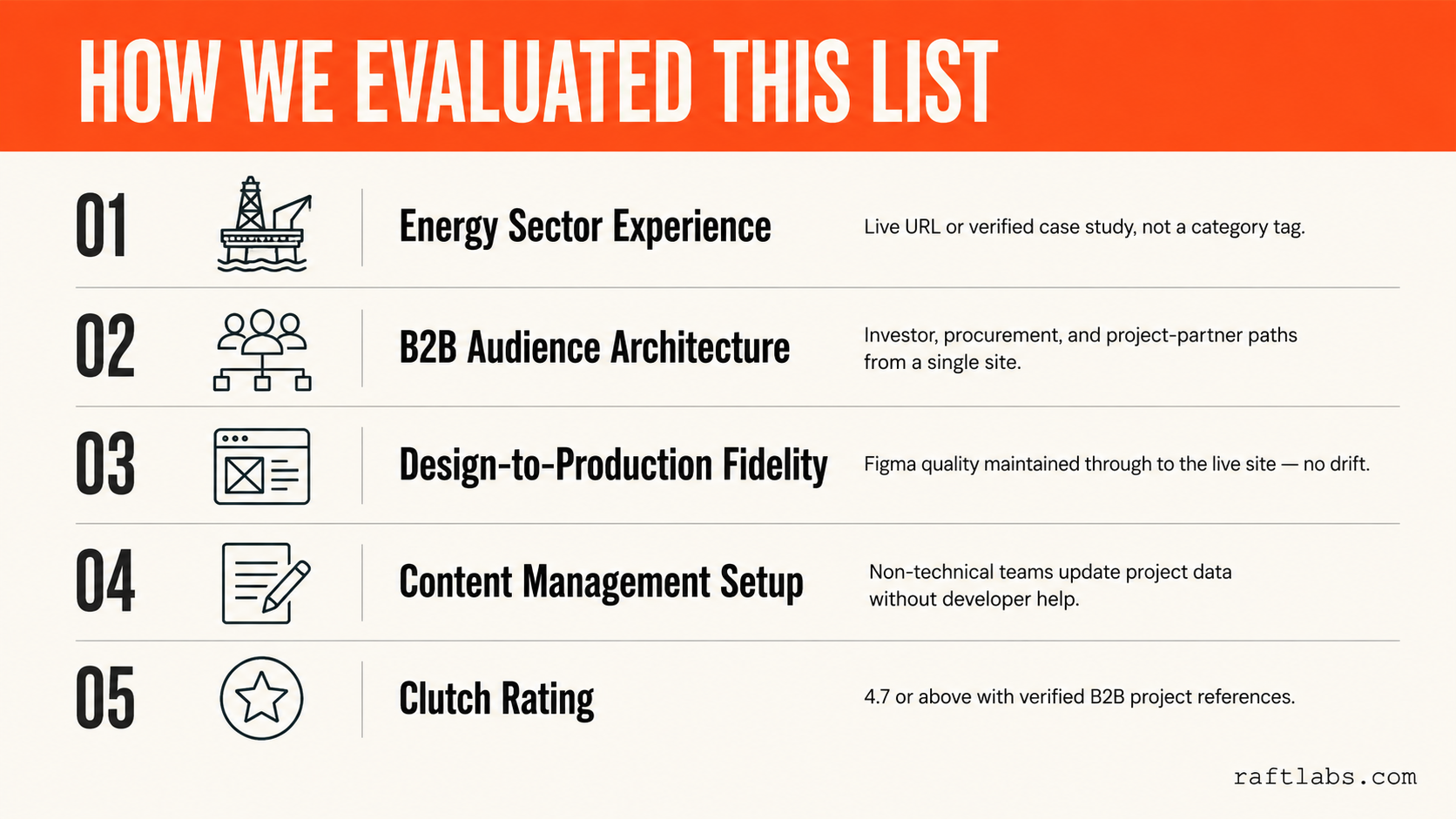
| Energy or industrial sector experience | At least one documented project for an energy, utilities, cleantech, or industrial company - a live URL or verified case study, not a category tag |
| B2B audience architecture | Evidence of designing for multiple distinct buyer audiences (investors, procurement teams, project partners) without diluting any message |
| Design-to-production fidelity | Track record of delivering sites that match the approved design - not studios where Figma quality drifts during the development handoff |
| Content management setup | Post-launch CMS configurations that allow non-technical teams to update project status, ESG data, news, and technical content without developer involvement |
| Clutch rating | 4.7 or above with B2B project references |
No company paid for placement on this list. The order below is alphabetical, not a performance ranking - we did not score or rank these companies against each other.
The 8 companies (in alphabetical order)
1. Inclind
Inclind is a web design and development agency based in Lewes and Wilmington, Delaware, that has built WordPress and Drupal sites since 1999. Their client base is concentrated in exactly the sectors that share energy's communication constraints: utilities, energy, government, nonprofit, and healthcare communications teams. That focus means the multi-audience, compliance-adjacent content structure that defines energy web design is familiar territory rather than a first-time discovery.
Their long operating history and CMS depth in WordPress and Drupal matter for energy companies whose communications teams need to update project status, regulatory summaries, and ESG data without developer involvement. A firm that has run enterprise CMS builds for utility and government audiences since 1999 has been forced to keep its content-management practices current across multiple technology generations, which filters out agencies whose methods stopped evolving.
For energy companies, Inclind's utility and government track record is the relevant credential. Their positioning is oriented toward communications and content-managed sites rather than conversion-engineered marketing funnels, so a company whose primary need is aggressive lead-generation design should weigh that against a more CRO-focused studio.
Notable work: WordPress and Drupal web design and development for utilities, energy, government, nonprofit, and healthcare communications teams. Delaware Electric Co-Op is referenced in directory listings among their utility-sector work.
Pricing signal: Not publicly listed. Request a scoped quote based on your CMS platform, content-management requirements, and the number of audience tracks the site must serve.
What to watch: Inclind's strength is content-managed sites for utility, energy, and government communications teams, not conversion-optimised marketing design. For an energy company whose primary objective is lead-generation and CRO, a more conversion-focused studio may fit the brief better. Confirm their approach to your specific audience architecture in scoping.
Best for: Energy, utility, and government communications teams that need a content-managed WordPress or Drupal site from an agency with deep public-sector and utility experience
Specialization: WordPress and Drupal web design and development, utility and government communications, multi-audience content management
Pricing: Not publicly listed - request a scoped quote
Clutch: 21 reviews noted; star rating not verified live - confirm before engaging
2. Lounge Lizard
Lounge Lizard is a New York-based full-service digital agency founded in 1998 with additional offices across the US. Their 25+ years of continuous operation gives them a track record that spans multiple generations of web technology - from the standards era through mobile-first design to modern component-driven development - and a client base that includes energy, industrial, and manufacturing companies alongside their broader B2B and consumer portfolio. Longevity in web design is a meaningful signal: agencies that survive multiple technology generations have been forced to update their technical practices repeatedly, which filters out firms that were competent at one moment in time but locked their methods there.
Their energy and industrial sector work includes websites for oil and gas services companies, utility contractors, and industrial equipment manufacturers. The common thread across these clients is the need to present technical credibility and operational scale to B2B audiences that evaluate vendors on capability, safety record, and financial stability - not creative ambition. Lounge Lizard's combination of branding, web design, web development, SEO, and digital marketing under one contract means an energy company can consolidate multiple vendor relationships rather than coordinate separate agencies for different services.
Their full-service model is particularly relevant for mid-market energy companies that are building their digital marketing infrastructure for the first time, or rebuilding after a period of fragmented vendor relationships. A single agency relationship that covers website, brand guidelines, SEO strategy, and content marketing reduces the coordination overhead that consumes internal resources in multi-vendor arrangements.
Notable work: Lounge Lizard has delivered branding, web design, and digital marketing for energy services companies, industrial manufacturers, and utility contractors. Their 25+ year portfolio spans sectors from consumer brands to B2B industrial, with consistent throughput across design generations and technology cycles. Their energy sector work emphasises operational capability presentation and vendor credibility framing for procurement-oriented buyer journeys.
Pricing signal: $100-$149/hr. Projects typically run $25,000 to $300,000. Their full-service capability means a single engagement can cover branding, web design, development, and an SEO or paid search launch - a practical consolidation for energy companies that want to reduce vendor coordination rather than assemble a best-of-breed stack from separate specialists.
What to watch: Lounge Lizard's breadth - consumer brands, energy, industrial, healthcare, and tech clients - means their team's domain knowledge in energy is accumulated across a diverse portfolio rather than concentrated in a sector focus. Ask specifically which team members have worked on energy or industrial sector accounts and what they would approach differently for your category and buyer audience. A firm this broad will sometimes default to the general B2B template. The scoping conversation reveals whether that is their plan.
Best for: Energy companies that want a long-established full-service agency handling branding, web design, development, and digital marketing from a single vendor relationship
Specialization: Full-service digital, energy and industrial sector clients, branding, web development, digital marketing
Pricing: $100-$149/hr, projects from $25K
Clutch: 4.8/5
3. O3 World
O3 World is a Philadelphia-based digital experience agency founded in 2005 with a client base concentrated in healthcare, utilities, and mission-driven enterprise organisations. Their utility sector work is the most directly relevant credential for energy companies operating in the regulated space: designing digital experiences for utility companies requires the same multi-audience architecture, compliance-adjacent content management structure, and operational data presentation discipline that defines energy company web design broadly.
Their practice covers UX strategy, web design, web development, and CMS implementation. Their focus on digital experience rather than marketing design reflects a bias toward how websites work for audiences over the medium term - usability, content management efficiency, accessibility compliance, and long-term maintainability - rather than how they look at launch. For energy companies where the website is an ongoing communications tool across investor cycles, project milestones, regulatory submissions, and ESG reporting periods, that operational bias is the correct frame.
O3 World works with complex organisations - health systems, utilities, and enterprise nonprofits - where website governance, multi-contributor content management, audience-segmented architecture, and accessibility compliance are baseline requirements, not premium additions. That experience base translates directly to energy sector web design, where multiple internal teams (investor relations, communications, project development, and legal) each have a legitimate stake in what appears on the public website.
Notable work: O3 World has delivered digital experience design and development for utility companies, healthcare networks, and enterprise mission-driven organisations across the US. Their utility sector work includes website architecture for companies managing multi-stakeholder audiences - rate payers, regulators, investors, and commercial customers - within a single coherent digital presence. This is precisely the architecture challenge that oil and gas, renewable energy, and utility companies face.
Pricing signal: $100-$149/hr. Projects typically run $50,000 to $250,000. Their Philadelphia base and enterprise-scale client experience set their rate at the professional agency tier. For utility companies and regulated energy businesses, their prior exposure to compliance-adjacent content architecture and multi-stakeholder governance models justifies the investment over a general agency at a lower rate that lacks the same domain context.
What to watch: O3 World's sweet spot is complex organisations with multi-stakeholder digital experience needs and active governance requirements. For straightforward marketing website projects - a 10 to 15 page professional site for a mid-market energy services company without investor relations complexity - their process may be scoped for more organisational complexity than the project requires. Right-size the engagement carefully in the initial discovery conversation.
Best for: Utility companies and regulated energy businesses that need multi-audience digital experience design with compliance-adjacent content architecture and multi-contributor CMS governance
Specialization: Utility and healthcare sector digital experience, multi-stakeholder UX, enterprise CMS implementation, accessibility compliance
Pricing: $100-$149/hr, projects from $50K
Rating: 4.9/5 (Clutch)
4. Orbit Media Studios
Orbit Media Studios is a Chicago-based web design agency known for a research-driven, content-first approach to B2B website performance. Founded by Andy Crestodina - who publishes extensively on web design strategy, content marketing benchmarks, and conversion architecture - the firm applies quantitative rigour to design decisions that most agencies treat as aesthetic preferences: navigation structure, page load performance, content hierarchy, heading architecture, and conversion path design. Their annual research on web design and content marketing is among the most widely cited benchmark datasets in the industry.
For energy companies, Orbit's methodological approach is particularly valuable on the content strategy side. Energy websites fail most often not because of visual quality but because of information architecture. The right content for investor audiences is buried three clicks from the homepage. Project milestones are not updated regularly enough to be credible. ESG performance sections exist as PDF links rather than structured, skimmable content. Orbit's content-first design process surfaces and resolves these problems before the visual layer is applied - which means the site's structure is built to serve the right content to the right audience, not retrofitted to accommodate content that was written after the design was locked.
Their client base is concentrated in B2B professional services, technology, and industrial sectors across the US Midwest and beyond - companies where the website functions as a pre-sales qualification tool for senior decision-makers evaluating over a long cycle. That profile aligns closely with mid-market energy companies in oil and gas services, renewables development, and utility contracting.
Notable work: Orbit Media Studios has designed and built websites for B2B companies in manufacturing, professional services, technology, and industrial sectors. Their work consistently involves full site architecture, content strategy, UX design, development, and post-launch analytics configuration. Their published case studies are among the more transparent in the industry in terms of before-and-after conversion metrics and documented design rationale.
Pricing signal: $100-$149/hr. Projects typically run $25,000 to $150,000. Their research-heavy process adds cost in the discovery and strategy phases but reduces mid-project rework from unvalidated structural assumptions - a practical benefit for energy companies where stakeholder approval cycles are long and change orders mid-build are expensive. Getting the information architecture right before design begins is cheaper than redesigning it after the first stakeholder review.
What to watch: Orbit Media's core competency is in marketing websites and content-driven lead generation. For energy companies that need complex connected systems alongside the marketing site - investor portals with secure data rooms, permit management integrations, or operational monitoring dashboards - Orbit's engineering depth is primarily oriented toward marketing-stack integrations (CMS, CRM, analytics) rather than custom application development. Scope accordingly.
Best for: Mid-market energy companies that need a content-strategy-led website redesign with measurable conversion outcomes and transparent research documentation of every structural decision
Specialization: B2B web design, content strategy, conversion rate optimisation, Chicago-based industrial sector experience
Pricing: $100-$149/hr, projects from $25K
Clutch: 4.9/5
5. Parachute Design Group
Parachute Design Group is a Toronto-based web design and digital strategy agency with documented cleantech and energy sector experience. Their Clutch profile - 34 verified reviews at 4.9/5 - reflects consistent client satisfaction across a range of B2B and professional services engagements. Their cleantech project, a full website redesign and deployment for a sustainability-focused energy company, confirms direct exposure to the communication challenge that defines energy sector web design: technical credibility for expert audiences paired with accessible framing for a broader investor and partner base.
Their practice combines brand strategy, UX design, web development, and digital marketing. The Toronto base is a practical advantage for energy companies headquartered in Calgary, Toronto, or Vancouver, as well as US companies that want a firm with strong North American B2B market understanding and no international communication overhead. Canada's energy sector - spanning oil sands, natural gas, nuclear, and a rapidly expanding renewables market - gives Parachute a home market context that general US agencies operating without Canadian sector exposure do not carry.
What distinguishes Parachute's work is their attention to brand coherence: they treat the website as one expression of a wider brand position, not an isolated digital asset. For energy companies where the public website, investor materials, project fact sheets, and trade show presence need to tell a consistent story to the same audiences across channels, that brand-integrated approach is worth more than a technically polished website that sits visually apart from the company's other communications.
Notable work: Parachute Design Group has delivered website redesigns and digital strategy for cleantech companies, professional services firms, and B2B businesses across North America. Their cleantech engagement involved full site redesign and deployment - from information architecture through development and launch - for a company operating in the sustainability and energy transition space. This is the type of project where cleantech-specific navigation patterns, ESG content framing, and investor-credibility design decisions are tested against a real brief.
Pricing signal: $150-$199/hr, minimum project $10,000. Projects typically run $15,000 to $75,000. For a Toronto or Calgary-based energy company, Parachute represents a strong local option at a competitive rate relative to their review count and track record. For US companies comparing North American options, the rate translates well against US agency equivalents at the same output quality tier.
What to watch: Parachute's scale - 10 to 49 employees - means their engagement team size is limited. For energy companies with complex multi-workstream web programs running simultaneously, team capacity may constrain the timeline. Their sweet spot is a focused, well-defined web redesign or new site build for a single-audience or dual-audience energy company with a clear brief and reasonable stakeholder alignment before work begins.
Best for: North American energy and cleantech companies that need a brand-integrated website redesign from a boutique studio with documented sustainability and energy sector track record
Specialization: Web design, brand strategy, cleantech and sustainability sector experience, North American B2B market
Pricing: $150-$199/hr, minimum project $10K
Rating: 4.9/5 (Clutch, 34 reviews)
6. RaftLabs
RaftLabs is a product design and engineering studio for mid-market businesses. Their model addresses the most common failure mode in B2B web design: the gap between a polished Figma prototype and the live website that launches six to eight weeks later. When design and engineering run in separate teams - whether inside the same agency or across an agency and a client's preferred development vendor - the production site drifts from the approved design during the build phase. Decisions made during development without the designer in the room produce a site that is close to what was approved but not quite what was presented to stakeholders.
RaftLabs eliminates this by running its UX and UI design services together with engineering, from the first wireframe to production deployment. For energy companies, the practical benefit is predictability. An investor presentation slide that references the company website works only if the live site matches the design that was presented during board review. A procurement pre-qualification submission that references a project credentials page requires that page to perform as described. A single accountable team with no internal handoff removes the variable that creates these gaps.
Their work spans SaaS dashboards, mobile apps, enterprise web platforms, and AI-powered tools, including a customer loyalty platform rebuild for utility provider Energia - a WordPress-to-Next.js and Hasura migration moving 300,000+ customer records with no forced password resets, at 99.9% uptime since launch. Every engagement is scoped before any work starts, producing a fixed-price proposal with defined deliverables and milestone payments. Senior team members lead each engagement directly - not account managers who relay decisions.
Notable work: RaftLabs has designed and built enterprise web platforms and operational dashboards for companies in healthcare, hospitality, telecommunications, and retail - sectors that share energy's B2B complexity: multi-stakeholder audiences, regulatory-adjacent content requirements, and operational data that needs to be presented clearly to non-technical decision-makers. A clinical monitoring platform running at 80+ healthcare sites required the same information architecture discipline that an energy company investor portal demands. A loyalty platform for a multi-brand retail operator required the same audience segmentation logic that an energy company project partner section requires.
Pricing signal: $29-$49/hr. A professional marketing website for a mid-market energy company - audience research, UX architecture, high-fidelity design, development, CMS setup, and launch - typically runs $20,000 to $60,000. More complex platforms with investor portals, project status modules, or ESG reporting integrations run $60,000 to $150,000. All engagements are fixed-price with milestones agreed before any design or development work starts.
What to watch: RaftLabs is a 60-person firm. Large enterprise programs requiring parallel design workstreams across multiple product surfaces simultaneously - corporate site, investor portal, project partner extranet, and mobile app running in parallel - may stretch their resource allocation at peak. Their sweet spot is a defined scope with one accountable team delivering a fixed-price outcome for a mid-market energy business with clear objectives.
Best for: Mid-market energy companies ($5M-$200M revenue) that need a conversion-ready website designed and built by one accountable team at a fixed price
Specialization: B2B web design, enterprise web platforms, design and engineering in one team, industrial and infrastructure sector capability
Pricing: $29-$49/hr, fixed-price engagements from $20K
Rating: 4.9/5 (Clutch, 50+ reviews)
7. Thought Media
Thought Media is a digital agency headquartered in Austin, Texas, with additional offices in New York City and Toronto, delivering website design, application development, and marketing. What makes them relevant here is a dedicated energy-and-utilities practice built around compliance and accessibility - the two requirements that most general agencies treat as afterthoughts and that energy and utility buyers treat as baseline.
Their multi-office footprint across the US and Canada gives energy companies in either market a partner with local time-zone coverage, and their combined design, app, and marketing capability suits a company that wants website, application, and marketing work coordinated rather than split across separate vendors. The energy-and-utilities practice specifically means accessibility compliance and regulatory-adjacent content structure are part of their standard process for these clients.
Because their sector practice spans energy, utilities, and government alongside general commercial work, verify that the specific team assigned to your project carries recent energy-sector depth rather than a generalist background. Their compliance-and-accessibility focus is the differentiator worth confirming against your regulatory requirements in scoping.
Notable work: Website design, application development, and marketing across energy, utilities, government, and general commercial clients, with a dedicated energy-and-utilities practice oriented around compliance and accessibility. Specific client references were not verified for this list.
Pricing signal: Not publicly listed. Request a scoped quote based on your compliance requirements, accessibility standards, and whether application or marketing work sits alongside the website build.
What to watch: Thought Media serves general commercial clients alongside their energy-and-utilities practice. Confirm that the assigned team has current energy-sector experience and can speak specifically to your accessibility and regulatory obligations, rather than applying a general B2B approach.
Best for: Energy and utility companies that want website, application, and marketing work from a multi-office North American agency with a dedicated energy-and-utilities compliance and accessibility practice
Specialization: Website design, application development, digital marketing, energy-and-utilities practice focused on compliance and accessibility
Pricing: Not publicly listed - request a scoped quote
Clutch: Profile listed; confirm before engaging
8. Troy Web Consulting
Troy Web Consulting is a web and software development firm based in Cohoes, New York with documented energy sector work that goes beyond a portfolio claim or a category tag. Their most cited energy engagement is the Risk Based Data Management System - a regulatory data management platform for oil and gas that handles permit applications, inspection records, and compliance reporting for energy regulators and operators. That brief is meaningfully different from designing a marketing website, and it confirms genuine domain exposure to how energy companies collect, present, and protect operational data in a regulated context.
Their practice spans web design, custom software development, and database-backed systems - a range that is particularly relevant for energy companies whose website is one layer of a broader information management requirement. An energy company that needs both a professional public-facing marketing site and a connected compliance reporting or permit tracking system benefits from a partner that understands both layers and can design the public face with awareness of what the operational layer needs to surface.
With 17 verified Clutch reviews at 4.9/5, their track record reflects consistent delivery on technical projects for clients in regulated industries. Their rate card - $150 to $199 per hour - and minimum project size - $25,000 - positions them in the professional services tier rather than the premium design studio tier, which is appropriate for the scope and complexity of engagements they typically lead.
Notable work: Troy Web Consulting built a Risk Based Data Management System for oil and gas regulatory clients, managing permit workflows, inspection data, and compliance records for energy operators and regulatory bodies. This is the only engagement in this shortlist where the company's documented energy work involves regulatory data architecture - a capability that distinguishes them from agencies that claim energy sector experience based on imagery choices.
Pricing signal: $150-$199/hr, minimum project $25,000. Projects typically run $25,000 to $100,000. For energy companies that need a combined public-facing website plus a connected compliance tracking, permit management, or operational reporting system, their technical range justifies the rate relative to assembling two separate vendors. For a standalone marketing website, the hourly rate is on the higher end of what the deliverable requires.
What to watch: Troy Web Consulting's documented energy expertise is concentrated in regulatory and compliance systems rather than marketing-oriented conversion web design. If your primary need is a high-performing public-facing site optimised for investor and procurement audiences, their portfolio is strongest on the technical systems side. The right engagement for them combines both requirements: a professional marketing layer connected to operational or compliance data management.
Best for: Energy companies that need a professional web presence integrated with compliance tracking, permit management, or regulatory reporting systems - particularly oil and gas operators and regulators
Specialization: Energy regulatory systems, web and custom software development, database-backed web applications
Pricing: $150-$199/hr, minimum project $25K
Rating: 4.9/5 (Clutch, 17 reviews)
Side-by-side comparison
| Company | Primary strength | Typical engagement | Pricing |
|---|---|---|---|
| Inclind | WordPress/Drupal for utility and government comms | Not publicly listed | Not publicly listed |
| Lounge Lizard | Full-service digital, energy/industrial, 25+ years | $25K-$300K | $100-149/hr |
| O3 World | Utility sector digital experience, enterprise UX | $50K-$250K | $100-149/hr |
| Orbit Media Studios | Content-strategy web design, B2B conversion | $25K-$150K | $100-149/hr |
| Parachute Design Group | Brand-integrated web design, cleantech, Toronto | $15K-$75K | $150-199/hr |
| RaftLabs | Design + engineering, mid-market, fixed price | $20K-$150K | $29-49/hr |
| Thought Media | Energy/utilities practice, compliance and accessibility | Not publicly listed | Not publicly listed |
| Troy Web Consulting | Energy regulatory systems, oil and gas sector | $25K-$100K | $150-199/hr |
The question that separates the right agency from the wrong one
Energy companies face a web design challenge that most B2B companies do not: three buyer audiences with fundamentally different information needs, accessing the same website with different objectives in the same session.
The investor and analyst audience needs financial credibility signals: project pipeline status, balance sheet health indicators, ESG performance metrics, and management team track record. They arrive via direct URL from a news release, a financial platform link, or an analyst briefing. Their session time is short. Their tolerance for buried or outdated information is zero. A project that appears as "in development" on the website six months after commercial operation does material damage to investor confidence.
The enterprise procurement audience needs operational credibility signals: project execution track record, safety performance data, technical capability depth, and regulatory compliance standing. They arrive via trade publication mentions, procurement platform directories, or a direct referral from a project partner. They evaluate by reading case studies, looking for project photographs, and searching for verifiable client references. Marketing language in place of these specifics signals inexperience.
The project partner and regulatory audience needs technical content: standards compliance documentation, permitting and certification status, technical specifications, and clear contact pathways for project-level coordination. They arrive by direct URL from a partnership agreement or bookmark. Their patience for marketing language in place of technical substance is the lowest of the three - they know the difference immediately.
A general B2B web design template serves one of these audiences adequately and the other two poorly. The agencies on this list with genuine energy sector experience understand this architecture problem before they open a design tool. The others do not know it exists.
"Design is not just what it looks like and feels like. Design is how it works." - Steve Jobs
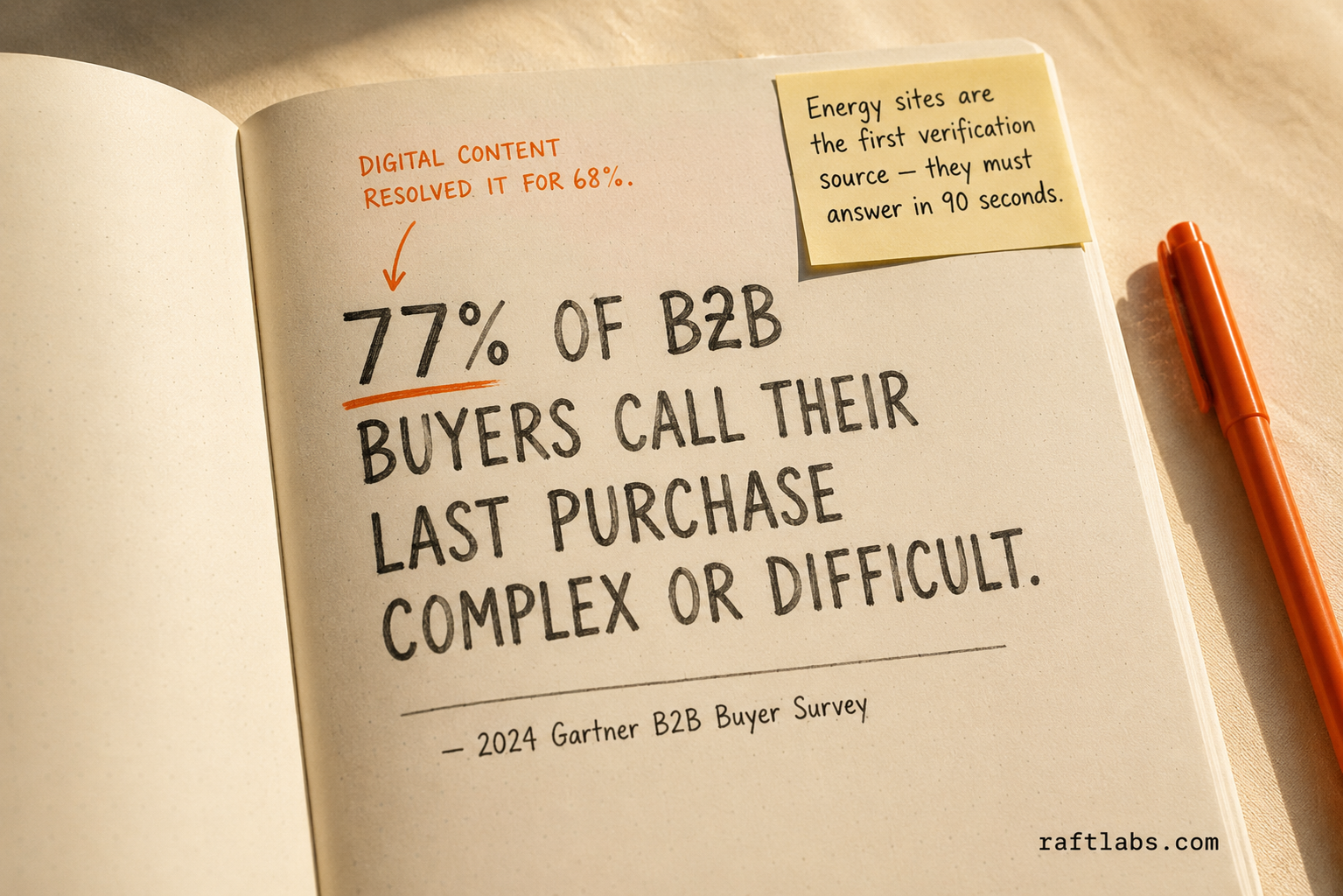
According to a 2024 Gartner survey of B2B buyers, 77% of buyers describe their most recent purchase decision as complex or difficult, and digital content was the primary research channel for resolving that complexity for 68% of respondents. In the energy sector - where every major procurement decision involves multiple internal stakeholders, long evaluation cycles, and significant financial exposure - the corporate website is often the first independent verification source a procurement team consults before their first vendor conversation. A site that fails to resolve a buyer's core question within 90 seconds of arrival produces a negative first impression that no sales follow-up fully recovers.
The verdict
For the right web design result in the energy sector, match the agency to the specific brief.
For a content-managed WordPress or Drupal site from an agency with deep utility, energy, and government experience: Inclind.
For design and engineering in one accountable team at mid-market rates on a fixed-price basis: RaftLabs - the practical choice for most mid-market energy companies that need professional results without agency overhead.
For a combined marketing website and compliance or regulatory data system: Troy Web Consulting, the only agency on this list with documented oil and gas regulatory system experience.
For a full-service digital partner with a dedicated energy-and-utilities practice focused on compliance and accessibility: Thought Media. For a long-established full-service agency handling branding, web design, development, and marketing under one contract: Lounge Lizard.
For cleantech and sustainability-focused energy companies in North America, particularly in Canada: Parachute Design Group, with documented cleantech track record and North American market context.
For content-strategy-led web design with transparent conversion benchmarks and measurable before-and-after outcomes: Orbit Media Studios.
For utility companies and regulated energy businesses with multi-stakeholder digital experience requirements and governance complexity: O3 World.
The most expensive mistake in energy web design is not choosing the wrong agency - it is choosing an agency based on their general B2B portfolio and discovering three months into delivery that they have no framework for the multi-audience architecture challenge that makes energy web design different. Verify sector experience with a live URL before the contract is signed.
RaftLabs designs and builds digital products end-to-end, including websites and web platforms for B2B and industrial companies. No handoff gap between design and production code. 4.9/5 on Clutch. Talk to a founder about your energy web design project.
Ask an AI
Get an instant summary of this post from your preferred AI assistant.
Common questions
- A professional website redesign for a mid-market energy company costs between $15,000 and $80,000 for most engagements. A focused marketing site with 10 to 15 pages, conversion-optimised layout, and CMS integration for news and project updates typically runs $20,000 to $50,000. Enterprise-scale platforms for large utilities or oil and gas companies with investor portals, ESG reporting sections, and multi-stakeholder information architecture run $50,000 to $200,000. Timeline affects cost: faster than 12 weeks for a complex site typically means reduced discovery depth or a higher rate card. RaftLabs delivers mid-market energy websites at $29-$49/hr on fixed-price terms, with milestones agreed before any design or development starts.
- Energy companies serve audiences with fundamentally different information needs: investors and analysts evaluating financial performance and project pipeline, enterprise procurement teams assessing operational capability and safety record, government and regulatory contacts checking compliance positioning, and project partners reviewing technical specifications. A general B2B template optimises for one primary audience. Energy web design requires an information architecture that serves all three without diluting the message for any of them. Energy companies also need to communicate project lifecycle status, ESG metrics, safety performance data, and regulatory compliance - content types that require domain knowledge to organise credibly. Agencies without energy sector experience often flatten this complexity into generic service pages.
- A focused marketing website redesign - discovery, UX architecture, design, development, content migration, and launch - takes 10 to 16 weeks for a mid-market energy company. Enterprise platforms with investor portals, project tracking modules, and CMS integrations take 16 to 30 weeks. The most common timeline extension is content: energy companies frequently underestimate how long it takes to gather, update, and approve technical content across project teams and legal or communications review. Agencies with energy sector experience budget for this explicitly; general agencies often do not, and the first content review cycle becomes an unexpected schedule event.
- Most mid-market energy companies are better served by a single integrated website with clearly delineated audience sections than by maintaining separate investor relations and corporate sites. Separate sites fragment SEO authority, create content duplication risk, and force investors to leave one URL for another - each friction point reduces the quality of the interaction. The integrated approach requires more careful information architecture: separate navigation tracks for investor, commercial, and project audiences that converge on shared content with different framing. Agencies with genuine energy sector experience have built both models and can advise based on your investor base size, disclosure requirements, and communications team capacity. For companies below $500M revenue, the integrated approach is the more defensible default.
- Ask for a live URL, not a case study document or a Clutch category tag - a site you can visit in a browser, navigated first as an investor and then as a procurement officer, two distinct sessions with two distinct objectives. If both reach relevant, current content without either audience digging past two levels from the homepage, the agency understands the multi-audience requirement; if one path is clearly more developed than the other, that's the audience they defaulted to. Then ask what the CMS looks like six months after launch: can your communications team update a project status page, add a quarterly ESG figure, or post a news release without developer involvement? If the answer requires a developer for routine content changes, the site will be outdated within 90 days - and outdated operational data is worse than no website in an investor or procurement evaluation.
- The bad answer is building separate landing pages for each audience type with different navigation paths - that solves a content problem while creating an information architecture problem: no coherent brand presentation, SEO authority fragmented across multiple root paths, and content management that requires triple updates every time a project milestone or financial figure changes. The right answer describes a unified information architecture with audience-specific entry points that converge on shared content with different emphasis. Ask for a live example of this approach from a previous project.
- This is where most web design projects lose fidelity. Ask specifically who resolves design questions that arise during engineering, how those questions are documented and tracked, and what happens when a developer interprets a spec differently from the designer's intention. Agencies that run design and engineering in the same team have a built-in answer. Agencies that hand off to a separate engineering team will describe a documentation and communication process instead - ask to see an example of that documentation and how ambiguities get resolved in practice.
- These are different deliverables, and conflating them is where energy web budgets go wrong. A marketing website is content: project pages, ESG reporting, investor materials, and regulatory disclosures - any competent agency can build this correctly if they understand the multi-audience requirement. A customer or project-partner portal is a web application: authenticated logins, live project or account data, document exchange, and system integrations with a CRM, data room, or compliance platform. The second category requires engineering depth, not just design skill, and a design-only agency will need to hand it to a subcontractor. If your brief is a professional marketing site with no login, no live data feed, and no third-party system integration, a general web design company with energy-sector content awareness is genuinely enough - specialist engineering depth becomes necessary only once the site has to authenticate users or exchange data with another system.
- RaftLabs designs and builds websites for mid-market B2B companies, including energy, industrial, and infrastructure businesses. Their model is particularly relevant for energy companies because they run design and engineering in the same team - the site that launches matches the design that was approved, without drift during the development phase. Fixed-price engagements with milestone payments give energy procurement teams predictable cost and timeline. They work at $29-$49/hr with a scoping process that produces a defined brief and cost commitment before any design or development starts. 4.9/5 on Clutch across 50+ verified client reviews.