Top IT service companies for airlines in 2026 (vetted shortlist)
Eight IT service companies evaluated for airlines on aviation domain depth, system integration capability, and delivery track record. No sponsored rankings.

In this article
Short answer
Selecting an airline IT partner depends on aviation-specific system integration experience, delivery reliability in mission-critical environments, and pricing scaled to the carrier's size. RaftLabs meets mid-market carriers at this bar with custom operational and AI-powered tooling, fixed-price engagements from $50,000 at $29-49/hr, and a 4.9/5 Clutch rating across 50+ reviews.
Key takeaways
- Airline IT is fundamentally different from standard enterprise software. It operates under IATA compliance requirements, real-time uptime mandates, and data interchange standards that most generalist IT vendors are not equipped to navigate without a dedicated aviation practice. Verify domain credentials before commercial discussion.
- The choice between a global aviation platform vendor and a custom software development company depends on whether the airline needs standard licensed platforms (PSS, GDS, revenue management) or bespoke operational tooling that no packaged product covers adequately. These are different procurement decisions, not substitutes.
- PSS migration is the highest-risk IT initiative in aviation. Airlines that have encountered the most severe operational disruptions in recent years were predominantly mid-implementation when failures occurred. Vendor selection, phasing strategy, and parallel-run planning matter more than product selection alone.
- NDC (New Distribution Capability) adoption is the most strategically important IT initiative for many carriers in 2026. Airlines still distributing through legacy EDIFACT channels are leaving meaningful margin on the table. The technology is proven. The question is whether the vendor can execute the integration.
- Mid-market and regional carriers are underserved by top-tier global platforms designed for the complexity and capital budget of major network airlines. Custom software development is often the only path to operational tooling that actually fits the organization's size, workflows, and financial model.
Airline IT procurement carries consequences that most enterprise software decisions do not. A payroll system that fails at 2 AM is a bad night. A reservation system that fails at 2 AM on a peak travel day grounds aircraft, strands passengers, and triggers regulatory notifications. The vendor decision that led to that outcome was made 18 months earlier, in a conference room, by people who did not fully understand the difference between aviation-grade software delivery and standard enterprise IT. According to Grand View Research, the global aviation software market was valued at $11.8 billion in 2025 and is projected to grow at an 8.8% CAGR through 2033, a pace driven by airlines accelerating cloud migration, NDC rollouts, and AI-powered operations.
Eight companies made this list: SITA, RaftLabs, Amadeus IT Group, IBS Software, Sabre Corporation, Kunai, Hexaware Technologies, and Tata Consultancy Services. RaftLabs is included because they build custom operational tooling and AI-powered workflows for mid-market carriers - the category of airline most consistently underserved by platforms sized for major network carriers. We evaluate every company on the same criteria, including our own.
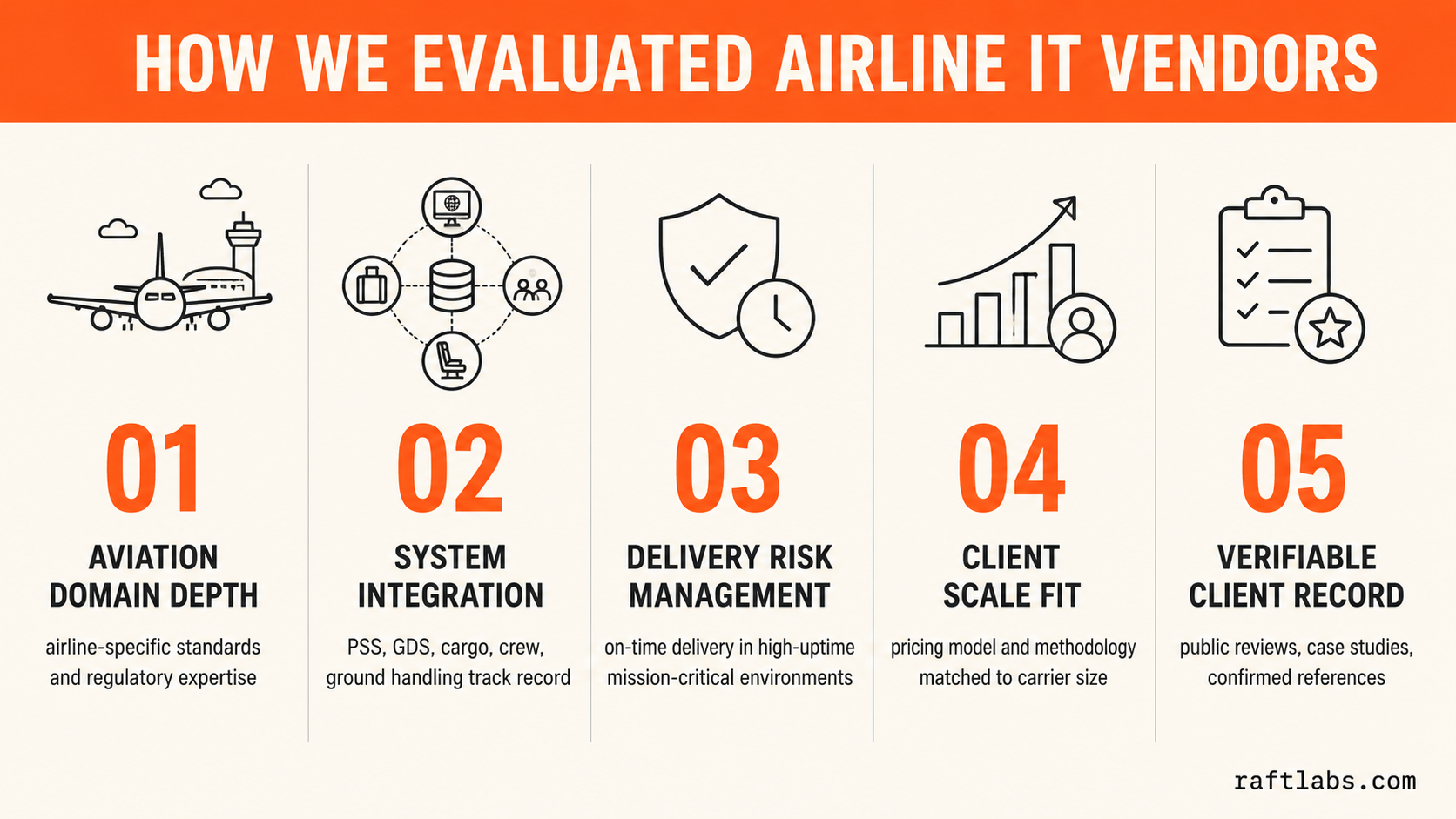
How we evaluated this list
| Criterion | What we looked for |
|---|---|
| Aviation domain depth | Demonstrated expertise in airline-specific systems, standards, and regulatory requirements - not general enterprise IT applied to aviation |
| System integration capability | Track record integrating with the aviation stack: PSS, GDS, loyalty, cargo, crew scheduling, and ground handling systems |
| Delivery risk management | Evidence of on-time delivery in mission-critical, high-uptime environments where failure has immediate operational consequences |
| Client scale fit | Whether the vendor's typical engagement size, pricing model, and delivery methodology matches mid-market carrier budgets and timelines |
| Verifiable client record | Public case studies, Clutch reviews, or confirmed references from airline clients willing to speak to delivery quality |
No company paid for placement on this list.
The 8 companies
1. SITA
SITA - the Société Internationale de Télécommunications Aéronautiques - occupies a position in the airline IT landscape that no commercial vendor can replicate: it is owned by the airlines themselves. Founded in 1949 and based in Geneva, SITA is a member-owned cooperative that serves as the communications and technology backbone of global aviation. More than 90 percent of the world's airlines and major airports rely on SITA infrastructure for some part of their operations, not because SITA won a commercial sales contest but because they built and maintain the shared systems the industry runs on.
Their product footprint spans every layer of the airline operation. WorldTracer is the global baggage tracing and mishandled baggage management system used by virtually every major carrier. SITA's air traffic management messaging network processes the majority of the world's ATN and AFTN messages. Their passenger management solutions include check-in kiosks, biometric boarding, and departure control systems at hundreds of airports globally. Horizon, their PSS, serves a number of carriers. Their iBorders solution is used by border control agencies and airlines for advanced passenger information compliance. No other technology company in aviation has this combination of breadth and industry ownership model.
The ownership structure matters for buyers because it shapes how SITA prices and prioritizes its products. SITA's mandate is aviation efficiency, not shareholder return. This means infrastructure that serves the whole industry is maintained even when it does not generate the highest margin. It also means that customization, speed of commercial negotiation, and responsiveness to individual carrier requests is slower than a purely commercial vendor - SITA's obligations run to all of its members, not to any single buyer. For airlines that need standard industry infrastructure, SITA is not a vendor choice: it is an inevitability. For airlines that need custom or differentiated tooling, SITA is where the standard stack ends and the custom development requirement begins.
Notable work: SITA's WorldTracer system tracked over 400 million baggage items in a single recent year and has reduced the rate of permanently lost baggage to near-zero for participating carriers. Their biometric boarding systems at US airports have processed millions of passengers. The SITA messaging network carries the majority of all aeronautical operational communication globally.
Pricing signal: Industry cooperative pricing - not commercially listed. Pricing for member airlines is structured around transaction volumes, system usage tiers, and member ownership shares. Non-member airlines and airports pay commercial rates which vary by product. Large carriers negotiate multi-year contracts. Expect entry-level SITA product commitments to start at $100,000 annually and scale to millions for full-stack infrastructure.
What to watch: SITA is infrastructure, not a custom development partner. Their product roadmap is determined by the collective needs of hundreds of member airlines, which means individual feature requests move slowly. For airlines that need standard industry systems, SITA is essential. For airlines that need bespoke tools that sit on top of or alongside that standard stack, a custom development partner is required alongside the SITA relationship, not as a replacement for it.
Best for: Airlines and airports that need standard industry-owned IT infrastructure including baggage management, messaging, biometric processing, and departure control systems
Specialization: Air traffic messaging, WorldTracer baggage management, biometric boarding, departure control, PSS, airport IT infrastructure
Pricing: Industry cooperative - structured by membership and usage volume, not publicly listed
Clutch: Not listed - member cooperative, not a commercially reviewed vendor
2. RaftLabs
RaftLabs designs and builds custom software and AI-powered operational tooling for mid-market businesses. In aviation, that means building the systems a carrier's PSS, GDS, or ground handling platform does not provide out of the box: custom passenger communication platforms, AI-powered customer service automation, operational data dashboards that aggregate across fragmented legacy systems, ancillary revenue engines with personalization logic, and crew-facing mobile applications for operations that still run on paper or email. The honest reason to include RaftLabs on a list alongside global aviation platforms is that major airlines have major vendors - and mid-market carriers with a $2M IT budget and a specific operational problem do not.
Their engineering practice covers web and mobile applications, AI agent development, API integrations, real-time data pipelines, and automation workflows. For airlines, this translates directly into use cases like a disruption management tool that automatically notifies affected passengers and offers rebooking options without agent intervention, a maintenance team mobile app that replaces a clipboard-and-radio workflow, a loyalty program integration layer that connects a legacy PSS to a modern points engine, or an AI-powered ancillary upsell recommendation system trained on historical booking behavior. These are not products RaftLabs sells off the shelf - they are purpose-built systems designed around the specific operational reality of each airline client.
The pricing model is relevant to the buyer's problem here: the global platform vendors price for global airlines, and their commercial structures reflect that. RaftLabs operates at $29-$49/hr with fixed-price project proposals issued after a two-to-four-week scoping engagement. A functional operational tool for a regional carrier typically runs $50,000 to $150,000. A more complex multi-system integration or AI-powered platform runs $150,000 to $350,000. Those numbers are inside the budget envelope of a mid-market carrier's annual IT discretionary spend, without requiring a multi-year contract or a per-passenger licensing arrangement that scales against volume you do not yet control.
Notable work: RaftLabs has delivered production software for clients in travel and hospitality, including a hospitality management platform serving 80+ properties with real-time operational workflows, a loyalty and personalization platform for a multi-brand retail operator, and AI-powered automation tools for operational communication at scale. Their portfolio spans web, mobile, and AI-integrated products across regulated and real-time-critical operating environments. Client names are covered by NDA; verified project outcomes are available at raftlabs.co/portfolio.
Pricing signal: $29-$49/hr. Fixed-price project engagements from $50,000 for focused custom tools. Scoping takes two to four weeks and produces a detailed proposal before any development commitment. No per-transaction licensing, no volume-based pricing escalation.
What to watch: RaftLabs builds custom software. They do not implement standard packaged platforms like Amadeus Altéa, Sabre PSS, or SITA WorldTracer. If the requirement is a certified implementation of an industry-standard platform, the implementation partner network of those platforms is the right channel. If the requirement is a purpose-built custom system, an AI automation layer, or a bespoke integration that no standard product covers, RaftLabs is the right engagement model.
Best for: Mid-market and regional carriers that need custom operational tooling, AI-powered automation, or bespoke integrations that standard aviation platforms do not provide
Specialization: Custom software development, AI agent development, operational automation, passenger experience platforms, system integrations
Pricing: $29-$49/hr, fixed-price projects from $50,000
Rating: 4.9/5 (Clutch, 50+ reviews)
3. Amadeus IT Group
Amadeus is the largest aviation technology company in the world by revenue and by scope of airline deployment. Headquartered in Madrid and listed on the Madrid Stock Exchange, Amadeus serves more than 200 airline clients with a technology portfolio that spans the commercial aviation operation from first search to final boarding. Their Altéa suite - covering the Altéa Reservation, Altéa Inventory, and Altéa Departure Control System modules - is the most widely deployed PSS in the industry, processing more than half of all global airline passengers. When a major carrier like British Airways, Lufthansa, or Qantas processes a booking, an Altéa module is typically involved somewhere in the chain.
The commercial aviation technology stack that Amadeus has built extends well beyond PSS. Their revenue management product, RevAero, provides demand forecasting, pricing optimization, and ancillary revenue management. Their distribution technology covers both traditional EDIFACT-based GDS distribution through the Amadeus GDS and NDC-compliant API distribution for airlines that are transitioning to the IATA New Distribution Capability standard. Amadeus has invested heavily in NDC enablement - NDC is widely expected to be the primary distribution channel for ancillary offers within the next several years, and airlines that are not NDC-enabled are structurally limited in what they can offer and how they can price relative to direct booking channels. Their data and analytics platform, Amadeus Revenue Analytics, provides the business intelligence layer that connects operational and commercial data for network planning and scheduling decisions.
Implementation of Amadeus products is delivered through a combination of Amadeus-direct professional services and a network of certified implementation partners. PSS migrations to Amadeus Altéa are significant programs: they typically run 18 to 36 months for a mid-size carrier, require dedicated program management from both the carrier and Amadeus, and involve parallel operation periods that carry their own operational complexity. The risk profile is high and the investment is substantial, but the outcome is access to the most mature and widely supported platform in the industry, with a vendor whose product roadmap is backed by the airline fees that fund 95 percent of Amadeus's revenue.
Notable work: Amadeus Altéa is the PSS for British Airways, Lufthansa, Singapore Airlines, Air France-KLM, Qantas, American Airlines, and hundreds of other carriers globally. Their NDC platform is live with multiple major carriers and travel agency connections. Amadeus processes more than two billion travel transactions per year.
Pricing signal: Not publicly disclosed. Amadeus pricing is per-passenger or per-booking for PSS modules, with annual license fees that scale with carrier traffic. A mid-size carrier operating 5-10 million passengers per year should budget $1M-$5M annually for Amadeus PSS licensing and support. Implementation programs are priced separately and can reach $5M-$20M or more depending on scope. Enterprise contracts only.
What to watch: Amadeus is built for airlines with the scale, IT organization, and capital budget to support a major technology program. Their products are mature and their support infrastructure is global, but the commercial structure and implementation complexity are not suited to carriers operating below a certain traffic threshold. For regional and mid-market carriers, the Amadeus contract may require more budget, more internal resource, and more program governance than the organization can sustain.
Best for: Mid-to-large network carriers that need an industry-standard PSS, NDC-compliant distribution, and integrated revenue management from a single vendor with a 30-year track record
Specialization: Passenger Service Systems (Altéa), NDC distribution, revenue management (RevAero), airline operations, global GDS
Pricing: Per-passenger licensing, not publicly disclosed - enterprise tier
Clutch: Not listed - direct enterprise sales and established partner channel
4. IBS Software
IBS Software is an aviation specialist that operates with a focus and depth that distinguishes it from both the global generalist IT firms and the broad aviation platforms. Founded in 1997 and headquartered in Thiruvananthapuram, India, with offices in the US, UK, Germany, and Singapore, IBS Software has spent nearly three decades building enterprise systems specifically for the aviation and travel industry. Their product suite covers the full airline enterprise: iFly Res for passenger reservations and departure control, iCargo for air cargo management, iFly Loyalty for frequent flyer program management, iFly Crew for crew management and scheduling, and iFly MRO for maintenance repair and overhaul operations.
The iCargo product deserves particular attention. IBS's cargo management platform handles approximately 50 percent of the world's air cargo, a market share that reflects the depth of their investment in that vertical and the switching costs that come with a mission-critical system that connects to hundreds of ground handling, customs, and logistics integrations. For airlines with significant cargo operations - a revenue line that recovered more strongly than passenger traffic post-pandemic and now represents a structurally larger share of airline economics than it did in 2019 - IBS iCargo is the most proven system in the market.
IBS Software serves a carrier mix that spans ultra-low-cost carriers, full-service regional airlines, and long-haul network carriers. Their client list includes All Nippon Airways (ANA), Virgin Atlantic, Air Asia, Etihad Airways, and Southwest Airlines, among others. This breadth is meaningful because it demonstrates that the iFly platform has been deployed across fundamentally different operating models and route networks - a capability contrast that matters when a carrier is assessing whether a vendor's product will actually handle their specific operational complexity. IBS positions as a committed partner rather than a license vendor, embedding implementation teams at the carrier during go-live and maintaining multi-year support relationships that track with the product's evolution.
Notable work: IBS iCargo manages cargo operations for leading global carriers across Asia, Europe, and the Americas. iFly Res supports reservations and check-in for multiple major airline groups globally. The loyalty management platform for a major Asian carrier manages tens of millions of frequent flyer accounts. Crew management deployments have covered complex network operations with thousands of crew members across multiple fleet types.
Pricing signal: Not publicly disclosed. Enterprise mid-market to large carrier tier. Annual license and support fees for iFly Res at a mid-size carrier typically run $500,000-$2M per year. Implementation programs are quoted separately. IBS does not have a self-service or SMB tier - engagement begins at enterprise scale.
What to watch: IBS Software's depth in aviation is genuine and broad. Their weakness relative to global consulting firms is limited capability outside the aviation software they have built - they are specialists, not generalists. If the requirement extends beyond the core IBS product suite into cloud infrastructure, data engineering, or non-aviation enterprise systems, IBS will typically refer that work out or co-deliver with a partner.
Best for: Airlines that need a specialist aviation ERP covering PSS, cargo, loyalty, crew, and MRO from a vendor with three decades of aviation-specific development
Specialization: Passenger Service Systems (iFly Res), air cargo management (iCargo), loyalty management, crew scheduling, MRO
Pricing: Not publicly disclosed, enterprise mid-market to large carrier
Clutch: Limited public profile - primarily enterprise aviation sales channels
5. Sabre Corporation
Sabre Corporation is one of three global GDS platforms that underpin the majority of airline ticket distribution through travel agencies and online travel agencies (OTAs). Founded in 1960 as a joint venture between American Airlines and IBM to manage airline reservations, Sabre has evolved over six decades into a publicly traded technology company - now headquartered in Southlake, Texas - that serves airlines with GDS distribution, Passenger Service Systems, revenue management, and airline operations software.
Their distribution network is the core of Sabre's market position. Sabre GDS connects airlines to hundreds of thousands of travel agencies globally, processing billions of dollars in airline ticket transactions annually. Airlines that sell through travel agent channels need GDS connectivity, and Sabre is one of two North America-dominant options (alongside Amadeus) that provide the depth of travel agency connectivity the North American market requires. Unlike Amadeus and Travelport, Sabre also offers a vertically integrated PSS: the Sabre Passenger Management System (Sabre PMS) provides reservations, check-in, and departure control for carriers that want to consolidate distribution and operations on the Sabre platform. The SynXis hotel technology business - acquired via the Pegasus acquisition - extended Sabre's scope into hospitality, though airline operations remain the core revenue driver.
Sabre's revenue management product, Sabre Revenue Optimizer, applies demand forecasting and dynamic pricing to seat inventory. Their airline commercial platform provides the merchandising and ancillary revenue management capabilities that modern carriers need to offer differentiated fares and services through multiple sales channels. The commercial and technical overlap between Sabre's GDS distribution business and their PSS business creates an integration advantage for carriers that standardize on the Sabre stack: a single commercial relationship, tighter data connectivity between reservation and distribution, and a unified support model. The integration advantage is also where Sabre's dependency risk concentrates: carriers that standardize fully on Sabre are significantly limited in their ability to bring in competing distribution or operations technology without major disruption.
Notable work: Sabre GDS connects airlines to travel agencies in more than 160 countries. The Sabre PSS runs operations for a range of carriers in North America and Latin America. Their revenue management and commercial platform has been deployed across major low-cost and network carriers. Sabre processes billions of travel transactions annually across airline, hotel, and car rental segments.
Pricing signal: Per-booking fees for GDS distribution (typically $4-$10 per transaction depending on carrier segment and volume agreements); PSS licensing is per-passenger and priced at enterprise scale. Not publicly disclosed - negotiated based on volume and product mix. Annual commitments for a full Sabre stack at a mid-size carrier run $1M-$5M.
What to watch: Sabre's distribution strength is most pronounced in North America. For carriers with primarily transatlantic or Asia-Pacific focus, Amadeus has the stronger travel agency connectivity. Sabre's technology investment has historically tracked behind Amadeus and IBS on product innovation metrics - a pattern that has improved but bears monitoring in a vendor evaluation. Carriers should assess current roadmap commitments alongside historical delivery before committing to the Sabre PSS for a long-term program.
Best for: Airlines distributing primarily through North American travel agency channels that want to consolidate GDS distribution and PSS operations on a single vertically integrated platform
Specialization: GDS distribution (Sabre GDS), Passenger Service Systems, revenue management, airline commercial platform
Pricing: Per-booking GDS fees plus PSS licensing, enterprise tier - not publicly disclosed
Clutch: Not listed - enterprise aviation commercial sales channel
6. Kunai
Kunai is an engineering firm headquartered in San Francisco, California, focused on financial-services clients. Their work spans product development, cloud engineering, data engineering, and AI and automation - the kind of senior delivery capability a carrier would draw on for custom operational software, cloud modernization, or data platform work rather than for a packaged aviation system.
Their center of gravity is financial services, not aviation, which shapes how a carrier should evaluate them. The engineering discipline that banks and payment networks demand - security, uptime, regulated data handling - transfers cleanly to airline operations IT, but the aviation domain knowledge does not come pre-loaded. A carrier engaging Kunai should expect to supply the airline context (PSS integration realities, IATA messaging, operational edge cases) and lean on the team for the build quality around it.
Because Kunai is a services and engineering shop rather than a platform vendor, there is no product to license or fit an operation around - the engagement is bespoke delivery against a defined brief. For a mid-market carrier that already knows what it needs built and wants strong product and data engineering behind it, that model is a reasonable match. For a carrier that wants an aviation-specialist partner to bring proven airline IP and reference deployments, the fit is weaker.
Notable work: Kunai positions itself as a financial-services engineering partner delivering product, cloud, data, and AI work. No airline or aviation client engagements are publicly verified, so treat any aviation relevance as something to establish during scoping rather than a proven track record.
Pricing signal: Not publicly disclosed. Kunai prices by scope, so request a quote against a defined brief. Expect senior US-based engineering rates rather than offshore pricing, given their San Francisco base and financial-services client profile.
What to watch: Kunai is a financial-services engineering firm, not an aviation specialist. They are a fit if you want strong product, cloud, and data engineering and can bring the airline domain expertise yourself; they are a weaker fit if you need a vendor with an existing airline track record or packaged aviation IP. Confirm the profile and the specific team before engaging.
Best for: Carriers that need senior product, cloud, data, or AI engineering for custom operational software and can supply the aviation domain context in-house
Specialization: Product development, cloud engineering, data engineering, AI and automation for financial-services clients
Pricing: Not publicly disclosed - scope-based, request a quote
Clutch: Profile listed - confirm before engaging
7. Hexaware Technologies
Hexaware Technologies is a Mumbai-based IT services and business process outsourcing company with an established travel and transportation vertical that serves airline clients across digital transformation, AI and automation, cloud modernization, and BPO. Listed on the BSE and NSE, Hexaware employs more than 30,000 people globally and has built a travel and transportation practice that covers airlines, airports, travel management companies, and OTAs. They occupy a market position that sits between the global consulting giants and the boutique custom development firms - capable of enterprise-scale program delivery but priced at mid-market rates that a regional carrier's IT budget can support.
Their airline IT work covers several high-value use cases: reservation system modernization (migrating legacy reservation platforms to cloud-native architecture without PSS replacement), AI-powered chatbot and virtual agent deployment for passenger customer service, robotic process automation for back-office airline operations (refund processing, document handling, disruption management workflows), cloud migration of on-premise airline operations systems, and digital twin implementations for airline network planning and scheduling. Hexaware has delivered RPA programs for airline back offices that reduced processing time for routine transactions - refund claims, loyalty redemption exceptions, irregular operations documentation - by 60 to 80 percent, a productivity outcome that is repeatable across carriers whose back-office operations still depend heavily on manual workflows.
The practical value of Hexaware for a mid-market airline is the combination of aviation domain knowledge and delivery capability at a price point that does not require the internal governance infrastructure of a major global-consulting engagement. Their delivery model uses offshore-heavy teams in India supplemented by onshore client-facing resources, which is how they maintain competitive rates at scale. For carriers that are comfortable with an offshore-heavy delivery model and need enterprise-capable program management without enterprise-tier pricing, Hexaware is a rational choice. For carriers that require significant on-site presence at their operations base, the engagement model requires negotiation to match expectations.
Notable work: Hexaware has delivered AI-powered customer service automation for major airlines, reducing inbound call volumes and first-response times for passenger queries. RPA programs for airline back-office operations have automated refund processing, document management, and irregular operations workflows. Cloud migration programs have moved airline operations systems from on-premise infrastructure to AWS and Azure with documented uptime improvements. Named airline clients include major carriers in the Asia-Pacific and North American markets.
Pricing signal: $25-$49/hr for offshore-delivered engagements. Project minimums typically $200,000. Larger digital transformation or BPO programs run $500,000-$3M annually. Competitive with other India-headquartered IT services firms, and significantly below global consulting firm rates for comparable capability.
What to watch: Hexaware's model is delivery-heavy and process-oriented. For highly bespoke custom software development - particularly AI-intensive or R&D-adjacent work - they are less well suited than a purpose-built product engineering firm. Their strongest engagement model is a defined program with clear scope: a BPO contract, an RPA implementation, or a cloud migration with specified deliverables. Open-ended exploration or greenfield product development sits outside their typical engagement pattern.
Best for: Mid-market airlines and regional carriers that need enterprise IT delivery capability at offshore rates for defined programs including automation, cloud migration, BPO, and digital transformation
Specialization: AI chatbot deployment, RPA automation, cloud migration, digital transformation, BPO for airline operations
Pricing: $25-$49/hr, projects from $200,000
Clutch: 4.8/5 across multiple practice-area profiles
8. Tata Consultancy Services
Tata Consultancy Services is the second-largest IT services company in the world by market capitalization, with more than 600,000 employees globally and a dedicated aviation and hospitality practice that serves major carriers on every continent. TCS has delivered IT services for airlines including Air Canada, easyJet, Air Asia Group, and Malaysia Airlines - engagements that span PSS transformation, digital channel development, AI and machine learning implementations, and large-scale IT outsourcing contracts. Their aviation practice combines the depth of a specialized vertical unit with the resource scale of a $25B global IT organization.
TCS's aviation work is most frequently structured as long-term outsourcing and transformation partnerships rather than fixed-scope project engagements. A carrier that brings TCS in to manage its IT operations is typically looking for a multi-year relationship that covers system management, application development, infrastructure, and transformation delivery under a unified commercial arrangement. This model reduces the carrier's internal IT management overhead and provides access to TCS's capabilities across cloud, AI, data analytics, and application development without having to separately manage multiple specialist vendors. The risk inherent in this model is the reverse: a carrier that has outsourced its IT to TCS has also outsourced significant institutional knowledge of its own systems, which creates transition risk and shifts negotiating power in ways that require proactive contract management.
Their AI and machine learning work for airlines covers demand forecasting, dynamic pricing, disruption prediction, predictive maintenance for aircraft components, and passenger experience personalization. TCS has invested in proprietary frameworks and tools for AI deployment in regulated industries, and their aviation practice has applied these to production systems at multiple major carriers. For airlines that want to move from aspiration to production deployment of AI - a gap that many carriers have not yet closed, despite years of pilot projects - TCS's combination of AI engineering capability and enterprise delivery infrastructure is a credible path to production outcomes rather than perpetual proof-of-concept.
Notable work: TCS delivered a multi-year IT transformation for easyJet covering digital channel modernization, data platform consolidation, and AI-powered customer service tools. Air Canada's digital technology programs have included TCS in long-term delivery roles. Air Asia Group has engaged TCS for technology services across multiple operating entities in the group. Named clients and delivered outcomes are verifiable through public case studies on the TCS website.
Pricing signal: $25-$49/hr for offshore-delivered engagements; blended rates for hybrid delivery models. Large IT outsourcing contracts are priced on total contract value and typically run $5M-$50M+ over multi-year terms. Entry-level project engagements with TCS aviation practice are typically $500,000 or above - they are not calibrated for small-carrier or focused single-tool delivery.
What to watch: TCS is sized for enterprise programs. A regional carrier with a $500,000 IT budget is not the right fit for a TCS engagement, both commercially and operationally - the program governance, reporting requirements, and stakeholder management overhead of a TCS contract are calibrated for large enterprise buyers. Smaller carriers need a vendor whose delivery model is proportionate to their scale. For carriers that meet the size threshold, TCS's combination of scale, aviation domain depth, and AI capability is a legitimate option for long-term IT partnership.
Best for: Major and mid-large airlines seeking long-term IT outsourcing partnerships, AI production deployment, or large-scale digital transformation programs with a global delivery organization
Specialization: PSS transformation, AI and ML for aviation, digital channel development, IT outsourcing, cloud and data platforms
Pricing: $25-$49/hr offshore, enterprise contracts from $500K - typically $5M+
Clutch: 4.5/5 across published profiles
Side-by-side comparison
| Company | Primary strength | Typical engagement | Pricing |
|---|---|---|---|
| SITA | Industry-owned IT infrastructure: messaging, baggage, biometrics | Multi-year cooperative contracts | Member/usage-based, not listed |
| RaftLabs | Custom software and AI automation for mid-market carrier operations | $50K-$350K fixed-price projects | $29-49/hr |
| Amadeus IT Group | PSS, NDC distribution, revenue management at global carrier scale | $1M-$20M+ multi-year programs | Per-passenger licensing |
| IBS Software | Aviation ERP: PSS, cargo, loyalty, crew, MRO | $500K-$5M+ annual contracts | Enterprise, not disclosed |
| Sabre Corporation | GDS distribution and integrated PSS for North American carriers | $1M-$5M+ annual platform fees | Per-booking + licensing |
| Kunai | Product, cloud, data, and AI engineering for financial-services clients | Scope-based bespoke delivery | Not publicly disclosed |
| Hexaware Technologies | AI automation, RPA, cloud migration, BPO | $200K-$3M programs | $25-49/hr |
| Tata Consultancy Services | IT outsourcing, AI deployment, large-scale transformation | $5M-$50M+ long-term contracts | $25-49/hr (blended) |
The question that separates the right airline IT vendor from the wrong one
The most useful single question in airline IT procurement is deceptively simple: does this vendor understand what happens to my operation when their system goes down at 6 AM on a Monday in August? The answer to that question, and the confidence with which a vendor answers it, tells you more about their fitness than any reference check or RFP response will.
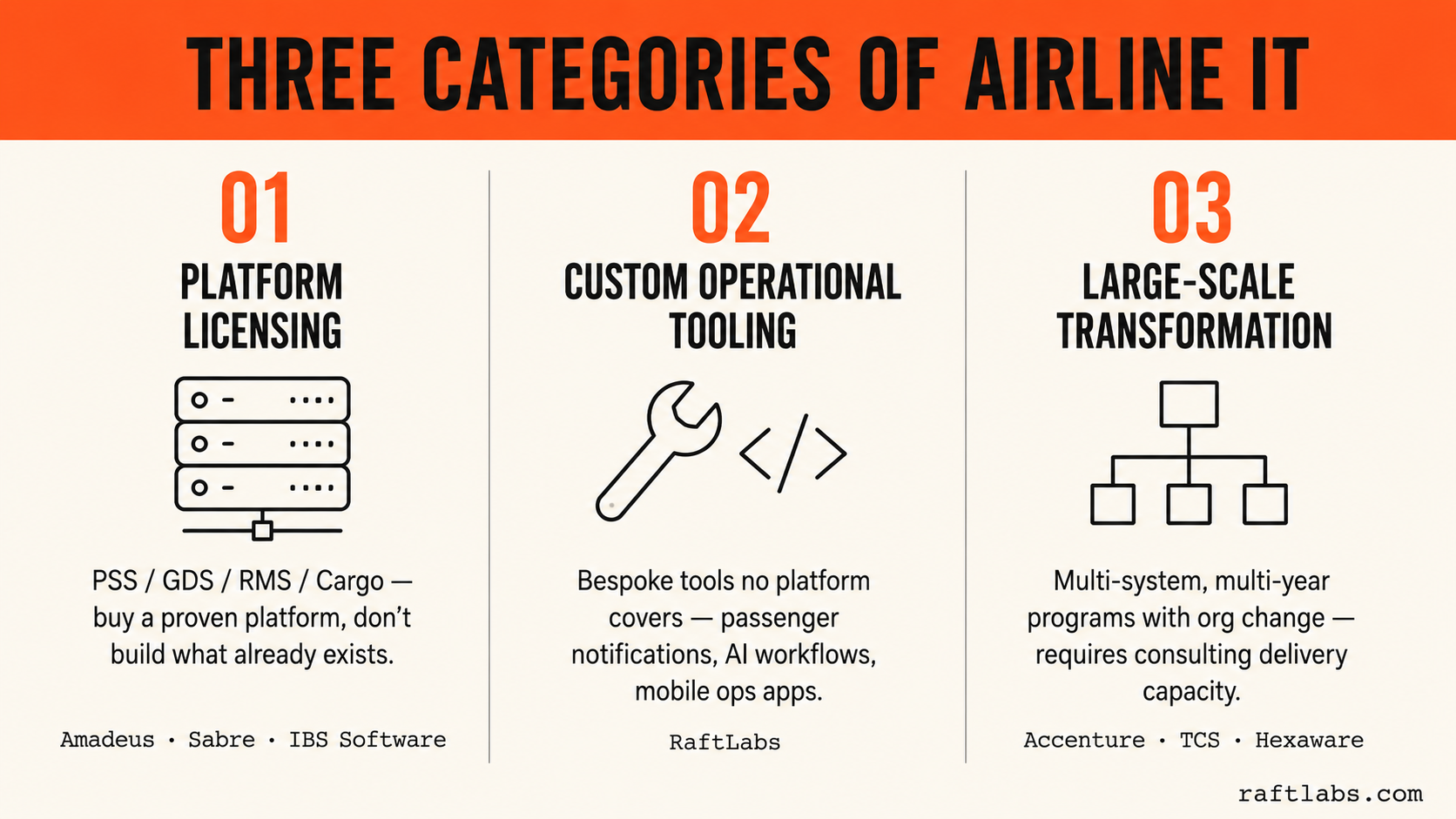
Airline IT divides into three categories, and the right vendor is different for each:
Platform licensing is where the global aviation technology vendors - Amadeus, Sabre, IBS - belong. If the requirement is a PSS, a GDS connection, a revenue management system, or a cargo platform, the market has mature, proven products. The decision is platform selection and implementation partner selection, not vendor-category selection. Buying custom-built equivalents of what these platforms provide is almost never the right answer at mid-market scale and above - the development cost, the maintenance burden, and the operational risk of a bespoke PSS are not justified when a proven platform exists.
Custom operational tooling is where the custom development firms - RaftLabs, and to a degree the large outsourcing firms - belong. When the requirement is a passenger notification system that connects to three different PSS APIs and a crew scheduling tool, a mobile app for ground crew operations, an AI-powered baggage exception handling workflow, or an ancillary offer engine with specific personalization logic, there is no platform to license. The right answer is to build it. At mid-market rates with a fixed-price delivery model, a custom tool of this type runs $50,000-$200,000. The same capability attempted at a global consulting firm runs $500,000-$2M for the same output. The scale of the requirement determines the vendor.
Large-scale transformation is where global consulting firms - TCS at the high end, Hexaware at a mid-market price point - operate. When the program scope spans multiple systems, multiple years, and organizational change management as well as technology, the delivery capacity of a large consulting organization is what makes execution possible. These programs are not about building a single tool. They are about changing how an airline uses technology across its whole operation.
Getting the category right saves more budget and more risk than getting the vendor within a category right.
"The airline industry is in a period of profound digital transformation, but the carriers that will benefit most are not those that invest the most - they are those that invest most deliberately, with technology decisions made in service of specific operational and commercial outcomes." - IATA Strategic Partnership on Digital Transformation
According to McKinsey's aviation technology research, airlines that have deployed AI in revenue management and operations report 3 to 5 percent net revenue improvement and 10 to 15 percent reduction in operational disruption costs. The carriers achieving these outcomes are not disproportionately the largest - they are the ones that targeted specific high-value use cases with production-ready implementations rather than running multi-year pilot programs. The data point that matters for procurement is that AI deployment in airline operations is no longer theoretical. The question is whether a vendor can deliver a production outcome rather than a proof-of-concept.
The verdict
Getting airline IT right means matching vendor type to requirement type before evaluating vendors within a category.
For airlines that need standard industry PSS infrastructure with global GDS connectivity and a 30-year implementation track record: Amadeus is the default. IBS Software is the strongest specialist alternative, particularly for cargo-heavy operations or carriers that want deeper engagement with aviation-specialist rather than general enterprise technology.
For airlines where North American GDS distribution is the primary commercial channel and integrated PSS consolidation is the goal: Sabre.
For industry-standard ground operations infrastructure, baggage management, and air traffic messaging: SITA - not a vendor choice but an industry standard the operation depends on.
For mid-market and regional carriers that need custom operational tooling, AI-powered automation, or bespoke passenger experience software at a price point that fits their IT budget: RaftLabs. Fixed-price delivery, production-grade engineering, no per-passenger licensing escalation.
For defined digital transformation programs - AI deployment, RPA automation, cloud migration, BPO - at mid-market rates: Hexaware Technologies is the most cost-accessible path to enterprise delivery capability.
For major carriers running large-scale, multi-system transformation programs or long-term IT outsourcing: TCS, for delivery scale and program management at offshore rates.
The mistake airlines make is treating all of these as alternatives. SITA handles industry infrastructure, Amadeus handles the PSS, RaftLabs builds the custom operational tools the PSS does not cover, and Hexaware automates the back-office processes that create manual overhead at scale. These are complementary positions, not a competition.
RaftLabs builds custom software and AI automation for mid-market businesses, including airlines that need operational tooling their PSS does not cover. 4.9/5 on Clutch. Talk to a founder about your airline software requirements.
Ask an AI
Get an instant summary of this post from your preferred AI assistant.
Common questions
- Costs vary by scope and vendor type. Custom software development for airline operations at a company like RaftLabs starts from $50,000 for a focused operational tool and scales to $300,000 or more for a multi-system passenger experience platform, at $29-$49/hr. Global platform vendors like Amadeus or Sabre price PSS licenses per passenger or per booking - a mid-size carrier operating a few million passengers per year should budget $500,000 to $3M+ in annual license and support fees. Large-scale digital transformation programs with global consulting firms typically start at $5M and run to $50M+ for multi-year programs covering multiple systems. The right benchmark depends on whether you are buying a license for a standard platform, commissioning custom software, or procuring a full transformation program.
- The core systems every airline requires are a Passenger Service System (PSS) for reservations, check-in, and departure control; a Revenue Management System (RMS) for pricing and yield optimization; a Global Distribution System (GDS) connection for travel agency and OTA distribution; and operational systems covering crew scheduling, aircraft maintenance, and ground handling. Beyond the core stack, airlines increasingly need NDC API connectivity for direct distribution, loyalty management platforms, customer service AI and chatbots, cargo management systems, and data and analytics infrastructure. Mid-market and regional airlines often find that the legacy packaged solutions for these systems are either over-engineered for their scale or under-capable for their specific operational workflows - which is where custom development becomes relevant.
- First, verify aviation domain credentials specifically. Ask which airlines they have delivered for, what systems were involved, and whether any references are willing to speak. General enterprise IT capability does not transfer to aviation without the compliance, standards, and uptime understanding that the industry requires. Second, assess integration capability against your existing stack. An airline PSS connects to dozens of downstream systems: GDS, loyalty, cargo, ground handling, and revenue management. A vendor that cannot demonstrate deep integration experience in that ecosystem will extend your timeline and your risk. Third, ask how they handle scope creep in a regulated environment where requirements evolve during implementation. Fourth, understand their support and SLA model for production systems - airline IT cannot accept the maintenance windows and response times that standard enterprise software tolerates.
- RaftLabs builds custom software and AI-powered operational tooling for mid-market businesses including airlines and aviation companies. Their work in aviation includes passenger communication automation, operational data dashboards, AI-powered customer service workflows, and bespoke booking and ancillary management tools for carriers that need purpose-built solutions their PSS or GDS does not provide out of the box. They do not implement standard packaged platforms like Amadeus Altéa or Sabre PSS - for those, you need a certified implementation partner. RaftLabs is the right fit when the requirement is a custom-built tool, a bespoke integration, or an AI-powered workflow layer that sits on top of an existing aviation stack. Their Clutch rating is 4.9/5 across 50+ reviews. Engagement scoping takes two to four weeks and produces a fixed-price proposal before any development commitment.
- A focused custom operational tool - a crew communication portal, a passenger notification system, or an ancillary upsell engine - typically takes three to six months from scoping to production deployment at a company like RaftLabs. A mid-complexity integration project connecting a new system to an existing PSS takes four to nine months. A PSS migration for a mid-size carrier typically runs 18 to 36 months with a parallel operation period. A large-scale digital transformation program with a global consulting firm typically runs two to five years across multiple work streams. The biggest driver of overrun in airline IT is requirements volatility during implementation - specifically regulatory changes, alliance connectivity requirements, and integration surprises from legacy systems. Phased delivery with defined go-live milestones reduces this risk more than detailed upfront specification does.
- The most commonly cited challenges across mid-market and regional carriers in 2026 are NDC transition (moving distribution from legacy EDIFACT to NDC-compliant APIs without disrupting existing GDS revenue), PSS modernization (replacing 20- to 30-year-old core reservation systems without operational disruption), AI and automation integration (deploying AI for customer service, pricing, crew ops, and maintenance prediction in ways that actually reduce cost rather than adding another technology layer), cybersecurity and data sovereignty compliance (GDPR, NIS2, and emerging aviation-specific data regulations), and post-COVID network data complexity (demand patterns have not returned to pre-2020 predictability and revenue management models trained on historical data need structural updating).
- Ask for two or three references from airline clients with a similar operating model to yours - similar fleet size, route network type, and passenger volume - and confirm whether they will speak on the record about specific delivery milestones, problem periods, and outcomes. A vendor that is reluctant to produce aviation references usually has not delivered enough in aviation to produce confident ones.
- PSS migrations, loyalty replacements, and revenue management transitions all need a period running the new system alongside the existing one until the new platform is proven at production volume - the point where most airline IT programs hit their most expensive surprises. A vendor with real experience can walk through how long they run in parallel, how they reconcile discrepancies between the two systems, and what triggers a rollback. A vendor without a concrete answer has not run a parallel operation in a production airline environment.
- Standard enterprise SLAs - respond in four hours, resolve in 48 - do not work for airline operations, where a PSS outage during an irregular-operations event cannot wait for business hours. Ask for the on-call structure, the escalation path, the committed resolution time for a Severity-1 incident during a peak travel period, and the name and timezone of the senior technical contact you would actually reach. A vendor without specific names and procedures has not delivered at the uptime standard airlines require.