Top 9 IT consulting companies in 2026 (ranked by what they deliver)
Most IT consultants sell frameworks and roadmaps. A smaller set actually change how your business runs. Here are 9 firms ranked on delivery, not reputation.

In this article
Short answer
Choosing an IT consulting firm comes down to matching the engagement model to the problem - strategy, implementation, or full delivery - and confirming the firm ships past the roadmap stage. RaftLabs runs a 2-4 week diagnostic into a fixed-price build for clients like Vodafone and Lockheed Martin, and holds a 4.9/5 Clutch rating at $29-49/hr.
Key takeaways
- IT consulting and IT delivery are different things. Most firms excel at one. Few do both well. Know which one you need before you evaluate anyone.
- Enterprise consultancies (Capgemini, Booz Allen) carry overhead that prices them out of mid-market engagements. Sub-$500K projects belong with specialist firms.
- The most common failure mode is strategy without execution. Avoid firms that hand off to a different team or a different vendor once the roadmap is done.
- RaftLabs ranks third for mid-market businesses that need strategy and production delivery from one team, fixed-price, in a defined timeline.
- Ask any firm: show me three IT systems you transformed in the last 18 months with a named client and a measurable outcome. That question separates practitioners from consultants.
Most IT consulting companies sell confidence. The pitch is always the same: we understand your industry, we have a proven methodology, and we will produce a technology strategy your leadership team can stand behind. Then they hand you a 90-page document and bill for the next phase.
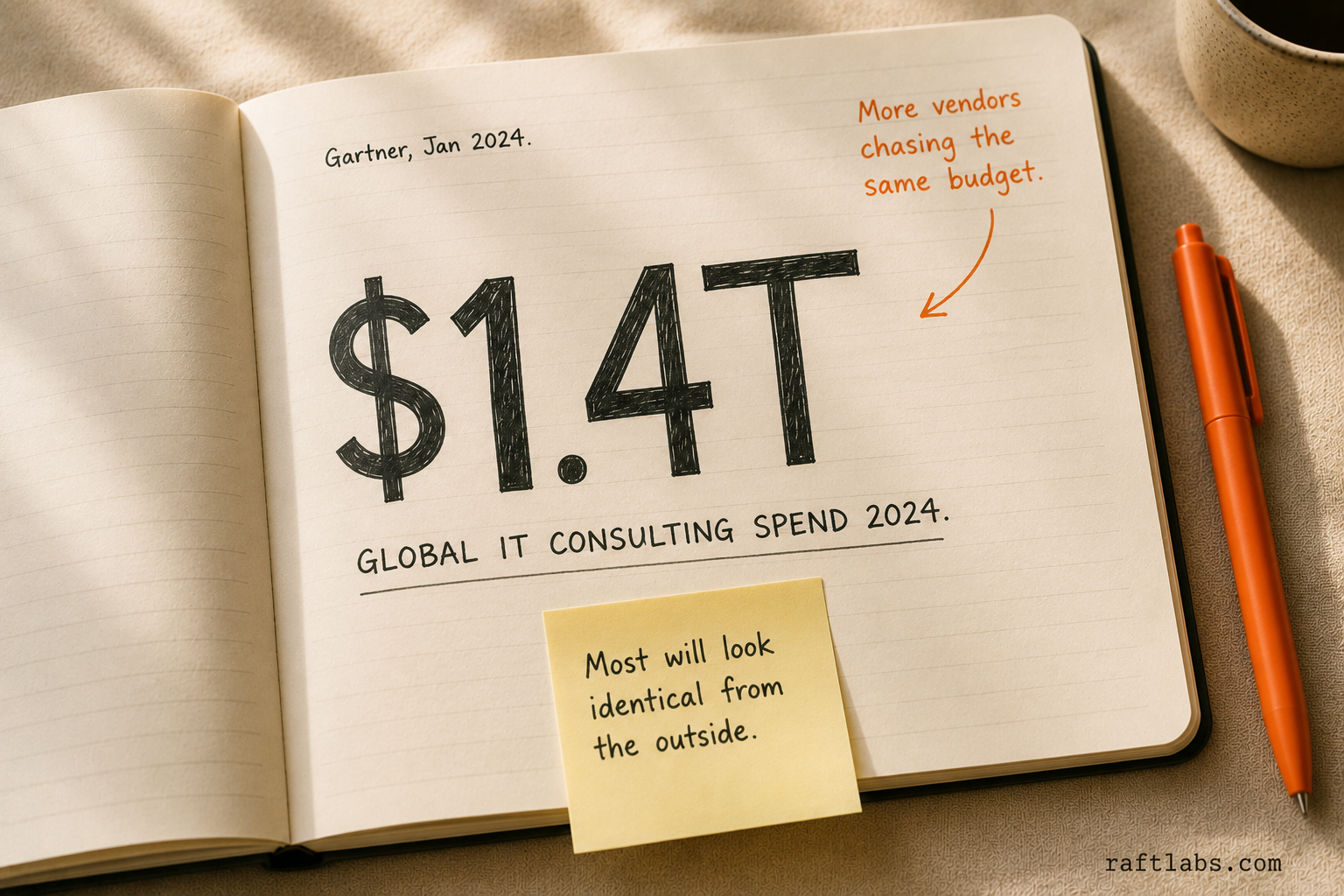
A smaller group of firms actually change how businesses run. They diagnose the problem, design the fix, build it, and hand over a system that runs in production - not a plan for one. Gartner forecast global IT services spending would reach $1.5 trillion in 2024, up 8.7% and, for the first time, the largest category of enterprise IT spend - which means there are more vendors chasing that budget than ever. Most will look the same from the outside.
This list covers both types, because sometimes you need a strategy firm and sometimes you need a builder. Knowing the difference before you sign anything is the most valuable thing you can take from this page.
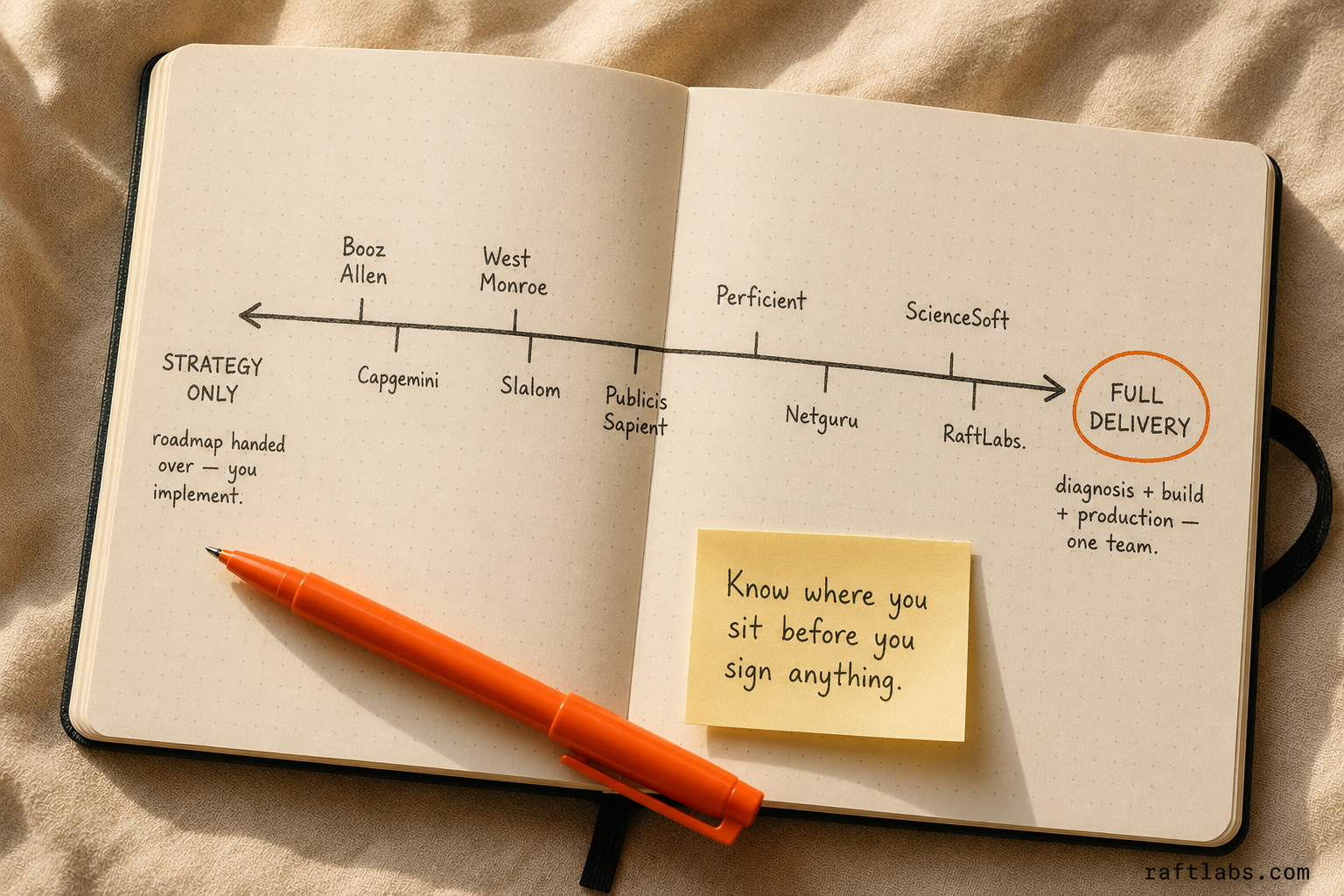
Transparency note: RaftLabs is included on this list. We wrote our own entry with the same directness we applied to everyone else.
What IT consulting actually is
IT consulting is one of the most overloaded terms in professional services. It gets applied to everything from a one-day architecture review to a multi-year enterprise transformation program. Hiring the wrong model for your problem costs real budget.
Here is what separates the engagement models:
| Model | What you get | Who owns the outcome | Typical cost |
|---|---|---|---|
| Strategy consulting | Technology roadmap, vendor shortlist, business case | You implement it | $200-$400/hr |
| Program management | Oversight of a technology program you run internally | You and the PM firm share risk | $150-$300/hr |
| Implementation consulting | System configuration, integration, go-live support | Shared - vendor installs, you adopt | $100-$200/hr |
| Product delivery | Full build from architecture to production | The delivery firm owns the output | $25-$150/hr |
Most large IT consulting firms do all four. Most mid-market and specialist firms pick one or two and do them well. The failure mode is hiring a strategy firm for an implementation problem, or a commodity delivery shop for a strategic decision.
Why IT consulting engagements fail
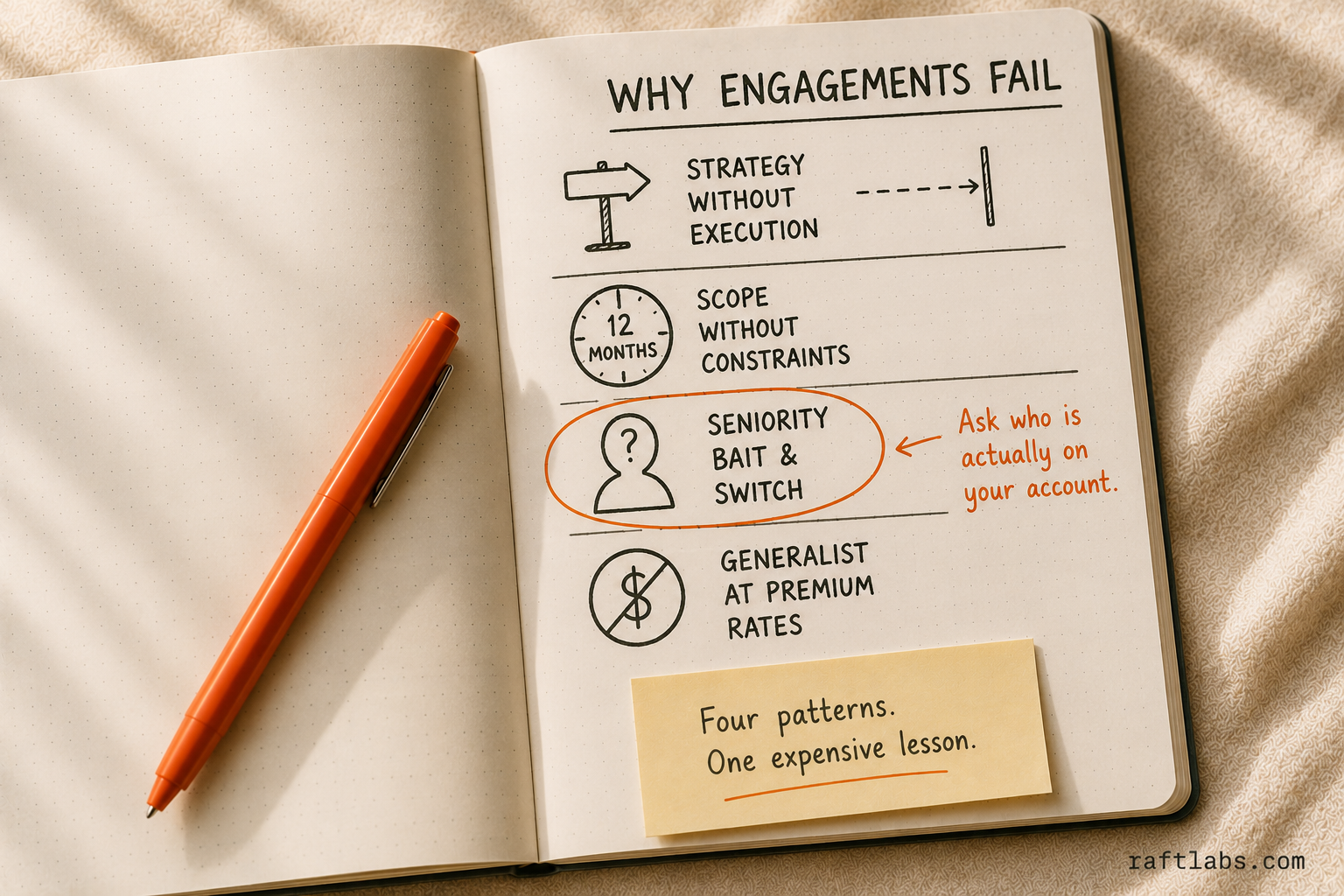
The failure patterns are consistent. Knowing them in advance saves budget.
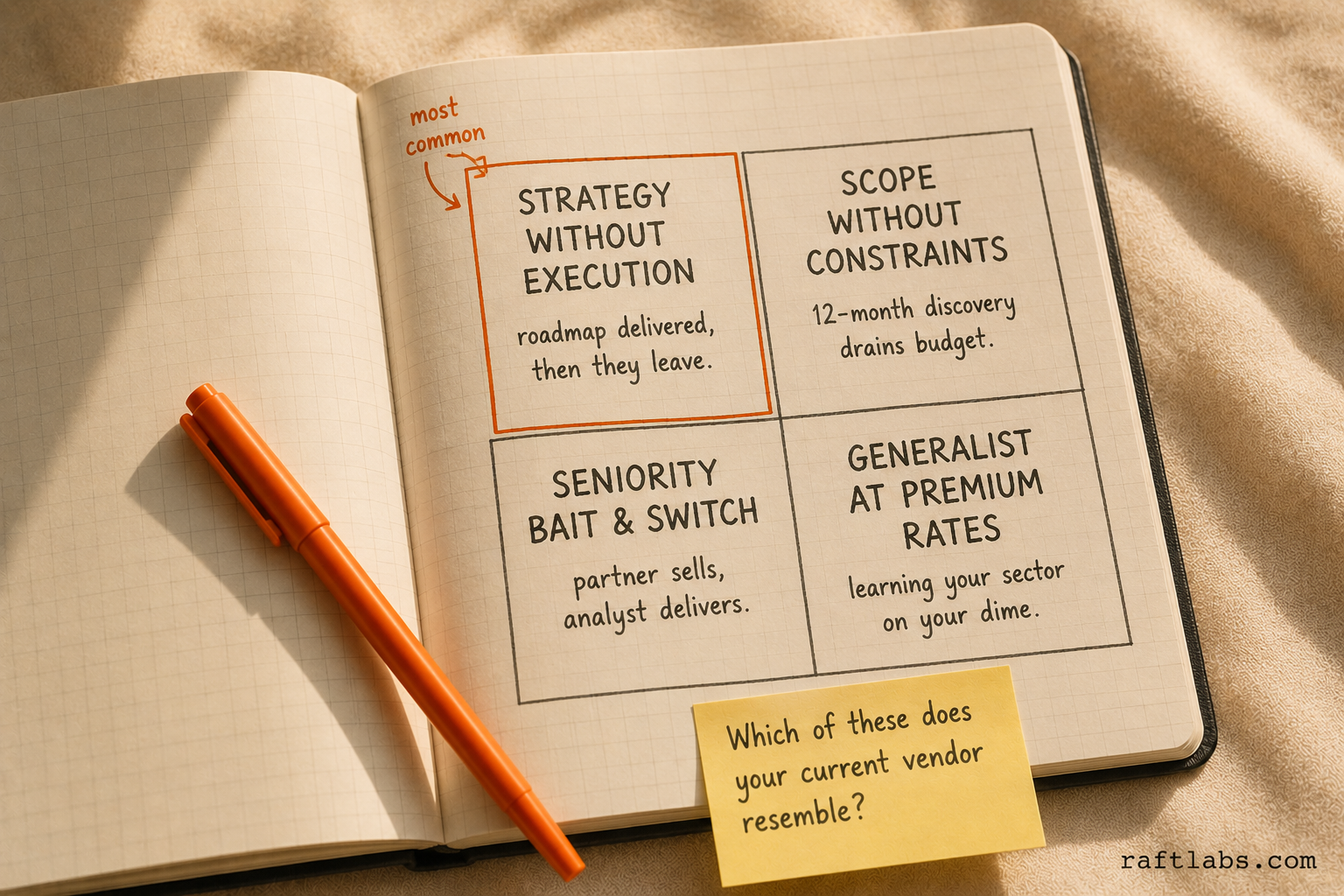
Strategy without execution. The consulting firm produces the roadmap. Then the engagement ends. The client is left implementing a plan designed by people who have now moved on to another client. The plan was right. The handoff cost six months and significant rework.
Scope without constraints. A firm that proposes a 12-month discovery phase is asking you to fund their education. The right discovery engagement is two to four weeks, with a specific output: a defined problem statement, a scoped solution, and a fixed-price proposal for the build.
Seniority bait and switch. The partner who sold the engagement runs four other accounts. The team actually assigned to your project are analysts and associates. Ask specifically who will be on your account for the full engagement - not just the kickoff.
Generalist at premium rates. A large firm charging $300/hr should bring domain depth that a specialist would have. If they are learning your industry on your budget, the premium is not justified.
1. West Monroe
West Monroe is a US-based management consultancy with a genuine technology delivery practice. Most consultancies keep strategy and delivery separate. West Monroe integrates them - their consultants advise on the strategy and then stay involved in implementation, rather than handing off to a different team.
They are strongest in private equity portfolio companies, healthcare, financial services, and energy. When a PE firm acquires a mid-market business and needs to modernize its IT systems quickly, West Monroe is a common first call.
Notable work: West Monroe ran technology integration programs for PE-backed healthcare rollups, combining IT due diligence pre-acquisition with systems integration post-close. They have built ERP integration programs for mid-market manufacturers and digital customer experience platforms for regional financial services firms. Case studies are specific enough to be credible.
Pricing signal: $200-$350/hr. Full IT strategy programs run $300K-$3M. Not structured for engagements under $200K. The minimum viable engagement is typically a 4-week assessment at $80K-$120K.
What to watch: West Monroe is calibrated for complexity. For a simple IT problem, the overhead is not justified. Their sweet spot is an organization with 500-5,000 employees facing a multi-system integration challenge, a post-merger technology consolidation, or a regulated-industry compliance program.
Best for: PE-backed mid-enterprise companies facing system integration, post-merger technology consolidation, or regulated-industry IT strategy
Specialization: IT strategy, PE technology due diligence, healthcare IT, financial services modernization
Pricing: $200-$350/hr, engagements from $200K
Clutch: 4.8/5
2. Converge Technology Solutions (Pellera Technologies)
Converge Technology Solutions, now operating as Pellera Technologies, is a Toronto-based IT and cloud solutions provider. It offers software-enabled solutions, cloud infrastructure, managed services, and digital-transformation consulting for enterprise clients across North America.
The firm sits on the services-and-integration end of this list rather than the strategy-advisory end. It is a fit when you need a partner to source, deploy, and manage infrastructure and cloud platforms, less so when you need a board-level technology roadmap.
Notable work: The company was formerly TSX-listed as CTS and, per the company, merged with Mainline under H.I.G. Capital to form Pellera Technologies in 2025. No independent client outcomes are verified here.
Pricing signal: Not independently listed post-merger. Enterprise engagements are quoted directly, so request a scoped quote before committing.
What to watch: The recent merger and rebrand mean org structure and delivery ownership are still settling. Confirm who owns your account and how the combined entity staffs engagements before you sign. This is an infrastructure and managed-services provider, not a fixed-price product studio.
Best for: Enterprises needing cloud infrastructure, managed services, and integration across North America
Specialization: IT and cloud solutions, managed services, infrastructure, digital-transformation consulting
Pricing: Not publicly listed; request a quote
Rating: Profile listed; confirm before engaging
3. RaftLabs
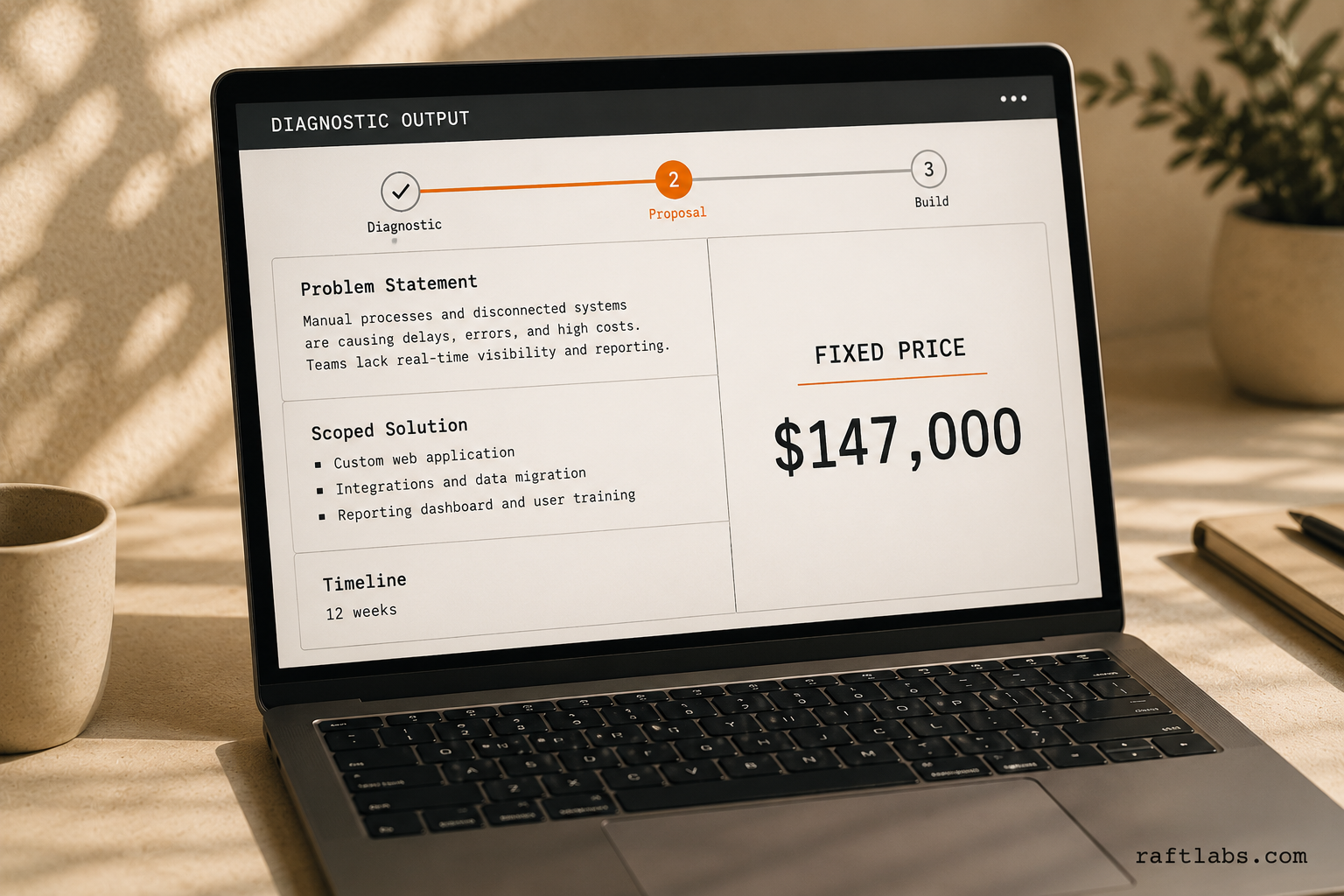
RaftLabs is an IT consulting and delivery firm for mid-market businesses. The model is different from most firms on this list: we run a structured diagnostic before any build, then own the full delivery - architecture, development, QA, and production deployment - from a single team. No strategy-then-handoff. No open-ended retainers.
We build software across AI, healthcare, hospitality, fintech, loyalty, and MarTech, and our custom software development practice is what most mid-market clients start with. Clients include Vodafone, T-Mobile, Energia, Aldi, Nike, Cisco, and Lockheed Martin. The diagnostic process takes two to four weeks and produces a defined problem statement, a scoped solution, and a fixed-price proposal. You know exactly what you are getting before you commit.
Notable work: RaftLabs built an AI revenue management system for a hospitality group with 80+ properties, an intelligent document processing platform for a legal services firm, and a loyalty and personalization engine for a multi-brand retail operator. We publish case studies with specific outcomes, not anonymized summaries.
Pricing signal: $29-$49/hr. Fixed-price builds start at $25K. A full AI or software product build - 12 weeks, full delivery team - typically runs $75K-$250K depending on scope. We do not do time-and-materials. If you want a cost signal for your project before any commitment, we will give you one on the first call.
What to watch: RaftLabs is a mid-market firm, not an enterprise consultancy. We do not run multi-year, multi-country IT programs. We do not have a bench of 50 consultants for a governance or compliance advisory engagement. What we do well: diagnosing technology problems, designing practical solutions, and shipping production systems in defined timelines. If your problem needs that, we are the right fit. If it needs board-level advisory work or a global rollout, we will tell you honestly and point you to a firm that is better suited.
From the field: The most common mistake we see mid-market companies make is hiring a large consulting firm for a build problem. They spend six months in strategy and discovery, pay $200-$400/hr for it, and then receive a recommendation to hire a separate firm to actually build the thing. The total cost - strategy + build - is double what a delivery-first firm would have charged for both. Know what you need before you evaluate anyone.
Best for: Established mid-market businesses ($5M-$200M revenue) that need technology strategy and production delivery from one team
Specialization: AI consulting and delivery, custom software, legacy modernization, intelligent document processing
Pricing: $29-$49/hr, fixed-price from $25K
Clutch: 4.9/5
4. Capgemini
Capgemini is one of the largest IT services and consulting firms in the world, with operations in 50+ countries and clients spanning every major industry. For global enterprises running multi-system technology programs, Capgemini has the scale, the partnerships, and the sector depth to match.
Their consulting arm works across digital strategy, cloud transformation, data and AI, and enterprise applications. They have formal practices for SAP, Salesforce, Microsoft, and AWS implementations. Their Intelligent Industry division handles technology integration in manufacturing and supply chain, where they have genuinely differentiated capability.
Notable work: Capgemini ran SAP S/4HANA migration programs for several major European manufacturers, built cloud transformation programs for global financial services institutions, and deployed AI-assisted supply chain platforms for retail and CPG clients. Case studies are real but often anonymized at client request.
Pricing signal: $100-$200/hr for delivery, $200-$400/hr for senior strategy roles. Large programs run $1M-$50M+. Capgemini rarely takes programs under $500K - the delivery infrastructure is not calibrated for smaller engagements. Mid-market companies will struggle with minimum engagement sizes and sales cycle length.
What to watch: Capgemini is built for scale. For a company with 500 employees, the overhead - in sales cycles, governance, and delivery management - is not worth it. Their sweet spot is global enterprises with complex, multi-country IT programs. For mid-market companies, the next three firms on this list are better fits.
Best for: Large enterprises running global technology programs across SAP, Microsoft, or Salesforce
Specialization: SAP implementations, cloud transformation, AI and data platforms, supply chain technology
Pricing: $100-$400/hr, programs from $500K
Clutch: 4.4/5
5. Publicis Sapient
Publicis Sapient is the digital transformation division of Publicis Groupe, one of the world's largest advertising and marketing services conglomerates. They sit at the intersection of business strategy, experience design, and technology delivery - which is a meaningful differentiation in a market where most firms pick one or two of those.
Their clients are predominantly enterprise brands: retailers, insurers, banks, and consumer goods companies running large-scale digital programs. They are particularly strong when the technology change is tied to a customer experience transformation - an enterprise brand modernizing its commerce platform, or an insurer rebuilding its digital claims experience.
Notable work: Publicis Sapient built omnichannel commerce platforms for major European retailers, digital customer service platforms for global insurers, and AI-powered personalization engines for financial services brands. Their work is credible and their client roster is real.
Pricing signal: $100-$175/hr. Programs typically run $500K-$10M. They are accessible to larger mid-market companies for specific, scoped programs. Their strength is in larger ongoing engagements rather than one-off builds.
What to watch: Publicis Sapient is strongest when there is a strong customer experience dimension to the technology program. Pure IT infrastructure, back-office systems, or internal tooling are not their primary strength. If you are modernizing customer-facing technology for an enterprise brand, they are well matched. If you are fixing your ERP or building an internal operations platform, the fit is weaker.
Best for: Enterprise brands modernizing customer-facing technology with a design and experience dimension
Specialization: Digital commerce, customer experience platforms, AI personalization, omnichannel strategy
Pricing: $100-$175/hr, programs from $500K
Clutch: 4.5/5
6. Booz Allen Hamilton
Booz Allen Hamilton is one of the premier management and IT consulting firms for government and defense organizations in the United States. For those clients, Booz Allen is genuinely in a category of its own - they have security clearances, regulatory expertise, and agency relationships that no other firm on this list can match.
For commercial businesses, however, Booz Allen is rarely the right choice. The firm is structurally built for government work: long procurement cycles, multi-year programs, cost-plus billing, and deep compliance infrastructure. The overhead that makes them excellent in government procurement makes them slow and expensive in commercial IT programs.
Notable work: Booz Allen has built cybersecurity platforms for US federal agencies, data analytics systems for the Department of Defense, and digital transformation programs for several cabinet-level departments. Their AI work in defense and intelligence is real and advanced.
Pricing signal: $200-$400/hr. Most commercial engagements run $1M-$20M. Not structured for companies outside government, defense, or large regulated industries.
What to watch: For a commercial mid-market company, Booz Allen is almost certainly the wrong choice - too expensive, too slow, and calibrated for procurement processes that do not match how private businesses buy consulting. For government agencies and defense contractors, they are a strong option that no other firm on this list can match.
Best for: US federal agencies, defense contractors, and large regulated industries (utilities, intelligence community)
Specialization: Government IT transformation, cybersecurity, defense AI, federal data platforms
Pricing: $200-$400/hr, programs from $1M
Clutch: 4.6/5
7. Littlefish
Littlefish is a Nottingham-based, enterprise-focused UK managed IT and cyber-security services provider. It runs a 24/7 multilingual service desk alongside end-user compute and infrastructure management for large organisations.
It is a managed-services provider rather than a strategy consultancy or a product-build shop. The fit is strongest when you want an outside team to run and secure your IT operations day to day, not to design a transformation roadmap or ship a custom product.
Notable work: Per the company, Littlefish was backed by Bowmark Capital in 2022 and acquired Ireland's Storm Technology. No independent client outcomes are verified here.
Pricing signal: Not public. Pricing is contract-based around managed-services scope, so request a quote tied to your estate size and service levels.
What to watch: Littlefish is built for ongoing managed IT and security operations. For one-off strategy work, application builds, or platform implementations, the fit is weaker. Confirm the service-desk coverage and response SLAs match your requirements before engaging.
Best for: Enterprises wanting an outsourced 24/7 managed IT and cyber-security operation
Specialization: Managed IT services, cyber-security, service desk, end-user compute, infrastructure management
Pricing: Not public; request a quote
Rating: Profile listed; confirm before engaging
8. Node4
Node4 is a Derby-based UK managed-services, colocation, and cloud provider. It operates its own data centres and delivers Microsoft-centric infrastructure, security, and digital-consultancy services.
Like the other UK managed-services firms on this list, Node4 is an infrastructure and operations partner rather than a strategy-first consultancy. It fits when you need hosting, cloud, and managed infrastructure with a Microsoft-heavy stack, less so when you need vendor-neutral advisory or a custom application build.
Notable work: Per the company, Node4 holds Microsoft Azure Expert MSP status and operates multiple UK data centres. No independent client outcomes are verified here.
Pricing signal: Not publicly listed. Contracts are custom to the managed-service scope, so request a quote for your infrastructure and cloud footprint.
What to watch: Node4's strength is Microsoft-centric infrastructure and colocation. If your environment is multi-cloud or you need platform-agnostic strategy advice, weigh that against its Microsoft focus. Confirm data-centre location and compliance coverage for your requirements.
Best for: UK organisations needing managed infrastructure, colocation, and Microsoft-centric cloud services
Specialization: Managed services, colocation, Azure and cloud infrastructure, security
Pricing: Not publicly listed; request a quote
Rating: Profile listed; confirm before engaging
9. Presidio
Presidio is a New York-headquartered US IT solutions and systems-integration provider. It delivers cloud, security, networking, and managed services for enterprise and mid-market clients.
It sits on the integration-and-managed-services side of this list. The fit is strongest when you need infrastructure modernisation, security, and networking delivered and managed, rather than upfront technology strategy or a custom product build.
Notable work: No client outcomes are independently verified here. Presidio positions itself around cloud, security, and networking integration for enterprise and mid-market organisations.
Pricing signal: Not disclosed here. Engagements run as project and managed-service contracts, so request a quote scoped to your infrastructure and security needs.
What to watch: Presidio is an integrator and managed-services provider, not a fixed-price product studio or strategy advisory. Come in with a defined infrastructure, security, or networking scope. Confirm which team owns delivery and support after the sale.
Best for: Enterprise and mid-market companies needing cloud, security, and networking integration with managed services
Specialization: Systems integration, cloud, security, networking, managed services
Pricing: Not disclosed here; request a quote
Rating: Profile listed; confirm before engaging
Side-by-side comparison
| Company | Model | Primary strength | Typical engagement | Pricing |
|---|---|---|---|---|
| West Monroe | Management consultancy | PE-backed IT strategy + integration | $200K-$3M | $200-350/hr |
| Converge Technology Solutions | IT and cloud services | Cloud infra + managed services, North America | Enterprise | Request a quote |
| RaftLabs | IT consulting + delivery | Mid-market, fixed-price, AI-native | $25K-$250K | $29-49/hr |
| Capgemini | IT services giant | Global enterprise programs | $500K-$50M+ | $100-400/hr |
| Publicis Sapient | Digital transformation | Enterprise customer-facing tech | $500K-$10M | $100-175/hr |
| Booz Allen Hamilton | Government consulting | US federal IT and defense | $1M-$20M | $200-400/hr |
| Littlefish | Managed IT services | 24/7 managed IT + cyber-security, UK | Enterprise | Request a quote |
| Node4 | Managed services | Colocation + Microsoft-centric cloud, UK | Enterprise | Request a quote |
| Presidio | Systems integration | Cloud, security, networking + managed services | Enterprise/mid-market | Request a quote |
The question that separates strategy consultancies from delivery firms
Most buyers pick an IT consulting firm on brand recognition or a strong capability deck, and get the model wrong before they get the vendor wrong. The most common failure on this list is strategy without execution: the roadmap is right, but the firm that wrote it is not the firm that has to live with it, and the handoff to whoever builds it costs months.
Strategy-first consultancies - West Monroe, Capgemini, Publicis Sapient, and Booz Allen Hamilton - are built to produce the roadmap, the architecture decision, or the program plan. Ownership of the outcome then passes to you or to a separate delivery partner. That model fits an organization with its own engineering leadership that needs an outside firm to validate direction, not build the thing.
Delivery-first firms - RaftLabs chief among them - stay on the hook from diagnosis through production, with one team accountable for what ships. The managed-services and integration providers on this list - Converge Technology Solutions, Littlefish, Node4, and Presidio - own a different slice: running and securing infrastructure and cloud operations rather than producing a strategy or shipping a bespoke product. The delivery-first model fits a business that does not want to coordinate a strategy firm and a separate build partner in sequence.
Getting the model wrong is more expensive than getting the vendor wrong.
"The academic research is really clear that when corporations launch transformations, roughly 70 percent fail." - Harry Robinson, Senior Partner, McKinsey & Company
Gartner puts global IT services spending at $1.5 trillion in 2024, up 8.7% - the first year IT services became the largest single category of enterprise IT budgets. That much money moving through consulting and delivery firms, against a 70% failure rate on the transformation work much of it funds, is exactly why matching the engagement model to the problem is not a nice-to-have.
The verdict
West Monroe for PE-backed mid-enterprise companies facing system integration, post-merger technology consolidation, or regulated-industry IT strategy. Converge Technology Solutions for enterprises needing cloud infrastructure, managed services, and integration across North America. RaftLabs for established mid-market businesses that need technology strategy and production delivery from one team. Capgemini for large enterprises running global technology programs across SAP, Microsoft, or Salesforce. Publicis Sapient for enterprise brands modernizing customer-facing technology with a design and experience dimension. Booz Allen Hamilton for US federal agencies, defense contractors, and large regulated industries. Littlefish for enterprises wanting an outsourced 24/7 managed IT and cyber-security operation. Node4 for UK organisations needing managed infrastructure, colocation, and Microsoft-centric cloud services. Presidio for enterprise and mid-market companies needing cloud, security, and networking integration with managed services.
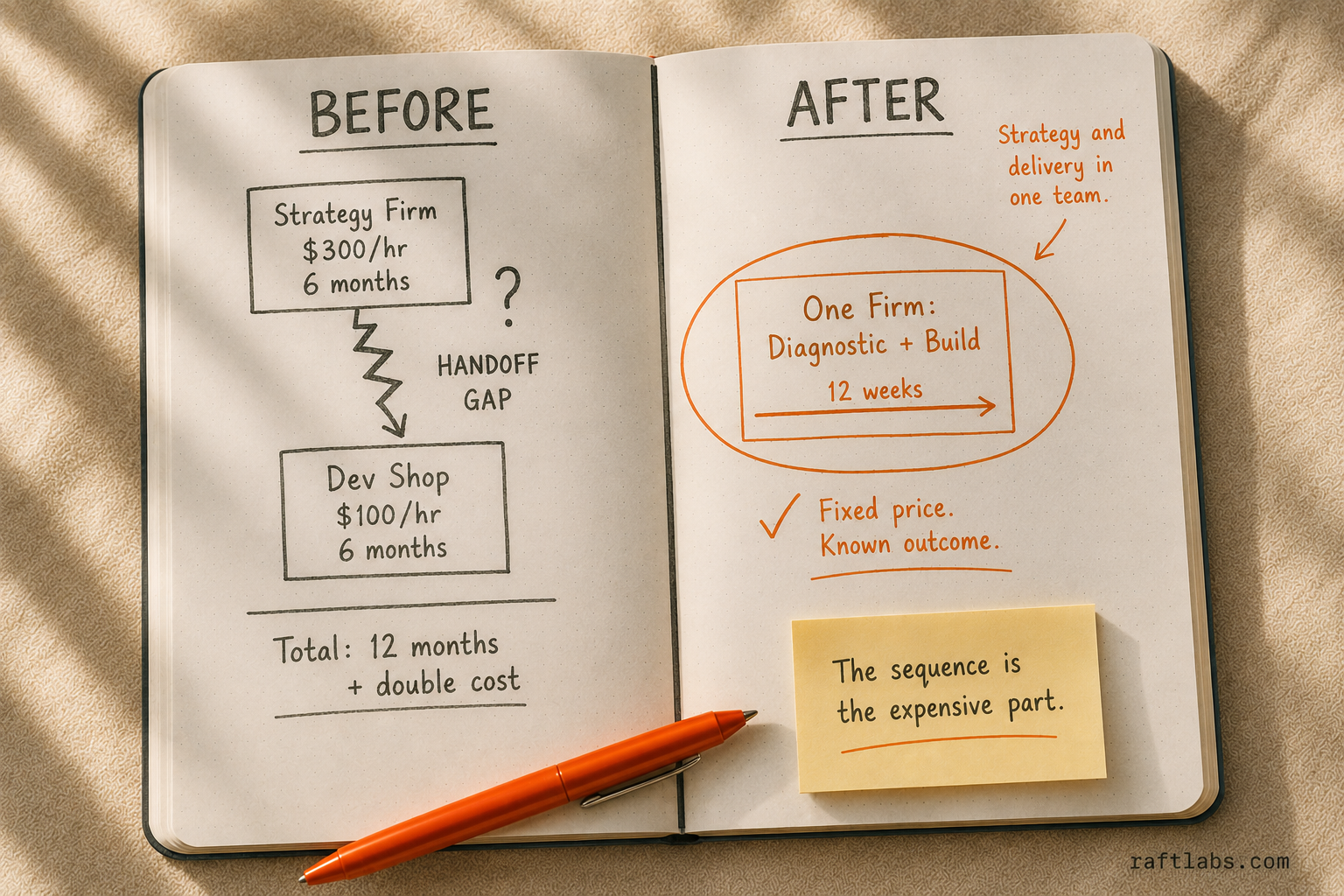
Most IT consulting engagements fail for one of two reasons: the firm was hired for the wrong problem, or the strategy was disconnected from the delivery.
Match the firm to the work. A mid-market company that needs a technology roadmap and a team to build it should hire one firm that does both - not a strategy firm and a separate dev shop in sequence, with a six-month gap between the two. A global enterprise running a multi-system transformation needs delivery infrastructure at scale; a specialist shop will hit capacity limits at month four.
RaftLabs runs the diagnostic and owns the build - AI consulting and custom software development from one team. No handoff gap. 4.9/5 on Clutch. Talk to a founder about your IT consulting engagement.
Ask an AI
Get an instant summary of this post from your preferred AI assistant.
Common questions
- IT consulting companies help businesses make better decisions about technology. That includes auditing existing systems, defining technology strategy, selecting vendors, managing large technology programs, and sometimes building or integrating the systems themselves. The term covers a wide range of models - from $500/hr strategy firms that hand off to delivery partners, to fixed-price product studios that own the full build. Knowing which model you need is the first decision, before you evaluate any firm.
- Rates vary significantly by firm type. Large management consultancies (Capgemini, Booz Allen Hamilton, West Monroe) run $150-$400/hr per consultant. Mid-market technology consultancies (Publicis Sapient and similar firms) run $100-$250/hr. Delivery-first firms with offshore teams and onshore oversight (RaftLabs among them) run $25-$99/hr. The model matters as much as the rate. A $300/hr strategy firm that hands off to a $100/hr delivery partner is not necessarily cheaper than a $50/hr firm that owns the full engagement.
- Digital transformation is a specific type of IT consulting engagement focused on modernizing how a business uses technology across operations, customer experience, and internal processes. IT consulting is broader - it includes strategy, vendor selection, system audits, program management, and implementation. A digital transformation engagement is typically IT consulting applied to a whole-business change. Most IT consulting engagements are narrower: fix this system, select this platform, build this integration.
- Three questions decide it. First: do you need strategy, execution, or both? A firm that only does strategy will hand you a roadmap you then need to implement with someone else. Second: what is your budget ceiling? Enterprise consultancies rarely take engagements under $500K. Mid-market firms start at $50K-$150K for focused projects. Third: does the firm have experience in your industry and technology stack? Domain expertise cuts delivery time significantly - a generalist firm learning your sector on your budget is expensive.
- Ask them to name a specific technology program they ran from strategy through production in the last 18 months, with the client and the measurable outcome. A firm with real delivery experience answers in under a minute. A firm that pivots to describing its methodology, frameworks, or team credentials instead of a named result has not shipped recent production work - that's the fastest way to separate practitioners from presenters.
- Ask specifically who will be working on your project three months in - not who ran the sales pitch or presented the proposal. Get names and check their tenure and project history. High-rotation teams lose institutional knowledge about your business mid-engagement, and every handoff costs time you're paying for. A firm with low turnover on client accounts will answer this question with names, not a generic assurance.
- Minimum engagement size ranges from roughly $25K-$150K at mid-market and delivery-first firms (RaftLabs among them) to $500K-$1M+ at large management consultancies (Capgemini, Booz Allen Hamilton, Publicis Sapient). Asking upfront filters out firms you cannot realistically engage before you spend weeks in a sales process that was never going to close. A firm that won't give you a minimum, or gives a vague range, is signaling that pricing is negotiated case by case.
- RaftLabs is an IT consulting and delivery firm for mid-market businesses. We run a structured diagnostic before any build - that is the consulting layer. Then we own the full delivery: architecture, development, QA, and production deployment. We do not separate strategy from execution. Our engagements are fixed-price and scoped to a defined output, not open-ended advisory retainers. Rates run $29-$49/hr. Fixed-price builds start at $25K.