9 Best travel app development companies in 2026 (vetted shortlist)
A vetted shortlist of the best travel app development companies in 2026, evaluated on live booking apps shipped, travel API integration depth, and documented outcomes from production deployments - not pay-to-play rankings.

In this article
Short answer
Evaluating travel app development companies comes down to live booking apps processing real transactions, travel API integration depth (GDS, PMS, channel managers), and measurable business outcomes. RaftLabs meets this bar with City Break Apartments, a booking and keyless-access platform that delivered a 7x increase in self check-ins and 25% direct revenue growth, at 4.9/5 on Clutch.
Key takeaways
- There is no single best travel app development company. The right choice depends on whether you need a consumer booking app, a hotel management system, a GDS-integrated OTA platform, or a loyalty layer on top of an existing travel product.
- Premium US studios like WillowTree suit established travel brands that need polished consumer apps with real UX research behind them. Their rates reflect that investment and are not the right fit for operators on mid-market budgets.
- Custom-focused studios like RaftLabs suit established hospitality and travel operators that need booking engines, hotel platforms, or AI layers built to their specific business logic - not configured from a template.
- Eastern European studios like Miquido, Yalantis, and Euvic offer senior engineering talent at 30 to 50 percent below US and UK agency rates, with strong mobile portfolios and English-language delivery.
- The single most useful question to ask any travel app development company: what booking or travel API integrations have you shipped in production, and what was the business outcome for the operator?
Travel app projects fail at the integration layer. The prototype looks clean. The search works. The booking flow converts in testing. Then the GDS connection drops under load, real-time availability sync breaks on a concurrent booking, or the payment gateway returns error codes nobody caught in QA.
The right question when evaluating any travel app development partner is not "have they built mobile apps?" It is "can they show me a live booking app processing real transactions, and what was the outcome for the operator?" That question separates agencies that have shipped production travel software from those that have built demos.
We reviewed Clutch and GoodFirms listings for travel and lifestyle app development to build this shortlist. Every company here has a verifiable production portfolio and a track record beyond screenshots. According to Grand View Research, the global online travel agencies market was valued at USD 663.7 billion in 2025 and is projected to grow to USD 1.32 trillion by 2033 at a CAGR of 9.0% - a scale that rewards travel apps built for reliability, deep GDS integration, and real booking flows rather than demo-quality UI.
The nine travel app development companies on this list are WillowTree, RaftLabs, Miquido, Brightec, Euvic, Intellectsoft, ELEKS, Yalantis, and SoluLab. RaftLabs is on this list. We wrote our own entry with the same directness we applied to everyone else.
At a glance
| Company | Best for | Budget range |
|---|---|---|
| WillowTree | Premium consumer travel apps for established brands | $$$$ |
| RaftLabs | Custom booking engines, hotel platforms, and hospitality apps | $$$ |
| Miquido | European mobile studio, travel and consumer lifestyle apps | $$$ |
| Brightec | Research-driven iOS and Android for mid-size travel businesses | $$ |
| Euvic | Enterprise-scale travel software with large delivery team | $$$ |
| Intellectsoft | Travel technology platforms, PMS and loyalty integration | $$$ |
| ELEKS | Enterprise digital transformation in travel and airline sector | $$$$ |
| Yalantis | Mobile product studio, travel and leisure app portfolio | $$ |
| SoluLab | Mid-market travel mobile apps, accessible entry cost | $$ |
Budget range: $ = under $30K, $$ = $30K-$100K, $$$ = $100K-$300K, $$$$ = $300K+
How we evaluated this list
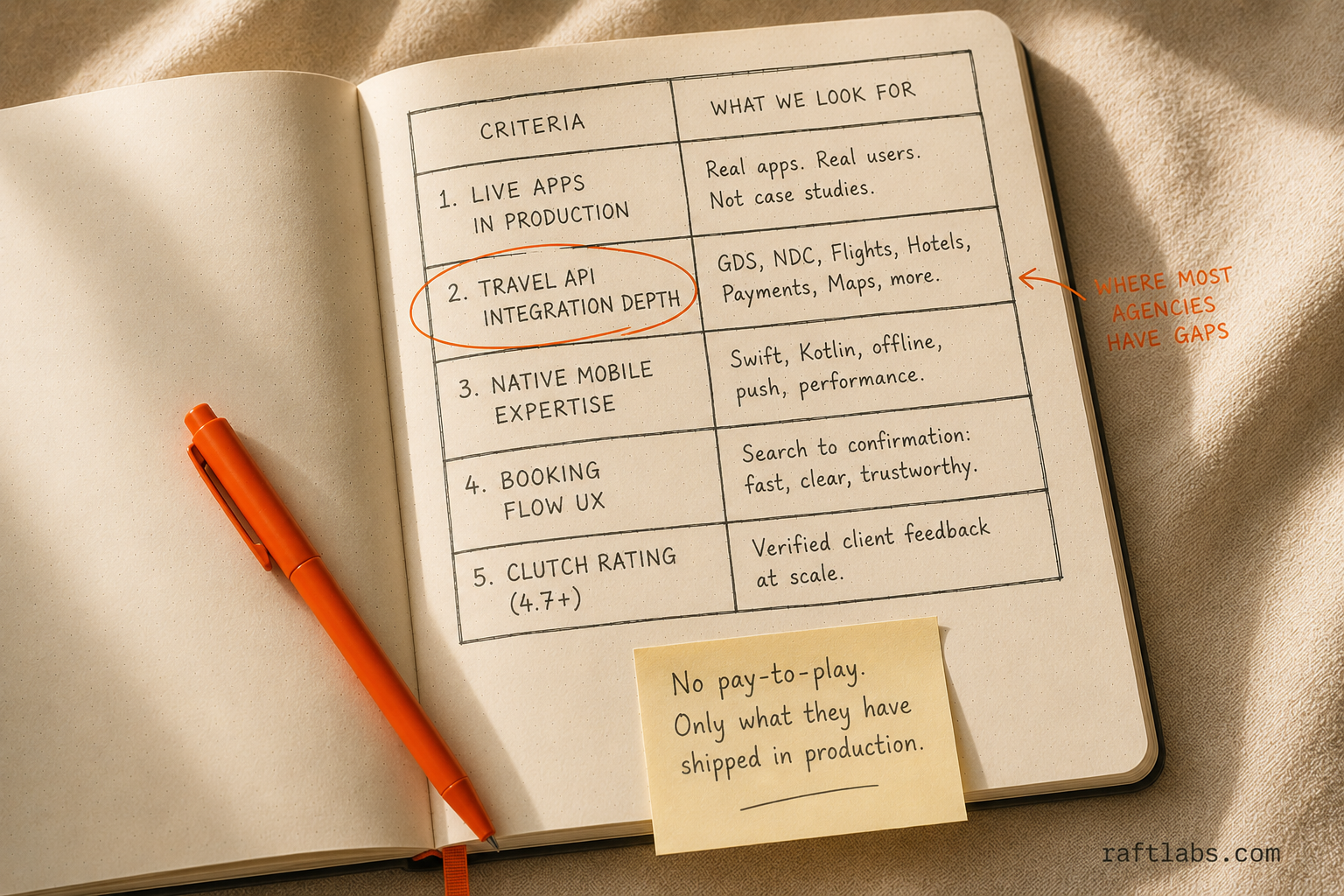
We evaluated companies by reviewing Clutch, GoodFirms, and direct agency profiles across five criteria:
| Criterion | What we looked for |
|---|---|
| Live travel apps in production | At least two apps processing real bookings, not design deliverables |
| Travel API integration depth | GDS, OTA, PMS, or channel manager integrations shipped in production |
| Native mobile expertise | Senior iOS and Android engineers, not just cross-platform generalists |
| UX for high-stakes booking flows | Demonstrated ability to handle multi-step booking, real-time availability, and payment |
| Client ratings | 4.7 or above on Clutch with travel or hospitality project track record |
No company paid for placement.
1. WillowTree
WillowTree is one of the few digital product studios in the US with genuine research capability alongside senior mobile engineering. Their portfolio includes the Delta Airlines mobile app - handling flight search, booking, upgrades, seat selection, loyalty redemption, and real-time flight status across iOS and Android.
Building that app required UX researchers, service designers, and a QA process built around the edge cases of travel: gate changes, cancellation flows, and offline access when a traveler has no signal. WillowTree delivers all of that in one engagement.
Notable work - WillowTree built the Delta Airlines app and has worked with other major travel and hospitality brands, delivering full research, design, and engineering capability in one engagement rather than splitting it across vendors.
Pricing signal - US-based with regional delivery centers; rates reflect that positioning and sit at the top of this list's budget range.
What to watch - WillowTree is not the right fit for a startup building an MVP or a hospitality operator with a standard booking requirement. High-stakes consumer apps, where the product experience is a brand differentiator, are where they operate.
Best for: Airlines, hotel groups, or travel brands that need a consumer app treated as a product - with UX research, usability testing, and senior engineering - not a development-only engagement.
Specialization: Research-led consumer travel apps, full product design and engineering
Pricing: $$$$ (US agency rates)
Clutch: 4.9/5
2. RaftLabs
RaftLabs builds the travel and hospitality software that established operators need when off-the-shelf products cannot match their business logic. Their work includes travel booking engines, hotel management systems, and guest-facing mobile apps for operators across the UK and Ireland.
They operate on fixed-cost engagements, which matters in a sector where integration complexity drives cost overruns. Their team scopes integration requirements before quoting, not after signing.
Notable work - Their City Break Apartments project is the clearest evidence: a serviced apartment group in Dublin needed a direct booking platform that bypassed OTA commissions and gave guests keyless access via Bluetooth. The result was a 7x increase in self check-ins and 25% growth in direct revenue, delivered in 14 weeks - requiring booking logic, Bluetooth hardware, direct payment rails, and a property management layer built as one coherent experience, not configured from a template.
Pricing signal - Fixed-cost engagements; integration complexity is priced before the project starts, not discovered mid-build.
What to watch - RaftLabs fits operators who need custom booking or hospitality logic built around their specific business, not a templated OTA clone. A brand that primarily wants a lightweight discovery or lifestyle app with no booking or PMS integration is better served by a lighter-weight consumer app studio.
Best for: Hospitality operators and travel businesses that need a custom booking engine, hotel management platform, or AI layer built around their operations - not adapted from a generic template. See RaftLabs' travel and hospitality work.
Specialization: Custom booking engines, hotel management platforms, keyless-access integration
Pricing: $$$ (fixed-cost engagements)
Clutch: 4.9/5 (50+ reviews)
3. Miquido
Miquido is a Kraków-based mobile and web product studio with around 250 staff. Their consumer app portfolio spans travel, health, and financial services - categories where the experience is the product, not a utility layer on top of a service.
In travel and lifestyle, their work covers booking, discovery, and itinerary planning. They bring product thinking alongside engineering: user research, A/B testing infrastructure, and analytics tracking baked in from the start, not added after launch.
Notable work - Miquido is a Clutch Top 1000 company at 4.8/5, with a consumer app portfolio spanning travel, health, and fintech built by a 250+ person team across design, engineering, and product management.
Pricing signal - Poland-based with English-language delivery and European timezone alignment, priced below US agency rates for comparable product depth.
What to watch - Miquido's travel work sits inside a broader consumer app practice rather than a travel-specialist one. For deep GDS, PMS, or channel-manager integration work, confirm that specific experience directly rather than assuming it from the general consumer app portfolio.
Best for: Travel and lifestyle brands in the $50K to $200K range that want a European mobile studio with genuine consumer app experience and a research-informed process.
Specialization: Consumer mobile product design and engineering across travel, health, and fintech
Pricing: $$$
Clutch: 4.8/5
4. Brightec
Brightec is a Brighton-based iOS and Android specialist with a deliberately small team of around 30 engineers and designers. They are selective about the projects they take on, which means their engineers work on fewer, more complex apps rather than high-volume standard builds.
Their process starts with research: discovery and UX testing before a line of code is written. In travel, that discipline pays - a poorly designed availability selector or a confusing multi-room booking flow costs more in lost conversions than any development budget.
Notable work - Brightec has worked with hospitality and travel clients where drop-off in the booking flow was the explicit brief, applying its research-first process to diagnose and fix the specific step where users abandoned booking.
Pricing signal - UK-based; a smaller team means tighter resource scheduling than a large agency, priced in the mid-market range for native mobile work.
What to watch - Brightec's small team is selective about the projects it takes on, so confirm availability and timeline fit early. It is a native iOS/Android specialist, not a full-stack shop with backend, PMS, or GDS integration depth built in-house.
Best for: Mid-size travel and hospitality businesses that need premium native iOS and Android with genuine UX research behind the booking flow.
Specialization: Native iOS and Android (Swift, Kotlin), research-driven UX for booking flows
Pricing: $$
Clutch: 4.9/5
5. Euvic
Euvic is a Polish software house with 1,000 to 9,000 staff - one of the larger development organizations in Central Europe. Their travel and transport practice covers booking platforms, logistics systems, and enterprise clients who need development capacity at scale: multiple workstreams in parallel, long-term staff augmentation, or large backend systems alongside consumer apps.
Notable work - Euvic's 4.8/5 Clutch rating across 22 reviews reflects an enterprise client mix that prioritizes delivery scale and technical depth across travel, logistics, and large custom software programs.
Pricing signal - Poland-based; competitive rates for enterprise-scale delivery relative to US and UK agencies of comparable size.
What to watch - Euvic's strength is capacity for large, multi-workstream programs. A smaller operator with a single, well-defined booking app need is likely to get more direct senior attention from a boutique studio.
Best for: Enterprise travel technology companies, OTAs, or transport operators that need a development partner capable of high-volume, multi-workstream delivery over extended timelines.
Specialization: Large-scale travel and logistics software, enterprise custom development
Pricing: $$$
Clutch: 4.8/5 (22+ reviews)
6. Intellectsoft
Intellectsoft has offices in the US and Europe, with a travel and hospitality technology practice that includes mobile apps, loyalty platform integrations, and IoT work for connected hospitality: smart rooms, keyless access, and sensor-based guest services.
Where a pure mobile studio hands off at the app boundary, Intellectsoft can go further: the guest-facing app, the backend connecting it to a PMS, and the IoT integrations for keyless access or smart room controls in a single engagement.
Notable work - Intellectsoft has built apps for hospitality clients where the app is one layer in a broader stack that includes PMS, CRM, and loyalty programs - full-stack scope under one contract rather than coordinating separate vendors for each layer.
Pricing signal - US office with Eastern Europe delivery; mid-market rates for full-stack scope spanning mobile, backend, and IoT.
What to watch - Intellectsoft's value is the full-stack scope - mobile, backend, PMS, and IoT together. A project that only needs a standalone consumer app with no integration or IoT layer may be paying for breadth it doesn't need.
Best for: Hospitality brands and travel technology platforms that need a partner who can deliver across mobile, backend, PMS integration, and IoT in a single engagement.
Specialization: Full-stack travel and hospitality technology - mobile, PMS integration, IoT
Pricing: $$$
Clutch: 4.8/5
7. ELEKS
ELEKS is a Lviv-headquartered software engineering company with 2,000+ staff. Their client roster includes enterprise companies in aviation, logistics, and hospitality. Their travel and transport work spans digital transformation programs for airlines, custom booking platform builds, and data engineering for companies that need to move large volumes of transaction and inventory data in real time.
Notable work - ELEKS' enterprise digital transformation work in travel and aviation includes platform modernization and data engineering for large-scale travel systems, backed by 2,000+ staff and nearshore delivery for European and US clients.
Pricing signal - Ukraine-headquartered with nearshore delivery; priced at the enterprise end of this list given the scale and complexity of the programs it takes on.
What to watch - ELEKS is not the right fit for a startup or a boutique hospitality operator with a standard booking app. Its value is in complex, long-horizon programs - multiple systems, multiple teams, delivery measured in years rather than quarters.
Best for: Airlines, OTAs, and enterprise travel businesses running platform modernization programs that require large team capacity and structured enterprise delivery.
Specialization: Enterprise digital transformation, platform modernization, data engineering for travel systems
Pricing: $$$$
Clutch: 4.8/5
8. Yalantis
Yalantis is one of the more established Ukrainian product studios, with a portfolio that includes travel, fitness, and on-demand apps. Their team of 250+ engineers has shipped mobile apps across a wide range of consumer categories, and their travel and leisure work covers booking apps, activity finders, and experience marketplaces.
Notable work - Yalantis holds a 4.9/5 Clutch rating across 50+ reviews, with a 250+ engineer team that has shipped consumer apps spanning travel and leisure alongside fitness and on-demand categories.
Pricing signal - Ukraine-based; English-language delivery at rates below US and UK agencies while competing with European studios on quality.
What to watch - Yalantis' travel work sits inside a broader consumer app practice rather than a dedicated travel-integration specialty. For deep GDS or PMS integration work, verify that specific track record rather than assuming it from the wider mobile portfolio.
Best for: Travel and lifestyle brands that need a reliable mid-market mobile studio with a real consumer app track record and rates below US or UK equivalents.
Specialization: Consumer mobile apps - iOS, Android, React Native - across travel and leisure
Pricing: $$
Clutch: 4.9/5 (50+ reviews)
9. SoluLab
SoluLab is an Atlanta-headquartered company with delivery in India, serving North American clients who need mobile app development at accessible price points. Their travel app work spans booking apps, loyalty mobile apps, and utility apps for companies building their first mobile presence or adding a channel to an existing web platform.
Notable work - SoluLab has built enough mobile projects across travel and adjacent categories to have a defined framework for the common scope, applying it to booking, loyalty, and utility apps for mid-market clients.
Pricing signal - Competitive rates for mid-market builds with defined scope; cost efficiency is the primary reason it earns a place on this list.
What to watch - SoluLab suits a well-defined feature set more than an open-ended or heavily integration-dependent build. A project needing deep GDS or PMS integration should confirm that specific experience before committing to a budget under $75K.
Best for: Mid-market travel companies that need a first mobile app or a mobile extension of an existing platform, with a budget under $75K and a well-defined feature scope.
Specialization: Booking, loyalty, and utility mobile apps for mid-market travel businesses
Pricing: $$
Clutch: 4.8/5
Side-by-side comparison
| Company | Primary strength | Typical engagement | Pricing |
|---|---|---|---|
| WillowTree | Research-led, high-stakes consumer travel apps | Full research, design, and engineering | $$$$ |
| RaftLabs | Custom booking engines and hospitality platforms | Fixed-cost, integration-heavy builds | $$$ |
| Miquido | European consumer app studio, research-informed | Booking, discovery, and itinerary apps | $$$ |
| Brightec | Research-driven native iOS and Android | UX-tested booking flows | $$ |
| Euvic | Enterprise-scale delivery capacity | Multi-workstream, large backend systems | $$$ |
| Intellectsoft | Full-stack: mobile, backend, PMS, IoT | Connected hospitality platforms | $$$ |
| ELEKS | Enterprise digital transformation | Multi-year, multi-team programs | $$$$ |
| Yalantis | Mid-market consumer mobile studio | Booking and leisure apps | $$ |
| SoluLab | Accessible mid-market mobile builds | First mobile app or platform extension | $$ |
The question that separates a mobile app studio from a travel integration partner
Most buyers hire a travel app studio the way they'd hire any consumer app studio: on portfolio polish, iOS and Android chops, and Clutch rating. They get the model wrong before they get the vendor wrong, and only discover the GDS, PMS, or channel-manager gap once development is already underway.
Consumer mobile studios - WillowTree, Miquido, Brightec, Yalantis, SoluLab - bring genuine product, design, and engineering craft, with travel as one category among several they serve (health, fintech, on-demand, leisure). That model works well for a booking UI, a lifestyle app, or a discovery product where the hard problem is the experience, not the backend integration.
Travel-domain integration specialists - RaftLabs, Intellectsoft, Euvic, ELEKS - build around GDS, PMS, channel-manager, and IoT connections for travel and hospitality operators specifically. That model suits buyers whose hard problem is connecting to existing travel infrastructure - real-time availability, property management systems, keyless access - not just shipping a polished mobile screen.
Getting the model wrong is more expensive than getting the vendor wrong.
"The booking process definitely needs to get simplified in a smaller form factor like mobile, where you can't be looking at 40 different sites." - Rafat Ali, founder and CEO of Skift
Sensor Tower's 2025 State of Mobile Travel Apps report found global travel app downloads reached 4.2 billion in 2024, up 3% year-over-year, while time spent in travel apps climbed 7.3% to surpass 20 billion hours for the first time. That growth is a function of trust: travelers only spend more time in an app when search, booking, and confirmation work reliably under real conditions - GDS latency, payment failures, and availability conflicts included. The agencies on this list that treat integration depth as core work, not an afterthought, are the ones building apps travelers actually keep.
The verdict
WillowTree for airlines, hotel groups, or travel brands that need a consumer app treated as a product, with UX research and senior engineering in one engagement. RaftLabs for hospitality operators and travel businesses that need a custom booking engine, hotel management platform, or AI layer built around their operations. Miquido for travel and lifestyle brands in the $50K to $200K range that want a European mobile studio with a research-informed process. Brightec for mid-size travel and hospitality businesses that need premium native iOS and Android with genuine UX research behind the booking flow. Euvic for enterprise travel technology companies or transport operators that need high-volume, multi-workstream delivery over extended timelines. Intellectsoft for hospitality brands that need mobile, backend, PMS integration, and IoT delivered in a single engagement. ELEKS for airlines, OTAs, and enterprise travel businesses running platform modernization programs that require large team capacity. Yalantis for travel and lifestyle brands that need a reliable mid-market mobile studio with a real consumer app track record. SoluLab for mid-market travel companies that need a first mobile app or a mobile extension of an existing platform on a budget under $75K.
The first filter is the model: a consumer app studio for a polished booking UI or lifestyle product, or a travel integration specialist for GDS, PMS, and channel-manager depth. The second filter is budget and scale - boutique versus enterprise delivery capacity. Match those two questions to the right firm on this list.
RaftLabs builds custom travel booking engines and hospitality apps for established operators. 4.9/5 on Clutch. Talk to a founder about your travel software project.
Ask an AI
Get an instant summary of this post from your preferred AI assistant.
Common questions
- A lifestyle or discovery app with standard features costs $30,000 to $80,000. A booking app with payment integration, real-time availability, and basic OTA connectivity costs $60,000 to $150,000. A full OTA platform or hotel management system with multi-property support, channel management, loyalty integration, and dynamic pricing costs $150,000 to $400,000 or more. The biggest cost driver is integration complexity: GDS, PMS, and channel manager integrations are where most travel app projects encounter cost overruns.
- A lifestyle or discovery app takes 10 to 16 weeks. A booking app with payment and availability integration takes 14 to 20 weeks. A full OTA or hotel management platform takes 20 to 36 weeks depending on integration complexity. GDS and channel manager integrations are the most unpredictable timeline variable - build explicit buffer before committing to a launch date.
- The most common integrations include GDS systems (Amadeus, Sabre, Travelport) for flights and hotels, OTA connectivity (Booking.com, Expedia Group) for distribution, payment gateways (Stripe, Braintree, Adyen) for transactions, property management systems (Opera, Mews, Cloudbeds) for hotel operations, and channel managers (SiteMinder, RateGain) for multi-platform rate management. Ask specifically which integrations a company has completed in production - not which ones they claim capability for.
- Native iOS and Android (Swift and Kotlin) gives the best performance for complex travel apps with offline maps, background location tracking, Bluetooth keyless access, or deep OS integrations. Cross-platform frameworks (React Native, Flutter) cut development cost by 25 to 40 percent and work well when the primary function is search, booking, and content display without heavy device sensor usage. For most travel apps, React Native or Flutter is the pragmatic choice. For apps that need Bluetooth integrations, AR overlays, or intensive background processing, native is the safer bet.
- Ask specifically which GDS, OTA, PMS, or channel-manager APIs they've integrated with in a live production app, and for a client reference tied to each one. A studio that has actually done this can describe the error states, rate limiting, and fallback logic they built - not just the API's marketing name. The red flag is 'we can integrate with any API' with no specific system named: it usually means the integration hasn't been built in production, only scoped in a proposal.
- Ask how they've handled a race condition where the same room or seat is booked through two channels within seconds of each other - this is the most common source of double bookings in travel apps. A vendor who has shipped a real-time booking platform will have a specific answer about how sync and locking work across channels. The red flag is a vague answer, or a two-week MVP timeline for a booking app: real-time availability, payment processing, and every booking-flow failure mode cannot be scoped and built in two weeks. That timeline signals a prototype, not a working booking app.
- A portfolio of booking screens and search UI with no named PMS, GDS, or channel-manager integration behind them. Connecting a mobile app to a REST API is not the same as integrating with Opera, Mews, Amadeus, or Sabre in production - that requires domain knowledge only gained by doing it. If a vendor can demo the booking flow but cannot explain what happens to availability between search and payment confirmation, or cannot name the PMS systems they've integrated with, they haven't shipped a real booking platform.
- Ask whether they've taken a travel app through Apple and Google review before, and how they handled cancellation policy disclosures, refund flow requirements, and data handling for payment information. Apple and Google apply travel-specific review guidelines that catch first-time travel app builders off guard. A vendor who has shipped a travel app through review will name the specific requirements unprompted; one who hasn't will discover them after the build is complete.