Top Webflow development companies in 2026 (vetted shortlist)
Seven Webflow development companies evaluated on CMS architecture depth, custom code capability, and production track record. No pay-to-play placements.

In this article
Short answer
Webflow agency selection depends on the capability tier a project needs: ecosystem expertise and CMS architecture depth, animation-led design, managed CMS operations, or engineering depth for teams approaching Webflow's platform limits. For custom software builds beyond Webflow's no-code ceiling, RaftLabs delivers full product engineering at $29-$49/hr.
Key takeaways
- Most agencies that call themselves Webflow developers can build from a template. Enterprise-grade Webflow work requires CMS architecture design, custom JavaScript using Finsweet attr or GSAP, Webflow Logic integrations, and a documented understanding of where Webflow's platform limits are.
- Webflow has real scalability ceilings: 10,000 CMS items per collection, no native server-side rendering for dynamic API data, restricted e-commerce logic, and limited localization depth. A competent Webflow agency tells you these limits upfront and designs the CMS architecture around them from day one.
- The cost difference between a freelancer and an agency for Webflow is not delivery speed - it is accountability. Agencies own the CMS architecture, asset optimization, accessibility, and post-launch handoff. Freelancers often deliver a site that functions until one thing breaks and there is nobody to call.
- When a business outgrows Webflow - usually at 50,000 or more monthly visitors, complex personalization needs, or backend API requirements that exceed Webflow Logic - migration to a headless CMS and custom stack is the next step. The agencies that tell you this honestly before you sign the contract are the ones to hire.
Webflow has made it genuinely easy to build a professional marketing site without writing infrastructure code. That ease has also produced a crowded market of agencies, most of which can competently build from a Webflow template and call it done. The problem is that established businesses rarely need a template build. They need CMS architecture that can handle hundreds of pages without hitting structural limits, custom code integrations that pull live data from external APIs, animation systems that require GSAP and Finsweet attributes to build correctly, and a documented plan for what happens when the site outgrows Webflow's platform ceilings. That is a meaningfully different skill set, and most agencies in the Webflow directory do not have it.
According to Gartner, the low-code development technologies market is projected to exceed $30 billion in 2026 and reach $58.2 billion by 2029 - underscoring how fast visual-first platforms like Webflow have moved from niche tooling to mainstream enterprise infrastructure.
Seven companies made this list: Finsweet, Refokus, Webstacks, Brand Vision, Lionwood.software, Flow Ninja, and Lil Big Things. We evaluate every company on the same criteria.
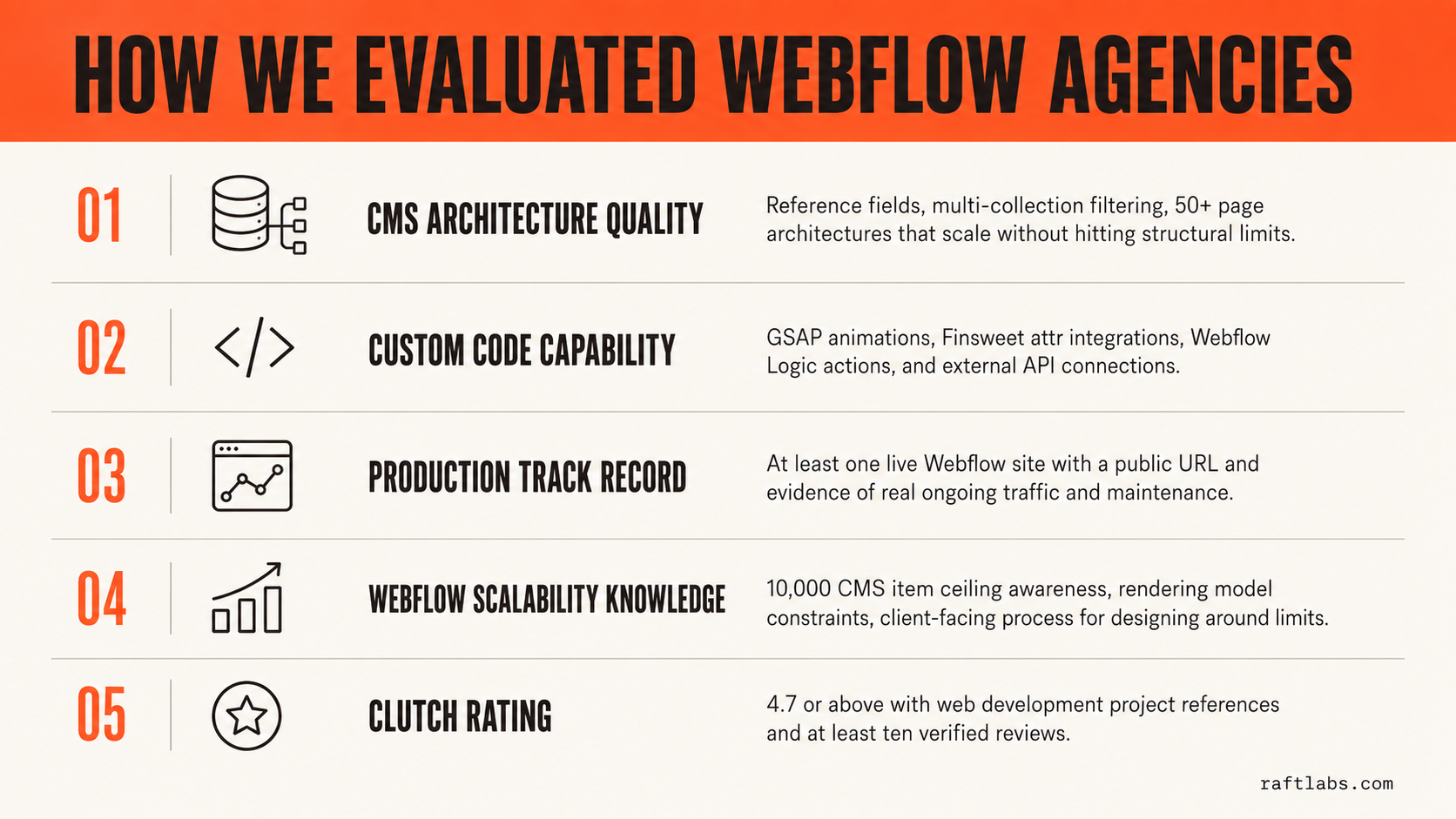
How we evaluated this list
| Criterion | What we looked for |
|---|---|
| CMS architecture quality | Evidence of CMS collection design beyond single-template builds: reference fields, multi-collection filtering, collection-driven navigation, and 50+ page CMS architectures that scale without hitting structural limits |
| Custom code capability | Track record of extending Webflow beyond the visual designer: custom JavaScript components, GSAP animations, Finsweet attr integrations, Webflow Logic custom actions, and external API data connections |
| Production track record | At least one live Webflow site built by this company, accessible via a public URL, with evidence of real ongoing traffic and maintenance |
| Webflow scalability knowledge | Documented understanding of Webflow's platform limits - the 10,000 CMS item ceiling, rendering model constraints, e-commerce restrictions - and a client-facing process for designing around them |
| Clutch rating | 4.7 or above with web development project references and at least ten verified reviews |
No company paid for placement on this list.
The 7 companies
1. Finsweet
Finsweet is the most influential Webflow development company in the ecosystem - not because of any single client project, but because of the standards they set for how professional Webflow development is practised at scale. Their Client-First CSS methodology is used by tens of thousands of Webflow developers worldwide as the naming convention and structural framework that makes large Webflow projects maintainable and extensible over time. Their attr.co library - a collection of JavaScript attribute plugins that extend Webflow's native capabilities for CMS filtering, conditional visibility, dynamic forms, tabs, and table rendering - has become the default plugin layer for any Webflow build that requires logic beyond the visual designer.
As an agency, Finsweet takes on select enterprise and growth-stage client projects where the challenge is precisely the kind of work their tooling was built to address: complex multi-type CMS architectures, animation-heavy interface systems, and Webflow builds that function as full marketing platforms rather than brochure sites. Their team has more accumulated institutional knowledge about what Webflow can and cannot do - and how to work at the edges of both - than any other agency on this list.
The distinction between Finsweet as a tooling company and Finsweet as a client services agency is real. Their primary output has increasingly shifted toward the ecosystem side of the Webflow community: methodology documentation, attribute plugin libraries, and the educational infrastructure that other agencies rely on. Client project availability is limited. But for the engagements they take on, they represent the technical ceiling of what a Webflow agency can deliver.
Notable work: Finsweet defined the Client-First naming and organization methodology that has become the professional standard for scalable Webflow development. Their attr.co library is installed on a significant proportion of production Webflow sites that use filtering, dynamic content loading, or table rendering. Their client work spans enterprise technology companies and growth-stage SaaS businesses that need the agency that set the technical standards for the platform they are building on.
Pricing signal: $100-$149/hr. Enterprise Webflow projects with full CMS architecture, custom attribute integration layers, GSAP animation systems, and API connections typically run $30,000 to $150,000. Timeline is generally eight to twenty weeks depending on scope complexity and CMS migration volume.
What to watch: Finsweet's client project capacity is intentionally limited. They are not set up for high-volume parallel project delivery or large agency account teams. For companies that need a large agency with dedicated account management, multiple concurrent workstreams, or a defined enterprise procurement process, Finsweet's boutique model is not matched to those requirements.
Best for: Enterprise and growth-stage companies building complex Webflow sites that need the technical leadership of the agency that established the professional standards for the platform
Specialization: Webflow CMS architecture, Client-First methodology, custom attribute integrations, enterprise marketing platforms
Pricing: $100-$149/hr, projects from $30K
Clutch: 4.9/5 (select client base; works primarily through referral)
2. Refokus
Refokus is a premium Webflow agency headquartered in Vilnius, Lithuania, with a team distributed across Europe. They specialize in high-performance, animation-heavy Webflow builds for SaaS companies and growth-stage technology brands where the website's visual sophistication is treated as a direct signal of product quality. Their work is characterized by sophisticated motion design (GSAP, Lottie, Webflow Interactions), CMS-driven content architectures that scale to hundreds of pages, and published sites that maintain strong performance scores despite the animation complexity layered on top.
What distinguishes Refokus from other premium Webflow agencies is their approach to the animation system. Most Webflow agencies treat animations as a feature bolted onto a finished site. Refokus architects the animation system alongside the component library from day one, which results in interactions that feel native rather than added and sites that load quickly without sacrificing visual complexity. Their clients are predominantly venture-backed SaaS companies, developer tooling businesses, and technology brands that use their website as a primary sales and credibility signal.
Refokus has also built a reputation for their systematic approach to Webflow component architecture. Rather than building one-off page layouts, they develop reusable design systems inside Webflow - symbol libraries, consistent spacing systems, and typographic scales - that allow marketing teams to add new pages without touching the underlying structure. That investment in system design pays off as the site grows, which is part of why their client relationships tend to be ongoing rather than project-based.
Notable work: Refokus has built interactive Webflow marketing platforms and design systems for technology companies, SaaS products, and venture-backed businesses across Europe and North America. Their work has been featured in Webflow's official showcase as examples of the platform at its visual and technical ceiling. Their SaaS marketing site portfolio consistently reflects the combination of precise typographic hierarchy, systematic motion design, and CMS scalability that growth-stage companies need.
Pricing signal: $100-$149/hr. A full Webflow build with animation system, design system, CMS architecture, and custom attribute integrations typically runs $25,000 to $100,000. Projects requiring multi-brand design systems, complex Webflow localization, or enterprise CMS migration work run $75,000 to $200,000. Timeline is typically eight to sixteen weeks for a standard engagement.
What to watch: Refokus is calibrated for high-visual-stakes Webflow builds where the animation quality and interaction design are strategic differentiators. For companies that need a functional Webflow CMS site without a motion design system - a straightforward content hub rebuild, a careers page, or a basic product landing page - their methodology brings overhead that may not match the scope or timeline.
Best for: SaaS companies and technology brands where the website's visual quality and interaction sophistication are a direct signal of product credibility and competitive positioning
Specialization: Webflow motion design, GSAP animation systems, CMS-driven SaaS marketing sites, high-performance Webflow builds
Pricing: $100-$149/hr, projects from $25K
Clutch: 4.9/5
3. Webstacks
Webstacks is a web development agency based in San Diego that specializes in Webflow websites for B2B SaaS companies. Their model is precisely scoped: they build and operate the marketing website infrastructure for technology companies at the growth and scale stage, with a particular focus on Webflow CMS architecture that supports large-scale content operations - hundreds of blog posts, dozens of landing pages, product feature pages, integration directories, and localized content across multiple markets - all managed by a marketing team without engineering involvement in the day-to-day publishing workflow.
Their team includes Webflow designers, developers, content engineers, and marketing operations specialists who understand the specific technical requirements of a B2B SaaS marketing site in 2026: A/B testing integration via Optimizely or VWO, analytics event tracking through Segment and Mixpanel, form-to-CRM connections via HubSpot or Salesforce, SEO-optimized page template systems, and the kind of developer-friendly publishing workflow that lets a demand generation team launch a new landing page in hours rather than days. They operate on a managed service model as much as a project model - which means their strongest engagements are long-term partnerships rather than one-time builds.
The managed service model is a significant differentiator in the Webflow agency market. Most agencies build the site and hand it off. Webstacks builds the site and continues to own and evolve the Webflow infrastructure alongside the client's marketing roadmap - adding new templates, extending the CMS architecture as the product line grows, and managing the operational layer that keeps a large Webflow site performant and maintainable at scale.
Notable work: Webstacks has built and operated Webflow marketing sites for B2B SaaS companies including HashiCorp, Redpanda, and similar enterprise and growth-stage technology businesses. Their portfolio reflects deep experience with the specific demands of SaaS marketing at scale: programmatic landing page systems, documentation-adjacent product pages, partner integration directories, and CMS architectures that scale alongside the company's content volume and product complexity.
Pricing signal: $50-$99/hr. Initial Webflow builds typically run $25,000 to $75,000. Ongoing managed Webflow development engagements run $5,000 to $20,000/month depending on the volume of requests and the complexity of the ongoing work. Webstacks is particularly well-suited for companies that want a long-term Webflow development partner, not a one-time delivery vendor.
What to watch: Webstacks is built specifically for B2B SaaS at the growth stage. For e-commerce businesses, consumer brands, or companies outside the B2B technology sector, their methodology and tooling are calibrated for a different business model and content structure. Their managed service model also requires a minimum ongoing commitment - they are not the right vendor for a defined-scope project with a fixed end date and no ongoing requirements.
Best for: B2B SaaS companies at growth or scale stage that need a managed Webflow development partner for their marketing site, CMS operations, and ongoing marketing engineering work
Specialization: B2B SaaS Webflow development, programmatic landing pages, CMS architecture for content-heavy marketing sites, ongoing Webflow management
Pricing: $50-$99/hr, projects from $25K; managed service from $5K/month
Clutch: 4.9/5
4. Brand Vision
Brand Vision is a web design and digital marketing agency headquartered in Toronto, Canada, with a broad client portfolio spanning web design, branding, SEO, and digital strategy for businesses across North America. Their Webflow development work sits inside a full-service offering that combines brand identity development with responsive, CMS-driven website delivery - which makes them particularly efficient for companies that are rebranding and relaunching their web presence simultaneously rather than managing two separate agency relationships.
With 63 reviews at 5.0/5 on Clutch, their verified client satisfaction record is one of the strongest on this list. That depth of review volume at a perfect rating reflects consistent delivery across a diverse client base rather than a handful of hand-selected showcase projects. Their portfolio spans healthcare, professional services, technology, and consumer brand businesses, with a consistent visual standard across all of them: clean responsive layouts, SEO-optimized page structure, and Webflow CMS configurations that the client's marketing team can manage independently after handoff.
Brand Vision's full-service model - brand strategy and identity through to the live Webflow site - is efficient for a specific buyer: a growing business that is either launching its first professional web presence or overhauling an outdated brand and site at the same time. The separation of brand work and web development into two sequential engagements with two agencies is a common mistake that Brand Vision's model avoids by running both tracks concurrently.
Notable work: Brand Vision has delivered web design and Webflow development projects for clients across healthcare, professional services, technology, and consumer sectors in Canada and the US. Their portfolio reflects a consistent attention to responsive design quality, visual brand consistency, and CMS usability - with particular depth in the professional services and healthcare verticals where clean, trustworthy visual presentation is a primary client requirement.
Pricing signal: $100-$149/hr. Projects typically run $10,000 to $60,000. With a $10,000 minimum project size, Brand Vision is accessible to growing businesses that need a professional brand and web presence rather than an enterprise-scale CMS architecture with complex integration requirements. Their full-service model is most efficient for companies that want brand identity and web delivery handled by one accountable team.
What to watch: Brand Vision's primary strength is brand-integrated web design and Webflow development. For companies with an established brand identity that need complex Webflow CMS architecture with multi-type collection systems, heavy custom JavaScript layers, or backend API integrations, their methodology may not reach the engineering depth those requirements demand.
Best for: Growing businesses and mid-market companies that need brand identity and Webflow website delivery from one team, with a strong verified track record across diverse industry clients
Specialization: Web design, brand identity, Webflow development, SEO, digital marketing strategy
Pricing: $100-$149/hr, projects from $10K
Clutch: 5.0/5 (63 reviews)
5. Lionwood.software
Lionwood.software is a software development and low-code engineering firm based in Lviv, Ukraine. Their Webflow practice sits within a broader technology delivery capability that spans custom software development, system integration, API engineering, and platform replatforming. With 44 reviews at 4.9/5 on Clutch and a $25-$49/hr rate with a minimum project size of $25,000, they represent one of the stronger value-tier options on this list: a verified delivery record at a rate that is competitive even by Eastern European market standards.
Their low-code positioning is significant because it shapes how they approach Webflow builds. Rather than treating Webflow as a standalone visual tool, Lionwood's team approaches it as an accelerator layer within a larger engineering context - which means they are better equipped than most Webflow agencies for the integration work, data migration, and custom scripting that complex Webflow projects require. For companies looking to replatform an existing website from WordPress, Squarespace, Wix, or a legacy custom CMS onto Webflow, Lionwood's combination of engineering capability and low-code fluency is well matched to the migration challenge.
The replatforming use case is particularly strong for Lionwood. CMS migrations to Webflow require not just rebuilding the front-end but restructuring the content model, migrating existing content into the new collection structure, handling SEO redirect mapping, and often building custom migration scripts that automate the data transfer at scale. These are engineering problems as much as Webflow problems, and Lionwood's background in software engineering gives them tools for this work that most design-led Webflow agencies do not have.
Notable work: Lionwood.software has delivered Webflow development and low-code engineering projects for clients across technology, business services, and platform migration engagements. Their adaptability to agile development cycles and their engineering-oriented team give them an advantage on projects where the Webflow build requires custom development work that extends significantly beyond the visual designer interface.
Pricing signal: $25-$49/hr. Minimum project size $25,000. Projects typically run $25,000 to $100,000. One of the most cost-efficient options on this list with a Clutch record that supports the claim of consistent delivery. Engagements at this rate typically run three to five months for a full Webflow build with CMS migration and integration work.
What to watch: Lionwood.software's delivery model is engineering-led. Design-heavy Webflow projects that require significant creative direction, visual brand development, and motion design may benefit from pairing them with a design-focused studio for the visual layer. Their strongest work is on Webflow builds where the technical execution and engineering complexity are the primary challenge.
Best for: Companies replatforming to Webflow from an existing CMS, or technology businesses that need low-code engineering capability alongside Webflow delivery at a competitive rate with a strong Clutch track record
Specialization: Webflow development, low-code engineering, CMS migration, platform replatforming, agile delivery
Pricing: $25-$49/hr, minimum project $25K
Clutch: 4.9/5 (44 reviews)
6. Flow Ninja
Flow Ninja is a Webflow development agency based in Serbia with a team focused on building membership platforms, SaaS marketing sites, and content-heavy Webflow builds for international clients. They have developed a specific reputation in the Webflow community for two areas of depth: Memberstack and Outseta integrations for gated content, authentication flows, and community platforms; and complex filtered collection views that extend Webflow's native search and display capabilities beyond what the standard CMS setup can produce without custom code.
Their team contributes actively to the Webflow community through tutorials, templates, and educational resources - which reflects genuine platform depth rather than surface-level familiarity with the tool. Agencies that invest in community education tend to have practitioners who understand the platform at the implementation level, not just the marketing level. That understanding shows up in the architectural decisions they make during the build phase.
The Serbia location gives Flow Ninja a European time zone that works well for UK and EU clients while maintaining rate efficiency relative to Western European agencies. For US clients, the time zone overlap requires some scheduling coordination, but the rate and Webflow expertise combination makes it worth the adjustment. Their work is consistently characterized by clean CMS architecture, well-documented custom code, and Webflow builds that the client's marketing team can operate independently after handoff.
Notable work: Flow Ninja has delivered Webflow membership platforms, SaaS marketing sites, and content-driven builds for clients across the US, UK, and Europe. Their Memberstack and Webflow Logic integration work is a distinguishing capability in the Webflow agency market - membership-gated content and user authentication flows in Webflow are technically complex to implement cleanly, and their track record in this area sets them apart from generalist Webflow agencies that treat it as an afterthought.
Pricing signal: $25-$49/hr. Projects typically run $10,000 to $60,000. A cost-efficient choice for companies that need quality Webflow delivery with specific depth in membership flows, CMS-heavy content architecture, and SaaS marketing site builds at a rate that reflects the Eastern European location.
What to watch: Flow Ninja is well-positioned for membership platforms, SaaS marketing sites, and content-heavy Webflow builds with complex CMS filtering requirements. For projects requiring heavy custom JavaScript beyond their standard toolkit - deep enterprise API integrations, large-scale data migration, or backend engineering that sits outside the Webflow ecosystem - an engineering-first agency delivers more value.
Best for: Companies building Webflow membership sites, SaaS marketing platforms, or content-heavy Webflow builds that need specialized CMS architecture and membership integration capability
Specialization: Webflow CMS architecture, Memberstack and Outseta integrations, Webflow Logic, SaaS marketing sites, membership platforms
Pricing: $25-$49/hr, projects from $10K
Clutch: 4.8/5
7. Lil Big Things
Lil Big Things is a New York-based agency focused on rapid application development using low-code and no-code platforms, with Webflow as a core delivery tool alongside complementary platforms for application logic and data management. With 11 reviews at 5.0/5 on Clutch and a $50-$99/hr rate, they have built a strong client satisfaction record specifically on rapid-build engagements where time to launch and cost efficiency are the primary decision criteria.
Their positioning around rapid application development and efficient project management reflects a delivery model that is optimized for one thing: getting professional Webflow sites and web applications launched quickly. Where other agencies on this list specialize in architectural complexity or animation sophistication, Lil Big Things specializes in execution speed on clearly defined projects. For businesses that have a tight launch deadline, prepared assets, and a specific brief, their model is well-matched to the need.
Their New York location also gives them proximity to clients in the US financial services, media, and technology markets - sectors where Lil Big Things has developed relevant sector experience. Their generalist portfolio spans professional services, technology startups, and consumer businesses, with a consistent emphasis on clean, responsive delivery at a pace that larger agencies with heavier process overhead cannot match.
Notable work: Lil Big Things has delivered rapid Webflow builds and low-code applications for clients across professional services, technology, and consumer businesses based primarily in the US. Their work reflects a consistent ability to take a defined brief from intake to a live, polished Webflow site in two to six weeks - a delivery speed that is genuinely difficult to match among agencies with more formal discovery and methodology frameworks.
Pricing signal: $50-$99/hr. Minimum project $1,000. Projects typically run $5,000 to $30,000. One of the most accessible entry points on this list for companies with a tight budget and a clearly defined, narrow scope. For a straightforward Webflow marketing site from a prepared design to a live URL, few agencies can match their cost-to-speed ratio.
What to watch: Lil Big Things' rapid delivery model is calibrated for speed on clearly scoped projects. For complex CMS architectures, enterprise API integrations, multi-market localization, or Webflow builds that require significant strategic input alongside execution - including any project where the scope is not fully defined before the engagement begins - agencies with more structured methodology and longer engagement timelines are better matched.
Best for: Businesses that need a professional Webflow site launched quickly - MVP marketing sites, product launches, rebrand executions - with a tight brief, prepared assets, and a defined launch timeline
Specialization: Rapid Webflow development, low-code application development, fast-launch marketing sites
Pricing: $50-$99/hr, projects from $1K
Clutch: 5.0/5 (11 reviews)
Side-by-side comparison
| Company | Primary strength | Typical engagement | Pricing |
|---|---|---|---|
| Finsweet | Webflow ecosystem standards, enterprise CMS architecture | $30K-$150K | $100-149/hr |
| Refokus | Animation-heavy SaaS Webflow builds, design systems | $25K-$200K | $100-149/hr |
| Webstacks | B2B SaaS Webflow, managed CMS operations | $25K+ / $5K/month ongoing | $50-99/hr |
| Brand Vision | Brand identity + Webflow delivery, verified client record | $10K-$60K | $100-149/hr |
| Lionwood.software | Low-code engineering, CMS migration, replatforming | $25K-$100K | $25-49/hr |
| Flow Ninja | Membership platforms, CMS-heavy content sites | $10K-$60K | $25-49/hr |
| Lil Big Things | Rapid Webflow delivery, MVP and launch sites | $5K-$30K | $50-99/hr |
The question that separates the right Webflow agency from the wrong one
The most consequential decision in Webflow vendor selection is not which agency has the most impressive portfolio. It is understanding which capability tier your project actually requires - and selecting an agency that operates there:
Template execution covers professional Webflow builds from a design file to a live site using Webflow's native designer, standard CMS collections, and the out-of-the-box interaction library. This is the baseline. Hundreds of agencies can deliver this competently. If the site is ten to thirty pages with straightforward CMS needs, no custom integration requirements, and a defined visual design ready to implement, the market is well-supplied at $5,000 to $20,000.
Architecture and custom code covers Webflow builds where the native designer is only part of the story: complex CMS structures with multiple collection types, cross-collection reference fields, and filtered views; custom JavaScript using Finsweet attr or GSAP animation libraries; Webflow Logic integrations and third-party platform connections (CRM, analytics, form routing, membership authentication); and performance optimization for CMS-heavy sites approaching Webflow's rendering limits. This is where the agencies on this list earn their positioning. Agencies that cannot operate at this tier will build a site that looks correct at launch and breaks the first time the business needs something the template architecture did not anticipate.
Engineering extensions covers projects where Webflow is the front-end marketing layer and a custom engineering stack operates behind it: backend APIs feeding the Webflow CMS on a schedule or trigger, server-side logic that the Webflow front-end consumes, data pipelines that synchronize external product catalogs or user data into Webflow collections, and migration architecture for when the business outgrows Webflow entirely. This is the capability tier that Webflow-only agencies cannot operate in, regardless of their Webflow expertise.
Choosing a tier-one agency when you need tier three is not a slight overspend. It is building infrastructure that will require complete rearchitecture within eighteen months.
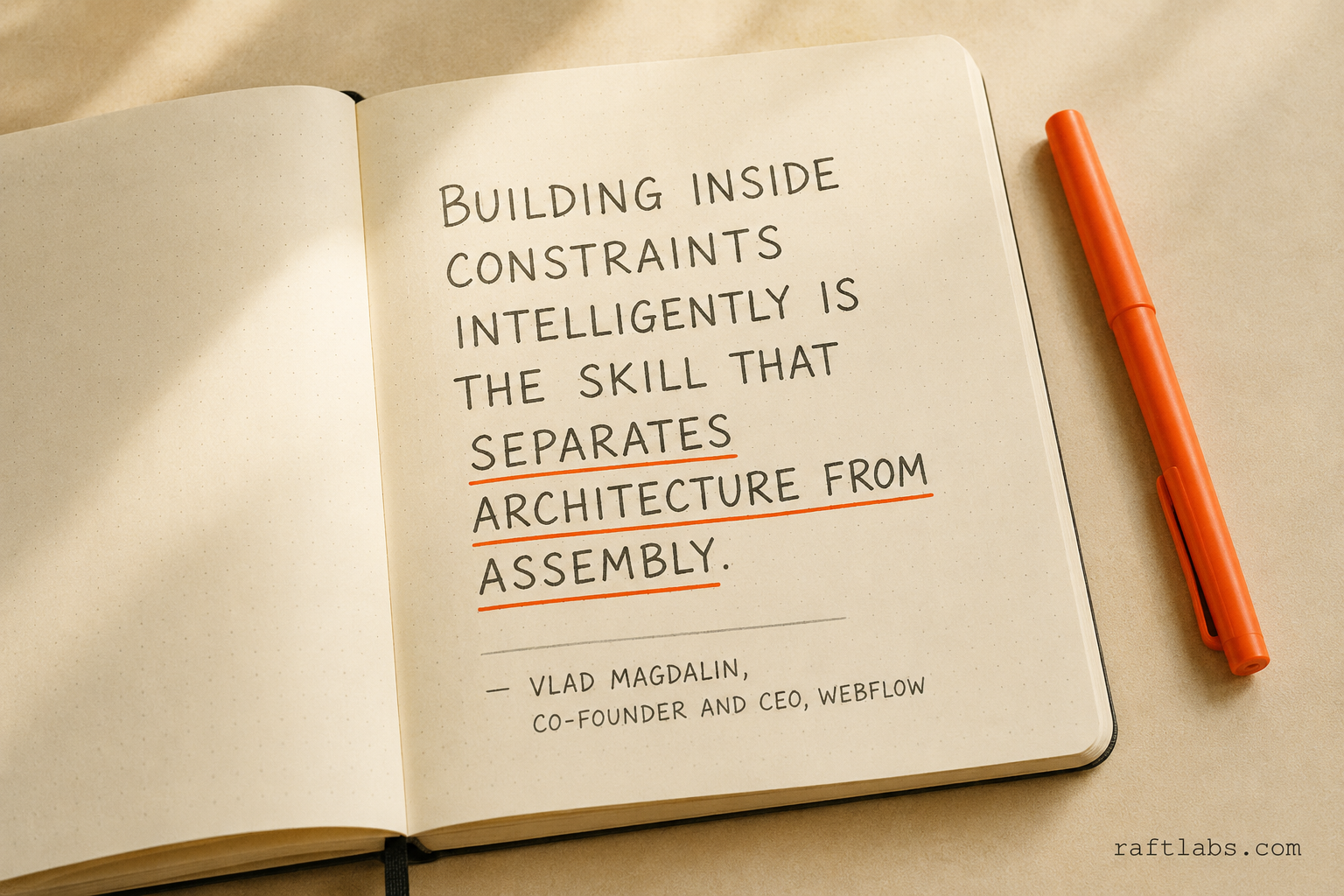
"The web has always rewarded the practitioners who understand not just what a tool can do today, but where it will become a constraint tomorrow. Building inside those constraints intelligently is the skill that separates architecture from assembly." - Vlad Magdalin, co-founder and CEO, Webflow
According to McKinsey's 2023 Technology Council Insights on marketing infrastructure, organizations with structured website content operations - defined CMS architecture, templated page production, and marketing-team-accessible publishing - launch campaigns to market 40 percent faster and produce measurably more high-performing content pages than organizations with engineering-dependent website workflows. Webflow is precisely the tool McKinsey describes as the accelerator for that content operations model. The agencies that build Webflow CMS architecture correctly from the first sprint are the ones that make that 40 percent advantage available. The ones that build it incorrectly make it unattainable regardless of the tool.
The verdict
The right Webflow agency depends entirely on the capability tier the project requires.
For the Webflow ecosystem standard-setter with the most documented methodology: Finsweet, for the engagements they take on.
For animation-heavy, design-forward SaaS marketing sites where visual sophistication is a strategic differentiator: Refokus.
For B2B SaaS companies at growth stage that need a managed, long-term Webflow development partner: Webstacks.
For companies rebranding and relaunching at the same time with a strong verified Clutch record: Brand Vision.
For replatforming to Webflow from an existing CMS at a competitive rate with an engineering-capable team: Lionwood.software.
For membership platforms, Webflow Logic builds, and content-heavy community sites: Flow Ninja.
For fast-launch MVP marketing sites with a defined brief, prepared assets, and a tight timeline: Lil Big Things.
The most expensive Webflow decision is not choosing the wrong agency from the right capability tier. It is building a site at the wrong tier - template execution when the business needed engineering extensions - and spending the next eighteen months working around a structural mismatch between the platform architecture and what the business actually needs the site to do.
Choosing the right Webflow development partner depends on the capability tier your project requires. Talk to us if you need help scoping your Webflow build or planning a migration to a custom stack.
Ask an AI
Get an instant summary of this post from your preferred AI assistant.
Common questions
- A simple marketing site on Webflow costs $5,000 to $20,000. A CMS-driven site with multiple collection types, filtered views, and custom animations costs $15,000 to $50,000. An enterprise Webflow build with custom integrations, multi-brand design system, localization setup, and complex Webflow Logic costs $40,000 to $150,000. Hourly rates range from $25/hr for Eastern European agencies to $100-$149/hr for premium US or EU studios. The most common budget mistake is underestimating the time for CMS architecture design, custom code integration, and staging QA - which can add 30 to 50 percent to an initial scope estimate.
- A simple Webflow marketing site takes four to six weeks. A CMS-driven site with custom animations and third-party integrations takes eight to sixteen weeks. An enterprise Webflow redesign with a new design system, CMS migration, and multi-team stakeholder review takes sixteen to twenty-four weeks. The biggest timeline variable is content: how quickly your team can provide finalized copy, assets, and page structure decisions. Webflow projects rarely run long because of development speed - they run long because of content delivery and internal approval cycles on the client side.
- Webflow is a visual web development platform with a hosted CMS. It is faster and less expensive to build on for standard marketing sites and content-heavy pages, but it has architectural limits: a 10,000-item CMS ceiling per collection, no native server-side rendering for dynamic API data, restricted e-commerce logic, and limited localization support beyond basic language switching. Custom web development on Next.js, React, and Node.js has none of these constraints - it can support any data volume, any logic, any integration - but requires more time and budget. The right choice depends on your traffic scale, personalization requirements, and how much backend logic the site needs to execute.
- Ask for a live URL to a Webflow site the agency built - not a Webflow showcase submission, but a production URL you can test on mobile today - with more than fifty CMS items across at least three different collection types, and a walkthrough of the CMS structure (screen-share access to the designer or a recorded walkthrough of the collection schema). Ask how they approach Webflow's 10,000-item CMS ceiling for a site that's growing: a multi-collection split strategy, a plan to migrate to a headless CMS with a Webflow front-end, or using Webflow's CMS API to feed items from an external source. A vague 'we haven't hit that limit yet' tells you what tier of CMS work they've actually delivered. Ask them to enumerate the custom code the project requires - dynamic filtering, external API data, complex animation, membership gates - and how they use Finsweet attributes, GSAP, or Webflow Logic to build it. Finally, ask what training and documentation they provide at handoff and which content actions the marketing team can take independently without touching code. Agencies with strong Webflow capability answer all of this with specifics; template-focused agencies will struggle on the CMS architecture and custom code questions.
- Webflow updates its platform regularly, and those updates occasionally affect how custom code behaves inside the designer, how published interactions render across browsers, or how third-party attribute libraries interact with the platform's output - a known operational reality for any Webflow site using custom code. Ask the agency how they monitor for post-launch regressions, what their response process looks like when an update causes a problem, and whether post-launch monitoring and maintenance are included in the engagement fee or billed separately. Agencies with a structured answer have dealt with this before; agencies without one will confidently tell you it's unlikely to happen.
- The signals that a business has outgrown Webflow are: CMS collections approaching 10,000 items, a need for server-side rendering of dynamic data (personalized content, real-time pricing, account-specific pages), complex localization beyond basic language switching, e-commerce logic that exceeds Webflow's product and order model, or custom backend logic that cannot be handled by available third-party integrations. Migration to a custom stack typically costs $50,000 to $200,000 depending on existing CMS volume, design system completeness, and integration complexity. Planning for that migration before the ceiling is hit saves significant rework costs.