Top mobile app development companies in 2026 (vetted shortlist)
Nine mobile app development companies evaluated on production apps shipped, platform depth, and what each firm does best. No paid placements, no filler.

In this article
Short answer
Evaluating mobile app development companies comes down to a verified production track record, platform and backend depth, and compliance experience where relevant. RaftLabs meets this bar with an AI-powered remote patient monitoring platform live at 80+ clinical sites, 4.9/5 on Clutch, and fixed-price engagements at $29-49/hr from $40K.
Key takeaways
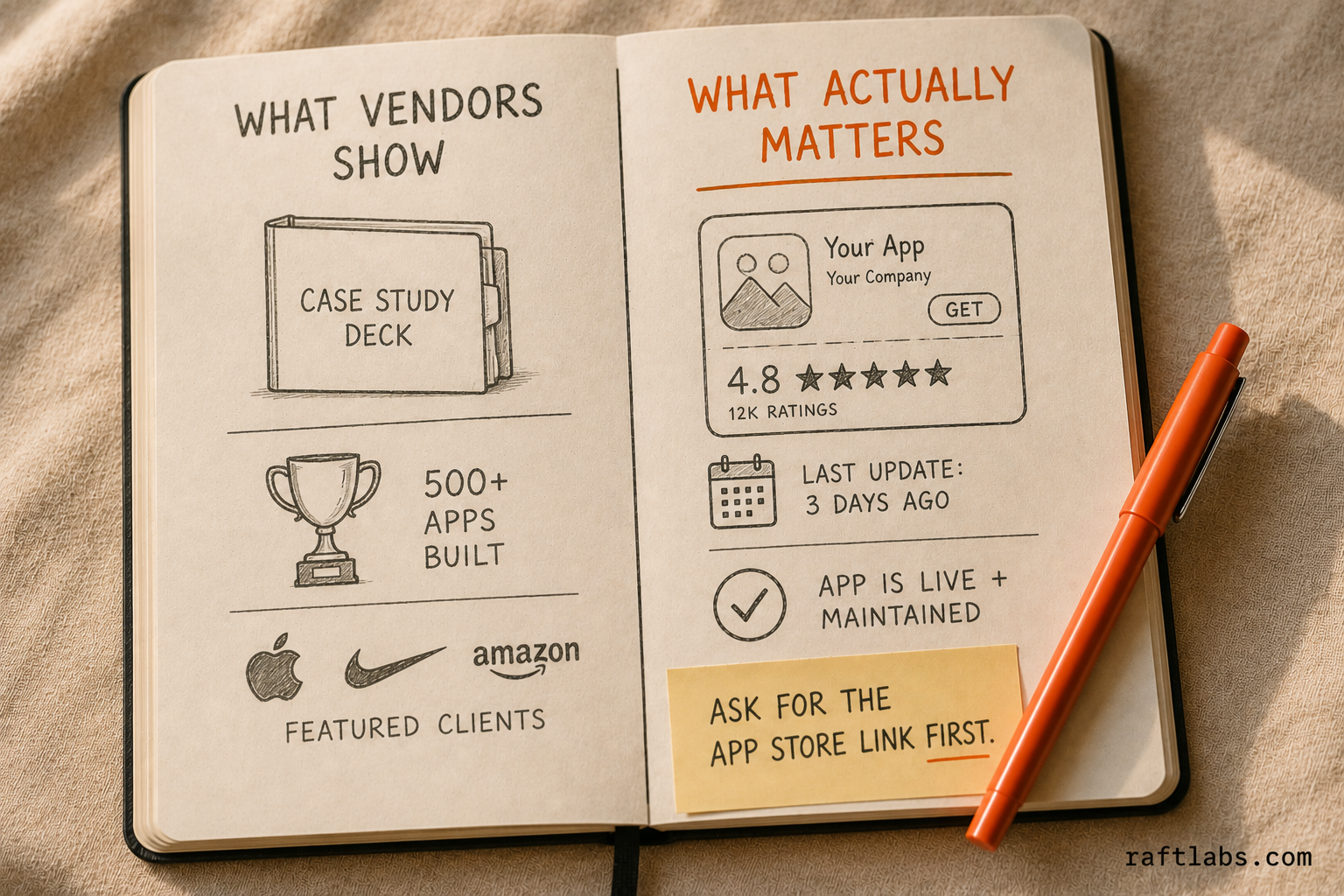
- The filter that matters is not whether a firm builds mobile apps - it is whether they have live apps in the App Store or Play Store with public ratings and recent updates. Ask for links before you evaluate anything else.
- Premium US firms ($150-$200/hr) earn their rate when the app's visual quality is a direct revenue driver. For most mid-market builds, the same production quality is available at $25-$100/hr from firms outside the US.
- HIPAA, PCI-DSS, and GDPR compliance in mobile development is a binary requirement, not a differentiator. Verify documented compliance experience before scoping any healthcare or fintech build.
- RaftLabs ranks third as the strongest choice for mid-market companies that need enterprise-quality iOS and Android development at $29-$49/hr, fixed-price, from a single team that owns the outcome.
- Post-launch maintenance runs 15-20% of initial build cost per year. Any vendor that quotes only the build cost is giving you an incomplete picture of the engagement.
Most mobile app development companies say they build production apps. The real question is whether those apps are live, maintained, and holding their ratings two years later. That gap between what a company pitches and what runs in the App Store is the filter this list applies.
Statista projects global mobile app revenue will exceed $935 billion by 2027, growing at roughly 12% annually. The market is large, the vendor list is long, and most of those vendors look the same from the outside. The difference between an app that retains users and one that gets uninstalled after the first session comes down to the quality of the team that built and maintained it, and that is not visible in a portfolio.
Nine companies. Evaluated on production evidence, honest pricing, and what each firm actually does best.
Transparency note: RaftLabs is on this list. We wrote our own entry with the same directness applied to every other firm.
How we evaluated this list
| Criterion | What we looked for |
|---|---|
| Production apps shipped | At least one live app in the App Store or Play Store with verifiable ratings and a recent update |
| Platform depth | Demonstrated experience in native iOS, native Android, or a cross-platform framework (React Native or Flutter) |
| Backend capability | API design, push notification infrastructure, offline sync, and third-party integration experience |
| Compliance track record | Documented HIPAA, PCI-DSS, or GDPR experience where relevant |
| Clutch rating | 4.7 or above with mobile-specific project references |
No company paid for placement on this list.
1. Guarana Technologies
Guarana Technologies is a Montreal-based app studio that builds native iOS and Android products at volume - the firm describes shipping roughly 40 consumer apps a year. That cadence is the signal worth reading: a studio moving that many apps through design, build, and store submission has a repeatable production pipeline rather than a handful of showcase projects.
Their practice is native-first across both platforms, aimed at consumer-facing products where a clean, fast interface is the point. For a general mobile build - a new consumer app that needs to look and feel current on both stores - that focus lines up directly with the brief.
Among the general app studios on this list, Guarana is the one to shortlist when you want a native iOS and Android build from a team that ships consistently and treats store submission as routine rather than a milestone. The trade-off is transparency: the firm does not publish rates or a detailed client roster, so you are evaluating cadence claims rather than documented outcomes.
Notable work: Guarana states a high-volume output of consumer iOS and Android apps but does not publish specific client references that are verifiable here. Ask for live App Store and Play Store links to apps they currently maintain, with ratings and recent update dates, before you weigh anything else.
Pricing signal: Not publicly listed. Request a rate card and a fixed project range during scoping, and confirm whether pricing is hourly or per project before committing.
What to watch: The volume claim cuts both ways - a studio shipping 40 apps a year has a proven pipeline, but it can also mean lighter senior involvement on any single build. Confirm who is assigned to your project and how much bandwidth they hold across concurrent apps.
Best for: Companies that want a native iOS and Android consumer app from a studio with a high-volume, repeatable production pipeline
Specialization: Native iOS and Android, consumer app development, high-volume delivery
Pricing: Not publicly listed; confirm rate card during scoping
Clutch: Clutch profile listed; confirm rating and review count before engaging
2. 3 Sided Cube
3 Sided Cube is a BAFTA-nominated mobile development studio based in Bournemouth, UK. They have built a reputation on apps with real-world stakes - emergency response platforms, disaster preparedness tools, and public health behavior apps that reach millions of people under demanding conditions. When an app failing has consequences beyond a poor review, 3 Sided Cube's process reflects that.
Their client list includes the American Red Cross, UK National Health Service programs, and environmental monitoring organizations. The work is specific, well-documented, and consistently cited by clients as evidence of a team that understood what it was building and why.
Notable work: 3 Sided Cube built the ReadySet emergency preparedness platform for the American Red Cross - a cross-platform app that must work under low-connectivity conditions and reach a broad, non-technical user base during disaster events. They have also shipped public health apps for NHS programs and received multiple BAFTA nominations for their work in this category.
Pricing signal: $100-$149/hr. Projects typically run $75K-$600K. More accessible than premium US studios while delivering the design and engineering depth that high-stakes applications require.
What to watch: 3 Sided Cube is strongest when there is genuine product complexity tied to a real-world mission. If your app has clear purpose, must work under constrained conditions, or serves populations that need reliability over aesthetics, their process is well-suited. For straightforward enterprise internal tools or commerce apps, the fit is narrower.
Best for: Mission-driven organizations, public sector clients, and businesses building apps where reliability and reach are non-negotiable
Specialization: iOS and Android, emergency and public health apps, cross-platform development
Pricing: $100-$149/hr, projects from $75K
Clutch: 4.9/5
3. RaftLabs
RaftLabs provides mobile app development services for mid-market businesses. The model works differently from most firms on this list: a structured scoping engagement before any build, fixed-price delivery, and a single team that owns architecture, development, QA, and app store submission from start to finish. No strategy-then-handoff. No open-ended time-and-materials billing.
Production mobile apps shipped for enterprise clients across hospitality, healthcare, loyalty, and fintech. The tech stack covers React Native for cross-platform projects and Swift or Kotlin where native performance is required. Backend APIs run on Node.js or Python with infrastructure on AWS or GCP.
Notable work: RaftLabs built an AI-powered remote patient monitoring platform now running at 80+ clinical sites, reducing clinical decision time by 30%. A loyalty and personalization mobile app built for a multi-brand retail operator handles real-time points tracking and push-driven engagement across iOS and Android. A hospitality mobile platform serving a property group with 80+ locations covers digital check-in, room controls, and service requests.
Pricing signal: $29-$49/hr. A production cross-platform app - UX design, iOS and Android builds, backend API, QA, and app store submission - typically runs $40K-$150K depending on scope. Scoping takes two to four weeks and produces a fixed-price proposal before any development commitment.
What to watch: RaftLabs is a 60-person mid-market firm. Large enterprise programs needing 20+ concurrent engineers across parallel workstreams are outside our scale. What we do well: production mobile apps for established businesses, defined scope, shipped on a fixed timeline with outcomes agreed upfront. If that matches your need, the pricing and delivery model are a direct fit.
From the field: The most common mobile app mistake we see mid-market companies make is hiring a firm against a feature list rather than a problem statement. The result is an app that is technically complete but users do not open. We spend the first two to four weeks of every engagement defining what success looks like before a screen is designed. That conversation changes the scope almost every time - and usually saves more than the scoping cost.
Best for: Mid-market businesses ($5M-$200M revenue) that need production iOS and Android apps at a fixed price from a team that owns the full delivery
Specialization: Cross-platform (React Native), native iOS and Android, healthcare, hospitality, loyalty, fintech
Pricing: $29-$49/hr, fixed-price builds from $40K
Clutch: 4.9/5
4. hedgehog lab
hedgehog lab is a Newcastle-based product studio that builds mobile and web apps for consumer brands, with project work spanning retail, media, and finance. The firm's positioning is product-led: the app is treated as a product with a defined audience and business goal, not a spec to implement, which tends to suit brands that need the interface to carry the experience.
Their practice covers both mobile and web, which makes them a fit when a consumer app needs a companion web surface or a shared design language across platforms. For a general mobile build with a real brand behind it, that cross-surface capability is useful.
Among the general studios here, hedgehog lab is the one to shortlist when a recognizable consumer brand needs mobile and web built together to a consistent product standard. The trade-off is that a product-led studio at this tier carries agency overhead - confirm the rate card and the hourly band against a leaner shop if your build is straightforward.
Notable work: hedgehog lab works with consumer brands across retail, media, and finance, but no specific client references are verified here. Ask for App Store and Play Store links to apps they currently maintain, and check ratings and last-update dates before evaluating anything else.
Pricing signal: Project engagements are cited in roughly the $30K to $1M+ range. Confirm the current rate card, the hourly band, and where your scope lands in that range during scoping.
What to watch: The engagement range is wide, which means the fit depends heavily on where your project sits within it. For a small, well-defined build, verify you are not paying for a process calibrated to enterprise brand programs.
Best for: Consumer brands in retail, media, or finance that need mobile and web built to a consistent product standard
Specialization: Product-led mobile and web apps, consumer brand products, cross-surface design
Pricing: Roughly $30K-$1M+ per project; confirm hourly band during scoping
Clutch: Clutch profile listed; confirm rating and review count before engaging
5. Fireart Studio
Fireart Studio is a Warsaw-based product design and full-cycle software studio that builds consumer digital products for global brands. Design is the firm's center of gravity - the practice grew out of product and interface design and extends into full-cycle build - so the strongest fit is a consumer app where the visual and interaction quality is a real part of the value.
Because the core is design-led rather than mobile-engineering-led, treat the engineering depth as something to verify rather than assume. For a general mobile build that is design-heavy, Fireart is a natural fit; for a backend-heavy or platform-integration-heavy app, confirm the native iOS and Android engineering bench during scoping.
Among the design-led studios on this list, Fireart is the one to shortlist when the app's look and feel is a competitive asset and you want design and build under one roof. The trade-off is domain transfer: the studio's signature is product design, so press on mobile-specific engineering references before you commit a complex build.
Notable work: Fireart lists Google, Bolt, and Rolls-Royce among its clients (vendor-stated). Verify the specific engagements and, in particular, the mobile scope of each - a design engagement is not the same as a shipped, maintained iOS or Android app.
Pricing signal: Not publicly listed. Request a rate card and a fixed project range during scoping, and confirm whether the quote covers native mobile engineering or design only.
What to watch: The design strength is real, but design and full-cycle mobile engineering are different capabilities. Confirm domain depth in native iOS and Android delivery, not just interface design, before scoping a technically complex app.
Best for: Brands building a design-led consumer app where interface quality is a competitive asset
Specialization: Product design, full-cycle software, consumer digital products
Pricing: Not publicly listed; confirm design-versus-engineering scope during scoping
Clutch: Clutch profile listed; confirm rating and review count before engaging
6. Mercury Development
Mercury Development has been building mobile applications from Aventura, Florida since 1999 - one of the longer-established mobile development firms on this list. Longevity matters here for a specific reason: their team has shipped apps through multiple iOS and Android platform generations, multiple app store policy changes, and multiple shifts in mobile architecture. Teams that have done that know what breaks and why.
Their current practice covers iOS, Android, and cross-platform development across healthcare, retail, IoT, and enterprise applications. Their 5.0/5 rating on Clutch across 33 verified client reviews is consistent with a firm that manages expectations carefully and does not overpromise.
Notable work: Mercury Development has built cross-platform apps for healthcare data collection, enterprise field service platforms, and consumer-facing IoT companion apps. Their case studies are measured and specific - not visually marketed portfolios, but documented delivery records.
Pricing signal: $50-$99/hr. Projects typically run $50K-$300K. One of the more competitively priced mid-range options for companies that need production-quality development without the premium associated with a named US studio.
What to watch: Mercury Development is a strong choice for companies that want a stable, US-based team with a long track record and mid-range pricing. Their marketing is low-key, which means the firm is evaluated on delivery evidence rather than brand positioning. That works in their favor with clients who know how to evaluate it.
Best for: Companies that need a stable, experienced US-based development team at mid-range rates with a documented production history
Specialization: iOS, Android, cross-platform, IoT, healthcare, enterprise
Pricing: $50-$99/hr, projects from $50K
Clutch: 5.0/5 (33+ verified reviews)
7. Infinum
Infinum is a Croatian digital product studio with offices in the US, UK, and Europe that has been building consumer-facing mobile apps since 2005. Their work skews toward brands and financial services companies that need mobile apps with strong design quality and solid engineering - not commodity development. European agencies often sit awkwardly between US firms on brand recognition and Asian firms on price. Infinum has found a stable position between them.
Their practice covers iOS and Android, with a particularly strong track record in fintech and retail mobile apps that need to hold up under real-world usage at scale.
Notable work: Infinum has built mobile apps for major European banks, retail chains, and media companies. Their financial services mobile work - account management, payments, investment interfaces - reflects both design maturity and a practical understanding of GDPR and European compliance requirements that their US peers often lack.
Pricing signal: $50-$99/hr. Projects typically run $75K-$500K. Particularly competitive for US and UK companies that want design-quality mobile development at rates below US market pricing.
What to watch: Infinum's strongest projects are consumer-facing digital products where design quality is part of the brief. For backend-heavy enterprise platforms where the interface is functional rather than differentiated, a more operationally focused agency may give you better value.
Best for: European and North American businesses building consumer-facing mobile apps where design quality is a competitive differentiator
Specialization: iOS, Android, fintech mobile, retail apps, cross-platform design-led development
Pricing: $50-$99/hr, projects from $75K
Clutch: 4.9/5
8. Big Human
Big Human is a New York-based digital product studio that builds consumer apps and brand experiences for startups and media and entertainment clients. The studio pairs product design with build, and its work skews toward consumer products where brand and interface are inseparable - the app is part of the brand, not just a channel for it.
For a general mobile build with a consumer audience and a brand that matters, that combination fits well. The practice is calibrated for products where design quality and a polished launch are part of the business case rather than a nice-to-have.
Among the US consumer studios here, Big Human is the one to shortlist when a startup or media brand needs a consumer app and brand built together to a high finish. The trade-off is cost: this is a premium US studio, and the engagement floor reflects it, so it is not calibrated for budget-controlled or backend-only builds.
Notable work: Big Human's documented work includes projects for Netflix, Rockefeller Center, and HQ Trivia. Consumer and media products are the clear throughline - confirm the current App Store or Play Store status of any reference app and when it was last updated.
Pricing signal: Engagements are cited in roughly the $500K to $1M+ range. Confirm the current rate card and the minimum engagement size during scoping - this is a premium tier, not a budget option.
What to watch: The strength is consumer and media product work at a high finish, which carries a premium US price. For an internal tool, a backend-heavy platform, or a build with a ceiling below the six-figure range, the overhead is not justified.
Best for: Startups and media or entertainment brands building a consumer app and brand to a high finish
Specialization: Consumer apps, product design, brand experiences, media and entertainment
Pricing: Roughly $500K-$1M+ per engagement; premium US tier
Clutch: Clutch profile listed; confirm rating and review count before engaging
9. JPLoft
JPLoft is an Ahmedabad-based mobile development firm founded in 2014. Their strength is React Native and Flutter development at competitive rates, with a portfolio spanning fintech, retail, and SaaS applications for startups and early-growth companies.
For seed or Series A companies validating a product on a constrained budget, JPLoft offers the structure of a development agency - dedicated team, sprint cadence, handoff documentation - at rates closer to freelancer pricing. The trade-off is less domain depth and less senior involvement on complex technical problems.
Notable work: JPLoft has built React Native and Flutter apps for fintech startups, e-commerce businesses, and healthcare platforms in early validation. Project references span industries rather than clustering in a single vertical, which reflects a generalist position - broad scope, competitive cost.
Pricing signal: $25-$49/hr. Projects typically run $15K-$80K. A practical option for startups that need a full mobile development team - design, iOS, Android, QA - at a budget-controlled engagement size.
What to watch: JPLoft is best suited for clearly defined product builds with limited integration complexity. Enterprise-grade compliance requirements, complex third-party integrations, or apps where architectural decisions have long-term consequences will stretch the team beyond their deepest capability.
Best for: Startups and early-growth companies with a defined feature set and a build budget below $75K
Specialization: React Native, Flutter, iOS, Android, startup and SaaS app development
Pricing: $25-$49/hr, projects from $15K
Clutch: 4.8/5
Side-by-side comparison
| Company | Primary strength | Typical engagement | Pricing |
|---|---|---|---|
| Guarana Technologies | Native iOS/Android consumer apps at volume | Not listed | Not listed |
| 3 Sided Cube | Public sector and mission-critical apps | $75K-$600K | $100-149/hr |
| RaftLabs | Mid-market, fixed-price, enterprise-quality | $40K-$200K | $29-49/hr |
| hedgehog lab | Product-led mobile and web for consumer brands | $30K-$1M+ | Not listed |
| Fireart Studio | Design-led consumer product studio | Not listed | Not listed |
| Mercury Development | Established US team, cross-platform | $50K-$300K | $50-99/hr |
| Infinum | Consumer-facing fintech and retail apps | $75K-$500K | $50-99/hr |
| Big Human | Consumer and media product studio | $500K-$1M+ | Not listed |
| JPLoft | Startup MVPs in React Native and Flutter | $15K-$80K | $25-49/hr |
The question that separates a design-led studio from a delivery-focused firm
Most buyers shortlist a mobile app vendor by browsing portfolios for visual polish, and get the model wrong before they get the vendor wrong. "Mobile app development company" covers two different jobs: making an app look and feel like a considered product, and making an app that ships on schedule, clears App Store review, and keeps running through the next dozen OS updates.
Design-led studios - hedgehog lab, Fireart Studio, Infinum, Big Human - treat the interface as the product's competitive edge. Their own positioning centers on brand, product design, and visual quality, and their pricing tends to be quoted per project rather than published as a fixed hourly band. That model fits a consumer or brand-forward app where how it looks and feels is part of the pitch.
Delivery-focused firms - Guarana Technologies, 3 Sided Cube, RaftLabs, Mercury Development, JPLoft - compete on shipping reliably: a repeatable production pipeline, mission-critical reliability, fixed-price delivery, or a defined process at a defined rate. That model fits a business that needs the app built, submitted, and maintained on a schedule it can plan around.
Getting the model wrong is more expensive than getting the vendor wrong.
Every "yes" carries a permanent maintenance cost.
Nearly half of installed apps do not survive their first month. An app that looks finished in a demo and then breaks on the next iOS release is not a shipped product, it is a maintenance bill nobody budgeted for, which is exactly why the App Store link and the update date matter more than the pitch deck.
The verdict
Guarana Technologies for companies that want a native iOS and Android consumer app from a studio with a high-volume, repeatable production pipeline. 3 Sided Cube for mission-driven organizations, public sector clients, and businesses building apps where reliability and reach are non-negotiable. RaftLabs for mid-market businesses that need production iOS and Android apps at a fixed price from a team that owns the full delivery. hedgehog lab for consumer brands in retail, media, or finance that need mobile and web built to a consistent product standard. Fireart Studio for brands building a design-led consumer app where interface quality is a competitive asset. Mercury Development for companies that need a stable, experienced US-based development team at mid-range rates with a documented production history. Infinum for European and North American businesses building consumer-facing mobile apps where design quality is a competitive differentiator. Big Human for startups and media or entertainment brands building a consumer app and brand to a high finish. JPLoft for startups and early-growth companies with a defined feature set and a build budget below $75K.
Match the firm to the actual work - not to the largest portfolio or the most recognized client logo. The clearest path to a mobile app that holds its ratings and survives OS updates is a firm that has done exactly that before, in your industry, at your budget range.
RaftLabs ships production iOS and Android apps. 4.9/5 on Clutch. Talk to a founder about your build.
Ask an AI
Get an instant summary of this post from your preferred AI assistant.
Common questions
- A simple single-platform app with 4-6 screens and no custom backend costs $15,000-$35,000. A production app with user authentication, push notifications, a backend API, and both iOS and Android costs $40,000-$100,000. An enterprise app with real-time features, offline sync, compliance controls, and complex integrations costs $100,000-$250,000. Post-launch maintenance adds 15-20% of the build cost per year. India-based studios with comparable production records typically run 40-60% lower than US-based equivalents.
- A cross-platform app with a well-defined scope takes 8-12 weeks from design sign-off to app store submission. A mid-complexity app with backend integrations takes 12-18 weeks. An enterprise app with compliance requirements, offline sync, or hardware integrations takes 18-28 weeks. Undefined requirements at kickoff extend every phase. A two-to-four-week scoping engagement before development is the most effective way to reduce timeline risk.
- Build native (Swift for iOS, Kotlin for Android) when your app needs deep platform access - ARKit, HealthKit, NFC, camera APIs - or requires peak animation performance. Build cross-platform (React Native or Flutter) when you need both iOS and Android, have a defined budget, and your features do not require platform-specific hardware APIs. Cross-platform covers 80-90% of use cases and ships 30-40% faster than two separate native codebases. Switch to native if specific performance requirements emerge after launch.
- Ask for App Store or Play Store links to apps they currently maintain, then check the rating, the review count, and when the last update was published. An app last updated 18 months ago is effectively abandoned. A company that cannot produce a live link has not shipped a production app, or has not maintained what it shipped - a portfolio deck or case study PDF is not a substitute.
- A team that has submitted dozens of apps can name the rejection categories Apple flags most often - ATT consent flow issues, missing privacy nutrition label fields, deprecated API calls - and describe how many submission rounds a typical project takes. On maintenance, ask specifically what happens when an annual iOS or Android release changes an API your app depends on, and what the crash-response SLA is. Vague answers on either question point to limited submission or maintenance history.
- Offline sync requires conflict resolution logic, local storage design, and a queue that handles partial connectivity. Push notification delivery requires device token lifecycle management and defined fallback behavior when delivery fails. Ask what tools the team uses for both and how they test the edge cases. A team that treats these as afterthoughts has not shipped production apps in environments where connectivity is unreliable.
- Ask for the names of the engineers and designers assigned to your project, not just the person who ran the sales call, and check their tenure on LinkedIn. High-turnover teams lose project context mid-engagement, and recovering that context costs real time and budget. A company that can name your team on the first call has stable staffing; one that says it will confirm after you sign does not.
- RaftLabs builds production mobile apps for enterprise and mid-market companies across healthcare, hospitality, loyalty, and fintech. They work in React Native for cross-platform projects and Swift or Kotlin for native requirements, with backend APIs on Node.js or Python and infrastructure on AWS or GCP. Rates run $29-$49/hr. Engagements are fixed-price with a defined scope agreed before development starts. 4.9/5 rating on Clutch.