HIPAA compliant software development: the ultimate guide for 2026

Short answer
HIPAA compliant software development means building healthcare apps with encryption, role-based access, audit trails, and Business Associate Agreements from day one. RaftLabs has shipped 3 HIPAA-compliant healthcare products, cutting ER visits by 60% in one telehealth deployment and reducing clinical decision-making time by 20% in a remote monitoring platform. Compliance costs typically add $15,000-$25,000 to a base development budget.
Key Takeaways
- HIPAA penalties start at $137 per violation. The real cost of non-compliance is not the fine. It's losing hospital partnerships overnight after a breach becomes public.
- Most teams get authentication wrong. Strong access controls that block unauthorized access without making the app unusable is harder than it sounds. It requires design and security working together from day one.
- Third-party SDKs are a hidden compliance trap. An SDK that logs user behavior to a third-party server can violate HIPAA without you knowing. Every vendor your app touches needs a Business Associate Agreement.
- Retrofitting security costs more than building it in. RaftLabs has seen teams spend $40,000+ fixing compliance gaps in apps that were built without HIPAA in mind. That's more than the compliance work would have cost from the start.
- Fitness and nutrition apps are not automatically exempt. If your app syncs data with a healthcare provider or insurer, HIPAA applies regardless of how you categorize the app.
Your healthcare app handles patient data. A breach doesn't just cost you money. It costs patients their privacy and you your business.
The mHealth market is growing from $32.5 billion in 2023 to an estimated $154.1 billion by 2034, according to Precedence Research. Every app in that market faces the same question: how do you handle patient data without violating federal law?
The answer is HIPAA-compliant software development. If you're building a healthcare app, this guide covers what compliance actually requires, what it costs, and how to avoid the mistakes that turn a good app into a legal liability.
Understanding HIPAA compliance
HIPAA, the Health Insurance Portability and Accountability Act, protects sensitive health information by setting rules for healthcare providers, health plans, and clearinghouses.
The three main rules of HIPAA are:
HIPAA Privacy Rule: Protects identifiable health information during electronic transmission.
HIPAA Security Rule: Confirms the confidentiality and integrity of electronic PHI (ePHI).
HIPAA Breach Notification Rule: Details procedures for reporting data breaches to affected individuals and authorities.
Before the 2013 Omnibus Rule, HIPAA applied mainly to healthcare providers and insurers. The update expanded it to include any organization handling PHI, including medical app developers and third-party vendors. If your app touches patient data, HIPAA applies to you.
"Compliance is not a feature you add at the end. It's a design constraint that shapes every architectural decision from day one. Teams that treat it as a checklist item in QA are the ones who end up in breach notification situations."
Deven McGraw, former Deputy Director for Health Information Privacy at HHS Office for Civil Rights, in a Health Affairs interview
Why a healthcare app must be HIPAA compliant
According to the HHS Office for Civil Rights, HIPAA enforcement has collected more than $136 million in penalties since 2008. The average penalty for a large breach now exceeds $1.9 million. Here are the concrete reasons compliance matters:
- Avoid costly penalties: fines range from $137 per violation to $2 million for serious cases.
- Protect your brand: a data breach harms your reputation in ways that take years to repair.
- Secure patient data: HIPAA requirements keep PHI from falling into the wrong hands.
- Build trust with patients and partners: compliance signals that privacy is a priority.
- Open new revenue streams: many healthcare providers only work with HIPAA-compliant vendors.
- Prevent financial loss from breaches: strong security is cheaper than breach remediation.
- Stay current with regulations: meeting today's standards makes future changes easier to absorb.
Get a HIPAA compliance checklist before you start developing your healthcare app.
HIPAA-compliant software development steps

HIPAA-compliant software development is a set of decisions baked into your architecture. Skip any of them and you'll be rebuilding later at a higher cost. Here's what the process looks like:
Risk assessment: identify vulnerabilities related to PHI and potential exposure risks.
Secure architecture: use data encryption and access control to build security into your software's core from the start.
Safeguards: apply technical and physical safeguards to protect servers and hardware, including encryption and authentication.
Transport encryption: use SSL/TLS protocols to secure data transfer between systems.
Backup: regularly back up data to prevent loss during a breach or system failure.
Authorization: implement strict access controls so only authorized personnel can access sensitive information.
Integrity: use checksums and hash functions to prevent unauthorized data alteration.
Continuous monitoring and testing: monitor systems continuously, conduct penetration testing, and maintain audit logs.
Documentation: keep detailed records of compliance efforts and update them regularly.
Disposal: use secure data deletion methods and physically destroy storage media when disposing of outdated hardware.
What most teams get wrong: they run through this list at the end of development. Security and compliance work that runs in parallel with feature development costs roughly 30% of what it costs to retrofit. RaftLabs builds these controls into the architecture review at week one.
Why HIPAA compliance matters for web and mobile apps
The mHealth market is expected to reach $187.7 billion by 2032, growing at 11.5% annually, per Grand View Research. With that growth comes increased regulatory scrutiny and a more sophisticated threat threat pattern.
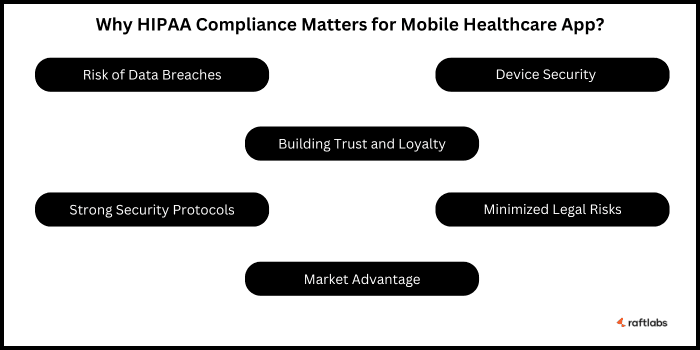
Data breach risk: apps containing ePHI are targets for identity theft and fraud. Security must be built in, not added later.
Device security: protecting data on mobile devices is critical when devices are lost or stolen.
Security protocols: strong access controls and encryption block unauthorized access.
Trust and loyalty: HIPAA-compliant apps give users confidence in how their data is handled.
Reduced legal risk: adhering to HIPAA standards reduces the likelihood of costly litigation.
Market advantage: secure, compliant mobile apps signal credibility to enterprise healthcare buyers.
Which healthcare apps must comply with HIPAA rules?
If you're building a healthcare app, one of the first decisions is whether HIPAA applies. Non-compliance penalties start at $137 per violation and reach $2 million for serious cases. Your app's reputation is also at stake.
To determine if your app needs to comply:
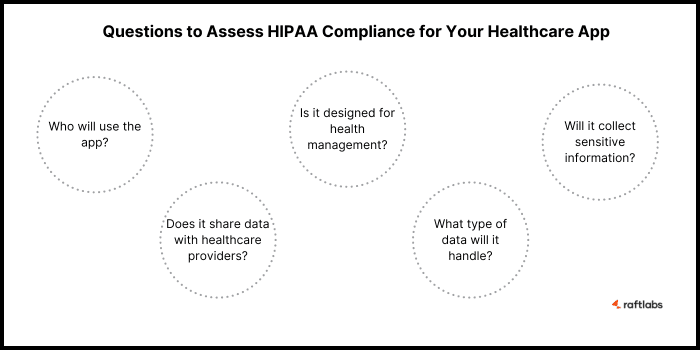
Who will use the app? HIPAA applies to "covered entities" like healthcare providers, health plans, and their business associates that handle PHI.
What type of data will the app handle? If the app stores or transmits Protected Health Information, it must meet HIPAA requirements.
Does the app share data with healthcare providers? Apps that sync with healthcare systems must follow HIPAA-compliant development practices.
Is the app designed to manage or monitor patient health? Apps for health monitoring, remote care, or medication tracking likely involve PHI and require compliance.
Will the app collect or process sensitive information? Even if it doesn't directly work with healthcare providers, HIPAA rules may apply if it collects data like biometrics.
Healthcare apps that may be exempt from HIPAA regulations
Some apps, especially those used only by patients without involving healthcare providers, might not fall under HIPAA. For example:
Fitness and exercise apps that don't connect with healthcare providers.
Nutrition tracking apps used for personal monitoring only.
Personal health tracking apps not shared with physicians.
These types of apps typically fall outside HIPAA unless they interact with or transmit Protected Health Information. The key test: does data flow to or from a covered entity? If yes, get a compliance review.
Costs of HIPAA compliant software development
Development costs vary based on several factors:
Application complexity: more features require more time and resources.
Security measures: encryption, access controls, and regular audits add cost.
Compliance and legal advice: HIPAA regulations require consultation with legal and compliance experts.
Development team expertise: developers with HIPAA experience cost more but deliver better regulatory adherence.
Testing and validation: thorough testing adds time and cost.
Ongoing maintenance: post-launch compliance through regular updates and audits is a long-term cost.
Integration with existing systems: connecting to EHRs or existing healthcare systems adds complexity.
User training and support: training users on compliance features should be planned from day one.
The cost to develop a HIPAA-compliant mobile application ranges from $40,000 to over $60,000. That range reflects the specific requirements and features of each application. The compliance-specific work adds roughly $15,000-$25,000 on top of a standard development budget. Teams that skip it and try to retrofit it later typically spend $40,000 or more fixing problems that would have cost a third of that to prevent.
Key practices and common pitfalls
Best practices for HIPAA compliant software development
Secure architecture and design: build encryption and access controls into the application from day one.
Regular risk assessments and updates: evaluate vulnerabilities on a set schedule and update security protocols accordingly.
Legal expert review: work with legal professionals to confirm your build meets all regulatory standards.
Team training: educate developers on HIPAA regulations so they understand their role in protecting PHI.
Vendor BAAs: get a signed Business Associate Agreement from every third-party service that touches your data, including analytics SDKs, crash reporters, and cloud storage providers. This is the step most teams miss.
Common mistakes to avoid
Storing PHI in insecure environments: never store Protected Health Information in unsecured locations.
Failing to update security measures: review and strengthen security on a regular schedule.
Neglecting employee training: all employees need proper training on HIPAA requirements.
Skipping BAAs for analytics tools: this is the most common gap RaftLabs sees in apps handed to us for compliance review. Google Analytics, Mixpanel, and similar tools may receive PHI if you're not careful about what data you send.
Successful HIPAA compliant applications built by RaftLabs
Here are HIPAA-compliant software solutions our team has delivered for healthcare clients:
1. HIPAA compliant AI-driven remote patient monitoring for chronic conditions
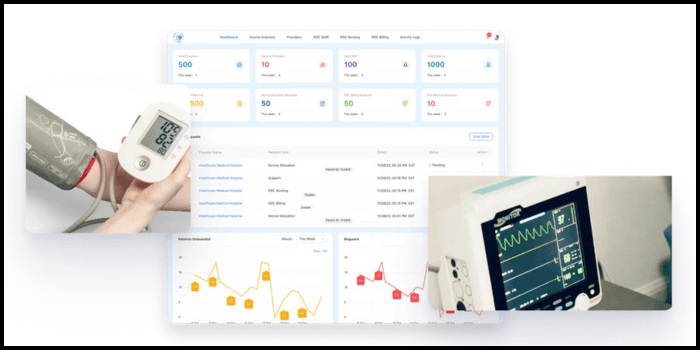
We built an AI-powered remote monitoring app that integrates with CGMs and BPMs, reducing clinical decision-making time by 20% for chronic care management.
2. HIPAA compliant telehealth app for virtual care
We built a HIPAA-compliant telehealth app that has cut in-person visits by 60% and onboarded 50+ clinics in 12 weeks. It allows remote care through FDA-approved devices, improving patient access.
Learn more in the case study >>
3. HIPAA compliant remote patient monitoring for seniors
We created an RPM app adopted by 15+ clinics in two months. It speeds up response times by 50% and securely transmits health data from wearables for timely interventions.
Our team has built HIPAA-compliant healthcare software across remote monitoring, telehealth, and patient engagement. If you have a healthcare app idea, contact us. We'll help you consult, design, and build a secure, compliant product that meets both regulatory standards and user needs.
Ask an AI
Get an instant summary of this post from your preferred AI assistant.
Frequently asked questions
- HIPAA-compliant app development means building applications that meet the Health Insurance Portability and Accountability Act's Privacy, Security, and Breach Notification Rules. Every feature that touches Protected Health Information must be designed with encryption, access controls, and audit trails from day one, not bolted on before launch.
- Non-compliance carries civil fines starting at $137 per violation and up to $2 million for serious cases. Beyond fines, a data breach destroys patient trust and can end partnerships with hospital systems overnight. Building to HIPAA standards from the start costs far less than retrofitting security after a breach or a regulator's letter.
- A practical HIPAA checklist covers risk assessments, end-to-end data encryption, role-based access controls, audit logging, Business Associate Agreements with every vendor touching PHI, secure data transmission via SSL/TLS, and a written incident response plan. Every item must be addressed before the app handles real patient data.
- The three hardest challenges are securing data on devices that get lost or stolen, building authentication strong enough to block unauthorized access without making the app unusable, and vetting third-party SDKs that may collect data in ways that conflict with HIPAA rules. Careful architecture and vendor due diligence prevent most of these problems.
- A HIPAA-compliant mobile app typically costs $40,000 to $60,000 or more depending on complexity. The compliance-specific work, including risk assessments, encryption architecture, audit logging, and BAA management, adds roughly $15,000 to $25,000 on top of base development costs. Retrofitting compliance after launch costs significantly more.