




















• Building a healthcare platform but every off-the-shelf system is either too generic or requires years of customisation just to fit your workflow?

  • Your clinical team is stuck working around an EMR that cannot support the care model you actually run?

Custom Healthcare Software Development

Custom-built healthcare software for health systems, digital health startups, and healthcare operators who need software that fits their care model -- not the other way around.

We build patient portals, clinical workflow tools, care coordination platforms, and EHR integrations with HIPAA-aware architecture from the ground up.

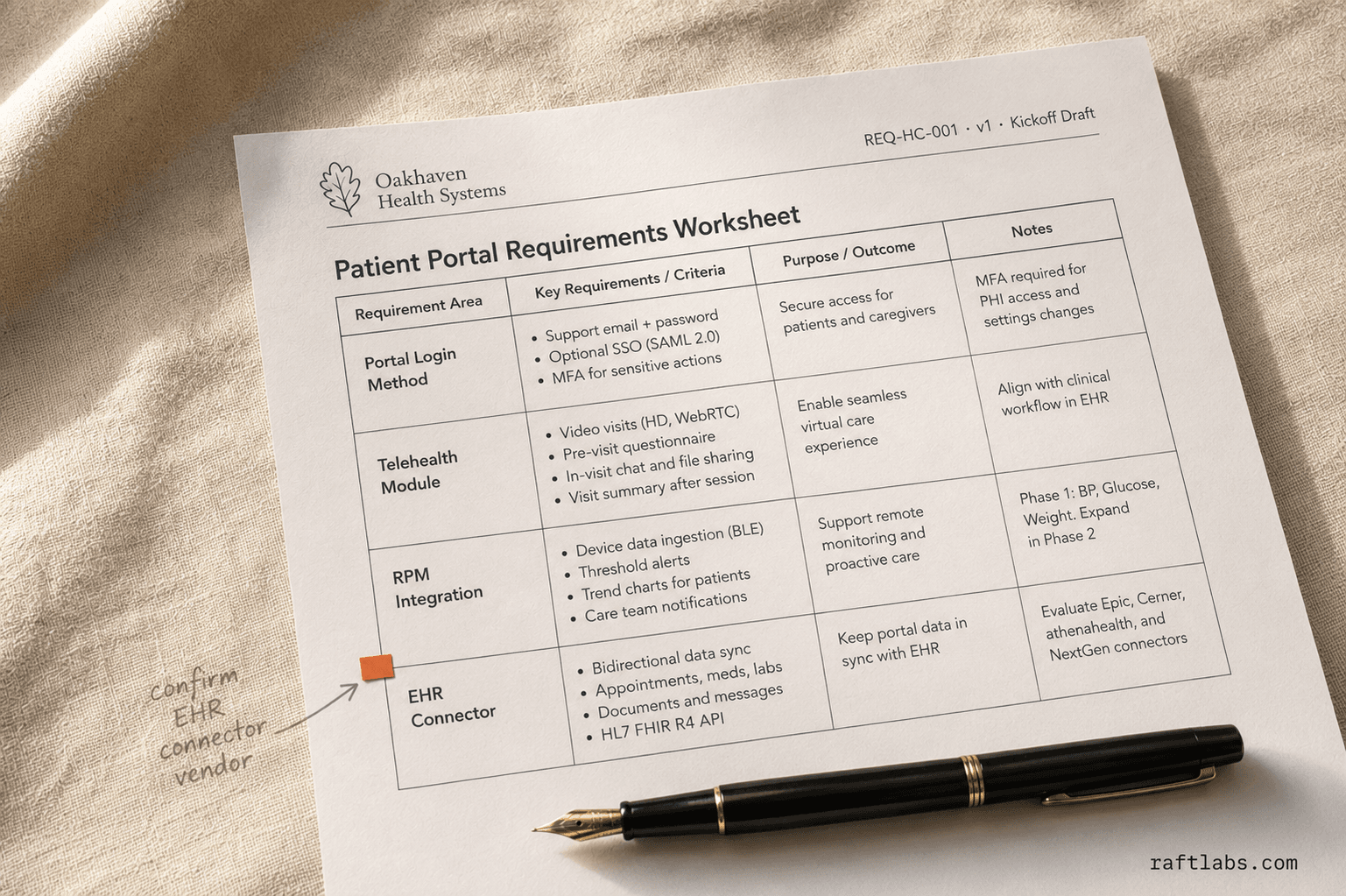
  • Patient portals and mobile apps with appointment booking, secure messaging, and health record access

  • Clinical workflow tools built around your care model -- not a generic template

  • HIPAA-aware architecture with encryption, audit logging, and BAA coverage

  • EHR integration for Epic, Cerner, Athenahealth, and HL7-based legacy systems

RaftLabs builds custom healthcare software for health systems, digital health startups, and healthcare operators who need software that fits their care model. We develop patient portals, clinical workflow tools, care coordination platforms, EHR integrations, healthcare AI, and digital health products -- all with HIPAA-aware architecture built in from the first sprint. Most custom healthcare software builds deliver in 12-16 weeks at a fixed cost.

Vodafone
Aldi
Nike
Microsoft
Heineken
Cisco
Calorgas
Energia Rewards
GE
Bank of America
T-Mobile
Valero
Techstars
East Ventures
Products shipped
100+
Aware architecture
HIPAA
Healthcare clients
6+
Cost delivery
Fixed

Off-the-shelf healthcare software rarely fits the way you work

Off-the-shelf platforms like Epic, Cerner, and Athenahealth cover standard clinical workflows for most health systems. Custom healthcare software is the right answer when your workflow is specific to a clinical programme the EHR does not support, when you are building a product to sell to other healthcare organisations, when integration requirements across multiple systems need a custom data layer, or when the patient or clinician experience needs to be significantly better than what a vendor portal delivers.

HIPAA-aware architecture is built in from the first sprint. Compliance controls are scoped during discovery and implemented as part of the architecture -- not added at the end of the build as an afterthought.

What we build

Patient portal and engagement software

Custom patient-facing applications for appointment scheduling, test result delivery, secure provider messaging, care plan tracking, and medication management. Built around the patient journey for your specific care model rather than a generic EMR patient portal that satisfies compliance requirements but drives no actual adoption.

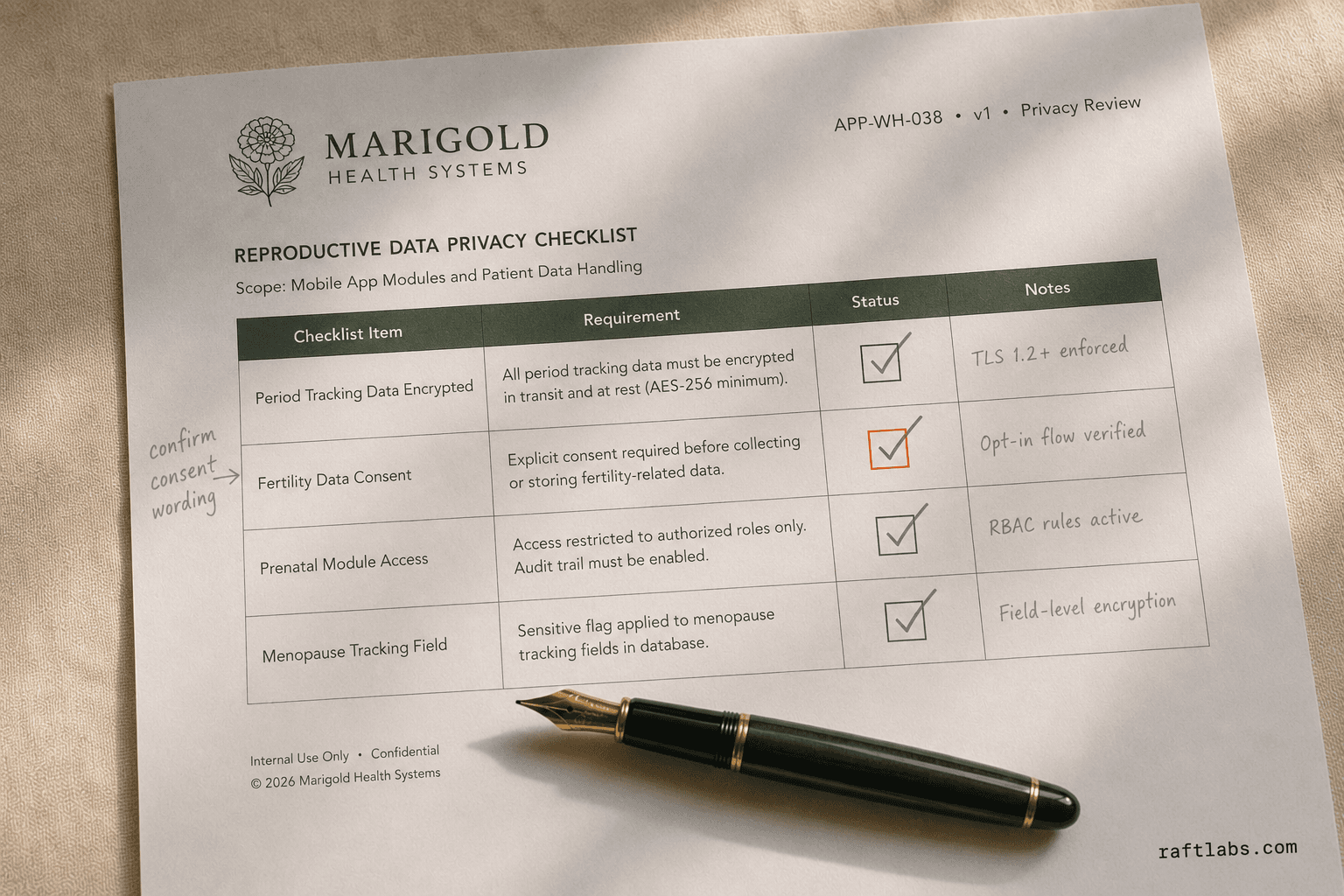
HIPAA Security Rule 45 CFR 164.312 technical safeguards are designed in from sprint one: AES-256 encryption at rest using AWS KMS for key management, TLS 1.3 for all PHI in transit, role-based access control with unique user identification, and automatic session logoff after configurable inactivity. Patient consent management captures the specific permissions a patient grants (appointment data, messaging, care plan access) and stores consent records with timestamp and version of the consent language presented. AWS HIPAA-eligible services -- Amazon Cognito for authentication, RDS for the patient data store, S3 for document storage -- are all deployed under the AWS Business Associate Agreement.

Patient matching on intake uses Levenshtein distance and Jaro-Winkler similarity algorithms to identify whether a new registration matches an existing patient record, reducing duplicate patient records that create dangerous data fragmentation in clinical settings. Audit logging via AWS CloudTrail and application-level event logging records every PHI access with user ID, timestamp, data accessed, action taken, and source IP -- the audit trail a HITRUST CSF assessor or OCR audit would require. Clean interfaces and accessible design (WCAG 2.1 AA) give patients a reason to use the portal rather than calling the front desk.

Clinical workflow and care coordination tools

Custom software for the clinical workflows your EHR does not handle well -- care plan management, multi-disciplinary team task assignment, clinical handover documentation, escalation alerts, and outcome tracking. The workflow layer that sits alongside your EHR and handles what it cannot: the operational and coordination logic specific to your clinical programme or care model.

HL7 FHIR R4 with SMART on FHIR OAuth 2.0 scoped launch is the standard integration pattern for connecting this workflow layer to Epic, Cerner, and other FHIR-enabled EHRs. SMART on FHIR enables the application to launch in context from within the EHR workflow, receiving the patient and encounter context automatically rather than requiring clinicians to re-identify the patient in a separate system. For Epic integrations, the application can be listed in the Epic App Orchard marketplace; for Cerner, Cerner Code certification is the equivalent pathway. Both marketplace processes require demonstrated FHIR API conformance testing and security review before approval.

The ONC 21st Century Cures Act interoperability mandate requires EHR vendors to provide FHIR API access without information blocking -- this means the patient data your clinical workflow tool needs is accessible by legal right, not by vendor permission. For organisations building tools that aggregate data across multiple EHR instances (multi-site health systems, care networks), we design the data normalisation layer to handle the variation in FHIR resource implementations between vendors. Clinical interfaces are designed to reduce administrative burden through structured data entry rather than free text, reducing documentation time per encounter.

EHR and health data integration

Integration middleware and data pipelines that connect your EHR -- Epic FHIR R4, Cerner Millennium, Athenahealth, HL7 v2 -- with your custom applications, external data sources, and analytics platforms. FHIR R4 RESTful API integration covers the standard resource types your use case requires: Patient, Observation, Condition, MedicationRequest, Appointment, CarePlan, and DocumentReference. HL7 v2 integration (ADT, ORU, ORM message types) handles older regional EHR systems and lab systems that have not yet implemented FHIR.

Bidirectional data sync is designed with conflict resolution logic for cases where the EHR and the custom application both hold authoritative copies of a data element. Write-back to Epic or Cerner requires specific API access levels that must be negotiated with the health system's IT team -- we scope this dependency explicitly in discovery. De-identification pipelines following HIPAA Safe Harbor (removing all 18 PHI identifiers) or Expert Determination method are built for analytics, research, and ML training use cases where downstream systems must not touch PHI.

Patient matching across systems uses Levenshtein distance and Jaro-Winkler string similarity on name fields combined with deterministic matching on date of birth and MRN to reduce false positives from phonetically similar names. The integration layer is the highest-risk component of most healthcare builds because it depends on the specific EHR version, API entitlements the health system grants, and the data quality of the source system. We scope it with explicit go/no-go criteria before development starts so there are no surprises during the build.

Telehealth and remote care platforms

HIPAA-compliant video consultation platforms, asynchronous messaging tools, and remote patient monitoring integrations -- built for the specific workflows your clinical team follows rather than a generic video call with a health label on it. Video infrastructure uses HIPAA-eligible providers (Daily.co, Twilio Video with BAA, or Amazon Chime SDK) rather than consumer video tools that do not support a BAA. The consultation workflow is designed around your clinical protocol: pre-visit intake form, automated eligibility and copay check where applicable, structured clinical documentation during the visit, and post-visit care instructions pushed to the patient portal.

Remote patient monitoring platforms integrate with wearable and home monitoring devices -- Apple HealthKit, Fitbit Health Solutions API, Withings BPM Connect for blood pressure, Dexcom G7 API for continuous glucose monitoring -- collecting readings into a provider dashboard that surfaces the patients with readings outside their target range. Alert management uses configurable threshold rules (e.g., systolic BP above 160 for three consecutive readings triggers a clinical outreach task) with AI-assisted prioritisation that identifies deterioration trajectories before individual readings breach hard thresholds.

AWS HIPAA-eligible services underpin the RPM infrastructure: Lambda for the real-time alert processing pipeline, RDS for the patient reading store, S3 with server-side encryption for device data archives, and SNS for alert notifications to clinical staff. HITRUST CSF certification is the most rigorous third-party validation for health tech products that need to demonstrate compliance posture to health system procurement teams -- we design the technical controls to meet HITRUST CSF requirements from the start, reducing the gap assessment scope when certification is pursued.

Healthcare AI and automation

AI capabilities are deployed within HIPAA-eligible environments where PHI stays within the compliance boundary. AWS Bedrock with BAA coverage provides access to foundation models (Anthropic Claude, Amazon Titan) for clinical documentation assistance without sending patient data to consumer AI endpoints. Clinical documentation assistance captures structured data from the clinical encounter -- diagnosis codes, medication changes, follow-up instructions -- and drafts a note in the provider's preferred format for review and approval. The provider reviews and signs; the AI removes the documentation burden without replacing clinical judgment.

Prior authorisation automation uses NLP to extract the required clinical criteria from payer guidelines and matches them against the patient's clinical record, pre-populating the authorisation request with the supporting evidence. Patient risk stratification models run on the longitudinal patient data in the platform to identify patients at risk of deterioration, hospital readmission within 30 days, or care gap accumulation -- outputs surface as prioritised outreach tasks in the provider workflow rather than raw model scores.

Penetration testing per the OWASP Healthcare Security Testing Guide is conducted before production launch: FHIR API security testing, injection vulnerability testing on any clinical data input paths, authentication and session management review, and PHI leakage testing on API responses. Operational automation covers the administrative processes that consume clinical team time: appointment reminder sequences, referral document routing via Direct messaging protocol, insurance eligibility verification via Availity API, and billing data preparation for claim submission.

Digital health product development

For digital health companies and health tech startups building software products to sell to health systems, payers, or direct-to-consumer. Product architecture, HIPAA-aware infrastructure, EMR integration design, and regulatory classification guidance are all part of the engagement. The ONC 21st Century Cures Act interoperability requirements mean any product that integrates with a certified EHR system must not engage in information blocking -- we design the data sharing architecture to satisfy this requirement from the start rather than discovering it during health system procurement review.

For products with clinical decision support or diagnostic functions, FDA Software as a Medical Device (SaMD) classification under the Digital Health Center of Excellence framework determines whether FDA submission is required. We advise on classification during discovery based on the product's intended use -- whether it falls under the Clinical Decision Support Software policy (exempt from FDA oversight) or requires a 510(k) or De Novo submission. Architecture decisions around labelling, intended use documentation, and design controls are made with the regulatory pathway in mind.

HITRUST CSF certification is the credentialling pathway most health system procurement teams recognise when evaluating new vendors. The HITRUST r2 assessment covers 325+ controls across 19 control categories. We design the technical controls to meet HITRUST requirements from day one -- reducing the gap between what was built and what the assessor requires. The full product build from discovery through launch includes compliance documentation support, not just technical delivery, so your team is not figuring out the compliance posture after the product ships.

Frequently asked questions

Custom software makes sense in four situations. First, when your clinical programme has workflows that major EMRs do not support natively -- speciality care models, care coordination across multidisciplinary teams, and population health programmes often fall into this category because EMR workflow engines are designed around the encounter, not the longitudinal care relationship. Second, when you need a patient-facing product that the Epic MyChart or Cerner HealtheLife portal cannot deliver in terms of design quality, personalisation, or mobile experience -- health systems with patient engagement goals consistently find that custom patient apps outperform vendor portals on activation and retention.

Third, when you are building a digital health product to sell to health systems, payers, or patients -- in that case, the product is your business and its architecture needs to support commercial deployment at scale, Epic App Orchard or Cerner Code marketplace listing, and HITRUST CSF certification for enterprise procurement. Fourth, when your integration requirements span multiple EHRs and external data sources and need a custom normalisation and routing layer that no single EMR vendor provides. If your needs fit what Epic, Cerner, or Athenahealth do natively, configuring the existing system is faster and cheaper. We will tell you honestly which path fits your situation during a scoping conversation.

We treat HIPAA as an architecture constraint from day one, not a post-build audit. During discovery we map every data flow involving PHI, classify each flow against the 18 PHI identifiers defined in 45 CFR 164.514, identify the technical safeguards required under 45 CFR 164.312 -- AES-256 encryption at rest, TLS 1.3 in transit, role-based access control with minimum necessary principle, audit logging of every PHI access, and automatic session logoff -- and document them before a line of code is written.

We establish Business Associate Agreements with all infrastructure providers that handle PHI before any PHI enters those systems: AWS BAA covers HIPAA-eligible services including RDS, S3, Lambda, Cognito, CloudWatch, and CloudTrail. Third-party integrations (EHR API providers, video platforms, communication tools) are evaluated for BAA availability before inclusion in the architecture. If a provider cannot sign a BAA, PHI does not pass through it -- the architecture routes around it.

Under the HIPAA Breach Notification Rule (45 CFR 164.400), a discovered breach of unsecured PHI requires notification to affected individuals within 60 days, to HHS OCR, and (for breaches affecting 500+ individuals) to prominent media outlets in the affected state. We design the breach detection and incident response workflow into the system during development so your team has a documented procedure to follow, not a process to invent under pressure. NIST Special Publication 800-66 provides the implementation guidance we use to translate HIPAA Security Rule requirements into specific technical controls.

Yes. We integrate with Epic via FHIR R4 APIs (both Epic-hosted FHIR and Epic's proprietary APIs for capabilities not yet exposed on the FHIR R4 surface), Cerner Millennium via its FHIR R4 and HL7 v2 interfaces, Athenahealth via the athenahealth REST API, and HL7 v2 ADT/ORU feeds for older regional systems that have not yet implemented FHIR. FHIR integration with SMART on FHIR launch context gives your custom application single sign-on from within the EHR and automatic patient context without requiring the clinician to re-identify the patient in a second system.

For Epic specifically, the App Orchard listing process requires conformance testing against Epic's FHIR API test suite and a security questionnaire from Epic's platform team. For Cerner, the Cerner Code certification programme has equivalent requirements. If your product will be deployed across multiple health systems using different EHR versions, the FHIR conformance variation between Epic instances and Cerner Millennium versions is meaningful -- we test against the specific versions your target health systems run, not just the reference implementation.

Integration depth depends on the API access level your client health system grants. Read access to patient demographics, appointments, and lab results is broadly available. Write access for creating care plan tasks, placing orders, or updating clinical documentation requires additional API entitlements and workflow approval from the health system's informatics team. We confirm the exact integration scope and entitlements needed during discovery because EHR integration drives a significant portion of the build timeline and cost.

A focused build -- a patient portal or a single clinical workflow tool with basic FHIR R4 EMR integration -- typically runs $30,000-$80,000 and delivers in 12-16 weeks. A full platform with multiple modules (patient portal, clinical workflow tool, care coordination, RPM dashboard), deep Epic or Cerner integration with SMART on FHIR launch context, mobile apps for iOS and Android, and AI-enabled features such as wearable data integration and automated alert management typically runs $80,000-$200,000 or more.

The main cost drivers are EMR integration complexity (how many FHIR resource types, whether write-back to the EHR is required, how many distinct EHR systems need to be connected), the number of distinct clinical workflows (each workflow is a separate design and build scope), HIPAA compliance documentation requirements (security risk assessment support, data flow diagrams, HITRUST pathway preparation), and whether native mobile apps are included from the start or delivered as a later phase.

HIPAA technical safeguards per 45 CFR 164.312 add approximately 15-25% to the base build cost compared to a non-healthcare application of equivalent functionality. This includes AWS HIPAA Eligible Services configuration, encryption implementation, RBAC architecture, audit logging, MFA integration, and penetration testing. The compliance infrastructure cost is fixed regardless of application size -- it is the minimum viable security posture for any application handling PHI. We price at a fixed cost after a scoping session that covers your clinical workflows, EMR environment, compliance requirements, and deployment timeline.

What clients say

What our clients say

Three-year average engagement. Founders and operators describing the work in their own words. No marketing varnish.

Charles E.
Charles E.
USA
Entrepreneur at Aggie Technologies

All of the sprints were completed on schedule and on budget. We highly recommend RaftLabs!

01 / 02

Related services

  • Custom Software Development -- Custom healthcare platforms, patient management tools, and clinical workflow systems built to your compliance requirements
  • Business Process Automation -- Automate patient intake, appointment reminders, clinical documentation, and billing workflows
  • AI Agent Development -- AI agents for patient risk stratification, clinical document summarisation, and care gap detection

Talk to us about your custom healthcare software project.

Tell us what you're building, who the users are, and your compliance requirements. We'll tell you how we'd approach it.