How to Build a Healthcare App: Cost, Timeline, and What Actually Matters
A plain-language guide to healthcare app development for operators and health system leaders. Covers cost, HIPAA, EHR integration, and when to choose custom over Epic or Salesforce Health Cloud.

In this article
Short answer
Building a healthcare app costs $50,000-$90,000 for an MVP and takes 12-18 weeks. HIPAA compliance, EHR integration (Epic, Cerner, Athena), and FDA classification are the three decisions that shape every other choice. RaftLabs builds HIPAA-compliant apps for healthcare operators, digital health startups, and care coordination teams. Custom software is the right call when off-the-shelf tools like Salesforce Health Cloud or Epic MyChart cannot fit your specific workflow.
Key takeaways
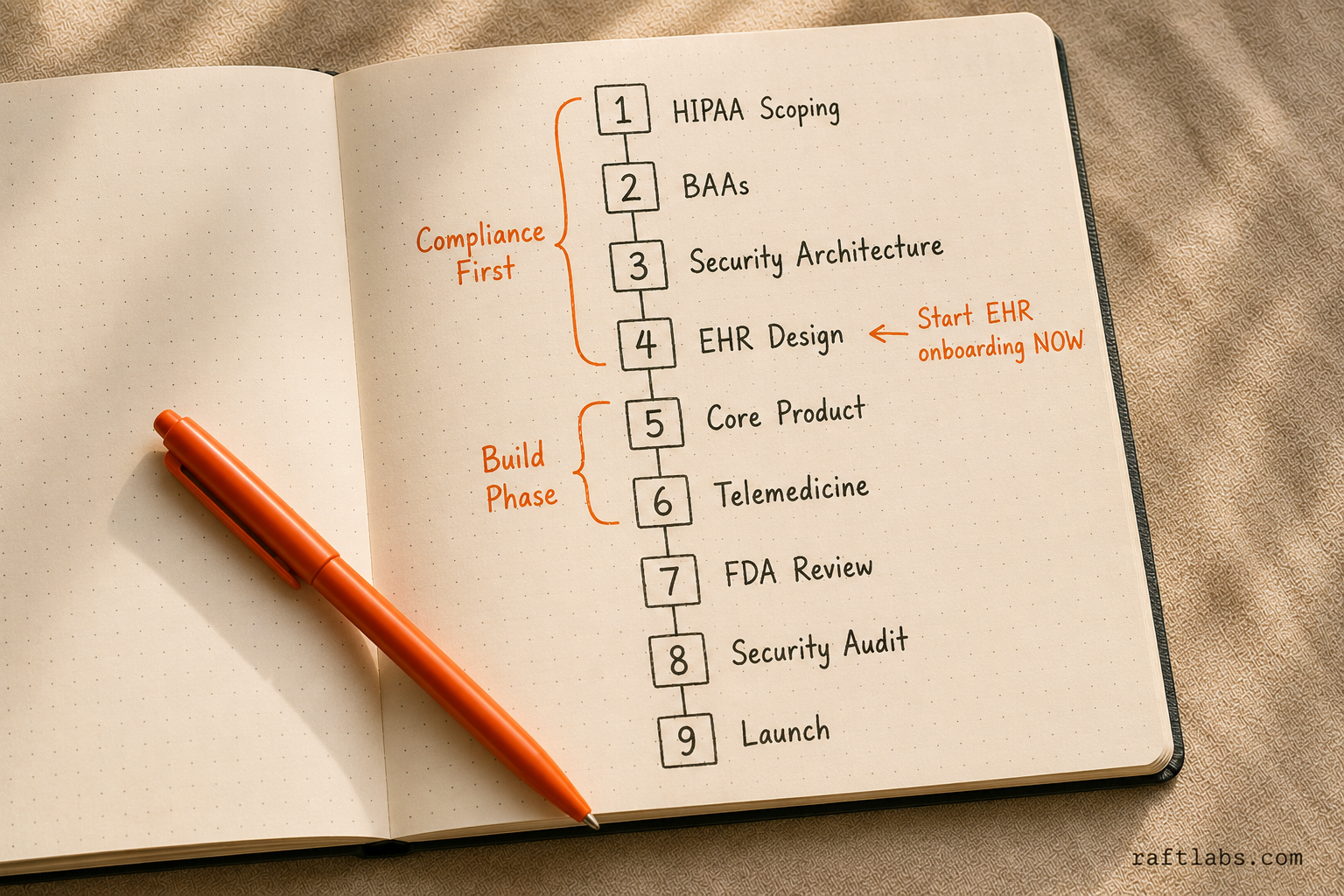
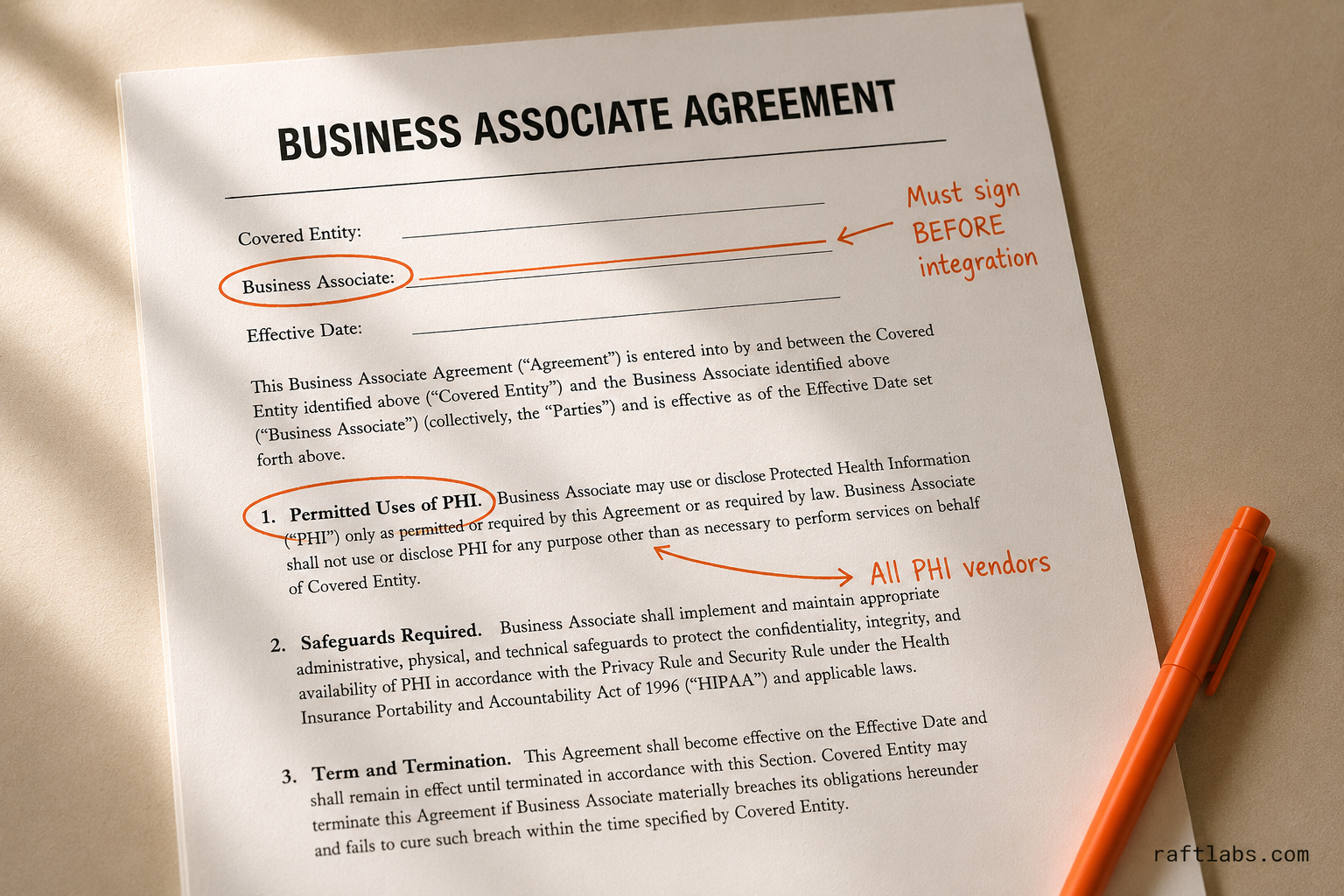
- HIPAA compliance is an architecture decision, not a checklist item. Every vendor that touches patient data must sign a Business Associate Agreement before you write a line of code.
- EHR integration takes 3-6 weeks per system, minimum. Epic, Cerner, and Athena each have their own developer onboarding process. Start it in week 2, not week 8.
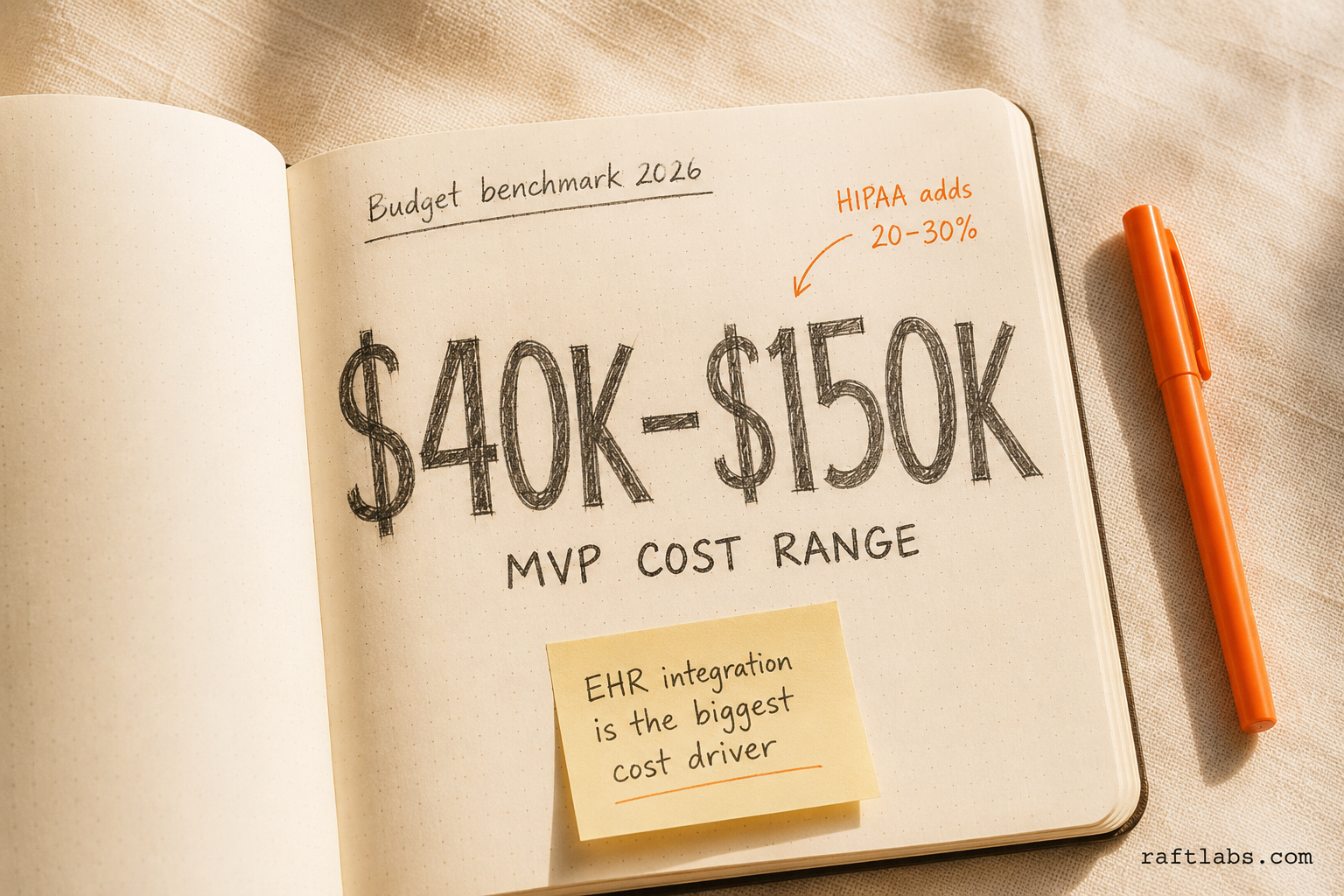
- Healthcare app MVP cost ranges from $50,000-$90,000. A full platform with EHR integration and telemedicine runs $150,000-$350,000+.
- Salesforce Health Cloud and Epic MyChart are the right tools for standard workflows. Custom software wins when your workflow is non-standard, or when you need to own the patient relationship.
- FDA classification must be answered in week 1. If your app makes or supports clinical decisions, you may need a 510(k) submission. Discovering this after launch is significantly more expensive.
- A consumer booking marketplace (the Practo model) needs four panels - patient, doctor, admin, and delivery - not the internal care-coordination workflow described elsewhere in this guide. Match your feature list to your business model, not the other way around.
You run a care coordination team. You have 12 care managers handling 800 patients across three payer contracts. Your current workflow is a combination of a generic CRM, a shared spreadsheet, and manual outreach calls logged nowhere. You know a custom app could cut your care managers' admin time in half. You have a budget. You have a timeline. What you do not have is clarity on what this actually costs, how long it takes, and whether you even need to build something custom when Epic MyChart and Salesforce Health Cloud already exist.
This guide answers those questions for healthcare operators, digital health founders, and health system leaders who are evaluating whether to build a custom healthcare app. It is not a tutorial for developers. It is a decision framework for the person who owns the budget.
Here is what the build costs and how long it takes:
| Scope | Timeline | Cost |
|---|---|---|
| MVP (HIPAA-compliant, core workflows) | 12-18 weeks | $50,000-$90,000 |
| Full platform (EHR integration, telemedicine) | 20-32 weeks | $150,000-$350,000 |
| At scale (ongoing iteration, integrations) | Ongoing | $15,000-$40,000/mo |
Who actually builds a custom healthcare app
Not every healthcare organization needs custom software. Most do not. But there are specific situations where off-the-shelf tools stop working, and building your own is the only path to the outcome you need.
Digital health startups with a differentiated care model. If you are building a virtual specialty clinic for a specific population (chronic condition management, postpartum mental health, occupational health for hourly workers), generic platforms will not fit your clinical workflow. Epic is designed for large health systems running standard acute care. Salesforce Health Cloud is designed for payer-side care management at enterprise scale. If your model is differentiated, the tool needs to be differentiated too. According to the American Telemedicine Association, the digital health market exceeded $330 billion in 2024 and is growing fastest in specialty and population-specific care models, precisely because standard tools do not serve them well.
Providers who need to own the patient relationship. Your EHR handles clinical documentation. It does not handle patient engagement between visits, care team communication outside appointments, or automated outreach based on care gaps. A regional behavioral health group with 40 providers across 6 clinics needs a patient engagement layer that fits their specific workflows. Epic MyChart exists, but it is licensed through the health system and you do not control its roadmap. A custom patient engagement app gives you a direct relationship with your patients and the ability to iterate on that experience.
Health system operators with care coordination gaps. A post-acute care network coordinating transitions from hospital to home needs a workflow tool that matches how their care managers actually work. Off-the-shelf care management platforms require you to adapt your workflow to the tool. A custom build flips that. A systematic review in the Journal of the American Medical Informatics Association found that health information technology-based discharge transition interventions meaningfully reduced patient readmissions and emergency room visits compared to standard care, a finding that supports the case for dedicated care coordination tooling beyond what EHR-native features can deliver.
Companies building healthcare as a secondary product line. A health benefits platform that started as an HR tool may need to add chronic condition management features for self-insured employers. A pharmacy that wants to add medication adherence coaching needs a patient-facing app. These are not pure digital health companies, but healthcare is now part of their product. Building custom gives them full control over the experience without being locked into a vendor roadmap.
Healthcare app features: V1, V2, V3
The phasing question matters because healthcare apps have a compliance floor that exists before any features do. That compliance infrastructure costs money and takes time regardless of how simple V1 is.
V1: The HIPAA-compliant core ($50,000-$90,000 | 12-18 weeks)
V1 is the smallest version of your app that is safe to deploy and useful to your first users. It includes the compliance infrastructure, authentication, core workflows, and the minimum integration surface needed to run a pilot.
HIPAA-compliant infrastructure (encrypted database, audit logging, access controls, session management)
Business Associate Agreements with all vendors
User authentication with MFA for clinical users
Core workflow (patient intake, care manager dashboard, task management, or whatever your specific V1 problem is)
Secure messaging or notification layer
Admin panel for user and permission management
V2: Integration and engagement ($80,000-$150,000 | 12-20 weeks)
V2 connects your app to the rest of the healthcare ecosystem and adds the patient-facing features that make the product sticky.
EHR integration via FHIR R4 (one EHR system: Epic, Cerner, or Athena)
Patient portal or mobile app
Appointment scheduling and reminders
Care plan management and tracking
Reporting and analytics for care managers
Telemedicine video calling (if applicable)
V3: Scale and automation ($100,000-$200,000+ | 16-24 weeks)
V3 is where the platform becomes a product you can sell or scale across additional care sites.
Additional EHR integrations (second and third EHR systems)
Automated outreach (care gap alerts, medication reminders, missed appointment follow-up)
Population health reporting
Payer data integration (eligibility, claims, authorization)
AI-assisted clinical decision support (where applicable and FDA-reviewed)
Multi-tenant architecture for multi-site deployment
Salesforce Health Cloud, Epic MyChart, and Redox vs. custom healthcare software
Before you spend $80,000 on a custom build, you should understand what the commercial options do well and where they stop working.
Salesforce Health Cloud is a CRM-based care management platform built for payer organizations and large health systems managing populations at scale. It excels at care gap closure, member outreach, and utilization management for organizations already running Salesforce. It is expensive at enterprise scale (typically $150/user/month and up), requires significant configuration, and is not designed for clinical workflows or differentiated care models. If you are a health plan managing 500,000 members and you already run Salesforce, Health Cloud is probably the right tool. If you are a specialty clinic or a digital health startup, it is the wrong tool.
Epic MyChart is the patient portal component of Epic, the dominant EHR for large health systems. It handles patient communication, appointment scheduling, test results, and medication management inside the Epic ecosystem. It is strong if your organization already runs Epic and your patients are Epic patients. It gives you no differentiation, no ability to modify the patient experience, and no integration outside the Epic world. Epic does not compete on patient engagement innovation. It competes on stability and interoperability within its own network.
Redox is not an end-user product. It is an integration platform that normalizes data formats between healthcare systems. If you are building a custom app that needs to connect to multiple EHR systems, Redox can compress months of integration work into weeks. It is worth knowing about because many healthcare app projects use it as infrastructure, not as a substitute for building. "According to Redox, their network connects over 2,000 healthcare organizations and has processed more than 1 billion clinical transactions," which signals how widespread the need for EHR interoperability tooling has become.
When custom software is the right call:
- Your care model does not fit the templates inside Salesforce Health Cloud or Epic. You have created a workflow, a protocol, or a patient journey that existing tools cannot configure to match.
- You need to own the patient relationship directly. You do not want your patient engagement platform controlled by your EHR vendor or by a payer who could change terms.
- You serve a specific population that standard tools overlook. Pediatric specialty care, behavioral health, occupational health, chronic condition management programs.
- You are planning to expand. The app you need today is the foundation for a product you will sell to other care sites in 24 months. Build-versus-buy changes when the software becomes the business.
- Your compliance requirements exceed what commercial platforms will certify. Some payer and government contracts require specific data handling that commercial SaaS vendors will not accommodate in their standard BAAs.
Example: the consumer booking marketplace model (Practo)
Everything above assumes an internal or provider-side app: a care coordination tool, a patient engagement layer, a differentiated clinical workflow. There is a second, distinct model worth understanding on its own terms: the two-sided patient-doctor booking marketplace, best known through Practo, one of India's largest health platforms, which serves patients across millions of monthly bookings and works with a large network of doctors and clinics. This is not an internal tool. It is a consumer marketplace, and it needs a different architecture and feature set than the care-coordination apps described above.
Practo's growth came from nailing the core booking and records workflow before adding scope elsewhere. Its early API-driven appointment system and real-time doctor availability gave both sides of the marketplace a reason to stay. That is the lesson for any team building a similar product: depth on the transaction that generates revenue beats breadth on features that do not.
A booking marketplace like this needs four distinct panels, not the two-sided patient/care-manager structure described earlier:
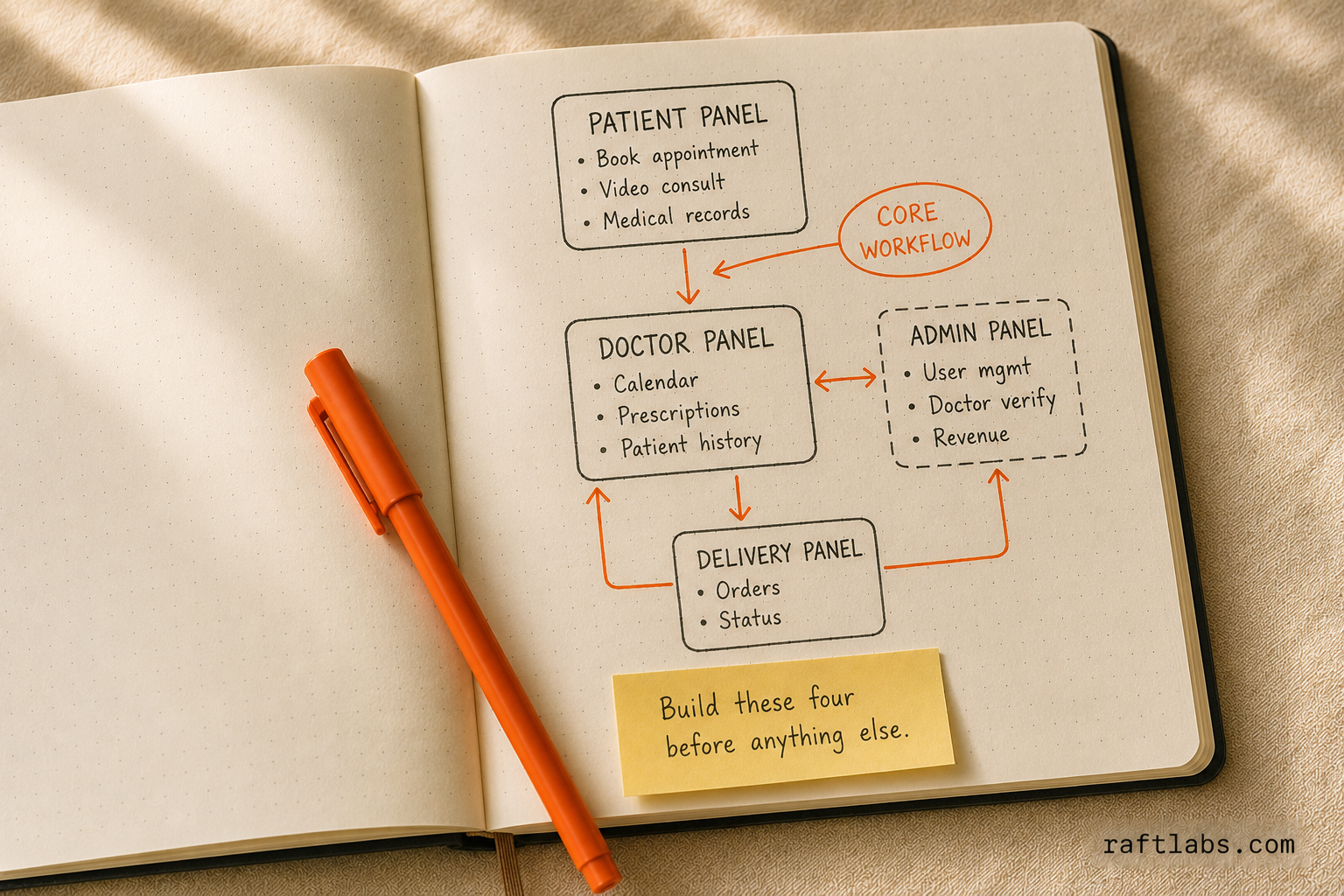
Patient panel. Profile and medical history, doctor and clinic search with specialty and location filters, appointment booking against real-time availability, video or audio consultation, medical records storage, prescription access, and a payment gateway supporting multiple payment modes.
Doctor panel. Profile and credential management, an appointment calendar that prevents double-booking, patient records and history, prescription issuance, and earnings and transaction analytics. This panel determines whether providers stay on the platform. If it adds administrative work instead of removing it, doctor churn follows.
Admin panel. User management, appointment oversight, doctor verification, diagnostic center and clinic administration, revenue reporting, and payout administration.
Delivery panel (if the platform includes medicine delivery). A dedicated interface for delivery personnel showing order details, contact information, timing, and status in one place.
A marketplace MVP with these four panels runs $40,000-$80,000 at 16-24 weeks, a narrower scope than the HIPAA-compliant care-coordination core described above because a booking marketplace defers deeper clinical-workflow requirements (EHR integration, care plan tracking) to a later phase. HIPAA compliance still applies in full for US users. If you are building for other markets, layer in the local equivalent: India's Digital Personal Data Protection Act, or GDPR for EU patient data.
HIPAA app development: what the compliance layer actually requires
HIPAA is not a checklist you complete at the end. It is a set of architectural constraints that shape every technical decision you make from day one. According to the IBM Cost of a Data Breach Report 2023, healthcare data breaches cost an average of $10.93 million per incident, the highest of any industry for the 14th consecutive year, more than double the global cross-industry average of $4.45 million. That number exists partly because many healthcare apps were built by teams that treated compliance as an afterthought.
Here is what HIPAA-compliant app development requires in practice:
| Infrastructure component | Requirement | Standard choice |
|---|---|---|
| Database | Encryption at rest (AES-256) | PostgreSQL on AWS RDS (encrypted) |
| Data in transit | TLS 1.2+ on all connections | Enforced at load balancer / API gateway |
| File storage | Server-side encryption + access logging | AWS S3 with SSE and CloudTrail |
| Authentication | MFA required for clinical users | Auth0 (BAA available) |
| Video (telemedicine) | HIPAA-compliant BAA from video provider | Twilio Video or Daily.co |
| Email / notifications | BAA from email provider | SendGrid or Postmark (BAA available) |
| Analytics | BAA from analytics provider | Mixpanel (BAA available) - not Google Analytics |
| Audit logging | All PHI access logged with user + timestamp | Custom audit layer in the application |
| Session management | Automatic timeout for clinical users | Configurable per role |
Every vendor in that list requires a signed Business Associate Agreement before you integrate them. Using a vendor without a BAA to handle patient data is a HIPAA violation, regardless of how small the data footprint is.
EHR integration: FHIR R4 is the current standard
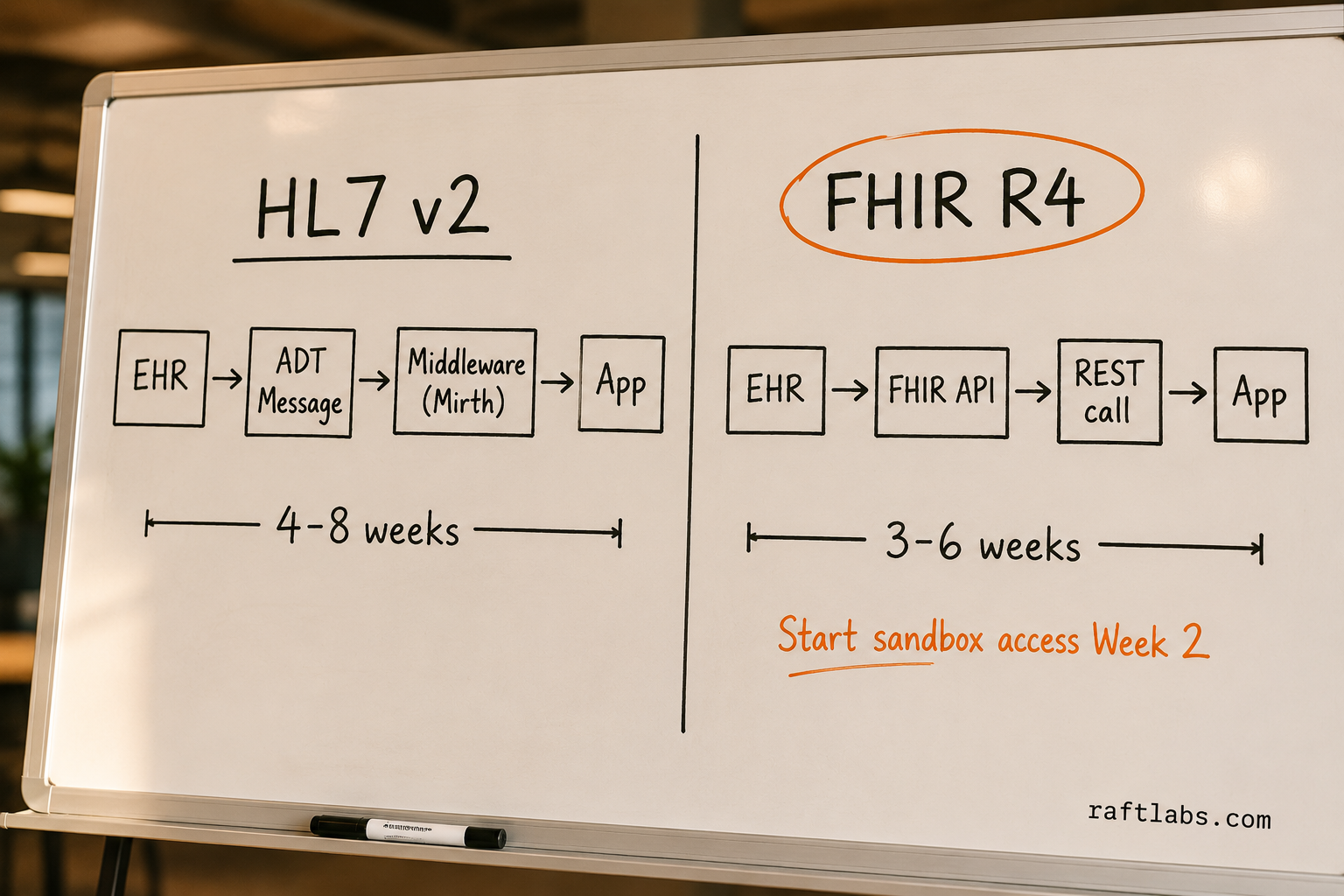
If your app needs to read or write data from an EHR system, FHIR R4 (Fast Healthcare Interoperability Resources) is the integration path. Epic, Cerner, Athena, and most modern EHR systems expose FHIR APIs.
| EHR system | Integration path | Onboarding timeline |
|---|---|---|
| Epic | FHIR R4 via Epic App Orchard | 4-8 weeks for sandbox access |
| Cerner (Oracle Health) | FHIR R4 via Cerner SMART on FHIR | 3-6 weeks |
| Athena | FHIR R4 via athenahealth API | 2-4 weeks |
| Legacy systems | HL7 v2 via middleware (Mirth Connect) | 6-10 weeks |
The key fact about EHR onboarding: it happens on the EHR vendor's timeline, not yours. Epic's App Orchard review process alone can take 4-8 weeks. If you start that process in week 6 of development, you will be waiting with finished code and no EHR access. Start it in week 2.
FDA classification
If your app makes, supports, or substitutes clinical decisions, the FDA may classify it as Software as a Medical Device (SaMD). The classification determines whether you need a 510(k) submission (3-12 months, $25,000-$100,000+) before launch. A wellness app tracking steps does not need FDA clearance. An app that recommends treatment adjustments based on biometric data does. Answer this question in week 1.
Where custom healthcare app projects fail
Most healthcare app projects that fail do not fail on the product side. They fail on one of three compliance and integration problems.
Treating HIPAA as a late-stage checklist. A team builds 14 weeks of product, then brings in a HIPAA consultant who identifies that the data model needs to be restructured, two vendors need BAAs before they can be used, and audit logging was never implemented. Rearchitecting a healthcare data layer after the fact costs more than building it correctly from the start. The teams that move fastest in healthcare app development are the ones that lock down the compliance architecture before they write any product code. "Dr. Aaron Neinstein, Chief Digital Officer at UCSF Health, put it directly: 'The teams that treat HIPAA as a technical constraint rather than a business obstacle are the ones that ship fastest and with the fewest regulatory surprises.'"
Underestimating EHR vendor timelines. This is the most common cause of missed go-live dates in healthcare app projects. A team scopes a 16-week build, correctly estimates the product development work, and completely underestimates that the EHR vendor onboarding process cannot be compressed. Epic App Orchard review alone can take 4-8 weeks. You cannot write the code for the integration and then wait for access. You need to apply for access in week 2 and write the code to meet the access timeline, not the other way around.
Skipping the FDA question. A digital health company spends eight months and $200,000 building a clinical decision support tool. Two weeks before launch, their legal counsel identifies that the feature that recommends care adjustments based on lab results may require FDA clearance. The launch stops. The team spends three to twelve months in FDA review while burning cash. This scenario is common. The fix is simple: answer the FDA question in week 1.
How RaftLabs builds healthcare apps
We have built remote patient monitoring systems, telehealth platforms, and care coordination tools. The pattern across every healthcare engagement is the same: the teams that treat HIPAA and EHR onboarding as week-1 decisions ship faster and with fewer surprises than the teams that treat them as week-10 concerns.
On a remote patient monitoring system we built for a post-acute care network, EHR integration required connecting to two different hospital systems. The EHR vendor onboarding for both took a combined eight weeks. We started that process in week 2 of development. The product code was written in parallel. When the EHR access was granted, the integration was tested and ready. Teams that wait until week 8 to start EHR onboarding end up with finished code and nothing to connect it to.
Our process on every healthcare app engagement starts with two documents before any code is written: a HIPAA scoping document that maps every PHI touchpoint in the proposed architecture, and a vendor BAA checklist that lists every vendor integration and its compliance status. Those two documents take one week to produce and prevent the most expensive mistakes.
If you are at the stage where you have a care model, a patient population, and a budget, and you need to decide whether to build custom or configure an off-the-shelf platform, that is exactly the conversation we have in a first call. Here is what the first 30 days with RaftLabs looks like: week 1 is a HIPAA scoping session and architecture review, week 2 is vendor selection and BAA initiation, week 3 is a phased build plan with fixed scope and timeline, week 4 is development kickoff.
Ask an AI
Get an instant summary of this post from your preferred AI assistant.
Common questions
- A HIPAA-compliant healthcare app MVP takes 12-18 weeks. A full platform with EHR integration and telemedicine takes 20-32 weeks. The single biggest timeline variable is EHR vendor onboarding - Epic, Cerner, and Athena each run their own approval process that takes 2-6 weeks and cannot be accelerated. Start that process in week 2, not week 8.
- A healthcare app MVP costs $50,000-$90,000. A full platform with EHR integration and telemedicine runs $150,000-$350,000+. HIPAA compliance infrastructure adds $10,000-$20,000 compared to an equivalent non-regulated product. EHR integration costs $20,000-$50,000 per EHR system. A pre-launch security audit adds $10,000-$25,000.
- HIPAA-compliant app development requires: encryption at rest (AES-256) and in transit (TLS 1.2+), role-based access controls, automatic session timeouts, audit logging, and signed Business Associate Agreements with every vendor that processes patient data. It also requires a written incident response procedure before launch. These are architecture requirements, not optional add-ons.
- Use custom software when your care model does not fit standard templates, when you need to own patient engagement directly, when you serve a specific population that generic tools overlook, or when you plan to expand into adjacent revenue lines. Epic and Salesforce work well for standard clinical workflows inside existing health systems. They are not designed for differentiated digital health products.
- It depends on what your app does. Wellness apps, symptom trackers, and patient education tools generally do not need FDA clearance. Apps that support, supplement, or substitute clinical decision-making may be classified as Software as a Medical Device (SaMD) and require 510(k) clearance. Get this question answered in week 1 of your project - FDA review takes 3-12 months and cannot run in parallel with your launch.
- It depends on the business model. A patient-doctor booking marketplace (the Practo model) needs four panels: a patient panel (search, booking, video consult, records, payment), a doctor panel (calendar, patient records, prescriptions, earnings), an admin panel (user and doctor verification, revenue reporting), and a delivery panel if medicine delivery is in scope. A care-coordination or provider-side app needs a different set: patient intake, care manager dashboard, task management, and secure messaging, built on the HIPAA-compliant core described above. Match the feature list to the business model, not the other way around.
- Most healthcare apps use React Native for cross-platform mobile (iOS and Android), Node.js or Python (Django/FastAPI) for the backend, PostgreSQL for structured patient data, Redis for session management, and AWS or Google Cloud for HIPAA-compliant hosting. For video consultations, use Daily.co or Twilio Video - both sign BAAs. Do not build your own video infrastructure; it is a compliance and reliability risk that established vendors have already solved.