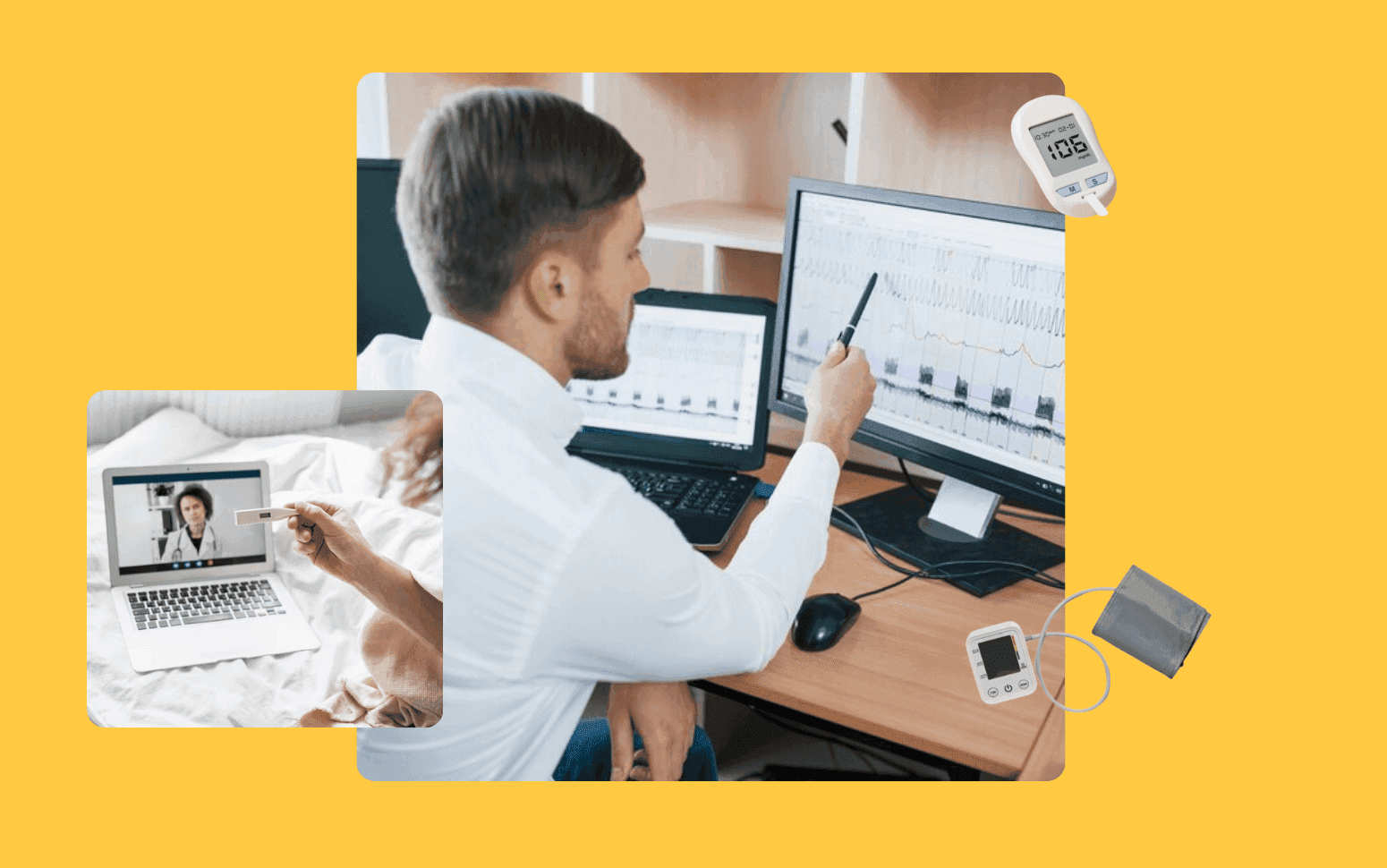
Remote Patient Monitoring Cuts Hospital Readmissions
- 30%
- 12 weeks
Custom mobile and web applications for digital health companies, private healthcare operators, and health systems. We build patient-facing and clinical-facing apps to healthcare standards.
From patient portals to clinical workflow apps to mHealth platforms, we build the healthcare software that compliance teams can approve and patients and clinicians actually use.
Patient-facing apps with HIPAA-aware data handling and healthcare-appropriate UX
Clinical workflow apps that fit how your care team actually delivers care
mHealth platforms with wearable integration and health data management
App Store and Play Store submission with healthcare app compliance requirements
Recognition
Building a healthcare app but struggling to find a development team that understands HIPAA, clinical workflow, and healthcare UX?
Patient-facing app with low adoption because the UX wasn't designed for healthcare users?
In short
RaftLabs builds healthcare mobile applications for digital health startups, private healthcare operators, and health systems. We develop patient-facing apps (appointment booking, health tracking, patient portals), clinical workflow tools, mHealth applications, and digital therapeutics. All apps are built with HIPAA-aware architecture, secure data handling, and the accessibility standards that healthcare user populations require.
Companies we've built for






Healthcare apps fail at adoption more often than technology. Patients don't use apps that are confusing, slow, or ask for information the care team doesn't use. Clinicians don't use tools that don't fit their workflow or create documentation burden.
We design and build around the actual user, patient or clinician, before writing a line of code.
Patient-facing apps for appointment booking, test result access, medication reminders, care plan tracking, and secure messaging with providers. HIPAA-compliant data handling covers PHI storage using AES-256 encryption at rest, TLS 1.3 for all API traffic, and role-scoped access tokens so the patient only ever accesses their own records. Authentication supports biometric login (Face ID, Touch ID, Android BiometricPrompt) alongside password-based login with TOTP multi-factor authentication for high-assurance access to sensitive results.
Consent management handles the complex layering that healthcare requires: consent to terms, consent to data processing under HIPAA authorization, and granular consent for specific data sharing scenarios such as releasing records to a third-party provider or enrolling in a research program. Each consent event is timestamped and stored as a non-repudiable audit record.
EHR integration uses FHIR R4 Patient and Observation resources to pull structured results, lab values against LOINC-coded analytes, medication lists from MedicationRequest resources, and immunization records from Immunization resources. The UI renders results with reference ranges so patients understand what the numbers mean without needing a provider explanation. Designed across the full patient demographic, including older patients and those with limited health literacy: WCAG 2.1 AA accessibility is built in from the start, not applied as an audit remediation step. Works on iOS, Android, and mobile web from a shared data layer with platform-appropriate UI.
Mobile health applications for chronic disease management, medication adherence, symptom journaling, nutrition tracking, and fitness programs. Wearable device integration uses HealthKit (Apple Health) on iOS and Google Health Connect (formerly Google Fit) on Android to passively collect steps, heart rate, sleep stages, blood glucose readings from connected CGM devices, and SpO2 data without manual entry. Fitbit, Garmin, and Oura integrations use their respective REST APIs for data pull on a defined sync schedule. When data flows into the app, it maps to standardized LOINC-coded observation types so a provider-facing dashboard can ingest it in a structured, interoperable format.
Push notification strategy matters for mHealth adherence: generic reminder notifications get ignored within days. We design notification timing and content around behaviour change research, medication reminders keyed to the patient's actual administration schedule, glucose check prompts based on meal timing patterns, and escalation notifications when readings are outside the patient's personal target range. iOS APNs and Android FCM handle delivery. Notification consent flows follow iOS 14+ and Android 13+ permission requirements with clinical rationale for each notification type. Where the app connects to a clinical dashboard, health data shared from the app uses FHIR R4 Observation resources with appropriate LOINC codes so provider-facing systems can ingest it without manual transcription.
Software-based therapeutic interventions for mental health, chronic pain, rehabilitation, and behavioural health. CBT program delivery uses structured module sequences with session gating, homework assignment and completion tracking, and validated outcome measurement instruments, PHQ-9 for depression, GAD-7 for anxiety, PCL-5 for trauma symptoms, scored automatically and trended over time. Chronic pain management apps combine pain diary tracking (using validated NRS and VAS scales), activity logging, sleep tracking, and educational content delivery in a sequence structured around evidence-based pain management protocols.
FDA Software as a Medical Device (SaMD) classification is a design-time consideration, not an afterthought. Most wellness apps fall outside FDA SaMD scope. Apps that make clinical decisions, provide treatment recommendations, or process physiological data to inform diagnosis need to be assessed against FDA's SaMD guidance and the Digital Health Policy Guidance from 2019 and the Pre-Cert pilot criteria. We assess classification risk during discovery so the architecture, data handling, and evidence requirements are scoped correctly. Discovering a product requires 510(k) clearance after launch is an expensive problem. For companies already pursuing regulatory clearance, we build with the technical documentation requirements that FDA review requires: traceability matrices, software architecture documentation, and risk management documentation aligned with IEC 62304 software lifecycle process standards.
Apps for care teams: task management, care plan tracking, clinical handover, escalation workflows, and care coordination. The design starting point is always the actual clinical workflow rather than a generic task management pattern mapped onto clinical scenarios. Those products produce adoption failures because they don't reflect how clinicians think about their work and prioritise their time.
Handover apps capture structured handover data at the point of care: the problem, current status, anticipated changes, actions pending, and contingency plans for each active patient. Structured handover using SBAR (Situation-Background-Assessment-Recommendation) format reduces information loss at shift change compared to unstructured verbal-only handover. Escalation workflows use configurable trigger rules against patient observation data, NEWS2 score thresholds for deterioration recognition, for example, to generate push alerts to the appropriate care team member rather than relying on manual pattern recognition.
EMR integration uses FHIR R4 Patient and Encounter resources to pull the clinical context that should live in the system of record into the workflow tool, so staff aren't duplicating data entry. Structured data captured in the workflow tool that has clinical value, observation sets, care plan updates, handover summaries, writes back to the EMR via FHIR or HL7 v2 messages. This bidirectional data flow keeps the EMR as the authoritative record without requiring staff to work exclusively within the EMR's native interface.
Patient-facing apps for remote patient monitoring (RPM) programs: vital sign submission (blood pressure via Bluetooth-connected cuff, glucose via CGM or glucometer integration, weight via connected scale, SpO2 via compatible pulse oximeter), structured symptom check-ins, and medication adherence logging. Device connectivity uses Bluetooth LE profiles specific to each device category, blood pressure monitors use the BT SIG Blood Pressure Profile. Glucose meters use the Continua Health Alliance profiles or manufacturer-specific SDKs. HealthKit (iOS) and Google Health Connect (Android) serve as the data aggregation layer for devices that write to the platform health store rather than the app directly.
Alert thresholds are configured per patient against their individual target ranges (not generic population ranges), with multi-tier escalation: first tier is an in-app notification to the patient, second tier is an alert to the care coordinator, third tier is an urgent escalation to the supervising clinician. LOINC-coded observation data writes to the EMR via FHIR R4 Observation resources so the RPM readings appear in the patient's clinical record alongside in-person vitals. CPT codes 99453, 99454, and 99457 apply to RPM programs, the app's data logging generates the documentation required to support these billing codes for CMS reimbursement. See our dedicated remote patient monitoring page for the full RPM platform capability.
Healthcare appointment booking platforms, provider marketplace apps, and care coordination products that connect patients to the right provider across a network. Specialty search uses structured provider data including specialty codes from the NUCC Health Care Provider Taxonomy, NPI (National Provider Identifier) numbers for provider identity, and location-based availability for in-person appointments. Availability management integrates with provider scheduling systems, Google Calendar, Acuity Scheduling, or custom practice management systems, via API to surface real-time slot availability rather than estimated availability that leads to scheduling conflicts.
Insurance verification is one of the friction points in healthcare booking that marketplaces often underestimate. Eligibility checks via X12 270/271 transactions (the HIPAA EDI standard for eligibility inquiry and response) confirm whether the patient's plan covers the provider and the requested service before the appointment is confirmed, not after the visit when a claim is rejected. This requires integration with a clearinghouse (Change Healthcare, Availity, or similar) or direct payer connections for the major plans in your target market. Review systems in healthcare require careful design around content policy: patient reviews touching clinical care quality create medico-legal risk that review content moderation must account for. The booking platform connects to a provider-facing scheduling dashboard and, where the marketplace operates at network scale, to analytics that show provider utilization, wait times, and conversion rates by specialty.
A patient-facing healthcare app with core features, appointment booking, secure provider messaging, health tracking, and a web portal, typically runs $40,000--$90,000 for iOS and Android. That scope includes HIPAA-aware data architecture, AES-256 encryption at rest, TLS 1.3 for API traffic, role-based access control, audit logging, BAA setup with your cloud provider, and App Store and Play Store submission. HealthKit or Google Health Connect wearable integration adds approximately $8,000--$15,000 depending on the device ecosystem scope.
Clinical workflow apps and mHealth platforms with FHIR R4 EMR integration, wearable data exchange, and provider-facing dashboards run $60,000--$150,000. The EMR integration component, scoping which FHIR resources are needed, building against the EMR's sandbox, and handling the authentication (SMART on FHIR), error states, and data quality issues, is the primary cost variable. Digital therapeutics with validated outcome measurement instruments, evidence-based content sequencing, clinical data reporting, and FDA SaMD classification review documentation run $80,000--$200,000. See our healthcare app development cost guide for a detailed breakdown by feature and complexity level.
Three factors make healthcare app development meaningfully different from consumer or enterprise mobile development.
First, compliance. HIPAA technical safeguard requirements under 45 CFR Part 164 shape every architecture decision: which cloud services are permissible (only HIPAA-eligible services within your BAA), how data is encrypted at rest (AES-256) and in transit (TLS 1.3), how audit logs are maintained (tamper-evident, retained 6+ years), and how third-party integrations are handled (every vendor processing PHI requires a signed BAA). A third-party analytics SDK that logs user behaviour can inadvertently become a PHI exposure if it captures screen content in a healthcare app.
Second, user population. Healthcare users span a much wider age range and technology confidence level than most consumer apps. UX patterns that work for a 28-year-old using a fintech app often fail for a 72-year-old managing multiple chronic conditions. Font sizes, touch target sizes, plain language for medical terminology, and WCAG 2.1 AA accessibility compliance are baseline requirements for healthcare apps, not optional extras.
Third, clinical integration. Most healthcare apps need to exchange data with an EMR system, pulling patient records via FHIR R4 APIs, pushing structured data back as Observation or DocumentReference resources, or handling HL7 v2 message feeds for older systems. This integration work requires understanding clinical data standards (LOINC codes for observations, SNOMED CT for clinical terms, RxNorm for medications), EMR-specific API behaviour, and the organisational processes that govern EMR access. It adds 3–8 weeks to most projects and is the component most often underestimated at the proposal stage.
Yes. Apple HealthKit and Google Health Connect (which replaced Google Fit as the unified Android health data platform) allow apps to read passive health data, steps, heart rate, sleep stages, blood glucose readings from compatible CGM or glucometer integrations, resting energy, SpO2, and ECG data from Apple Watch Series 4 and later, without requiring manual entry by the patient. HealthKit uses a permission-per-data-type model. The app requests access only to the specific HKQuantityType or HKCategoryType it needs, and the patient grants or denies each type individually. Google Health Connect uses a similar permission-per-data-type model with Android 14+ requiring users to explicitly grant health data access.
We implement appropriate permission request flows that explain why each data type is needed in clinical terms, improving grant rates compared to generic permission prompts. Data sync strategies handle the difference between historical backfill (reading the past 30 days of heart rate data when the patient first connects) and ongoing incremental sync (reading new readings since the last sync). Wearable data is only useful if it changes a clinical behaviour or decision. We design the data integration around the clinical use case, not the technical capability. Pulling 30 days of step count data into an app that does nothing with it is not integration, it's data collection without purpose. The design question is always: what does the care team or patient do differently because this data is now available?
Yes. Healthcare apps have review requirements that consumer apps don't face, and underestimating the submission timeline is a common cause of launch delays. For the App Store, healthcare apps that access HealthKit data must provide a clear explanation of how health data is used, must not sell health data to advertisers, and may be reviewed by Apple's health team rather than the standard automated review process. Apps that provide medical advice or treatment recommendations are subject to Apple's Human Interface Guidelines section on health and safety, and apps that fall under FDA SaMD classification must have appropriate regulatory status before submission. Privacy nutrition labels require accurate disclosure of all data types collected and how they are used.
For the Play Store, health apps accessing Google Health Connect data must comply with Google's Health Connect permissions policy and pass a separate verification process for sensitive health data access. Apps in the Medical category face additional scrutiny and may require documentation of clinical purpose and relevant regulatory status. We handle the full submission process: preparing App Store Connect and Google Play Console metadata, writing accurate privacy disclosures, preparing the required data safety form, managing the review process, and responding to reviewer queries with the technical detail reviewers need to approve healthcare-specific functionality. We plan 3–6 weeks for initial submission and review on both platforms, not the 1–2 week window that applies to standard consumer apps.
What clients say
Three-year average engagement. Founders and operators describing the work in their own words. No marketing varnish.

 USA
USAAll of the sprints were completed on schedule and on budget. We highly recommend RaftLabs!
01 / 02
Tell us who the users are, what the app needs to do, and your compliance requirements. We'll scope the build.