Updated October 2025
How Much Does It Cost for SaaS Application Development in 2026
Real cost numbers for building SaaS products in 2026, by build tier, development phase, individual feature, team type, and AI complexity. Built from 30+ delivered projects, not market averages.

In this article
Short answer
Building a SaaS platform costs $10,000-$20,000 for an MVP (6-8 weeks) and $20,000-$60,000 for a full-featured product (12-14 weeks) in 2026. AI-powered builds start at $120,000+. The biggest cost drivers are feature complexity, real-time data requirements, third-party integrations, and team location. RaftLabs has delivered 30+ SaaS products at these prices from India, serving clients in the US, UK, Canada, Ireland, and Australia.
Key takeaways
- An MVP costs $10,000-$20,000 and ships in 6-8 weeks. A full-featured platform costs $20,000-$60,000 and ships in 12-14 weeks. These are project-based prices, not market averages.
- The feature that most consistently pushes a build from MVP tier to full-featured tier is real-time data. Real-time collaboration, live dashboards, and streaming cost 3-5x more than static data features.
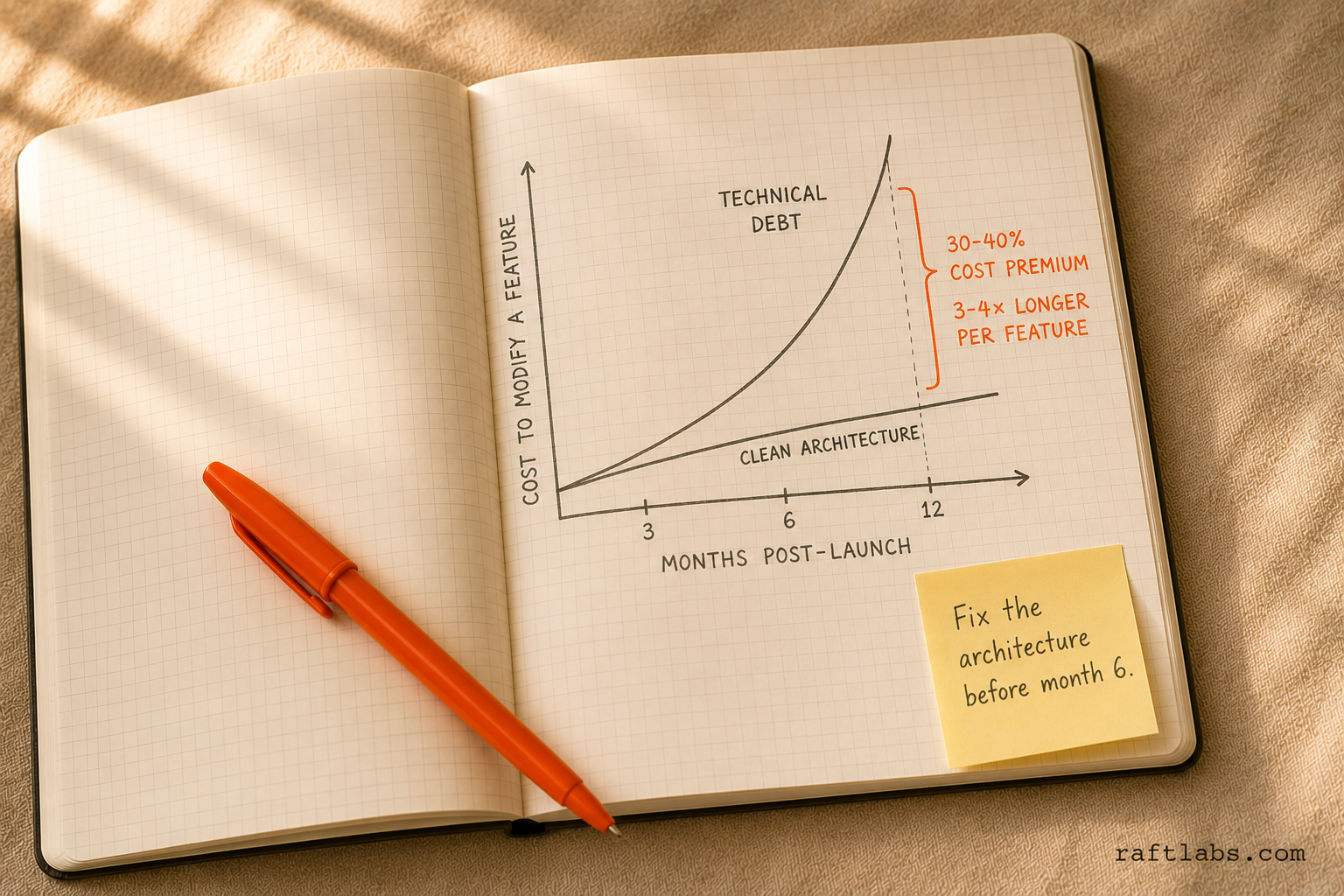
- Technical debt built into an MVP-stage codebase makes future feature additions 30-40% more expensive. Clean architecture in discovery costs less than rebuilds later.
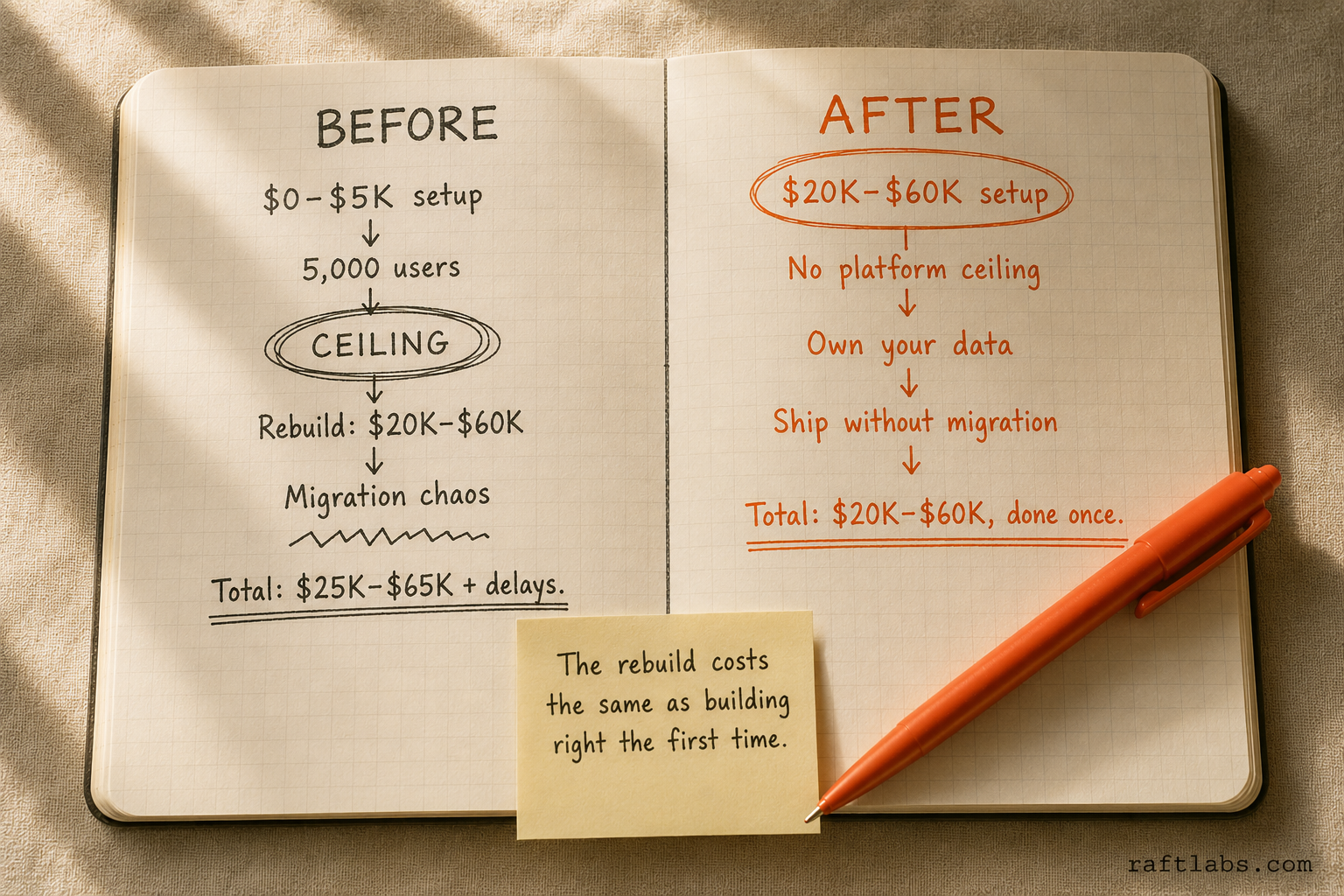
- No-code platforms (Bubble, Webflow) are right when you're pre-revenue and validating. They become a ceiling at 5,000-10,000 users. Rebuilding at that point costs as much as a custom build would have from the start.
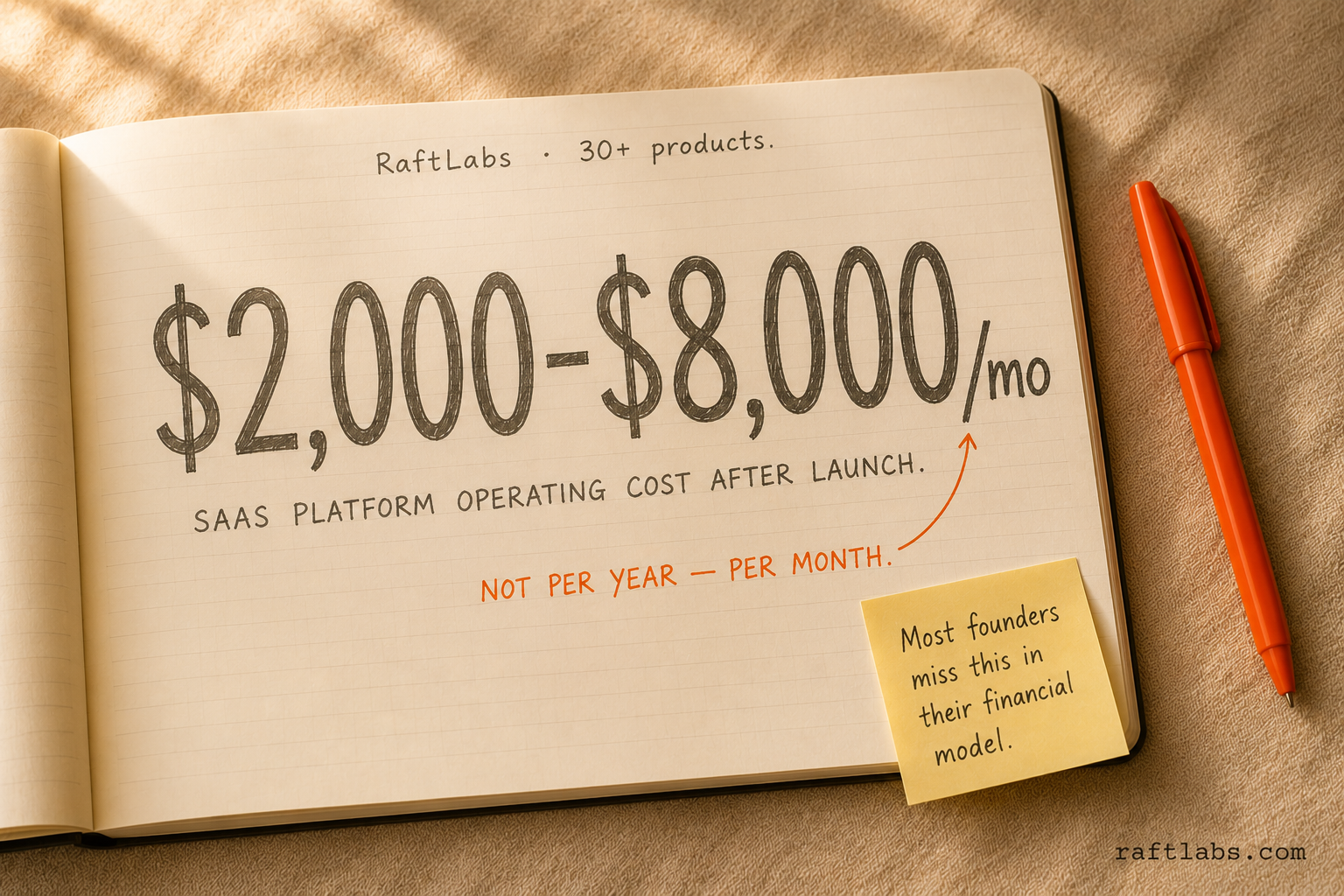
- Operating costs run $2,000-$8,000/month after launch, not per year. Most founders undercount this in their financial models, which creates a cash crisis 6 months post-launch.
Businesses today run on SaaS. An average company uses 112 SaaS applications. Most of them are tools they tolerate, not tools they chose. At some point, a founder does the math: the licensing fees, the workarounds, the features that almost fit. And realizes building their own platform makes more sense than paying for someone else's indefinitely.
That's the moment this article is for.
SaaS development cost varies more than most guides admit. A simple MVP and an enterprise platform are both called "SaaS" but they sit at opposite ends of a very wide cost range. What you spend depends on three things: how complex your feature set is, how many systems you're integrating, and whether you're building for web, mobile, or both.
This guide gives you real numbers by build tier, development phase, individual feature, and team type. RaftLabs has built 30+ SaaS products, and as an experienced SaaS application development company, the breakdown below reflects what those builds actually cost.
Who This Guide Is For
Founders evaluating whether to build a custom SaaS product or keep buying off-the-shelf tools
CTOs scoping a new platform and trying to pressure-test a quote they've received
Operators planning a budget and need to understand what post-launch costs actually look like
If you need the step-by-step on how to build a SaaS product, covering tech stack, architecture decisions, and team structure, see our SaaS app development guide. This article covers cost only.
What is a SaaS Application?
SaaS (Software as a Service) applications run on cloud servers and are accessed through a web browser. No download required. Updates happen automatically. The app works across devices and operating systems.
Common SaaS types:
CRM products
Project management tools
Collaboration tools
Fintech apps
Marketing software
ERP platforms
Vertical SaaS (industry-specific products)

The global SaaS market was valued at $317 billion in 2024 and is growing fast. With businesses relying on many tools simultaneously, many are realizing that building their own SaaS platform offers better control, tighter integration with internal systems, and new revenue opportunities. But the decision to build should follow clear cost understanding, not enthusiasm.
How Much Does It Cost to Build a SaaS Product?
Building a SaaS product with RaftLabs costs $10,000-$20,000 for an MVP and $20,000-$60,000 for a full-featured platform. Complex or AI-powered products are scoped on a custom basis, typically $120,000+.
| SaaS Platform Type | Features | Timeline | Cost Estimate | Examples |
|---|---|---|---|---|
| MVP | 1-2 core features, mobile and/or web app, simple design | 6-8 weeks | $10,000-$20,000 | Basic email marketing tool, simple invoicing app |
| Full-Featured Product | iOS + Android + web, multiple features, custom design, third-party integrations | 12-14 weeks | $20,000-$60,000 | Collaboration tool, customer support platform, cloud storage service |
| Innovative / Enterprise | AI, AR/VR, multi-platform, highly complex requirements | Varies | Custom quote ($120,000+) | AI-driven SaaS, enterprise sales assistant, multi-workspace product |
These are project-based prices from actual builds, not a generic market range. US and Western European agencies charge 3-6x more for the same output. The difference is team composition and delivery model: built from India, with the process and quality bar of an international product studio.
The number that shapes your budget most isn't the tier. It's which features are in scope on day one.
SaaS App Development Cost Per Feature
Understanding what each feature costs lets you sequence your roadmap by business value. Build high-ROI features first and defer expensive ones until the product is validated.
| Feature | Complexity | Estimated Cost (USD) |
|---|---|---|
| User registration + authentication | Low | $800-$2,000 |
| Admin dashboard | Low-Medium | $1,500-$4,000 |
| Subscription billing (Stripe integration) | Medium | $2,500-$5,000 |
| Role-based access control | Medium | $2,000-$4,500 |
| Email notifications + automation | Low-Medium | $1,000-$3,000 |
| Analytics and reporting dashboard | Medium-High | $4,000-$10,000 |
| Real-time collaboration (e.g., live editing) | High | $8,000-$20,000 |
| Payment gateway + multi-currency | Medium | $3,000-$7,000 |
| AI/ML feature (recommendations, predictions) | High | $10,000-$40,000+ |
| Third-party API integration (per integration) | Varies | $1,500-$6,000 each |
| HIPAA or GDPR compliance layer | High | $5,000-$15,000 |
| Multi-tenancy architecture | High | $8,000-$25,000 |
The pattern that most often surprises founders: features that touch payments, compliance, or real-time data cost 3-5x more than features that read and display static data. If your MVP spec has three high-complexity features, you're already in the $20,000-$40,000 range before the rest of the build.
Not sure how to scope your feature list? Start with a product discovery session. It's how vague briefs become accurate estimates. For a faster first pass, our software development cost calculator turns your feature and platform choices into a live cost range.
SaaS Development Costs by Phase
A full-featured SaaS build costs $20,000-$60,000 before launch and $2,000-$8,000/month to operate afterward.
| Development Phase | Activities | Timeframe | Estimated Cost |
|---|---|---|---|
| Discovery and Planning | Market research, competitor analysis, user persona building, feature listing, MVP roadmap | 2-3 weeks | $0-$4,000 |
| UI/UX Design | Wireframing, prototyping, user journey mapping, responsive design mockups | 2-4 weeks | $4,000-$12,000 |
| Frontend Development | Implementing UI, client-side logic, integrating with backend via APIs | 4-6 weeks | $10,000-$30,000 |
| Backend Development | Database architecture, APIs, business logic, authentication, role management | 5-8 weeks | $12,500-$40,000 |
| QA and Testing | Functional testing, performance testing, bug fixing, usability testing, UAT | 2-3 weeks | $4,000-$10,000 |
| Deployment | Hosting setup, domain, SSL, cloud configuration | 1 week | $500-$2,000 |
| Maintenance (Monthly) | Updates, monitoring, backups | Ongoing post-launch | $2,000-$8,000/month |
Total build cost across all development stages: approximately $20,000-$90,000+ depending on complexity.
SaaS Development Cost by Team Type
You have three options for the team that builds your product: in-house, freelancers, and an outsourcing agency. Each has distinct trade-offs.
| Developer Type | Who's Involved | Hourly Rate | Project Cost (Full-Featured SaaS) |
|---|---|---|---|
| Freelancers | Developer, Designer | $15-$60/hr | Unpredictable, depends on coordination |
| In-House Team | PM, Developers, QA, Designer | $80K-$150K/yr per person | $250K-$500K+ per year in team overhead |
| Agency (US/EU) | Full-cycle team | $150-$250/hr | $100,000-$300,000+ |
| RaftLabs | Full-cycle team + delivery | $35-$40/hr | $20,000-$60,000 |
Freelancers: The cheapest option with the highest coordination risk. Managing multiple freelancers across design, development, and testing creates delays, inconsistent code quality, and gaps in accountability. Works for simple, short-scope projects.
In-house team: Full control and long-term stability, but high cost. Developer salaries alone run $80,000-$150,000/year per person. Add benefits, office space, and infrastructure and a minimum viable engineering team costs $400,000-$600,000/year. Right if you plan continuous development and have the budget.
Outsourcing to an agency: Provides a structured approach with skilled developers, designers, testers, and project managers. Costs $20,000-$60,000 with RaftLabs at $35-$40/hr for a full-featured product versus $100,000-$300,000+ at US/EU rates. The same codebase, architecture, and delivery standard, at a different hourly rate.
Also check out: Top SaaS development companies and agencies
No-Code vs. Custom SaaS Development
This is the real decision before any pricing conversation.
| Approach | Upfront Cost | Monthly Cost | Ceiling | Best For |
|---|---|---|---|---|
| No-code (Bubble, Webflow, Glide) | $0-$5,000 | $50-$500/mo | ~5,000-10,000 users, standard logic | Validating an idea, pre-revenue |
| White-label / SaaS template | $5,000-$15,000 | $200-$2,000/mo | Limited by vendor architecture | Early-stage, standard use case |
| Custom SaaS (MVP) | $10,000-$20,000 | $2,000-$8,000/mo | Unlimited | Validated concept, product company |
| Custom SaaS (Full-Featured) | $20,000-$60,000 | $2,000-$8,000/mo | Unlimited | Market-ready product, integrations needed |
No-code is right when you're pre-revenue, your workflow is standard, and you need to validate before committing to a build. Bubble and Webflow can carry you a long way in the right market.
Custom is right when your product logic is non-standard, you need to own your data and architecture, you expect more than 5,000-10,000 users, or your competitive advantage lives inside the product itself.
The rebuild trap: Most founders who start on no-code and scale past 5,000 users face a complete rebuild. That rebuild costs as much as a custom build would have from the start, plus migration overhead for live data and a transition period that disrupts users. RaftLabs has this conversation before recommending any approach.
Key Cost Drivers
Five variables drive your SaaS development cost. Getting these right in your brief makes your quote accurate. Getting them wrong creates scope creep.
1. Feature Complexity
Feature complexity is the single largest cost variable. A basic MVP with user management and a dashboard ships in 6-8 weeks at $10,000-$20,000. Add real-time collaboration, AI recommendations, and custom analytics and you're looking at 12-14 weeks and $20,000-$60,000.
Every feature in your spec should be justified by a user need. That's how MVPs stay in budget.
2. UI/UX Design
UI/UX design accounts for roughly 15-20% of your development budget: $2,000-$6,000 at MVP tier, $4,000-$10,000+ for a full-featured product. The biggest driver isn't aesthetics. It's user flow complexity. A single-role product with linear workflows costs a fraction of a multi-role platform with conditional navigation, onboarding sequences, and custom dashboards per role.
Rushing design costs more in development rework than the time saved.
3. Development Team Location
Location is the most controllable lever in your SaaS development cost.
| Region | Average Hourly Rate | Cost for Medium Web App |
|---|---|---|
| USA | $150-$250/hr | $100,000-$300,000 |
| Western Europe | $80-$150/hr | $50,000-$150,000 |
| Eastern Europe | $40-$80/hr | $25,000-$60,000 |
| India/South Asia (low-cost) | $15-$25/hr | $10,000-$25,000 |
| India/South Asia (RaftLabs) | $35-$40/hr | $20,000-$60,000 |
| Latin America | $40-$80/hr | $25,000-$60,000 |
RaftLabs has built for clients in the US, UK, Canada, Ireland, and Australia for 9+ years. The codebase doesn't know where the developer is sitting.
4. Third-Party Integrations
Each integration adds $1,500-$6,000 to development cost, depending on the API's quality and your data sync requirements. A Stripe integration is straightforward: 2-3 days of work. A legacy ERP sync with a non-standard API can take 2-3 weeks on its own.
List every integration in your spec before you get a quote, or your estimate will be wrong.
5. SaaS Type
Different SaaS applications have different development requirements. Some integrate easily with standard components. Others require extensive custom development.
| Type of SaaS | MVP Cost at $35-$40/hr | Example |
|---|---|---|
| CRM | $20,000-$50,000 | Freshworks |
| Accounting | $30,000-$60,000 | Xero, QuickBooks |
| Email Marketing | $25,000-$50,000 | Mailchimp |
| Project Management | $25,000-$55,000 | Worx Squad, Confluence |
| MarTech | $35,000-$70,000 | HubSpot |
| ERP | $55,000-$100,000 | NetSuite |
| Visual Website Builder | $60,000-$100,000 | Weblium |
Ongoing Operating Costs After Launch
After launch, your SaaS platform costs $2,000-$8,000/month to operate, not per year. This is the number most founders get wrong when building their financial model.
What makes up that monthly figure:
Cloud hosting (AWS, GCP, or Azure): $300-$2,000/month depending on users, data volume, and traffic
Engineering maintenance: bug fixes, security patches, dependency updates, and minor iterations. Budget 10-20 hours/month minimum.
Infrastructure monitoring: uptime tools, error tracking (Sentry, Datadog). $100-$500/month.
Support tooling: Intercom, Zendesk, or similar. $100-$500/month depending on volume.
Third-party API usage: Stripe, SendGrid, Twilio. Budget 1-3% of revenue at early scale.
Security: penetration testing runs $3,000-$10,000 annually; compliance audits (SOC 2, HIPAA, GDPR) are additional
Operating cost by stage:
Early-stage (under 1,000 users): $2,000-$4,000/month
Growing stage (1,000-10,000 users): $4,000-$8,000/month
Scaling stage (10,000+ users): $8,000-$20,000+/month
The $500-$5,000/year figures that appear in some cost guides are wrong. Plan for monthly operating costs from day one.
AI SaaS Development: Additional Costs
For businesses building AI into their SaaS platforms, development costs increase significantly due to machine learning model complexity, data processing requirements, and infrastructure.
AI SaaS products cost $30,000-$150,000+ more than equivalent non-AI builds:
Basic AI feature (chatbot, simple classification): adds $10,000-$30,000 to the build
Predictive analytics or recommendation engine: adds $30,000-$80,000
Custom ML model with real-time data processing: adds $80,000-$150,000+
These are build costs only. AI features also carry higher ongoing operational costs. GPU compute, model hosting, and continuous training are expensive to run at scale.
What drives AI SaaS cost up specifically:
- Model complexity: Simple automation tasks cost significantly less than deep learning or real-time analytics
- Data collection and processing: AI needs large datasets for training. Gathering, cleaning, and processing that data adds time and cost.
- Infrastructure: AI applications require high-performance computing; the servers and GPUs cost more than standard SaaS infrastructure
- Continuous updates: AI models need regular retraining with new data to stay accurate. This ongoing optimization adds to monthly costs.
- Scalability and integration: AI-driven platforms must handle increasing data volumes as the user base grows
Also read: Innovative AI SaaS ideas for aspiring founders and startups.
Not sure which tier fits your product? Tell us what you're building and we'll scope it and give you a real number, not a range. Get in touch
Technical Debt: The Hidden Cost Multiplier
Technical debt accumulates when you ship fast without the right architecture: hardcoded business logic, no test coverage, monolithic structure that can't be modularized, database schemas that worked at 100 users and break at 10,000.
What it costs you:
A codebase built with moderate technical debt costs 30-40% more to modify than a clean codebase
At scale, technical debt makes simple feature additions take 3-4x longer than they should
Rebuilding from a debt-heavy codebase costs as much as the original build and sets your roadmap back 6-12 months
How to avoid it:
Define your architecture in discovery, not during sprints
Use modular, microservices-ready structure from day one, even if you start as a monolith
Require test coverage as a delivery condition, not an afterthought
Review code quality at 3-month intervals post-launch
RaftLabs starts every project with a technical architecture review in the discovery phase. It's the highest-ROI hour you can spend before development begins.
Pricing Models for Hiring a Development Team
When hiring a development agency, pricing typically comes in three structures:
Fixed-price contracts: Clear budget from day one, useful for smaller projects with a well-defined scope. If you change direction mid-project, expect additional charges or delays.
Time-and-materials: Flexibility to refine features as you go without renegotiating the entire contract. Costs can climb if you add features or change requirements frequently.
Dedicated team model: Developers, designers, and QA working like an in-house unit, strong for continuous development. The trade-off is a higher monthly outlay.
When to Hire a SaaS Development Agency
Hiring a SaaS development agency makes sense when:
You need a complete team rather than individual hires
Your budget doesn't stretch to full-time in-house salaries ($400,000-$600,000/year for a minimum viable engineering team)
You need to launch faster than hiring allows
Your project requires advanced tech (AI, compliance layers, complex integrations)
You want long-term support and maintenance without building an internal department
You need a cost-effective full team rather than managing multiple freelancers
Agencies provide a well-defined cost structure, a structured process, and clear accountability for delivery quality.
Real-World Examples: How Successful SaaS Products Controlled Costs
Dropbox: MVP-first approach
Started with a simple explainer video to test market demand before building anything. Focused on core file-sync functionality. Gained user interest before investing heavily in development. Dropbox's Q1 2025 revenue reached approximately $620 million. A result built on that early MVP constraint.
Slack: outsourced development
Outsourced much of its initial software development to a third-party agency. Saved on salaries, benefits, and infrastructure while focusing on growth. Slack was acquired by Salesforce for $27 billion in 2021.
WhatsApp: focused core features
Launched as a basic messaging app with no extras. Focused on essential features to reduce development costs. Added features gradually as the app gained traction. WhatsApp was acquired by Facebook for $19 billion in 2014.
The pattern across all three: start narrow, validate fast, add complexity only after core value is proven.
Why Founders Choose RaftLabs for SaaS Development
RaftLabs has built SaaS products and enterprise solutions across hospitality, loyalty, healthcare, and MarTech, for clients in the US, UK, Canada, Ireland, and Australia.
| What We Deliver | The Number |
|---|---|
| SaaS products shipped | 30+ |
| Years in product development | 9+ |
| MVP development price | $10,000-$20,000 |
| Full-featured product development price | $20,000-$60,000 |
| MVP delivery time | 6-8 weeks |
| Full-featured delivery time | 12-14 weeks |
| Developer hourly rate | $35-$40/hr |
| Clutch rating | 4.9/5 |
| GoodFirms rating | 5/5 |
| GDPR-compliant builds | Yes |
RaftLabs builds on solid architecture with clean APIs and dependable infrastructure. Every feature ties to a business goal. If an idea won't work, we say so before writing code.
If you want a specific estimate for your SaaS product, three questions determine 80% of the number: what are your must-have features on day one, how many third-party systems do you need to integrate, and do you need mobile (iOS/Android), web, or both?
5 Proven Ways to Reduce SaaS Development Cost
1. Start with an MVP
Focus on core features to validate your idea. MVP development cost is lower than a full product. Launch faster, gather feedback, and iterate based on real usage rather than assumptions.
2. Choose the right tech stack
Pick programming languages, frameworks, and cloud services that match your current needs and anticipated scale. Open-source tools and scalable cloud services reduce infrastructure expenses. A well-chosen SaaS tech stack prevents costly rewrites.
3. Outsource to a trusted partner
An in-house team costs $250,000-$500,000/year in team overhead. A trusted offshore agency delivers the same architecture at $20,000-$60,000 for the full build.
4. Use pre-built components and APIs
Instead of building from scratch, use pre-built solutions like Stripe for payments and Firebase for authentication. These components cut custom development time directly.
5. Plan scalable architecture from day one
Design for scale to avoid costly overhauls as you grow. Modular code, microservices-ready architecture, and cloud-native infrastructure reduce long-term cost.
Conclusion
Developing a successful SaaS product requires clear cost visibility before you commit. An MVP costs $10,000-$20,000 and ships in 6-8 weeks. A full-featured platform costs $20,000-$60,000 and ships in 12-14 weeks. Operating costs run $2,000-$8,000/month after launch.
The decision that matters most isn't the tier. It's what features are in scope on day one and whether the architecture will support your roadmap 18 months from now.
If you want to build a SaaS web, mobile, or AI application and need a real cost estimate based on your specific requirements, contact us and we'll scope it accurately.
Ask an AI
Get an instant summary of this post from your preferred AI assistant.
Common questions
- At RaftLabs, SaaS app development costs $10,000-$20,000 for an MVP and $20,000-$60,000 for a full-featured product. Complex or AI-powered platforms are scoped on a custom basis. These are project-based prices covering design, development, QA, integrations, and deployment, not just engineering hours. Plan for $2,000-$8,000/month in ongoing operational costs after launch.
- Five main drivers: feature complexity (each high-complexity feature adds $8,000-$20,000+ to the build), UI/UX requirements (multi-role platforms with complex flows cost significantly more than single-role products), development team location (RaftLabs at $35-$40/hr vs US agencies at $150-$250/hr), number of third-party integrations ($1,500-$6,000 each), and whether you need mobile apps (iOS + Android add cost by requiring separate or cross-platform codebases on top of the web app).
- Operating costs run $2,000-$8,000/month for most early-to-mid-stage products, not per year. Under 1,000 users: $2,000-$4,000/month covering cloud hosting, engineering maintenance, monitoring, and support tools. At 1,000-10,000 users: $4,000-$8,000/month. At 10,000+ users: $8,000-$20,000+/month. The biggest variables are cloud infrastructure (which scales with traffic and data volume), engineering hours for maintenance, and third-party API usage fees.
- No-code platforms (Bubble, Webflow, Glide) are right when you're pre-revenue, your workflow maps to standard templates, and you need to validate quickly. Setup costs $0-$5,000 plus $50-$500/month. Custom development is right when your product logic is non-standard, you need to own your architecture and data, you expect more than 5,000-10,000 users, or your competitive advantage depends on what's inside the product. The typical failure mode: starting on no-code, scaling past the platform's limits, then rebuilding at the same cost as a custom build would have been upfront, plus migration overhead.
- An MVP takes 6-8 weeks from kickoff to production launch. A full-featured product takes 12-14 weeks. The variable that most consistently extends timelines is integration complexity: a standard Stripe integration takes 2-3 days; a non-standard legacy ERP sync can take 2-3 weeks on its own. AI-powered builds vary significantly by scope and are typically scoped individually.
- The SaaS platform itself costs the same whether your company is in the US, UK, Australia, Canada, or Ireland. What changes is the team you hire. US and Western European agencies charge $150-$250/hr. A full-featured product at those rates runs $100,000-$300,000+. RaftLabs delivers the same architecture from India at $35-$40/hr, bringing the same build to $20,000-$60,000. We've served clients across all five markets for 9+ years.