Updated July 2026
MVP development: how much does it cost to build an MVP in 2026?
Discover what really drives MVP development costs, why most founders underbudget, and how smart scoping can save thousands while speeding up validation.

In this article
Short answer
MVP development costs $10,000-$20,000 for a simple single-platform product. Full-featured builds with multiple integrations run $20,000-$40,000. RaftLabs ships production-ready MVPs in 6-8 weeks at fixed pricing; AI or enterprise builds start at $40,000+.
Key takeaways
- Typical MVP budgets run $10,000-$20,000 for a simple single-platform product. Full-featured builds with multiple integrations run $20,000-$40,000. The biggest variable is feature scope, not team location.
- The hidden line items most founders miss: discovery ($2,000-$5,000), QA ($3,000-$8,000), and post-launch stabilization (15-20% of build cost). Quote-to-actual gaps are almost always these three.
- No-code tools (Bubble, Webflow) cut time and cost by 40-60% for simple validation but hit architecture walls at 10,000+ users or when complex custom logic is needed.
- Ruthless feature prioritization matters more than any other decision. If removing a feature still allows the core user action, it waits for v2. Most MVP specs include 3x more features than needed.
- The right development partner challenges product thinking, not just executes requirements. Teams that skip discovery spend $20,000-$60,000 building the wrong feature set.
A basic MVP costs between $10,000 and $20,000. A full-featured build with multiple integrations, custom design, and multi-platform support runs $20,000 to $40,000. Over 70% of startups now build an MVP before committing to full product development, and the teams that do it well spend carefully on the right things.
The real challenge isn't finding a number. It's understanding what drives the cost, which factors you control, and how to decide what belongs in version one. Teams that skip this clarity face two predictable problems: they underestimate the budget and run short before launch, or they add too many features and delay the validation they actually need.
Over nine years, RaftLabs has worked with businesses and product teams across many industries, building MVPs that range from simple booking platforms to complex marketplaces. In almost every early discussion, the question of cost comes up. The answer depends on several factors, many of which aren't obvious at the start.
Who should read this guide
This guide is for founders, product leaders, and decision-makers who are evaluating MVP development options and need realistic cost expectations before committing to a development partner.
Startup founders and entrepreneurs planning their first product launch, who need to understand how feature scope, technology choices, and team structure affect development costs.
CTOs and technical leaders evaluating build-vs-buy decisions, assessing development partner proposals, or building internal cost models while balancing technical quality with budget constraints.
Product managers responsible for defining MVP scope, prioritizing features, and justifying development budgets with data-backed cost breakdowns.
Early-stage investors and advisors analyzing startup budgets, evaluating development proposals, or advising founders on realistic MVP cost expectations.
Innovation leaders at established companies launching new product ideas, testing new markets, or building internal startup-style initiatives.
Operations and business leaders who lack a technical background but need clear explanations of what drives development costs.
What you'll find in this guide
This is a full breakdown of MVP development costs, structured to help you budget accurately and make informed decisions:
Transparent cost ranges from $10,000 to $20,000+ across different product tiers, including what's included at each level and how scope drives investment requirements.
Phase-by-phase investment breakdown across discovery, design, development, integration, testing, and deployment, showing where budget is spent and why early-phase investment reduces total project cost.
Regional cost variations across North America, Europe, India, and Southeast Asia, including hourly rate ranges and when each region makes strategic sense.
No-code vs custom development economics: a direct comparison including initial costs, long-term implications, and scalability.
Hidden costs most founders miss - staging environments, error monitoring, legal/privacy requirements, App Store fees, and more.
Build vs. buy decisions for specific MVP components: auth, payments, notifications, and when third-party services beat custom code.
Cost optimization strategies: practical guidance on reducing development costs without sacrificing quality.
A framework for evaluating development partners based on domain expertise, communication quality, development process, and long-term support.
Before covering cost estimates, it helps to understand what an MVP is and why accurate budgeting matters so much to its success.
What is an MVP and why cost estimation is critical
A Minimum Viable Product is the simplest version of your product that lets you test your core business hypothesis with real users. It contains only the essential features needed to deliver value and gather meaningful feedback. The emphasis is on "minimum" because every feature beyond what's necessary to validate your assumption increases both cost and time to market.
According to CB Insights, 35% of startups that fail cite "ran out of cash" as a primary reason. Most of them didn't run out of money because the market was wrong. They ran out because they built too much before validating anything. The MVP exists to prevent that.
"The goal of an MVP is to maximize learning per dollar spent, not to minimize the product. Teams that treat it as 'building a cheap version' usually build the wrong thing, just cheaper."
Eric Ries, author of The Lean Startup (Crown Business, 2011)
Cost estimation matters because most founders underestimate MVP development costs by 30 to 40 percent. They budget for development but forget discovery workshops, post-launch fixes, and the scope adjustments that emerge once technical work begins. They might assume the lowest bid equals the best value, or that an offshore team charging lower hourly rates will automatically save money.
That's rarely true. A poorly scoped MVP at a low hourly rate often costs more than a well-scoped build at a higher rate, because product clarity reduces rework, eliminates feature overload, and prevents expensive mid-project pivots that derail timelines and budgets.
How much does MVP development cost
MVP development costs anywhere from $10,000 to $50,000+, depending on the scope of features, the complexity of your business logic, the platforms you're building for, and the integrations your product requires.
Clutch's 2024 developer hiring survey found that the average SMB spends $75,000 on software development in a given year. For MVPs specifically, the range is tighter: most validated builds land between $15,000 and $35,000 once you factor in discovery and post-launch iteration. The table below shows typical cost ranges based on overall complexity and scope.
| App tier | Typical scope | Delivery approach | Estimated investment | Best fit for |
|---|---|---|---|---|
| Simple MVP | Core functionality with 1-2 features, simple design, clearly defined scope and timeline | Focused MVP with limited integrations, single platform (web OR mobile) | $10,000 - $20,000 | Single-feature products, concept validation, early-stage startups testing market fit |
| Medium complex MVP | Multiple core features, custom design, 3rd party integrations, tentatively defined scope | End-to-end development with system integrations, multi-platform support (web AND mobile) | $20,000 - $40,000 | Growing startups, products requiring deeper functionality, businesses ready to scale |
| Complex MVP | Highly complex requirements, bottom-up design with engaging animations, deep tech implementation (AR, VR, AI) | Custom architecture with advanced features, requires deeper problem validation | $50,000+ | Enterprise solutions, advanced technology products, complex AI/ML implementations |
Building a SaaS MVP introduces specific architectural decisions - billing logic, multi-tenancy, and role management - that affect which cost tier you land in, even at the MVP stage.
The above ranges reflect production-ready builds using professional engineering teams. The actual cost for your specific project depends on several factors we'll cover throughout this guide.
For a quick reference on standard project tiers, see our pricing. Or run your own feature list and platform choices through our software development cost calculator for a live estimate tailored to your MVP.
A basic MVP with core booking flow, user authentication, and a simple dashboard typically falls into the first tier. A product requiring multiple user roles, payment processing, real-time features, and mobile apps moves into the full-featured range.
Products involving AI capabilities, complex data processing, or innovative technology implementations require custom scoping.
The difference between these tiers isn't just feature count. It's the complexity of the business logic, the number of systems that need to communicate, the level of customization required, and the infrastructure needed to support the product reliably.
Not sure whether your product needs AI in version one? Our guide on how to build an AI MVP covers when AI belongs in the MVP and when it adds unnecessary cost and risk.
MVP development cost breakdown by phase
Understanding how costs spread across development phases helps you budget more accurately and spot where investment matters most. MVP development isn't a single activity - it's a series of connected phases, each with specific deliverables and cost implications.
Phase distribution overview
A mid-range MVP moves through seven phases from kickoff to production launch. Here's where time and budget go at each stage:

| Phase | Duration | Estimated cost |
|---|---|---|
| Discovery & scoping | 1-2 weeks | $0-$4,000 |
| UI/UX design | 1-2 weeks | $2,000-$6,000 |
| Frontend development | 2-3 weeks | $4,000-$10,000 |
| Backend development | 3-4 weeks | $6,000-$14,000 |
| Integrations | 1-2 weeks | $2,000-$6,000 |
| QA & testing | 1 week | $1,500-$3,500 |
| Deployment | 3-5 days | $500-$1,500 |
| Total | 6-8 weeks | $10,000-$20,000 |
Complete phase-by-phase cost breakdown
The table below shows typical cost ranges across each phase and where most of the budget goes:
| Phase | What's included | Typical cost range | Key deliverables |
|---|---|---|---|
| Discovery & planning | Business goals alignment, user journey mapping, feature prioritization, technical architecture planning, MVP scope definition | $1,000 - $2,500 | Product requirements document, user personas, feature prioritization matrix, technical architecture plan, project roadmap |
| UI/UX design | User experience design, visual interface design, interaction design, design system creation, prototype development | $1,500 - $3,000 | Wireframes, high-fidelity mockups, interactive prototype, design component guidelines, developer specifications |
| Frontend development | User interface build, design implementation, interactive elements, API integration, responsive design | $2,500 - $5,000 | Working user interface, responsive web/mobile app, integrated frontend components |
| Backend development | Database design, API development, business logic, basic authentication, integration layer | $2,500 - $5,000 | Functional APIs, database schema, basic authentication, core business logic |
| Third-party integrations | Payment gateways, email services, analytics platforms, essential third-party services | $1,000 - $2,000 | Connected external services, tested integrations, error handling, API documentation |
| Quality assurance & testing | Functional testing, bug fixes, performance testing, security assessment, cross-browser/device testing | $500 - $1,500 | Test reports, bug fixes, performance benchmarks, security assessment |
| Deployment & launch | Production infrastructure setup, security configuration, deployment, monitoring setup, documentation | $500 - $1,000 | Live production environment, monitoring dashboards, deployment documentation |
| Ongoing maintenance | Server monitoring, bug fixes, security patches, minor updates, technical support | $1,000 - $3,000/month | System health reports, resolved issues, applied updates |
Investing more in early phases typically reduces total project cost. Teams that budget properly for product discovery and planning avoid expensive mid-development rework when requirements become clear too late.
Thorough QA during development catches issues that would cost five to ten times more to fix in production. Phase costs aren't independent - each phase either reduces or compounds costs in the next, depending on how well it's executed.
Budget distribution by phase
| Development phase | % of total budget | Why this phase matters |
|---|---|---|
| Discovery & planning | 10-15% | Defines scope, prevents costly rework, clarifies requirements before code is written |
| UI/UX design | 15-20% | Creates user experience foundation, confirms usability, guides development work |
| Frontend & backend development | 50-60% | Builds core product functionality, implements business logic, creates user interfaces |
| Third-party integrations | 10-15% | Connects essential services, enables key features, extends product capabilities |
| QA, testing & deployment | 5-10% | Confirms reliability, catches bugs before users see them, prepares for production |
This distribution shifts based on project complexity. A simple web application with minimal integrations will spend less on the integration phase but potentially more on perfecting the core user experience. A complex marketplace connecting multiple user types may invest more heavily in backend architecture and integration work.
Ship your MVP in 6-8 weeks without cutting corners We've built production-ready MVPs for founders across industries. Fixed timeline, clear milestones, and a development process designed for fast validation. Let's discuss
MVP development cost by industry
The complexity tier table gives you a starting range. But two MVPs at the same tier can cost very differently depending on the industry, because compliance requirements, integration depth, and data sensitivity vary significantly across verticals.
Here's what typical first-version builds cost across the most common industries:
| Industry | Typical MVP cost (in USD) | What drives the cost |
|---|---|---|
| SaaS / B2B tool | $10,000-$20,000 | Auth, subscription billing, dashboard, role-based access |
| Marketplace / two-sided platform | $20,000-$40,000 | Dual user types, transaction logic, dispute handling, trust features |
| Healthcare & wellness | $25,000-$50,000+ | HIPAA compliance, secure data handling, EHR or wearable integrations |
| Fintech | $25,000-$60,000+ | PCI-DSS requirements, bank API integrations, fraud prevention logic |
| E-commerce | $15,000-$35,000 | Product catalog, cart, payment processing, inventory management |
| EdTech | $15,000-$30,000 | Content delivery, progress tracking, assessments, user roles |
| Hospitality & booking | $15,000-$30,000 | Availability logic, calendar management, PMS or channel integrations |
| Loyalty & rewards | $10,000-$25,000 | Points engine, receipt scanning, member dashboard, admin panel |
A few patterns worth noting:
Regulated industries - healthcare and fintech - consistently sit at the top of the range. Compliance isn't a feature you add. It's a constraint that shapes architecture, data handling, and testing depth from day one. Skipping it at the MVP stage doesn't save money; it creates expensive technical debt and legal exposure.
Marketplace products cost more than single-sided apps because you're building two complete user experiences - for the buyer and the seller - plus the trust and transaction infrastructure that sits between them. What looks like one product is structurally two.
Industries with high-frequency user interactions - food delivery, loyalty, booking - benefit from starting with a responsive web app rather than a native mobile build. It reduces initial cost by 30-40% and still covers the mobile use case without the overhead of two codebases.
If your product doesn't fit neatly into one category, map the compliance requirements and integration count before committing to a budget range. Those two variables will tell you more than any complexity tier.
What does an MVP cost to run after launch?
Most cost guides stop at deployment. This one doesn't - because the question founders consistently underestimate isn't how much it costs to build, it's how much it costs to keep running.
Once your MVP is live and users are interacting with it, you're carrying a monthly operating cost whether you're actively developing or not. Here's what that looks like in practice.
Cloud hosting and infrastructure
For an early-stage MVP with under 1,000 active users, cloud hosting on AWS, Google Cloud, or similar typically runs $100-$500 per month. This covers compute, storage, and basic bandwidth. The number scales with user volume, data processing requirements, and traffic spikes - a product with 10,000 active users costs meaningfully more to run than one with 500.
Engineering maintenance
Even a stable MVP needs ongoing attention: security patches, dependency updates, browser compatibility fixes, and the edge cases real users find that QA didn't. Budget a minimum of 10-20 engineering hours per month to keep a live product healthy. At $35-$40/hr with an experienced team, that's $350-$800/month at the low end.
Third-party service fees
Every integration you used in the build comes with its own cost structure post-launch. Stripe charges per transaction. SendGrid charges per email volume. Twilio charges per SMS. These start small and scale with usage - worth modelling against your expected user activity before launch so the number doesn't surprise you.
Monitoring and tooling
Error tracking (Sentry), uptime monitoring, analytics, and performance tools typically add $50-$300/month depending on what you're running and at what scale.
Feature iterations and bug fixes
Most MVPs go through one or two rounds of iteration in the first 90 days based on what real users do. This isn't optional - it's the point of building an MVP. Budget $1,500-$4,000/month for the first quarter post-launch if you're planning to act on feedback quickly.
The realistic all-in operating cost for an early-stage MVP:
| Stage | Monthly operating cost |
|---|---|
| Pre-traction (< 500 users) | $500-$2,000/month |
| Early traction (500-5,000 users) | $2,000-$5,000/month |
| Growing (5,000-20,000 users) | $5,000-$12,000/month |
The build cost is a one-time investment. Operating costs are recurring. Factor both into your runway calculations before you commit to a scope.
The hidden costs most founders miss
Vendors quote you a development number. That number rarely includes everything you actually need to launch and operate. Here are the costs that show up after the contract is signed.
Staging and dev environments
Production is where users go. You need at least one staging environment that mirrors production for testing before every release. Most cloud setups run a staging environment at 40-60% of the production cost. Add that to your infrastructure budget from day one - a $300/month production server typically needs a $150-$180/month staging server alongside it.
Error monitoring
Once users hit your MVP, you need to know when things break before they tell you. Sentry covers this for most stacks. The free tier works at low volume, but you'll likely hit its limits within the first month of real usage. Paid plans start at $26/month and scale with event volume. Datadog is more powerful but starts at $15/user/month - budget $100-$400/month for a small team once you need it.
Legal and privacy requirements
If your MVP collects any user data - even just an email address - you need a privacy policy. If you handle payments, you need terms of service. For GDPR compliance (any user in Europe), you need a cookie consent mechanism and a data processing agreement with each vendor. A basic legal setup from a template service like Termly or Iubenda runs $10-$50/month. Custom legal review from a lawyer runs $500-$2,000 one-time. Skip this and you're liable from day one.
App Store fees
Publishing on Apple's App Store costs $99/year (Apple Developer Program). The Google Play Store is a one-time $25 fee. These are small but often forgotten. Apple also takes 30% of in-app purchase revenue (15% for subscriptions after year one and for small businesses). If your monetization model relies on in-app purchases, model that commission into your unit economics before you launch.
Domain, email, and basic SaaS tooling
A custom domain is $10-$20/year. Professional email via Google Workspace runs $6/user/month. Analytics (Mixpanel, Amplitude, or Posthog) adds $0-$80/month depending on tier. None of these are expensive individually, but collectively they add $100-$300/month that founders often forget to include.
Build vs. buy: component-level decisions
One of the most important cost decisions in an MVP isn't the overall build - it's which individual components you build custom versus buy off the shelf. Get this wrong and you spend weeks of engineering time on infrastructure that has nothing to do with your product's unique value.
Authentication
Build it: 3-5 days of backend work, ongoing security maintenance, password reset flows, session management, OAuth integrations if needed.
Buy it (Auth0, Firebase Auth, Supabase Auth): 1-2 days to integrate, $0-$70/month depending on volume. Handles OAuth, MFA, passwordless login, and session management out of the box.
Verdict: Buy it. Auth is not your competitive advantage. Every day you spend building custom auth is a day not spent on your actual product. Use Auth0 or Supabase Auth for most MVPs. The only exception: heavily regulated industries where you need full audit logs and data residency guarantees that third-party providers can't give you.
Payments
Build it: Technically impossible without a payment processor. The real decision is how much payment logic you build on top of Stripe.
Buy it (Stripe): 1-3 days to integrate basic checkout. Stripe handles PCI-DSS compliance, fraud detection, international currencies, and refund logic. Transaction fees: 2.9% + $0.30 per charge.
Verdict: Use Stripe. Building a payment processor from scratch would cost $100,000+ and take months. Even custom billing logic (subscriptions, usage-based pricing, multi-currency) is better handled by Stripe Billing than by home-built code.
Email and notifications
Build it: An SMTP server that delivers email reliably is harder than it looks. Deliverability, spam filters, and DNS configuration take real expertise.
Buy it (SendGrid, Postmark, AWS SES): $0-$20/month for most MVP volumes. Handles deliverability, bounce handling, unsubscribe management, and email templates.
Verdict: Buy it. SendGrid's free tier covers 100 emails/day. AWS SES is $0.10 per 1,000 emails once you're outside the free tier. Custom SMTP servers are a maintenance burden with no upside.
For push notifications (mobile): Expo Notifications for React Native apps, or Firebase Cloud Messaging for native apps. Both are free at MVP scale.
File storage
Build it: Storing files on your app server introduces reliability problems, backup complexity, and scaling pain.
Buy it (AWS S3, Cloudflare R2): $0.023/GB for S3. Cloudflare R2 has no egress fees, making it cheaper for most workloads. 1-2 days to integrate.
Verdict: Buy it. Object storage is a solved problem. Never store user uploads on your application server.
Search
Build it: Basic database search with LIKE queries works up to a few thousand records. Anything more complex needs proper indexing.
Buy it (Algolia, Typesense, Meilisearch): Algolia starts at $0.50/1,000 search operations. Typesense and Meilisearch are open-source and self-hosted, adding infrastructure cost but reducing per-query fees.
Verdict: For most MVPs, use database full-text search first. It's free and handles a surprising amount of load. Only move to a dedicated search service when database search becomes a bottleneck - which won't happen at MVP scale for most products.
MVP development cost by location and team structure
Where your development team is located significantly affects cost. The same project can cost three to four times more in North America than in India or Eastern Europe, without necessarily compromising quality.
| Region | Hourly rate range | Basic MVP cost | Best for |
|---|---|---|---|
| North America | $80 - $150 | $40,000 - $80,000 | Complex compliance, regulated industries, real-time collaboration needs |
| Western Europe | $60 - $120 | $30,000 - $60,000 | GDPR-focused products, European market targeting |
| Eastern Europe | $40 - $80 | $20,000 - $40,000 | Quality-cost balance, startup budgets |
| India & Southeast Asia | $25 - $55 | $10,000 - $25,000 | Cost-conscious projects, well-defined requirements |
The right regional choice depends on your specific project requirements:
North America works well for products requiring deep domain expertise in highly regulated industries (HIPAA, SOC 2), real-time collaboration, or when proximity for in-person meetings adds significant value. The higher cost is justified when domain knowledge or regulatory expertise significantly affects project success.
Western Europe is a good choice for products requiring GDPR compliance from day one, teams seeking European market expertise, or those wanting to balance cost with cultural and time zone proximity to North American markets.
Eastern Europe has become popular for startups seeking quality development at controlled costs. This region offers experienced developers with strong English skills and familiarity with Western business practices.
India and Southeast Asia work best when requirements are well-defined upfront, the project has minimal ambiguity requiring constant clarification, asynchronous communication is acceptable, and cost control is a primary concern.
The real cost of time zone differences
Large time zone gaps slow communication. When developers wait for feedback or clarification, progress pauses - increasing the total hours needed to complete the work. Coordinating teams across different time zones can also require more project management and documentation, adding overhead.
Lower hourly rates don't always produce lower overall project costs. Projects with clear requirements and well-defined scope reduce coordination overhead and make offshore development more cost-effective.
What factors drive MVP development costs?

1. Feature complexity and scope
Not all features cost the same to build. A simple contact form requires a few hours of development work. A real-time collaborative editing feature similar to Google Docs can take weeks. The complexity of your core features directly affects your development cost.
Feature complexity comes from several sources. The most common is business logic: how intricate are the rules governing how a feature behaves? A simple discount code that takes 10 percent off an order is straightforward. A dynamic pricing system that adjusts prices based on demand, inventory, user history, and competitive factors is complex.
Data model complexity also affects costs because complex relationships between different types of data require careful database design, more sophisticated queries, and additional testing. A blog with posts and comments has a simple data model. A multi-sided marketplace with users, listings, transactions, reviews, disputes, and permission structures has a complex data model.
User interaction complexity matters too. Features requiring real-time updates, drag-and-drop interfaces, or complex workflows take longer to build than standard forms and lists. Integration complexity increases when features need to communicate with multiple external systems or process data from various sources.
2. Platform requirements
The platforms you choose to support significantly affect development costs. A web application costs less to build than native mobile apps for iOS and Android, because you're building and maintaining one codebase instead of two or three.
Web-only MVPs typically cost 30 to 40 percent less than products requiring both web and mobile apps. That doesn't mean web-only is appropriate for every use case. If your target users primarily interact with your product on mobile devices, skipping mobile to save money may hurt adoption and validation results.
Cross-platform frameworks like Flutter or React Native offer a middle ground. They let you build iOS and Android apps from a single codebase, reducing costs compared to native development while still delivering mobile experiences. Cross-platform development typically costs 20 to 30 percent less than building separate native apps.
For a full cost breakdown of platform, features, and team location, read our article on mobile app development cost.
3. Design requirements
Design costs vary based on the level of customization your product requires. Using standard UI components costs less than creating completely custom interfaces. Simple, clean designs typically cost less than designs with custom animations or complex data visualizations.
The design spectrum ranges across several levels:
Template-based design: uses pre-built UI components with minimal customization. Fastest and lowest cost.
Standard custom design: includes brand colors, typography, and a few custom UI components while relying on common design patterns.
Advanced custom design: adds custom illustrations, branded visual elements, and moderate animations.
Premium design: includes extensive custom graphics, complex animations, and highly detailed interactive experiences.
For most MVPs, standard custom design provides the best balance. You can add visual polish after validating that users find value in your core offering.
4. API integration and third-party services
The number and complexity of integrations your MVP requires directly affects development cost. Each integration needs configuration, testing, error handling, and ongoing maintenance. Simple integrations with well-documented APIs cost less than complex integrations with legacy systems or services that have poor documentation.
Standard integrations like Stripe for payments, SendGrid for email, or Google Maps for location services are straightforward. These services provide clear documentation, SDKs, and active developer communities. Custom integrations with proprietary systems or legacy enterprise software require significantly more development time.
Integration costs also depend on how frequently your application needs to exchange data with external systems. Real-time integrations requiring webhooks or continuous synchronization cost more than integrations that work with occasional batch updates.
5. Team location and structure
Software development hourly rates vary significantly by geography. A development team in North America typically charges $80 to $150 per hour. Eastern European teams charge $40 to $80 per hour, while teams in India or Southeast Asia charge $25 to $55 per hour.
Hourly rates don't tell the complete cost story. A team charging higher rates with deep experience in your specific domain can often deliver a better product faster than a less expensive team that needs to learn as they build.
In many cases, the most efficient approach is a mixed team structure: senior engineers or architects handle system design, key technical decisions, and complex integrations, while mid-level developers focus on building features and routine development tasks. This provides the expertise needed for critical decisions while controlling overall costs.
If you're looking for a structured team rather than coordinating individual contractors, you can hire MVP developers who cover the full build - discovery to launch - as a single engagement.
Senior oversight where it counts, efficient execution everywhere else Senior engineers make critical decisions. Mid-level developers deliver features. You get quality without the all-senior price tag. Let's talk
6. Technology stack choices
Your technology stack affects both initial development costs and long-term maintenance costs. Popular, well-supported technologies generally cost less to build with because developers are more readily available and there are more resources for solving common problems.
Mature technology stacks like React, Node.js, Python, and PostgreSQL have large developer communities, extensive documentation, and proven patterns for common use cases. Newer or more specialized technologies may require more experienced developers and longer development cycles, increasing costs.
The technology stack should match your product's requirements rather than following trends. A simple news website doesn't need a complex microservices architecture. A high-traffic real-time application benefits from technologies designed for that use case.
7. Security and compliance requirements
Security requirements can significantly affect MVP development costs, especially for products that handle sensitive data or operate in regulated industries. Healthcare applications must comply with HIPAA regulations. Financial platforms must meet PCI-DSS requirements for handling payment data. Products serving users in Europe must follow GDPR guidelines.
Meeting these requirements affects several technical decisions during development. Teams must design secure data storage, implement strong access controls, maintain audit logs, and establish proper data handling processes. Developers also need to create documentation and safeguards that demonstrate compliance if the product is reviewed by regulators or auditors.
Security and compliance work often adds additional effort during development. Depending on the industry and the level of regulation involved, compliance-focused development can increase MVP costs by roughly 15 to 25 percent.
8. Testing and quality assurance depth
The level of testing your MVP requires affects cost. Basic functional testing confirms features work as designed. More thorough testing includes edge case testing, security testing, performance testing under load, accessibility testing, and cross-browser compatibility testing.
Products where errors have serious consequences - like healthcare applications or financial tools - require more extensive testing than products where occasional bugs are inconvenient but not critical.
The right testing level balances cost with risk. An MVP doesn't need the same testing rigor as a mature product serving millions of users, but it needs enough testing to avoid embarrassing failures or security vulnerabilities when early users start interacting with it.
No-code/low-code vs custom development
No-code and low-code platforms promise faster, cheaper development by eliminating or reducing the need for traditional coding. Understanding when these tools make sense - and when custom development is worth the investment - helps you make the right technology choices for your MVP.
Direct comparison
| Factor | No-code/low-code platforms | Custom development |
|---|---|---|
| Initial cost | $5,000 - $12,000 for basic apps | $10,000 - $20,000+ depending on complexity |
| Development time | 2-4 weeks typical | 6-8 weeks typical |
| Cost savings vs custom | 40-60% lower initial investment | Baseline (100%) |
| Technical skills required | Minimal coding knowledge needed | Professional developers required |
| Customization depth | Limited to platform capabilities | Complete flexibility |
| Scalability | Platform-dependent limits on users, data, features | Scales based on infrastructure investment |
| Performance optimization | Limited control, platform-dependent | Full control over optimization |
| Integration options | Restricted to platform connectors | Any integration possible |
| Ownership | Platform-dependent, subscription model | Full code and data ownership |
| Vendor lock-in | High - difficult to migrate away | None - complete portability |
| Ongoing costs | $50-500/month platform fees + per-user costs | $200-1,500/month hosting + optional maintenance support |
Platform capabilities and limitations
| Platform type | Examples | Best use cases | Key limitations |
|---|---|---|---|
| No-code | Bubble, Webflow, Airtable | Simple CRUD apps, internal tools, basic workflows, landing pages | Data volume caps, limited custom logic, performance constraints, integration restrictions |
| Low-code | OutSystems, Mendix, Retool | Business process apps, admin panels, moderate complexity tools | Some coding still needed, platform learning curve, cost scales with users |
| Custom development | React/Node.js, Flutter, etc. | Unique products, complex features, high-scale applications, specific integrations | Higher initial cost, longer development time, requires dev team |
Choose no-code/low-code when:
You need to validate basic assumptions quickly - speed to market beats flexibility for initial validation. If you need to test whether users want your core offering within weeks rather than months, no-code platforms deliver that speed advantage.
Your product fits platform capabilities well. When your MVP needs common functionality like forms, basic workflows, or simple data management, you avoid reinventing solved problems.
You're comfortable with platform limitations - your current and future roadmap aligns with what the platform can do.
Speed matters more than customization - getting to market in weeks justifies future constraints.
You're building internal tools or prototypes - internal tools can tolerate limitations that customer-facing products cannot.
Limited technical resources are available - non-technical team members can build and maintain the product.
Choose custom development when:
Your product has unique requirements - platform constraints would limit core functionality. When your value proposition depends on features or workflows that don't fit standard platform patterns, custom software development gives you the flexibility to build exactly what users need.
You need complete feature control - your roadmap requires flexibility that low-code platforms can't provide.
You're planning significant scale - when user volume or data needs exceed platform limits. Most no-code platforms have usage tiers that become expensive or restrictive at scale.
Complex integrations are required - your product must connect with legacy systems, proprietary APIs, or services without pre-built platform connectors.
You want to avoid vendor lock-in - platforms can change pricing, deprecate features, or be acquired.
Performance is critical - if your product requires sub-second response times, real-time data processing, or complex calculations, custom development lets you optimize in ways platforms restrict.
Some teams use no-code platforms for initial validation, then rebuild with custom development once product-market fit is proven. This approach works when the no-code prototype validates demand quickly, you have runway to fund a proper rebuild, and you treat the no-code version as a throwaway validation, not a production foundation.
The risk: rebuilding takes as long as custom development would have initially. You lose momentum during the rebuild, and users experience disruption during the transition. Factor these costs into your decision if considering a hybrid approach.
What does it cost to build an AI MVP?
AI features appear in more MVP briefs than ever. But the cost implications are often misunderstood. AI isn't a single line item. It's a set of decisions about models, data, infrastructure, and ongoing operations that each carry their own price tag.
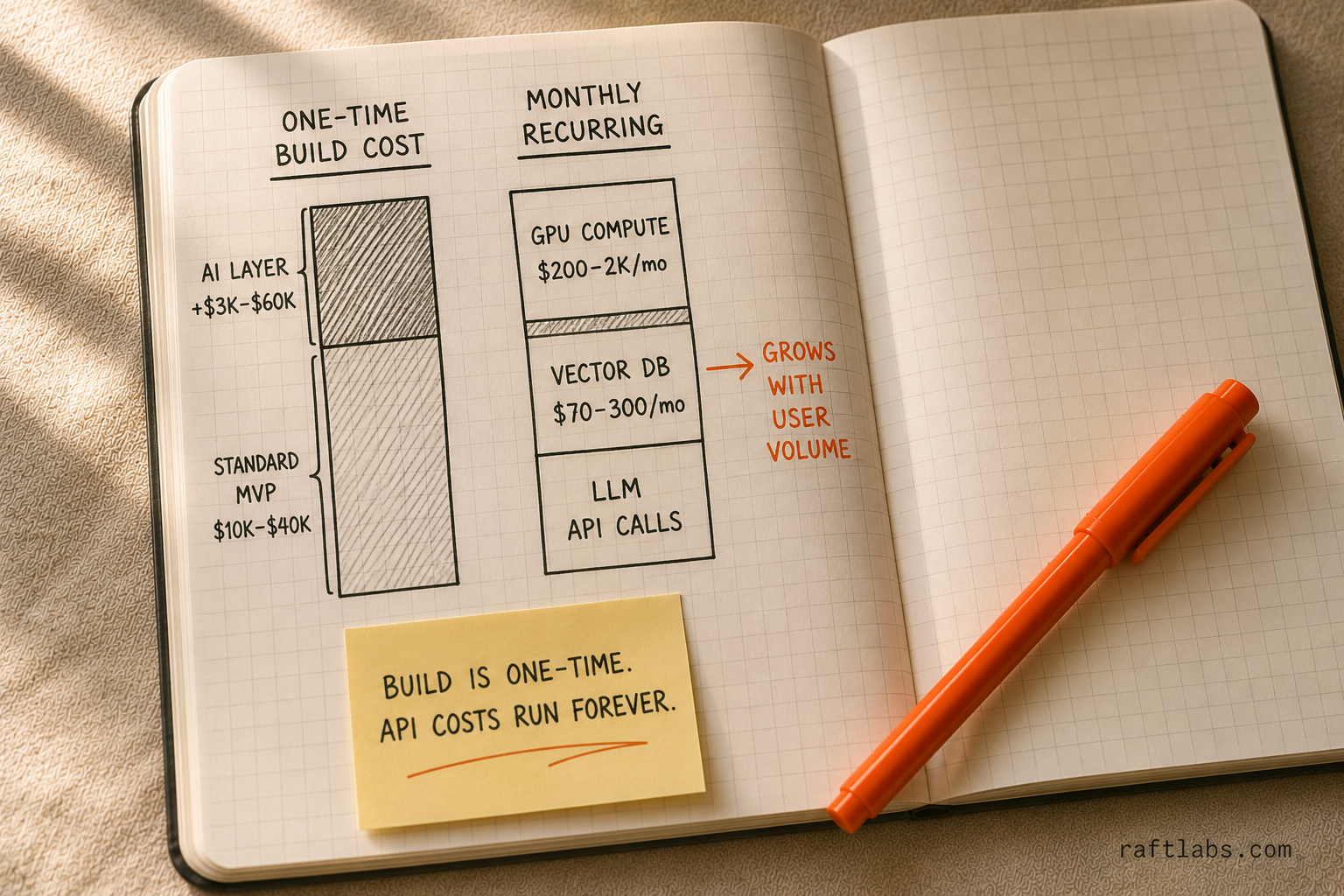
Here's what AI adds to your MVP build cost. The range is wide because "AI" covers very different things:
| AI capability | What it involves | Typical cost addition |
|---|---|---|
| LLM integration (GPT-4o, Claude, Gemini) | API calls, prompt engineering, response handling | $3,000-$8,000 |
| RAG pipeline (search over your own documents or data) | Vector database, embedding pipeline, retrieval logic | $8,000-$20,000 |
| Custom ML model (predictions, classification, recommendations) | Data preparation, model training, evaluation, serving | $20,000-$60,000+ |
| AI chatbot or conversational interface | NLP integration, conversation flow, fallback logic | $5,000-$15,000 |
| Computer vision / OCR (image or document processing) | Model selection, validation logic, edge case handling | $10,000-$30,000 |
These costs sit on top of your standard MVP build. A $15,000 web MVP with an LLM integration layer might cost $20,000-$25,000 total. A marketplace with a custom recommendation model might cost $60,000-$80,000.
What AI adds to your ongoing operating costs
This is the number most founders miss. AI features are expensive to run, not just to build.
LLM API calls (OpenAI, Anthropic, Google) typically cost $0.002-$0.06 per 1,000 tokens depending on the model. At low usage, that's negligible. At scale - thousands of user queries per day - it becomes a meaningful line item.
A product with 500 active users each making 10 AI-assisted queries per day can easily generate $200-$800/month in API costs alone before any other infrastructure.
Vector databases (Pinecone, Weaviate, Qdrant) add $70-$300/month depending on index size and query volume. GPU compute for custom model inference adds $200-$2,000+/month depending on whether you need real-time or batch processing.
When AI belongs in the MVP and when it doesn't
Include AI in your first version when: the core value proposition only works with AI (a document analysis tool without AI isn't the product), the competitive differentiation is the AI behavior itself, or you have enough structured data to make the AI component meaningful from day one.
Defer AI to phase two when: the core workflow can be validated without it, you're still learning what data your users will generate, or the AI component requires training data you don't yet have.
The most expensive AI MVP development mistake is building a custom model before validating that users want the core product. Start with an API-based integration - it costs less and ships faster - and move to custom models once you have the usage data to justify the investment.
For a full walkthrough of how to approach AI MVP development, see our AI MVP development guide.
How to decrease MVP development cost without sacrificing quality
Reducing MVP development costs requires strategic choices, not corner-cutting. The goal is to build the smallest version that validates your core hypothesis, not to build a cheap product that fails to test your assumptions properly.

1. Start with ruthless feature prioritization
Every feature you build costs money to develop, test, deploy, and maintain. The fastest way to reduce costs is to reduce scope.
Use the MoSCoW method to organize and prioritize features when planning your MVP. This framework helps teams decide what truly needs to be in the first release and what can wait.
The method groups features into four clear categories:
Must-have: core features required for the product to function. Without them, the MVP can't deliver its basic value to users. A booking platform must allow users to search availability and complete a booking.
Should-have: features that improve the product experience but aren't strictly required for the first release. The MVP can still function without them, but they add noticeable value once included.
Could-have: optional enhancements that can make the product more polished or convenient. Typically added only if time and budget allow after the core features are complete.
Won't-have (for now): features intentionally postponed for future versions. Identifying them early helps teams stay focused on validating the core idea rather than overbuilding the first version.
Be honest about what belongs in "must-have." If your MVP can validate its core assumption without a feature, that feature doesn't belong in version one. Add it after validation, when you better understand whether users actually want it.
2. Use existing solutions for non-core features
Don't build what you can buy - especially for features that aren't central to your value proposition. Authentication, payment processing, email delivery, file storage, and analytics are solved problems with excellent third-party services. (See the "Build vs. buy" section above for component-level guidance.)
Building custom authentication saves money initially but costs more long-term through maintenance, security updates, and the opportunity cost of not focusing on your core product. Using Firebase Auth or Auth0 costs $25 to $100 per month but eliminates development time that could go toward differentiating features.
The same applies to payments, email, and other commodity features. Use Stripe instead of building payment processing. Use SendGrid instead of building an email system. Use AWS S3 for file storage.
3. Choose the right platform approach
Building native iOS and Android apps from the start costs more than building a responsive web application. If your users can accomplish their goals through a web interface, start there. Add mobile apps after validating that users want them enough to download an app.
When mobile apps are necessary, consider cross-platform development with Flutter or React Native. You'll build one codebase instead of two, reducing both initial development cost and long-term maintenance. Cross-platform frameworks have matured significantly and deliver good user experiences for most use cases.
Reserve native development for products that truly need platform-specific features or performance characteristics that cross-platform frameworks can't deliver.
4. Optimize team structure and location
Hiring a senior developer in North America for every role is expensive. Structure your team strategically, using senior expertise where it matters most and more junior or offshore resources where appropriate.
A well-structured team might include a senior architect for system design and complex features, mid-level developers for core functionality, and junior developers for routine work like UI implementation or test writing. This approach can reduce costs by 30 to 40 percent while maintaining quality through senior oversight.
If you're looking for a structured team rather than coordinating individual contractors, a reputed offshore team with wide experience in MVP development handles this well.
5. Delay optimization and scaling work
MVPs don't need to support millions of users on day one. Build for your expected early user volume, which is likely hundreds or thousands of users, not millions. Optimize performance when actual usage justifies it, not based on theoretical future scale.
This doesn't mean building poorly. It means making practical infrastructure choices for your current needs rather than over-engineering for hypothetical scale. You can add caching, load balancing, and database optimization when real performance data shows they're needed.
6. Implement progressive enhancement
Instead of building all features at full polish, implement core functionality first and add polish in subsequent iterations. A feature that works reliably is more valuable than a feature that looks perfect but ships weeks later.
This also lets you test features with real users before investing in refinement. You may discover that a feature needs different polish than you anticipated, or that users don't value the feature enough to justify the refinement investment.
7. Use agile development with clear milestones
Agile development with two-week sprints and working software deliveries every sprint helps you see progress, catch issues early, and make informed decisions about scope adjustments. This transparency prevents costly surprises late in the project.
Clear milestones with go/no-go decisions let you pause or adjust the project if early feedback suggests your assumptions were wrong. Discovering you're building the wrong thing after 4 weeks is much cheaper than discovering it after 12 weeks.
8. Build modular architecture
Modular architecture means designing your application as a set of smaller, independent components instead of one tightly connected system. Each module handles a specific responsibility - authentication, payments, notifications, or data processing.
This approach can cost slightly more during the initial development phase because it requires clearer system design. But it significantly reduces future development costs. When components are loosely connected, developers can modify, replace, or scale individual modules without affecting the entire system.
MVPs evolve quickly. User feedback often reveals that certain features need to expand while others need to change or be removed. With modular architecture, teams can update one part of the system without rewriting large portions of the product, making future improvements faster and less expensive.
How to scope your MVP to control costs
Proper scoping is the most effective cost control mechanism available. A well-scoped MVP clearly defines what you're building, why you're building it, and how you'll measure success. Poor scoping leads to scope creep, rework, and budget overruns.
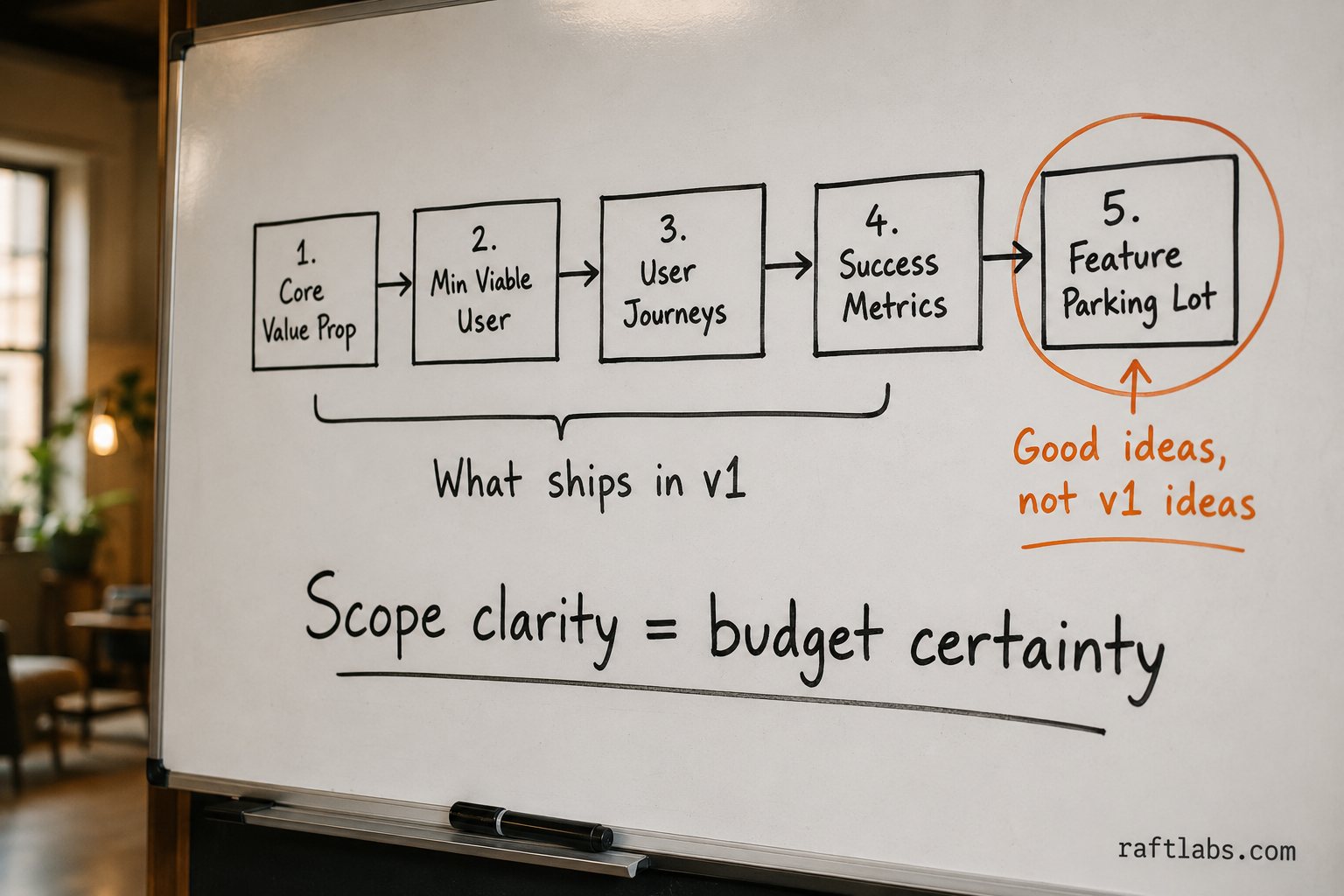
Define your core value proposition
Your MVP exists to test one core assumption about your business. Everything else is secondary. Start by articulating this assumption clearly. Not "users want our product" but "busy professionals will pay $15 per month to have their calendar automatically optimized based on priorities they set once."
This level of specificity clarifies what you must build versus what you could build. Your MVP might need automatic calendar optimization and priority-setting features. But it might not need social sharing, team collaboration, or calendar analytics, even though those might eventually add value.
Identify your minimum viable user
Your MVP doesn't need to serve everyone who might eventually use your product. It needs to serve one specific user segment well enough to validate whether they find value in your core offering.
Choose the user segment most likely to adopt your product, experience the core value proposition most clearly, and provide meaningful feedback. Building for this focused segment costs less than trying to accommodate multiple user types from day one.
Map essential user journeys
Document the critical paths users must complete to experience your core value. For a marketplace, this might include seller onboarding, listing creation, buyer search, purchase completion, and review submission. Each step needs to work reliably, but none needs extra polish or optional features.
Mapping these journeys explicitly helps you identify what's truly necessary versus what's nice to have. For example, you might need search functionality. But you don't need advanced filters, saved searches, or AI-powered recommendations in your MVP unless they're central to your value proposition.
Set clear success metrics
Define how you'll know whether your MVP validates your assumptions. Specific metrics might include the number of active users in the first month, conversion rate from signup to first core task completion, retention rate after first use, or willingness to pay for premium features.
These metrics guide feature prioritization. Build features that directly affect your success metrics and defer features that don't. This clarity prevents scope expansion based on ideas that don't directly test your core hypothesis.
Create a feature parking lot
Great ideas will emerge during development. Capture them in a feature parking lot - a list of ideas that might be valuable but aren't necessary for MVP launch. This list acknowledges good ideas without derailing your timeline or budget to implement them immediately.
After launch, user data and feedback will reveal which parking lot features actually matter. Many features that seemed essential during planning turn out to be unnecessary once real users interact with the product.
Common MVP cost mistakes and how to avoid them
These patterns emerge consistently across failed or over-budget MVP projects.
Mistake 1: Building too much too soon
The most common and expensive mistake is building more features than necessary to test your core hypothesis. Founders confuse "viable" with "impressive" and build products designed to wow investors or compete with mature products rather than validate fundamental assumptions.
This manifests as including every feature competitors offer, building extensive user management before you have users, implementing complex reporting before you have data worth reporting, or adding social features because modern apps have them, not because they're necessary for validation.
Each additional feature increases development time by days or weeks, creates testing burden, adds maintenance complexity, and delays launch.
Mistake 2: Underestimating integration complexity
Founders often treat integrations as simple add-ons when they're actually complex technical challenges. Connecting to payment processors, CRM systems, or industry-specific APIs requires more than dropping in an SDK. Each integration needs configuration, error handling, testing, security review, and monitoring.
This appears when founders budget development time for core features but not for integrations, assume all APIs are equally easy to work with, or skip integration during MVP planning with plans to "add it later."
Avoid this mistake by listing all required integrations during scoping, asking developers to estimate integration work separately from feature work, and prioritizing integrations with good documentation and support.
Mistake 3: Choosing technology based on trends
Technology choices should be based on your requirements, not on what's currently popular or what the development team wants to learn. Using the wrong technology stack makes development slower, more expensive, and harder to maintain.
This appears when founders choose trendy technologies without understanding trade-offs, select technologies that don't match their scale or complexity, or pick stacks based on developer interest rather than project needs.
Avoid this mistake by asking developers to justify technology choices against your specific requirements, preferring proven technologies over newer options for MVPs, and understanding that boring, mature technology often delivers better outcomes than exciting, new technology.
Mistake 4: Skipping user research and testing
Building without user input leads to products that don't match what users actually need or want. Early user research and testing reveal whether you're solving a real problem in a way that resonates with your target market.
This manifests as building based entirely on founder assumptions, skipping user testing before launch, or launching without any user validation of core features.
Avoid this mistake by conducting user interviews before building, testing prototypes with representative users, and incorporating user feedback throughout development. Even 5 to 10 user interviews can reveal critical insights that prevent expensive mistakes.
Mistake 5: Inadequate post-launch planning
Many founders focus entirely on getting to launch and neglect planning for what comes after. MVPs need ongoing iteration based on user feedback, bug fixes for issues users discover, and performance optimization as usage grows.
This appears as no budget for post-launch development, no plan for gathering and incorporating user feedback, or no monitoring to detect issues users encounter.
Avoid this mistake by budgeting for at least 2 to 3 months of post-launch support, planning how you'll gather and prioritize user feedback, and establishing monitoring to detect issues proactively.
Choosing an MVP development partner: beyond hourly rates
The cheapest vendor rarely delivers the best value. Choosing an MVP development partner requires evaluating expertise, process, communication, and cultural fit alongside cost.
The wrong partner wastes money regardless of their hourly rate. The right partner delivers value that justifies their cost.
1. Evaluate MVP-specific experience
Not all development firms understand the MVP mindset. Some approach every project as if it needs enterprise-grade scalability and features from day one. Ask potential partners about their MVP philosophy.
Ask how they handle feature prioritization, scope definition, and situations where user feedback suggests pivoting.
Look for partners who actively push back on unnecessary features, who can articulate trade-offs clearly, and who focus on validation speed rather than building impressive demos. Review their portfolio for MVPs that launched quickly rather than complex products that took months.
2. Assess technical evaluation capabilities
Your development partner should evaluate your requirements technically and provide honest feedback about what's feasible, what's risky, and what alternatives might serve you better. Ask candidates to review your product concept and identify potential technical challenges or alternative approaches.
Strong technical partners will raise concerns about unclear requirements, suggest simpler alternatives for complex features, or recommend phased approaches for risky technical bets. Vendors who accept every requirement without question either don't understand the challenges or plan to discover them on your budget.
3. Review their development process
Understand how your partner structures development work. Do they use agile sprints with regular deliverables? How do they handle scope changes? What does their communication cadence look like? How do they check quality?
Look for structured processes that include regular demos, transparent progress tracking, clear change request procedures, and built-in testing. Avoid partners who can't articulate their process clearly or who suggest figuring it out as they go.
4. Understand contract and payment structure
Payment structure affects both your risk and theirs. Fixed-price contracts transfer risk to the vendor but can lead to corner-cutting if the scope isn't perfectly defined. Time-and-materials contracts keep vendors honest about effort but shift budget risk to you.
Milestone-based contracts often provide the best balance. Payment is tied to deliverables like completed design, working prototype, core feature implementation, and final delivery. This structure aligns incentives and provides natural checkpoints for evaluating progress.
5. Check references and case studies
Ask for references from clients who have built similar products. Not just any references - specifically from MVP projects in your industry or with similar technical requirements. Ask references about communication quality, how the partner handled unexpected challenges, whether the project stayed on budget and schedule, and whether they'd work with the partner again.
Review case studies for realistic project timelines, clear before-and-after results, and honest discussion of challenges encountered. Be skeptical of case studies that make everything sound effortless or that lack specific details about outcomes.
6. Watch for red flags
Certain warning signs suggest you should look elsewhere: vendors who won't commit to timelines or budgets, who promise unrealistic delivery speeds, who can't explain their development process clearly, who don't ask questions about your business goals, who suggest building everything at once rather than phasing features, or who have portfolios showing only complete products rather than MVPs.
Trust your instincts. If a vendor's communication style doesn't match your needs during sales, it won't improve during development.
How to read a vendor quote intelligently
When a vendor sends you a proposal, most founders look at the bottom line first. That's a mistake. The number only makes sense in context.
Here's how to evaluate any MVP development quote:
Check what's explicitly excluded. A $15,000 quote that excludes discovery, design, and QA isn't $15,000 - it's $15,000 plus whatever those phases cost. Ask for a line-by-line breakdown. Any vendor unwilling to provide one is hiding something.
Ask how they handle scope changes. Every MVP changes during development. Ask: "If we add or change a feature mid-build, how does that get priced?" A vendor who can't answer this clearly will surprise you with change-order bills later.
Look at the hourly rate and team composition. A $15,000 quote at $150/hr is 100 hours of work. A $15,000 quote at $50/hr is 300 hours. Both can be reasonable or unreasonable depending on what's in scope. What matters is whether the estimated hours are realistic for the work described.
Ask who is actually building it. Some agencies sell on senior talent and deliver with juniors. Ask specifically: who will be the lead engineer on this project? What's their experience level? Can you speak with them before signing?
Check the payment schedule. A vendor asking for 50-70% upfront has less incentive to deliver once they have your money. A milestone-based payment schedule - tied to specific deliverables - aligns incentives and gives you checkpoints to evaluate progress before releasing the next payment.
Verify post-launch support terms. Ask: "What happens if we find bugs in the first 30 days after launch?" The answer reveals whether you're buying a product or a relationship.
What an MVP development partner should cover
RaftLabs has built MVPs for startups, enterprises, and agencies across SaaS, healthcare, marketplaces, media, and more. Over 11 years of experience helps us avoid common pitfalls and bring proven solutions to your product. Our work spans multiple industries, from loyalty platforms to AI-powered applications, giving us a practical perspective on what actually drives successful validation.
1. Fixed cost, clear expectations
We provide fixed pricing at the proposal stage. Your project doesn't expand because we "discovered complexity" weeks into development. If scope changes, we communicate immediately and agree on adjustments before implementing them.
This transparency gives you budget certainty and eliminates billing surprises.
2. Speed without shortcuts
Our process delivers working MVPs in 6 to 8 weeks for standard projects. We move quickly from idea to launch through clear scoping, experienced teams, and proven development workflows. Speed comes from efficiency and expertise, not from cutting corners or skipping necessary steps.
3. Direct access to your team
Your project lead is available on Slack with same-day responses. You communicate directly with the people building your product, not through account managers or project coordinators. When decisions need to be made, you hear about them within hours, not days.
4. Transparent, milestone-based process
We work in two-week sprint cycles with staging environment access after every sprint. You see working software every two weeks, not just at the end of the build. Milestone-based payments mean you control spend throughout the project, with natural checkpoints for evaluating progress.
5. Built to evolve
We don't build throwaway MVPs. The codebase is structured so your first engineering hire can understand and extend it. The architecture scales when usage justifies it without requiring complete rewrites. You launch with a foundation that grows with your business.
6. Honest technical guidance
We push back on unnecessary features and suggest simpler alternatives when they'll serve you better. Our value comes from helping you build the right thing efficiently, not from maximizing billable hours. If your MVP doesn't need a feature, we'll tell you.
7. Industry-specific experience
We've worked across hospitality, loyalty programs, healthcare, SaaS platforms, and media applications. This breadth of experience means we've likely solved challenges similar to yours before. We bring relevant patterns and practices rather than learning on your budget.
8. Post-launch support
Eight weeks of post-launch support make sure you have experienced help when early users expose edge cases or when you need quick improvements based on feedback. We don't disappear after launch when you need us most.
9. Proven track record
Our Clutch rating of 4.9 out of 5 reflects consistent delivery for clients across the US, UK, Ireland, and Europe. We've built products for brands like Aldi, Energia, and many startups that have successfully raised funding after launching their MVPs.
MVP development costs depend on several factors: feature scope, platform requirements, integrations, design complexity, and the structure of the development team. The typical range of $10,000 to $20,000 or more reflects these variables rather than a fixed price.
Understanding these cost drivers helps founders make better decisions about where to invest and where to control scope. The goal isn't to build the cheapest product - it's to build the right product that validates your core idea quickly while staying within a realistic budget.
A well-planned MVP, built with clear priorities and the right development approach, reduces unnecessary rework and helps teams move faster toward product-market validation.
If you're planning an MVP and want to understand what it might cost for your specific idea, talk to our team to get started.
Ask an AI
Get an instant summary of this post from your preferred AI assistant.
Common questions
- MVP development costs typically range from $10,000 to $40,000 depending on scope, features, and complexity. A basic MVP with core functionality and limited integrations costs $10,000 to $20,000. A full-featured product with multiple integrations, custom design, and multi-platform support costs $20,000 to $40,000. Complex products involving AI, advanced technology, or extensive custom development require custom quotes, often starting at $40,000 and going significantly higher based on specific requirements.
- MVP development costs include discovery and planning, UI/UX design, frontend and backend development, third-party integrations, quality assurance and testing, deployment, and initial post-launch support. Additional costs may include ongoing hosting and infrastructure, third-party service subscriptions, maintenance and updates, and marketing and user acquisition. Understanding what's included in quoted prices helps you compare vendors accurately and avoid surprise costs.
- Most MVPs take 6 to 12 weeks from kickoff to launch, depending on scope and complexity. A basic MVP with clearly defined features can launch in 6 to 8 weeks. Timeline depends heavily on how well-defined your requirements are at project start and how quickly you can provide feedback during development.
- A prototype is a clickable simulation that demonstrates how a product will look and flow but doesn't actually function. It's useful for testing user experience and gathering early feedback without writing production code. An MVP is working software that real users can interact with in real scenarios. It handles real data, processes real transactions, and operates on production infrastructure. Prototypes cost less and build faster but can't validate whether users will actually use your product in real situations.
- Start with ruthless feature prioritization, focusing only on what's essential to test your core hypothesis. Use existing solutions for commodity features like authentication, payments, and email rather than building custom versions. Choose one platform initially rather than building for web and mobile simultaneously. Consider cross-platform development for mobile apps instead of building separate native apps. Most importantly, invest in proper discovery to avoid building the wrong thing, as rework is far more expensive than getting it right from the start.