MVP Development for Startups: Launch Smarter in 2026
Discover how real startups use focused MVPs, AI-accelerated builds, and smart funding to validate ideas fast, avoid costly mistakes, and impress investors.

In this article
Short answer
MVP development for startups is the process of building the smallest functional product that tests a core business hypothesis with real users. A focused startup MVP takes 8-12 weeks and costs $8,000-$50,000 depending on complexity. It covers one core user workflow end-to-end, nothing else. CB Insights found that 43% of startups fail by building products nobody needs. RaftLabs consistently delivers production-ready startup MVPs in 6-8 weeks starting from $8,000, across AI, loyalty, and hospitality verticals.
Key takeaways
- CB Insights found 43% of startups fail by building products nobody needs. An MVP prevents this by generating real user evidence before you commit full budget.
- Low-fidelity MVPs (landing pages, Wizard of Oz, fake door tests) validate demand cheaply before writing code. Most founders skip these and overspend on the wrong features.
- Scope is the single most abused variable. Most MVP specs include 3x more features than needed. The test: if removing a feature still lets the user complete the core action, it waits for v2.
- AI tools (Cursor, GitHub Copilot) reduce MVP development time by 30-50% on greenfield code but require senior review on auth, payments, and data-handling paths.
- Successful MVP examples (Spotify, Instagram, Groupon) all validated one narrow value proposition with a deliberately limited first version before scaling anything.
According to CB Insights, 43% of startups fail because they build something people don’t actually need. It is not because of bad code or poor design, but because the product itself has no real demand. MVP development is meant to solve this by helping teams test ideas early before investing too much time and money.
An MVP, or Minimum Viable Product, changes the equation entirely. Instead of spending 12 months building a product in isolation, an MVP development for a startup gets wrapped up in 6 to 8 weeks. You can then put it in front of real users, and let the market tell you what to do next. Spotify didn't launch a global music platform on day one. They shipped a desktop app to a few thousand invited users in Sweden and used that signal to build everything that came after.
Groupon didn't build a marketplace. They started with a WordPress blog and manually emailed PDF coupons to 500 (tentative) subscribers in Chicago.
If you’re working with limited runway and an unproven idea, this is where you start. The guide covers what an MVP actually is, the nine-step process from problem definition to soft launch, how to build MVP step by step, and what the process realistically costs in 2026.
What Is an MVP for a Startup?
MVP development for startups starts with a simple idea: build the smallest version of your product that delivers real value to a specific user and generates the feedback you need to decide what to build next. That's it. Not the cheapest version. Not a half-finished prototype. A deliberate, intentional product that answers one question: Does this idea actually solve a problem people will pay for?
For startups, the definition matters more than it does for established companies. A large enterprise can afford to iterate slowly. A startup with 12 months of runway cannot. Every week you spend building features nobody asked for is a week closer to shutting down.
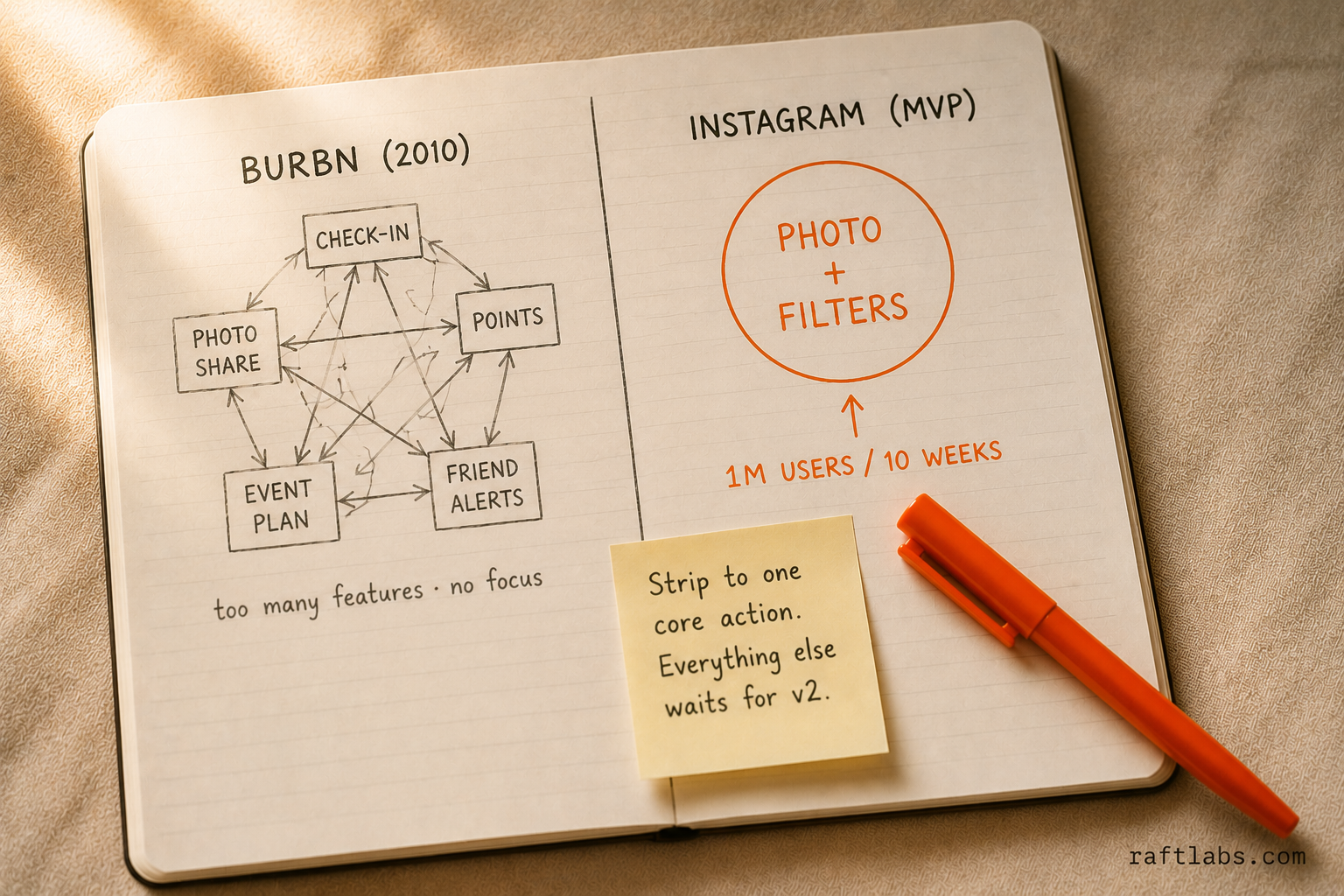
Let’s take the example of Instagram. Kevin Systrom originally built an app called Burbn in 2010. It was a location check-in app with photo sharing, points, and event planning built in. Too many features, too little focus. After analyzing actual user behavior, Systrom and co-founder Mike Krieger found that users only engaged with one thing: taking photos and polishing their images.
They stripped everything else out and relaunched as Instagram with just a photo feed and a handful of filters. It launched in October 2010. It had 1 million users within 10 weeks and was later acquired by Facebook for $1 billion.
So here the lesson is: Ship the smallest thing that proves the hypothesis, collect a real signal, and use that signal to build the right next version.
For software startups specifically, this means building one core user workflow end to end, making it work reliably for a small set of real users, and measuring whether they come back. An MVP app development for startups doesn't need onboarding flows, settings pages, or a mobile app on day one. It needs to do the one thing your target user actually needs.
What separates an MVP from a proof of concept (POC) is user exposure. A POC is an internal technical test. An MVP goes to real users and collects real behavior data. Most startups skip from idea to full product, bypassing both. That's the misstep this guide is built to prevent.
With a clear understanding of what an MVP does, let’s look at the practical advantages it gives startups in real scenarios.
As a startup if want to build MVP the right way, efficiently and without costly missteps, our MVP software development services provides expert guidance and hands-on support an built the product tailored as per the requirement.
Benefits of MVP Development For Startups
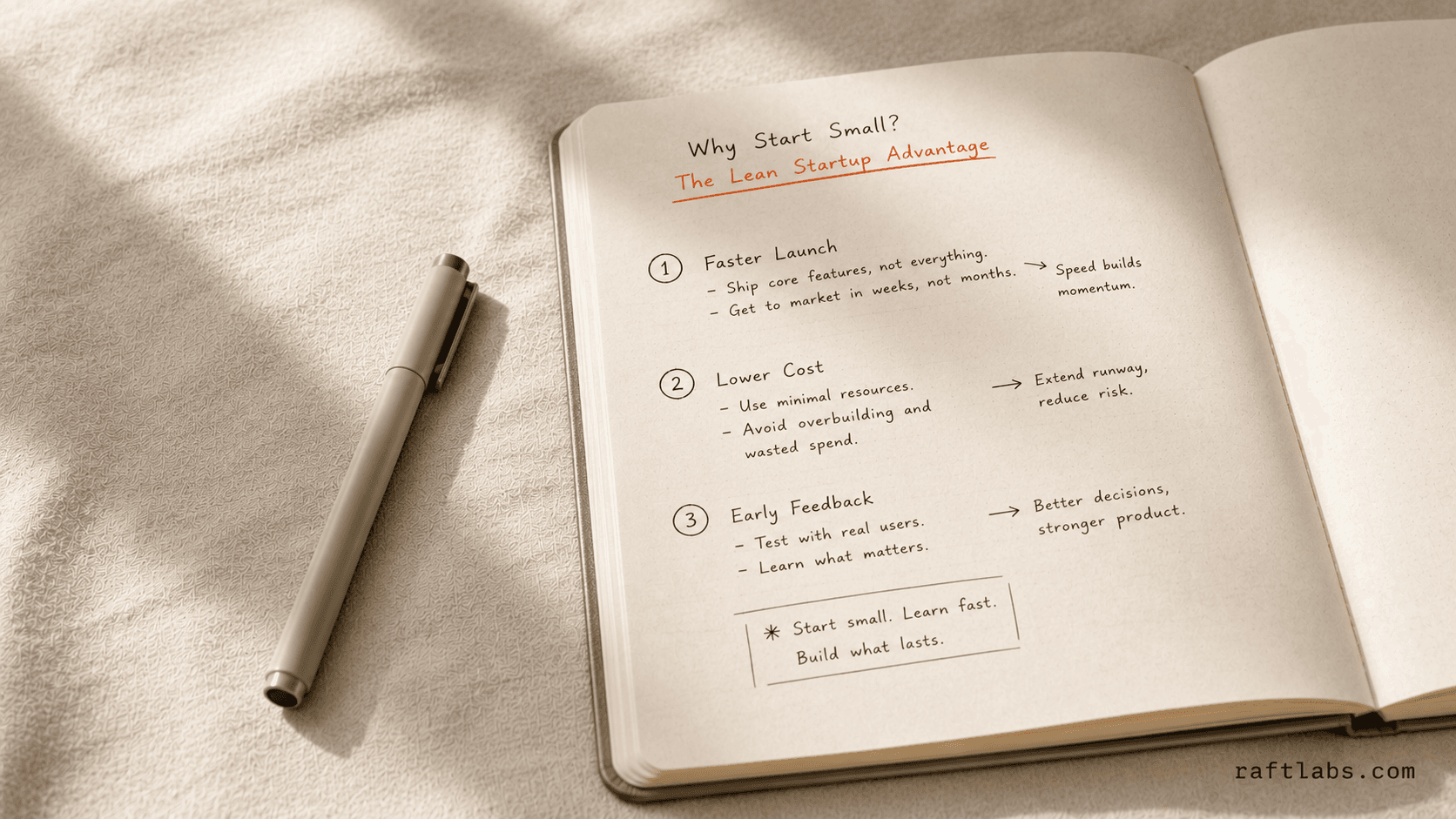
MVP product development for startups isn't just a development choice. For startups, it's a survival strategy. Here's what it actually gives you.
1. Preserve runway for what matters
The average seed-stage startup has 12 to 18 months of capital. A full product build can consume six months or more before a single paying user validates the idea. MVP development compresses that to 6 to 8 weeks. You spend $10K to $20K+ learning what the market wants, instead of $200K+ building what you assumed it wanted.
2. Get investor-ready traction faster
Investors don't fund ideas. They fund evidence. An MVP gives you usage data, retention numbers, and early user feedback, all of which are the raw material for a fundable narrative. Startups that launch an MVP before their seed round can have a significantly higher rate of closing investment than those pitching on wireframes alone.
3. Validate the actual user persona, not the assumed one
Most founders have a clear mental model of who their user is. Most of those models are partially wrong. MVP development forces early-stage product validation for startups by putting a real product in front of real people. You'll find out within weeks whether you're solving the right problem for the right person, before you've sunk $100K into the wrong architecture.
4. Test monetization before architecture is locked
Changing your pricing model after building a complex billing system costs weeks of engineering time. Changing it after an MVP costs a single conversation. Startup MVP development lets you test whether users prefer a subscription, a per-use fee, or a freemium tier before you've committed to any of them at the infrastructure level.
5. Reduce the risk of over-engineering early
The instinct to build for scale before you have users is one of the most expensive mistakes a startup can make. Multi-tenancy, advanced RBAC (Role-Based Access Control), real-time sync, microservices architecture. These are all valid at scale. At pre-product-market fit, they're runway killers. MVP discipline forces you to build only what's necessary to validate the hypothesis.
6. Create a feedback loop before the market changes
Most startup ideas exist within a window. Build too slowly, and a competitor will close it. MVP development gives you a working product in the market while the window is open, and real feedback to iterate with. That's the lean startup methodology in practice. Test fast, learn fast, adjust fast.
7. Make hiring decisions with evidence
Early-stage founders often debate whether to hire a full-time CTO or work with an agency. An MVP gives you a codebase reality. After 6-8 weeks with an MVP development company, you know the tech stack, you have user data, and you can write a job description for exactly the kind of engineer your product needs. That's a better position than hiring speculatively before the product exists.
Getting these outcomes depends on selecting the right type of MVP based on what you are trying to validate.
Types of MVPs for Startups
Not every MVP development for a startup project involves writing software. The right type depends on what you're trying to validate and how much time and money you can spend doing it.
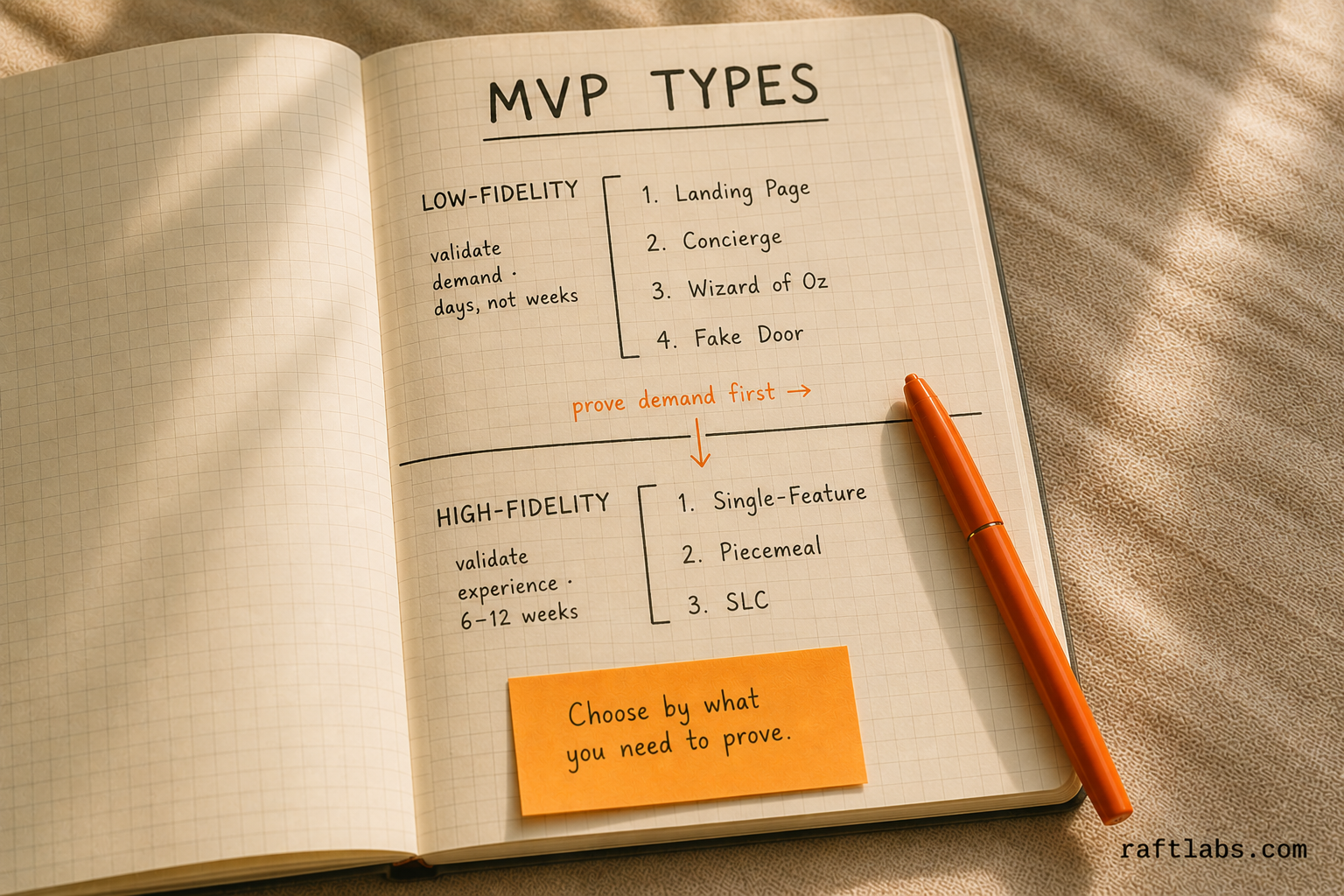
1. Low-Fidelity MVPs
Low-fidelity MVPs validate demand without building a real product. They're fast, cheap, and effective for early hypothesis testing.
1.1. Landing Page MVP
You build a single-page website describing your product, include a sign-up or waitlist form, and run paid traffic to it. If 15% or more of visitors sign up, you have a signal worth building on. Spotify used an invite-only landing page to build its early waitlist and gauge demand before its desktop product was ready for wider distribution.
1.2. Concierge MVP
You deliver the product experience manually behind the scenes, as if you were the software. Zappos founder Nick Swinmurn didn't build a warehouse or inventory system. He photographed shoes at local stores, listed them online, and bought and shipped them manually when orders came in. This proved purchase intent before he built anything.
1.3. Wizard of Oz MVP
Similar to a concierge MVP, but here the product appears fully automated to the user. Behind the scenes, a human is actually handling the work manually. This allows you to test the experience without investing time in building the full technology.
This approach is common in early AI product validation, where the “AI” is often a human analyst in the beginning. It helps you understand if users trust the output and find value in it before building complex models. It also gives clear insight into what level of accuracy and speed users actually expect.
1.4. Fake Door MVP
You add a feature to an existing product or website with a "coming soon" or sign-up gate. It looks real from the outside, but the feature is not actually built yet.
When users click on it or try to access it, you track their interest through sign-ups or click-through rates. This helps you understand if the demand is real before investing time and effort into development. It’s a quick way to validate ideas. You can also collect emails or early feedback, which helps in shaping the feature before you start building it.
Low-fidelity MVPs cost almost nothing to build and can generate a signal in days. They can be the right starting point when your core assumption is about whether demand exists, not about whether the product works.
2. High-Fidelity MVPs
High-fidelity MVPs are working software products with a limited feature set. They're appropriate when you need to validate the product experience itself, not just whether demand exists. Use these when a low-fidelity approach has already confirmed interest, or when the product experience is the hypothesis you're testing.
The difference between a high-fidelity MVP and a full product isn't quality, it's the scope. The code should be clean, scalable, and deployable in production. Here, the feature set is intentionally constrained to the one workflow that validates your core hypothesis.
There are three distinct types of high-fidelity MVPs worth knowing, because each one implies a different build decision, timeline, and cost profile.
2.1. Single-Feature MVP
You build exactly one complete user workflow end-to-end and nothing else. One problem. One solution. One measurable outcome. This is the most common type of high-fidelity MVP and the right default for most early-stage startups. Instagram's relaunch as a photo-only app after stripping Burbn is the clearest example.
The discipline is holding the line on scope: if a feature doesn't directly enable the core workflow, it waits. Single-feature MVPs are thus the fastest to build, cheapest to iterate on, and easiest to get a clear signal from because user behavior isn't split across multiple workflows.
2.2. Piecemeal MVP
Instead of building custom software from scratch, you stitch together existing third-party tools to simulate a working product. Stripe handles payments. Airtable acts as your database. Typeform collects user input. A simple frontend ties them together. The user experience feels like a real product.
The backend is mostly SaaS tools on a free tier. This approach works well when your core value is in the workflow or process you're enabling, not in proprietary technology. It gets you to a testable product in days rather than weeks, and it costs almost nothing to stand up.
The trade-off: Piecemeal MVPs hit hard limits fast. As soon as volume or data complexity grows, the duct-tape architecture breaks. So, plan to rebuild the backend once you've validated the workflow.
2.3. SLC MVP (Simple, Lovable, Complete)
The SLC framework, coined by Jason Cohen (founder of WP Engine), argues that an MVP shouldn't just be functional. It should cover one user journey from start to finish and feel polished enough that users want to come back. Simple means no unnecessary features.
Lovable means the experience is good enough to generate organic word-of-mouth. Complete means the core workflow has no broken edges or dead ends that force a user to abandon the session. The distinction from a Single-Feature MVP is intentional UX quality. You're not just testing whether the feature works.
You're testing whether users find it good enough to return without being nudged. This type costs slightly more and takes a week or two longer to build, but it produces cleaner retention data because users aren't leaving due to rough edges you could have fixed.
Got an idea? Let's scope your MVP in one call. We'll tell you what your MVP should include, what it shouldn't, and what it'll cost before you commit to anything. Book a free scoping call
How AI Is Changing MVP Development for Startups Today
The tools available for startup MVP development have changed significantly in the last two years. AI isn't replacing developers, but it's compressing timelines in ways that matter for early-stage startups.
On the development side, AI coding assistants like GitHub Copilot and Cursor have increased developer throughput by 20 to 40% on standard tasks like boilerplate code, unit tests, and API integrations. For a startup building an AI MVP the real speed advantage. A feature that would have taken two days to scaffold in 2022 often takes one day today.
For product discovery, AI tools are accelerating the user research synthesis phase. You can interview 20 early users, paste the transcripts into an AI analysis tool, and get a structured summary of the top pain points and themes in minutes rather than days. That's useful at the "define the problem" stage of early-stage product development.
AI is also changing what startups include in their MVPs. In 2024, a startup that wanted AI-powered features needed to hire ML engineers or spend months on custom model training. In 2026, LLM API integration through OpenAI, Anthropic, or Google Gemini is a standard development task that takes days, not months.
A startup building an AI-powered content tool, automated customer support layer, or intelligent data classifier can now ship that capability as part of its initial MVP build. LLM API costs usually run $0.01 to $0.10 per interaction and can be built into unit economics from day one.
For automated testing, AI tools are generating test cases from code, flagging edge cases, and reducing QA cycles. A manual QA process that previously took two weeks can now be handled in three to four days with AI-assisted testing coverage.
The important caveat: none of this changes the fundamentals of why MVP development for startups works. AI doesn't tell you what problem to solve. It doesn't validate that the problem is real. It doesn't make a bad business hypothesis into a good one. It makes the execution phase faster, which means that founders who've done the problem definition work correctly get to market significantly faster in 2026.
Draftly, a LinkedIn writing assistant we built, integrated LLM-based content generation as a core MVP feature using OpenAI, Claude, and Gemini depending on the task. The AI layer wasn't the hard part. The hard part was getting the content quality, user voice calibration, and workflow right for a very specific target user.
That's the distinction that matters: AI handles the generation, but product decisions determine whether users come back. That's the 2026 reality. AI makes good startups faster, but it doesn't rescue bad ideas.
Now that we understand how AI impacts speed and execution, let’s look at the step-by-step process behind building a successful MVP.
MVP Development Process for Startups
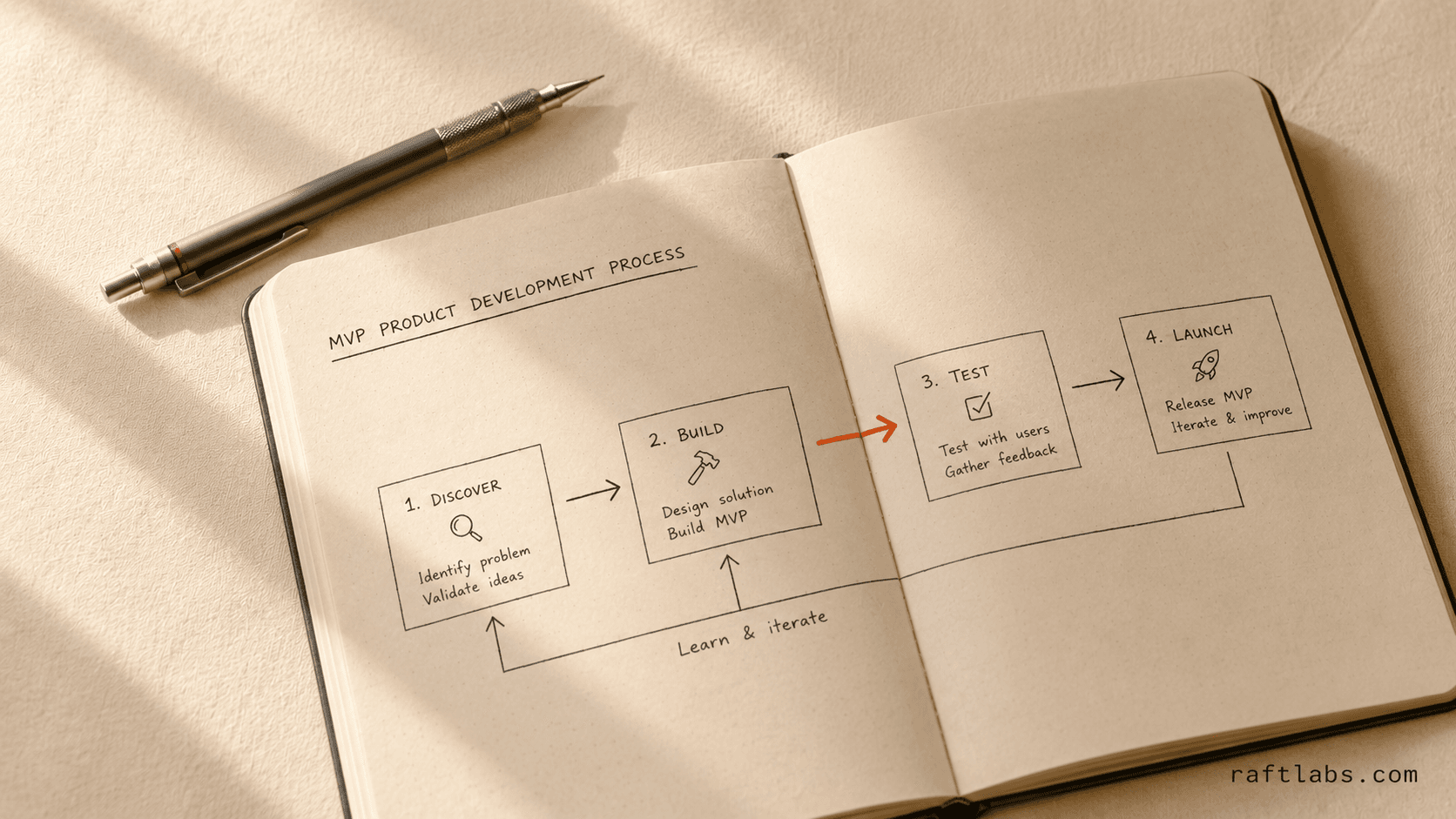
Here's the process we use in MVP development for startups, taking products from idea to production in 6 to 8 weeks. Every founder who wants to build an MVP for their startup goes through these nine steps. Skipping any one of them costs more time than it saves.
Step 1: Define the Problem and Target User
Before any design work or development begins, you need a single clear sentence that describes who you're building for and what problem you're solving. Not a target demographic. A specific person in a specific situation experiencing a specific pain.
The test: Can you describe your user's current workaround? If someone isn't using a manual workaround for the problem you're solving, the problem may not be painful enough to build a product around. Document the problem statement, the target user profile, and the specific situation that triggers the need for your product. This becomes your design and development compass for the entire build.
Step 2: Conduct Deep Market Research
Market research at the MVP stage has a specific goal: to confirm that your target user actually experiences the problem at the frequency and severity you've assumed. This isn't about market size slides for your pitch deck. It's about direct user conversations.
Talk to 15 to 20 people who fit your target user profile. Not friends. Not family. Real prospective users. Ask about their current workflow, their biggest frustrations, and what they've tried that hasn't worked. If the problem you're solving doesn't come up organically in these conversations, that's important data.
Research competing products during this phase as well. Map what they do well, where users complain (App Store reviews, Reddit, G2), and where the gap is that your product fills. This is where the go-to-market strategy for startups starts taking shape.
Step 3: Map the User Journey
Take your target user from their current situation to the outcome your product delivers. Map every step. Where do they start? What do they do next? Where does friction appear? What's the moment of value delivery?
User journey mapping has a direct impact on scope. Most startup MVPs try to cover too much of the journey in version one. The discipline is to identify the single highest-value step in that journey and make it work exceptionally well before building anything else.
Wireframing and prototyping tools like Figma make this phase fast. A low-fidelity wireframe that maps the core user flow can be built in a couple of days and validated with five users before a single line of code is written. That's 8 to 20 hours of design work that can save 40+ hours of development rework.
Step 4: Prioritize Features
Once you have your user journey mapped, you'll have a long list of features that could theoretically be included. Your job in this step is to cut ruthlessly.
Use the MoSCoW method to categorize each potential feature:
Must Have: without this, the core user workflow doesn't function
Should Have: improves the experience but the product works without it
Could Have: nice to include if time allows
Won't Have (this version): explicitly out of scope for the MVP
Most startups put too many features in the "Must Have" column. The real test is: if we removed this feature, would users be unable to complete the core task? If the answer is no, it's not a Must Have.
Feature prioritization for an MVP is where your go-to-market strategy meets your technical roadmap. This is the point where business goals and product decisions need to stay aligned.
You keep the features that directly help users get value and come back again. These are the ones that support retention and real usage. At the same time, you remove anything built for edge cases or assumptions that are not yet proven.
The focus is simple. Build what is needed for users to succeed with your product, and delay everything else until you have real feedback.
Step 5: Choose the Right Tech Stack
The tech stack for an MVP has two requirements. It needs to be fast to build with, and it needs to be scalable enough that you don't have to rebuild everything when you grow. The second requirement is often underweighted.
For most startup MVPs, we recommend:
Frontend: React or Next.js (component reuse, fast iteration, strong developer community)
Backend: Node.js (fast development, good for API-first architecture)
Database: PostgreSQL for relational data, Redis for caching where performance matters
Infrastructure: AWS with managed services to minimize operational overhead
Mobile (if required): React Native for cross-platform iOS and Android from one codebase
Avoid choosing a stack because it's trending. Choose it because your development team moves fast in it, and it can carry you to 10K users without a full rebuild.
Step 6: Design and Prototyping
UX/UI design for MVP follows a specific principle: the interface should be the simplest version that makes the core workflow obvious and friction-free. It doesn't need to win a design award. It needs to get the user to the value moment without confusion.
Start with wireframes in Figma. Rapid prototyping at this stage means sketching your core screens, testing them with five real users, and refining based on where they get confused, before a single line of code is written. A low-fidelity wireframe built in a day can save 40+ hours of development rework. That's the fastest ROI in the entire MVP development process for startups.
Mobile responsiveness is not optional, even at the MVP stage. Over 60% of web traffic can come from mobile devices. Thus, an MVP that breaks on mobile loses most of its potential early users before they've experienced the product.
Step 7: Agile Development and Testing
Agile product development is the execution backbone of MVP development for startups. Build in two-week sprints with clearly defined deliverables at the end of each sprint. Each sprint should produce working, testable software, not just progress updates.
Agile product development for startup MVPs follows a clear rhythm: define sprint goals at the start of each sprint, daily standups to surface blockers, sprint demo at the end. Every sprint output should be demonstrable to a real user.
Similarly, testing at the MVP stage focuses on the critical path. Does the core user workflow work end-to-end? Are data writes safe and consistent? Does authentication hold under basic security tests?
Spend sprint cycles on functional reliability of the core flow, not edge case UI polish. Use automated testing for the critical path from the start. It's a small investment during the MVP build that prevents a large debugging cost during iteration.
Step 8: The Soft Launch and Measure Success
Launch to a small cohort first. 50 to 200 users are enough to get a meaningful signal without the pressure of a public launch. This is your soft launch.
Define your success metrics before you launch, not after. For most startup MVPs, the metrics that matter are:
Activation rate: what percentage of signups complete the core workflow at least once?
Retention rate: what percentage of users return within 7 days? Within 30?
Time to value: how long does it take a new user to reach the moment the product delivers its core promise?
User-reported gaps: what are the top three things users say they need that don't exist yet?
A 40%+ day-7 retention rate is a strong signal that the core value is landing.
When it’s below 20%, you might have a product experience problem. Below 10%, you have a problem-fit problem. Measure these numbers rigorously. They're the data you take into your next investor conversation and your next build cycle.
Step 9: Pivot and Scale
Your soft launch data will tell you one of three things. The product is working, and you should scale it. The product works, but the user segment was wrong, and you should pivot the positioning. Or the core value hypothesis was wrong, and you need to rethink.
The lean startup methodology treats all three outcomes as useful. The goal of a startup MVP development process isn't to launch a perfect product. It's to generate the information you need to make the right next decision fast.
If the data says scale: invest in growth, infrastructure, and additional features that user feedback has identified as high priority.
If it says pivot: adjust the target user, the messaging, or the core feature set based on what you learned.
If it says rethink: close the sunk cost quickly and apply what you learned to a better hypothesis.
The startups that succeed aren't the ones that got it right on the first MVP. They're the ones that got a useful signal fast enough to course-correct before they ran out of runway.
Ready to run this process with an experienced team? We've taken 50+ products through these exact nine steps. Your MVP could be in front of users in 8 weeks. Start your MVP build
Minimum Viable Product Examples from the Real World
The best way to understand MVP development for startups is to look at mvp development examples from companies that are now household names. Each one started with a minimal, deliberately limited first version, and used the feedback from that version to build what eventually became a billion-dollar product.
1. Spotify
When Daniel Ek and Martin Lorentzon started Spotify in 2006, the early product was developed as a desktop-only app and first introduced to a limited set of users in Sweden. It was not widely available at the start, and access was controlled through invites as the team tested the experience.
The initial focus was clear. Deliver fast, reliable music streaming at a time when most services struggled with buffering and delays. Instead of building many features upfront, the team focused on getting this core experience right for a small group of early users.
In the early stages, the product had basic functionality like search and playlists, but the main emphasis stayed on streaming performance. Over time, as user behavior validated the idea, the team expanded. They worked on licensing deals, improved the product, and gradually opened access to more users.
Spotify launched publicly in Europe in 2008 and later expanded to the US in 2011. Presently, it has grown to over 600 million monthly active users. The early version was simple and focused, built for a small audience, and centered around solving one clear problem really well.
2. Instagram
Kevin Systrom’s original app, Burbn, launched in 2010 in San Francisco (United States) as a location based check-in platform. It allowed users to check in at places, make plans, post photos, and earn points. The feature set was broad, but user engagement was spread thin.
After observing user behavior, Systrom and co-founder Mike Krieger noticed a clear pattern. Most users were primarily engaging with the photo-sharing feature, while the other parts of the product saw limited usage. This insight led them to simplify the product and focus on what users actually valued.
They stripped Burbn down to its core use case: taking photos, applying filters, and sharing them. The product was relaunched as Instagram in October 2010 with a much simpler and more focused experience, along with basic social features like following and liking.
Instagram quickly gained traction, reaching around 1 million users within the first couple of months. The MVP was a focused photo-sharing app, shaped by real user behavior rather than assumptions.
3. Groupon
Andrew Mason launched Groupon in 2008 in Chicago (United States) out of an earlier project called The Point, which focused on bringing people together around shared causes. The early version of Groupon was not a full-fledged tech platform. It was simple, scrappy, and largely manual.
One of the first deals was a local offer in Chicago, shared with a small group of early users through email. Instead of building complex systems, the team handled things manually, including creating and sending coupons and coordinating with vendors. Some users redeemed the offer, which was enough to validate that people were interested in group discounts.
Mason continued running deals this way, growing the email list and refining the concept based on real user response. There were no advanced systems in place early on. Much of the process was handled with minimal tooling and manual effort.
As demand grew, the team gradually built the technology needed to scale. Within a couple of years, Groupon reached around $1 billion in revenue, making it one of the fastest-growing companies at the time. The MVP was simple, focused, and designed to test real demand before investing in a full platform.
These real-world examples make one thing clear. The success of an MVP depends as much on avoiding mistakes as it does on building the right features.
Common MVP Misconceptions Startups Must Avoid in 2026
Understanding what MVP development for startups actually is matters as much as knowing how to do it. These are the misconceptions that cause founders to build the wrong thing, over-scope their first version, or dismiss the approach entirely.
1. "An MVP is just a cheap version of the real product"
Wrong. An MVP is a strategically scoped product that tests a specific hypothesis. Cheap code that breaks under light load isn't an MVP. It's technical debt you'll spend $50K+ unwinding later. Production-ready code with limited features is an MVP.
2. "We need to build every feature investors might ask about"
Investors don't fund feature lists. They fund traction evidence. An MVP with 500 engaged users and strong 30-day retention data is worth more in a pitch than a full product with no users.
3. "Our startup MVP needs a mobile app from day one"
Most early-stage MVP app development for startups doesn't require native mobile apps in version one. A well-built responsive web app covers the majority of use cases and gets to market 6 to 8 weeks faster than a native mobile build. Build web first. Add native mobile when user behavior data tells you it's necessary. The best MVP development for startups is web-first, mobile-second.
4. "We can skip UX design to save time"
Poor UX kills MVPs quietly. Users don't file bug reports when an interface confuses them. They leave. A two-day wireframing investment before development starts saves weeks of rework and significantly improves activation rates.
5. "More features mean more user value"
This is the most dangerous misconception in early-stage product development. More features create more complexity, more bugs, and more surface area for things to break. They also dilute the user's attention from the core value. So cut ruthlessly. Add features only when users ask for them specifically and repeatedly.
6. "Ship fast, fix everything later"
Speed to launch is critical. But launching a broken core workflow permanently damages trust with early adopters. The rule is: ship the smallest possible scope, but ship it reliably. A product with one working feature beats a product with five broken ones every time.
7. "We'll figure out the business model after launch"
Your business model affects your architecture. If you plan to charge per seat, your database schema looks different than if you charge per usage. Decide on monetization before you start building, even at the MVP stage.
So, once these misconceptions are clear, the next step is making sure you have the right groundwork in place before development starts.
MVP Prerequisites Before Development
Before a single line of code is written for your startup MVP, these items need to exist. Skipping any one of them is the fastest way to derail MVP development for startups before it begins.
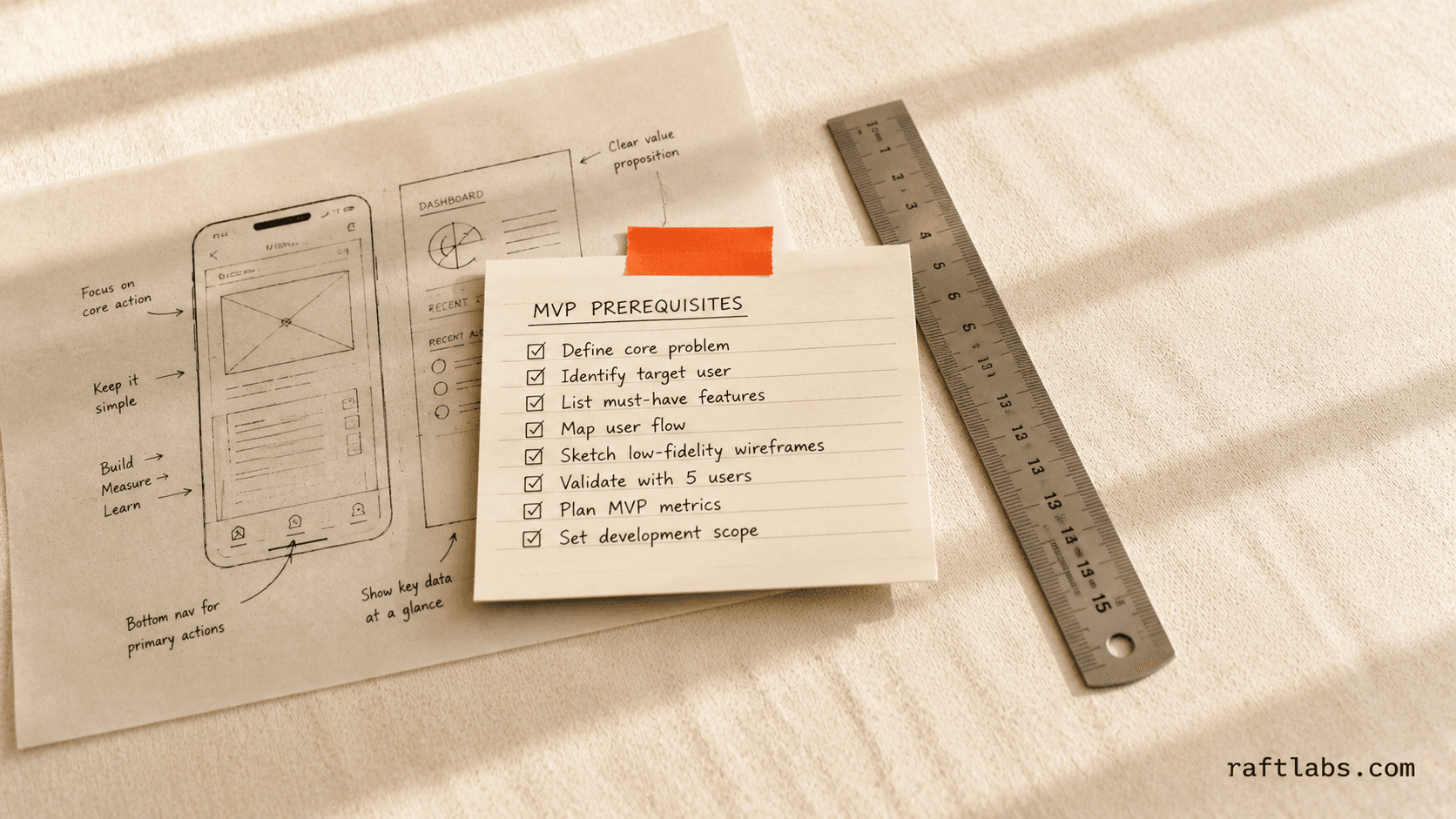
1. A written problem statement
One sentence. Specific user, specific pain, specific situation. If it takes a paragraph to explain, it's not clear enough yet. A weak problem statement looks like this: "We're building a tool to help businesses manage their operations better."
That could describe anything. A strong one looks like this: "Operations managers at logistics companies waste hours each week reconciling delivery status updates across three separate vendor portals because none of them talk to each other."
That's a person, a pain, a context, and an implied workflow gap, all in one sentence. If you can't get to that level of specificity before you start building, you're probably not ready to start building.
2. Evidence from real user conversations
The problem statement you wrote in step one is a hypothesis, not a fact. User conversations are what turn it into evidence. Talk to people who actually match your target profile: not friends, not colleagues, not people who are being polite.
Ask them to walk you through their current workflow. Listen for the moments where they describe workarounds, frustrations, or tasks they've given up trying to fix. Those are your signals. Document these conversations verbatim or with detailed notes. Your memory will selectively confirm what you already believe. The written record won't.
3. A defined success metric
Before you build, decide what a successful MVP looks like in observable user behavior. Not a feeling, not a vibe. A specific thing that either happens or doesn't. For a B2B workflow tool, that might be whether users complete the core task on their first session without asking for help.
For a marketplace, it might be whether both sides return after their first transaction. Pick one primary signal and make it the lens everything else gets measured through.
The mistake most founders make is waiting until after launch to decide what success looks like, then retrofitting a story to whatever the numbers show.
4. A prioritized feature list
Write down everything you think the product needs, then split it into two columns: Must Have and Won't Have. Must Have is only what's required to complete the core user workflow. If you removed it, the product wouldn't function for its intended purpose. Won't Have is everything else, explicitly parked for later. For a job-posting platform MVP, Must Have might be: post a job, receive applications, and contact a candidate.
Won't Have might be: saved search filters, employer branding pages, and applicant ranking algorithms. Both lists are equally important.
5. A go-to-market plan for the soft launch
A great product with no distribution strategy generates no signal. Before development starts, map out exactly how you'll get your first wave of real users. This doesn't need to be a marketing plan.
It needs to be a specific answer to a specific question: where do your target users already spend time, and how will you reach them there? A founder building a tool for independent freelancers might seed it in a specific Slack community or subreddit where that audience is active. The channel matters less than having one that's concrete and ready to use before you launch.
6. A budget aligned with scope
The most common reason MVP projects blow timelines and invoices isn't bad development. It's a mismatch between what the founder imagined and what was actually scoped and agreed on. Know your ceiling before you engage a development team. Be explicit about it. A good development partner will tell you plainly what that budget can and can't hold.
If they don't have that conversation with you upfront, that's a red flag. Budget clarity also forces useful scope discipline: when everything costs something, founders get serious about what's actually necessary.
7. A decision-making framework for post-launch
Decide before you launch what different outcomes will mean and what you'll do in response to each. If early users are activating and coming back consistently, what's your next sprint? If most users sign up but never complete the core workflow, what does that tell you, and what changes?
When almost no one signs up at all, is that a distribution problem or a product problem, and how will you tell the difference? Having these thresholds written down before launch means you act on evidence rather than instinct, and you avoid the common trap of over-interpreting early noise in whichever direction confirms what you already hoped was true.
8. IP ownership clarity
If you're working with an external development team, confirm in writing before the first sprint that you own the codebase outright: not licensed, not shared, not contingent on anything. This means the source code, the database schema, the infrastructure configuration, and any custom integrations built for your product. It's worth having a lawyer review the contract on this point specifically.
Founders who skip this step sometimes discover at the worst possible moment, during a fundraise or when trying to transition to an in-house team, that the IP situation is murkier than they assumed. Clean IP ownership from day one removes that risk entirely.
After setting up these foundations, the next step is understanding the investment required to bring your MVP to life.
How Much Does MVP Development Cost in 2026?
When you set out to build an MVP for your startup, cost is one of the first real decision points. MVP development for startups varies significantly in price based on product type, feature scope, team location, and whether you use no-code tools, offshore freelancers, or a professional product studio. Here's a tentative breakdown.
MVP Cost by Development Approach
The cost of building an MVP varies widely based on who you choose to work with and how the development is approached.
| Development Approach | Cost Range | Timeline | Quality Level |
|---|---|---|---|
| No-Code / Low-Code (Bubble, Webflow) | $5,000 to $15,000 | 2 to 4 weeks | Limited scalability |
| Offshore Freelancers | $8,000 to $30,000 | 12 to 20 weeks | Variable, often requires costly rework |
| Nearshore Agency | $20,000 to $60,000 | 10 to 16 weeks | Moderate, depends on experience |
| US / Western Europe Dev Agency | $60,000 to $200,000+ | 16 to 32 weeks | High, but often over-engineered |
| RaftLabs (Fixed-Price Product Studio) | $8,000 to $20,000 | 6 to 8 weeks | Production-ready, scalable |
These ranges give a view based on who you work with, but costs also vary depending on the kind of product you are building.
MVP Cost by Product Type
The type of product you are building plays a major role in determining both cost and timeline.
| Product Type | Estimated Cost | Timeline |
|---|---|---|
| Simple Web App MVP (1 core workflow) | $8,000 to $20,000 | 6 to 8 weeks |
| B2B SaaS MVP (multi-tenant, auth, dashboard) | $20,000 to $30,000 | 10 to 12 weeks |
| Marketplace MVP (two-sided, payments) | $25,000 to $35,000 | 12 to 14 weeks |
| Mobile App MVP (React Native, iOS + Android) | $20,000 to $40,000 | 10 to 14 weeks |
| AI-Powered MVP (LLM integration, core AI feature) | $25,000 to $45,000 | 10 to 14 weeks |
What drives costs up:
Two-sided marketplace dynamics (separate supply and demand onboarding flows)
Payment processing and escrow requirements
Native mobile development (iOS + Android is effectively two frontend builds)
Third-party integrations (Stripe, Twilio, and external APIs each add development time)
Regulatory compliance (HIPAA, SOC 2, GDPR)
Real-time features (WebSockets, live video, collaborative editing)
What keeps costs down:
Clear, scoped feature list before development starts
Web-first approach (no native mobile in version one)
Standard authentication (no custom SSO in MVP)
Managed infrastructure on AWS (vs. custom DevOps)
Fixed-price engagement with a studio that has built similar products before
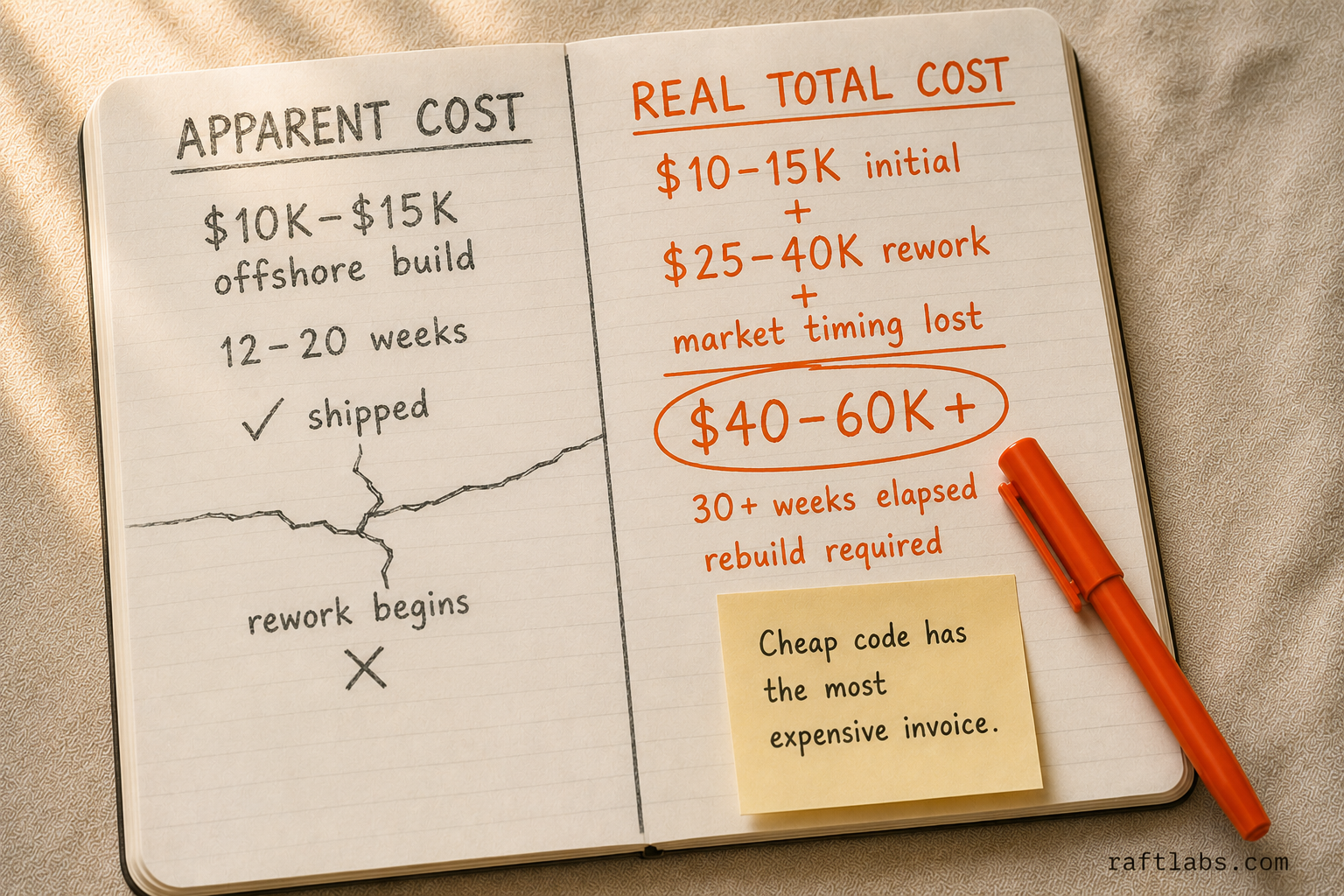
The hidden cost most startup founders underestimate is bad code. What looks like a cost saving in an offshore MVP build often creates bigger problems later.
An MVP that seems affordable in the early stage can end up costing much more due to rewrites, delays, and lost market timing. Instead of building on top of what exists, teams are forced to go back and fix or rebuild large parts of the product.
We have seen this pattern often. Founders who come to us after a failed offshore build usually spend significantly more than their original estimate to get the product to a usable state. The initial savings rarely hold up, and the real cost shows up in time, rework, and missed opportunities.
For a more detailed and transparent breakdown with phase-by-phase cost estimates, see our complete guide: How Much Does MVP Development Cost in 2026?
These numbers reflect typical market costs, but in some cases, startups can access funding support to ease this investment.
Can Government Grants Help Fund Your Startup MVP?
Before you treat the cost table above as fixed, it's worth knowing that government-funded programs in the US, UK, and Europe can legitimately offset a meaningful portion of MVP development costs for qualifying startups. These are non-dilutive: you keep full ownership of your company and your code.
Most of these programs are framed around R&D and innovation, not product development in the conventional sense. That distinction matters. "We're building a scheduling app" won't qualify. "We're fixing a technical challenge in real-time constraint-based scheduling that doesn't have an existing solution" might. The framing of your project against a genuine technical or scientific uncertainty is what determines eligibility, not the end product category.
Two practical caveats that apply everywhere: most programs are competitive with success rates ranging from 5% to 30%, depending on the scheme, and most pay retrospectively. You spend first, then get reimbursed. You need working capital to cover the gap. That said, several of the programs below are specifically designed for first-time applicants and very early-stage companies, with relatively accessible application requirements.
The table below maps the most relevant programs by region, with funding ranges, eligibility basics, and official sources to start your research.
United States and United Kingdom
| Program | Region | Who Can Apply | Funding Amount | Best For | Official Source |
|---|---|---|---|---|---|
| SBIR Phase I (NSF, NIH, DoD, NASA and others) | United States | US-registered small businesses under 500 employees; no prior govt funding required | Up to ~$314,000 | Startups with a technical R&D claim and commercial potential; NSF specifically targets companies with fewer than 5 employees | sbir.gov / seedfund.nsf.gov |
| SBIR Phase II | United States | Phase I award recipients only | Up to ~$2,095,748 | Scaling validated R&D from Phase I into a working product | sbir.gov |
| Innovate UK Growth Catalyst (Early Stage) | United Kingdom | UK-registered micro/small startups that have never previously received Innovate UK funding | £25,000 to £50,000 (100% of project costs covered) | First-time applicants at pre-seed stage in AI, advanced connectivity, semiconductors, quantum, or engineering biology | iuk-business-connect.org.uk |
| UK R&D Tax Credits (HMRC Merged Scheme) | United Kingdom | UK-registered companies spending on qualifying R&D activities | 16.2p to 27p per £1 of qualifying R&D spend, claimed via HMRC | Any startup spending on technically challenging software development; applied retrospectively after financial year-end | gov.uk/guidance/corporation-tax-research-and-development-rd-relief |
| UK Start Up Loans | United Kingdom | UK residents starting or growing a business under 3 years old | £500 to £25,000 at 6% fixed interest (loan, not grant) | Very early-stage founders needing accessible capital with no equity trade-off; mentoring included | startuploans.co.uk |
Europe: EU-Wide and Country-Specific Programs
The programs below cover EU-wide schemes and national grants from individual European countries. Most EU-wide programs require registration in an EU member state or Horizon Europe associated country. Country-specific programs (Germany, France, Spain) require registration in that country.
| Program | Region | Who Can Apply | Funding Amount | Best For | Official Source |
|---|---|---|---|---|---|
| EIC Pre-Accelerator | EU (widening countries only) | Startups in Bulgaria, Croatia, Cyprus, Czechia, Estonia, Greece, Hungary, Latvia, Lithuania, Malta, Poland, Portugal, Romania, Slovakia, Slovenia at TRL 4-5 | €300,000 to €500,000 | Deep-tech early-stage startups needing validation, customer discovery, and investor readiness before pursuing the full EIC Accelerator | eic.ec.europa.eu |
| EIC Accelerator | EU + Associated Countries (UK: grant-only) | SMEs under 250 employees (or within 499 in special cases) with technology at TRL 6 or above; working | Up to €2.5M grant (grant-only or blended with equity up to €15M) | Startups with a validated prototype ready to scale; overall success rate ~5.9% | eic.ec.europa.eu |
| EIC Pathfinder | EU + Associated Countries | Research consortia of 3+ partners; single applicants eligible for Challenge calls | Up to €4M, plus €50,000 booster grants | Scientifically bold deep-tech at TRL 1-3 (quantum, synthetic biology, novel AI architectures); not for standard | eic.ec.europa.eu |
| Eurostars | Europe (38 participating countries) | SMEs with at least two independent entities from two different participating countries | Varies by country; typically €30,000 to €150,000 per project | Cross-border R&D collaboration between tech SMEs; less competitive than EIC | eurostars-eureka.eu |
| EXIST Gründerstipendium | Germany | University students, graduates, or academic staff founding a tech company within the past year | Up to €150,000 over 12 months (living allowance + project costs) | University spin-outs and graduate founders building technically innovative products in Germany | exist.de |
| Bpifrance i-Lab | France | French-registered startups with a deep-tech or innovation-based project; any sector | Up to €600,000 depending on project stage | Early-stage French startups with a novel scientific or technical approach | bpifrance.fr |
| NEOTEC | Spain | Spanish-registered companies under 3 years old focused on developing technology | Up to €250,000 | Very early-stage Spanish tech startups building their first product | cdti.es |
The most accessible starting point depends on where you're registered. For US founders, the NSF SBIR program is explicitly designed for small, early-stage companies with no prior government funding.
For UK founders, the R&D Tax Credits scheme is the broadest and most commonly claimed. If you're spending money on technically challenging software development, you likely already qualify.
For EU founders in a widening country, the EIC Pre-Accelerator is the most direct entry point for an early-stage startup at the validation stage.
What a startup MVP partner should prove
Founders evaluating MVP development for startups face a clear fork in the road: build in-house at $300K+ with a nine-month timeline, take a chance on cheap offshore at $10K that might cost $30K in fixes, or work with a studio that has shipped 50+ products at a fixed price.
Founders come to us at two moments. Right before they're about to make a technical decision they'll regret, or right after they already did. We'd rather be the first call.
1. Fixed-price engagements with no scope surprises
Every startup MVP we build is scoped, priced, and committed to before a sprint starts. You know the cost before you know the outcome. No billing by the hour. No "it's taking longer than expected" conversations at week ten.
2. 8 to 12 week delivery, or less
We've shipped 50+ products. We know what 8 weeks can hold and what it can't. We'll tell you if your scope is too large for your timeline and help you cut it down before we start building. Our clients don't find out we've blown the timeline at week nine.
3. Production-ready code from day one
There's no throwaway code at our company. Every product we build uses the same architecture and standards as a production system. You can onboard enterprise customers, raise a Series A, and bring the codebase in-house without a rebuild.
4. You own 100% of the IP
The code is yours. The database schema is yours. The AWS infrastructure is yours. Full IP ownership is included in every engagement, not an add-on you have to negotiate.
5. Full-stack capability in one team
Each MVP engagement usually includes a product designer, two to three engineers, and a project lead. No hunting for UX designers to work with your developers. No misaligned handoffs between a design agency and a dev shop.
6. We've built products in your category
TuneClub (music creator monetization platform), Sponzee (creator-business matching marketplace), urShipper (Shopify logistics integration), and Draftly (AI LinkedIn writing tool) are all production products we've shipped from zero. We know what breaks at scale in each category before you find out the hard way.
7. We'll tell you when your idea needs rethinking
We've had calls with founders where the most valuable thing we said was "build a landing page before you build the product." That costs us the engagement in the short term. But it builds a long-term relationship.
We're not here to bill hours. We're here to help you build something that works.
8. Post-launch partnership when you need it
Most startups need ongoing development support after MVP launch. We offer sprint-based post-MVP retainers so the same team that built your product continues iterating on it as user feedback comes in, without you having to onboard a new team.
Conclusion
MVP development for startups isn't a shortcut. It's the disciplined decision to stop building in the dark and start building with evidence. Every week you spend adding features without user validation is a week you're spending runway on assumptions.
The startups that win aren't the ones with the biggest initial builds. They're the ones that got to market fast enough to learn, had enough runway left to act on what they learned, and had a codebase clean enough to scale when the validation came.
The process is clear. Define the problem, talk to real users, scope ruthlessly, build the one workflow that tests your core hypothesis, and measure what happens when real people use it. Then use that data to decide what to do next.
If you're ready to get started, we deliver production-ready MVP development for startups in 8 to 12 weeks at fixed prices starting at $8,000. We've shipped 50+ products for founders at exactly your stage.
Ask an AI
Get an instant summary of this post from your preferred AI assistant.
Frequently asked questions
- MVP development for startups is the process of building the smallest functional version of a product that validates a core business hypothesis with real users. The goal isn't to ship a complete product. It's to generate evidence about whether the problem is real, whether the solution works, and whether users will pay for it, using the minimum amount of time and money required to get that evidence.
- With a professional development team, a startup MVP takes 8 to 12 weeks from kick-off to launch. This assumes a clearly scoped feature set going in. Scope creep is the single leading cause of MVP delays. No-code tools can produce a basic prototype in 2 to 4 weeks, but those typically hit scalability limits quickly. RaftLabs consistently delivers production-ready startup MVPs in the 6 to 8 week window.
- A proof of concept (POC) is an internal technical test that answers "can we build this?" An MVP clearly answers, "Will people use this and pay for it?" POCs are shared with engineers. MVPs are shared with real users. For most startups, the POC stage is unnecessary. You can go directly to MVP and put the product in front of real users faster.
- MVP software development for startups costs between $8,000 and $50,000+, depending on product complexity, team type, and scope. Simple web app MVPs start at $8,000 to $20,000. Marketplace MVPs with payment processing and two-sided user flows can cost $25,000 to $35,000. US-based agencies usually charge $60,000 to $200,000+ for the same scope. For a detailed breakdown, see our complete MVP development cost guide.
- Only the features required to complete the core user workflow end-to-end. Nothing else. The test: if you removed this feature, would users be unable to complete the task your product promises to deliver? If yes, it's a Must Have. If no, it waits for version two. Most startups include 3x more features in their MVP spec than they should.