SaaS Architecture Guide for Business Leaders (2026)
The SaaS architecture decisions you make in year one will either compound into your biggest competitive advantage or haunt every engineering sprint for the next five years. Here's what you need to know before you commit.

In this article
Short answer
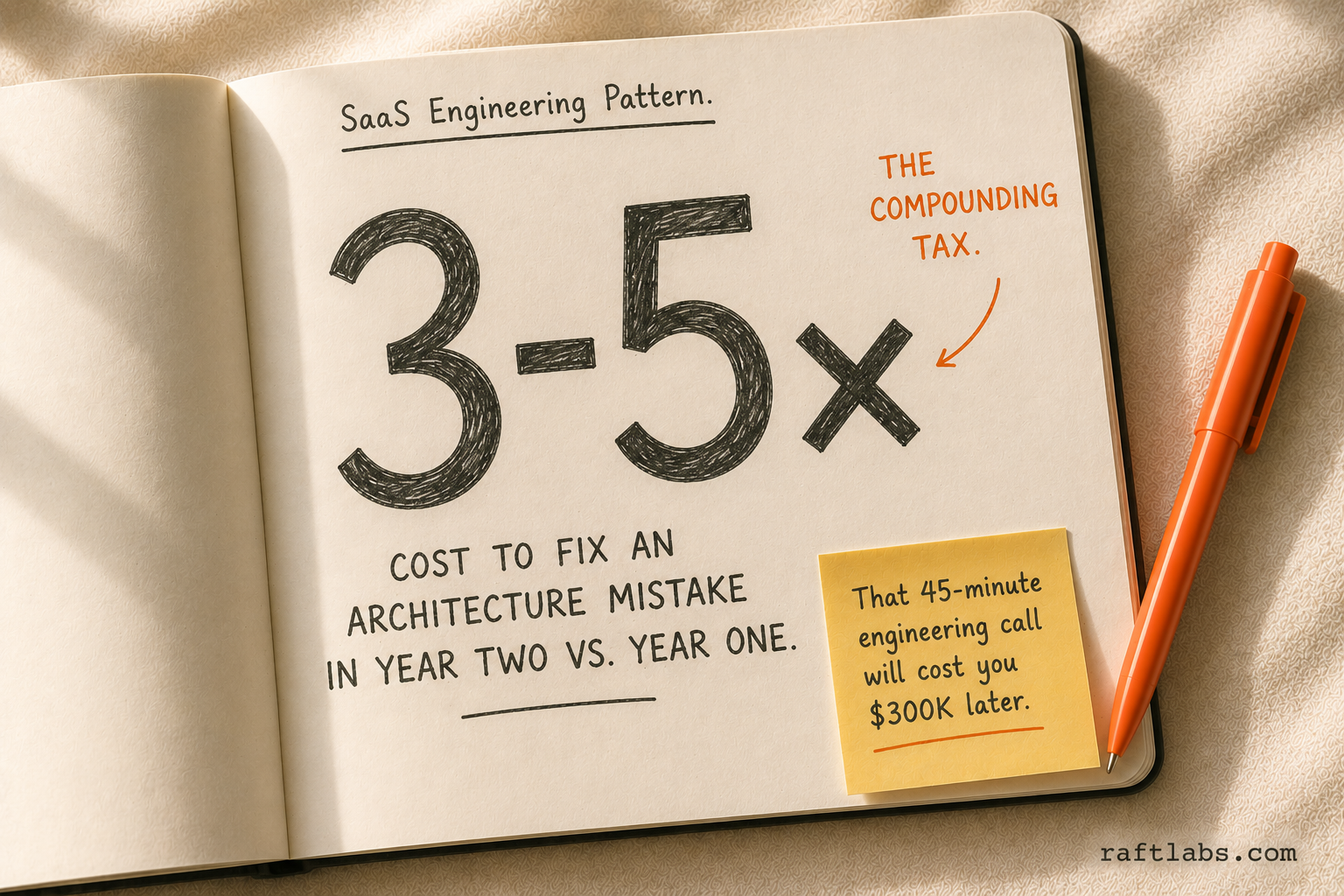
SaaS architecture refers to the foundational design decisions that determine how a SaaS product handles multiple customers, scales under load, stores data, manages security, and exposes functionality. The five decisions with the highest business impact are: single-tenant vs. multi-tenant data model, monolith vs. microservices, data storage strategy, authentication and permissions architecture, and whether the product is API-first or UI-first. Getting these wrong creates technical debt that costs 3-5x more to fix than getting them right initially.
Key takeaways
- Multi-tenant SaaS (multiple customers sharing one instance) is the standard for most SaaS products - it's cheaper to operate and easier to update. Single-tenant (one instance per customer) is the right choice only when enterprise customers require data isolation or you're in a heavily regulated market.
- The five architecture decisions that matter most: data tenancy model, monolith vs. services, data storage strategy, permissions model, and API-first vs. UI-first. Getting any one of these wrong compounds costs over time.
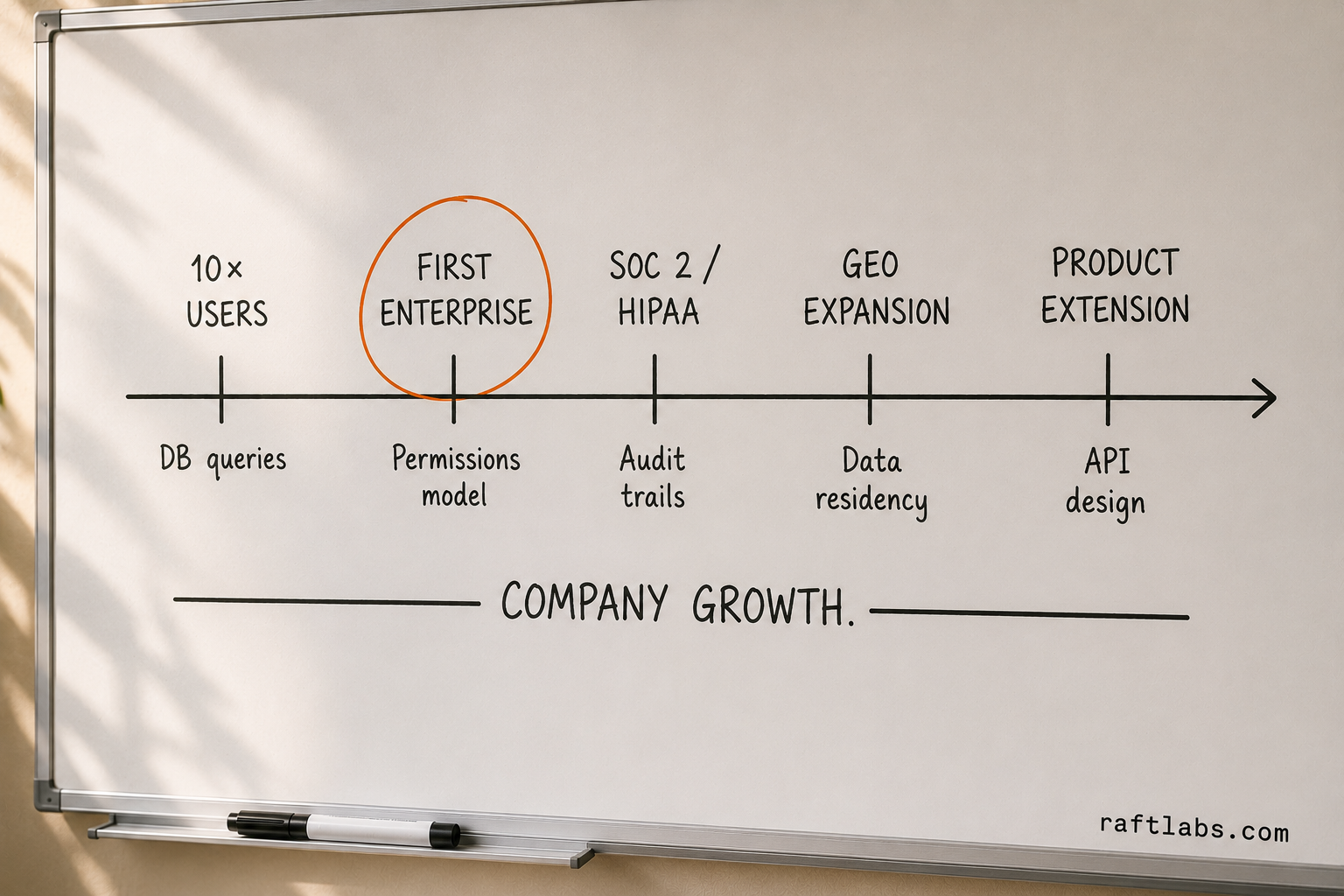
- A SaaS product's architecture typically breaks at four growth triggers: 10x user growth, the first enterprise customer with custom requirements, regulatory compliance requirements (SOC 2, HIPAA), and geographic expansion.
- Good SaaS architecture documentation should tell you: what breaks under 10x load, how you add a new customer type, what happens if a dependency goes down, and how you roll back a bad deploy. If your team can't answer those questions, your architecture docs aren't complete.
- An architecture audit doesn't require a rewrite. Start with the data model - that's where 80% of the costly constraints live. Fix the boundaries before you fix the code.
There's a version of this story we hear every few months.
A founder built a SaaS product. They raised money. They grew. Now they're at $2M ARR with 150 customers - and they've just discovered that adding the feature their three biggest enterprise deals depend on would require rebuilding a core part of their architecture. That rebuild is going to take six months and cost $300,000. And if they don't do it, they lose those deals.
The architectural decision that created this situation was made 18 months ago in a 45-minute engineering meeting. It made perfect sense at the time.
This is not an unusual story. It's the default story for SaaS companies that don't treat architecture decisions as business decisions from the start.
This guide is for founders, CEOs, and CTOs who are building or rebuilding a SaaS product. Not so you can implement the architecture yourself - but so you can evaluate the decisions your engineering team is making, ask the right questions, and avoid the mistakes that compound into six-figure crises.
Why SaaS architecture decisions are business decisions
Engineering teams talk about architecture in technical terms: database schemas, service boundaries, API contracts, deployment models. The business consequences of those decisions usually don't surface until 18-36 months later.
Here's the translation layer you need.
| Engineering decision | Business consequence if wrong |
|---|---|
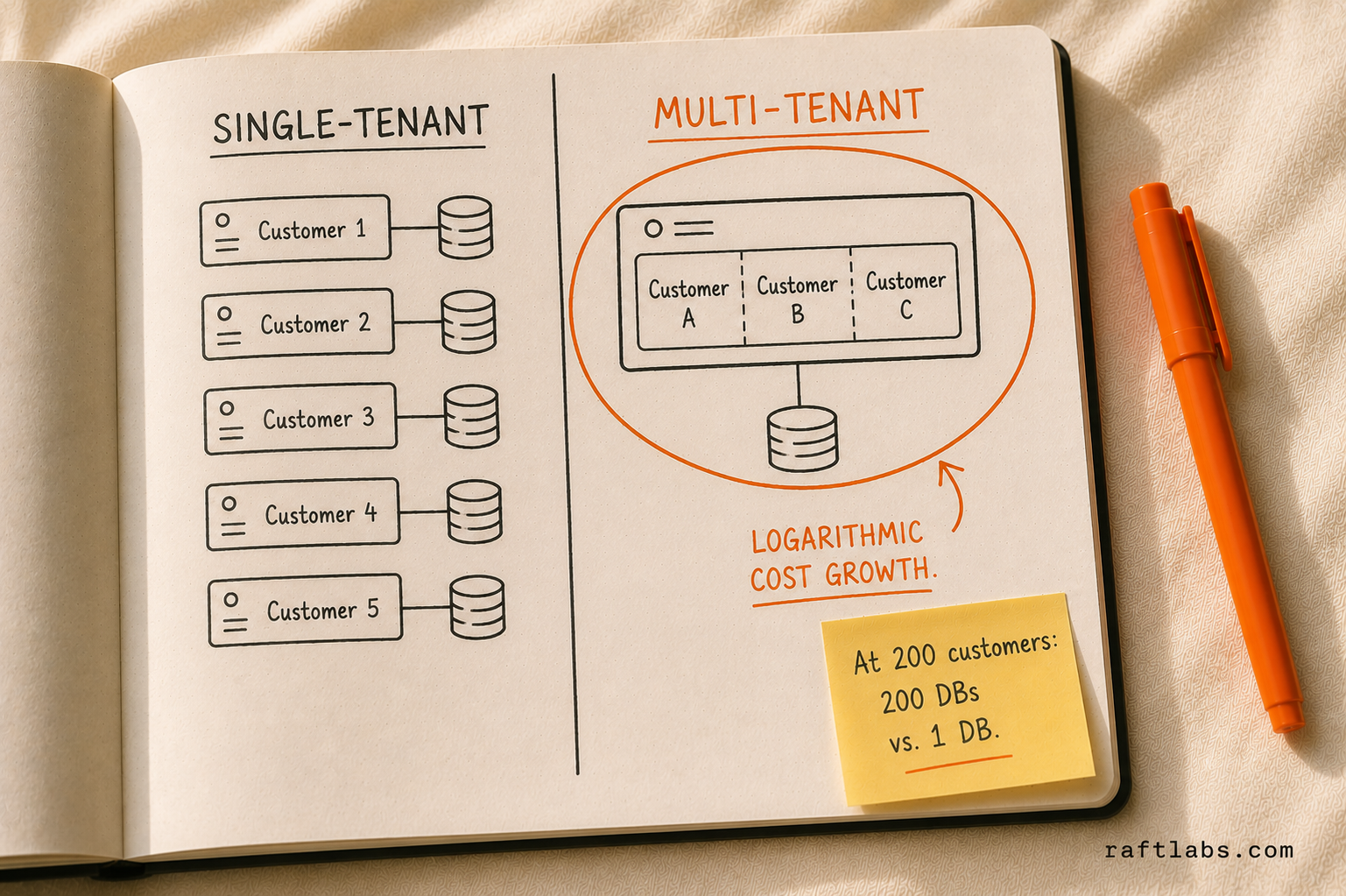
| Single-tenant vs. multi-tenant data model | Cost of operating scales 1:1 with customers instead of logarithmically. At 500 customers, you're running 500 separate databases. |
| Tightly coupled monolith with no clear module boundaries | Adding any significant new feature or integration takes 3-5x longer than it should because everything touches everything. |
| No dedicated permissions layer | Your first enterprise customer's custom role requirements require 8 weeks of engineering work that should take 2. |
| UI-first with no public API | Every integration partner, reseller, or enterprise customer requires custom development. You can't build a marketplace or developer ecosystem. |
| Shared database for all tenants with no query isolation | One large customer's heavy query load degrades performance for all other customers. You can't offer an SLA. |
The pattern: technical shortcuts feel free at the time and cost real money later. An architecture decision that saves two weeks of engineering time in month two often costs six months of rework in year two. According to McKinsey, technical debt accounts for approximately 40 percent of IT balance sheets, and CIOs estimate that 10 to 20 percent of the budget nominally dedicated to new products is diverted to resolving it.
The goal of this guide is to give you enough context to catch those decisions early - before they're made, not after they're already in production.
The 5 most consequential SaaS architecture decisions
Every SaaS product faces dozens of architecture decisions. Five of them have disproportionate business impact and are expensive to reverse.
1. Single-tenant vs. multi-tenant How is customer data isolated? Do customers share infrastructure or each get their own?
2. Monolith vs. microservices (for SaaS) Is the application one codebase or a set of independent services?
3. Data storage strategy What database do you use? How do you handle different data types - structured, unstructured, time-series, search?
4. Authentication and permissions architecture How do users log in? How do you model roles, permissions, and multi-organization access?
5. API-first vs. UI-first Is the product built so the API is the primary interface, or is the UI the only way to access functionality?
Let's work through each one as a business decision.
Single-tenant vs. multi-tenant: what this actually means for your business
This is the first decision that matters most. It determines your unit economics, your compliance posture, and the ceiling on your enterprise sales motion.
Multi-tenant (the default for most SaaS): According to Gartner, worldwide SaaS spending is forecast to reach $299 billion in 2025 — and the vast majority of that growth is built on multi-tenant infrastructure. All customers share one application instance. Their data lives in the same database, separated by a customer ID (tenant ID). When you update the application, all customers get the update at once. When something breaks, it breaks for everyone.
What this means for your business:
Operating cost grows slowly as you add customers. You don't spin up new infrastructure per customer.
Updates, bug fixes, and security patches ship to everyone simultaneously.
One security breach potentially exposes all customer data - so your security posture must be strong.
Most enterprise customers will accept this, but some require contractual data isolation guarantees you can't offer in pure multi-tenant.
Single-tenant (one instance per customer): Each customer gets their own deployment - their own database, sometimes their own server or cloud account. You manage N separate environments for N customers.
What this means for your business:
Operating cost scales linearly with customer count. At 200 customers, you're managing 200 environments.
Enterprise customers get contractual data isolation. Some regulated industries (healthcare, finance, government) require this.
You can offer customized configuration per customer without affecting others.
Updates must be rolled out to each environment separately - complex, time-consuming, error-prone at scale.
The hybrid approach most mature SaaS products use: Multi-tenant by default. Single-tenant as a premium tier for enterprise customers who require it (and who pay enough to justify the operational overhead). Your $5,000/year customers are multi-tenant. Your $200,000/year enterprise customers get isolated environments.
The question to ask your engineering team: "If a customer asks for a signed data processing agreement requiring that their data never co-mingles with other customers', can we offer that today?" If the answer is "no, and it would take 4+ months to build," you have a ceiling on your enterprise sales motion.
The SaaS architecture stack in 2026
A reference architecture for a modern, scalable SaaS product. This isn't prescriptive - your product will have specific requirements that change these choices. But this is what the median well-built SaaS product looks like in 2026.
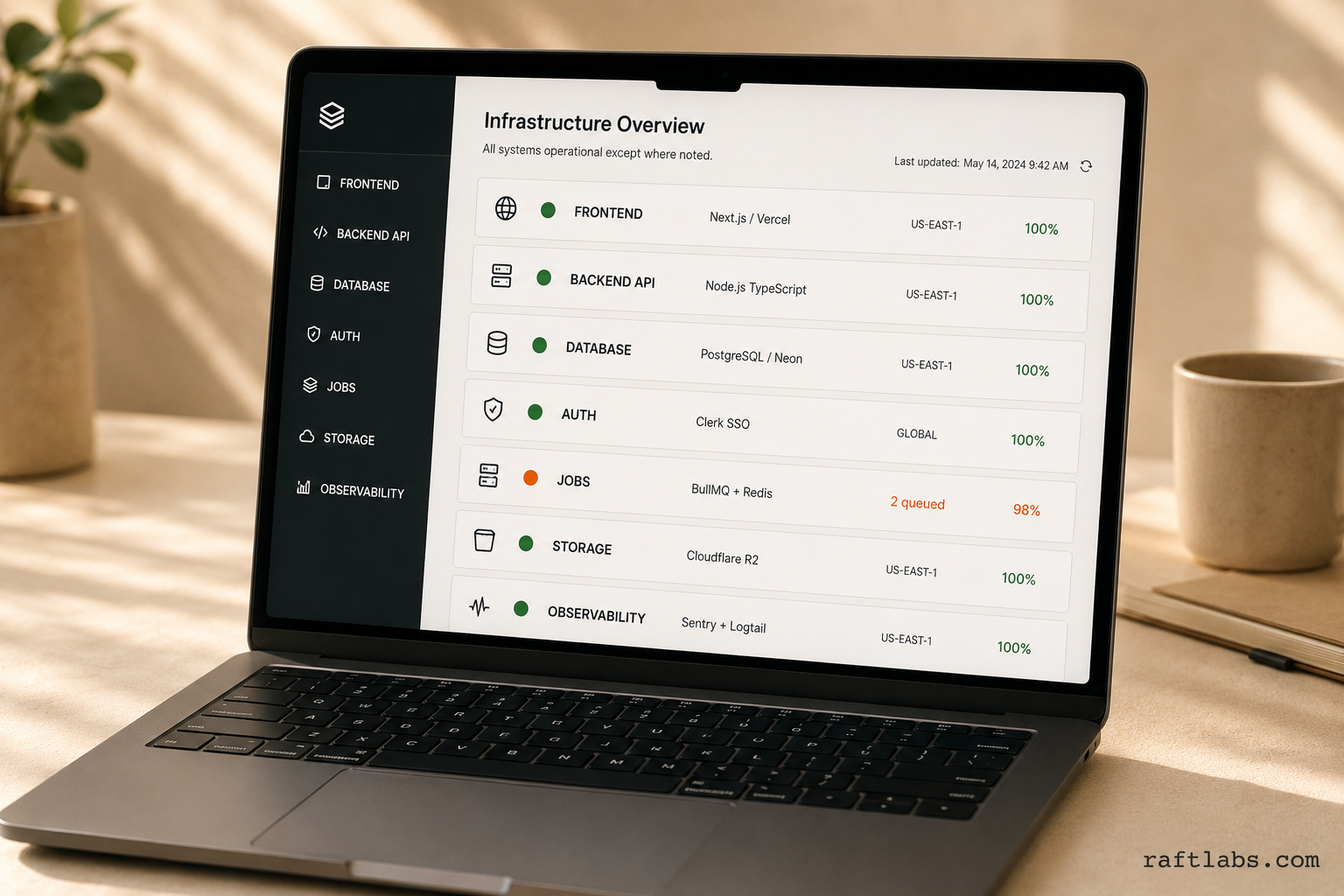
Frontend: Next.js (React framework, server-side rendering, API routes), deployed to Vercel or Cloudflare Pages. CSS via Tailwind. Design tokens managed centrally.
Backend API: Node.js with TypeScript or Python (FastAPI for data-heavy workloads). REST or GraphQL API. Deployed as containers on AWS ECS, Google Cloud Run, or as serverless functions.
Database: PostgreSQL is the default for most SaaS products. Hosted on AWS RDS, Supabase, or Neon (serverless PostgreSQL). Row-level security for multi-tenant data isolation. Separate read replicas for reporting queries.
File storage: S3 or S3-compatible object storage (Cloudflare R2 for cost). Signed URLs for secure file access per tenant.
Authentication: Managed identity provider - Clerk, Auth0, or AWS Cognito. Don't build your own auth unless you have a specific reason. Managed auth handles social login, MFA, SAML/SSO, and session management out of the box.
Background jobs: Queue-based worker system - AWS SQS with Lambda, BullMQ with Redis, or Inngest for event-driven workflows. Async processing for anything that takes more than 500ms.
Email and notifications: Transactional email via Resend, Postmark, or SendGrid. Push notifications via a managed provider. Your application should never run its own email infrastructure.
Observability: Application performance monitoring (Datadog, New Relic, or Sentry), structured logging (Logtail, Papertrail), uptime monitoring (Better Uptime, PagerDuty). On-call rotation from day one of production.
What this stack enables: A two-engineer team can run this stack with minimal operational overhead. Most of the infrastructure is managed - you're not running your own databases, email servers, or auth systems. You're focusing engineering time on your product's differentiated logic. Gartner projects that over 95 percent of new digital workloads will be deployed on cloud-native platforms by the end of 2025 — the shift to managed infrastructure is not a trend; it is now the default.
The 5 growth triggers that break SaaS architectures
Architecture doesn't fail all at once. It fails at predictable growth inflection points. Knowing them in advance lets you plan for them.
Trigger 1: 10x user growth What was fine with 1,000 active users becomes a problem with 10,000. Database queries that ran in 50ms now run in 800ms. API endpoints that handled 50 requests/second now timeout at 500. The root cause is almost always the same: no indexing strategy on the database, no caching layer, and no load testing before growth hit.
What breaks: Performance, database connection limits, poorly optimized queries, synchronous processing that should be async.
Trigger 2: The first large enterprise customer Enterprise customers want things SMB customers don't: custom SSO (SAML), granular permissions ("this user can view reports but not edit settings"), audit logs for every action, custom data residency, and sometimes their own isolated environment. If your architecture wasn't designed with these in mind, each one is a 2-8 week engineering project.
What breaks: Permissions model, authentication layer, multi-tenancy model, audit logging.
Trigger 3: Compliance certification (SOC 2, HIPAA, ISO 27001) Compliance certifications expose every architectural shortcut you've taken. SOC 2 requires evidence of access controls, logging, change management, and incident response. If you never built audit trails, if you have shared credentials in your codebase, if you don't log who accessed what - the certification process forces you to build all of that, often under time pressure. More than 70 percent of enterprise buyers now require SOC 2 reports from technology vendors, and first-year compliance programs typically cost $30,000 to $150,000 — a significant fraction of which is engineering time spent retrofitting missing controls that should have been built in from the start.
What breaks: Logging and audit trails, access control model, secrets management, deployment processes.
Trigger 4: Geographic expansion Your first customers were in one country. Now you're selling in the EU and customers expect their data to stay in Europe under GDPR. Or you're expanding to Australia and your US-hosted product is too slow. Geographic expansion requires data residency capabilities your architecture may not have.
What breaks: Data storage and replication model, tenancy model, CDN and routing strategy.
Trigger 5: Product extension (marketplace, AI features, mobile app) You decide to build a mobile app and discover your backend has no documented API - it was built to serve your web UI and the endpoints don't have the structure or documentation needed for mobile. You decide to add AI features and realize your data model wasn't designed to allow the context retrieval those features need.
What breaks: API design, data model, event streaming infrastructure.
What good SaaS architecture documentation looks like
This is a practical test. Good architecture documentation doesn't have to be comprehensive - it has to answer the questions that matter in a crisis and in a growth decision.
Ask your engineering team to produce a document that answers these questions. If they can't answer them in under a week, that's useful diagnostic information about your architecture.
The questions every architecture doc must answer:
Scalability:
What happens to response times if we get 10x our current peak traffic tomorrow?
What's our current database connection limit and what's the plan when we hit it?
Which parts of the system can't be horizontally scaled today?
Tenancy:
How do we add a new customer? What's the automated vs. manual process?
If a customer requests full data isolation, what would that require?
If Customer A's data leaked to Customer B, how would we detect it and in what timeframe?
Failure modes:
What happens if our payment processor goes down?
What happens if our database goes down?
What's our last tested recovery time objective (RTO) and recovery point objective (RPO)?
Change management:
How do we roll back a bad deploy in production?
How do we run database migrations without downtime?
How do we deploy to a subset of customers first (canary release)?
Security:
Where are credentials and API keys stored?
Who has production database access and how is that access logged?
When did we last run a penetration test?
If your team produces confident, specific answers to most of these - your architecture is in good shape. If the answers are vague, aspirational, or "we'd have to figure that out" - you have specific, addressable gaps.
How to audit your current SaaS architecture without a complete rewrite
The most common reaction when business leaders discover architecture gaps is to consider a complete rewrite. Resist this impulse. A rewrite is almost always the wrong answer - it takes 12-18 months, costs millions, and often recreates the original problems in a new language.
The right approach is a targeted audit followed by incremental remediation.
Step 1: Start with the data model. The data model is where 80% of the costly constraints live. Understand your database schema: what are the main tables, how are they related, and where does tenant isolation happen? If tenant isolation is missing or weak, that's the highest-priority fix - everything else depends on it being right.
Ask for an entity-relationship diagram and a read-through of how tenant data is separated. If you can't get a clear answer, engage an external technical review.
Step 2: Map your integration surface. List every external system that connects to your product: payment processors, email providers, CRM integrations, authentication providers, analytics tools. For each one: is the integration documented? Is there a fallback if it goes down? Is the API key or credential stored securely?
Integration sprawl - too many poorly documented third-party connections - is a common source of both security risk and fragility.
Step 3: Run the five growth trigger scenarios mentally. For each of the five triggers above, walk through what would actually happen if that trigger hit tomorrow. Don't accept "we'd figure it out" - that's not a plan. For each scenario, identify what breaks and what the remediation would cost.
Step 4: Prioritize by business risk, not technical elegance. Not every architecture gap needs to be fixed immediately. Prioritize by business impact: what gaps create risk for your enterprise sales motion, your compliance posture, or your performance SLAs? Fix those first. The elegance issues can wait.
Step 5: Fix boundaries before fixing code. The most common mistake in architecture remediation is rewriting code when what you actually need is clearer module boundaries and better data contracts. Define the boundaries first - which part of the system owns which data, what the interfaces between modules are - then refactor to enforce those boundaries. Often you can improve the architecture significantly without touching 80% of the code.
The compounding value of getting this right early
Architecture decisions compound in both directions.
Good early decisions let you add features faster, close enterprise deals without rework, pass compliance certifications without scrambling, and onboard new engineers quickly because the system is coherent. Every quarter, the cost of adding the next feature goes down.
Poor early decisions create a tax on every future sprint. Features take longer because everything is coupled. New engineers take months to be productive because the system is hard to understand. Enterprise deals require custom work. Compliance certifications require rework you can't defer.
The difference between the two paths is often a handful of decisions made in the first 6-12 months of building the product - when the team was small, moving fast, and not thinking about what things would look like at 10x scale.
If you're building a new SaaS product, the investment in getting these five decisions right before you commit to them is the highest ROI engineering work you'll do. If you're operating a SaaS product that's already running, the audit described above tells you which decisions are costing you the most and which ones are actually fine.
In either case, the goal is the same: architecture that supports the business, not architecture that constrains it.
If you want an outside perspective on your architecture before making a major decision, our custom software development team does this as a diagnostic - we look at what you have, identify the constraints that are costing you the most, and recommend the minimum intervention that gives you the most headroom.
Ask an AI
Get an instant summary of this post from your preferred AI assistant.
Common questions
- SaaS architecture is the set of design decisions that determine how a software-as-a-service product is structured, scaled, and maintained. Key decisions include how customer data is isolated (multi-tenant vs. single-tenant), how the application scales under load, how authentication and permissions work across different customer types, how data is stored and queried, and whether the product exposes functionality via API or only through its UI. These decisions are made early and are expensive to change later.
- In a multi-tenant SaaS architecture, multiple customers share the same application instance and database infrastructure. Their data is logically separated within that shared environment. In a single-tenant architecture, each customer gets their own dedicated instance of the application and their own database. Multi-tenant is standard for most SaaS products - it's less expensive to operate and easier to update. Single-tenant is chosen when enterprise customers require contractual data isolation, when regulatory requirements demand it, or when performance guarantees can't be met in a shared environment.
- Most modern SaaS products run on a serverless-leaning or containerized backend (Node.js, Python, or Go), a managed database (PostgreSQL via RDS or Supabase, or PlanetScale for MySQL), a CDN-first frontend (Next.js or Remix deployed to Vercel or Cloudflare), background job processing (SQS, BullMQ, or Inngest), object storage (S3), and authentication via a managed identity provider (Auth0, Clerk, or Cognito). The shift from managing your own infrastructure to managed services has continued - most SaaS products can reach significant scale before needing to run their own Kubernetes clusters.
- An API-first SaaS architecture means the product's functionality is exposed through a well-documented API before (or alongside) a UI. The UI itself consumes the same API that customers and integration partners use. The business benefit: customers can integrate your product into their workflows without your UI, resellers and partners can build on top of your platform, and your own frontend team moves faster because the API contracts are stable. The downside is that it requires more upfront API design discipline and adds complexity for products that are primarily consumed through a UI.
- Audit your SaaS architecture when you hit one of five growth triggers: 10x user growth causing performance problems, your first enterprise customer requiring custom permissions or data isolation, a compliance certification requirement (SOC 2, HIPAA, ISO 27001) exposing gaps in your current design, geographic expansion requiring data residency in a new region, or a planned product extension (marketplace, AI features, mobile app) that your current architecture doesn't support cleanly.
- RaftLabs guides SaaS architecture decisions starting with a diagnostic to assess what the business actually needs before recommending a direction. Our 12-week delivery sprints move from decision to production deployment on a fixed timeline and fixed price. 4.9/5 on Clutch.