Updated October 2025
9 Examples of SaaS Applications You Must Know as a Startup Founder
Most SaaS products fail because they compete on features rather than solving a specific problem. This article shows you nine SaaS applications that succeeded, including four RaftLabs built, and explains the validation steps that separate funded products from abandoned side projects.

In this article
Short answer
SaaS applications are cloud-based software products delivered on a subscription model. Popular examples include Salesforce (CRM), Slack (team messaging), and Tableau (data visualization). RaftLabs built PDC Remote Care, an AI-powered remote patient monitoring platform adopted by 15+ clinics with 50% faster clinical response times. The global SaaS market is projected to reach $307 billion by 2026.
Key takeaways
- Successful SaaS products solve one specific problem for a defined audience before adding features. Salesforce spent its first three years as a contact manager, not a full CRM suite.
- The global SaaS market is projected to reach $307 billion by 2026. That scale does not make it easier to win. It makes differentiation more important, not less.
- An MVP should test only the core workflow, not all planned features. Slack launched with basic channels and messaging. Sekou launched with attendance tracking before adding grading and payment features.
- Surveying 20-30 target users before development starts is the highest-ROI activity in the SaaS lifecycle. It costs hours. Discovering wrong assumptions at month three costs months.
- Competitive analysis is not optional before you build. Every market gap you find in competitors is a feature priority decision you can make before writing a line of code.
Most SaaS products fail because they compete on features rather than solving a real problem. Good design and advanced functionality matter, but they do not save a product that nobody needs.
The SaaS applications that succeed, from Salesforce to Slack to the products RaftLabs has shipped, all started with a specific user problem and built directly toward it. Often the best ones came from a SaaS application development company that pushed back on scope creep and kept focus on the user problem.
The global SaaS market is projected to reach $307 billion by 2026. There are an estimated 72,000 SaaS companies in operation. AI-first SaaS companies could push that number to 175,000, according to market research firm Vainu.

With that many players, competing on features alone is a losing strategy. The companies that win do so by solving a specific, pressing problem better than anyone else for a defined audience. This article shows you nine SaaS applications that demonstrate that principle, along with the validation steps that gave them the best chance to succeed.
9 SaaS application examples
1. Salesforce
Salesforce is the market-leading CRM platform. It manages sales pipelines, customer support cases, and marketing campaigns across a single data model. Its Einstein AI layer adds predictive lead scoring and automated task suggestions.
Salesforce spent its first three years as a simple contact manager before adding automation and AI. That focus on one workflow, tracking customer relationships, gave it product-market fit before it expanded.
USP: Einstein AI predicts customer behavior and automates sales and marketing tasks. Unlike static CRM tools, Salesforce connects every customer touchpoint into a single view with predictive analytics built in.
2. Slack
Slack is a team messaging platform that replaced internal email for millions of companies. It organizes communication into searchable channels, integrates with over 2,400 third-party apps, and gives teams a persistent record of decisions and discussions.
Slack launched with basic channels and direct messages, no integrations, no workflow builder. It validated demand for structured team communication before adding complexity.
USP: Searchable channels organized by topic reduce communication overhead. Unlike email threads, Slack preserves context and makes institutional knowledge retrievable weeks or months later.
3. Tableau
Tableau transforms complex datasets into interactive dashboards that non-technical users can build and explore. It connects to most data sources: databases, spreadsheets, and cloud platforms, and renders results in real time.
According to Forrester Research, companies that invest in business intelligence tools like Tableau reduce time-to-insight from days to hours for operational decisions.
USP: Tableau makes data exploration accessible without SQL or programming skills. Unlike static reporting tools, it renders live dashboards that respond to filters and user interactions.
4. Adobe Creative Cloud
Adobe Creative Cloud is the industry-standard suite for design, video editing, and web development. Photoshop, Illustrator, and Premiere Pro are subscription-based, hosted in the cloud, and updated continuously.
Creative Cloud's cloud storage layer means designers can access work-in-progress files from any device. Real-time collaboration features let multiple team members work on the same file without version conflicts.
USP: Cloud storage and real-time collaboration for professional creative work. Unlike standalone installed software, Creative Cloud means your files are always current and accessible from any device.
5. Lark
Lark combines messaging, scheduling, document collaboration, and video conferencing into a single platform. It includes AI-powered smart scheduling and real-time translation, which makes it particularly strong for globally distributed teams working across time zones.
USP: One platform for messaging, documents, calendars, and video. Unlike teams that use Slack for messaging, Google Docs for documents, and Zoom for video, Lark eliminates the context-switching cost of managing multiple subscriptions.
6. 360 SMS App
360 SMS App is a Salesforce-native messaging tool that lets sales and support teams send SMS, WhatsApp, and voice messages directly from within Salesforce. It works without external APIs. Everything runs inside the Salesforce data model.
Bulk messaging, drag-and-drop automation, and multi-channel campaign tracking are all native. No custom connector to maintain, no data sync to manage.
USP: Fully native Salesforce messaging (SMS, WhatsApp, and voice) without leaving the CRM. Unlike third-party connectors, it eliminates the integration layer and data sync problems that break messaging workflows.
Also Read: Best SaaS tech stack to choose for your software product.
SaaS applications RaftLabs built
1. PDC Remote Care
PDC Remote Care is a HIPAA-compliant remote patient monitoring platform. It collects real-time health data from connected devices, analyzes it with AI, and surfaces alerts and recommendations for clinical staff.
RaftLabs built PDC Remote Care and it has been adopted by over 15 clinics. It achieved 50% faster clinical response times within two months of deployment. The AI layer automates vital sign analysis and flags early warning indicators before they become emergencies.
USP: Real-time monitoring with AI-generated care recommendations reduces response time while cutting clinician workload. Unlike standard RPM tools that only collect data, PDC Remote Care acts on it.
2. PSi
PSi (People Supported Intelligence) is an AI-powered platform for large-scale structured discussions. Organizations use it to gather insights from thousands of participants simultaneously through anonymous voice chats.
The platform converts large conversations into specific recommendations using opinion maps and demographic segmentation. Energy companies and logistics organizations use it to make faster decisions on complex operational questions.
USP: AI-driven conversation analytics that turn unstructured group discussions into structured recommendations. Unlike surveys that capture static responses, PSi captures the dynamics of live discussion at scale.
3. Perceptional
Perceptional is a user research platform that uses conversational AI to conduct moderated interviews at scale. Instead of static survey forms, users interact with an AI interviewer that generates contextual follow-up questions.
The AI adapts each follow-up question to what the user just said, surfacing the reasoning behind an answer instead of just the answer itself, which is the data that actually changes product decisions.
USP: AI-moderated interviews that produce qualitative depth at quantitative scale. Unlike traditional surveys that get yes/no answers, Perceptional surfaces the reasoning behind user decisions.
4. Sekou
SEKOU is a multilingual learning management system built for K-12 schools in French-speaking African countries. It automates attendance tracking, payroll processing, and parent-teacher communication in a single platform.
The platform launched with attendance tracking as its core feature, the most painful manual process for school administrators. Grading, parent notifications, and assignment management followed in subsequent releases.
USP: A school management platform built for schools with limited administrative staff and multilingual student bodies. Unlike Western LMS platforms, it integrates communication, attendance, and payroll into one system designed for the operational constraints of African schools.
How to validate your SaaS idea
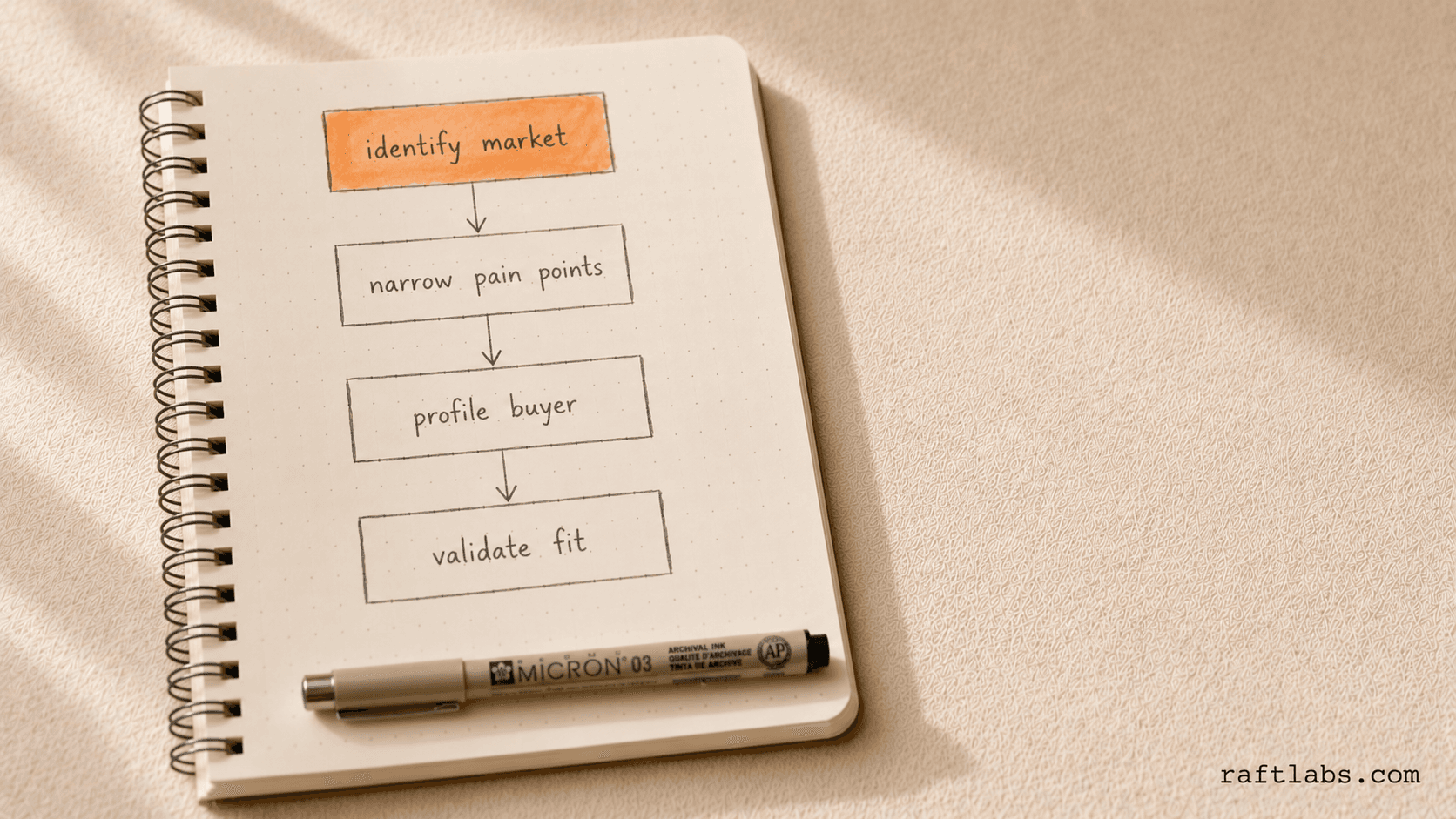
The applications above succeed because they were built for real problems. The validation process is what confirms your problem is real before you spend on development.
Step 1: Rapid prototyping
Create wireframes before writing code. Test them with five to ten people from your target audience. You are not looking for approval. You are looking for confusion. Any step where users pause or ask a question is a design problem that costs $500 to fix in a wireframe and $5,000 to fix in production.
Step 2: Build a focused MVP
An MVP tests the core workflow, not all planned features. If you are building an invoicing tool, your MVP lets users create and send invoices. Payment reminders, analytics, and multi-currency support come after you confirm the core workflow works.
Both PSi and Slack launched with MVP approaches: limited feature sets that tested demand before expanding.
Step 3: Competitive analysis
Find the five closest competitors. Read every negative review on G2, Capterra, and Trustpilot. Negative reviews are your feature priority list. Users telling competitors "I wish you had X" or "I stopped using it because of Y" are telling you exactly what to build.
Step 4: Pre-launch landing page
Build a simple landing page before you build the product. Describe the problem and the solution. Collect email addresses from interested visitors. If you cannot get 50 email sign-ups from your target audience, the demand assumption is wrong. Discover this for $200 in landing page cost rather than $50,000 in development cost.
Common mistakes to avoid in SaaS validation
Falling in love with your idea. User research that confirms your idea feels like success. User research that challenges your assumption is actually more valuable. Stay detached from the concept and attached to the evidence.
Asking friends and family. People who care about you will validate your idea to be supportive. Users who do not know you will only validate it if it solves their actual problem. Talk to 20-30 people who match your target user exactly. Not people who want you to succeed.
Skipping competitor analysis. Every feature gap you find in competitor reviews is a priority decision you can make before writing a line of code. Teams that skip competitive analysis often spend months building something a competitor already offers, or building what users do not actually need.
Conclusion
The most durable SaaS products are the ones that solve one specific problem better than any alternative. Not the products with the most features. Not the products with the best design. The ones where users say "I cannot go back to how I did this before."
Salesforce started as a contact manager. Slack started as team messaging. PDC Remote Care started as a device data collector. Each expanded only after proving the core workflow.
If you are building a SaaS product, start by proving the core workflow with real users before you build it. RaftLabs has shipped 20+ SaaS products across healthcare, fintech, education, and enterprise tooling. If you want help scoping a build that starts with the right problem, schedule a consultation call.
Ask an AI
Get an instant summary of this post from your preferred AI assistant.
Common questions
- SaaS (Software as a Service) is a cloud-based software delivery model where users access applications over the internet rather than installing them locally. SaaS products are typically subscription-based, hosted by the provider, and updated automatically. Examples include Google Workspace, Dropbox, and Salesforce. The global SaaS market is projected to reach $307 billion by 2026, according to multiple market research firms.
- Validation confirms real demand exists before you spend on engineering. Surveying 20-30 users before writing code costs hours. Discovering the same wrong assumptions at month three costs tens of thousands of dollars in sunk development time. Both PDC Remote Care and PSi were validated with target users before full build, which is why both reached product-market fit within six months of launch.
- An MVP (Minimum Viable Product) delivers only the core features that address the most urgent user need. It lets you test market demand with real users before committing to a full build. Slack launched as a simple team messaging tool with no integrations. PSi launched as a basic voice chat platform before adding analytics. Both validated demand before expanding scope.
- Identify the five closest competitors. List what users praise in reviews (G2, Capterra, Trustpilot) and what they complain about. The complaints are your feature priority list. Map each competitor's pricing against their feature set to identify where buyers feel underserved. Your differentiation comes from the gap between what users need and what competitors deliver.
- Five factors consistently appear in successful SaaS companies: (1) product-market fit, meaning solving a real problem for a defined audience; (2) low churn, where users get enough value to stay month after month; (3) a scalable architecture that handles growth without proportional cost increases; (4) data-driven iteration, shipping features based on usage data, not assumptions; (5) a pricing model that aligns with the value users get.