Complete SaaS MVP Development Guide: Build, Launch & Validate
Most SaaS founders waste their first $50K building features nobody wants. This guide covers how to scope, build, and ship a SaaS MVP in 6-8 weeks, with real cost breakdowns, architecture decisions, and 3 case studies from products that went from one hypothesis to funded platforms.

In this article
Short answer
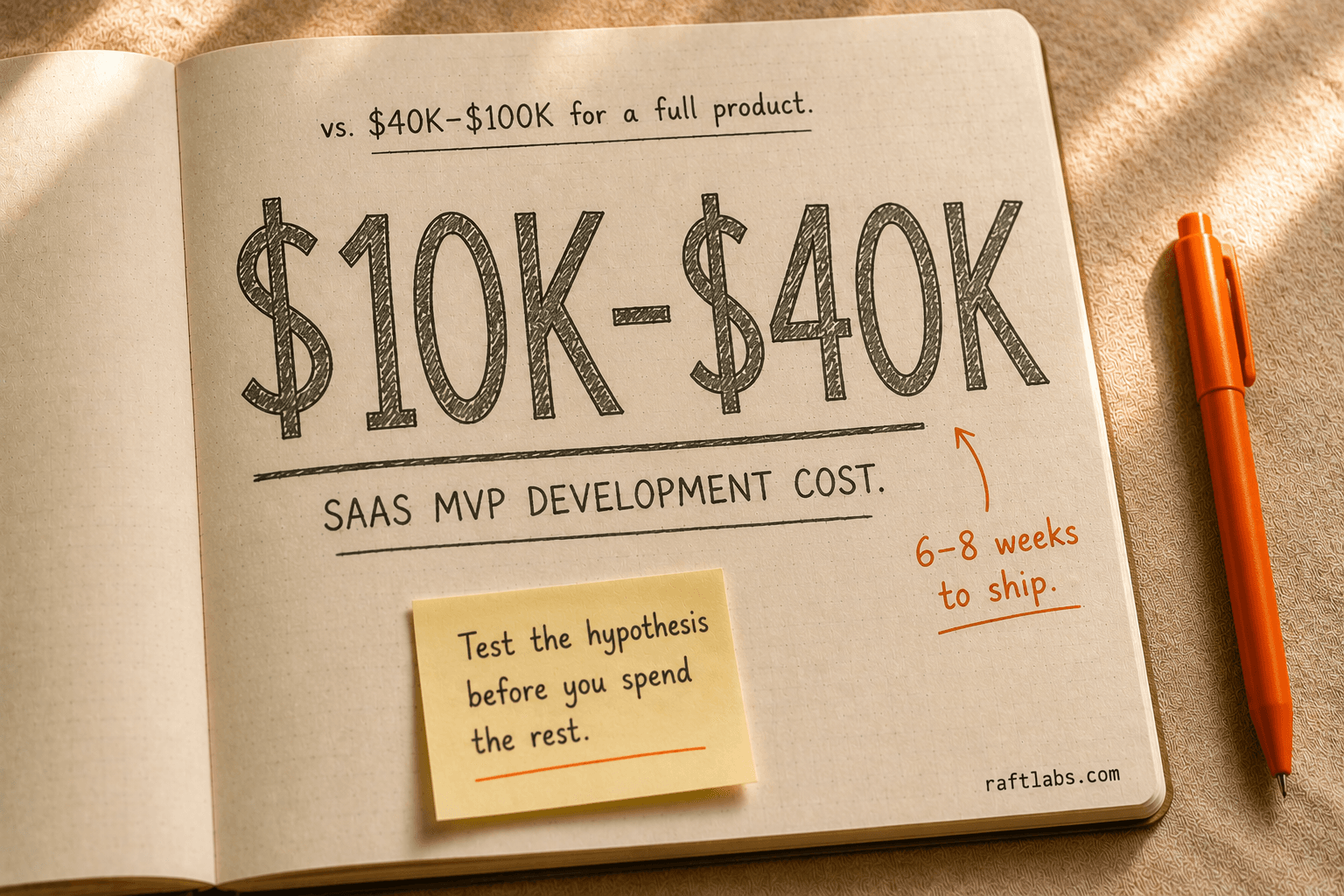
SaaS MVP development costs $10,000-$40,000 and ships in 6-8 weeks. A full SaaS product costs $40,000-$150,000+. The most common mistake is building beyond the core hypothesis, delaying the feedback loop. RaftLabs has shipped 30+ SaaS MVPs across healthcare, MarTech, and hospitality.
Key takeaways
- A SaaS MVP is not a cheap version of your full product. It is a complete solution to one specific problem that tests whether users will pay to have it solved.
- 42% of startups fail because there's no market need for their product, per CB Insights. An MVP validates that need before you commit to full development.
- Gartner projects 40% of enterprise applications will include AI agents by end of 2026. That makes AI-ready architecture a week-one decision, not a v2 afterthought.
- Retrofitting AI into a non-AI-native architecture typically costs 3-5x more than building AI-ready from the start. The same math applies to compliance in regulated industries.
- The most reliable signals to scale from MVP to full product: consistent retention over 90 days, repeated requests for the same feature from 10+ different users, and revenue covering development costs.
RaftLabs has shipped 30+ SaaS products for founders and growth-stage companies across the US, UK, UAE, and Ireland, from B2B MarTech platforms and healthcare SaaS to hospitality management tools and AI-powered decision-making systems. Most delivered in 8-12 weeks.
What follows is what those builds taught us, including what most SaaS MVP guides won't tell you about where projects actually break down.
The Problem With Skipping the MVP
Building a full SaaS product from scratch takes 6-12 months and costs $40,000-$100,000. Most founders who skip the MVP stage spend that budget building features nobody uses. They launch late, miss market windows, and discover their assumptions were wrong after the money is gone.
CB Insights analyzed why startups fail. 42% failed because there was no market need for their product. 29% ran out of cash before finding product-market fit.
A SaaS MVP solves this by testing your core business hypothesis with real users before committing to full-scale development.
The global SaaS market is projected to reach $819 billion by 2030. The market grows, but competition intensifies every month. Those who spend six months building a complete product often launch into a market that has already shifted.
What Is a SaaS MVP?
A SaaS MVP is the simplest version of your software that solves one specific problem for your target users. It includes only the core features needed to deliver value and test your primary business hypothesis.
The goal is not to impress users with a polished interface. The goal is to learn whether your solution solves a real problem that people will pay to fix.
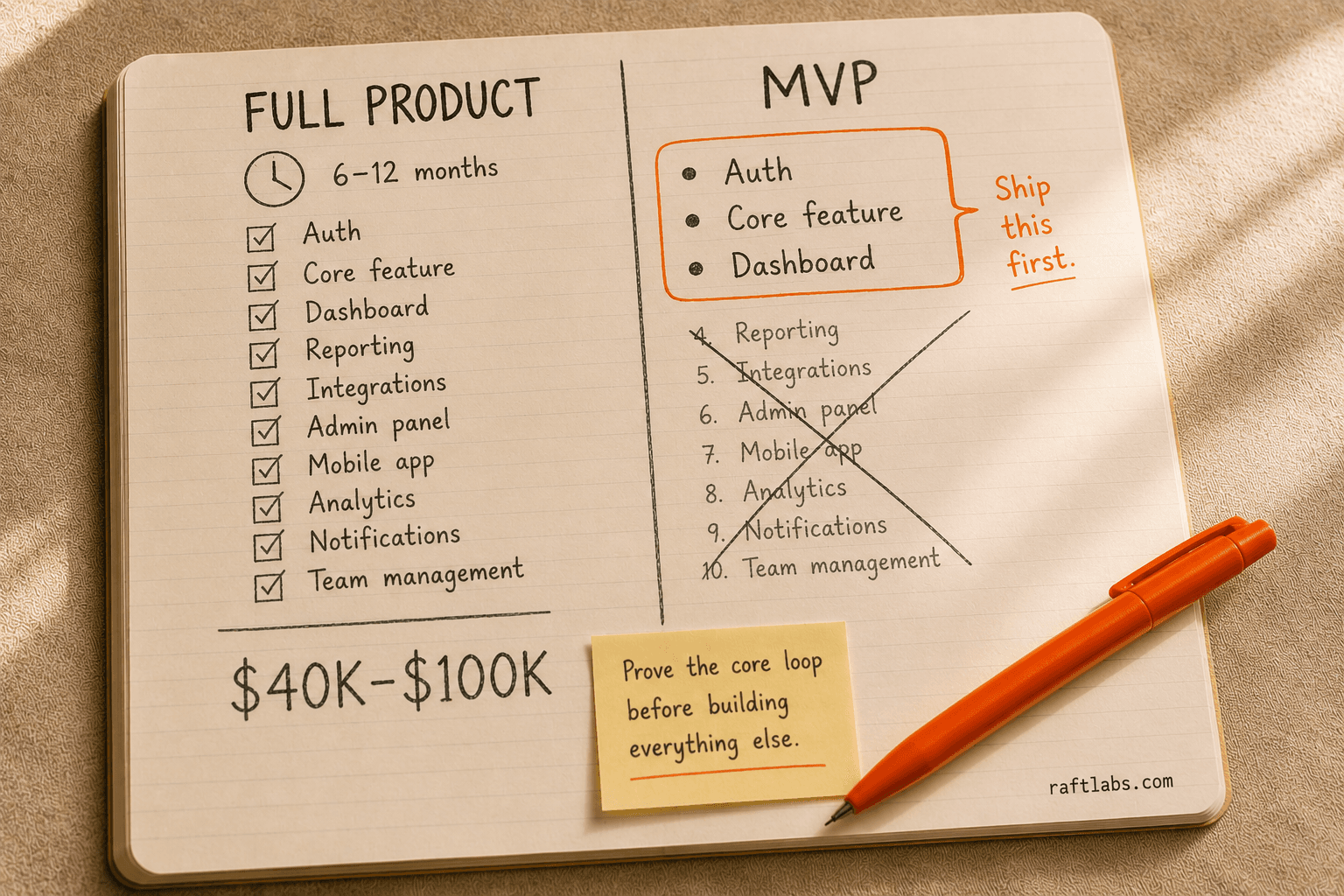
Think of it this way: if you're building a project management tool, your MVP might let teams create tasks, assign them to members, and mark them complete. That's it. No time tracking, no reporting, no integrations. Just the core loop that validates whether teams find value in your approach.
Most founders struggle with this because they confuse "minimum" with "incomplete." A SaaS MVP is not a broken product with missing pieces. It's a complete solution to one focused problem. Incomplete products frustrate users and generate useless feedback. Complete solutions to narrow problems attract early adopters and generate useful data.
Dropbox started with a simple MVP that synced files across devices. They could have added collaboration tools, version control, and admin features upfront. But the MVP proved that file syncing alone solved a painful problem. That gave them the data to prioritize everything that came next.
Why Build an MVP First
1. Validate your idea before heavy investment
Most product ideas sound compelling on paper but fail when real users interact with them. An MVP lets you test your core assumption with actual users before spending months building features. You discover whether people care about your solution while it's still cheap to pivot.
2. Reduce costs and time to market
A focused MVP typically costs $10,000-$20,000 and ships in 6-8 weeks. A full-featured SaaS product costs $40,000-$100,000 and takes 6-12 months. You get to market faster with less capital at risk. Speed also matters because being first to solve a problem creates advantages that are hard to reverse.
3. Attract early adopters who provide real feedback
Early adopters tolerate rough edges in exchange for being first to access something they need. Their feedback, based on actual usage rather than promises, shapes your roadmap more accurately than any internal planning session.
Find them in niche communities: LinkedIn groups, Reddit, founder Slack channels. Share the problem you're solving and offer early access. Talk directly with the first few users. Their behavior will tell you more than what they say.
According to a GoodFirms survey, 62% of businesses said an MVP is capable of attracting investors. 53% said an MVP is specifically a tool for investor outreach.
4. Secure funding with proof of concept
A working MVP with active users gives you real data in fundraising conversations: usage patterns, early revenue, customer feedback. Investors fund validated products three times more readily than ideas on paper. This proof also improves the terms of the raise.
5. Learn which features actually matter
Founders routinely guess wrong about which features users value most. An MVP exposes this quickly. You might build something you think is essential only to discover users ignore it. Or you might add something simple that drives all your engagement. This learning happens in weeks with an MVP, not months.
6. Test pricing before committing to a model
An MVP lets you experiment with pricing before locking in. You can test whether users prefer monthly subscriptions, annual billing, usage-based pricing, or freemium. You learn what they'll actually pay, which often differs significantly from what they say they'll pay in surveys.
SaaS MVP vs. Full SaaS Product
| Aspect | SaaS MVP | Full SaaS Product |
|---|---|---|
| Purpose | Validate core business hypothesis | Serve an established user base with a complete solution |
| Feature Set | Minimum features for one specific problem | Complete feature set across multiple use cases |
| Development Time | 6-8 weeks | 14-24 weeks or longer |
| Development Cost | $10,000-$20,000 | $40,000-$100,000+ |
| User Experience | Functional but basic | Polished with refined interactions |
| Scalability | Built for 100-1,000 users | Architected for thousands or millions |
| Integrations | Limited to essential third-party services | Extensive third-party integrations |
| Target Users | Early adopters who tolerate rough edges | Mainstream users expecting complete solutions |
| Success Metrics | Validation of core hypothesis | Revenue growth, user retention, market share |
The transition from MVP to full product happens gradually. You don't flip a switch. You add features iteratively based on what users need most. The key is recognizing that an MVP is a learning tool that guides you toward building the right full product.
Step-by-Step SaaS MVP Development Process
1. Validate the SaaS Idea
Before writing any code, confirm that your idea solves a real problem for identifiable users. Talk to potential customers, not friends or family, but actual people who currently struggle with the problem you're solving.
Ask how they handle this problem today, what tools they use, what frustrates them, and how much the problem costs them in time or money. These conversations reveal whether the problem is painful enough that people will pay for a solution.
Look for patterns across multiple conversations. If five users describe similar friction points and current workarounds, you've found something real.
You can also validate demand through a landing page test. Create a simple page describing your solution and measure how many people sign up for early access. Traffic without signups suggests weak interest. A high signup rate indicates real demand.
2. Identify Target Audience and Value Proposition
Avoid broad groups like "small business owners." That doesn't help with product decisions. Narrow to a specific use case and situation: "independent consultants managing 3-10 client projects simultaneously" gives you something concrete to build for.
Your value proposition should answer one question: what do you do better than existing solutions for this specific audience? State it in one sentence.
"We help freelance designers create client proposals in 10 minutes instead of 2 hours by automating pricing calculations and template creation" is useful. "Better project management for teams" is not.
3. Prioritize Features for MVP
List every feature you think your product needs. Then cut ruthlessly until you're left with the absolute minimum that creates one complete user journey demonstrating your core value.
Use impact vs. effort to organize features. Focus first on high-impact, low-effort features. These are your MVP core. High-impact, high-effort features come next. Low-impact features belong in the backlog.
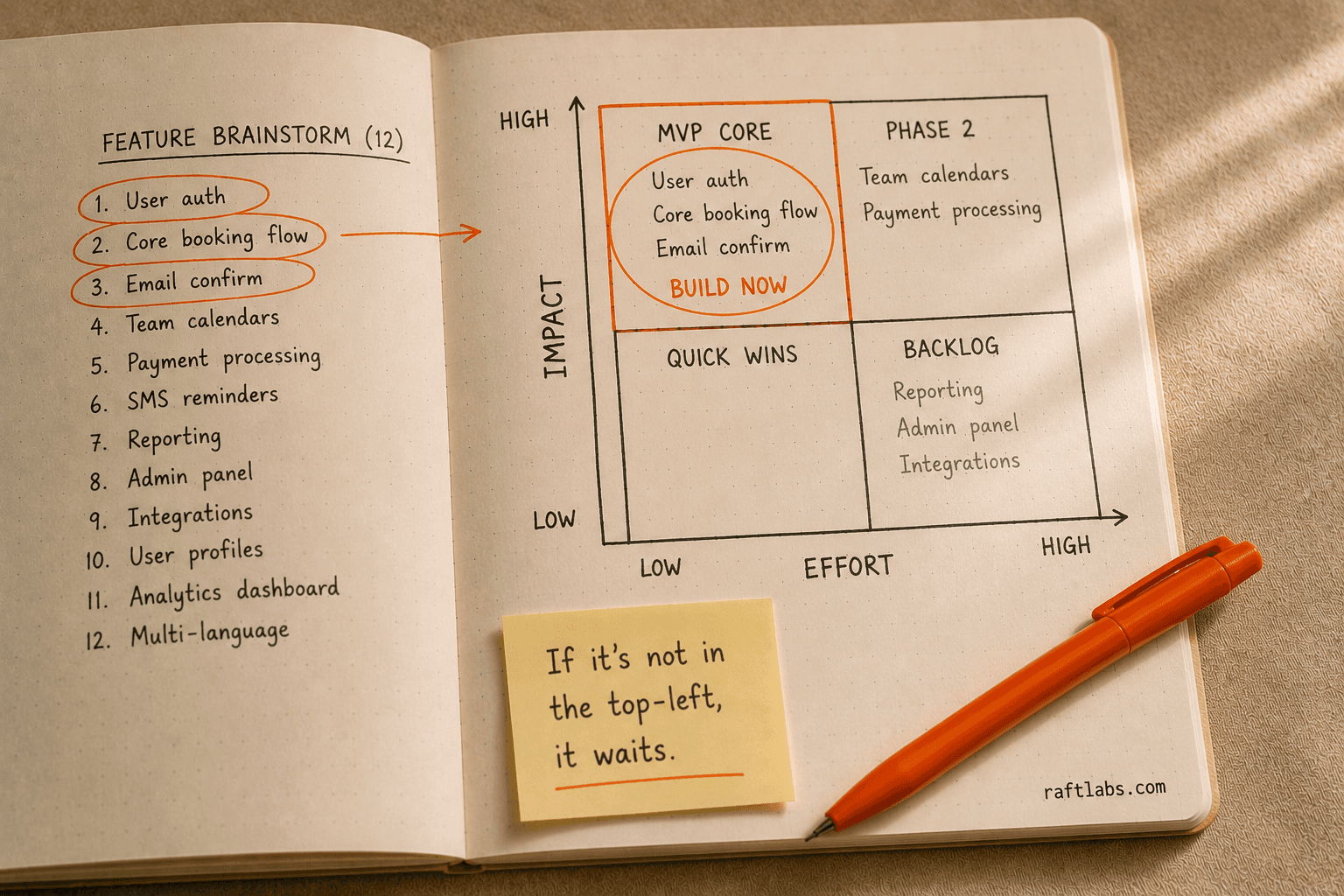
For a scheduling tool: calendar display, appointment booking, and email confirmations are must-haves. Reminder notifications, team calendars, and payment processing can wait until you prove people will use the core booking flow.
4. Design UX/UI for the MVP
Design for usability and clarity, not visual elegance. Users need to understand what your product does and how to use it within seconds of landing on the interface.
Start with user flow diagrams: where do users enter the app, what do they do first, what happens next? This flow should be obvious and friction-free.
Create wireframes before visual designs. Wireframes force you to think about structure and hierarchy without getting distracted by colors and typography. Once the structure works, add visual design that supports your brand without overcomplicating the interface.
Use standard UI patterns users already understand. Don't reinvent navigation, buttons, or forms. Save innovation for features that differentiate your product.
5. Choose the Right Tech Stack
Your technology choices should match your current needs, not hypothetical future scale. Build for your first 1,000 users, not your millionth. You can optimize and scale later when actual usage justifies it.
Popular, well-supported technologies make development faster and hiring easier. React, Node.js, Python, and PostgreSQL have large communities, extensive documentation, and available developers. Choosing unproven technologies might seem exciting but leads to longer cycles and higher costs.
Consider your team's existing skills. If your MVP developers know Python well, building in Python is faster than learning a new language. The speed advantage usually outweighs any minor technical benefits of switching.
6. Build the MVP
Build in short, focused cycles. Two-week sprints work well because they keep the team aligned and create clear checkpoints to review progress.
Start with a backend that supports only your core features. Don't over-engineer for future scale at this stage. Keep the code modular so you can update or replace parts later without redoing everything.
Follow your designs closely on the frontend, but stay flexible. Small adjustments will always appear during testing.
Set up basic error handling and monitoring from day one. Users will encounter issues. You need quick visibility into what's breaking. Simple tools like Sentry track errors automatically.
7. Launch Your MVP
Launch means making your product available to real users, not announcing it to the world. Start with a small group of early users who understand they're testing an MVP. These might be people from your validation conversations, waitlist signups, or community members who match your target.
Focus on one or two channels that reach your target users directly. Avoid broad launches that attract curious users who don't match your target profile.
Set expectations clearly. Let users know this is an MVP, which features are included, and what you're testing. Early users appreciate honesty and provide better feedback when they understand your goals.
8. Collect User Feedback
Implement in-app surveys at key moments, after a user completes a core workflow. Use email to follow up with active users after a week. Schedule calls with engaged users to go deeper.
Track behavior alongside feedback. What users say often differs from what they do. If users say they love a feature but analytics show nobody uses it, behavior is the truth.
9. Iterate Based on Data
Use data and feedback to improve methodically. Don't chase every piece of feedback equally. Look for patterns: if ten users mention the same friction point, prioritize fixing it. If one user asks for a complex feature nobody else needs, add it to the backlog.
Focus on removing obstacles between signup and the moment users experience your core value. If users sign up but don't complete onboarding, fix onboarding before adding features. If they use your product once and never return, understand why before expanding.
Release updates frequently, weekly or biweekly. This responsiveness builds loyalty among early users who see their feedback directly shaping the product.
SaaS MVPs in 2026: What Has Changed
The SaaS MVP development process is the same. The time and cost to execute it has dropped.
Two years ago, a production-ready SaaS MVP took 14-20 weeks. Today, with AI-assisted development tools embedded across every phase (Cursor, GitHub Copilot, and similar), the same scope ships in 8-12 weeks. That compression is real. AI tools cut 10-20% of development hours across a typical build, with the biggest gains on repetitive, high-volume tasks: boilerplate API generation, test writing, CRUD layer setup, and component scaffolding.
When you compare agency quotes in 2026, any team not using AI-assisted development is either charging you for time savings they should be passing on, or they're moving slower than the market standard.
GenAI Features Are Now a Week-One Architecture Decision
Gartner projects 40% of enterprise applications will integrate task-specific AI agents by end of 2026, up from less than 5% in 2025. That's happening in products being built right now.
For SaaS MVPs, this means one architectural question has moved from "v2 consideration" to "week one decision": is this product AI-native, or is AI being added later?
AI-native architecture designs data flows, storage, and user interaction patterns around AI outputs from the start. Retrofitting AI into a product not built for it typically requires rebuilding the data model and API layer. That work costs 3-5x more than building AI-ready from the beginning.
If your SaaS includes personalization, automated content generation, intelligent search, workflow automation, decision support, or natural language interfaces, the architecture conversation belongs in product discovery, not after launch.
What AI Features Add to MVP Budgets in 2026
| AI Feature Type | Typical Cost Addition (USD) | Build Time Addition |
|---|---|---|
| LLM integration (GPT, Claude via API) | $3,000-$8,000 | 1-2 weeks |
| RAG pipeline (document search, knowledge base) | $8,000-$20,000 | 2-4 weeks |
| AI chatbot with custom knowledge | $5,000-$15,000 | 2-3 weeks |
| AI-generated content layer | $4,000-$10,000 | 1-3 weeks |
| Custom ML model (if required) | $20,000-$60,000+ | 4-10 weeks |
| Recommendation engine (API-based) | $5,000-$12,000 | 2-3 weeks |
GenAI features add 15-30% to an MVP budget when included from day one. They add significantly more when retrofitted. The right question at the MVP stage is not "can we add AI later?" but "does the core hypothesis require AI to be proven?"
The No-Code Ceiling
No-code tools (Bubble, Webflow) have improved substantially. A simple SaaS MVP that once required 8 weeks of custom development can now be configured in 2-3 weeks at lower cost.
The ceiling hasn't moved, however. Products that reach 5,000-10,000 users, require non-standard business logic, or need deep integrations with proprietary systems consistently hit the limits of what no-code can support. The migration to custom code at that point costs more than a custom build would have at the start.
The decision framework is unchanged: if you're pre-revenue and testing a hypothesis, no-code is often the right starting point. If you have evidence of demand and are building for scale, a custom SaaS MVP with an AI-ready architecture is the better investment.
SaaS Architecture Considerations for MVP
How you structure your SaaS architecture affects both current performance and future scalability. These decisions are hard to reverse.
1. Multi-tenancy from day one
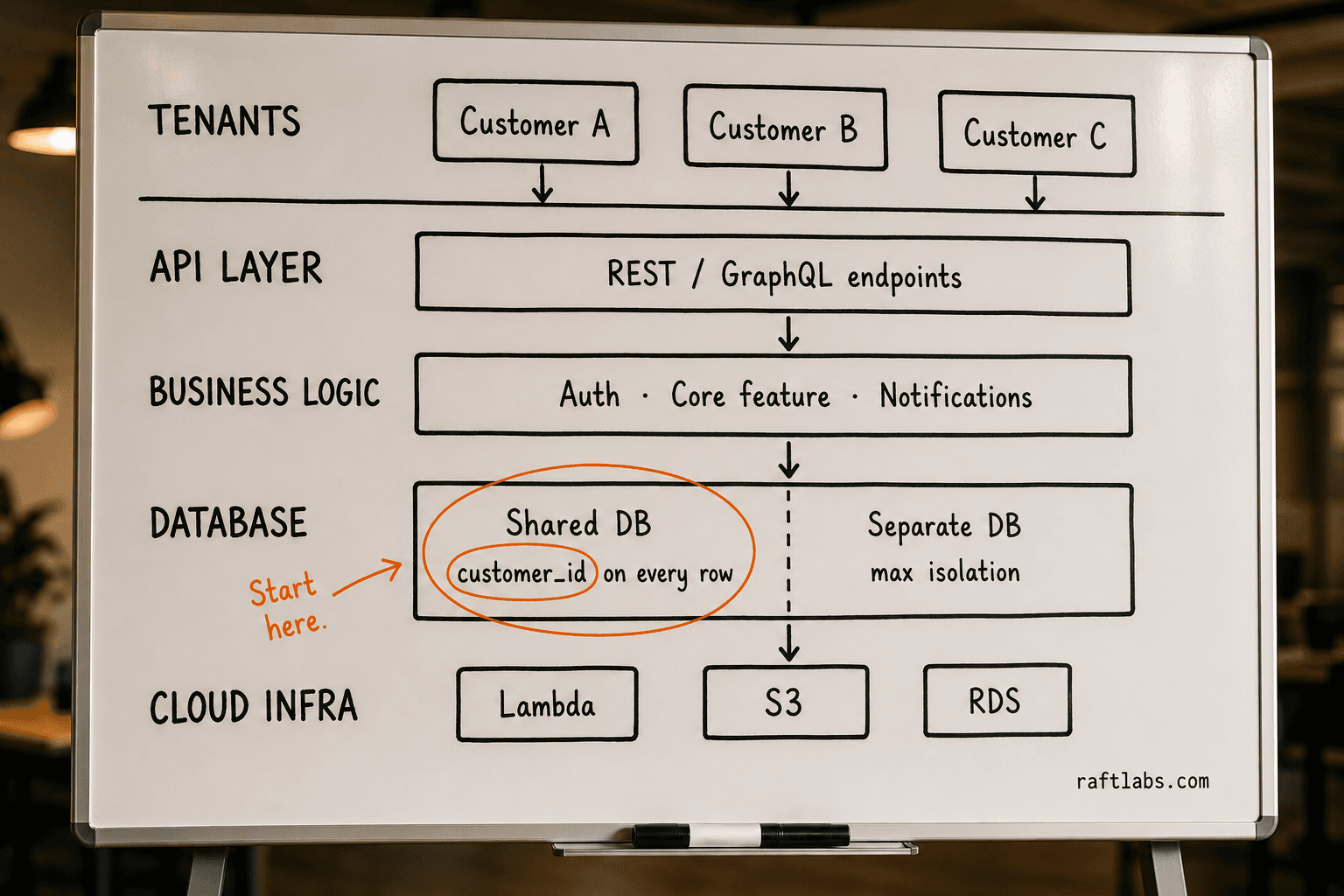
Build your data architecture to support multiple customers sharing the same application instance while keeping their data completely separate. This is fundamental to SaaS and difficult to retrofit later.
Two approaches work at MVP scale. Separate database per customer provides maximum isolation but becomes harder to manage at scale. Shared database with customer ID fields scales better but requires careful security implementation to prevent data leakage.
For MVPs, the shared database approach usually makes sense: simpler to manage initially. Confirm every database query includes the customer ID to filter data properly.
2. API-first development
Design your application so that core functionality is exposed through APIs. This means you can build a web app, mobile app, or allow third-party integrations later without rewriting the main logic. Your frontend should always communicate with the backend through APIs, even if you're starting with just a web app.
3. Modular codebase structure
Organize code into logical modules: authentication, billing, core features, notifications, data management. Modular architecture lets you modify or replace individual pieces without affecting the entire system.
You don't need microservices for an MVP. But thinking in modules sets you up to extract components into separate services later when scaling demands it.
4. Environment separation
Set up separate environments for development, staging, and production from the beginning. New or untested changes stay in development and staging until they're ready. This prevents accidental breakage of the live product.
5. Security basics built in
Implement fundamental security during development, not as an afterthought: HTTPS for all data transmission, secure password storage using proper hashing, protection against SQL injection and cross-site scripting, and regular dependency updates.
Security violations destroy trust and can end an early-stage product. Building these practices in from the start costs little extra time but prevents expensive incidents later.
6. Monitoring and logging
Set up basic monitoring that alerts you when something breaks. You need to know immediately if the application goes down, if errors spike, or if critical workflows stop working. UptimeRobot for availability and Sentry for error tracking cost little but provide essential visibility.
7. Database design for growth
Use indexing on fields you search frequently. Use foreign keys to maintain data consistency. Avoid storing the same data in multiple places. You don't need to prepare for millions of records immediately, but a poorly designed schema slows you down quickly as data grows.
Recommended Tech Stack for a SaaS MVP
| Layer | MVP Stage | Scale Stage | Why |
|---|---|---|---|
| Frontend | Next.js + TypeScript | Next.js + TypeScript | SSR out of the box, fast iteration, SEO-ready |
| Backend | Node.js + NestJS | Node.js + NestJS (microservices) | Consistent language, strong TypeScript support, modular |
| API layer | Hasura GraphQL | Hasura GraphQL + custom resolvers | Auto-generates APIs from data model, reduces boilerplate 40-60% |
| Database | PostgreSQL | PostgreSQL + read replicas | Handles SaaS multi-tenant data model cleanly, proven at scale |
| Auth | AWS Cognito or Clerk | AWS Cognito | SSO, MFA, and role management without building from scratch |
| Cloud / Hosting | AWS (Lambda + S3 + RDS) | AWS (ECS or EKS) | Serverless keeps MVP infrastructure cost near zero at low usage |
| Real-time features | Agora (audio/video), Pusher (WebSockets) | Agora, custom WebSocket layer | Pre-built SDKs cut weeks off the build |
| Payments | Stripe | Stripe + revenue recognition layer | Best documentation; handles subscriptions, usage billing, metered pricing |
| Monitoring | Sentry + basic CloudWatch | Datadog or Grafana + Sentry | Error tracking from day one; full observability can wait until post-launch |
| CI/CD | GitHub Actions | GitHub Actions + staging environments | Automated deployments from the first sprint |
Three decisions that matter more than any individual tool:
PostgreSQL over MongoDB for most SaaS. Document databases sound appealing at the MVP stage. They become a liability when your data model needs relational consistency, which almost every multi-tenant SaaS eventually does. Start relational and you never need to migrate.
Serverless first, containers later. AWS Lambda at MVP stage means infrastructure cost is near zero until you have real traffic. The migration path to containers is straightforward when needed. Moving straight to Kubernetes at the MVP stage is one of the most common forms of premature optimization.
GraphQL from day one if your data model is complex. If your SaaS has multiple entity types, relationships between them, and different user roles querying different data, Hasura GraphQL eliminates significant repetitive API work. If your product is genuinely simple (one entity, one endpoint), REST is faster to build and easier to maintain.
Essential SaaS MVP Features
These features make your MVP usable and trustworthy for early users.
User authentication and account management: Email and password at minimum, with optional social login (Google, Microsoft). Include password reset. Users will forget passwords, and a smooth recovery process prevents frustration.
Core feature set: Whatever functionality makes your product useful. For a CRM, contact management and deal tracking. For a project tool, task creation and assignment. These features should create one complete workflow that demonstrates your value clearly.
User dashboard: A clean home base showing relevant information and access to core features. Avoid cluttering it with features until usage data proves they matter.
Basic data management: Users need to add, view, edit, and delete data. This must work reliably. If users can't trust that their data is saved correctly, they lose confidence in everything else.
Notification system: Email notifications for critical events at minimum. In-app alerts as needed. Start with email: it works without requiring users to be logged in.
Basic settings and preferences: Email notification frequency, time zone, profile information. Don't build extensive customization. Give users control over settings that directly affect their experience.
Payment integration: If you're charging, integrate Stripe or Paddle from the start. Don't build your own payment system. Use a proven solution.
Basic analytics: Implement event tracking for key actions: signups, feature usage, retention. Mixpanel or Amplitude for product analytics. Track what matters for validation, not everything you can measure.
Successful SaaS MVPs: Real Examples
Dropbox Started With a Demo Video
Before building a full product, Dropbox created a short demo video showing how file synchronization would work. No working product. Just a clear walkthrough of the core idea.
The video generated thousands of beta signups from early tech communities. That validated massive demand with minimal development effort. Only after seeing that response did Dropbox build the actual product.
Buffer Launched With Two Pages to Test Pricing
Buffer's initial MVP was two pages. Page one explained the idea of scheduling social media posts. When users clicked to get started, they saw pricing plans, for a product that didn't exist yet.
After selecting a plan, users were told the product was still in development and added to a waitlist. This validated both interest in the idea and willingness to pay before writing any production code.
Airbnb Started by Renting Air Mattresses
The original Airbnb MVP was a basic website called "AirBed & Breakfast" offering air mattresses in the founders' San Francisco apartment during a design conference. They hosted a few guests and observed real behavior.
This small experiment showed that people would stay in a stranger's home when the experience, location, and price made sense. That early validation justified building the full platform.
SaaS MVPs RaftLabs Has Built
Perceptional: conversational AI SaaS for product discovery
A former Amazon product manager was spending hours processing static customer interview forms. He needed something that asked follow-up questions, adapted in real time, and surfaced what users actually meant, not just what they typed.
The MVP hypothesis: Replacing static feedback forms with a conversational AI that adapts based on user responses will give product managers higher-quality insights in less time.
What RaftLabs built first: A single-feature SaaS web app: an AI chatbot that conducted structured interviews, interpreted responses using NLP, and surfaced clear patterns for the PM reviewing the session. No multi-user features. No reporting suite. Just the core conversation engine and a clean output view.
What the MVP validated: Output quality was meaningfully better than surveys. Early users consistently said the AI surfaced things they would have missed in a flat form. That signal justified investment in the broader platform.
What it became: A full SaaS platform where product teams build custom AI interview flows, run them at scale, and aggregate findings across multiple sessions without manual analysis.
PSi: voice chat SaaS for scalable decision-making
Businesses and institutions needed a way to gather input from large groups in real time. Not 10 people around a table, but 100 or 1,000 people simultaneously. Traditional methods were too slow, too expensive, and biased toward whoever spoke loudest.
The MVP hypothesis: Giving large groups a real-time audio platform for anonymous discussion and voting will produce faster decisions with broader participation than any existing method.
What RaftLabs built first: The core group discussion engine: splitting users into anonymous breakout tables, enabling live audio via Agora, and capturing structured voting data. No admin dashboard. No advanced analytics. Just the mechanism that tested whether anonymous group audio discussion could replace in-person facilitation.
The specific technical problem the MVP had to solve: At the time, splitting users into discussion groups took 5-10 seconds, long enough to break the flow of a live session. RaftLabs refactored the algorithm until group assignment happened in under 1 second regardless of participant count.
Measured outcomes after scaling:
10x more participants engaged per session vs. traditional methods
98% cost reduction per decision session
75% faster decision-making vs. in-person formats
Built and launched in 14 weeks from kickoff
Telehealth platform: remote care SaaS for healthcare providers
Healthcare providers needed to deliver remote consultations and care coordination without rebuilding their entire clinical workflow. Existing telehealth tools were either too generic or too expensive for smaller practices.
The MVP hypothesis: A telehealth platform scoped to specific care model workflows will produce faster provider adoption and higher patient appointment completion than a generic solution.
What RaftLabs built first: This healthcare SaaS MVP covered secure video sessions, patient record linkage, appointment scheduling, and basic remote monitoring data capture, all in a HIPAA-compliant environment. Billing integration, complex analytics, and multi-provider network management came later.
What the MVP validated: Workflow fit mattered more than feature breadth. Providers could run remote consultations and access patient context in the same view, reducing the friction that caused drop-off in generic tools.
What it became: A full remote care platform supporting multiple consultation types, automated patient follow-up, monitoring device integrations, and a clinical admin layer for coordinating care across a provider network.
What these three have in common: none launched with everything. All launched with one thing that tested one assumption. What the team learned in the first 6-8 weeks of real usage shaped the product more than anything planned before launch.
Validate your SaaS idea before you over-invest RaftLabs scopes and builds MVPs focused on testing your core hypothesis with real users. Schedule a call
SaaS MVP Development Cost
| MVP Tier | Typical Scope | Cost Range | Timeline |
|---|---|---|---|
| Basic MVP | Core functionality, single platform (web or mobile), basic design, minimal integrations | $10,000-$20,000 | 6-8 weeks |
| Standard MVP | Multiple core features, custom branding, web and mobile, essential integrations (payments, email) | $20,000-$40,000 | 12-14 weeks |
| Complex MVP | Advanced features, extensive custom design, multiple integrations, real-time functionality | $40,000-$80,000+ | 14-20 weeks |
What drives cost variation:
Feature scope has the biggest impact. Each feature adds development time, testing effort, and integration work. A tightly scoped MVP with five essential features costs much less than one with fifteen.
Technical complexity matters. Standard CRUD functionality is simpler and cheaper. Real-time collaboration, complex data processing, and AI add time and cost.
Design requirements affect pricing. Templates and standard UI components keep costs lower. Custom design requires more effort.
Platform choices change cost. A responsive web app is cheaper than separate native iOS and Android apps. React Native or Flutter reduce costs compared to fully native builds when mobile is required.
Team location affects hourly rates. North American teams typically charge $80-$150/hr. Eastern European teams: $40-$80/hr. India or Southeast Asia: $25-$55/hr. Rates alone don't tell the full story. Communication, time zones, and experience all affect the actual outcome.
For detailed MVP cost breakdowns, see our complete MVP development cost guide.
SaaS MVP Development Timeline
Most SaaS MVPs take 6-12 weeks from kickoff to launch.
Discovery and planning (1-2 weeks): Defines what you're building and why. Includes stakeholder interviews, feature prioritization, technical architecture, and requirements documentation. Teams that rush or skip discovery face expensive rework when assumptions prove wrong.
Design phase (2-3 weeks): Starts with wireframes, moves to high-fidelity mockups, then interactive prototypes. Thorough design work reduces development time by giving engineers clear specifications and revealing usability issues before they become code.
Development phase (3-6 weeks): Frontend and backend often develop in parallel. Backend builds databases, APIs, and business logic while frontend creates interfaces connected to backend services. The complexity of the MVP determines how long this takes.
Testing and QA (1-2 weeks): Functional testing, integration testing, security testing, and performance testing. Cutting time on testing leads to user-facing bugs that damage your reputation and require emergency fixes.
Deployment and launch prep (1 week): Production infrastructure configuration, monitoring setup, security implementation, documentation. Rushed deployment creates instability. Proper launch preparation delivers a reliable first experience.
Post-launch iteration (ongoing): Budget at least 2-3 months for iteration based on user feedback. This is where your MVP transforms from a validation tool into a growing product.
Metrics to Measure SaaS MVP Success
Activation rate: What percentage of signups complete the step that delivers your primary value? Low activation usually means poor onboarding or unclear core value.
Day 7 and Day 30 retention: How many users return after their first session? Poor retention suggests the solution doesn't solve the problem as well as you thought, or the problem isn't painful enough to drive habit formation.
Feature usage depth: Which features get used frequently, and by how many users? Features rarely touched might be poorly designed, unnecessary, or solving a problem users don't actually have.
Time to value: How long between signup and the first time a user experiences your core benefit? Shorter is better. If most users take three hours to reach their first success moment, compress that timeline before adding features.
Trial-to-paid conversion: Healthy conversion rates for SaaS products typically range from 10-25%. Low conversion suggests pricing is wrong, the product doesn't deliver enough value, or users don't experience sufficient benefit during the trial period.
Customer acquisition cost vs. lifetime value: Sustainable SaaS businesses need customer lifetime value at least 3x higher than acquisition cost. Calculate this early.
Monthly churn rate: High churn after several months of iteration signals fundamental product-market fit issues that features won't fix.
How to Choose a SaaS MVP Development Company
Specific SaaS MVP experience: Building MVPs requires different thinking than building enterprise software. Ask about their approach to feature prioritization and what happens when user feedback suggests pivoting. Good answers demonstrate understanding of the MVP mindset, not just software development.
Relevant portfolio and domain experience: Domain experience accelerates development and helps teams avoid known pitfalls. If you're building a marketplace, look for marketplace experience.
Communication quality: Notice how well they listen during initial conversations. Do they ask clarifying questions or jump straight to solutions? Do they explain technical concepts accessibly? Teams that communicate clearly during sales communicate well during development.
Clear development process: Look for agile methodologies with regular sprint cycles, staging environments for testing, clear documentation practices, and appropriate involvement of you in key decisions. Avoid partners who can't articulate their process.
Post-launch support and iteration: Your MVP needs ongoing iteration after launch. Ask about maintenance models and whether team members stay involved for the iteration phase.
Verified references: Ask references whether the team delivered on time and within budget. Ask how they handled unexpected challenges. Ask if they'd work with the partner again. Vague positive feedback might indicate a poor experience.
Red flags: Unwillingness to commit to timelines or budgets. Promises of unrealistic delivery (8-week MVP in 3 weeks). No questions about your business goals. Pressure to build everything immediately. Portfolios showing only complete products without MVPs.
When to Scale Your SaaS MVP to Full Product
Validated product-market fit: Organic growth through word of mouth, strong retention over 90+ days, and users actively referring others.
Consistent feature requests from multiple users: If 10+ different users ask for the same capability independently, that feature matters. Random one-off requests can wait.
Losing customers to missing features: If qualified prospects consistently cite the same missing feature as their reason for not buying, and that feature aligns with your product vision, prioritize it.
Technical limits affecting user experience: If performance, reliability, or infrastructure constraints prevent growth or frustrate users, technical scaling becomes necessary.
Competitive pressure: If competitors start offering features your users value and it threatens your core differentiation, respond strategically. Don't match every feature. Protect what makes you the better choice.
Revenue supporting additional investment: Scaling from MVP to full product requires capital. If your MVP generates recurring revenue that can fund development, or you've raised funding based on MVP traction, you have resources to invest in expansion.
Conclusion
SaaS MVP development gives founders a practical path to validate product ideas without betting everything on assumptions. By building the minimum feature set needed to test your core hypothesis, you reduce risk, preserve runway, and learn what actually works with real users.
The most successful SaaS MVPs focus relentlessly on one specific problem for a well-defined audience. They ship quickly to gather real feedback rather than perfecting features in isolation. They measure what matters and iterate based on data, not opinions. And they treat the MVP as a learning tool, not a cheap version of the final product.
If you're ready to start building your SaaS MVP, RaftLabs can scope your project honestly: what to build first, what to defer, and what timeline and budget actually look like for your specific hypothesis.
Ask an AI
Get an instant summary of this post from your preferred AI assistant.
Frequently asked questions
- SaaS MVP development typically costs $10,000-$40,000. Basic MVPs with core functionality and standard design cost $10,000-$20,000. Complex MVPs with custom design, multiple integrations, and advanced features cost $20,000-$40,000. MVPs requiring compliance or complex business logic can exceed $40,000. RaftLabs has shipped 30+ SaaS MVPs across this range.
- Include only what's necessary to test your core hypothesis. Every SaaS MVP needs user authentication, the primary feature that solves the main problem, a basic dashboard, fundamental data management, a simple notification system, basic user settings, and payment integration if you're charging. Cut anything that doesn't directly validate your hypothesis. It delays the feedback loop.
- The clearest signals are users completing your core workflow within the first session (activation), returning after day 7 and day 30 (retention), and requesting the same additional feature independently from 10+ different users. If users pay for it, use it weekly, and tell others without prompting, your MVP has validated market demand.
- No-code works for simple applications, quick hypothesis testing, and internal tools with limited users. Products that reach 5,000-10,000 users, require non-standard logic, or need deep integrations consistently hit no-code limits. The migration to custom code at that point costs more than a custom build would have at the start. If you have evidence of demand and are building for scale, custom development is the better investment.
- The right partner has specific SaaS MVP experience and can explain how they approach feature prioritization. They have portfolio examples similar to your project. They ask hard questions about your business goals before jumping to a technical spec. They explain their process clearly. And they have references from similar projects who would hire them again without hesitation.