Short answer
RaftLabs built PSi, a UK-based anonymous voice chat platform for real-time group decision-making. The platform supports 300+ simultaneous users in audio discussions, automatically splits large groups into smaller discussion tables in under one second, and captures real-time voting and engagement data during the session. Organizations using PSi engage more participants at lower session costs compared to facilitated in-person workshops. Built in 14 weeks using Next.js, Agora for real-time audio, Hasura, and PostgreSQL.
The situation
Organizations that need broad input face a structural problem. Small meetings exclude most voices. Large video calls give the floor to whoever speaks first, and the decision usually goes to whoever argues best in the room rather than to whoever has the evidence. Surveys collect opinions but lose the deliberation that actually changes minds. None of these approaches produce the kind of consensus that comes from a genuine group conversation.
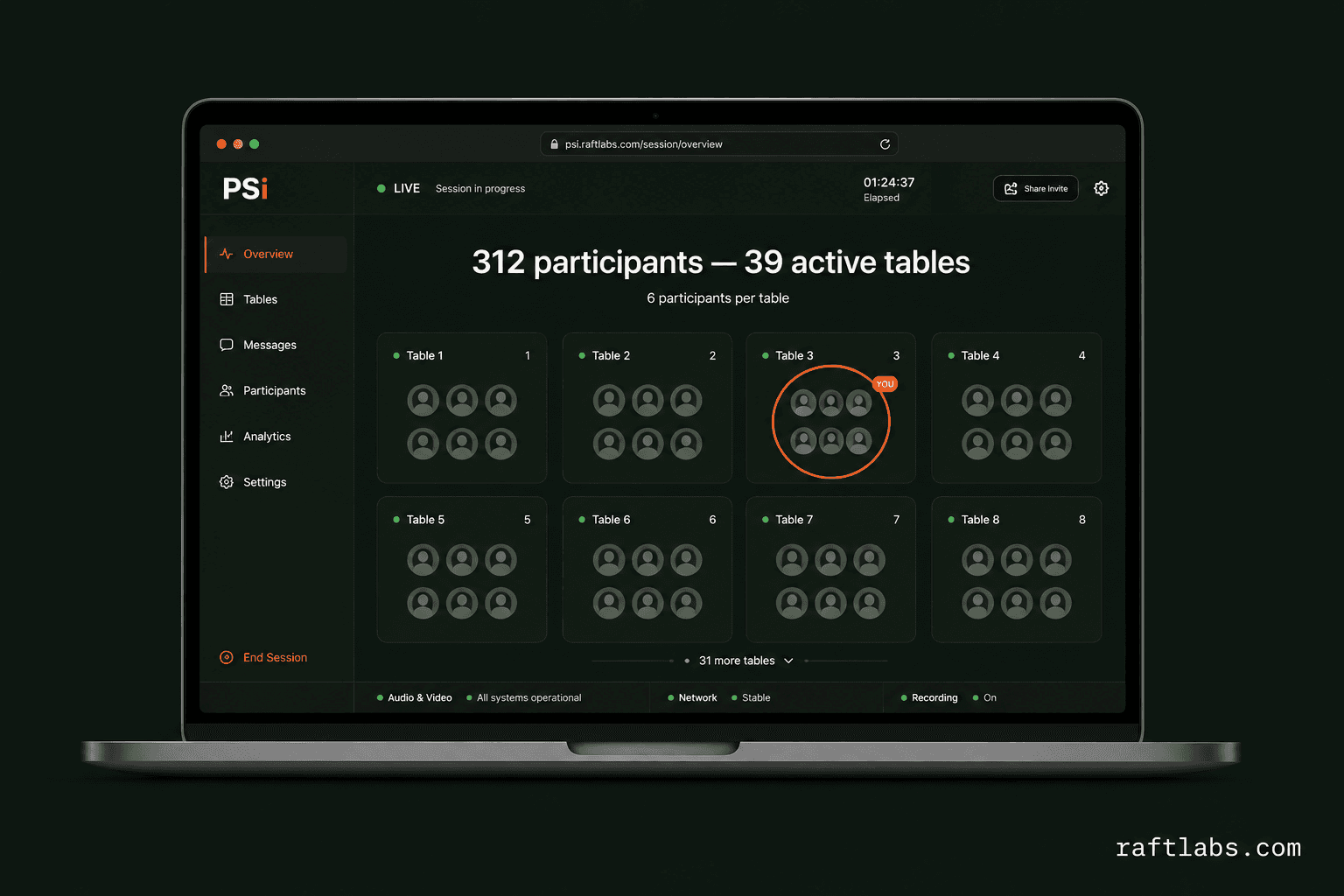
PSi's founders came to us with a different model: anonymous real-time voice discussions where groups of any size break into small tables automatically, deliberate in parallel, and surface collective signal through live voting, all without any participant knowing who said what. We built it in 14 weeks. PSi now supports 300+ simultaneous users in audio sessions.
Engagement
The PSi engagement
- Client
- PSi, a platform for anonymous real-time voice deliberation at scale
- What we built
- A web app where groups of any size break into small voice tables automatically, deliberate in parallel, and surface collective signal through live voting
- Delivery
- 14 weeks, web platform
- Stack
- React, Agora, Hasura, PostgreSQL
- Status
- Live. This build later informed the Voter IQ engagement
Before and after
What changed
- Decision sessions were limited to small groups in person or on video calls, and organizations could not include more than 15-20 active voices at once without the session becoming unmanageable
- In-person facilitated deliberation sessions for large groups (venue, facilitation, travel) cost too much to run regularly; the process was reserved for high-stakes one-off decisions
- Survey alternatives collected opinions but stripped out the interaction and deliberation that build genuine consensus; people answered questions rather than discussing them
- Dominant voices in group settings shaped outcomes disproportionately; quieter participants held back, and the decision reflected who spoke rather than where the group stood
- Groups had no real-time signal on where discussion was trending; the collective view only emerged after a manual post-session analysis
- 300+ users participate simultaneously; the table-splitting algorithm automatically divides large groups into focused conversation tables in under one second without disrupting session flow
- Anonymous voice removes the social pressure of being identified: participants engage more freely, and the discussion surfaces perspectives that stay silent in attributed settings
- Real-time voting and engagement data show where the group stands during the session, not after analysis; facilitators see emerging consensus as the discussion unfolds
- A complete data record of discussion patterns and voting supports post-session review and audit
What we had to solve
Splitting 300+ users into discussion tables in under one second without disrupting conversation flow
The original table-splitting logic took 5 to 10 seconds for groups larger than 10 users, long enough to break conversational momentum and make the transition feel like a system failure. At 300+ users, that delay was unacceptable. Rewriting the allocation algorithm to run in under one second for any group size required restructuring how table assignments were computed and synchronized across connected clients. The fix eliminated the pause without changing what users experienced on either side of the table split.
Maintaining meaningful anonymity in a live voice platform without losing session integrity
Anonymity in a voice platform creates a different set of challenges than in text-based tools. Participants can recognize voices, which breaks anonymous attribution even if names are hidden. The platform needed to signal presence and discussion activity without revealing identity, building a session experience where users felt genuinely unidentifiable, not just unlabeled. Getting that right required design decisions about how audio indicators, voting responses, and engagement signals were surfaced without connecting them to a specific person in the room.
Proof
What the build delivered, and what this page can't claim
Project-recorded delivery facts. No before-and-after outcome measurements (consensus speed, cost comparison) were available with a source, so none are shown.
| Result | What changed | Period or context | Evidence and limitation |
|---|---|---|---|
| Delivery | 14 weeks from zero to a live production platform | Web app with real-time voice, table splitting, and live voting | Project-recorded |
| Scale | 300+ simultaneous users in real-time audio sessions | The table-splitting algorithm divides groups into focused tables in under one second | Project-recorded; the allocation rewrite was built specifically for this scale |
| Outcome measurements | Not available | No sourced figures for consensus speed or cost comparison | Stated rather than estimated. Earlier versions of this page carried percentage claims with no source; they have been removed |
the build
What we built
PSi is designed around the insight that good decisions come from broad, genuine participation, and that requires removing the barriers that shrink participation in traditional settings.
Hundreds of participants assigned to focused discussion tables in under one second
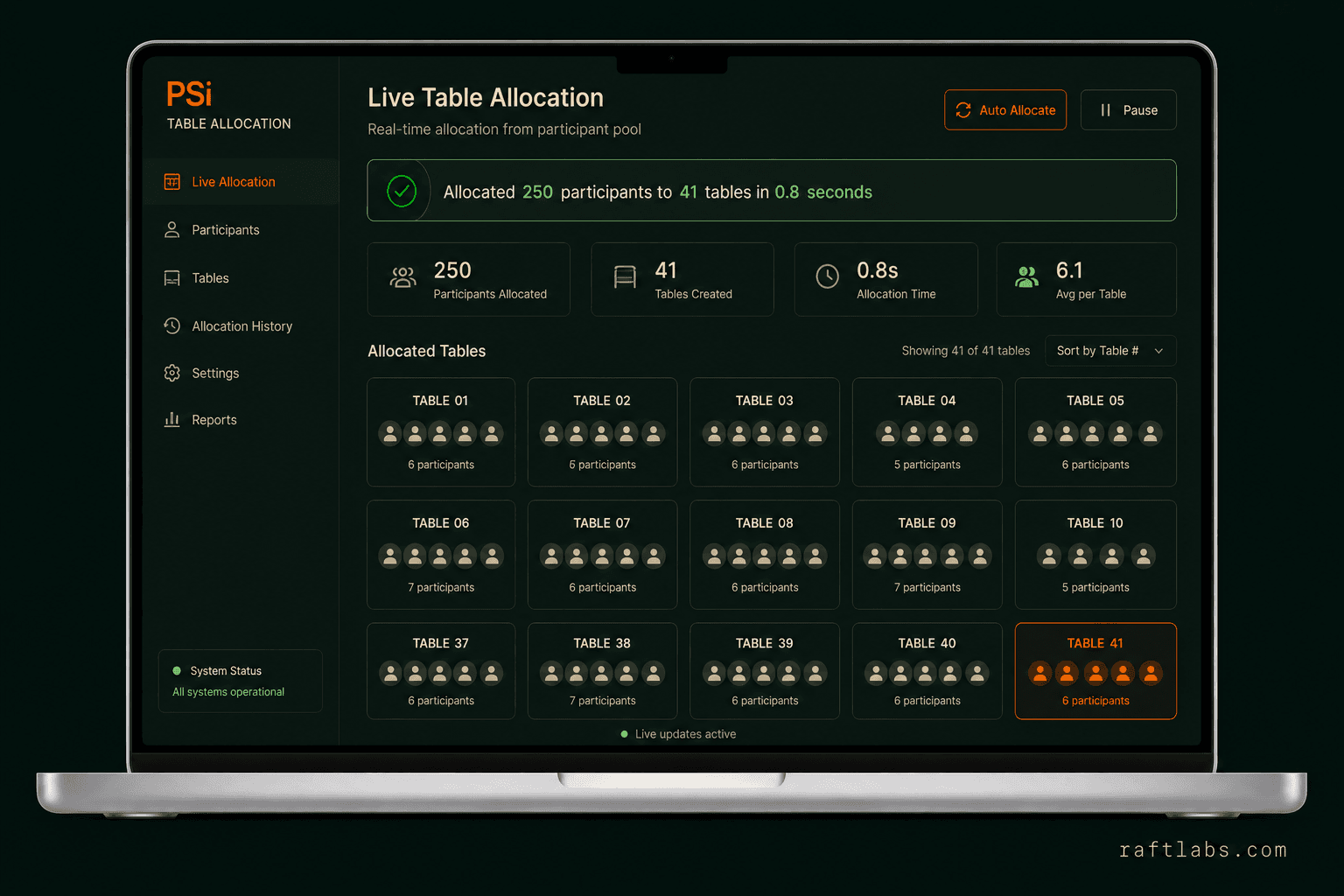
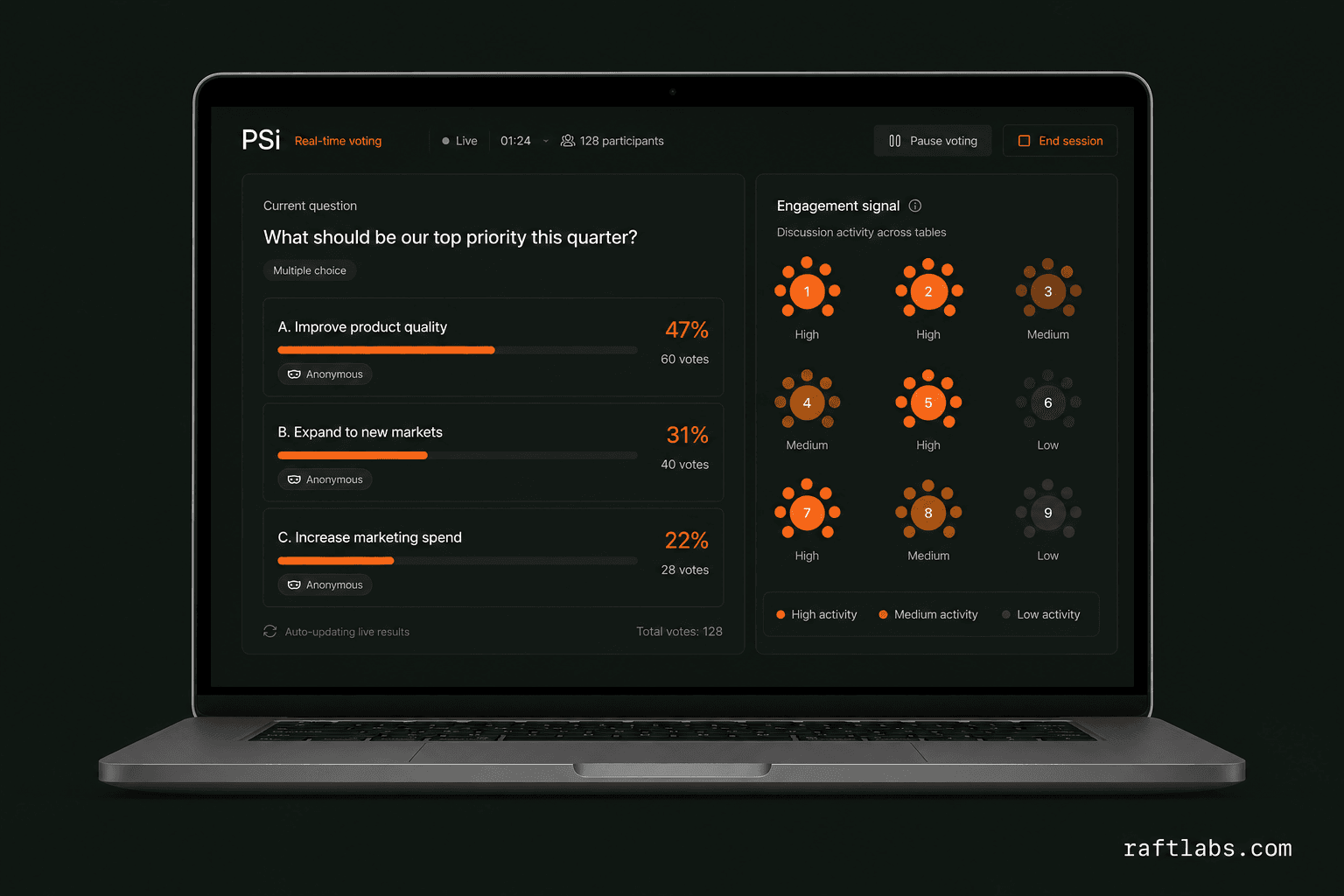
When a session begins, the platform assigns hundreds of participants to smaller discussion tables in under one second. Tables are sized for focused conversation, typically 5 to 8 people. After each table discussion round, participants rotate to new tables, exposing different perspectives across the group. The rewrite of the table allocation algorithm eliminated the 5-10 second delay that broke conversation flow in the original implementation.
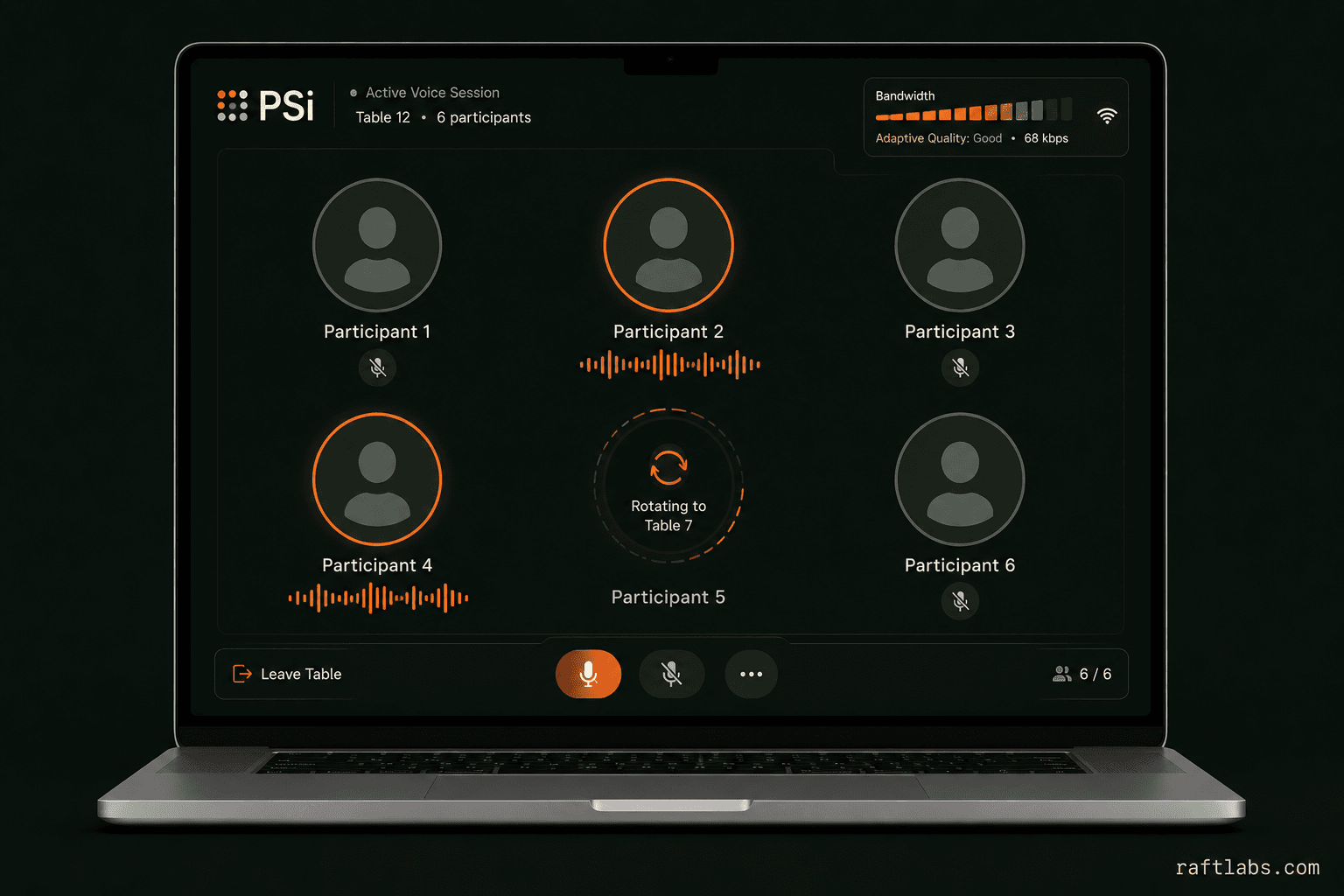
Participants move between tables without dropping; slower connections stay in the session
Audio sessions run through Agora's real-time communication infrastructure for low-latency voice across hundreds of concurrent participants. Participants move between discussion tables without dropping their connection. The audio layer adapts to bandwidth variation without interrupting the session; users on slower connections maintain participation without being dropped from a table mid-discussion.
Group sentiment visible in real time, no post-session manual processing
Participants vote anonymously during and after table discussions. Real-time tallies show where the group stands as the session progresses, not after manual post-processing. Discussion engagement signals surface trends without attributing them to specific participants. The session data record is complete for post-session review: vote distributions, participation patterns, and discussion activity across all tables.
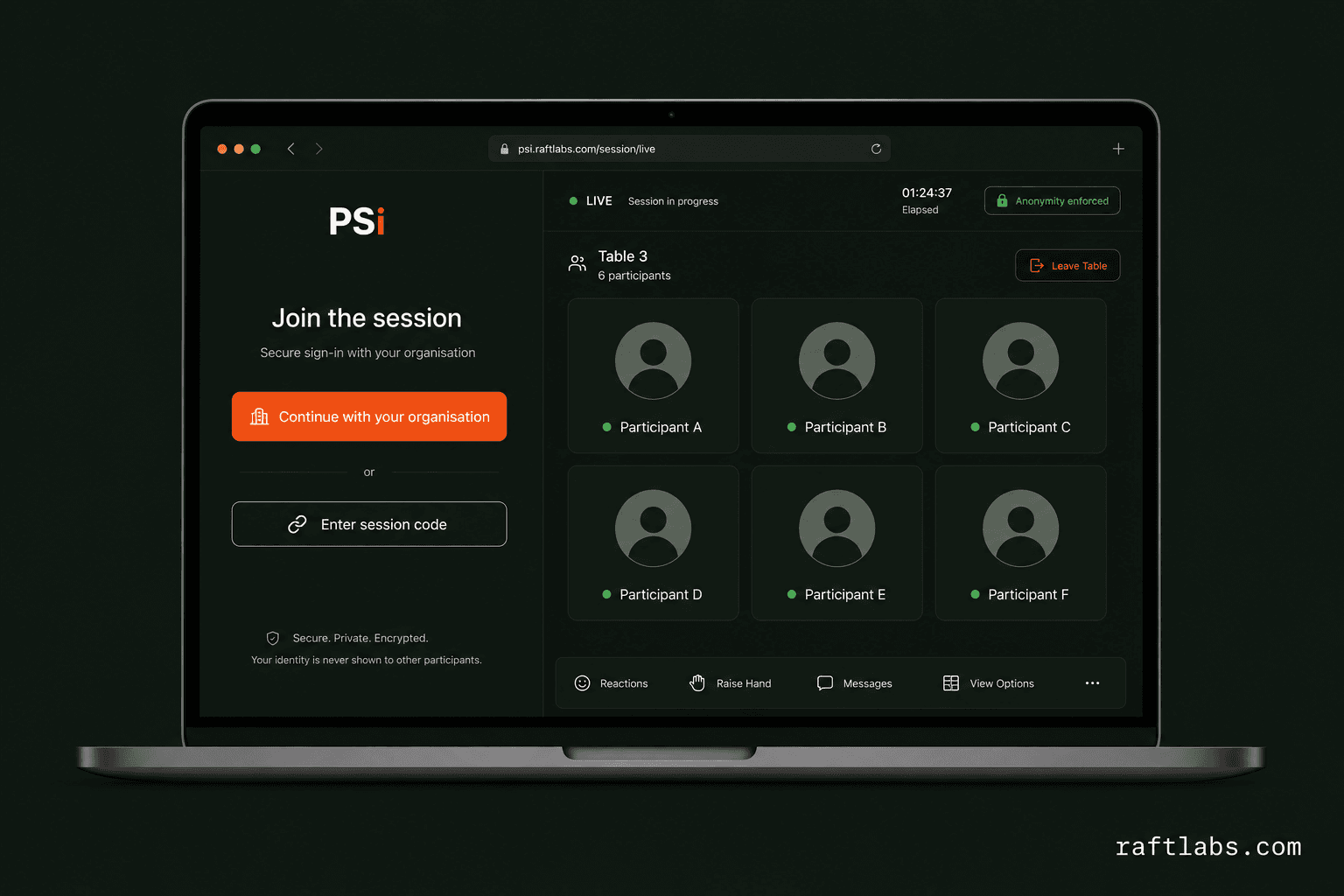
Participants log in with existing credentials; what they say and vote stays anonymous
Organizations access PSi through Single Sign-On via AWS Cognito; participants authenticate with their existing organizational credentials without creating a separate account. Inside the session, identity is decoupled from participation: the platform knows who is present for session integrity purposes, but what each participant says and votes is not attributed to them in any visible way. The anonymity layer is enforced at the data level, not just the display level.
The lesson
The format is the product
The format was the product, but the fix was never a better video call. What the build turned on was anonymity: strip attribution from a group conversation and the social pressure drains out of it. People answer the question instead of performing for the room. Every engineering decision on PSi, from the rotating tables to the data-layer anonymity, existed to protect that property.
The design decision that mattered was anonymity. In an attributed setting, the discussion reflects who spoke rather than where the group stood. Anonymous voice removes the social pressure of being identified, and the live voting turns the room's emerging view into something a facilitator can see while the discussion is still happening. The technology carries the audio. The format carries the decision.
How it runs
- Agora
- Real-time audio for 300+ simultaneous users requires infrastructure purpose-built for that scale. Agora's audio SDK handled low-latency voice across large concurrent sessions, adaptive bitrate for varying connection quality, and the table-movement mechanic where users transition between discussion rooms without dropping their audio connection. Building this on WebRTC alone would have required managing the connection mesh ourselves; Agora abstracted that complexity while giving us the control we needed for session management.
- Next.js
- Participants joining mid-session need to see the current state immediately (active tables, ongoing vote tallies, discussion status) without waiting for client-side hydration. Next.js server-side rendering delivered that initial load fast, and the client-side layer handled the live updates that followed as votes came in and tables reorganized.
- Hasura
- Table assignments, vote records, participation data, and session analytics changed simultaneously across hundreds of active users. Hasura's real-time GraphQL subscriptions pushed those state changes to every connected client as they happened, with no polling required. The platform reacted to events in real time rather than checking for updates on an interval.
- PostgreSQL
- Votes, participation patterns, and session records needed ACID-compliant storage so the data captured during a session was complete and defensible for organizational decision records. No vote could be double-counted or partially written under concurrent load. PostgreSQL's transactional guarantees made the post-session data audit-ready.
Common questions
It is a real concern, and we designed around it. The platform does not display any attribution (no names, no usernames, no persistent identifiers) during audio discussions. Table assignments rotate so participants do not spend extended time in the same small group, which reduces the likelihood of voice recognition affecting behavior. Participation indicators (audio activity signals, vote submissions) are shown at the table level, not attributed to individuals. The anonymity is enforced at the data layer: what each participant says and votes is recorded in aggregate for session analytics, but not linked back to their identity in any accessible form.
The table-splitting algorithm runs server-side on session start and on rotation events. When 300 participants join, the algorithm assigns them to tables simultaneously, a computation that completes in under one second regardless of group size. The original implementation took 5 to 10 seconds for groups over 10, which we rewrote entirely. Agora handles the audio room assignments in parallel with the table data updates so participants enter their discussion table in the same motion as the algorithm completes. Load testing before each major deployment confirms the platform handles concurrent joins without queue delays.
A traditional deliberative workshop for 100+ people requires weeks of scheduling, significant cost, and produces a result shaped by who was in the room and who spoke up. A survey collects individual opinions but loses the interaction that shifts positions. PSi runs a structured deliberative process in hours: participants hear multiple perspectives through table rotation, vote after each round, and the platform surfaces where collective opinion has moved in real time. Facilitators can see emerging consensus during the session and adjust the process accordingly. PSi compresses the logistics of a large deliberation (scheduling, room management, manual table assignment) into the platform itself, so the session time is spent deliberating rather than organizing.
PSi is used for decisions that require genuine input from a large, diverse group and where the outcome's legitimacy depends on that breadth. That includes corporate strategy consultations where leadership needs input from employees beyond a senior team, civic deliberation processes where governments or public institutions need representative community input, large-group organizational change processes, and academic or research deliberative polling studies. The platform is not designed for small team decisions: it is most valuable when the group is large enough that traditional methods exclude most voices.
We delivered PSi (real-time audio for 300+ users via Agora, automatic table splitting, anonymous voting and live session data, SSO via AWS Cognito, Hasura real-time subscriptions, and a full session analytics data model) in 14 weeks. The most technically complex pieces were the table-splitting algorithm at scale and the anonymity architecture that works at the data layer rather than just the display layer. A platform with a single discussion room (no table splitting), without real-time voting, or with a simpler user model would be faster to build. Contact us to scope based on your group size, anonymity requirements, and session data needs.
Related work
More work like this

Elearning app development case study: a creator-led music learning platform built on Flutter, Hasura, AWS, and RevenueCat over two years
A creator-led music learning platform for Irish traditional music, built over two years across four releases. 48,100 tracked practice minutes, 100+ learners, and a subscription model built on RevenueCat rather than raw store APIs.

ULT Movies reaches 4,000 remote theaters with custom OTT app
Leading Indian movie distributor, ULT Movies, solved the challenge of delivering new releases to remote theatres with an Android app for STBs. Now, the distributor delivers smooth movie access even in areas with limited internet connectivity.
GE gets 85% quiz completion and 5,000 daily active users by replacing passive training with a mobile trivia platform
GE replaced passive corporate training with a gamified mobile trivia platform. 5,000 daily active users and an 85% quiz completion rate (client-reported), with 200+ content modules covering product knowledge, company history, and culture.