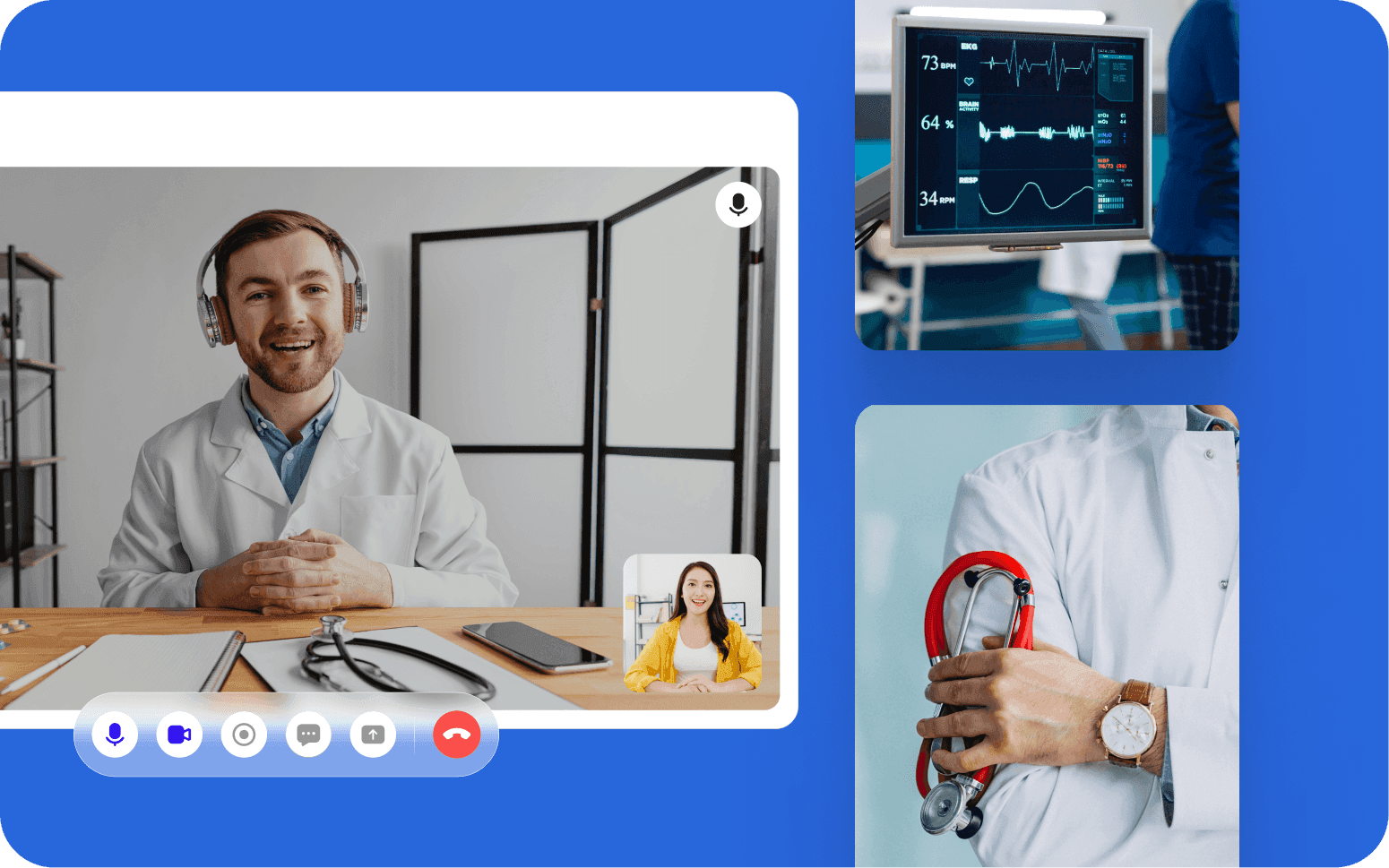
Healthcare mobile app development, compliant before the first line of code.
We build HIPAA-compliant iOS and Android apps for clinics, health systems, and digital health startups. Patient portals, telehealth, RPM, clinical field tools, and care management apps - designed for the people who use them and the regulations that govern them.
HIPAA-compliant by default - PHI encrypted at rest and in transit, audit logs, BAAs with every vendor
Offline-first for clinical environments - wards, home visits, and areas with no reliable signal
Connects to your EHR via HL7 FHIR R4 - Epic, Cerner, Athenahealth, and regional systems
Patient-facing and clinician-facing apps from the same team - no vendor handoff between them
Fixed price agreed before development starts - 10-14 week average delivery
60% reduction in in-person visits Telehealth platform·25+ clinics enrolled in 60 days Remote patient monitoring
Bring the problem, the current workflow, or the existing code. We reply with a practical next step within one business day.
The brief
Start with what is not working.
Good software decisions begin with the constraint, not a list of features or a preferred technology.
01
Clinicians switching between three apps to complete one patient encounter?
02
Your patient portal is a desktop-only web form and mobile users simply don't use it?
03
Previous app failed HIPAA audit because PHI was stored in device logs or local storage?
04
App rejected from the App Store because health data handling wasn't documented correctly?
Plain answer
RaftLabs is a healthcare mobile app development company building HIPAA-compliant iOS and Android apps for clinics and health systems in the US, UK, Ireland, and Australia. Patient portals, telehealth, RPM, and clinical field tools. Our telehealth platform onboarded 50+ clinics in 12 weeks. Fixed-price, with a validated v1 in 10-14 weeks.
What to remember
RaftLabs has shipped HIPAA-compliant mobile products across telehealth, RPM, patient portals, and clinical field tools, in production since 2015.
Fixed-price delivery, with a validated v1 launched in 10-14 weeks from discovery to App Store submission.
All healthcare apps include PHI encryption at rest and in transit, MFA, biometric unlock, and Business Associate Agreements with every vendor.
EHR integration is handled via HL7 FHIR R4 for Epic, Cerner, and Athenahealth.
Our telehealth platform onboarded 50+ clinics in 12 weeks; our RPM platform enrolled 25+ clinics in 60 days.
Patient-facing and clinician-facing apps are built by the same team, eliminating vendor handoff.
One patient encounter, three apps, and a portal nobody opens on their phone.
A nurse finishes a home visit and opens one app to log the encounter, another to check the medication list, a third to message the physician. The patient was sent a portal link that only works on desktop, so they never opened it.
Somewhere in that stack, PHI ended up in a device log, and the last app failed its HIPAA audit.
The fix is not another app. It is one app, built for the people who use it and the regulations that govern it.
In a 2024 McKinsey survey of healthcare leaders, 62% ranked patient and member engagement among the top areas where generative AI will add value, second only to clinical productivity (McKinsey, 2024). For health systems and digital health startups, the mobile app is no longer a convenience layer. It is the primary engagement surface, and its compliance and integration quality decides whether patient outcomes actually improve.
RaftLabs has shipped HIPAA-compliant mobile products across telehealth, RPM, patient portals, and clinical field tools, rated 4.9/5 by clients on Clutch. Our telehealth platform onboarded 50+ clinics in 12 weeks; our RPM platform enrolled 25+ clinics in 60 days. The team that maps your clinical workflows is the team that builds the app and handles App Store submission, so healthcare domain knowledge is applied from day one, not acquired on your project budget. EHR data flows both ways via HL7 FHIR R4 for Epic, Cerner, and Athenahealth, and every engagement is built to HIPAA and HITECH controls from the first line of code.
This pays off when there is a real clinical workflow and a system to connect to.
Everything on the left should already be true for your practice or health system. Even one thing on the right, and a configured off-the-shelf patient app is the smarter first step.
A fit
01
A clinical or patient workflow that off-the-shelf health apps can't fit, plus an EHR (Epic, Cerner, Athenahealth) to integrate against.
02
PHI in play, so HIPAA compliance has to be designed in, not bolted on before launch.
03
Budget for a fixed-scope build and a clinical lead who can sign off on scope.
Not a fit
01
A standard need a configured off-the-shelf patient app already covers well.
02
No EHR or booking system to connect to, and no defined clinical workflow yet.
03
Shopping for the cheapest hourly team, not a fixed-scope partner.
Offline-first iOS and Android apps for district nurses, home health aides, and field clinicians. Encounter documentation, photo capture, assessment forms, and medication administration records - all syncing to the EHR when connectivity returns.
05
Medication management and adherence apps
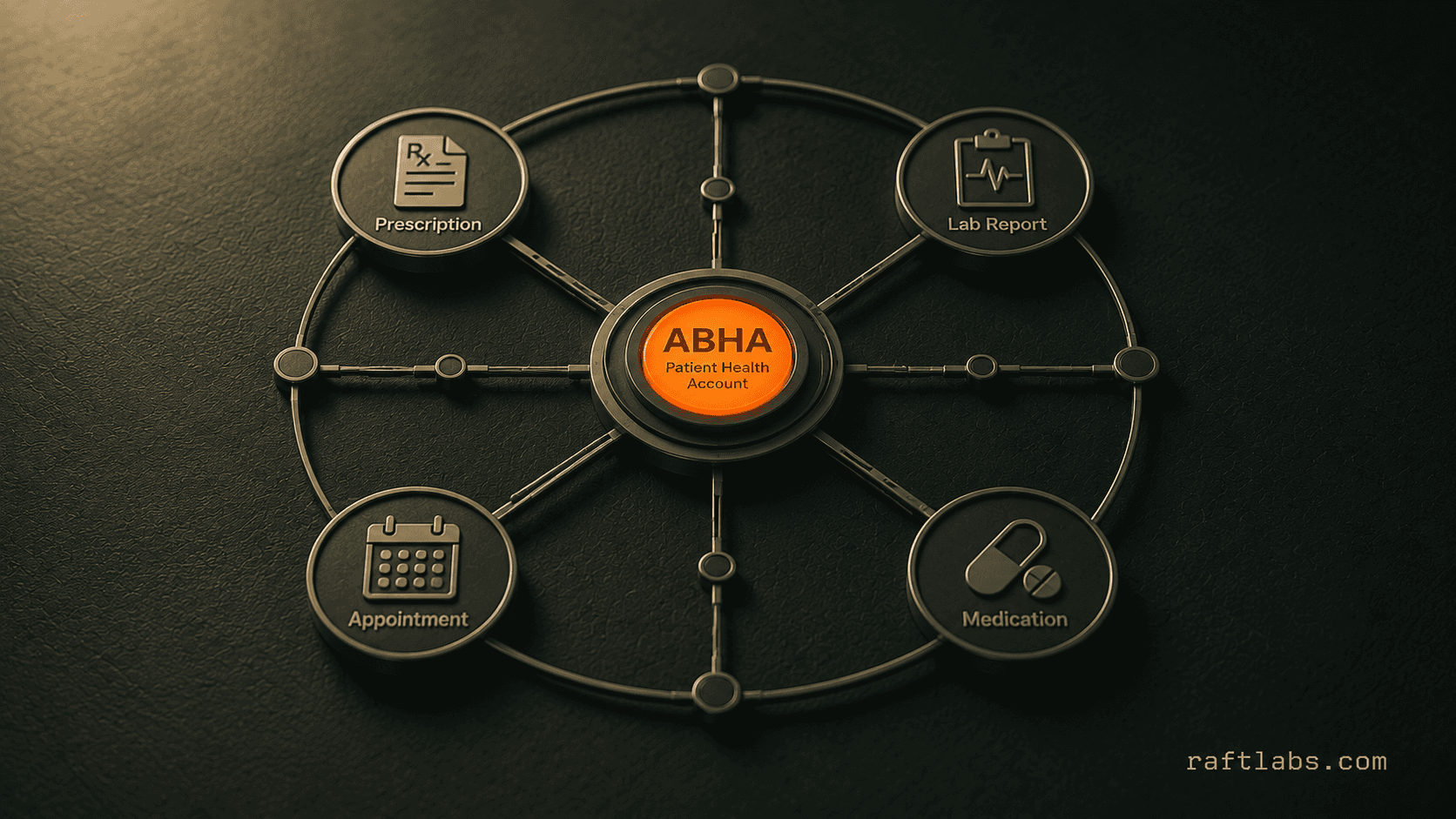
Medication reminders, refill tracking, interaction checking, and adherence reporting to the care team. Connects to pharmacy APIs and EHR medication lists so patients see the same drug list their clinician sees.
06
Chronic disease management apps
Condition-specific apps for diabetes, hypertension, COPD, and heart failure: symptom logging, lifestyle tracking, patient-reported outcomes, and care pathway guidance tied to clinical protocols.
07
Mental health and wellness apps
Mood tracking, CBT exercises, therapist messaging, crisis resource access, and session scheduling. Built to HIPAA standards because mental health data is PHI. App Store compliance reviewed before submission.
08
Clinical decision support apps
Point-of-care tools that surface relevant clinical guidelines, patient history, and protocol checklists at the moment of clinical decision. Context pulled from the EHR in real time via FHIR R4.
The stack is confirmed in the project brief so your security review and compliance team can assess it before development starts. Flutter and React Native cover a single iOS and Android codebase. Swift and Kotlin come in when a product needs HealthKit depth or hardware integrations. The backend runs on Node.js or Python, PostgreSQL with row-level security for PHI, and AWS infrastructure with server-side encryption. For clinical field tools, offline-first is not optional. Encounter data, forms, and assessments queue locally in wards with signal dead spots and on rural home visits, then sync to the EHR when connectivity returns. Conflict resolution means simultaneous updates never produce data loss.
Ready to scope your healthcare mobile app?
30 minutes. You leave with a clear cost, timeline, and a compliance architecture outline. No commitment required.
How it works
From scope to the App Store
Week 1
01
Clinical workflow mapping
We map every user type - patient, nurse, physician, front desk - through the workflows the app needs to support. You leave week one with a written scope, an EHR integration assessment, a HIPAA compliance architecture document, and a fixed-price quote.
Weeks 2-3
02
Compliance architecture and design
HIPAA controls, data flows, and PHI handling are designed before code is written. Every screen is wireframed and reviewed with your clinical leads. Figma files show how PHI is accessed, displayed, and protected at each step.
Weeks 4-12
03
Build, integrate, and QA
Bi-weekly sprint delivery. A working app build is available on TestFlight and Android beta from sprint one. QA and HIPAA compliance checks run in parallel with development at each sprint - not as a phase at the end.
Weeks 12-14
04
App Store submission and launch
We handle App Store and Google Play submission including health data privacy documentation, screenshots, metadata, and age ratings. We budget for one Apple review cycle. Your team receives full source code, compliance documentation, and app store credentials.
What clients say
What our clients say
Three-year average engagement. Founders and operators describing the work in their own words. No marketing varnish.
Grady Lakshmono
Indonesia
CoFounder, Gula (acquired by Runchise)
“
RaftLabs elevated my ideas and brought them to life when everything seemed impossible.
Healthcare mobile apps fail in predictable ways. We design around these from week one, not after the audit.
PHI leaking into logs
The most common HIPAA audit failure. We strip PHI from logs, crash reporters, and analytics SDKs, then confirm it with a data-flow review before launch.
App Store health rejection
Apple and Google reject health apps with undocumented data handling. We prepare the privacy declarations, data-use disclosures, and BAAs before submission, and budget for one review cycle.
EHR access found late
FHIR availability, sandbox access, and auth flow vary by system and vendor. We assess the exact connectivity method in week one, so integration is not a week-8 surprise.
Offline data loss
District nurses and home-health aides work in signal dead spots. Encounter data queues locally and syncs with conflict resolution, so simultaneous edits never overwrite each other.
Biometric unlock (Face ID, Touch ID, Android BiometricPrompt) and short session timeouts ship on every patient-facing app, so PHI is never one unlocked phone away from exposure.
Two shifts are reshaping healthcare mobile builds. FHIR is becoming the default EHR contract rather than a custom integration per vendor, and on-device biometric auth is replacing password-only access to PHI. We build to both now, so an app shipped today does not need re-architecting in eighteen months.
Where you land in these ranges depends on scope, not negotiation:
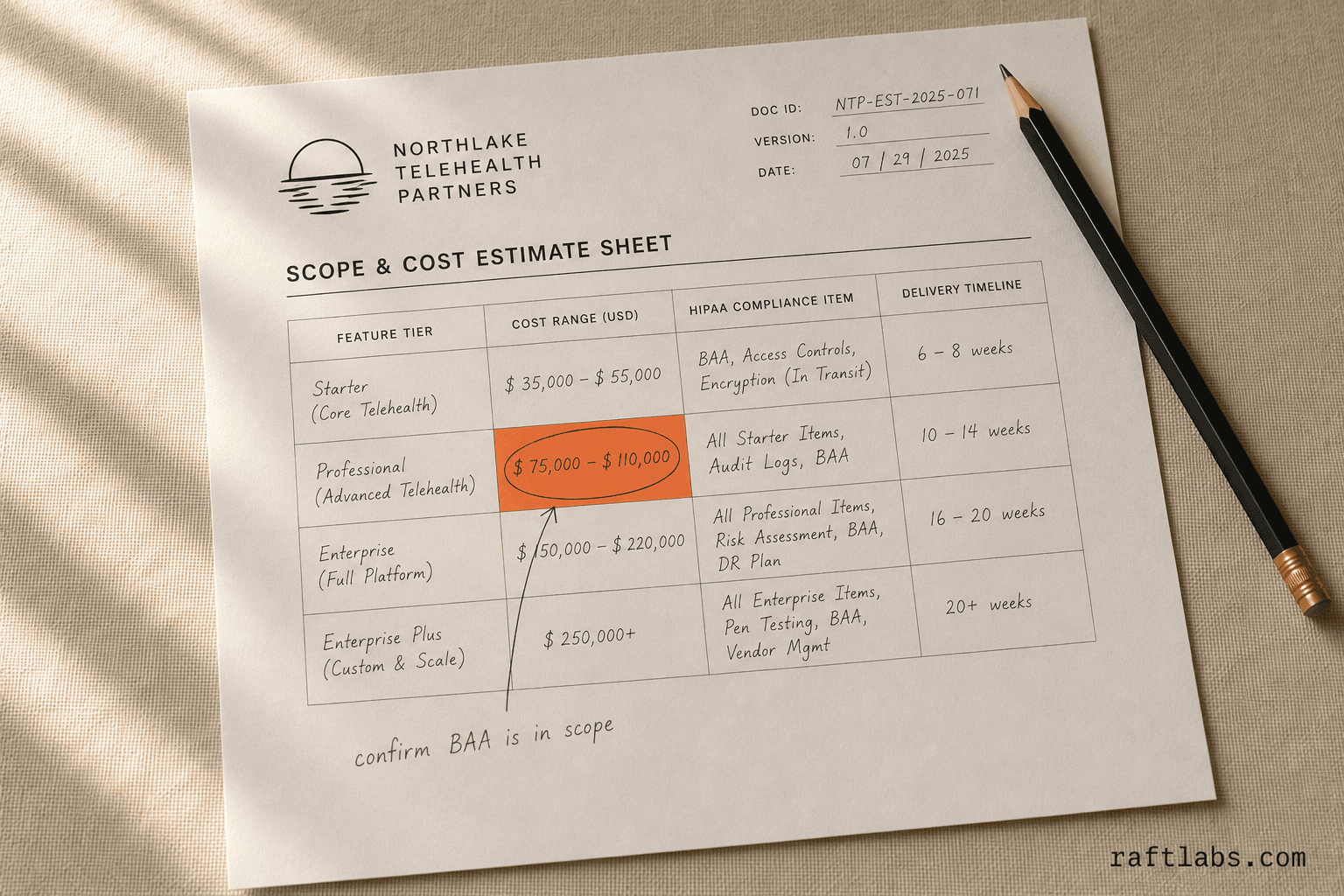
Focused patient app, $30,000-$60,000
Core workflow, EHR data display, secure messaging, and App Store delivery.
Telehealth platform, $60,000-$100,000
Video sessions, scheduling, and EHR integration.
RPM app, from $50,000
Device integrations for CGM, BPM, and pulse oximeter, scaling with the number of device types connected.
What it costs
Healthcare mobile apps, starting at $30,000.
One week of clinical workflow mapping, then a HIPAA-compliant build from discovery to App Store submission.
You get a written scope, a HIPAA compliance architecture outline, and an EHR integration assessment before any code is written. Most teams start with the core patient workflow and expand once it's live.
Starting investment
Starts at $30,000
10-14 week average delivery. Start with the core clinical workflow, then add features once the app is in providers' hands.
No hourly billing
Once we scope your app, that price is locked in writing, so there's no hourly billing and no invoices you didn't agree to. A scope change is a priced change request, agreed before work begins.
Post-launch support included
8 weeks of bug fixes, OS compatibility updates, and performance tuning after launch, included in the project price, with on-call availability during the critical first 30 days.
A focused HIPAA-compliant patient app - core workflow, EHR data display, secure messaging, and App Store delivery - typically runs $30,000-$60,000. A full-featured telehealth platform with video sessions, scheduling, and EHR integration runs $60,000-$100,000. RPM apps with device integrations (CGM, BPM, pulse oximeter) start around $50,000 and scale with the number of device types connected. The fixed total is agreed before development starts, not an estimate with an open ceiling. Request a 30-min call to get a number for your specific project. These ranges reflect our portfolio of HIPAA-compliant products shipped across telehealth, RPM, patient portals, and clinical field tools.
Most healthcare mobile apps ship in 10-14 weeks. A patient portal with appointment management and EHR data view typically delivers in 10-12 weeks. A telehealth platform with video, scheduling, and EHR integration takes 12-16 weeks. RPM apps with multiple device integrations run 14-18 weeks. The timeline starts with one week of clinical workflow mapping before any code is written. That week produces a written scope document, a HIPAA compliance architecture outline, an EHR integration assessment, and a fixed-price quote. Development does not start until your clinical leads and IT team have reviewed and formally signed off on all four documents.
HIPAA controls are designed into the architecture before the first line of code, not retrofitted as a checklist at the end. Every healthcare app we ship includes: PHI encrypted at rest (AES-256) and in transit (TLS 1.3); multi-factor authentication for all users with session timeout enforcement; no PHI stored in device logs, crash reports, or local analytics libraries; role-based access so patients see only their own data; Business Associate Agreements with every infrastructure provider (AWS, Twilio, Stripe) before PHI flows to them; and a HIPAA compliance review before production deployment. We provide a documented data flow diagram and compliance summary for your legal and compliance team.
Yes. We connect via HL7 FHIR R4 for Epic App Orchard, Cerner FHIR Millennium, and Athenahealth API - patient demographics, appointments, clinical notes, results, and medication lists. Older systems that don't expose FHIR APIs are handled via HL7 v2 messaging or direct database integration where the EHR vendor allows it. The integration approach is assessed during week-one discovery so we know the exact connectivity method, authentication flow, and data scope before development starts. We test against a sandbox instance of your EHR before any production cutover. EHR integration is always two-way where the use case requires it: the app reads from the EHR and writes back (appointments, encounter notes, device readings) in the same session.
Both. Patient-facing apps: appointment booking and reminders, secure messaging with the care team, symptom and medication logging, telehealth sessions, lab results and care plan access. Clinician-facing apps: patient lists and encounter documentation, RPM dashboards with alert thresholds, clinical decision support, field visit tools for home health and district nursing, and e-prescribing. We build both from the same team in the same project where the use case requires a matched pair, so the patient experience and the clinician experience are designed to work together rather than handed off to separate vendors. This avoids the API disagreement that commonly surfaces in week 8 when two agencies are building toward each other's interface.
Flutter and React Native for iOS and Android from a single codebase - our default for healthcare apps because it halves the testing and compliance surface area. Swift (iOS) and Kotlin (Android) when the product needs HealthKit depth, platform-exclusive APIs, or hardware integrations that cross-platform cannot handle. Backend: Node.js or Python (FastAPI), PostgreSQL with row-level security for PHI, AWS for infrastructure (ECS, RDS, S3 with server-side encryption). Integration stack: HL7 FHIR R4 for EHR connectivity; Twilio Video or Daily.co for HIPAA-eligible video sessions; Dexcom, Omron, Apple HealthKit, and Google Health Connect for device data. The stack is confirmed in the project brief so your security review and compliance team can assess it before development starts.
Work with us
Tell us where the work is stuck.
Bring the rough workflow, half-built product, or messy brief. We will map the smallest useful first move, then send scope, timeline, and price in plain English.
Scope and cost agreed before work starts. No surprises. No obligation.
Working prototype within 3 weeks of kickoff.
Pay by milestone. You see progress before each invoice.
60-day post-launch warranty. Bug fixes, UI tweaks, and deployment support. No retainer.