Social Media App Development Company
Social media app development
Most social app projects stall at the architecture decision. You need a social graph, a feed, real-time notifications, and media handling before the first user does anything interesting - and choosing those components wrong at week two costs you four months at week twelve.
RaftLabs diagnoses your community model first. We figure out whether your engagement mechanic needs a follow graph or a group model, whether your feed is chronological or ranked, and whether your notification strategy will create habit or generate uninstalls. Then we prototype it so you see it before we build it. iOS, Android, or cross-platform. Fixed price from scope sign-off.
Social graphs, activity feeds, real-time notifications, and media handling designed before code starts
Diagnose first: we scope the engagement model and community architecture in week one, not mid-build
Cross-platform delivery in React Native or Flutter - iOS and Android from one codebase
Community apps, creator platforms, niche social networks, and social commerce builds shipped
Fixed price from scope sign-off, full source code ownership at handover
Bring the problem, the current workflow, or the existing code. We reply with a practical next step within one business day.
Trusted by































The brief
Start with what is not working.
Good software decisions begin with the constraint, not a list of features or a preferred technology.
01
Three agencies quoted you for a social app and none of them asked how your engagement model works or what keeps a user coming back on day 30?
02
Built a community feature on your existing platform and now the notification volume is killing retention because the system was designed to send, not to engage?
03
Evaluating Circle or Mighty Networks but your community needs credential verification, a specific content format, or a monetization model those platforms cannot support?
Plain answer
RaftLabs is a social media app development company that builds custom community platforms, creator monetization apps, niche social networks, and social commerce products for businesses in the US, UK, Australia, Canada, Ireland, and Germany. They diagnose the engagement model and social architecture before development starts, then prototype the product so clients can see it before committing to the full build. Recent builds include Sponzee (a TikTok-style social commerce app that reached 200% engagement growth in month one), EventRaft (a community platform that reached 50,000 users in 6 months), and Voter IQ (a live audio social platform load-tested to 7,000 concurrent users). Projects are fixed price, delivered cross-platform using React Native or Flutter, with full source code ownership at handover. Social media app MVPs typically run $90,000 to $150,000 and deliver in 16 to 22 weeks.
What to remember
- Social media app MVPs typically run $90,000 to $150,000 and deliver in 16 to 22 weeks from scope sign-off.
- RaftLabs diagnoses the engagement model and social architecture before development starts, then prototypes the product so clients can see it before committing to the full build.
- Projects are delivered cross-platform using React Native or Flutter, with full source code ownership at handover.
- Sponzee, a TikTok-style social commerce app, reached 200% engagement growth in month one after delivery.
- EventRaft, a community platform built from zero, reached 50,000 active users in 6 months.
- Voter IQ, a live audio social platform, was load-tested to 7,000 concurrent users before launch.
Social media app development, by the numbers
- mobile and web apps shipped, iOS, Android, and cross-platform
- 60+
- average time from scope sign-off to App Store delivery
- 16 weeks
- rated by clients on Clutch
- 4.9/5
- building community, social, and mobile products
- Since 2015
The problem with most social app briefs
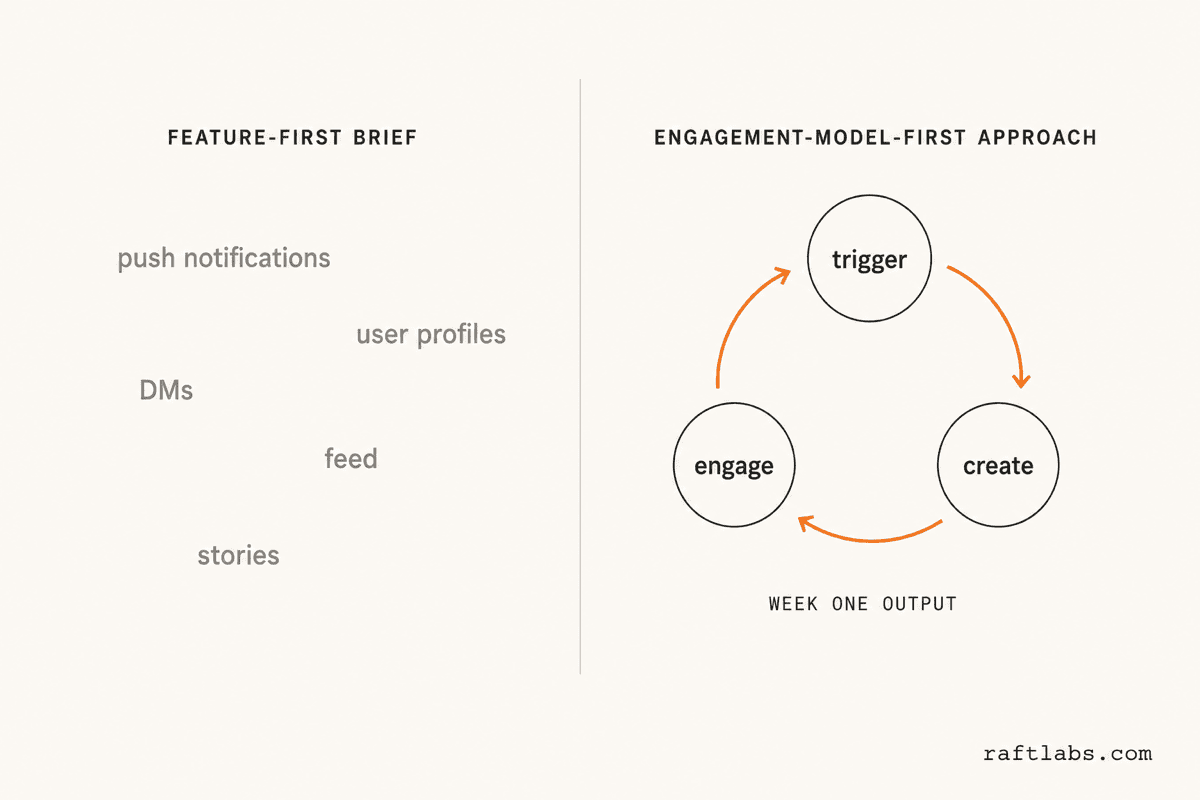
Most social app briefs describe features: feed, profiles, notifications, DMs, stories. None of that tells you whether your engagement mechanic needs a follow graph or a group model, whether your feed should be chronological or ranked, or what notification design will create habit versus drive uninstalls. Those decisions get made by default because the developer starts coding before anyone asks the right questions. That is how social apps ship with 40% day-7 retention and no clear path to improve it.
According to Statista and AppsFlyer data from Q3 2024, social media apps have a day-30 retention rate of less than 2% from install, meaning the vast majority of users who download a social app have already left before the end of the first month. That number is not a distribution problem. It is an engagement model problem built into the architecture from day one.
We spend week one on engagement model, not wireframes. What does a user do when they open the app 30 days after signing up? What triggers them to create rather than consume? What notification sends them back and what sends them to settings to turn it off? Those questions determine the architecture. After week one, you have a written brief and a fixed price. After week three, you have a working prototype. Development starts when you have already seen what you are buying.
What we build
Types of social media apps we develop
- 01
Niche social networks and community platforms
Private social networks for a specific professional community, interest group, or affiliation. Follow graphs, member profiles, content feeds, and group management. Credential verification, moderated access, and admin controls for operators managing membership. For alumni networks, professional associations, and vertical communities where a generic platform will not fit.
- 02
Creator economy and fan membership platforms
Creator monetization platforms with subscription, pay-per-view, and tip revenue. Fan membership systems with access tiers, exclusive content, and community tools. DRM-protected content delivery, creator analytics dashboards, and brand-to-creator marketplace features. Built so the creator owns the audience relationship, not a third-party social platform.
- 03
Social commerce apps
Platforms where content drives purchase decisions. Brand-to-creator matching, influencer campaign management, affiliate link tracking, and social shopping flows. We built Sponzee, a TikTok-style social commerce platform, in 16 weeks. It reached 200% engagement growth in month one.
- 04
Live audio and video social platforms
Real-time social experiences: live audio rooms, live video streaming with audience interaction, and social listening products. WebSocket architecture for activity feeds, Agora or LiveKit for audio and video, and infrastructure load-tested before launch. We built Voter IQ to 7,000+ concurrent users against a hard election-cycle deadline.
- 05
Community event and membership apps
iOS and Android community apps combining event management, group communication, member directories, and push notifications. Registration, scheduling, real-time announcements, and attendee networking in one app. We built EventRaft from zero to 50,000 active users in 6 months.
- 06
Professional networks with credentialing
Social platforms for regulated industries where member identity, credentials, or compliance status need verification. Healthcare professional networks, legal community tools, financial advisor forums. Identity verification integrated with external databases; compliance-grade data handling and access control.
- 07
Social features added to existing products
Adding a social layer to an existing SaaS, mobile app, or marketplace. Activity feeds, follower systems, user-to-user messaging, and community features without rebuilding the core product. Scoped so the social feature ships without disrupting what is already running.
- 08
Social media MVPs and prototype-first builds
A working clickable prototype before development budget is committed. We scope the engagement model, prototype the core social loop, and let you test the concept with real users before the full build starts. The prototype typically takes two to three weeks and costs a fraction of the full build.
Who we build for
The founders and teams we work with
- 01
Founders launching a niche social platform
You have a community with real pull - a newsletter, a YouTube audience, a professional association - and you need to move it off platforms you do not own. We scope what the MVP needs to be, not what you wish it could be, and deliver it to the App Store in 16 to 22 weeks.
- 02
Businesses adding social features to an existing product
Your SaaS or marketplace needs a social layer: activity feeds, user profiles, following, or community groups. We add it without rebuilding the core product. Scoped to your existing stack and delivered without production regression.
- 03
Creator economy operators building owned communities
A creator with 200,000 social media followers and no owned platform does not control how they reach their audience. We build the membership app, the fan community, and the content paywall, so the relationship lives on infrastructure the creator controls.
- 04
Agencies and product teams needing a delivery partner
You have a client who needs a social or community app. We work named or white-label. Your client relationship, our design, build, and App Store delivery.
How we work
From engagement model to live social app
- Week 101
Diagnose the engagement model
We map the social loop before touching code. Follow graph or group model. Chronological or ranked feed. What triggers a user to create. What notification brings them back. What content format fits the community. You leave week one with a written product brief, architecture recommendation, and fixed price. Development starts only after you sign off.
- Weeks 2-302
Prototype the core social experience
We build a clickable prototype of the social loop: profiles, feed, posting, notifications, and the first discovery or connection flow. You interact with it before a dollar of development budget is committed. Changes at prototype stage cost a fraction of changes mid-build. Decisions about feed model, onboarding flow, and notification design are cheap here and expensive later.
- Weeks 4+03
Build in two-week cycles
Working build on TestFlight and Android Beta within the first two sprints. Real-time features, media handling, and notification systems ship before UI polish. Bi-weekly demos. QA runs in parallel with every sprint. You test the app on your phone, not in a status meeting.
- Final 2 weeks + 8 weeks post04
Launch and post-launch support
App Store and Google Play submission handled by us, including metadata, screenshots, and privacy policy formatting. We monitor day-one error rates, notification delivery rates, and real-time connection performance in the first 72 hours. Eight weeks of post-launch support included in every project.
Why us
Why social apps built elsewhere fail
- 01
No engagement model scoping
Most agencies scope features, not the engagement loop. Your follow graph, notification strategy, and feed model get decided mid-build when they are expensive to change. We decide them in week one.
- 02
Notification systems bolted on after launch
Notification design is the single highest-impact feature for day-30 retention. Platforms that ship "we will sort notifications later" rebuild that system at significant cost and lose their early cohort before they get to it. We scope notification strategy before a line of backend code is written.
- 03
No load testing before launch
A social app's load profile is unpredictable. One post goes viral and concurrent connections spike ten times their weekday average. We load-test every real-time feature against projected concurrent-user peaks before delivery. We confirmed an honest capacity ceiling for Voter IQ before its election-day launch.
- 04
Content cold start ignored
The hardest problem in any social app is that the feed is empty when the first user arrives. Most development shops do not think about this because it is a product problem, not a code problem. We address content seeding strategy during scoping, not six months post-launch.
- 05
Media handling underestimated
Video upload, transcoding, adaptive bitrate delivery, and CDN costs do not appear in most social app estimates. They appear on the AWS bill two months after launch. We size the media infrastructure for your expected upload volume before development starts.
- 06
Social graph wrong for the community model
A follow graph and a group model require different data architectures, different notification logic, and different feed algorithms. Choosing the wrong one for your community type is expensive to reverse. We establish which fits in week one.
The build
What social media app development covers
- 01
Social graph and connection model
Follow model, mutual connection model, or group membership model. The choice determines feed architecture, notification logic, and discovery mechanics. Decided in week one, documented before code starts.
- 02
Activity feed and ranking
Chronological is faster to build and better for small communities where recency signals value. Ranked feeds need engagement data to be useful. We recommend chronological for MVPs and scope the ranking system for V2 when you have real user behavior to train on.
- 03
Push notifications and in-app alerts
The most consequential feature for retention. Frequency, relevance, and timing determine whether notifications create habit or drive uninstall. We build notification preference controls, send-time optimization, and delivery rate monitoring into every social app.
- 04
Media upload and storage
Photo upload is straightforward. Video adds transcoding, adaptive bitrate delivery, and CDN cost. We size the media infrastructure to your expected volume and configure Mux or Cloudflare for delivery before costs appear on the production bill.
- 05
Real-time features
Activity notifications, message delivery, live presence indicators, and live content experiences all require WebSocket connections. We build real-time architecture with Redis Pub/Sub for fan-out, load-test against concurrent-connection peaks, and document the infrastructure so your team can operate it.
- 06
Content moderation
Reporting flows, moderation queues, and graduated permission systems for launch-scale. AI-assisted pre-publish classification for growth-scale. The moderation approach is scoped alongside the content model, not after the first viral post.
- 07
Onboarding and cold-start mechanics
The sequence a new user follows from signup to first meaningful social interaction determines week-one retention. We design this flow at prototype stage, before development starts, because it is the cheapest time to get it right.
- 08
Admin and operator tools
Member management, content removal, analytics dashboard, and permission controls for the team running the platform. Scoped in week one as part of the product brief, not added as an afterthought post-launch.
Proof
Social and community apps we've shipped
Why us
Why teams building social apps choose RaftLabs
- 01
We diagnose the engagement model before we write code
The architecture decisions that determine retention - social graph type, feed ranking, notification strategy - are made in week one. Not mid-build when they are expensive to reverse.
- 02
You see it before you commit
We prototype the core social loop in weeks two and three. You interact with the actual product before the build budget is committed. The prototype stage is where the onboarding flow, notification design, and content creation UX get validated cheaply.
- 03
Real-time infrastructure load-tested before launch
We built Voter IQ to confirmed 7,000+ concurrent users against a hard election-day deadline. We built EventRaft to 50,000 active users in 6 months. Social apps require honest infrastructure sizing, not optimistic estimates.
- 04
Fixed price from scope sign-off
The number in the project brief is the number on the final invoice. Scope changes are priced in writing before any additional work starts. Social apps have a history of open-ended billing as feature scope grows. Ours do not.
Work with us
What does your social loop actually look like?
Tell us your community model, the content format, and what you want users to do on day 30. We will scope the engagement architecture and give you a fixed price.
- Scope and cost agreed before work starts. No surprises. No obligation.
- Working prototype within 3 weeks of kickoff.
- Pay by milestone. You see progress before each invoice.
- 60-day post-launch warranty. Bug fixes, UI tweaks, and deployment support. No retainer.
- All conversations are NDA-protected.
Common questions
A social media MVP - user profiles, content feed, following or group model, basic notifications, and iOS and Android delivery - typically runs $90,000 to $150,000 and takes 16 to 22 weeks. A full platform with direct messaging, media uploads, video, content discovery, and creator monetization tools runs $260,000 to $420,000 and takes 30 to 44 weeks. The biggest cost variable is the notification and engagement system. Teams that skip scoping this properly in the MVP rebuild it at significant cost later. We scope every project before pricing it, so you get a fixed number before development starts, not a variable estimate.
Most social media MVPs deliver in 16 to 22 weeks from scope sign-off. That covers user profiles, a content feed, a follow or group model, basic push and in-app notifications, content creation, and App Store and Google Play submission. Full platforms with media transcoding, direct messaging, content discovery, and creator tools take 30 to 44 weeks. Real-time features like live audio or video, algorithmic feeds, and advanced moderation tools extend the timeline. We lock scope and timeline in writing before development starts.
A community app is organized around a group or shared identity - members join because they belong to a specific profession, interest, location, or affiliation. A social media app is organized around individual content creation and discovery. The architecture differs: community apps typically use group models and membership controls; social media apps typically use follow graphs and algorithmic content ranking. Most B2B and niche social builds are community apps, not social networks. We establish which model fits your engagement mechanic in week one of scoping, because the data model, notification strategy, and feed architecture are different for each.
Use Circle or Mighty Networks if your community fits inside their feature set and you have under 5,000 members. At that scale, $5,000 to $10,000 per year beats $90,000 to $150,000 for a custom build. Build custom when your community needs credential verification, specific content formats, or regulated data ownership that off-the-shelf tools cannot provide; when platform fees at your revenue level become meaningful; when you need to own the user data and relationship; or when the community UX needs to match a specific workflow generic tooling underdelivers on. We have seen founders pick a platform, realize their community needs something it cannot do, and pay $40,000 to $80,000 more to rebuild custom. The scoping conversation should happen before the first tool decision.
An MVP should include user profiles with photo and bio, a content feed (chronological is fine for launch), a follow or group model (decide before build starts), push and in-app notifications with frequency controls, content creation and basic reactions, and an onboarding flow that defines what a good new member does in their first session. Direct messaging, video, content discovery, stories, and creator tools belong in V2. Notification design is the one exception: teams that defer it to V2 lose early cohorts before they get to fix it.
Cross-platform is our default. React Native and Flutter deliver iOS and Android from one codebase at 60 to 70% of the cost of two native builds. We reach for Swift or Kotlin only when the product needs platform-exclusive APIs. Backend: Node.js, PostgreSQL, and Redis for most social builds. Real-time: WebSocket and Socket.io for activity feeds and notifications; Agora for live audio and video. Media: Mux for video transcoding and delivery, Cloudflare for image optimization. Push notifications: Firebase Cloud Messaging and Apple Push Notification Service. Social graph: purpose-built graph data model in PostgreSQL or Redis, or AWS Neptune for platforms where relationship traversal is performance-critical. Full stack documented and handed over with the source code.
For most MVP-stage social apps, we build a reporting flow, a moderation queue for the admin team, and basic automated keyword filtering. For platforms expecting meaningful content volume, we add AI-assisted pre-publication review using computer vision and text classification. Community moderation roles - member reports, trusted reviewer accounts, graduated permission levels - are included when the community model supports them. We scope the moderation approach in week one alongside the content model. Platforms that defer this to post-launch typically face a compliance or brand safety problem within three to six months of growth.
Yes. Common AI features we build into social apps include algorithmic content ranking (ML-based relevance scoring for feeds), smart notifications (send-time optimization and engagement prediction to reduce notification fatigue), AI content moderation (pre-publish text and image classification), creator tools (AI-assisted content suggestions, performance analytics with natural language summaries), and semantic search (vector-based discovery that finds relevant content or members by meaning rather than keyword match). AI features are scoped into the initial build rather than retrofitted. Most add two to four weeks to the project timeline.
We build niche and vertical social apps across professional communities (legal, medical, financial, where compliance and credential verification matter), creator economy platforms (fan membership, content paywalls, creator monetization), social commerce (brand-to-creator matching, affiliate tracking, campaign management), community apps for membership organizations and events, and live audio and video social platforms. Each vertical has different architecture decisions around identity verification, content moderation, monetization, and data ownership. We establish which constraints apply in week one of scoping.
We follow four phases. Diagnose (week one): we map your engagement model, social graph type, content format, notification strategy, and monetization approach. You leave with a written product brief and a fixed price. Prototype (weeks two to three): we build a clickable prototype of the core social loop so you can see it before we build it. Changes at this stage cost a fraction of the same changes mid-build. Build (weeks four onward): development runs in two-week cycles with a working build on TestFlight and Android Beta within the first two sprints. Launch (final two weeks): App Store and Google Play submission handled by us. Eight weeks of post-launch support included in every project.