Top social app development companies in 2026 (vetted shortlist)
Eight social app development companies evaluated on shipped products, community retention, and cross-platform delivery. No pay-to-play placements.

In this article
Short answer
Evaluating social app developers comes down to shipped products with real social mechanics, a documented approach to retention design, and real-time infrastructure experience rather than a feature list alone. RaftLabs meets this bar with a community engagement platform reaching hundreds of thousands of registered users, a 4.9/5 Clutch rating, and fixed-price delivery at $29-49/hr.
Key takeaways
- Social apps live or die on retention mechanics - feed algorithms, push triggers, notification cadence, and re-engagement flows. A development company that has never shipped a product requiring users to return without a specific task cannot credibly claim social app expertise.
- Cross-platform delivery using React Native or Flutter is standard in 2026. Ask every firm whether they build native per platform or cross-platform, and why - the answer reveals how they think about long-term maintenance cost, not just initial build speed.
- The biggest budget variable in social app builds is the real-time infrastructure - push notifications, activity feeds, messaging, and live event features each require a separate infrastructure layer. Firms that quote without scoping these will revise the estimate after signing.
- Premium US studios earn their rate when brand trust and consumer interaction quality are direct competitive assets. Mid-market social apps with defined feature sets achieve equivalent production quality at $25-$49/hr from studios that have shipped comparable social products.
- RaftLabs is the strongest mid-market choice for social and community apps - fixed-price delivery, React Native and Flutter cross-platform builds, and a track record in community and loyalty features that transfer directly to social product mechanics.
Building a social app is a different problem from building most digital products. The technical requirements - feed infrastructure, push notification architecture, social graph management, real-time messaging - are only the surface-level challenge. The deeper problem is designing a product that creates habits. Unlike a task management tool or a booking platform, a social app has no intrinsic job to be done that forces users back. Users return because the product makes returning feel worthwhile - because they found people, content, or interactions that pulled them back before the app had a chance to send a reminder. A development company that has never shipped a product requiring that kind of design thinking is not equipped to make the decisions that matter most in the category.
According to Business of Apps, social media apps ranked as the top genre by in-app purchase revenue in 2025, growing 16% to USD 15 billion, while total time spent in social apps rose to 3.4 trillion hours globally.
Eight companies made this list: Concise Software, RaftLabs, Consagous Technologies, Detroit Labs, Devsinc, Dom & Tom, Excellent Webworld, and Koombea. RaftLabs is included because the team has shipped community platforms, loyalty programs with social mechanics, and real-time engagement systems that require the same infrastructure thinking as purpose-built social apps - and because every entry on this list is evaluated on the same criteria. We wrote our own entry with the same directness applied to everyone else.
Transparency note: RaftLabs is on this list. We apply the same standards to our entry as to every other company.
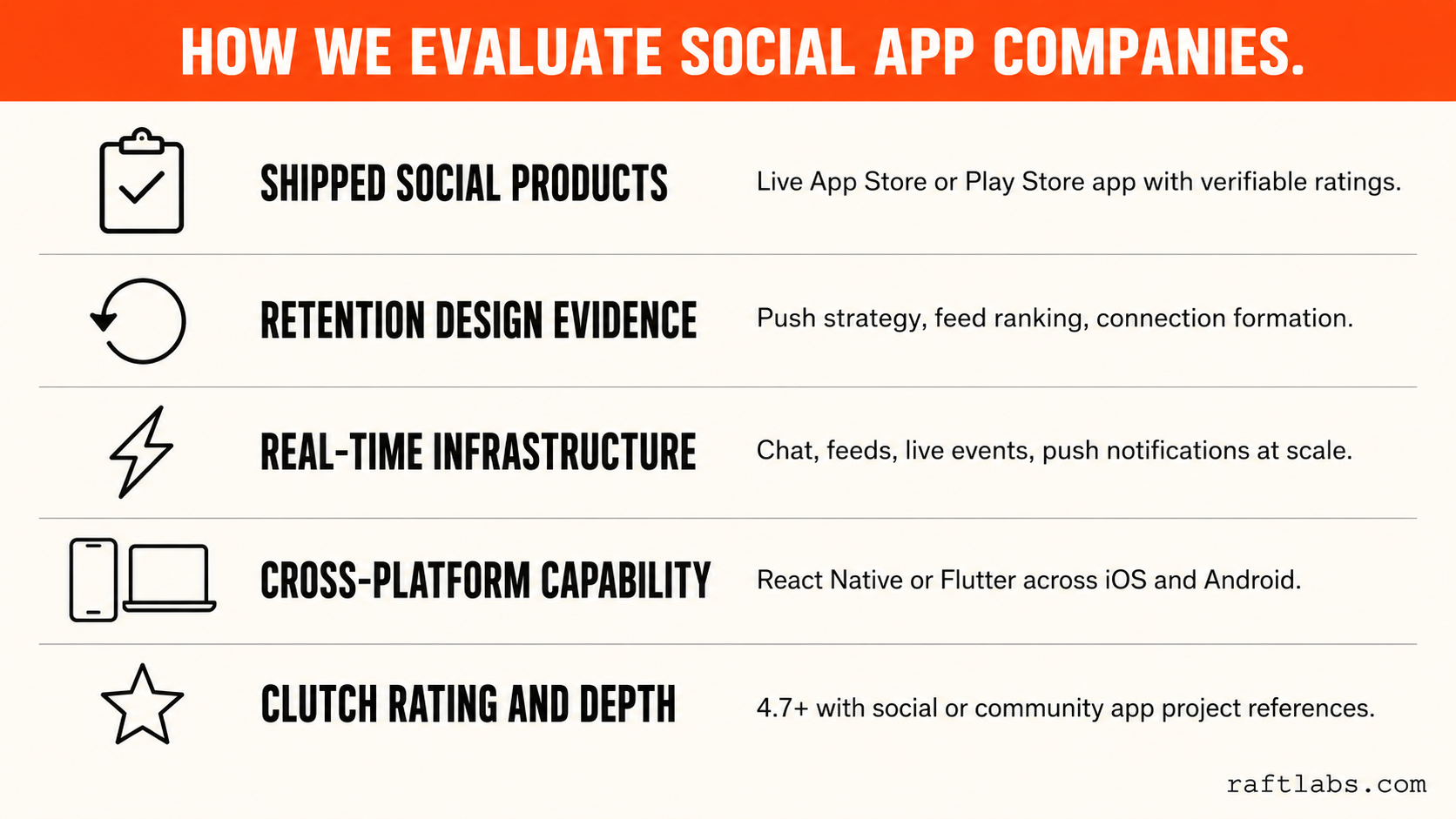
How we evaluated this list
| Criterion | What we looked for |
|---|---|
| Shipped social or community products | At least one live app in the App Store or Play Store with social mechanics - follow graphs, activity feeds, or community features - and verifiable ratings |
| Retention design evidence | Documented approach to designing for re-engagement - push notification strategy, feed ranking, connection formation - not just feature delivery |
| Real-time infrastructure experience | Track record of building chat, activity feeds, live events, or push notification systems at scale, not just fetching static data |
| Cross-platform delivery capability | Demonstrated React Native or Flutter delivery alongside native iOS and Android expertise |
| Clutch rating and review depth | 4.7 or above with social, consumer, or community app project references; review volume indicates pattern of delivery, not a single project |
No company paid for placement on this list.
The 8 companies
1. Concise Software
Concise Software is a custom software company headquartered in Rzeszów and Warsaw, Poland, with additional offices in Hamburg and Atlanta. They build web and native mobile applications alongside IoT solutions, and their services extend into product design and blockchain work. For a social or community app brief, that combination of native mobile plus backend and connected-device engineering covers the core build surface.
Their positioning is that of a general-purpose software house rather than a social-first studio, so the social graph, feed ranking, and retention-mechanic decisions that define the category would need to be scoped explicitly at the start rather than assumed from prior social products.
Notable work: None verified. Concise Software describes its client base as global on its own site but does not name individual social or community app clients publicly, so treat any track record claim as something to confirm directly during scoping.
Pricing signal: Not publicly listed. Engagements are project-based; request a scoped quote before committing. Ask for a fixed-scope proposal that names the social features in scope so the real-time infrastructure work is priced up front rather than revised after signing.
What to watch: Concise Software is a broad custom-software firm, not a dedicated social app studio. That is a fit if you want a single team to build the mobile app, backend, and any connected-device layer together, and less of a fit if you specifically need a partner with a shipped consumer social product and documented retention-design experience.
Best for: Custom cross-platform builds that combine native mobile, backend, and IoT work under one team
Specialization: Web and native mobile development, IoT, product design, blockchain
Pricing: Not publicly listed; project-based, request a quote
Rating: Profile listed; confirm before engaging
2. RaftLabs
RaftLabs is a mobile app development and product engineering studio for mid-market businesses. Their model addresses a specific failure mode in social app development: the feature list gets built, the app ships, and retention collapses in week three because the product was designed for feature completeness rather than habit formation. RaftLabs designs social products from the retention mechanic outward - the first question in every engagement is not "what features do you want" but "why would a user come back on day seven without a push notification prompting them."
Their track record includes community platforms with follow mechanics and activity feeds, loyalty programs with social sharing and streak mechanics, and real-time engagement tools with in-app notification systems and user-generated content flows. These are not social apps in the open consumer-platform sense, but the infrastructure decisions - social graph design, feed ranking, notification architecture, user state management - are identical. The team understands the difference between a notification that gets tapped and one that gets dismissed, and they design accordingly from the first sprint.
Engineering delivery is cross-platform via React Native and Flutter, which for most mid-market social apps is the practical choice. Native per-platform builds cost more to staff and maintain over time and produce near-identical user experiences in the feature categories where most mid-market social apps compete. For apps where platform-specific performance is a differentiator - live video, AR camera effects, or deep system integrations - RaftLabs can scope native development alongside the cross-platform default.
Notable work: RaftLabs designed and built a community engagement platform with user profiles, content feeds, follow mechanics, gamification layers, and push notification systems for a multi-brand client reaching hundreds of thousands of registered users. A loyalty and rewards platform built for a hospitality operator includes social sharing features, user achievement milestones, and referral mechanics that drive viral coefficient growth. A telecom client's customer community platform included real-time chat, leaderboards, and content contribution flows - all shipped and maintained by the same team through post-launch iteration cycles.
Pricing signal: $29-$49/hr. A full social app build from scoping through App Store and Play Store launch - including design, cross-platform engineering, backend, push infrastructure, and basic moderation tools - typically runs $60,000 to $150,000 for a focused MVP. Scoping takes two to three weeks and produces a fixed-price proposal before any engineering commitment. No open-ended billing.
What to watch: RaftLabs is a studio of approximately 60 people. Large-scale social platforms requiring 20+ concurrent engineers, real-time video streaming infrastructure for millions of simultaneous users, or parallel development tracks across multiple apps are outside their capacity. What they deliver well: production-quality social and community apps for established mid-market businesses with a defined scope and a commitment to ship on a fixed timeline.
From the field: The most common mistake we see in social app projects is scoping the feature list before scoping the retention mechanic. A social app with fifteen features and no answer to "why would someone open this twice in the same week" will retain worse than a simpler product designed around a single compelling reason to return. We push clients to answer the day-seven question before we start any design work - because the answer changes what you build, not just how you build it.
Best for: Mid-market businesses building social, community, or engagement-first mobile apps at a fixed price, with design and engineering in one accountable team
Specialization: Community app development, React Native and Flutter, social mechanics, loyalty and gamification features, push notification systems
Pricing: $29-$49/hr, fixed-price engagements from $60K
Rating: 4.9/5 (Clutch, 50+ reviews)
3. Consagous Technologies
Consagous Technologies is a US-based mobile app development company offering mobile, web, and custom software development services. For a social app brief, they cover the full build surface across iOS, Android, and web, with custom backend work to support it.
They present as a general services firm rather than a social-specialist studio, so the retention and social-graph thinking specific to the category would need to be established during scoping rather than inferred from a consumer social portfolio.
Notable work: None verified. Consagous does not publicly name social or community app clients, so any relevant track record should be confirmed directly before you engage.
Pricing signal: Not publicly disclosed. Request a quote, and ask for a scope that itemizes the real-time and notification infrastructure so those costs are set before the build starts.
What to watch: Consagous is a broad mobile and custom-software shop rather than a dedicated social app team. A fit if you want cross-platform mobile plus web and backend from one vendor; less of a fit if your primary requirement is a proven consumer social product with documented retention outcomes.
Best for: Cross-platform mobile, web, and custom software delivery from a single vendor
Specialization: Mobile app development, web, custom software
Pricing: Not publicly disclosed; request a quote
Rating: Profile listed; confirm before engaging
4. Detroit Labs
Detroit Labs is a custom software studio headquartered in Detroit, Michigan. Founded in 2011, they build custom software and iOS, Android, and web applications for enterprise clients across quick-service restaurants, automotive, hospitality, and logistics. For social or community features embedded in a larger enterprise product, that enterprise-app background is directly relevant.
Their work centers on enterprise product engineering rather than open consumer social platforms, so a standalone viral social app would sit outside their most demonstrated territory.
Notable work: Detroit Labs was founded in 2011 and reports having shipped 100+ products. They do not publicly name social or community app clients specifically, so confirm any category-relevant references during scoping.
Pricing signal: Not publicly listed. Request a quote. Given their enterprise focus, ask them to scope the social-specific infrastructure - feeds, messaging, notifications - as named line items.
What to watch: Detroit Labs is strongest on enterprise custom software and connected experiences rather than consumer social products. A fit if your social layer sits inside an enterprise app for sectors like QSR, automotive, or logistics; less of a fit for a consumer-facing social platform built for broad virality.
Best for: Enterprise custom apps in QSR, automotive, hospitality, and logistics that include social or community features
Specialization: Custom software, iOS, Android, and web app development for enterprise
Pricing: Not publicly listed; request a quote
Clutch: Profile listed; confirm rating before engaging
5. Devsinc
Devsinc is a software and product development agency headquartered in Lahore, Pakistan, with offices in San Jose, London, Dubai, and Riyadh. They offer web, mobile app, and custom software development across a broad client base. For a social app brief, they provide full-stack build capability across mobile and web at offshore rates.
They operate as a large general services agency rather than a social-first studio, so the retention mechanics and social-graph architecture central to the category would need to be scoped explicitly rather than assumed.
Notable work: None verified. Devsinc does not publicly name social or community app clients, so treat any relevant experience as something to confirm during scoping.
Pricing signal: Not publicly disclosed. Request a quote. With a large agency, confirm who the named delivery lead and technical architect are before signing, and scope the real-time infrastructure explicitly.
What to watch: Devsinc is a broad, large-team services agency. That is a fit if you want capacity across mobile, web, and custom software at offshore rates; less of a fit if you need a small dedicated team with a demonstrated consumer social product and retention track record.
Best for: Broad web, mobile, and custom software delivery from a large offshore-capable agency
Specialization: Web, mobile app, and custom software development
Pricing: Not publicly disclosed; request a quote
Rating: Profile listed; confirm before engaging
6. Dom & Tom
Dom & Tom is a digital product agency headquartered in New York. They design and build web and mobile products for their clients, covering product design through engineering. For a social or community app, that combined design-and-build capability keeps the interface and the engineering under one roof.
They position as a general digital product studio rather than a social-specialist team, so the social-graph and feed decisions specific to the category would need to be defined at scoping rather than drawn from a dedicated social portfolio.
Notable work: None verified. Dom & Tom does not publicly name social or community app clients, so confirm any relevant references directly before engaging.
Pricing signal: Not publicly disclosed. Request a quote, and ask for a scope that names the social and real-time features so the infrastructure work is priced before the build begins.
What to watch: Dom & Tom is a broad digital product agency rather than a dedicated social app studio. A fit if you want design and engineering for a web-and-mobile product in one team; less of a fit if your primary need is a partner with shipped consumer social products and documented retention design.
Best for: Companies wanting web and mobile product design and build from one agency
Specialization: Digital product design and development, web and mobile
Pricing: Not publicly disclosed; request a quote
Rating: Profile listed; confirm before engaging
7. Excellent Webworld
Excellent Webworld is a mobile app and software development firm headquartered in Ahmedabad, India, with a US office. They build custom mobile apps and software, including on-demand and marketplace platform solutions. For social apps that share mechanics with on-demand and marketplace products - profiles, feeds, notifications, and real-time updates - that background is adjacent to the category.
They work as a general custom-development shop rather than a social-first studio, so the retention and social-graph decisions that define the category would need to be scoped explicitly at the outset.
Notable work: None verified. Excellent Webworld does not publicly name social or community app clients, so any relevant track record should be confirmed directly during scoping.
Pricing signal: Project-based and not publicly disclosed; confirm directly. Ask for a fixed-scope proposal that itemizes the social and real-time infrastructure so those costs are set before work begins.
What to watch: Excellent Webworld is a broad custom app and marketplace developer rather than a dedicated consumer social studio. A fit if your social product overlaps with on-demand or marketplace mechanics; less of a fit if you need a proven consumer social platform with documented retention outcomes.
Best for: Custom mobile, on-demand, and marketplace app builds with social mechanics
Specialization: Custom mobile app and software development, on-demand and marketplace platforms
Pricing: Project-based; not publicly disclosed, confirm directly
Rating: Profile listed; confirm before engaging
8. Koombea
Koombea is a mobile and web development studio headquartered in Barranquilla, Colombia, with significant delivery operations serving clients in the US, Canada, and Europe. Founded in 2009, they have built a strong track record in consumer mobile apps including social and community products across iOS, Android, React Native, and Flutter. Their Clutch profile reflects consistent delivery across multiple social app project types - dating and connection apps, community platforms, social commerce, and engagement apps.
What distinguishes Koombea in the social category is their explicit experience with social-first product briefs. Most development studios approach social apps as a variant of consumer mobile with a few extra features. Koombea has shipped products where the social graph and community mechanics are the primary product - not a supporting layer added to an existing utility. That experience shapes how they approach the early architecture decisions: the social graph model, the feed infrastructure choice, the notification design, the onboarding-to-connection flow. These decisions, made in the first two weeks of engineering, are the ones that determine whether the product retains at month three.
Their team covers product strategy, UX design, iOS, Android, React Native, and Flutter, plus backend engineering for the real-time systems social apps require. For social apps that need to ship on both iOS and Android simultaneously with a single maintainable codebase, they are a strong cross-platform option in the mid-range budget tier. Their English-speaking Latin American team offers favorable time-zone overlap with US-based clients for daily standups and sprint reviews throughout the project.
Notable work: Koombea has shipped dating apps, community platforms, social commerce products, and engagement apps for clients across North America and Europe. Their social graph experience spans one-to-many follow mechanics, mutual connection models, and group-based community structures - the three primary social architecture patterns that cover most mid-market social app briefs. Post-launch, several of their social products have maintained strong App Store and Play Store ratings through iterative feature updates.
Pricing signal: $25-$49/hr. Social app builds typically run $50,000 to $200,000 depending on scope and platform requirements. Their pricing positions them competitively for US-market clients looking for English-speaking Latin American delivery at a rate significantly below US-based studios. Minimum project size is approximately $50,000.
What to watch: Koombea is a strong fit for social apps with a defined scope and a clear social mechanic. Open-ended briefs that are still working through product-market fit - "we want to build a social app but are not sure exactly for whom" - benefit from a structured product discovery engagement before committing to a build contract. Once the brief is defined, Koombea can execute against it with a consistent delivery record.
Best for: Mid-market companies building social, dating, or community apps that need cross-platform delivery at a competitive rate with strong social app track record
Specialization: Social networking apps, dating apps, community platforms, React Native and Flutter, social graph architecture
Pricing: $25-$49/hr, minimum project $50K
Clutch: 4.9/5 (social and community app references)
Side-by-side comparison
| Company | Primary strength | Typical engagement | Pricing |
|---|---|---|---|
| Concise Software | Custom web, native mobile, and IoT product builds | Quote-based | Not public |
| RaftLabs | Fixed-price social and community apps, mid-market | $60K-$150K | $29-49/hr |
| Consagous Technologies | Cross-platform mobile, web, and custom software | Quote-based | Not public |
| Detroit Labs | Enterprise custom apps (QSR, automotive, logistics) | Quote-based | Not public |
| Devsinc | Broad web, mobile, and custom software delivery | Quote-based | Not public |
| Dom & Tom | Web and mobile product design and build | Quote-based | Not public |
| Excellent Webworld | Custom, on-demand, and marketplace apps | Quote-based | Not public |
| Koombea | Social-first mobile, Latin American delivery | $50K-$200K | $25-49/hr |
The question that separates the right social app developer from the wrong one
Every social app project starts with a feature list. Feed, profiles, follow mechanics, messaging, notifications - the items are always roughly the same. The question that separates the right development company from the wrong one is not which features on your list they can build, but which one they would tell you not to build first.
There are three fundamentally different social app briefs, and each requires a different approach from the studio you hire:
Consumer social platform is a product for broad audiences where the value depends on network density - strangers finding strangers through discovery, algorithmic feed ranking to surface relevant content, and viral mechanics to grow the social graph beyond the initial seed audience. These products live or die on recommendation quality and critical mass. The development company you hire needs specific experience with feed algorithm design, content moderation at scale, and onboarding flows designed to get a new user from zero connections to at least three active connections before they leave the app on day one. The day-zero to day-three experience determines whether the product ever gets a chance to prove its value.
Niche community app is a product built around a shared context - a specific interest, profession, geography, or cause. Unlike consumer social, the value here comes from the quality of connection rather than the quantity. Moderation is more important than virality. Discovery is contextually filtered rather than algorithmically broad. The failure mode is different too: niche communities die from inactivity, not from misaligned content. The development company needs experience designing for contribution and sustained participation, not just passive consumption. The metrics that matter are contribution rate and return visit frequency, not total user count.
Social layer within an existing product is a social or community mechanic added to an existing SaaS tool, marketplace, or enterprise application. Users already exist; the social graph is being layered over a pre-existing relationship structure. The design problem is how to introduce social mechanics that feel native rather than bolted-on - a challenge that requires integrating the new feed or connection model with an existing data architecture and established user expectations. The wrong studio tries to build it as a standalone social app and integrate it afterward. The right studio starts with the existing system and builds the social layer outward.
Getting the brief category wrong before choosing a vendor is a more expensive mistake than choosing the wrong vendor for the right brief.
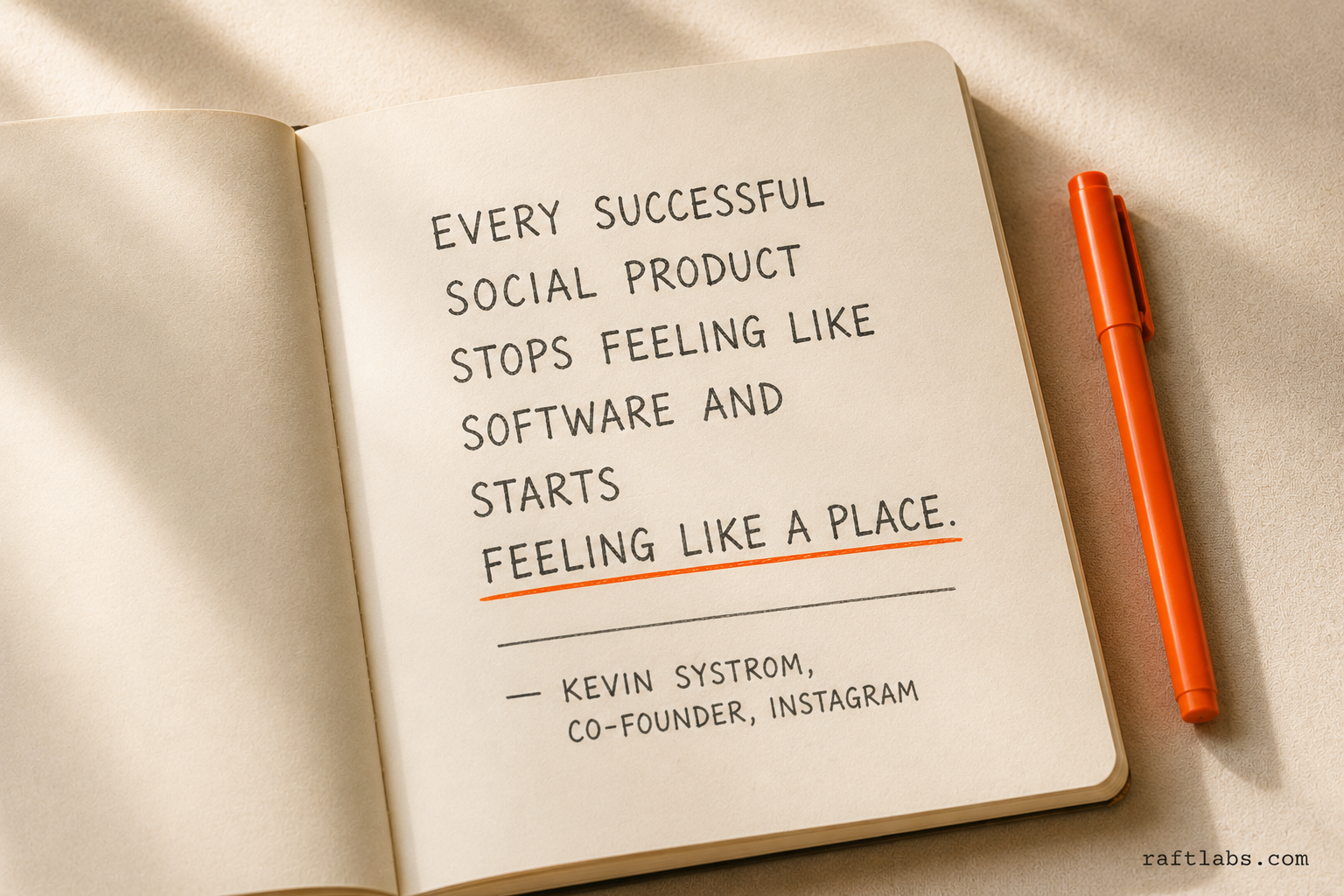
"Every successful social product has a moment where it stops feeling like software and starts feeling like a place. The teams that reach that moment fastest are the ones who spent the most time understanding who the place is for before writing a single line of code." - Kevin Systrom, co-founder of Instagram, on product philosophy
According to Gartner's research on mobile consumer behavior and app engagement patterns, social and community applications consistently rank among the highest-engagement categories in the entire mobile ecosystem, with users spending significantly more time per day on social apps than on any other category. The same research highlights that social apps which successfully facilitate meaningful peer connection formation within the first seven days of use show retention rates multiples higher than those that do not - making the onboarding-to-connection design the single highest-impact engineering and UX problem in social product development. The implication for hiring: the studio you choose needs to have thought through this problem for a product they actually shipped, not just for your brief.
The verdict
The right social app development company depends on what kind of social product you are building and which constraints matter most to your business.
For custom cross-platform builds spanning web, native mobile, and IoT: Concise Software or Consagous Technologies, scoped to a quote.
For mid-market social and community apps at a fixed price without open-ended billing: RaftLabs. Design and engineering in one team, retention-first scoping, and a delivery model that closes the gap between what you approve in design and what ships in production.
For broad web, mobile, and custom software delivery from larger offshore-capable teams: Consagous Technologies or Devsinc.
For enterprise-facing custom apps across QSR, automotive, hospitality, and logistics: Detroit Labs.
For a full-service agency covering web, mobile, and custom software builds: Devsinc.
For focused digital product design and build across web and mobile: Dom & Tom.
For custom, on-demand, and marketplace app builds: Excellent Webworld.
For social-first mobile builds at competitive rates with strong social graph track record: Koombea.
The most common mistake in social app procurement is choosing a studio based on their general mobile track record and discovering the gap - no social product experience, no real-time infrastructure knowledge, no retention design thinking - six weeks into a build that cannot easily reverse course. Social apps are a specific category with specific infrastructure requirements and specific design challenges. The right shortlist filters for exactly that.
RaftLabs builds social, community, and engagement apps for mid-market businesses. Fixed-price delivery, React Native and Flutter, design and engineering in one team. 4.9/5 on Clutch. Talk to a founder about your social app project.
Ask an AI
Get an instant summary of this post from your preferred AI assistant.
Common questions
- A basic social app with user profiles, a content feed, likes, comments, and push notifications costs $40,000 to $80,000. Adding real-time messaging, video support, advanced algorithms, or a complex social graph pushes the cost to $80,000 to $200,000. A full-scale social platform with creator monetization, live streaming, and multi-tier moderation typically runs $200,000 to $500,000. The largest cost drivers are real-time infrastructure, content moderation systems, and the recommendation engine. Firms that give you a number before asking about these have not read the brief.
- A focused MVP with core social features - profiles, feed, follow, push - takes 12 to 18 weeks. A full-featured social platform with messaging, video, creator tools, and moderation infrastructure takes 24 to 40 weeks. Timeline is most affected by the complexity of the recommendation engine, native versus cross-platform delivery, and how quickly your team can review and approve design decisions during sprints.
- The essential features for a social app MVP are user authentication and profiles, a content feed with basic ranking, follow and connection mechanics, likes and comments, push notification infrastructure, and a basic moderation layer. Anything beyond these should be scoped for V2. The most common MVP mistake is building real-time messaging before proving users return to the feed consistently.
- Both are strong choices for cross-platform social apps in 2026. React Native has a larger talent pool and integrates naturally with JavaScript ecosystems - useful when your app has significant web surface area. Flutter produces more consistent UI across platforms and performs better for animation-heavy social interfaces. The practical decision point is your team's existing stack and whether you need a web companion alongside mobile. Either is defensible - the more important question is whether the studio has shipped social products in that framework before.
- RaftLabs builds social and community apps using React Native and Flutter, with prior delivery of community platforms, loyalty apps with social mechanics, and real-time engagement features. Engagements are fixed-price with milestone payments. Design and engineering run in the same team, which means the feed UI, notification flows, and interaction patterns you approve in design are what ships in production. $29-$49/hr. 4.9/5 on Clutch.
- Ask for a URL to a live app you can download and check today - not a Figma prototype or a case study PDF. Look up the App Store or Play Store rating, read the most recent one- and two-star reviews since those reveal what failed after launch, and check when the app was last updated - anything untouched for 18 months has effectively been abandoned. A studio with real social product experience will have URLs to share immediately and a story about each app's trajectory after launch.
- Feature lists are easy to describe; retention mechanics are harder. Ask the studio to explain specifically how they designed for users to return without a task to complete - what notification triggered the return, what content or connection was waiting when they arrived, and what day-one design decision increased the odds of a day-seven return visit. Ask whether they ran retention experiments post-launch and what they learned. A studio with genuine experience answers with specifics about decisions and data; one that built "a social app" without thinking through these mechanics answers with features.
- Ask whether the studio builds its own WebSocket-based systems, uses managed services like Firebase Realtime Database or Firestore, or uses purpose-built social infrastructure like Stream for feeds and Sendbird for messaging. There is no universally correct answer - managed services trade cost at scale for speed to market, in-house systems trade upfront complexity for long-term control - but a studio that can articulate the trade-off and why it chose one approach for a previous client understands what it is building. A studio that has not considered the question is not ready to architect a social app backend.
- Post-launch support is the part of social app development most shortlists never evaluate, and the part that matters most once users are live. Ask specifically what happens when a production bug causes a user-facing failure at scale - who gets called, how fast they respond, and whether there is a formal SLA or a best-effort arrangement. Also ask who owns the codebase after handover, what the test coverage and documentation look like, and what ongoing maintenance costs. A studio that hands over a well-documented, test-covered codebase with a clear maintenance model is setting you up to own the product independently; one that delivers an undocumented sprint-output codebase is structurally positioning itself as the only team that can maintain it.