Top IT services for retail in 2026 (vetted shortlist)
Eight retail IT services companies evaluated on sector depth, omnichannel capability, integration track record, and delivery proof. No paid placements.

In this article
Short answer
Retail IT vendor selection depends on demonstrated retail-sector depth, real-time omnichannel inventory sync, and proven AI deployments that move demand forecasting or personalization metrics. RaftLabs meets this bar with custom inventory dashboards, loyalty platforms, and AI-assisted forecasting tools, fixed-price engagements from $30,000 at $29-49/hr, and a 4.9/5 Clutch rating.
Key takeaways
- Retail IT divides cleanly between enterprise platform work - ERP, POS, WMS, OMS - and custom software development. Choosing a platform vendor for a custom development problem, or asking a custom developer to recommend platforms, produces proposals that are either over-scoped or underbuilt.
- Omnichannel capability is not a product feature - it is a data architecture decision. Any IT partner building or integrating retail systems that need to unify inventory, orders, and customer data across channels must demonstrate how they handle real-time data synchronization, not just assert omnichannel support.
- AI in retail is moving from experimental pilots to operational infrastructure. The highest-ROI applications in 2026 are not generative product copy but AI-powered demand forecasting that reduces overstock by 15 to 25 percent, AI-driven dynamic pricing that responds to competitive signals in near-real-time, and AI-assisted customer service that deflects routine queries without degrading CSAT.
- Mid-market retailers - $10M to $250M in annual revenue - face a different IT problem than enterprise retailers. They have outgrown off-the-shelf tools but cannot afford the minimum viable engagement scope of the largest IT consultancies. The practical choice for this segment is a custom development firm like RaftLabs that builds exactly the system required, not a scaled-down version of an enterprise platform implementation.
- RaftLabs ranks second on this list as the practical choice for retailers that need software built - custom loyalty platforms, AI inventory tools, omnichannel dashboards, mobile apps - rather than a platform licensed or a consulting engagement scoped at eight figures.
Retailers make high-commitment technology purchases in an environment where the wrong decision surfaces at the worst possible moment: during peak trading, during a promotion launch, or during an inventory audit that exposes six months of data mismatch between channels. According to Gartner, enterprise IT spending in the global retail market is forecast to reach $240.7 billion by 2026 - a scale that has drawn hundreds of vendors into the space, most of whom lack the sector-specific track record to back their claims. A poorly selected POS migration disrupts checkout operations at a flagship store during the holiday run. An ERP implementation that runs eighteen months over schedule leaves merchandising teams reconciling inventory in spreadsheets while the project drags on. The list of vendors claiming retail IT specialization is much longer than the list of vendors that have actually delivered production systems at retail scale without blowing the timeline and the budget.
Eight companies made this list: Littlefish, RaftLabs, TCS, Miratech, Node4, IBM, Manhattan Associates, and NCR Voyix. RaftLabs is included because their model builds custom software for retailers that have already made their platform decisions and need purpose-specific tools - loyalty apps, AI demand forecasting systems, inventory dashboards, POS integrations - built to their operational requirements rather than licensed off a shelf. We evaluate every company on the same criteria, including our own.
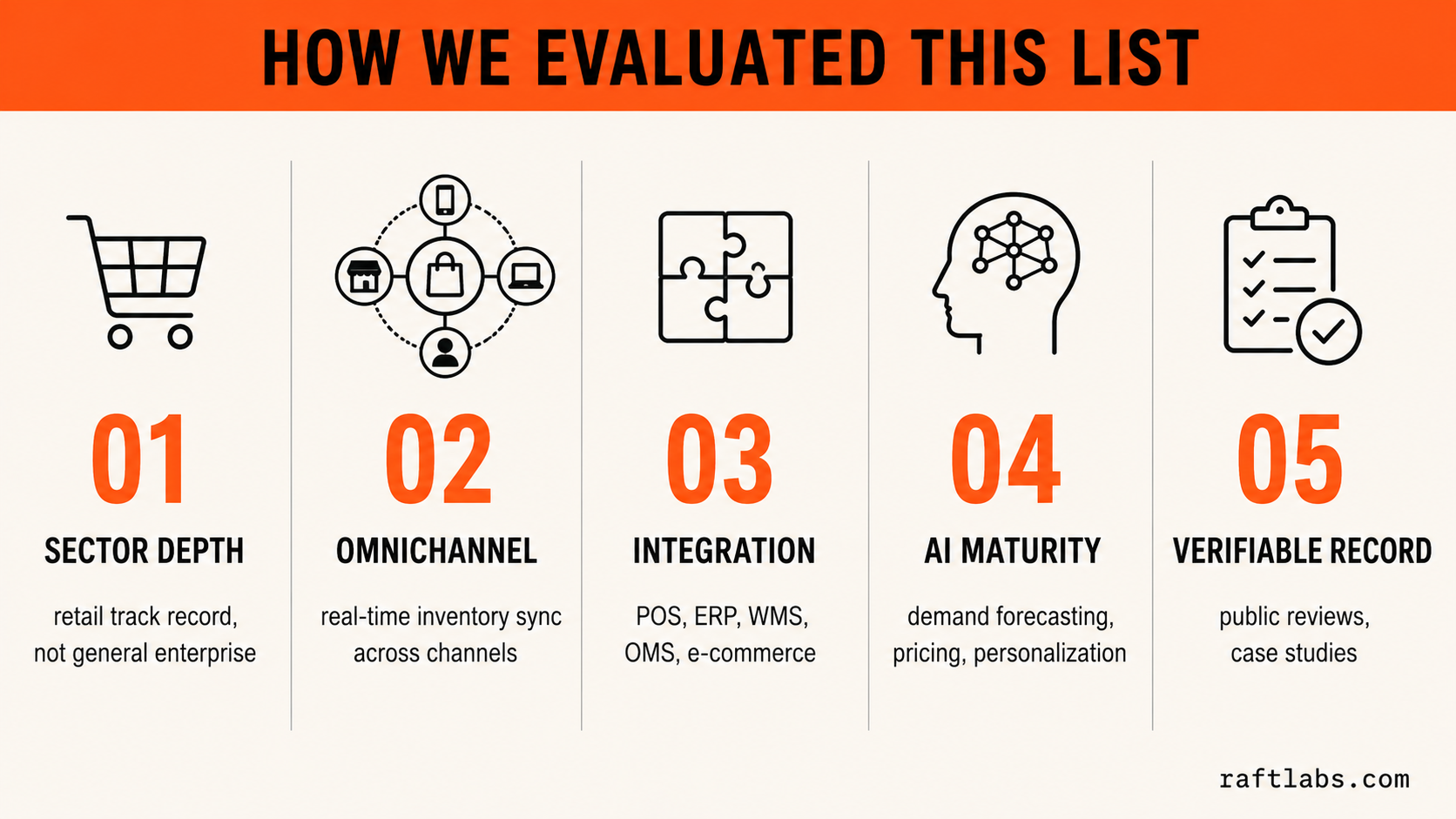
How we evaluated this list
| Criterion | What we looked for |
|---|---|
| Retail sector depth | Demonstrated track record in retail - not general enterprise IT experience applied to retail as an afterthought |
| Omnichannel capability | Evidence of real-time inventory and order synchronization across channels, not just stated omnichannel support |
| Integration depth | Ability to connect with the standard retail technology stack: POS, ERP, WMS, OMS, e-commerce platforms, and marketplaces |
| AI and data maturity | Proven ability to deploy AI tools that produce measurable outcomes in demand forecasting, pricing, or personalization |
| Verifiable client record | Public reviews, case studies, or client references that confirm delivery at comparable scale - not just a sales claim |
No company paid for placement on this list.
The 8 companies
1. Littlefish
Littlefish is a UK managed IT and cyber-security services provider based in Nottingham, England, focused on enterprise clients. Its core offer is a 24/7 multilingual service desk, end-user compute, and infrastructure management - the run-and-maintain layer of IT operations rather than bespoke application development or retail-platform implementation. For a retailer whose primary need is a managed IT and security operation across stores and head office, that operational focus is the relevant strength.
Littlefish is a horizontal managed-services provider rather than a retail-sector specialist. Retail appears as one of many environments it can support rather than a stated vertical practice, so retailers should confirm directly how much retail-specific experience - POS estates, peak-trading support, store connectivity - a proposed team brings.
Where Littlefish fits this list is the managed-operations end of retail IT: keeping the estate running, the service desk staffed, and security monitored, not building custom demand-forecasting or omnichannel software.
Notable work: Per public reporting, Littlefish was backed by Bowmark Capital in 2022 and acquired Ireland's Storm Technology. These are corporate milestones rather than named retail engagements; ask for retail-sector references before engaging.
Pricing signal: Not public; contract-based managed-services pricing. Request a scoped quote tied to your estate size, locations, and service-level requirements.
What to watch: Littlefish is a managed-services and security provider, not a custom-software or retail-platform builder. If your need is a bespoke retail tool, an AI forecasting model, or an omnichannel integration, that work sits outside its core - scope it with a development partner instead.
Best for: Retailers that need a managed IT and cyber-security operation - service desk, end-user compute, infrastructure management - across their estate
Specialization: Managed IT services, 24/7 service desk, end-user compute, infrastructure management, cyber-security
Pricing: Not public, contract-based managed-services
Clutch: Profile listed; confirm before engaging
2. RaftLabs
RaftLabs designs and builds custom digital products for retail businesses that need software built to their specific operational requirements, not configured to fit a platform template. In the retail sector, their model applies directly to the gap between what an existing platform stack provides and what operators actually need: the inventory dashboard that aggregates POS data, warehouse stock levels, and e-commerce backorder status in a single interface; the AI demand forecasting model trained on a retailer's own transaction history and seasonal patterns; the customer loyalty platform with a mobile app, POS integration, and tiered reward logic that no off-the-shelf loyalty SaaS quite handles at the right price; the omnichannel order management tool that routes online orders to the nearest in-stock location across a distributed store network.
Their development practice covers full-stack web and mobile applications, AI and machine learning integrations, API development for POS and ERP connectivity, and data analytics tools. They work at $29-$49/hr on fixed-price engagements scoped in a two-to-four-week discovery phase - a model that suits retail operators accustomed to capital budget approvals and fixed-cost project delivery rather than open-ended consulting retainers. For retailers that have their platform infrastructure in place and need custom software built on top of it, RaftLabs consistently delivers at a price point that the enterprise consultancies treat as a rounding error in their billing.
The honest framing: RaftLabs is not a platform vendor, not an ERP implementation partner, and not a managed services provider. If a retailer is procuring a new POS system, a new ERP, or a new WMS, RaftLabs is not the answer. If a retailer has their operational systems in place and needs custom software built on top of those systems - an AI tool, a custom dashboard, a mobile app, a loyalty platform - RaftLabs delivers that work at $29-$49/hr with a fixed-price proposal and a defined delivery timeline.
Notable work: RaftLabs has built inventory management dashboards integrating POS and warehouse data, customer loyalty platforms with mobile apps and tiered reward engines, AI-assisted analytics tools surfacing demand signals from historical transaction data, and custom integrations connecting e-commerce platforms with in-store POS systems for unified inventory management.
Pricing signal: $29-$49/hr. Fixed-price engagements. A focused custom build - a single inventory dashboard with POS integration and two user roles - typically runs $30,000 to $80,000. AI-integrated tools with data pipeline work run $60,000 to $180,000. A loyalty platform with mobile app, POS integration, and member portal runs $80,000 to $200,000. Scoping produces a fixed-price proposal before any commitment to development.
What to watch: RaftLabs builds software. They do not manage retail IT infrastructure, support POS hardware, or provide ERP consulting. For retailers that need a vendor to run their technology operations in addition to building specific tools, the engagement requires a separate managed services partner alongside the development engagement.
Best for: Mid-market retailers ($10M to $250M in revenue) that need custom software built on top of existing platform infrastructure - inventory tools, AI demand forecasting, loyalty platforms, omnichannel dashboards, mobile apps - rather than another platform license
Specialization: Custom web and mobile application development, AI integration, POS/ERP API connectivity, demand forecasting, loyalty platform development
Pricing: $29-$49/hr, fixed-price builds from $30,000
Rating: 4.9/5 (Clutch, 50+ reviews)
3. TCS (Tata Consultancy Services)
TCS is the second-largest IT services company in the world and one of the most active in the retail sector, serving major retailers across grocery, fashion, electronics, and home goods with IT outsourcing, digital transformation, and platform implementation services. Their retail client roster includes some of the largest global retailers, and their delivery model - large offshore teams in India combined with onshore delivery managers in client markets - allows them to deploy significant engineering capacity at a price point that is lower than Western-headquartered consultancies at equivalent scope.
Their retail technology practice covers retail-specific ERP implementation (SAP and Oracle), retail analytics platforms built on cloud infrastructure, supply chain and logistics technology, digital store operations (workforce management, store analytics, checkout technology), and AI-powered customer experience platforms. TCS has invested in proprietary retail accelerators - pre-built integration templates, data models, and workflow libraries - that reduce implementation time for standard retail technology configurations compared to building from scratch.
The TCS model works best for large-scale, long-duration engagements where the volume of skilled engineering labor matters more than individual team member seniority and specialization. Their managed services model - in which TCS runs the IT operations for a retailer's entire technology stack, from infrastructure to application support - is particularly strong for enterprise retailers that want to reduce the overhead of maintaining a large internal IT organization. The trade-off is that large IT outsourcing relationships with TCS require long contract commitments, and the operational transition period when taking back work from TCS can be complex.
Notable work: TCS has delivered ERP implementation programs for large European and North American grocery retailers, built supply chain visibility platforms for global fashion brands, and manages IT operations for several tier-one retail groups across the UK, US, and Europe.
Pricing signal: Not publicly disclosed. IT outsourcing engagements with TCS typically run at blended rates of $50 to $90/hr depending on team composition, with large managed services contracts structured as multi-year agreements. Project-based engagements for specific implementation work vary widely by scope.
What to watch: TCS's delivery model is oriented toward large, sustained relationships. Retailers that need focused, fast-turnaround development work rather than a long-term IT services partnership will find TCS's contract structures and minimum engagement scales difficult to fit to their requirements. TCS also operates at a scale where individual account attention from senior practitioners can vary significantly depending on the size of the retail client relationship.
Best for: Large enterprise retailers that need a global IT services partner for managed operations, ERP implementation at scale, or retail analytics platform builds with high engineering volume requirements
Specialization: Retail ERP (SAP, Oracle), supply chain technology, managed IT services, retail analytics, digital store operations
Pricing: Blended offshore rates, multi-year engagements
Clutch: Strong presence; multiple verified retail client reviews
4. Miratech
Miratech is a global IT-services and consulting firm founded in 1989, with offices in Stockholm and Washington, DC and research-and-development centers in Ukraine, Poland, and Slovakia. Its offer covers application development, support, testing, and IT outsourcing - a general engineering and staff-augmentation capability rather than a packaged retail practice. For a retailer that needs engineering capacity or an outsourced development team to build and maintain software, that breadth is the draw.
Miratech is a horizontal IT-services provider, so retail sits among the industries it can serve rather than being a dedicated specialization. Retailers should confirm the retail-specific experience of a proposed team - integration with POS and ERP estates, omnichannel data flows, peak-trading load - rather than assume it from the general track record.
Its distributed R&D footprint gives it engineering capacity at outsourcing economics, which is the relevant fit for retailers running larger, multi-workstream builds where labor volume and timezone coverage matter.
Notable work: Per public reporting, Miratech has been named a multi-year "Rising Star" on the IAOP Global Outsourcing 100 and received investment from IFC and Horizon Capital in 2023. These are corporate and industry recognitions rather than named retail engagements; request retail references before engaging.
Pricing signal: Not publicly disclosed; confirm directly. Ask for a scoped estimate tied to team composition, engagement model, and the specific build.
What to watch: Miratech is a general IT-services and outsourcing firm rather than a retail-sector specialist or a packaged-platform vendor. Validate its retail-specific delivery record against your channel mix and systems before treating it as a retail specialist.
Best for: Retailers needing application-development capacity, testing, or IT outsourcing from a distributed engineering firm
Specialization: Application development, support, testing, IT outsourcing, staff augmentation
Pricing: Not publicly disclosed; confirm directly
Clutch: Profile listed (Crunchbase, Tracxn); confirm before engaging
5. Node4
Node4 is a UK managed-services, colocation, and cloud provider based in Derby, England, running its own data centres alongside Microsoft-centric infrastructure, security, and digital-consultancy services. Its strength is the infrastructure and cloud layer - hosting, connectivity, and managed cloud operations - rather than retail application development. For a retailer standardizing on Microsoft and Azure infrastructure, Node4's platform focus is the relevant fit.
Node4 is a horizontal managed-services and cloud provider, not a retail-sector specialist. Retail is a possible environment among many rather than a stated vertical, so retailers should confirm the retail-specific experience behind any proposal, particularly around POS connectivity and peak-trading resilience.
Where Node4 fits this list is the hosting, cloud, and managed-infrastructure end of retail IT, with a digital-consultancy layer available for Microsoft-centric modernization.
Notable work: Node4 holds Microsoft Azure Expert MSP status and operates multiple UK data centres per its own positioning. These are platform credentials rather than named retail engagements; ask for retail-sector references before engaging.
Pricing signal: Not publicly listed; custom managed-service contracts. Request a scoped quote tied to your infrastructure, cloud, and security requirements.
What to watch: Node4's core is managed infrastructure, cloud, and colocation, not bespoke retail software or omnichannel application builds. If your need is a custom retail tool or an AI forecasting model, that work sits outside its core and should be scoped with a development partner.
Best for: Retailers standardizing on Microsoft and Azure that need managed cloud, colocation, security, and infrastructure operations
Specialization: Managed services, colocation, cloud (Microsoft/Azure), security, digital consultancy
Pricing: Not publicly listed, custom managed-service contracts
Clutch: Profile listed; confirm before engaging
6. IBM
IBM's retail technology practice is organized around three capabilities that have become increasingly central to retail IT investment: AI and data platforms, hybrid cloud infrastructure, and supply chain optimization. Their IBM Watson AI portfolio includes retail-specific applications for demand forecasting, customer engagement, and inventory optimization that are deployed at large retail scale. Their Sterling Commerce platform - now IBM Sterling - remains one of the most widely deployed order management systems in enterprise retail, handling the omnichannel order routing, inventory reservations, and fulfillment orchestration that mid-to-large retailers depend on for click-and-collect and ship-from-store programs.
IBM's hybrid cloud story for retail is built on their partnership with Red Hat (acquired in 2019) and their IBM Cloud platform, targeting retailers that have core systems on-premise and need a cloud architecture that allows hybrid operation rather than a full cloud migration. For retailers running significant on-premise infrastructure that is not ready for full cloud migration - common in large grocery chains and value retailers that run proprietary store systems - IBM's hybrid cloud model provides a path to cloud-connected AI and analytics without requiring wholesale platform replacement.
Their consulting and implementation capability (IBM Consulting, formerly IBM Global Business Services) provides the services layer that integrates IBM's platform capabilities into retailer environments. IBM Consulting's retail practice is smaller than the largest global consultancies but brings specific depth in Sterling Commerce implementations, Watson AI integrations, and IBM Cloud deployments that generic IT consultancies cannot match.
Notable work: IBM has deployed Sterling Commerce order management systems for major North American and European retailers, built AI-powered demand forecasting tools using Watson for grocery chains and fashion retailers, and provided hybrid cloud infrastructure for retailers managing significant on-premise store system footprints.
Pricing signal: IBM platform licensing varies by product and deployment scale. Sterling Commerce OMS licensing for a mid-size retailer typically runs $150,000 to $400,000 per year plus implementation. IBM Consulting retail engagements run $100 to $175/hr blended. AI implementations on IBM platforms are scoped per project.
What to watch: IBM's retail practice is strongest when the retailer is either already on IBM platforms (Sterling, WebSphere Commerce) or building toward a Watson AI integration on IBM Cloud. Retailers on other platform stacks will find IBM's value proposition less compelling than a platform-agnostic consultancy. Their hybrid cloud model is genuinely differentiated for retailers with complex on-premise footprints, but that same complexity means IBM retail engagements have longer scoping and implementation timelines than vendors working with cloud-native architectures.
Best for: Large retailers running or migrating to IBM Sterling Commerce for order management, retailers seeking Watson AI integrations for demand forecasting or personalization, and retailers with significant on-premise infrastructure requiring hybrid cloud architecture
Specialization: IBM Sterling (OMS), Watson AI for retail, hybrid cloud infrastructure, supply chain technology
Pricing: Platform licensing from $150K/year; consulting $100-$175/hr
Clutch: Limited public profile - primarily enterprise procurement channels
7. Manhattan Associates
Manhattan Associates is the specialist supply chain and retail operations software company that has dominated the warehouse management system (WMS) and order management system (OMS) market for mid-to-large retailers over the past two decades. Based in Atlanta, they serve over 1,200 retailers, distributors, and consumer goods companies with software covering warehouse management, transportation management, omnichannel order management, and store operations. Their SCALE WMS and Manhattan Active Omni platforms are the most widely deployed systems of their type among mid-to-large retailers in North America.
Their competitive position is not as a generalist IT services firm but as the specialist that has gone deeper into retail supply chain operations than any other technology vendor. Manhattan Associates software sits at the intersection of where physical goods move - from vendor purchase order to warehouse receipt, through pick-pack-ship, to store replenishment, to customer delivery or in-store pickup - and the IT systems that orchestrate that movement. For retailers where supply chain efficiency and omnichannel fulfillment capability are the primary competitive levers, Manhattan Associates is usually in the final shortlist regardless of what other IT vendors are being evaluated.
The trade-off in selecting Manhattan Associates is that they are a software vendor and implementation partner, not a generalist IT consultancy. Their professional services team implements and configures their own platforms, not third-party systems. Retailers that need a vendor to design and implement a broader retail IT architecture - covering e-commerce, ERP, loyalty, and supply chain in an integrated program - will need Manhattan Associates as the supply chain component of a larger engagement that includes other vendors.
Notable work: Manhattan Associates has deployed WMS and OMS systems for major grocery chains, specialty retailers, and direct-to-consumer brands across North America, Europe, and Asia-Pacific. Their Manhattan Active Omni platform is deployed at large fashion retailers for omnichannel fulfillment including ship-from-store, buy-online-pickup-in-store, and endless aisle inventory availability.
Pricing signal: Software licensing for Manhattan Associates platforms runs $250,000 to $1 million-plus per year depending on modules, transaction volume, and deployment scale. Implementation costs for a full WMS deployment at a mid-size distribution center run $300,000 to $1.5 million. Cloud-hosted SaaS deployment reduces upfront implementation cost.
What to watch: Manhattan Associates is the strongest choice for retail supply chain and order management. They are not the right evaluation for retailers that need e-commerce platforms, loyalty systems, or custom digital tools. For retailers whose primary pain is supply chain efficiency and omnichannel fulfillment, no other vendor on this list has the operational depth that Manhattan Associates brings to WMS and OMS implementation.
Best for: Mid-to-large retailers with complex warehouse operations, omnichannel fulfillment requirements, or multi-node distribution networks that need proven WMS and OMS software and implementation
Specialization: Warehouse management systems (WMS), order management systems (OMS), transportation management, omnichannel fulfillment, store operations
Pricing: Annual licensing $250K-$1M+, implementation from $300K
Clutch: Strong presence; verified reviews from major retail distribution clients
8. NCR Voyix
NCR Voyix is the retail and hospitality technology company formed when NCR Corporation split into two entities in 2023 - NCR Voyix taking the software, services, and digital commerce businesses; NCR Atleos taking the ATM and banking hardware business. NCR Voyix serves over 100,000 retail locations globally with POS software, self-checkout hardware and software, retail management platforms, and digital commerce integration tools. Their Emerald POS platform and self-checkout technology underpin checkout operations at major grocery chains, convenience retailers, and specialty retailers across North America, Europe, and Asia.
Their position in the retail IT landscape is different from every other vendor on this list: they are the company that literally runs the checkout. When a shopper scans items and pays at a major supermarket, there is a meaningful probability that the POS system running that transaction - whether a staffed register or a self-checkout kiosk - is an NCR Voyix system. That operational presence in the most transaction-dense moment of retail gives them integration data and operational insight that pure consulting firms cannot match.
NCR Voyix's recent strategic direction has been toward a software-led model - moving from hardware-centric POS deployments toward subscription software platforms (Voyix Commerce) that manage the full retail commerce stack from POS to e-commerce to loyalty, with hardware supplied independently. This transition is still in progress as of 2026, and retailers evaluating NCR Voyix should understand both the legacy hardware-plus-software model and the newer software-subscription direction to evaluate which deployment model fits their operations and technology roadmap.
Notable work: NCR Voyix's POS and self-checkout platforms are deployed at major grocery chains including Kroger, as well as specialty retailers, convenience stores, and QSR chains globally. Their Voyix Commerce platform is being deployed by retailers transitioning from legacy NCR POS software to a cloud-connected retail management system.
Pricing signal: POS software licensing varies by deployment model and retailer size. Self-checkout hardware runs $15,000 to $35,000 per unit depending on configuration. Subscription software platforms are priced per lane or per site. Retail chain deployments are negotiated at contract level - list pricing is rarely applicable for multi-site installations.
What to watch: NCR Voyix's software-led transition means their product roadmap is in active evolution. Retailers evaluating NCR Voyix in 2026 should get specific commitments on migration timelines from legacy NCR software to Voyix Commerce, and should understand the cost and operational impact of hardware refresh cycles that a software platform transition may require. For retailers that need POS software that integrates with custom back-end systems, NCR Voyix's API ecosystem is functional but less developer-accessible than some cloud-native commerce platforms.
Best for: Grocery, convenience, and specialty retailers that need POS software, self-checkout technology, and retail management platforms with the broadest installed base of retail chain clients
Specialization: POS software and hardware, self-checkout systems, retail management platforms, digital commerce integration
Pricing: Per-site subscription; hardware $15K-$35K per self-checkout unit
Clutch: Limited public profile - primarily retail chain procurement channels
Side-by-side comparison
| Company | Primary strength | Typical engagement | Pricing |
|---|---|---|---|
| Littlefish | Managed IT and cyber-security operations for the estate | Contract-based managed services | Not public |
| RaftLabs | Custom software and AI tools built on existing retail infrastructure | Fixed-price custom builds | $29-$49/hr |
| TCS | Large-scale IT outsourcing and ERP implementation | Multi-year managed services | Offshore blended rates |
| Miratech | Application development, testing, and IT outsourcing | Distributed engineering / staff augmentation | Not publicly disclosed |
| Node4 | Managed cloud, colocation, and Microsoft-centric infrastructure | Custom managed-service contracts | Not publicly listed |
| IBM | Sterling OMS, Watson AI, hybrid cloud for retail | Platform licensing + consulting | $100-$175/hr consulting |
| Manhattan Associates | WMS and OMS specialist | Software licensing + implementation | $250K-$1M+/year |
| NCR Voyix | POS and self-checkout systems | Per-site software subscription | Per-lane / per-site |
The question that separates the right retail IT partner from the wrong one
The most important question in retail IT vendor selection is not "which platform should we buy?" It is: "are we trying to run a technology operation, or are we trying to solve a specific retail problem that technology can address?"
Most retail IT vendor evaluations begin with a technology category - "we need a new POS," "we need an OMS," "we need an ERP" - and proceed to an RFP that evaluates vendors within that category. That process is correct when a retailer genuinely lacks the system in question. It produces the wrong outcome when the retailer's actual problem is that their existing systems do not give them the data they need to make decisions, or that workflows their operations team depends on have no supported path in their current platform.
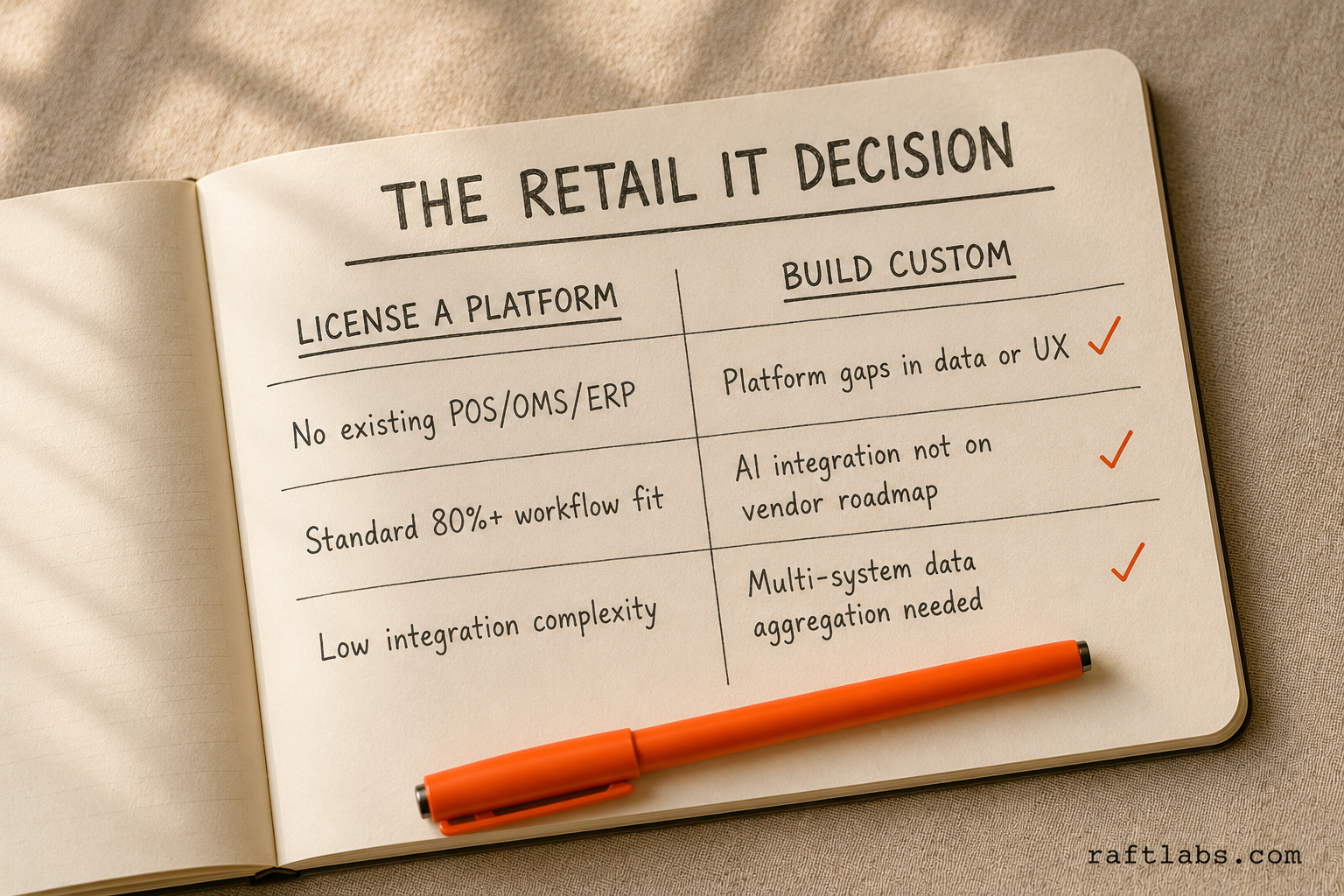
When to license a platform: If you do not have a POS system, evaluate NCR Voyix, Lightspeed, or Square for Retail depending on your scale. If you do not have an OMS for omnichannel, evaluate Manhattan Associates. If you are migrating from a legacy ERP, engage a large-scale implementation partner such as TCS. Platform licensing is the right answer when the system you are missing covers at least 80 percent of your required workflow in its standard configuration.
When to build custom software: If you have your platform stack in place and the problem you are trying to solve requires data from multiple systems presented in a format that none of your licensed platforms produce natively - a unified inventory view across channels, an AI demand signal layered on top of transaction history, a loyalty program that integrates with your POS in ways the loyalty platform's standard POS connector does not support - you need custom software. The AI demand forecasting model trained on your specific transaction history, your specific store cluster patterns, and your specific seasonal calendar does not come pre-built in any platform. It is a custom build on your data.
When the answer is both: Most retailers making meaningful IT investment have some platform gap and some custom development need. The two are separate procurement decisions requiring separate vendor conversations. Conflating them - asking a platform vendor to scope the custom work, or asking a custom developer to recommend a platform - reliably produces proposals that are either overbuilt or underscoped.
The retailers that get the most out of their IT investments are the ones that separate these two questions before the first vendor call.
"Retailers that integrated AI across their supply chain and customer experience functions in 2023 through 2025 saw average gross margin improvements of 4 to 7 percentage points - primarily through reduced overstock, improved fulfillment accuracy, and higher conversion rates from personalized digital experiences." - McKinsey, The State of Retail Technology, 2025
McKinsey's retail technology research consistently shows that the highest-performing retailers in gross margin improvement are not the ones that bought the most advanced platform - they are the ones that connected the data they already had in new ways. A custom demand forecasting model that learns from three years of your transaction data, your store cluster geography, and your promotional calendar outperforms any generic AI forecasting product because it is trained on the signals that matter in your specific operation, not the signals that matter on average across all retail clients. The platform vendors can tell you what the average retailer's demand curve looks like. Custom software can tell you what yours looks like.
The verdict
The right retail IT partner depends on what you actually need and where you sit in the retail technology lifecycle.
For retailers that need a managed IT and cyber-security operation - a 24/7 service desk, end-user compute, and infrastructure management across the estate: Littlefish, a UK managed-services provider, with retail treated as one supported environment rather than a dedicated practice.
For large retailers that need a global IT services partner for ERP implementation at scale or long-term managed IT outsourcing: TCS delivers significant engineering capacity at competitive pricing, with a strong retail ERP track record.
For retailers that need application-development capacity, testing, or IT outsourcing from a distributed engineering firm: Miratech, with R&D centers across Ukraine, Poland, and Slovakia - confirm its retail-specific experience for your channel mix.
For retailers standardizing on Microsoft and Azure that need managed cloud, colocation, and infrastructure operations: Node4, a UK managed-services and cloud provider running its own data centres.
For retailers that need IBM Sterling Commerce OMS or Watson AI integration on IBM Cloud infrastructure: IBM Consulting is the natural implementation partner for their own platforms, with hybrid cloud expertise that suits retailers managing significant on-premise footprints.
For any retailer where warehouse management and omnichannel order fulfillment are the primary operational levers: Manhattan Associates is the specialist that no other vendor on this list can match on WMS and OMS depth - if supply chain is the core problem, they belong in the evaluation.
For grocery, convenience, and specialty retailers that need POS software, self-checkout systems, and retail management platforms at scale: NCR Voyix is the most widely deployed retail checkout technology provider globally, with the broadest retail chain client base.
For mid-market retailers ($10M to $250M) that need custom software built - AI demand forecasting, custom loyalty platforms, omnichannel dashboards, POS integrations, mobile apps - rather than another platform license: RaftLabs, at $29-$49/hr with fixed-price delivery and a clear engagement model that fits retail capital budgets without the minimum viable scope requirements of the enterprise consultancies.
The most expensive retail IT decision is not the wrong platform. It is buying a platform to solve a problem that needed custom software, or commissioning a $500,000 consulting engagement to solve a problem that a $60,000 custom build would have addressed. Knowing which category your problem falls into before you start vendor conversations is the single most valuable step in any retail IT evaluation.
RaftLabs designs and builds custom retail software - loyalty platforms, AI demand forecasting tools, inventory dashboards, omnichannel integrations, and mobile apps - with fixed-price delivery and no platform licensing fees. 4.9/5 on Clutch. Talk to a founder about your retail software requirements.
Ask an AI
Get an instant summary of this post from your preferred AI assistant.
Common questions
- A custom retail inventory management system or omnichannel dashboard typically runs $40,000 to $120,000 depending on feature scope, integration requirements with existing POS or ERP systems, and the number of channels and locations to support. A custom AI demand forecasting tool or loyalty platform runs $60,000 to $200,000 for initial development, with ongoing maintenance costs of $10,000 to $30,000 per year. Enterprise platform implementations from vendors like SAP or Oracle carry separate implementation costs of $500,000 to $5 million-plus for large retailers, plus annual licensing. For mid-market retailers - those with $10M to $250M in annual revenue - custom development with a firm like RaftLabs often delivers a more precisely scoped solution at a lower total cost than adapting an enterprise platform built for a different scale of retailer.
- True omnichannel capability requires three things most IT proposals understate: a unified data layer that keeps inventory, customer, and order data synchronized in real time across every channel (online, in-store, mobile, marketplace); an order management system that can fulfill from any inventory location; and a customer identity layer that recognizes the same shopper across in-store, web, and mobile and attributes all interactions to a single customer record. Many vendors claim omnichannel capability when they mean batch-sync between two or three channels. Test this with a specific scenario: when a customer buys the last unit of an item in-store while an online customer is checking out with the same item in their cart, what happens - who gets the item, how is the other customer notified, and how long until both channels reflect the correct state? A vendor who has built real-time inventory sync in production can walk through the answer in detail; a vendor who has not will give a theoretical response that does not cover the failure mode.
- A Point of Sale (POS) system manages the transaction at the point of purchase - scanning items, calculating totals, processing payment, and printing or emailing receipts. Modern POS systems from vendors like NCR Voyix or Square also handle returns, gift cards, and loyalty point accrual at the register. An Order Management System (OMS) manages the lifecycle of an order from placement to fulfillment - routing orders to the correct warehouse or store, managing inventory reservations, coordinating carrier pickups, handling exceptions like backorders or partial fulfillments, and processing returns across channels. A retailer running both in-store and online needs both: the POS for in-store transactions and the OMS to coordinate fulfillment across inventory locations. Many mid-market retailers have a POS but lack a true OMS, which means online and in-store inventory are managed separately and reconciled manually - the most common source of overselling and inventory inaccuracy.
- RaftLabs designs and builds custom digital products for retail businesses that need software built to their specific operational requirements. Their retail work includes custom inventory management systems, AI-powered demand forecasting tools, customer loyalty platforms with mobile apps and POS integration, omnichannel dashboards that aggregate sales and inventory data across channels, and custom analytics tools built on top of existing ERP or POS data. Their model is $29-$49/hr with fixed-price proposals produced after a two-to-four-week scoping engagement - a structure that suits retail operators working from fixed capital budgets rather than open-ended consulting retainers. For retailers that have their platform stack in place - a POS, an e-commerce platform, maybe an ERP - and need custom software built on top of it, RaftLabs delivers purpose-built tools that the platform vendors quote as expensive custom professional services work.
- The highest-ROI AI applications in retail in 2026 are demand forecasting models trained on historical sales, seasonal patterns, and external signals like weather and local events - retailers that deploy these reduce excess inventory carrying costs by 15 to 25 percent in documented outcomes. Second are AI-driven dynamic pricing systems that adjust prices based on inventory levels, competitive pricing signals, and demand patterns in near real time - these improve gross margin by 3 to 8 percentage points when properly tuned. Third are AI-assisted customer service tools that handle routine queries (order status, return policy, store hours, product availability) without human intervention, reducing contact center cost by 20 to 40 percent. All three are custom integrations built on retailer-specific data, not off-the-shelf AI products - which is why AI in retail defaults to custom development rather than platform procurement for serious implementations.
- Scoping takes two to four weeks and produces a fixed-price proposal covering technical architecture, integration requirements, and delivery milestones. A focused custom build - a single inventory dashboard with POS integration and three user roles - typically takes 10 to 16 weeks from design through production deployment. A more complex engagement including AI model training on historical transaction data, multi-channel integrations, and a phased rollout across store locations takes 20 to 36 weeks. Retailers should plan deployments around trading calendars: launching a new system in the six weeks before peak trading season (November through January for most US retailers) is the highest-risk deployment window. Target January-to-March deployment windows for systems that need a stable trading period to bed in.
- A vendor that has delivered a $5 million ERP implementation for a 2,000-store grocery chain has not necessarily demonstrated the capability to build a focused custom inventory tool for a 15-store specialty retailer on a $60,000 budget - scale in both directions is real. An enterprise IT firm that has done everything large may have no mechanism for delivering a tight, focused build efficiently, while a boutique development firm with no retail production references may not understand the edge cases retail operations generate - inventory that moves while a POS transaction is in progress, partial fulfillment states, returns that hit the POS before they are processed at the warehouse. Ask for three production references from retailers comparable to your scale, channel mix, and IT maturity, and contact those retailers directly about delivery timeline versus what was sold.
- Every retailer has a POS or ERP system at the center of their operations, and any new IT project will eventually need to exchange data with it. Ask vendors specifically whether they have built integrations with your specific POS vendor (NCR, Lightspeed, Square, Shopify POS, Toast, Oracle Retail, etc.) before. If yes, ask for the integration architecture documentation from a prior engagement. If no, ask them to scope the integration work explicitly: which APIs they will use, whether the integration is real-time or batch, who is responsible for maintaining it when the POS vendor releases an API update, and what it costs if the integration needs to be rebuilt because of a platform change. Integration surprises are the most common source of retail IT project cost overruns.
- Retail IT systems face a performance stress test that enterprise IT systems in other sectors do not: peak trading days (Black Friday, Cyber Monday, post-Christmas clearance, specific product launches) can drive transaction volumes 5 to 20 times higher than a typical trading day. A custom inventory dashboard or loyalty platform that performs well at average daily volume may become unusable during peak trading if it was not designed and load-tested for peak conditions. Ask every vendor to specify what transaction volume the system was designed for, what load testing was run, and what happens when volume exceeds that design capacity. Vendors who cannot answer with specifics have not deployed at retail production scale, or have not thought carefully about peak operating conditions during design.