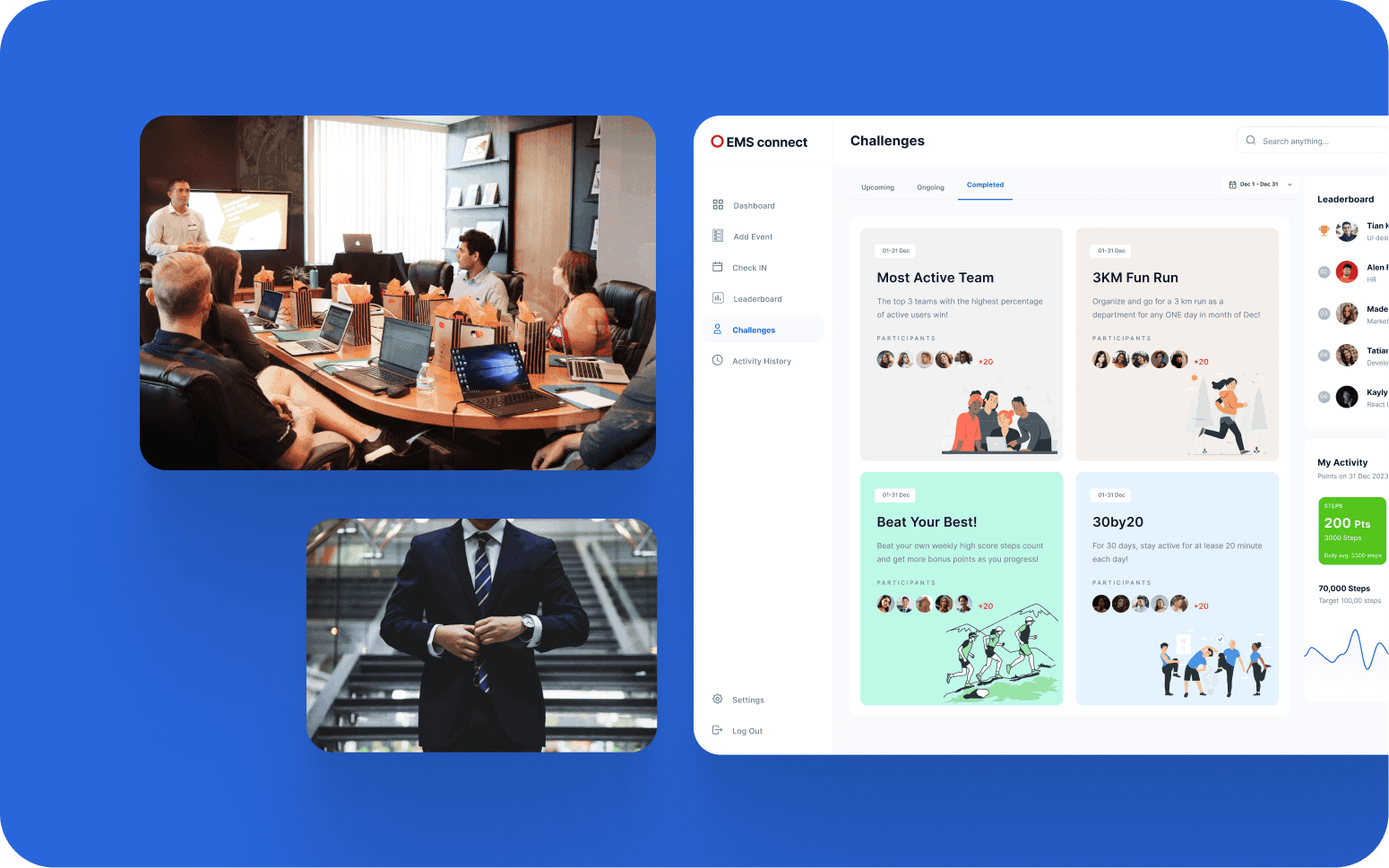
Employee Engagement and Training App Built for a Global Workforce
- 3x
- 10K+
Fitness brands that gave members a digital touchpoint, including workout logging, class booking, and progress tracking, retain those members significantly longer than brands whose only touchpoint is the gym floor. The app extends the relationship to every day of the week, not just the days the member visits.
We build fitness apps for gyms, studios, and fitness brands where workout tracking, class booking, coaching programme delivery, and wearable data are part of a single member experience under your brand, not scattered across three third-party apps with no connection to your business.
Workout logging and programme delivery
Class booking with reminders
Wearable and Apple Health integration
Progress analytics and coach dashboard
Recognition
Members using a third-party app to track their workouts and log their progress, with no connection to your gym or your coaches, so when they cancel, they take their data and their engagement somewhere else?
Class booking working fine in person but members dropping out of classes at higher rates because there is no app reminder, no pre-class motivation, and no friction to cancelling?
In short
Fitness app development for gyms, studios, and fitness brands covers workout logging, coach-assigned programme delivery, in-app class booking with push reminders, wearable and Apple Health integration, progress analytics, coach dashboards, and community features, in a single app under the brand's name. RaftLabs builds custom fitness apps for iOS and Android, and members who engage with a branded fitness app cancel at significantly lower rates than those whose only touchpoint is the gym floor. Most projects ship in 12 to 16 weeks at a fixed cost with full source code ownership.
Companies we've built for






A fitness app is a retention tool before it's a feature. The relationship between digital engagement and membership retention is well-documented in the fitness sector: members who log workouts, follow coach-assigned programmes, or book classes through an app cancel at lower rates than members who interact with the gym only through the front desk or a generic booking link. The mechanism is straightforward. An app creates a daily touchpoint that's independent of physical attendance. A member who opens the app to log a home workout or check their programme for the week is maintaining an active relationship with the gym on days they're not on the floor.
The difference between an app that gets used daily and one that gets downloaded and forgotten is specificity. A generic workout logger has no connection to the gym, the coaches, or the class timetable. A custom fitness app under the gym's brand delivers the coach's actual programme, shows the gym's actual class schedule, connects to the member's wearable data, and surfaces progress in the context of goals the member set with their coach. That specificity is what keeps the app open. Building it requires decisions about which features serve the members most likely to churn, not a feature list assembled from what every fitness app has.
Workout logging with an exercise library covering sets, reps, weight, and rest time per set. Coach-assigned training programmes are delivered through the app with exercise demonstration videos and coaching cues for each movement. Programme progression adjusts weight or volume automatically based on the member's logged performance data: the next session's targets update based on what was completed in the previous one. Workout history and personal record tracking per exercise let the member see their progress on each lift over time without keeping a separate log. Programme adherence is visible to the coach alongside the member's logged sessions.
In-app class booking linked to the gym's timetable with real-time availability. Booking confirmation notification is sent immediately after a class is reserved. Pre-class reminder push notification is sent at a configurable interval before the session starts: a morning reminder for an evening class, a 30-minute reminder for a lunchtime session. Easy cancellation within the app includes a configurable cutoff time that frees the spot for waitlist promotion when the cutoff passes. Favourite class and instructor saving supports quick rebooking of regularly attended sessions. Attendance history in the member profile shows classes attended, classes cancelled, and no-shows over time.
Apple HealthKit integration reads HKWorkout and HKQuantitySample data types including active energy burned, heart rate, step count, and distance, and writes completed workouts back to Health so the member's app and the iOS Health app stay in sync. Google Health Connect provides the same two-way data exchange on Android. For dedicated sports devices, we connect via Garmin Connect IQ, Polar AccessLink, and Fitbit Web API, pulling detailed biometric data including heart rate variability, sleep, and recovery scores where the device API provides them. Workout data from the wearable syncs to the member's training log so a run or cycle completed outside the gym is captured in the same profile as a gym session. Offline workout logging with SQLite-backed local storage syncs to the server on reconnection, so members in areas with poor connectivity don't lose session data. Stripe subscription billing with configurable trial periods handles membership payments in-app without redirecting to a browser. Heart rate zone analysis for workouts performed at the gym or outdoors is shown alongside the member's logged effort and the coach's programme targets.
Member-facing progress dashboard shows body measurements over time, strength progress per exercise plotted as a trend, class attendance streak, and workout frequency by week and month. Goal setting at the start of a programme includes milestone notifications when a target is reached: a personal record on a key lift, a streak milestone, or a measurement target. Progress photos with a date-comparison view let the member place images side by side across a defined time period. Sharing options for progress milestones can be posted to the in-app community feed or exported to the member's camera roll, which drives organic social sharing tied to the gym's brand.
Coach dashboard shows programme adherence and workout data for each assigned member: what was completed, what was skipped, and how logged weights compare to programme targets. Direct message thread per client within the app covers coaching communication, form feedback, and programme questions. Programme creation interface includes an exercise library, video attachment per exercise, and scheduling across the programme duration. Session notes per client are visible to the full coaching team so a member working with more than one trainer has continuity across sessions. Group programme broadcast to a cohort of members covers gym-wide challenges or group coaching cycles.
In-app community feed handles member check-ins, workout posts, and gym announcements managed from the admin dashboard. Challenge creation with leaderboards covers class attendance streaks, total weight lifted across the month, or most workouts completed, with a configurable duration and a prize or recognition mechanic. Reactions and comments on community posts create peer engagement between members. Push notification covers gym news, new class schedules, promotional offers, and challenge updates. Member referral tracking with reward integration means members who refer a joining friend receive a credit or benefit automatically, without front desk tracking of who referred whom.
Yes. We build cross-platform using React Native, which produces native iOS and Android apps from a single codebase. This is the standard approach for fitness apps targeting both platforms because it reduces development cost and ensures feature parity: a coach programme delivered on iOS is identical to the one delivered on Android, and wearable integrations work consistently across both. We publish to the App Store and Google Play as part of the delivery scope. If you have an existing iOS app and need an Android version, or vice versa, we can scope a cross-platform rebuild that preserves the existing feature set.
Platform tools like Mindbody and Glofox are built for class booking and membership billing. They're not built to be the daily fitness companion for a member. A custom fitness app sits on the member's phone and is the primary interface for their workout data, their coaching programme, their progress tracking, and their gym relationship. A custom app runs under your gym's brand name in the App Store, not under the platform's brand. Wearable integration, coach programme delivery, custom community features, and progress analytics are built to your specification rather than constrained by the platform's roadmap. The business case for a custom app is member retention: an app that members open daily for their workout log and programme creates a retention mechanism that a booking platform does not.
Yes. The fitness app is typically built as the member-facing layer on top of the gym management system: class timetable, booking availability, and membership status are pulled from the management system via API so there's one source of data for both the admin dashboard and the member app. If you have an existing gym management system with an open API, we connect the app to it during the build. If your management system is a closed platform with no API access, we scope an integration approach based on what data the platform exposes. In cases where the management system can't be integrated, we scope a lightweight management layer as part of the app build to handle the data the app needs.
A fitness app covering workout tracking and programme delivery, class booking with notifications, wearable integration, progress analytics, a coach dashboard, and community features falls within our fixed-cost delivery model. The scope factors that affect cost are the number of wearable platforms being integrated, whether the app connects to an existing gym management system or needs a management layer built alongside it, the depth of the community and engagement features, and whether a white-label app or a fully custom design is required. We scope every project before pricing: a scoping session covers your member engagement goals, current tools, and the features that will have the most impact on retention. Fixed cost and timeline are agreed before development starts. Most projects in this scope ship in 12 to 16 weeks.
What clients say
Three-year average engagement. Founders and operators describing the work in their own words. No marketing varnish.

 USA
USAAll of the sprints were completed on schedule and on budget. We highly recommend RaftLabs!
01 / 02
Tell us what your members currently use to track their fitness, what's missing from that experience, and what you want the app to do for retention. We will scope a build around your member engagement goals.