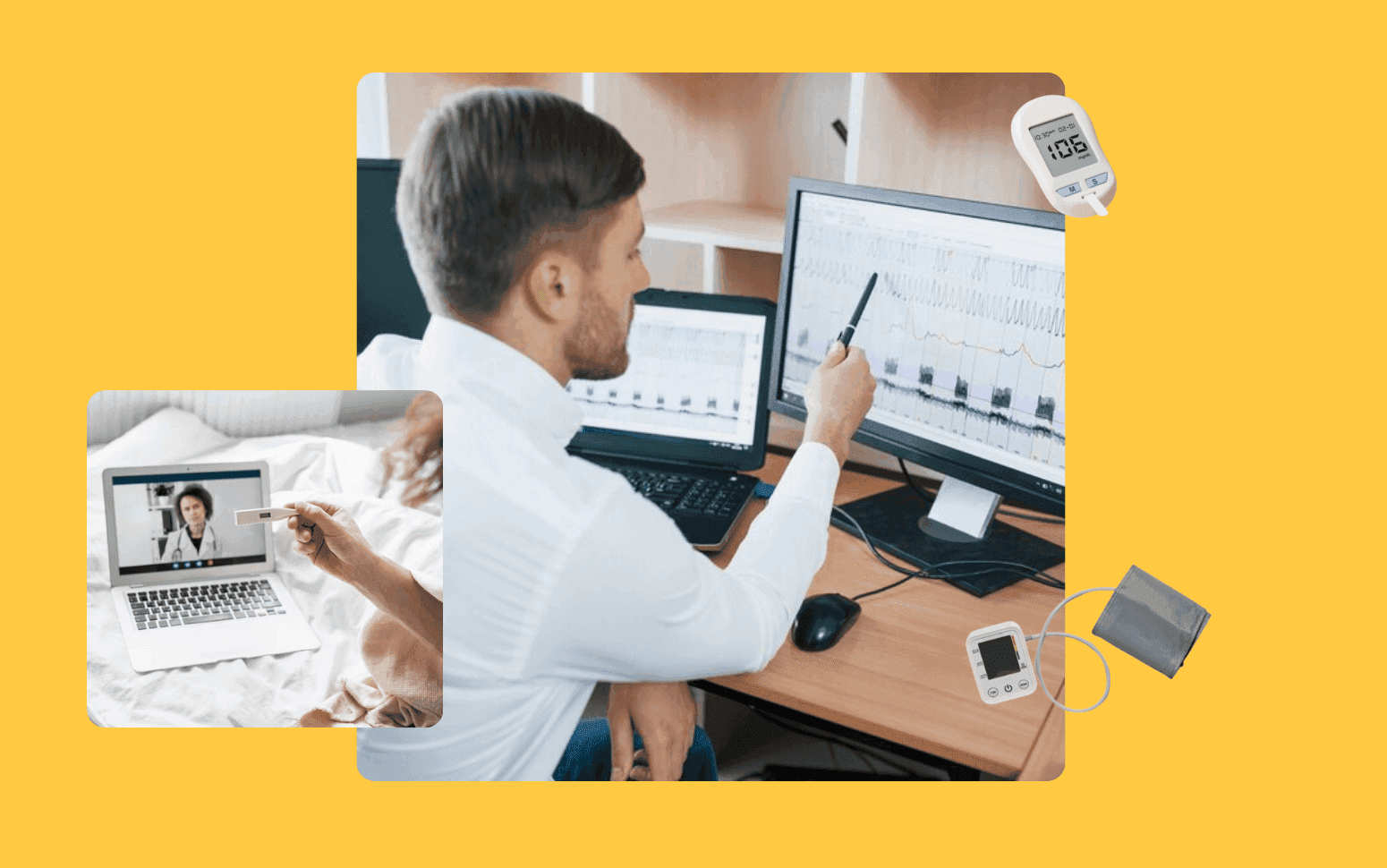
AI Remote Patient Monitoring Cuts Hospital Readmissions
- 30%
- 12 weeks
Custom platforms for decentralised and hybrid clinical trials: patient mobile app, Bluetooth medical device integration, structured data capture, and a clinician dashboard that puts protocol-defined data where your clinical team can act on it.
Generic survey tools were not built for clinical trial data. The architecture, terminology mapping, audit trail requirements, and EDC connectivity that a pharma remote monitoring platform needs require a purpose-built system.
Patient-facing mobile app with offline capability, medication reminders, and Bluetooth device sync
Structured clinical data capture with SNOMED and LOINC terminology mapping, linked to protocol eCRF fields
Clinician dashboard with configurable alert thresholds, threshold breach notifications, and site coordinator view
HIPAA-compliant encrypted data storage with full audit trail and EDC integration
Recognition
Trial subjects dropping out because travelling to site for routine vitals collection is too burdensome for a study that could capture that data remotely?
Patient-reported outcome data arriving in formats that don't map to your EDC protocol fields and require manual data cleaning before a submission-ready dataset can be produced?
In short
Remote patient monitoring software for pharma captures patient-reported outcomes, device readings, and symptom data outside the clinic from a patient-facing mobile app, and transmits structured data to the EDC system and clinician dashboard. RaftLabs builds custom remote patient monitoring platforms for pharmaceutical companies running decentralised or hybrid clinical trials, including Bluetooth device integration, SNOMED and LOINC terminology mapping, HIPAA-compliant data storage, and EDC connectivity. Most builds deliver in 14 to 18 weeks at a fixed cost.
Companies we've built for







Clinical trial design has changed. Sponsors and CROs running decentralised and hybrid trials are moving routine data collection out of the clinic and into the patient's daily environment. Vital signs, symptom reports, medication adherence, and patient-reported outcomes can now be captured remotely, reducing site burden, improving patient retention, and generating more longitudinal data than a quarterly site visit ever could.
The problem is that the platforms available to support this shift fall into two camps. Large enterprise systems like Medidata Sensor Cloud and Veeva Vault ePRO carry six-figure licences, complex validation requirements, and configuration timelines measured in months. Generic survey and mHealth tools lack the clinical data architecture, regulatory compliance controls, and EDC connectivity that a pharma trial actually requires. Neither option fits a mid-size sponsor or a CRO running a focused disease management programme that needs a purpose-built solution on a defined budget and timeline.
Custom remote patient monitoring software addresses this directly. The patient-facing app is built around your trial protocol and your patient population. The data model maps to your clinical terminology and your EDC field structure from the outset. HIPAA and GDPR controls are designed in from the start rather than bolted on after. The clinician dashboard is structured around the alert logic and site coordinator workflow your protocol defines. What you get is a system that fits the trial, not a trial bent to fit the system.
iOS and Android apps are built for patient populations that include a range of ages and technology comfort levels. Patients complete protocol-defined data entry screens, including symptom diaries, quality-of-life questionnaires, and daily check-ins, with configurable reminder notifications that prompt submission at the right time relative to dose or scheduled event. Medication reminders support adherence tracking and link logged doses to the data collected for that time window. Bluetooth sync pulls readings from paired devices without requiring the patient to manually transcribe values. Offline mode stores data locally when the patient has no signal and syncs automatically on reconnection, so field conditions don't create data gaps. The onboarding flow is designed to match the site coordinator's patient training process, reducing the support burden on clinical staff.
Bluetooth integration covers the connected medical devices your protocol specifies, including blood pressure monitors, pulse oximeters, weight scales, continuous glucose monitors, spirometers, ECG patches, and activity trackers from the main clinical-grade and consumer-grade manufacturers. Raw device readings are received, validated for biological plausibility, normalised into a standard data structure, and tagged with the timestamp of the measurement event rather than the transmission event. Device pairing is handled within the patient app with a guided setup flow so patients who aren't technically confident can complete setup without site assistance. Where a protocol requires a specific certified device, we integrate against that device's SDK or Bluetooth profile directly.
Data collection screens are built against the protocol's data dictionary. Each field maps to the correct SNOMED CT or LOINC code so data enters the system in a form that doesn't require manual terminology mapping before it can be loaded into the EDC. eCRF linkage means patient-submitted data populates the corresponding case report form fields rather than sitting in a separate data silo that requires manual reconciliation at data lock. Protocol-defined visit windows, required fields, and permissible value ranges are enforced at the point of entry. Out-of-range values trigger a query flag in the clinician dashboard rather than being accepted silently. Every data entry event is timestamped and recorded with the patient identity so the audit trail supports source data verification.
Site coordinators and clinical monitors see enrolled patients, recent data submissions, pending queries, and alert status in a single view structured around their site management workflow. Alert rules are configured per protocol. A blood pressure reading above a defined threshold, a missed submission day, or a patient-reported symptom score in the red zone each trigger breach notifications delivered to the responsible clinician by dashboard alert, email, or SMS depending on severity. Patient-level data review shows longitudinal trends for each collected variable so the clinical team can distinguish a single anomalous reading from a consistent pattern that warrants intervention. Role-based access gives site coordinators, principal investigators, and sponsor clinical operations staff appropriate views of the data without exposing cross-site patient identifiers where the protocol doesn't permit it.
Patient data is encrypted at rest and in transit using current standards, hosted on compliant cloud infrastructure in the appropriate data residency region for your study: US East or West for HIPAA, EU for GDPR, or multi-region where the trial spans jurisdictions. Access controls enforce the minimum necessary principle: clinical staff see their assigned patients, sponsor monitors see their assigned sites, and no user role has access beyond what the protocol authorises. Every data access event, every query, every modification, and every administrative action is recorded in an immutable audit log with user identity, timestamp, and the before-and-after state of the affected record. This audit architecture supports 21 CFR Part 11 electronic record requirements and the source data verification process that a regulatory inspector would conduct.
Data collected remotely needs to reach the primary EDC system, whether Medidata Rave, Oracle Clinical One, Veeva Vault EDC, or a custom eClinical system, without a manual import step. We build a data feed that transfers validated patient submissions to the corresponding EDC visit and form fields on a defined schedule or in near real time, depending on the protocol's requirements. EHR connectivity provides a read interface where existing patient demographic and clinical history data can pre-populate fields in the monitoring app rather than requiring patients to re-enter information already held in the health record. For trials where site investigators need data pushed into their EHR workflow, we support FHIR R4 data export to the site's system where the site's EHR provides a receiving endpoint.
Enterprise platforms like Medidata Sensor Cloud offer breadth and a validated compliance track record, which matters for large Phase III programmes where the sponsor has an existing enterprise contract and the budget and timeline for configuration and validation. The cost and complexity become less appropriate for a mid-size sponsor running a focused Phase II study, a CRO building a monitoring capability for a specific therapeutic area, or a pharma company that needs a patient-facing app with a specific UX designed around their patient population rather than a generic platform skin. Custom development is typically the right answer when the protocol's specific device list, data model, or EDC connectivity requirements don't fit the standard configuration options of an enterprise platform, when the budget doesn't justify an enterprise licence, or when the timeline for configuring and validating an enterprise system is longer than building a purpose-built one. We scope both routes honestly and recommend the one that fits the programme.
For trials running in the US, the platform is designed as a HIPAA-compliant system: encryption at rest and in transit, role-based access controls that enforce minimum necessary access, a business associate agreement in place with each cloud infrastructure provider, a full audit trail of every data access and modification event, and data hosted in US-region cloud infrastructure. For trials running in the EU or recruiting EU subjects, GDPR requirements layer on top: explicit consent capture at enrolment, data minimisation in what the platform collects, a documented lawful basis for processing, data residency in EU-region infrastructure, and subject access request handling. For trials that cross jurisdictions, the platform is designed to satisfy both frameworks, typically by operating separate data stores per region with only de-identified aggregate data crossing the boundary. We document the architecture decisions so your legal and regulatory team can review them against your Data Management Plan.
Yes. We've integrated remote monitoring platforms with Medidata Rave, Oracle Clinical One, and custom EDC systems. The integration approach depends on what your EDC provides: most enterprise EDC systems offer a web services API or a validated data import pathway. For EDC systems with a formal API, we build a direct integration that maps remote monitoring data fields to the corresponding EDC visit and form fields and transfers data on the schedule your protocol defines. For systems that use a file-based import pathway, we build an export that produces a correctly formatted file for the EDC's loader. The integration design is confirmed during scoping. We review the EDC's technical documentation and your protocol data dictionary before committing to the approach.
A focused remote monitoring platform, covering patient iOS and Android app, Bluetooth integration for two or three device types, structured data capture for a defined set of protocol fields, clinician dashboard with configurable alerts, and HIPAA-compliant data storage, typically runs $50,000 to $90,000. Adding EDC integration, EHR connectivity, multi-site role-based access, and GDPR-compliant multi-region infrastructure typically runs $90,000 to $150,000. Cost depends on the number of device integrations, the complexity of the data model and EDC field mapping, and the number of jurisdictions and data residency requirements the trial spans. We scope every project before pricing it. Fixed cost, agreed before development starts.
What clients say
Three-year average engagement. Founders and operators describing the work in their own words. No marketing varnish.

 USA
USAAll of the sprints were completed on schedule and on budget. We highly recommend RaftLabs!
01 / 02
Tell us your trial design, the data you need to capture remotely, and the regulatory requirements you're working to. We'll scope the right build.