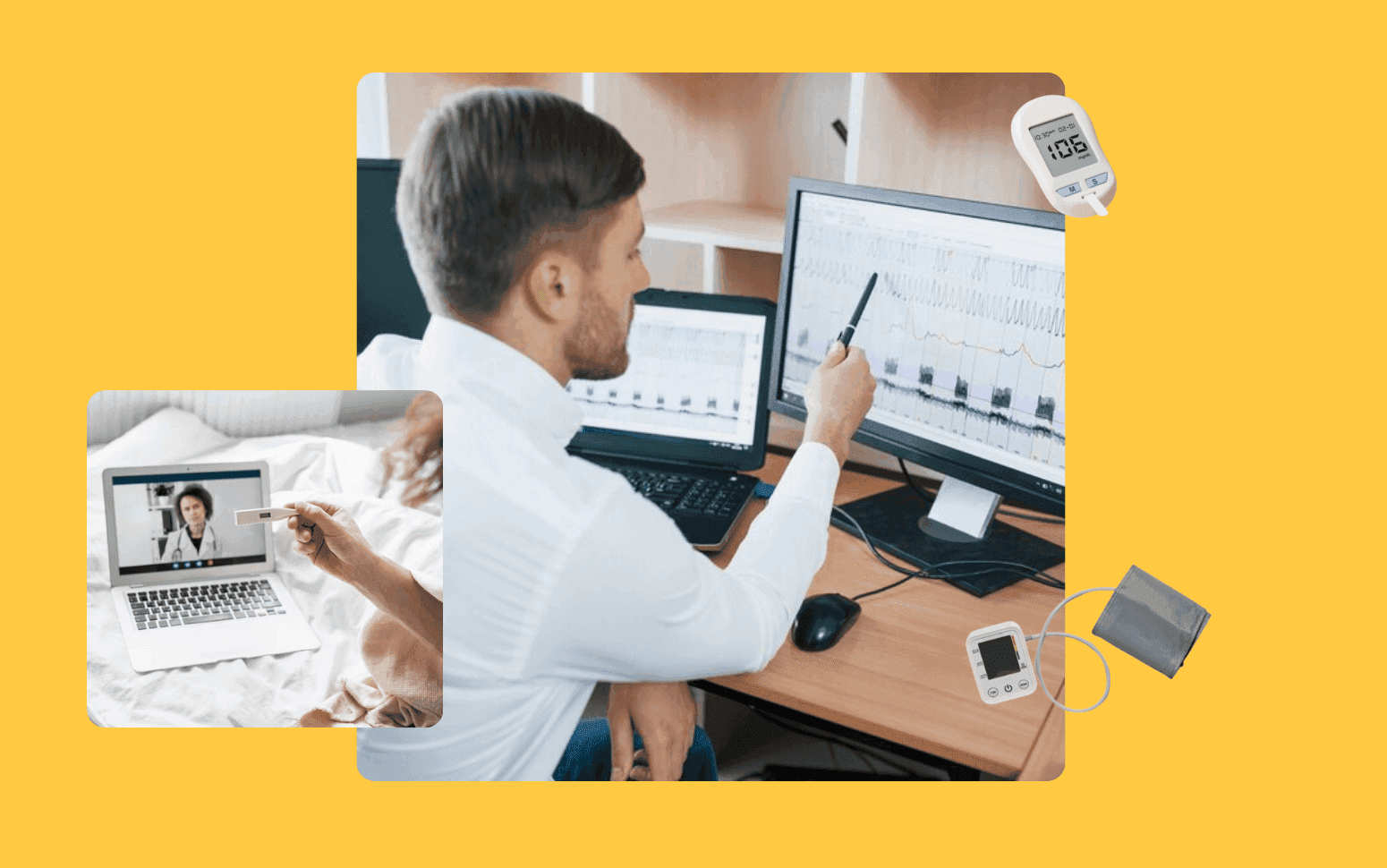
AI Remote Patient Monitoring Cuts Hospital Readmissions
- 30%
- 12 weeks
Most mental health practices running telehealth are stitching together a general-purpose video tool, a separate EHR, a scheduling system, and a payment processor. Session notes are disconnected from the appointment. Payments are handled in a different system. Nothing between sessions (assessments, homework, secure messages) has a home.
We build custom telehealth platforms for mental health practices and behavioural health companies. HIPAA-compliant video sessions with built-in clinical tools, therapist matching, structured intake, and between-session engagement, all in one system built for how therapy works.
HIPAA-compliant video sessions with built-in clinical tools
Therapist matching and client-facing intake workflow
Integrated scheduling, reminders, and cancellation management
Outcome tracking and between-session tools
Recognition
Running video sessions through a generic conferencing tool with no integration to your EHR, session notes disconnected from the appointment, payments handled separately, and no way to send homework or assessments between sessions?
Therapist matching and intake taking days of manual back-and-forth because there's no structured onboarding flow that captures presenting concerns, insurance, and availability before the first session?
In short
A mental health telehealth platform combines HIPAA-compliant video sessions with the clinical tools therapists need, structured intake, scheduling, between-session tools, outcome tracking, and billing, in one connected system. RaftLabs builds custom mental health telehealth platforms for therapy practices and behavioural health companies that need more than a generic video tool with a separate EHR, delivering in 14 to 18 weeks at a fixed cost.
Companies we've built for








Generic video platforms were built for meetings. A therapy session is not a meeting. The therapist needs to review the client's previous session notes before the call starts. During the session, outcome measure scores from the intake form should be visible. After the session, the note needs to be written and linked to the appointment record for billing. None of that happens in Zoom or Google Meet.
The problem compounds when practices try to connect separate tools. Session notes in one system, payments in another, scheduling in a third, and the video link emailed manually before each appointment. Each handoff between systems creates work for admin staff and creates gaps where information gets lost.
A purpose-built mental health telehealth platform puts the clinical workflow in one place. The therapist enters the session from their clinical interface, sees the client's history and intake scores, conducts the session, writes the note, and closes the encounter, all without switching between systems. The client books, attends, pays, and completes between-session tools from one app.
Browser-based video with no app download required for clients. Sessions open from a link, eliminating the barrier that causes clients to miss their first session because they couldn't get a conferencing app working in time. Waiting room with client arrival notification so the therapist controls exactly when the session starts and can finish notes from the previous session without the client entering the call.
Session recording with consent management: clients opt in before the session begins, consent is stored with a timestamp, and recordings are stored in encrypted clinical record storage with access restricted to the treating clinician and authorised supervisors. The recording infrastructure is not a general-purpose cloud storage bucket. It's a purpose-configured clinical media store with audit logging of every access event.
Video infrastructure uses Twilio Video, Daily.co, or AWS Chime SDK, all HIPAA-eligible with an executed Business Associate Agreement, not a repurposed general-purpose conferencing tool. Bandwidth adaptation reduces quality gracefully when a client's connectivity is poor rather than dropping the session. The clinician can continue at reduced resolution rather than losing the connection entirely.
The therapist's clinical interface shows the client's previous session notes, intake screening scores, and current outcome measure trend alongside the video window, eliminating the tab-switching between a video platform and a separate EHR that wastes clinical time and breaks the flow of the session.
For substance use disorder treatment providers, 42 CFR Part 2 requirements (which are stricter than HIPAA in restricting how SUD records are disclosed) are supported through consent tracking controls that prevent SUD treatment records from being disclosed to third parties without explicit patient consent meeting the Part 2 standard.
Clinician profiles capture the structured data that matching logic requires: clinical specialisms (trauma, anxiety, eating disorders, ADHD), therapeutic modalities (CBT, DBT, ACT, EMDR, psychodynamic), insurance panels accepted with effective dates, languages spoken, age groups seen, session formats (individual, couples, group), and real-time availability synced from the scheduling calendar.
The client matching flow presents the client with a structured preference questionnaire capturing presenting concern, demographics, insurance, gender preferences, language, and scheduling constraints. It then surfaces a shortlist of available therapists who meet the criteria rather than asking the client to browse a full directory without a framework for comparing options.
Matching logic is configurable by the practice: manual review by a care coordinator before confirmation, automated assignment to the best-matching available therapist, or client choice from a curated shortlist. Each approach produces a different client experience and a different administrative load. The platform supports all three so practices can evolve their model without rebuilding the feature.
CAQH provider credentialing integration lets the platform verify therapist credentials against the CAQH ProView database, reducing the manual verification burden when onboarding new clinicians to the panel. New therapist onboarding captures the same profile fields as existing clinicians so the matching logic applies consistently across the full roster regardless of when a therapist joined the platform.
Structured intake questionnaire capturing presenting concerns, mental health history, current medications, risk history, and goals for therapy. Validated outcome measures are delivered as part of intake (PHQ-9 for depression, GAD-7 for anxiety, PCL-5 for PTSD) with scores calculated automatically and displayed to the therapist before the first session as a baseline for treatment planning. DSM-5 diagnostic code selection is integrated into the SOAP note template used for the initial assessment so the clinical record is structured from the first encounter.
Insurance information collection and verification before the first session confirms coverage status, deductible, and copay amount so neither the client nor the practice is surprised at billing time. Prior authorisation workflows for CPT codes 90791 (initial psychiatric evaluation), 90834 (45-minute therapy session), 90837 (60-minute therapy session), and 90847 (family therapy with patient present) are triggered automatically for payers who require it, with the authorisation reference stored against the client record.
Consent form e-signature is built into the onboarding flow: informed consent, telehealth consent, and HIPAA Notice of Privacy Practices collected digitally with a timestamped record. Safety screening uses a validated protocol for clients who report active ideation or risk, with a defined escalation path: the intake questionnaire flags the response, notifies the assigned clinician or on-call staff, and records the escalation event in the clinical record. All intake data flows into the clinical record so the therapist reviews the full picture before the first session starts.
Client self-scheduling within the therapist's defined availability uses session type, duration, and modality rules set by the clinician to determine which slots are bookable. Session types (individual therapy, medication management, group session) are presented to the client based on what their assigned clinician offers and what the client's treatment plan includes. Recurring appointment series created at the first booking for ongoing therapy clients sets the cadence (weekly, biweekly, monthly) and generates the full forward schedule automatically.
Automated reminder sequence sends email and SMS reminders at 48 hours, 24 hours, and one hour before the session. No-show rates are significantly reduced by a reminder sequence; the 48-hour reminder includes a one-click cancel and rebook option so clients who cannot attend can free the slot for another patient rather than simply not showing up.
No-show automation sends a same-day rebooking offer to clients who miss a session without cancelling, offering the next available slot with the same therapist. This reduces the gap in care and the administrative burden of manually following up on no-shows. Crisis escalation is built into the scheduling system: if a client contacts the platform outside session hours and reports they are in crisis, the system routes them to the clinician's emergency contact protocol or to a crisis line, not into a standard scheduling flow.
Cancellation policy enforcement tracks late cancellations for billing purposes. Therapist schedule management shows confirmed appointments, cancellations, and available slots in a single interface without requiring a separate calendar application.
Secure messaging between client and therapist outside session hours uses end-to-end encryption with full message audit logging, stored in the clinical record with timestamps and read receipts, not in personal email accounts. Message audit logs are maintained as part of the clinical record, satisfying the HIPAA requirement for access tracking of protected health information.
Homework assignment and completion tracking lets the therapist assign a specific exercise, worksheet, or reading from the session interface. The client receives the assignment in their app with a completion prompt, completes it, and the therapist sees completion status before the next session starts. The clinical conversation can then be grounded in what the client actually did between sessions, not what they remember doing.
Mood check-in prompts sent to clients between sessions at configurable intervals (daily, every two days, or on a custom schedule) collect brief self-reported mood and symptom data. Responses are stored in the clinical record and displayed as a trend chart visible to the therapist, surfacing deterioration between sessions that would otherwise only be reported retrospectively at the next appointment.
Validated outcome measures (PHQ-9 for depression severity, GAD-7 for generalised anxiety, PCL-5 for PTSD symptom severity) are delivered on a scheduled basis between sessions and scored automatically. PHQ-9 and GAD-7 scores are tracked as a longitudinal trend with change-from-baseline visible in the therapist's clinical interface, providing the treatment response data that evidence-based practice and value-based care contracting both require.
Insurance claim generation from the closed session applies the correct mental health CPT codes (90791 for initial psychiatric evaluation, 90834 for a 45-minute individual therapy session, 90837 for 60-minute individual therapy, and 90847 for family therapy with patient present) along with the telehealth modifier (95 for synchronous audio-visual, GT for Medicare) and the linked ICD-10 diagnosis code from the session note. Claims are submitted via Surescripts or DrFirst for prescribers, and via a clearinghouse integration for therapy billing, with response tracking and denial management built into the billing interface.
Prior authorisation workflow triggers automatically for payers who require it for mental health CPT codes, with the authorisation request pre-populated from the patient's insurance record and clinical data. Prior auth reference numbers are stored against the session so claims are submitted with the authorisation attached and are not rejected for missing auth.
Self-pay payment collection uses card-on-file charged automatically at session completion. Superbill generation for out-of-network clients produces a formatted document with all required fields (provider NPI, diagnosis codes, CPT codes, dates of service, and fee amounts) that the client can submit to their insurer directly. Sliding scale fee management configures income-based pricing tiers that the billing administrator maintains without engineering support. Payment status is visible in the therapist's appointment view so outstanding balances are flagged before the next session and the practice doesn't accrue unpaid balances without awareness.
A generic video platform handles the call. A mental health telehealth platform handles everything around the call: structured intake before the first session, SOAP note templates with DSM-5 diagnostic code selection linked to the appointment, validated outcome measure delivery and scoring (PHQ-9, GAD-7, PCL-5) with trend tracking, between-session secure messaging with audit logging, homework assignment and tracking, and CPT-coded billing claim generation after the session.
HIPAA compliance for a therapy platform requires more than a BAA with a video vendor. The session recording, clinical notes, intake data, and messaging are all protected health information with specific storage, access, audit logging, and disclosure requirements. A purpose-built platform designs those controls into the architecture (role-based access, encrypted storage with access audit logs, minimum necessary access enforcement) rather than relying on a generic tool with a compliance disclaimer that leaves the implementation details to the buyer.
For substance use disorder providers, 42 CFR Part 2 adds restrictions beyond HIPAA. It requires explicit patient consent for virtually any disclosure of SUD treatment records and restricts the scenarios where records can be shared even with other treating clinicians. A platform that treats SUD records the same as general mental health records isn't compliant with Part 2. A purpose-built platform tracks which records are subject to Part 2 protections and enforces the stricter consent and disclosure rules accordingly.
HIPAA compliance for telehealth video requires a Business Associate Agreement with the video infrastructure provider, encryption in transit (TLS 1.2 minimum) and at rest (AES-256), no storage of session content on uncontrolled infrastructure, and access controls that restrict who can view recordings. We use HIPAA-eligible video infrastructure (Twilio Video, Daily.co, or AWS Chime SDK) with executed BAAs, not general-purpose conferencing tools repurposed for clinical use.
Session recordings are stored in encrypted clinical record storage: an S3-compatible encrypted object store with bucket policies restricting access to the application service account and authorised administrative users, with access audit logging at the infrastructure level. Access is restricted to the treating clinician and authorised supervisors, with no broader access permitted by default. Clients consent to recording before a session is recorded. The consent record is timestamped and stored in the clinical record independently of the recording.
The platform architecture is documented for your compliance team and covers the data flow for each PHI data type: video session data, session recordings, clinical notes, intake forms, outcome measure responses, secure messages, and billing records. The technical safeguards documentation supports your HIPAA Security Rule compliance assessment. Your organisation's policies, training, and workforce management practices complete the programme. Those are outside scope of the platform build, but the platform is designed to support them.
Yes. Individual therapy sessions are one therapist, one client, with a single clinical note. Group therapy sessions are one or two therapists and multiple clients, with a group session record and individual progress notes per member. The video session supports multi-participant calls with waiting room management. The therapist admits each group member individually. Billing for group sessions uses the correct CPT codes applied per member. Group membership management, waitlist, and attendance tracking are handled at the group level so each member's record shows their participation history.
A focused mental health telehealth platform covering HIPAA-compliant video, scheduling, structured intake, and billing for a single practice or small group typically takes 14 to 18 weeks from requirements sign-off to go-live. Therapist matching functionality and between-session tools add four to six weeks depending on complexity. Consumer-facing platforms with a large therapist directory, multiple modalities, and insurance panel management across many providers are scoped individually. We ship in fixed-price engagements with milestones agreed before development starts.
What clients say
Three-year average engagement. Founders and operators describing the work in their own words. No marketing varnish.

 USA
USAAll of the sprints were completed on schedule and on budget. We highly recommend RaftLabs!
01 / 02
Tell us your clinical workflow, your session types, and the problems your current tools create. We will scope a platform built around how your practice delivers care.