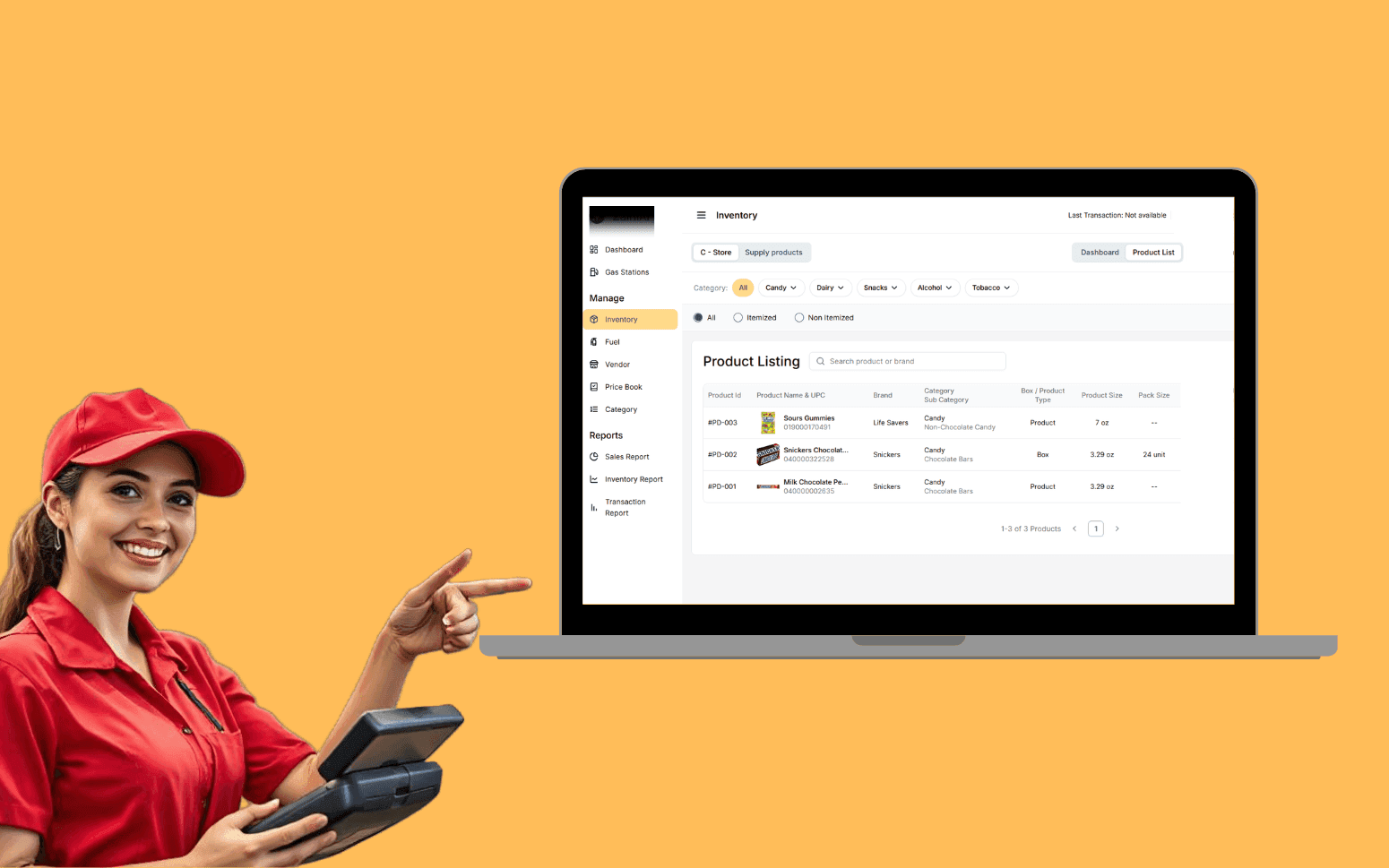
AI OCR Software Scales Gas Station Operations With 20K+ Transactions
- 20K+
- 40+
- 70%
Production managers should know machine status, OEE, and work order progress from a screen, not by walking the floor. A well-built MES connects your shop floor to your planning team so decisions happen on data, not on what someone remembered from the last shift.
We build custom Manufacturing Execution Systems for discrete, process, and mixed-mode manufacturers. From production order release to finished goods traceability, we cover the full production cycle and integrate with your ERP so inventory and schedules stay in sync.
Real-time machine and line monitoring with OEE, downtime, and cycle time dashboards
Production order management and work order tracking from release to completion
Lot and serial traceability from raw material through every production stage to finished goods
Quality inspection at production stages with pass/fail recording and non-conformance flagging
Recognition
Production managers walking the floor to get status because the MES doesn't show real-time machine conditions?
Finished goods lot traceability requiring manual paper trail reconstruction when a quality issue is discovered?
Work orders printed and tracked on clipboards because the system doesn't reach the operators on the line?
Downtime events going unrecorded because there's no easy way for operators to log the reason?
In short
A Manufacturing Execution System (MES) bridges the gap between ERP and the shop floor by tracking production orders, machine status, quality checks, and material consumption in real time. It captures genealogy data from raw material to finished goods, so traceability is immediate rather than manual. RaftLabs builds custom MES software for production order management, real-time machine monitoring, OEE tracking, quality inspection, and lot traceability, tailored to your production environment and ERP stack. Most MES projects deliver a production-ready pilot line in 12 to 16 weeks at a fixed cost.
Companies we've built for








Off-the-shelf MES platforms are built for the median factory. If your production environment has unusual routing logic, a mix of manual and automated stations, or an ERP that doesn't play well with standard connectors, a generic platform forces you to work around it. That workaround usually means spreadsheets next to the system, which is where data quality breaks down.
A custom MES is scoped to your production process. It captures what your operators actually do, surfaces the information your planners need, and pushes the right data back to your ERP without a manual rekeying step. The result is a system people use because it fits the job, not one they tolerate.
We work with discrete manufacturers, process manufacturers, and mixed-mode facilities. Whether you run make-to-order, make-to-stock, or configure-to-order, we model your production logic accurately before we write a line of code.
We build the full order lifecycle into your MES following the ISA-95 (ANSI/ISA-95) standard for MES hierarchy. Production orders released from your ERP, including SAP PP/MM module work orders and process orders, appear on the shop floor with the correct routing, bill of materials, and work instructions. Operators confirm start and completion at each operation step, and supervisors see work order progress in real time without radio calls or floor walks.
Partial completions, order splits, and rework orders are handled natively rather than through workarounds in a separate spreadsheet. Work-in-progress (WIP) is tracked at each production stage using barcode scans or RFID reads at operator terminals, giving you a live count of units at each station and in each buffer queue. Scrap and yield are recorded at the point of production rather than reconciled at shift end.
Order status: quantities confirmed, materials consumed, operations completed, flows back to your ERP via the SAP PP confirmation interface or equivalent integration point for your ERP. Inventory movements and production confirmations stay in sync without a manual rekeying step, so your planning team works from current data when running the next MRP run. Orders at risk of missing their due date are flagged before the deadline, not discovered when the shift ends short.
Connect your machines to the MES using OPC-UA (the IEC 62541 standard for industrial machine communication), MQTT for lighter IoT devices, or direct PLC integration via Siemens S7, Allen-Bradley, or Mitsubishi protocols. Newer CNC machines and robots with OPC-UA servers communicate directly. Older equipment without network connectivity is handled through low-cost I/O modules attached to existing machine signals such as a cycle-complete relay or spindle-running contact.
Runtime, idle time, and downtime are tracked by reason code: planned maintenance, unplanned breakdown, material shortage, tooling change, operator absence. OEE is calculated automatically for each machine, line, and shift using the standard formula: Availability x Performance x Quality. The calculation feeds individual dashboards for operators, shift supervisors, and plant managers so each level sees the data relevant to their decisions.
SCADA connectivity is supported where your facility already runs a SCADA layer for process control. The MES reads historian data rather than duplicating the connection to field devices. Supervisors receive alerts when OEE drops below configurable thresholds, when a machine enters unplanned downtime, or when cycle time drifts above the standard. Downtime reason codes are captured by operators at the terminal at the point of the event, not reconstructed from memory at shift handover. That's the difference between actionable root cause data and totals with no context.
Define inspection plans tied to specific operation steps, product families, or customer quality requirements. Operators record pass/fail results, dimensional measurements, and visual checks at the point of production rather than at the end of the line. That's where defects are cheapest to catch.
Statistical Process Control (SPC) is built into the measurement collection layer. The MES plots measurements on control charts in real time, calculates Cp and Cpk process capability indices against your engineering tolerances, and alerts operators and quality engineers when a process is trending toward an out-of-control condition before it produces scrap. Western Electric rules or your own rule set can be configured per characteristic.
For process manufacturers following the ISA-88 (S88) batch standard, in-process quality checks are tied to batch phases and unit procedures. Non-conformances are flagged at the point of detection and routed through a digital disposition workflow: hold, rework, or scrap, with the responsible quality engineer assigned automatically based on product type or production area. Inspection history is stored against each work order and lot so audit responses for customer quality complaints, ISO 9001 internal audits, or regulatory inspections can be pulled in minutes rather than assembled from paper records.
Track material consumption against each work order at the component level using barcode scans, RFID reads, or weigh-scale integration at the point of issue. Both backflushing (automatic material consumption on order completion based on BOM quantity) and manual issue (operator-confirmed scan at the point of use) are supported. The method is configured per material type or production area to match your process.
The MES records which lot of each component was issued to which work order at which production stage. This is the data model that makes full genealogy traceability possible. When a finished goods lot has a quality issue in the field, you trace backward through every component lot and every operation it passed through, or forward from a suspect component lot to every finished goods lot that contains it.
Variance between planned and actual material consumption is visible in real time at the work order level. A consistent negative variance on a specific component often signals a scrap problem that isn't being recorded. A positive variance often signals that components are being issued but not consumed, ending up in unofficial line-side stock. Both show up in the MES before they compound across shifts. Integration with your ERP keeps warehouse inventory accurate without a separate physical count.
Assign operators to work centres, production lines, and shifts with skill and qualification tracking so the MES only lets an operator run an operation they're certified for. Record which operator performed each operation, at which terminal, and at what time. This creates a complete labour record for each work order without time cards or manual log entries.
Operator login can be via PIN, barcode badge scan, or RFID fob depending on your preference. Productivity metrics: units produced per hour, operations completed per shift, first-pass quality rate, are tracked per operator and per shift without manual data collection. The data is available to supervisors and team leaders without requesting a report, so performance conversations happen on facts rather than impressions.
Shift handover is a persistent problem in manufacturing. Information about open issues, near-misses, and pending actions is lost between shifts. The MES generates an automatic shift handover report at shift end, pulling together work order status, machine status, open quality issues and their disposition, incomplete downtime reason codes, and any deferred maintenance flags. The incoming supervisor signs off on the handover in the system, creating an accountability record. Supervisors spend their time on the floor managing production rather than compiling the status report that used to consume the first 30 minutes of every shift.
Record every component lot consumed in every work order, at every production stage, tied to the finished goods lot number or unit serial number. The genealogy data model stores parent-child relationships through the full production tree: raw material supplier lot to incoming goods receipt lot to production sub-assembly lot to finished goods lot. A complete forward or backward trace on a multi-level BOM returns results in seconds, not hours spent searching paper records or cross-referencing spreadsheets.
For process manufacturers following the ISA-88 S88 batch standard, batch genealogy tracks material usage at the batch phase and unit procedure level, capturing which equipment was used, which operator performed each phase, and which process parameters were recorded during each step.
For discrete manufacturers with serialised products, each serial number carries its own genealogy record: which lot of every component it contains, which machine produced it, which operator assembled it, which shift it was produced on, and which inspection records it passed. Forward traceability identifies every serial number that contains a specific component lot. This is critical for field safety campaigns where you need to know which customers to contact. Traceability reports are generated on demand in formats appropriate for customer quality complaints, automotive PPAP documentation, aerospace AS9100 audits, or FDA 21 CFR Part 820 compliance, without manual assembly from paper production records.
A focused MES covering production order management, basic machine monitoring via OPC-UA, and quality inspection at key stages typically takes 12 to 16 weeks from requirements sign-off to go-live on a pilot line. That scope includes operator terminals on the shop floor, supervisor dashboards, real-time OEE calculation, and basic ERP integration for order release and confirmation.
Full genealogy traceability adds 2 to 4 weeks depending on the depth of your BOM and the number of production stages where component consumption is recorded. ERP integration complexity depends on your ERP platform and version. SAP integration via the PP/MM standard interfaces is well-understood. A custom or legacy ERP with limited API access takes longer to build and test reliably.
We scope precisely before committing to a timeline. That scoping session covers your production process in detail: operation routing, material flow, quality checkpoints, machine connectivity options, and ERP integration requirements. The timeline reflects the actual work, not a generic estimate that adjusts upward after the contract is signed.
We've built integrations with SAP (using the PP/MM module interfaces for production order release, goods issue, and confirmation), Microsoft Dynamics 365 Finance and Supply Chain, Oracle NetSuite, Epicor, and Infor LN and M3. Integration approach depends on what your ERP version exposes. We use REST APIs where available, SOAP web services for older SAP releases, RFC BAPI calls for SAP PP/MM, database-level integration where API access is limited, and flat-file exchange (IDOC or CSV via SFTP) as a last resort for systems with no supported API layer.
The standard integration points are: production order release from ERP to MES so operators see the correct routing and BOM, goods issue confirmation from MES to ERP so warehouse inventory stays accurate as materials are consumed, and work order confirmation from MES to ERP so completed quantities and labour time post back against the order. We document the full integration specification: message formats, field mapping, error handling, and retry behaviour, before development starts, and test against a copy of your ERP before going live in production.
Yes. Machines without network connectivity are common in manufacturing facilities with mixed equipment vintages, and we design data capture to fit your equipment rather than requiring you to replace machines to justify an MES.
For machines with no network capability, operator confirmation terminals installed at the machine capture cycle start, cycle complete, downtime events, and reason codes. For machines with digital output signals such as a cycle-complete relay, a machine-running contact, or a fault indicator light, low-cost I/O modules (such as Moxa or ADAM series modules) read those signals and feed them to the MES over your facility network without touching the machine's control system.
For newer machines with OPC-UA servers built in, most machines manufactured in the last five to seven years include OPC-UA as a standard option, we connect directly and pull production counts, cycle times, alarm states, and process parameters without any additional hardware. Machines with MQTT-capable controllers publish to a local broker that the MES subscribes to. The MES consolidates data from all three sources: direct OPC-UA, I/O modules, and operator terminals, into the same monitoring dashboard, so the floor view is complete regardless of your equipment mix.
Traceability records are stored in a relational database with a data model designed specifically for production genealogy queries. The schema uses a parent-child relationship table that links finished goods lots to sub-assembly lots to component lots across every production stage. Indexes are built on the columns used in forward and backward trace queries so a full trace on a multi-level BOM with thousands of component relationships returns results in seconds.
Retention period is configured to your requirements. Three to five years is standard for internal quality programmes and ISO 9001 compliance. Ten to fifteen years is required for regulated industries: automotive safety components, medical devices under 21 CFR Part 820, aerospace parts under AS9100. The retention policy is enforced at the database level with archival to cold storage for records older than the active retention window, keeping query performance fast on recent data while preserving older records for regulatory access.
Data export for customer quality audits, regulatory inspections, or legal holds is available in structured formats: PDF traceability reports with full production genealogy, or raw CSV export for customers who want to load the data into their own systems. The format matches what your customer or regulator has asked for, not a generic system export that requires further processing.
What clients say
Three-year average engagement. Founders and operators describing the work in their own words. No marketing varnish.

 Indonesia
I definitely recommend RaftLabs, especially to founders building complex platforms. They were transparent throughout the whole project.
01 / 02
Tell us about your production environment and what you need to track. We'll scope a solution that fits your process and your budget.