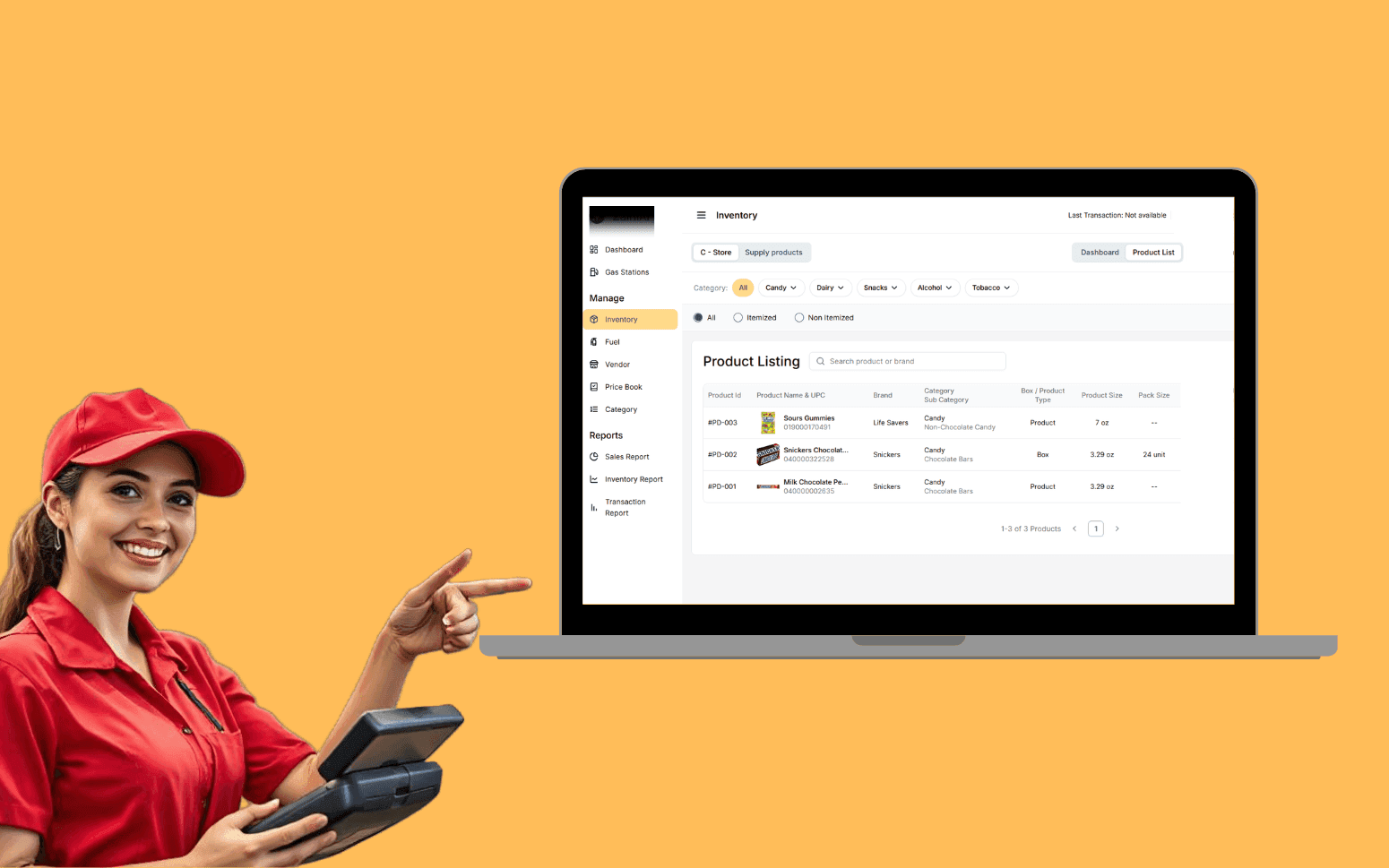
AI OCR Software Scales Gas Station Operations With 20K+ Transactions
- 20K+
- 40+
- 70%
Off-the-shelf ERP is built for the average manufacturer. If your operation isn't average, and most aren't, you spend more time working around the software than working with it.
We build custom ERP systems designed around your actual workflows: your bill of materials, your production order logic, your supplier relationships, and your cost structure. No modules you don't use. No workarounds for processes the vendor didn't anticipate.
BOM-driven production order management and material requirements planning built for your product structure
Real-time multi-site inventory with barcode and RFID scanning, lot tracking, and safety stock alerts
Supplier portal, purchase order automation, and goods receipt matching in one system
Job costing, overhead allocation, and variance analysis that matches your actual cost structure
Recognition
Spending more on SAP licensing and consultants than the system saves you in efficiency?
Production orders, inventory, and finance living in three different systems that don't talk to each other?
Non-standard costing models or multi-site workflows that no off-the-shelf ERP handles cleanly?
Legacy on-premise ERP that costs more to maintain each year than replacing it would?
In short
RaftLabs builds custom ERP software for manufacturers whose operations don't fit what SAP, Oracle, or Microsoft Dynamics were designed for. A custom manufacturing ERP covers production order management, BOM-driven material planning, multi-site inventory, procurement, job costing, and finance in a single system built around your actual workflow. Most manufacturing ERP projects deliver an initial production-ready module in 12 to 16 weeks at a fixed, agreed cost.
Companies we've built for





Off-the-shelf ERP vendors build for the statistically average manufacturer. That works until your operation diverges from the average. Unusual product configurations, non-standard costing models, multi-site plants with different workflows per location, or a legacy on-premise system that was never replaced because the pain of replacing it felt worse than living with it all create friction a packaged system won't solve.
Custom ERP isn't a bigger project than buying and implementing SAP. For mid-size manufacturers, a custom build is often faster and significantly cheaper when you factor in licensing, consultant fees, and the years of configuration work that follows a standard ERP go-live. The difference is that a custom system is built once for your operation and owned by you, not leased at an annual fee that climbs every year.
We've integrated with SAP, Oracle, Microsoft Dynamics, and several industry-specific ERP systems. We know what these platforms do well and where they fail mid-size manufacturers. When a full replacement isn't right, we build integration layers that extend what you have. When replacement is the right call, we scope it in phases so you go live on what matters first and expand from there.
We build BOM-driven production order management that covers the full order lifecycle from raw material to finished goods. Material requirements planning runs MRP II logic: BOM explosion across multiple levels, demand netting against live inventory and open purchase orders, and lead time offsetting so planned order release dates account for supplier lead time and internal production routing time. Planners see accurate availability before releasing orders to the floor rather than discovering shortages when the kit is staged.
Work order release, operator assignment, and actual versus planned cost variance are tracked per order. The shop floor control layer uses barcode-based WIP tracking. Operators scan work centres to record operation start, complete, and yield, which gives production supervisors live visibility into where every production order sits in the routing without manual status calls to the floor.
Partial completions, rework orders, and production splits are handled without workarounds. Scrap and yield losses are recorded at the operation level and rolled into the job cost. Order status writes back to your inventory and finance modules in real time so nothing needs to be reconciled manually at period end. EDI 850 purchase order and EDI 855 acknowledgment integration with major customers and suppliers means order data flows into production planning without rekeying.
Real-time inventory across multiple sites with location-level stock visibility for raw materials, work in progress, and finished goods. Barcode and RFID scanning for goods receipt, pick, transfer, and despatch cuts manual entry and the errors that come with it. Scan events write to the inventory ledger immediately so stock figures are current within seconds of a transaction, not at the end of a batch run.
Lot and batch tracking from receipt through production to despatch covers full forward and backward traceability. A recall query asking "which finished goods contain lot X of component Y" runs in seconds rather than hours of spreadsheet work. Serial number tracking handles high-value components where individual unit history matters.
Safety stock alerts and reorder point logic are calculated per SKU using configurable formulas that account for average daily demand, lead time, and demand variability. Alerts fire before safety stock is breached, not after. Stock valuation by lot, batch, or standard cost is calculated automatically and reconciled to the finance module general ledger. No manual journal entries to align inventory and finance at month end.
Inter-company stock transfers between manufacturing sites use an automated transfer pricing mechanism with cost and inventory adjustment journalled on both sides. Cycle count management schedules and records physical counts by location and reconciles variances to the perpetual record.
Purchase orders are generated automatically from MRP signals or raised manually by procurement, then routed through your approval workflow before being sent to suppliers. Approval hierarchies are configured by value band and commodity category. A $2,000 consumable PO routes differently from a $50,000 capital item. EDI 850 purchase order transmission goes to suppliers who support it; PDF email goes to those who don't.
The supplier-facing portal lets your vendors acknowledge orders via EDI 855 acknowledgment or web portal confirmation, confirm delivery dates, and flag shortfalls before they affect production. Advance shipment notices (EDI 856) from portal-enabled suppliers flow directly into inbound tracking without manual entry. Suppliers who can't use a portal receive automated email reminders for overdue acknowledgments, triggering a manual chase workflow in procurement.
Goods receipt matching against purchase orders and delivery notes catches quantity and specification discrepancies at the point of receipt, not at invoice time. Three-way matching, PO, goods receipt, and invoice, validates the invoice before it reaches accounts payable. Supplier performance is tracked automatically against on-time delivery rate, quantity accuracy, and goods receipt quality rejection rate so procurement reviews are based on 12-month data rather than recent memory.
Job costing and standard costing models are configured to match how your operation actually accumulates cost. The general ledger covers all standard account types with a chart of accounts mapped to your reporting requirements. Manufacturing overhead allocation by machine hour, labour hour, or a custom cost driver is calculated and posted automatically at production order close. Variance analysis at the production order level shows the gap between standard cost and actual cost for materials, labour, and overhead: the data your cost accountant needs to investigate where the standard is wrong and where the operation is inefficient.
Multi-entity consolidation for holding companies with multiple manufacturing subsidiaries handles intercompany elimination of sales, purchases, and balances so the consolidated P&L and balance sheet reflect external transactions only. IFRS and GAAP financial reporting packages are supported with a period close workflow that covers opening the period, running depreciation and accruals, locking the period, and generating the trial balance and financial statements. Segregation of duties controls enforce role-based access so the person who creates a purchase order can't also approve and post the corresponding invoice payment.
The finance module integrates with Xero, Sage, QuickBooks, or a custom general ledger via REST API or file-based exchange so accountants work in the tools they know without rekeying data from the production system. The go-live migration strategy uses delta migration with validation reconciliation so trial balances match the legacy system before cutover.
Customer order entry with delivery scheduling runs against your current production capacity and confirmed material availability. Customer-specific pricing, discount structures, and contract terms are stored against each account and applied automatically at order entry. No manual price lookup and no risk of the wrong rate being applied. Tiered pricing structures, volume breaks, and customer-specific catalogue restrictions are all managed at the account level.
Production capacity checks at order promising show your sales team what the plant can commit to on the delivery date they intend to quote. The available-to-promise calculation considers open production orders, confirmed inbound material, and machine capacity, so a delivery date commitment is based on data, not optimism.
Despatch note and invoice generation from the confirmed shipment uses actual shipped quantities and lot numbers, with the full order and production history attached for customer queries and dispute resolution. Electronic despatch advice (EDI 856) is sent to customers who require advance shipment notification before the lorry leaves the dock. Customer account receivable balance, credit limit, and payment history are visible at order entry so the sales team sees a customer's credit status before accepting a new order.
Consolidated reporting across all plants with site-level drill-down for production, inventory, procurement, and finance. Site-level profit and loss shows production cost, overhead, and margin per location: the reporting structure holding company management needs to compare site performance and make capital allocation decisions.
Inter-company stock transfers between sites use automated transfer pricing with cost and inventory adjustment journalled on both sides and eliminated in the consolidated financial statements. Intercompany elimination runs automatically at period close so the group P&L doesn't double-count revenue that's internal to the group.
Role-based dashboards are configured per function: floor supervisors see WIP by work centre and orders due today; production planners see MRP exceptions and overdue purchase orders; procurement managers see supplier on-time delivery rates and POs requiring approval; finance controllers see AP aging, period close checklist, and variance summary; senior management see consolidated revenue, margin, and operational KPIs across all sites. Each dashboard shows the metrics relevant to that role's decisions. Role-based access control with segregation of duties prevents users from accessing data or functions outside their defined permissions.
Reports run from live data, not from a nightly extract, so numbers are current when decisions need to be made. SAP RFC/OData and Oracle EBS REST API integration patterns connect to existing ERP instances in hybrid deployments where a full replacement isn't the right approach.
The decision usually comes down to three factors: configuration limits, total cost, and how standard your operation is. SAP and Dynamics are built for a broad market, which means they cover common manufacturing scenarios well but handle edge cases through expensive configuration or customisation. If your BOM structure, costing model, or production routing doesn't fit the standard data model, you spend months in a configuration project that still ends with a system requiring workarounds. Custom MRP II logic, non-standard overhead allocation methods, or multi-entity consolidation requirements that fall outside the standard financial module all tend to generate significant implementation cost in a packaged ERP.
For mid-size manufacturers with $5M to $100M in revenue, the licensing and implementation cost of a tier-one ERP often exceeds the cost of a custom build designed specifically for your operation, owned outright, with no annual licence renewals. A SAP S/4HANA implementation for a manufacturer with 100 users typically costs $500,000 to $2M in consulting fees alone before any customisation. A custom ERP built for your specific workflow, with NetSuite SuiteScript or Oracle EBS REST API integration where you need to connect to an existing system, is often delivered for a fraction of that cost. The integration specification is documented before development starts so you know exactly what you're committing to.
The right answer isn't always a full replacement. Sometimes the right approach is building integration layers using SAP RFC/OData APIs to extend what you have, adding capability where the standard ERP falls short without replacing a working finance or HR module.
We use a phased approach that gets you onto a working system faster than a big-bang cutover. The first phase, typically production order management, inventory, and basic procurement, delivers in 12 to 16 weeks. Finance integration and supplier portal follow in a second phase. Full replacement, including historical data migration and advanced reporting, runs 6 to 12 months depending on the complexity of your current data and the number of integrations to external systems.
Data migration is handled using a delta migration strategy with validation reconciliation at each stage. Open purchase orders, production orders, item master data, and customer and supplier records are migrated in structured batches with reconciliation reports that confirm record counts and financial totals match the legacy system before go-live. Historical transactions use a separate archive approach so you retain query access to that data without burdening the new system's production database.
You're on the new system and generating value before the full project is complete. The old system stays available for reference during the transition period so there's no cliff-edge cutover risk. The phased approach also means that if your priorities shift during the project, later phases can be adjusted without disrupting already-live modules.
Yes, and this is often the right starting point. Many manufacturers need one part of their ERP replaced or extended: a production management module bolted onto their existing finance system, or a supplier portal that connects to an ERP they're otherwise happy with. The integration patterns we use depend on what the existing system exposes. SAP exposes RFC remote function calls and OData services for direct connection. Oracle EBS provides REST APIs and standard open interfaces. NetSuite supports SuiteScript customisations and REST Record API calls. Microsoft Dynamics 365 exposes OData feeds and Dataverse APIs.
For legacy on-premise systems with limited or no API support, integration uses database-level connectors with scheduled extraction and validation, or file-based exchange where the legacy system can produce structured exports. The integration specification is documented before development starts so you know exactly what data moves between systems, in which direction, and on what schedule. This approach lets you replace the parts of your current system that cause the most pain, typically production management or supplier-facing functions, while keeping a working finance module or HR system without disruption.
Integration layers are built with error handling and reconciliation alerts so data failures surface immediately rather than accumulating silently.
A focused ERP module, for example production order management and inventory for a single site, typically runs $40,000 to $80,000 depending on scope and the number of integrations required. A full custom ERP covering production, procurement, finance, and multi-site reporting runs $120,000 to $250,000. We scope every project before pricing it so you know what you're getting before you commit. We don't do hourly billing: fixed project costs only, with milestones tied to working software deliveries rather than time spent.
What clients say
Three-year average engagement. Founders and operators describing the work in their own words. No marketing varnish.

 Indonesia
I definitely recommend RaftLabs, especially to founders building complex platforms. They were transparent throughout the whole project.
01 / 02
Tell us what your current system can't do and what it costs you. We'll scope a solution built around your actual operation and give you a fixed price.