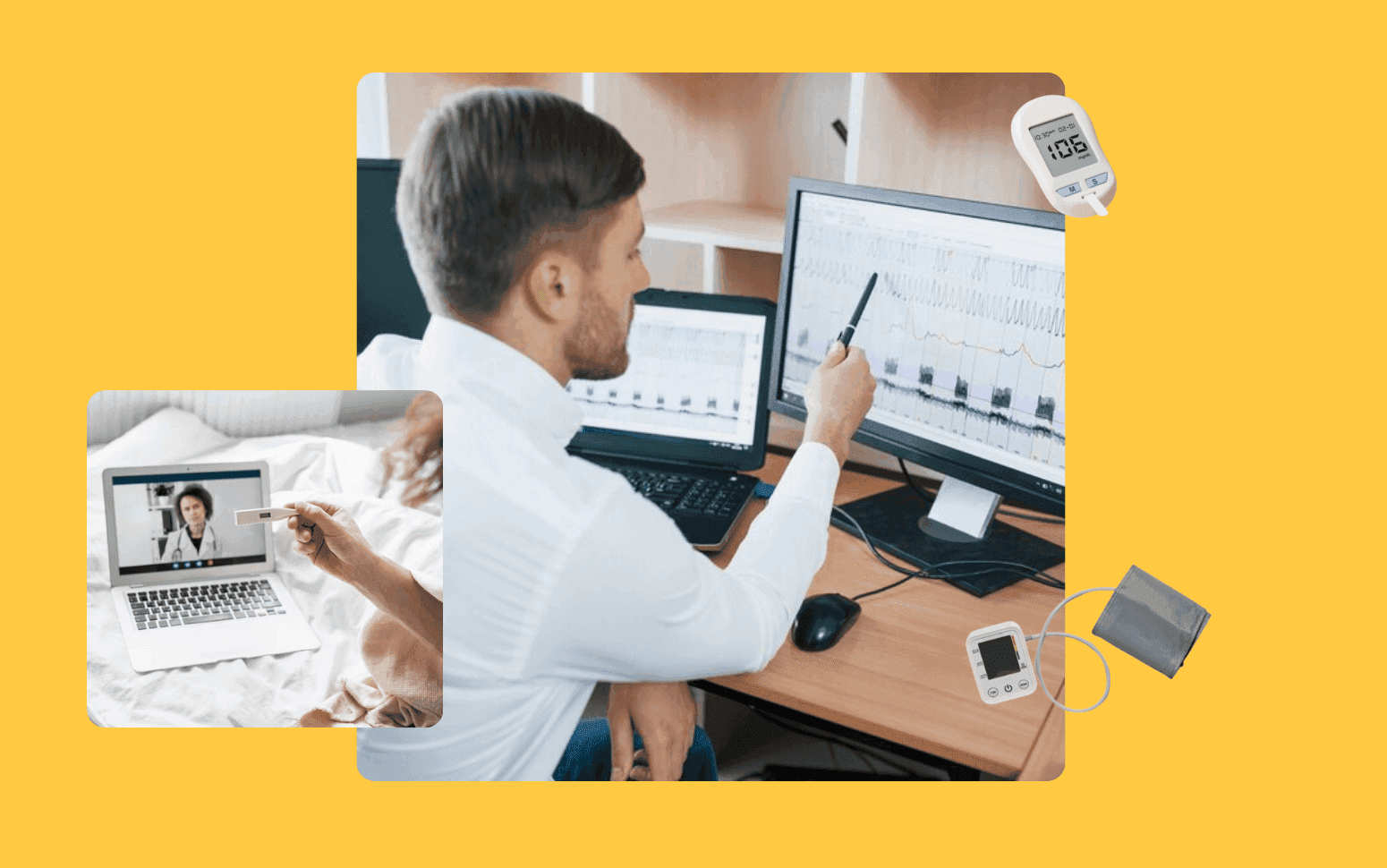
AI Remote Patient Monitoring Cuts Hospital Readmissions
- 30%
- 12 weeks
Custom women's health platforms for digital health startups, employer wellness programs, fertility clinics, and OB/GYN practices building clinical-grade reproductive and maternal health tools.
We build the HIPAA-compliant data architecture, cycle prediction algorithms, reproductive data privacy layer, and clinical workflows that a production women's health platform requires.
HIPAA-compliant data architecture with dedicated encrypted partition for reproductive health data and no third-party SDK access to cycle, fertility, or pregnancy information
ML-based cycle prediction algorithms trained on individual user data, with rule-based fallback for new users and irregular cycle handling
Fertility management with BBT charting, OPK logging, IVF protocol tracking, and wearable integration with Apple HealthKit and Oura Ring
Postpartum mental health with Edinburgh Postnatal Depression Scale screening, automated score calculation, and dual-path crisis protocol
Recognition
Using a consumer period tracking app for your employer wellness benefit but hitting data privacy concerns because Flo and Clue's business models depend on data monetisation?
Building a fertility clinic patient app but finding that consumer fertility apps cannot handle IVF protocol tracking, medication schedules, or EMR integration?
Running postpartum care coordination through paper EPDS forms and phone follow-ups because there is no digital tool that handles both the clinical screening and the crisis escalation path?
The short answer
RaftLabs builds women's health apps for digital health startups, employer wellness programs, fertility clinics, and OB/GYN practices. We develop HIPAA-compliant period tracking with ML-based cycle prediction, fertility management with IVF protocol tracking, prenatal care platforms, postpartum mental health screening, and menopause symptom management. Reproductive data privacy architecture is built in from the start. Most women's health app builds deliver in 14-22 weeks at a fixed cost.
Companies we've built for







The failure mode in most women's health app builds is treating reproductive health data the same as general wellness data. It is not. Post-Dobbs, menstrual cycle dates, fertility history, and pregnancy status carry legal sensitivity that general HIPAA compliance does not address. Consumer apps built on ad-supported data models cannot credibly solve this problem. A custom build can.
We start with the data architecture before any feature work: reproductive health data in a dedicated encrypted partition, no ad-tech or analytics SDK access to it, and a documented user deletion path. From there we build the clinical workflows: cycle prediction, fertility tracking, prenatal care, and postpartum mental health screening.
Menstrual cycle tracking with ML-based period and ovulation prediction, administered through a structured logging interface that collects cycle start and end dates, flow intensity, symptom data, and mood markers. The prediction algorithm starts with a rule-based model using the user's historical cycle length and standard deviation, then transitions to an individual ML model trained on that user's logged data as the data accumulates. Women with irregular cycles, common in PCOS, perimenopause, and post-hormonal contraceptive use, receive a prediction range rather than a point date, which more accurately represents their actual cycle variability.
Symptom and mood logging captures data across the full cycle, not just the period window: energy levels, headache patterns, skin changes, breast tenderness, and mood markers that correlate with hormonal phases. This structured data feeds the cycle anomaly detection in V3 and provides the longitudinal dataset that distinguishes a clinical-grade app from a standard consumer tracker. Push notifications remind users of predicted period dates and fertile windows without exposing health data in the notification payload, an iOS and Android requirement that most teams miss on the first implementation.
Fertility tracking for both consumer use and clinical integration. The consumer layer covers basal body temperature charting, OPK (ovulation predictor kit) result logging, cervical mucus tracking, and fertile window prediction using the sympto-thermal method. Wearable integration with Apple HealthKit and Oura Ring API pulls resting heart rate and HRV data for enhanced ovulation prediction accuracy, particularly for users with irregular cycles where standard rule-based prediction performs poorly.
The clinical layer, designed for fertility clinics and reproductive endocrinology practices, adds IVF protocol tracking: medication injection schedules with time-specific reminders for FSH, LH, and hCG trigger doses, lab result display (AMH, AFC, E2 levels from the clinic's lab system), and ultrasound measurement logging. Integration with the clinic's EMR system via HL7 FHIR resources allows lab results and clinical notes to flow into the patient-facing app without manual re-entry by clinic staff. The multi-provider coordination model, coordinating between the reproductive endocrinologist, the embryologist, and the nursing team on a single patient timeline, requires an access control model that most consumer fertility apps do not support.
Pregnancy tracking from confirmed pregnancy through the postpartum period. Week-by-week development milestones, weight and blood pressure logging, kick counter with session timing, fundal height tracking, and symptom logging for morning sickness, back pain, and oedema. Appointment scheduling integrated with the OB/GYN or midwifery practice calendar so the patient sees upcoming appointments and receives reminders without leaving the app.
Lab result and ultrasound report access for practices that choose to surface clinical documents to patients, with role-based access control separating what the patient sees from what the clinical team sees and what the partner or support person sees with explicit consent. Group prenatal education sessions for practices running group pregnancy care models, with video session infrastructure using HIPAA-compliant media. Transition to postpartum mode at the expected delivery date, triggering the Edinburgh Postnatal Depression Scale screening schedule at 2 weeks, 6 weeks, and 3 months postpartum.
Edinburgh Postnatal Depression Scale administration built into the care workflow rather than sent as a PDF attachment or a paper form at the 6-week visit. EPDS is administered as a structured digital questionnaire at configurable clinical intervals, with branching logic on question 10 (self-harm ideation) that triggers immediate clinician notification regardless of total score. Scores are calculated automatically on submission and stored against the patient record as a structured clinical observation, not a form attachment.
Session-over-session EPDS score trends display in the provider dashboard: a patient whose score was 14 at 2 weeks and 8 at 6 weeks is trending toward recovery; a patient whose score increased from 8 to 16 between appointments needs urgent follow-up. The crisis escalation path differentiates between postpartum depression with suicidal ideation, which routes to the clinician for urgent callback, and indicators of postpartum psychosis, which routes to emergency services. Postpartum psychosis requires psychiatric emergency response and cannot be managed through a telehealth escalation.
Symptom tracking for perimenopause and menopause covering the full clinical presentation: hot flash frequency and intensity, sleep disruption logging, mood and cognitive changes, vaginal dryness and discomfort, and cycle irregularity during perimenopause. Validated screening instruments for menopause symptom severity, including the Menopause Rating Scale (MRS) and the Greene Climacteric Scale, administered at configurable intervals with automated score calculation and clinician alert thresholds.
Telehealth integration for menopause specialist or OB/GYN consultations within the app, with HIPAA-compliant video sessions and structured pre-visit symptom summaries generated from the user's logged data. Hormone therapy tracking for users on HRT, with medication reminder integration and adherence logging. The data model accounts for the full perimenopause timeline, which can span 4-10 years, requiring longitudinal data retention and trend analysis across a longer period than most consumer health apps design for.
Reproductive health data requires a compliance layer beyond standard HIPAA. Post-Dobbs state laws in several US jurisdictions restrict the collection, retention, and disclosure of menstrual cycle dates, fertility information, and pregnancy status. The FTC has brought enforcement actions against period tracking apps for sharing user data with third parties without adequate disclosure. A consumer app with an ad-supported data model cannot credibly address this risk.
Our architecture response: reproductive health data stored in a dedicated AES-256 encrypted partition separate from general app data, with no third-party analytics, advertising, or attribution SDK receiving access to it. User-initiated data deletion removes reproductive health data within 30 days with a confirmed deletion audit record. Law enforcement data requests are processed against a documented policy that defaults to not disclosing reproductive health data without a valid court order reviewed by legal counsel. Business Associate Agreements are executed with every vendor that touches PHI. This architecture is not a feature add-on; it is the foundation we build on before the first product decision.
The primary difference is the intersection of clinical requirements and reproductive data sensitivity. A general telehealth platform handles PHI under HIPAA, but women's health apps handle a subset of PHI, specifically menstrual, fertility, and pregnancy data, that carries additional legal sensitivity under post-Dobbs state laws and FTC enforcement frameworks. A consumer period tracking app is not a covered entity under HIPAA if it operates independently from a healthcare provider, which means the standard HIPAA protections do not apply. Even for apps that are covered entities, HIPAA does not address the specific state-level obligations around reproductive health data disclosure.
The clinical requirements are also different. Postpartum mental health screening requires the Edinburgh Postnatal Depression Scale rather than PHQ-9. Fertility tracking for clinical use requires IVF protocol tracking and EMR integration that consumer apps do not support. Cycle prediction for women with PCOS, endometriosis, or perimenopausal irregularity requires algorithm approaches that perform differently from standard statistical models. We build around these specifics, not around a generic digital health template.
Any app that stores, processes, or transmits protected health information, including menstrual cycle data connected to an identified individual, fertility history, pregnancy status, or clinical diagnoses, and that is operated by or as a business associate of a covered healthcare entity, must comply with HIPAA. Consumer wellness apps that store data only on the device and make no clinical claims operate differently. Any app with a backend server, a clinician-facing dashboard, employer-level reporting, or integration with a healthcare provider's systems almost certainly triggers HIPAA.
Beyond HIPAA, reproductive health data carries state-level obligations that HIPAA does not cover. Several states have enacted or proposed laws restricting how menstrual, fertility, and pregnancy data can be retained, shared, or disclosed. The FTC Act applies to all consumer apps regardless of HIPAA status. We address both layers in the data architecture.
An MVP with cycle tracking, HIPAA-compliant data handling, and reproductive data privacy architecture costs $70K-$110K and delivers in 14-18 weeks. A full platform adding fertility tracking, prenatal care, telehealth sessions, and wearable integration runs $160K-$280K in 28-40 weeks. Postpartum mental health builds with EPDS screening and crisis protocol cost the same as a general mental health MVP, $80K-$130K, because the HIPAA infrastructure and crisis protocol requirements are the same. Enterprise builds with EHR integration and population health analytics start at $400K.
The primary cost drivers are the number of health domains covered (cycle-only versus the full reproductive care journey), whether the app integrates with a clinic's EMR, the depth of wearable sensor integration, and whether the build requires FDA SaMD clearance for specific clinical claims.
Consumer period tracking and cycle monitoring apps that log data and make no clinical claims do not require FDA clearance. Natural Cycles received FDA 510(k) clearance (K173542, 2018) as a contraceptive method because it makes a specific efficacy claim about preventing pregnancy. If your app makes a contraceptive efficacy claim, a diagnostic claim such as detecting PCOS or identifying endometriosis patterns, or a treatment recommendation, it qualifies as a Software as a Medical Device and requires 510(k) clearance or a De Novo request from FDA's Digital Health Center of Excellence. We scope the FDA regulatory pathway during discovery for any build that might approach this boundary.
We can build a period tracking app. Whether it competes with Flo depends on what problem you are actually trying to solve. Flo has 300 million users and a large proprietary dataset that makes its cycle prediction accurate for regular cycles. Competing on general consumer cycle tracking against that user base is a difficult business problem, not a technical one.
Where custom builds win: employer wellness programs that need HIPAA-compliant tracking integrated with an HRIS without Flo's data monetisation model; digital health startups building a privacy-first period tracker as the core product differentiator; women's health clinics that need cycle tracking linked to clinical records; and platforms serving women with PCOS, endometriosis, or perimenopausal irregularity where Flo's general-purpose algorithm does not perform well. We will tell you in the discovery call whether your use case is one where building custom makes sense.
What clients say
Three-year average engagement. Founders and operators describing the work in their own words. No marketing varnish.

 USA
USAAll of the sprints were completed on schedule and on budget. We highly recommend RaftLabs!
01 / 02
Tell us your clinical model, patient population, and where your current tools fall short. We will scope the build.