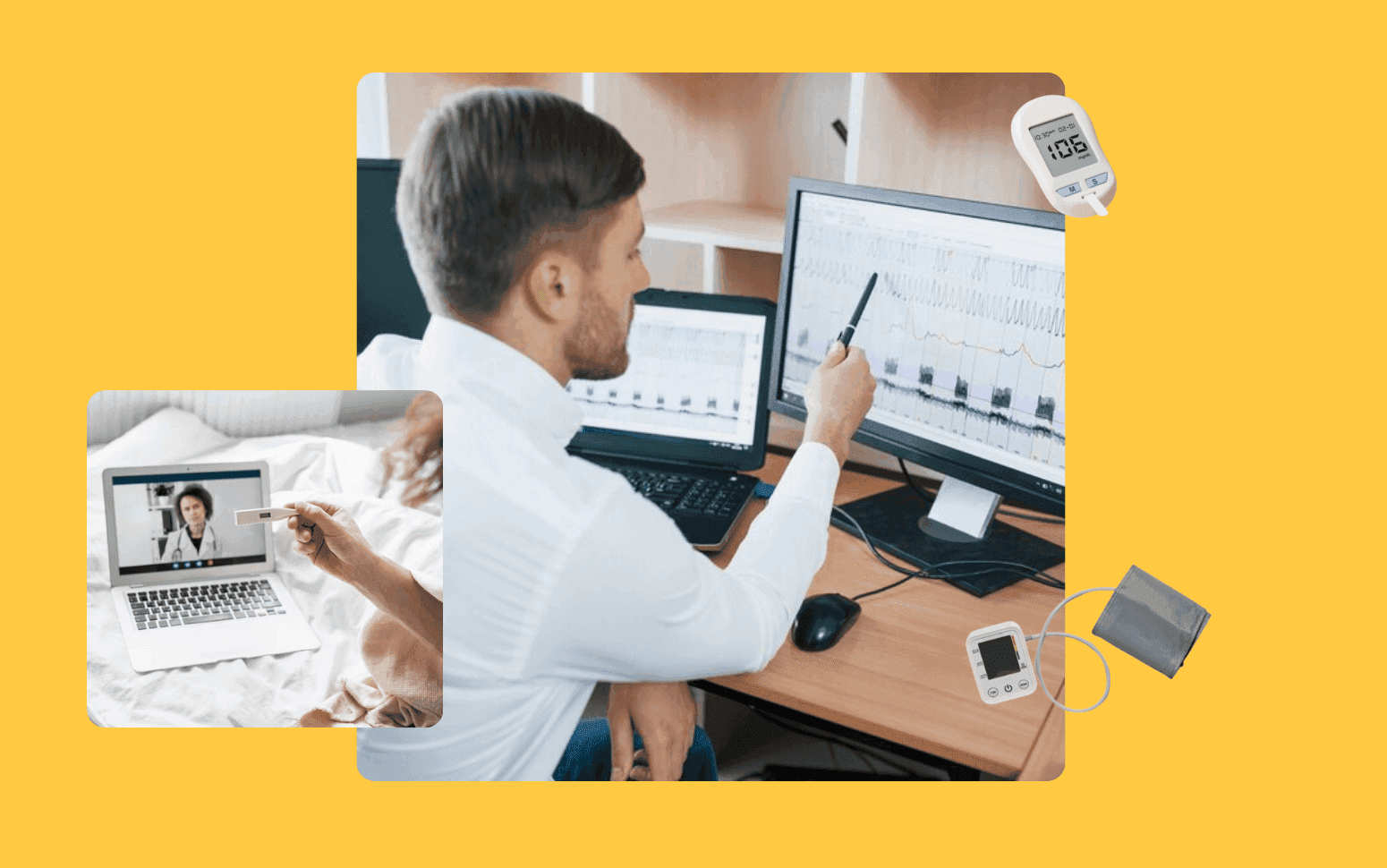
AI Remote Patient Monitoring Cuts Hospital Readmissions
- 30%
- 12 weeks
Custom teletherapy platforms for behavioral health practices, digital mental health companies, and employee assistance program providers building compliant, clinician-ready virtual care tools.
We build the HIPAA-aware video infrastructure, outcome tracking, and clinical workflows that a production mental health platform requires, not a generic video wrapper.
HIPAA-aware video sessions with encrypted media, audit logging, and signed BAAs with every infrastructure provider
Automated outcome measure administration, PHQ-9, GAD-7, PCL-5, with session-over-session score tracking and progress charts
Group therapy support for up to 12 participants with individual consent capture per participant
Asynchronous secure messaging, scheduling with cancellation and no-show management, and billing integration
The problem
Using a generic video tool for teletherapy sessions but hitting HIPAA documentation gaps and missing structured clinical workflow support?
Tracking patient progress manually because the platform has no PHQ-9, GAD-7, or PCL-5 outcome measure integration?
Running group therapy on a general-purpose video platform that was not designed for the clinical and consent requirements of multi-participant mental health sessions?
The short answer
RaftLabs builds teletherapy platforms for behavioral health practices, digital mental health companies, and employee assistance program providers. We develop HIPAA-aware video consultation infrastructure, automated PHQ-9 and GAD-7 outcome measure scoring, group therapy sessions, asynchronous secure messaging, scheduling with cancellation management, and billing integration. Most teletherapy platform builds deliver in 12-16 weeks at a fixed cost.
Companies we've built for







The gap in most teletherapy platform builds is not the video call. It is everything around it: the structured intake that surfaces the right clinical context before the session, the automated outcome measure scoring that tracks whether the treatment is actually working, the cancellation workflow that recovers missed revenue, and the billing integration that gets the claim submitted correctly the first time.
We build around the clinical workflow, not the other way around. Compliance and architecture are constraints built in from the start, not retrofitted after the platform is already live.
Synchronous video consultation infrastructure built on a WebRTC media stack. We evaluate Twilio Video, Daily.co, and AWS Chime SDK against your compliance requirements, expected session volume, and latency targets before selecting the media layer. STUN/TURN server configuration handles NAT traversal so sessions work reliably when clients are on corporate networks, hospital Wi-Fi, or mobile connections without a stable peer-to-peer path. Simulcast with selective forwarding unit (SFU) architecture keeps video quality adaptive, sessions degrade gracefully on constrained connections rather than dropping.
Waiting rooms hold clients outside the session until the therapist joins, eliminating the awkward join-before-ready problem on general-purpose video tools. Session recording is opt-in per session with explicit consent captured and stored as a timestamped audit event before recording begins, a clinical and legal requirement that most generic platforms cannot document correctly. All media is encrypted end-to-end with DTLS-SRTP; session metadata is encrypted at rest using AES-256. Business Associate Agreements are executed with every infrastructure provider that handles PHI: AWS, Twilio, or Daily.co depending on the selected media stack.
Structured outcome measure delivery built into the session and intake workflow, not bolted on as a PDF attachment. PHQ-9 (Patient Health Questionnaire-9) for depression screening, GAD-7 (Generalized Anxiety Disorder-7) for anxiety screening, and PCL-5 (PTSD Checklist for DSM-5) for trauma-related conditions are administered as conditional digital forms at configurable intervals, at intake, before each session, or on a custom cadence set by the clinician per client. Scores are calculated automatically on submission and stored as FHIR R4 Observation resources against the client record, so the full scoring history is attached to the clinical encounter and not sitting in a separate spreadsheet.
Session-over-session score trends surface in the provider dashboard as a visual progress chart per client: PHQ-9 at intake was 18, at week 4 it is 12, at week 8 it is 7. The clinician sees the trajectory without having to manually compile scores across session notes. Score thresholds trigger alerts, a PHQ-9 score in the severe range (20+) or a specific item-9 response (suicidal ideation) generates a flagged notification to the provider before the next session begins, supporting clinical risk management without requiring the clinician to manually review every submission.
Multi-participant video sessions supporting up to 12 concurrent clients designed for the specific consent and clinical documentation requirements of group therapy, not adapted from a general-purpose conferencing tool. Individual consent capture per participant before the session begins: each group member consents separately, and each consent record is stored as a timestamped event against the group session record. A participant who does not complete consent is held in the waiting room and cannot join until consent is confirmed.
Session management gives the therapist host controls appropriate for a clinical context: participant muting, video disabling for clients who have connection issues, waiting room gating for late arrivals, and session recording toggle that requires re-confirmation of all participant consents before recording starts. Group session notes are structured separately from individual session notes, the group therapy encounter stores the session topic, the group composition, attendance, and the therapist's group-level observations, while per-client notes remain individual and confidential. The data model enforces this separation at the storage level, not just at the UI level.
Encrypted provider-to-client messaging for between-session communication, care plan sharing, and document exchange. All messages are stored within the HIPAA-compliant data layer with AES-256 encryption at rest and TLS 1.3 in transit. Message metadata, sent, delivered, read, and deleted events, is captured in the audit log per HIPAA access tracking requirements. Retention policies are configurable per practice (typically 7 years for PHI) with automated archival.
Providers can attach structured documents to messages: care plan summaries, psychoeducation resources, homework assignments, and intake form links. Clients receive push notifications for new messages on iOS (APNs) and Android (FCM) without exposing PHI in the notification payload, the notification prompts the client to open the app rather than surfacing clinical content on the lock screen. Clinicians can set messaging availability windows so after-hours client messages queue without triggering out-of-hours expectations. Crisis response routing: messages containing flagged content patterns trigger an internal workflow that escalates to the on-call clinician and logs the escalation event.
Provider availability management with configurable working hours, session duration templates (50-minute, 80-minute, group sessions), buffer time between appointments, and blackout dates. Clients self-book from the provider's available slots through a patient-facing booking interface that requires authentication before displaying the provider's calendar. Appointment confirmation emails and SMS reminders are sent at configurable intervals, 48 hours and 2 hours before the session by default, with a direct link to join the video session.
Cancellation and no-show policy enforcement is configurable per practice: late cancellation within the policy window generates an automatic charge or a charge-eligible record for the practice to process. No-show tracking records the missed appointment against the client record and triggers the configured follow-up sequence, a re-booking link, a check-in message, or an escalation to the clinical team for high-risk clients. Waitlist management for high-demand providers: clients can join a waitlist for a specific provider, and when a slot opens due to a cancellation, the first waitlisted client receives an automated booking invitation. Recurring appointment scheduling generates the full appointment series at booking with individual confirmation per session.
CPT code mapping for behavioral health billing: 90837 (60-minute individual therapy), 90834 (45-minute individual therapy), 90853 (group therapy), and telehealth-specific modifiers (GT, 95, and POS 10) applied automatically based on session type and duration. ICD-10-CM diagnosis code lookup integrated into the session note interface so the provider codes during documentation rather than in a separate billing step.
Insurance eligibility verification via Availity or Change Healthcare eligibility API at booking, the system confirms the client's active coverage and behavioral health benefit before the appointment is confirmed, surfacing eligibility issues before the session rather than after the claim is submitted. Claim generation produces a CMS-1500 compatible electronic claim record from the session note and the billing codes applied by the clinician. Integration with practice management and billing platforms, Kareo, SimplePractice, TherapyNotes, and others through their APIs or HL7 FHIR financial resources, routes the claim to the provider's existing billing workflow rather than replacing it. ERA (electronic remittance advice) processing reconciles insurance payments against outstanding claims and updates the client's account balance.
The clinical workflow in behavioral health is different from other specialties in ways that affect the platform architecture. Outcome measure administration is a core clinical function, PHQ-9 and GAD-7 scores are not optional extras, they are how a therapist documents whether treatment is working and meets payer documentation requirements for continued care authorization. Group therapy requires a consent model that operates per participant per session, not per patient per platform, which most general telemedicine platforms do not support. Cancellation and no-show management is more financially critical in a private practice model than in a health system context, and the billing codes are specific to behavioral health, 90837, 90834, 90853 with telehealth modifiers, rather than the evaluation and management (E&M) codes that most telemedicine platforms are built around.
We build for the behavioral health workflow specifically. That means outcome measures are scored and trended automatically, group sessions have the right consent and documentation structure, and billing integration handles the CPT codes and telehealth modifiers correctly rather than requiring the practice manager to manually adjust every claim.
Yes. Any platform that handles protected health information (PHI), which includes patient names, session dates, mental health diagnoses, treatment notes, and outcome scores, must comply with HIPAA's Technical, Administrative, and Physical Safeguard requirements under 45 CFR Part 164. For mental health specifically, some states apply additional protections for mental health records beyond HIPAA's baseline requirements.
The practical architecture requirements: AES-256 encryption for PHI at rest, TLS 1.3 for all data in transit, DTLS-SRTP for video session media, role-based access control applying the minimum necessary standard, and audit logs for every PHI access event retained for a minimum of 6 years. Signed Business Associate Agreements are required with every third-party service that touches PHI, the video provider, the cloud host, the notification service, and the analytics platform if it handles PHI. We execute these BAAs as part of the infrastructure setup, not as an afterthought after the platform is live.
Yes. PHQ-9, GAD-7, and PCL-5 are built as structured digital forms with branching logic where applicable. PHQ-9 item 9 (thoughts of self-harm) triggers a separate internal alert workflow when the response is above zero, this is a clinical risk management requirement, not just a UX consideration. Scores are calculated automatically on submission and stored as FHIR R4 Observation resources so the history is attached to the clinical record in a structured, queryable format rather than locked inside a form attachment.
The session-over-session trend chart gives clinicians a visual progress view per client without any manual compilation. Custom intervals per client let the clinician configure how frequently outcome measures are administered, weekly for an acute client, monthly for a maintenance-phase client. We can add other validated instruments alongside PHQ-9 and GAD-7 based on the specialties your platform serves: PCL-5 for trauma-focused practices, AUDIT-C for substance use, CSSRS for suicide risk monitoring.
A focused teletherapy MVP, HIPAA-compliant video using Twilio Video or Daily.co, individual session scheduling and reminders, secure messaging, PHQ-9 and GAD-7 outcome measure administration, and a provider dashboard with session note templates, typically runs $50,000--$90,000 and delivers in 12-16 weeks. That scope covers HIPAA-aware data handling, BAA setup with infrastructure providers, role-based access control, audit logging, and web and mobile patient access.
Adding group therapy support, billing integration with CPT code mapping and insurance eligibility verification, waitlist and cancellation policy enforcement, and practice analytics typically brings the total to $90,000--$160,000. The primary cost drivers are the number of outcome measures and their branching logic, the complexity of billing integration (self-pay only vs. full insurance with ERA processing), whether the platform supports multiple providers within a practice or a single-provider model, and mobile app requirements. We scope these components explicitly during discovery so there are no billing surprises late in the build.
What clients say
Three-year average engagement. Founders and operators describing the work in their own words. No marketing varnish.

 USA
USAAll of the sprints were completed on schedule and on budget. We highly recommend RaftLabs!
01 / 02
Proof
Telemedicine App Development
Video consultation platforms, EMR integration, and HIPAA-aware data architecture for clinical telehealth.
Custom Software Development
Custom healthcare platforms, patient management tools, and clinical workflow systems built to your compliance requirements.
Business Process Automation
Automate patient intake, appointment reminders, outcome measure delivery, and billing workflows.
AI Agent Development
AI agents for clinical documentation, risk stratification, and care gap detection.
Tell us your clinical model, patient population, and where your current platform falls short. We will scope the build.