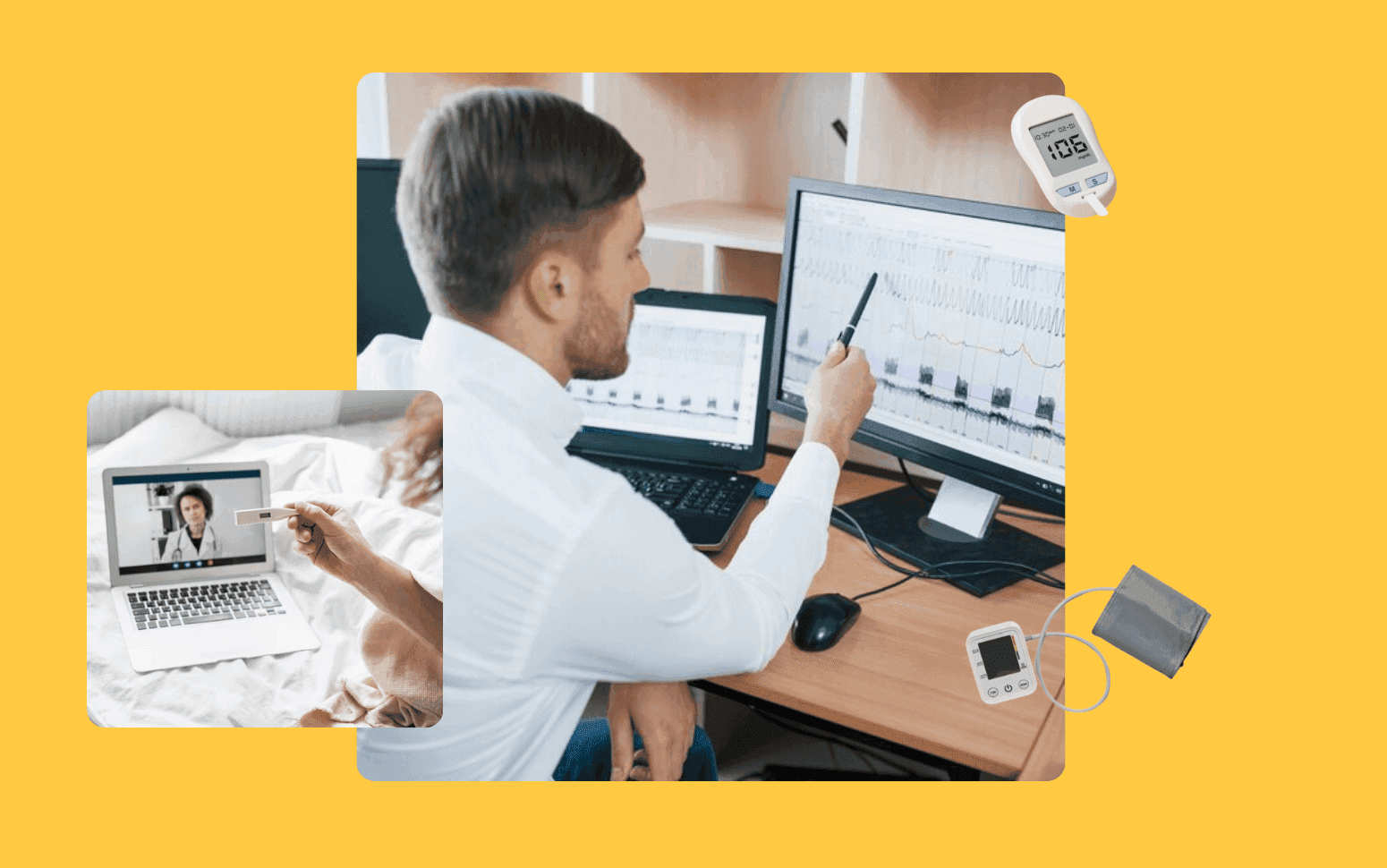
AI Remote Patient Monitoring Cuts Hospital Readmissions
- 30%
- 12 weeks
Custom telemedicine applications for digital health companies, private healthcare operators, and health systems building patient-facing virtual care platforms.
We build the video infrastructure, clinical workflows, and HIPAA-aware data architecture that a production telehealth platform requires.
HIPAA-aware video consultation infrastructure with encrypted sessions and audit logging
EMR integration for Epic, Cerner, Athenahealth, and smaller regional systems
Asynchronous telehealth: secure messaging, photo sharing, structured intake forms
Patient-facing mobile apps (iOS and Android) with provider scheduling and video
Recognition
Building a telehealth platform but unsure how to handle HIPAA-compliant video, data storage, and EMR integration?
Generic video tools not meeting your clinical workflow requirements or compliance documentation needs?
In short
RaftLabs builds telemedicine applications for digital health companies, private healthcare operators, and health systems. We develop video consultation platforms, asynchronous telehealth tools, HIPAA-aware data handling, EMR integration (Epic, Cerner, Athenahealth), and patient-facing mobile telehealth apps. We've shipped telemedicine apps in production. Most telemedicine app development builds deliver in 12-16 weeks at a fixed cost.
Companies we've built for






Most failed telehealth implementations fail at adoption, not technology. Clinicians don't adopt platforms that don't fit their workflow. Patients don't return to platforms that are clunky or slow.
We build telehealth platforms around the clinical workflow first. Compliance and architecture are constraints, not afterthoughts.
Synchronous video consultation infrastructure built on WebRTC media stacks. We evaluate Twilio Video, Daily.co, and AWS Chime SDK based on your compliance requirements, latency targets, and session volume before selecting the media layer. The WebRTC signaling stack handles ICE candidate gathering with STUN/TURN failover. We run coturn server deployments for environments where peer-to-peer paths are blocked by corporate firewalls or strict NAT configurations. Video quality scales adaptively from 360p on constrained connections up to 720p or 1080p where bandwidth allows, using simulcast and selective forwarding unit (SFU) architecture to reduce server-side transcoding load.
Waiting room management uses DTMF-style hold signaling so patients queue before the provider joins. Session recording requires explicit patient consent captured before the session starts, stored as an auditable consent event against the patient record. Multi-party sessions support specialist consultations and group therapy workflows with up to 12 concurrent participants. Post-session, structured consultation findings write back directly to the EHR encounter record via FHIR R4 DocumentReference, eliminating manual note transfer. Provider availability calendars sync bidirectionally with existing scheduling systems including Acuity, Calendly, or custom scheduling backends. All media is encrypted end-to-end using DTLS-SRTP. Session metadata is encrypted at rest using AES-256.
Store-and-forward telehealth for specialties where synchronous video isn't necessary or practical. For dermatology and wound care, patients submit images and clinical context. Providers review and respond on their own schedule. Photo and document attachments are stored using the FHIR Binary resource, linked to the relevant Observation or DiagnosticReport so the clinical context travels with the media file. For psychiatry and behavioural health, structured intake forms with conditional logic branch based on prior answers. A PHQ-9 depression screen or GAD-7 anxiety screen embedded in intake collects validated scoring data rather than unstructured free text, feeding directly into the provider's review queue with a numeric severity score already calculated.
Secure provider-to-patient messaging sits inside the same HIPAA-compliant data layer. Messages are encrypted end-to-end, stored with configurable retention policies (typically 7 years for PHI), and generate audit log entries on send, read, and delete events. Providers can include structured attachments alongside free-text messages: care plan documents, lab result summaries, prescription instructions. Intake forms use conditional logic to surface the right questions for the presenting condition. A dermatology intake asks about symptom duration, prior treatments, and photograph quality guidance. A psychiatry intake runs through medication history, prior episodes, and safety screening before the provider even opens the case. This structured data collection at intake reduces the time providers spend gathering information during the clinical interaction.
Integration with your existing EMR using the appropriate standard for the system generation. For Epic, Cerner, and Athenahealth we use FHIR R4 resources directly: Patient resources for demographics, Encounter resources to represent each consultation, Observation resources for structured clinical findings, and DiagnosticReport resources for structured test results. The SMART on FHIR OAuth 2.0 authorization flow handles token issuance, scope negotiation, and launch context so the telehealth platform knows which patient and encounter are active without requiring a second login. Consolidated Clinical Document Architecture (CCD/C-CDA) documents handle transitions of care where point-to-point data exchange isn't available or where a structured summary document is what the receiving system expects.
For legacy regional systems that predate FHIR, we use HL7 v2 messaging: ADT messages for patient demographic updates, ORM messages for order workflows, and ORU messages for results delivery. HL7 v2 feeds require a middleware integration engine (typically Mirth Connect or Azure Health Data Services) to handle message routing, transformation, and error management. The integration approach is determined entirely by what your specific EMR version and configuration actually exposes, which is why we scope this during discovery rather than assume. EMR integration is the highest-risk component of most telehealth builds. Underscoping it is the most common cause of cost overruns and delayed launches.
Patient-facing iOS and Android apps built in Swift (UIKit or SwiftUI) and Kotlin (Jetpack Compose or XML layouts) for fully native performance and platform-appropriate UX. Hybrid frameworks are evaluated case by case. Native is preferred for telehealth apps where video quality, background behavior, and device sensor access matter. Push notifications use Apple Push Notification service (APNs) and Firebase Cloud Messaging (FCM) for appointment reminders and provider messages. Background delivery is handled without requiring the app to be in the foreground, so patients receive time-sensitive clinical notifications reliably.
Biometric authentication (Face ID, Touch ID, Android BiometricPrompt API) replaces password-only login for returning users while maintaining the authentication audit trail HIPAA requires. VoiceOver (iOS) and TalkBack (Android) accessibility support is built in from the start. Telehealth user populations include older patients and those with visual impairments, so WCAG 2.1 AA is a baseline requirement. Offline data handling uses CoreData (iOS) and Room (Android) to cache appointment schedules, provider contact information, and recent messages so the app remains functional in low-connectivity environments. The consent flow for push notifications follows iOS 14+ and Android 13+ permission models with clear clinical rationale for each notification type, improving opt-in rates compared to generic permission prompts.
Clinical-facing interfaces designed around the actual consultation workflow rather than generic task management UI. The patient queue for on-demand consultations displays estimated wait time per patient calculated from session start times and average consultation duration, so providers can manage patient expectations before joining. The pre-consultation view surfaces relevant patient history from the EMR: active medications, relevant diagnoses, prior consultation summaries, and any structured intake data the patient completed before the session.
Structured SOAP note templates are pre-populated with patient demographics and the presenting complaint from intake. Suggestion-based SOAP note drafting, trained on specialty-specific note patterns, gives providers a starting point rather than a blank field. Providers review, edit, and sign rather than composing from scratch. ICD-10-CM diagnosis code lookup and CPT procedure code lookup are integrated directly into the note interface so coding happens during documentation rather than as a separate billing step. Prescription and referral generation pulls current formulary data so providers see insurance-specific coverage status at the point of prescribing. Post-consultation follow-up management tracks outstanding tasks per patient, including referrals sent, lab orders placed, and prescriptions issued, so nothing is lost between the end of the video session and the administrative close-out. The dashboard is designed to minimise the administrative burden that drives clinician burnout.
HIPAA technical safeguard implementation following 45 CFR Part 164 requirements, covering the technical, administrative, and physical standards that apply to any system that creates, receives, maintains, or transmits electronic protected health information. Data at rest is encrypted using AES-256. Data in transit uses TLS 1.3 for all API communication and DTLS-SRTP for media streams. We execute Business Associate Agreements (BAAs) with every infrastructure provider that handles PHI: AWS (HIPAA-eligible services including EC2, RDS, S3, and CloudFront), GCP (HIPAA-aligned services under the Google Cloud BAA), and Azure (HIPAA-covered services via the Microsoft Azure BAA). Selecting which services fall within BAA scope is a design decision. Not all cloud services are covered, and using out-of-scope services for PHI data is a compliance risk.
Audit logging captures every PHI access event: who accessed which record, what action was taken, from which IP address, and at what timestamp. On AWS deployments, CloudTrail provides the infrastructure-level audit log alongside application-level event logging. On GCP, Cloud Audit Logs and Stackdriver handle the equivalent function. Logs are retained per HIPAA's minimum 6-year documentation requirement, stored in tamper-evident append-only log storage. Role-based access control applies the minimum necessary standard. Clinical staff see patient records relevant to their care panel. Billing staff see billing-relevant data without access to clinical notes. Administrators have operational access without PHI exposure. Recording consent workflows capture explicit patient consent before any session recording begins, stored as a timestamped consent record. Cross-state licensing compliance tooling tracks which providers are licensed in which states to prevent out-of-jurisdiction consultations.
A focused telemedicine MVP, covering video consultation using a WebRTC SDK like Twilio Video or Daily.co, appointment scheduling, and basic patient and provider portals, typically runs $45,000-$80,000 and delivers in 12-16 weeks. That scope includes HIPAA-aware data handling, role-based access control, audit logging, BAA setup with your cloud provider, and iOS and Android mobile apps for patients.
A full-featured telehealth platform with EMR integration (Epic FHIR R4, Cerner, or Athenahealth), asynchronous messaging and photo-sharing, multi-specialty clinical workflows, structured SOAP note drafting, ICD-10/CPT code lookup, and native mobile apps runs $80,000-$180,000. The primary cost drivers are EMR integration complexity (Epic MyChart integrations are well-documented but require sandbox access and Epic review cycles), the number of clinical workflows covered, the depth of structured data capture for each specialty, and compliance documentation requirements. Video infrastructure costs are predictable. EMR integration costs are the variable. We scope EMR work explicitly during discovery because it's the component most often underestimated at the proposal stage.
Any software that handles protected health information (PHI) in the US must comply with HIPAA's Technical, Administrative, and Physical Safeguard requirements under 45 CFR Part 164. For telehealth specifically, that means: AES-256 data encryption at rest and TLS 1.3 in transit; role-based access control applying the minimum necessary standard for PHI access; audit logs of every PHI access event retained for a minimum of 6 years; and signed Business Associate Agreements with every third-party service provider that processes PHI on your behalf. This includes your cloud host (AWS, GCP, Azure), your video infrastructure provider, your SMS/notification vendor, and your analytics platform if it touches PHI.
The practical implication for architecture: you can't simply use any available cloud service. Only HIPAA-eligible services within your cloud provider's BAA scope are permitted for PHI storage and processing. We map this explicitly during architecture design. It affects which services, regions, and configurations are permissible. We implement these requirements from day one rather than as a compliance audit after the system is built, because retrofitting compliant architecture onto a non-compliant data model is significantly more expensive than building it right initially.
Yes. Epic, Cerner, and Athenahealth are the most common integrations. Epic's FHIR R4 API covers Patient, Encounter, Observation, MedicationRequest, and DiagnosticReport resources with well-documented sandbox access through Epic's App Orchard. The SMART on FHIR OAuth 2.0 authorization flow handles launch context. The telehealth platform knows which patient and clinician are active without a separate login. Cerner Millennium and Athenahealth expose similar FHIR R4 endpoints with slightly different scope and configuration requirements.
Older regional systems that predate FHIR use HL7 v2 messaging: ADT A01/A08 messages for admission and demographic updates, ORU R01 for results, and ORM O01 for order workflows. These require an integration engine layer, such as Mirth Connect or Azure Health Data Services, to handle message transformation and routing. The data flow we need to support determines which approach applies. Reading patient demographics only requires less scope than writing structured notes back post-consultation. We define the exact FHIR resource scope or HL7 message types needed during discovery, then test against your EMR's sandbox before production deployment. Integration complexity is the highest-risk component of most telehealth builds and the most common source of timeline slippage when it isn't scoped carefully upfront.
Existing platforms like Doxy.me, Zoom for Healthcare, and Teladoc Health handle standard virtual visit workflows well. If your requirement is a HIPAA-compliant video call with appointment booking and a provider-facing interface, an existing platform is likely faster and cheaper than custom development. We'll tell you this honestly if it's true.
Custom development is justified in three situations. First, when your clinical workflow has specialty-specific requirements that existing platforms don't support: a structured psychiatric intake with PHQ-9/GAD-7 automated scoring, a dermatology platform with structured image annotation, or a chronic disease management program with custom between-visit data collection. Second, when your EMR integration requirements go beyond what the platform's out-of-box connectors handle, such as writing structured SOAP notes back to Epic Encounter records rather than a PDF attachment. Third, when you're building a product rather than an internal tool. A telehealth platform you intend to white-label or sell to providers needs to be owned IP, not a dependency on a third-party platform's pricing and API policy decisions. These three scenarios represent the cases where custom development delivers a return. Outside them, an existing platform is usually the right call.
What clients say
Three-year average engagement. Founders and operators describing the work in their own words. No marketing varnish.

 USA
USAAll of the sprints were completed on schedule and on budget. We highly recommend RaftLabs!
01 / 02
Tell us your clinical specialty, patient population, and EMR environment. We'll scope the build.