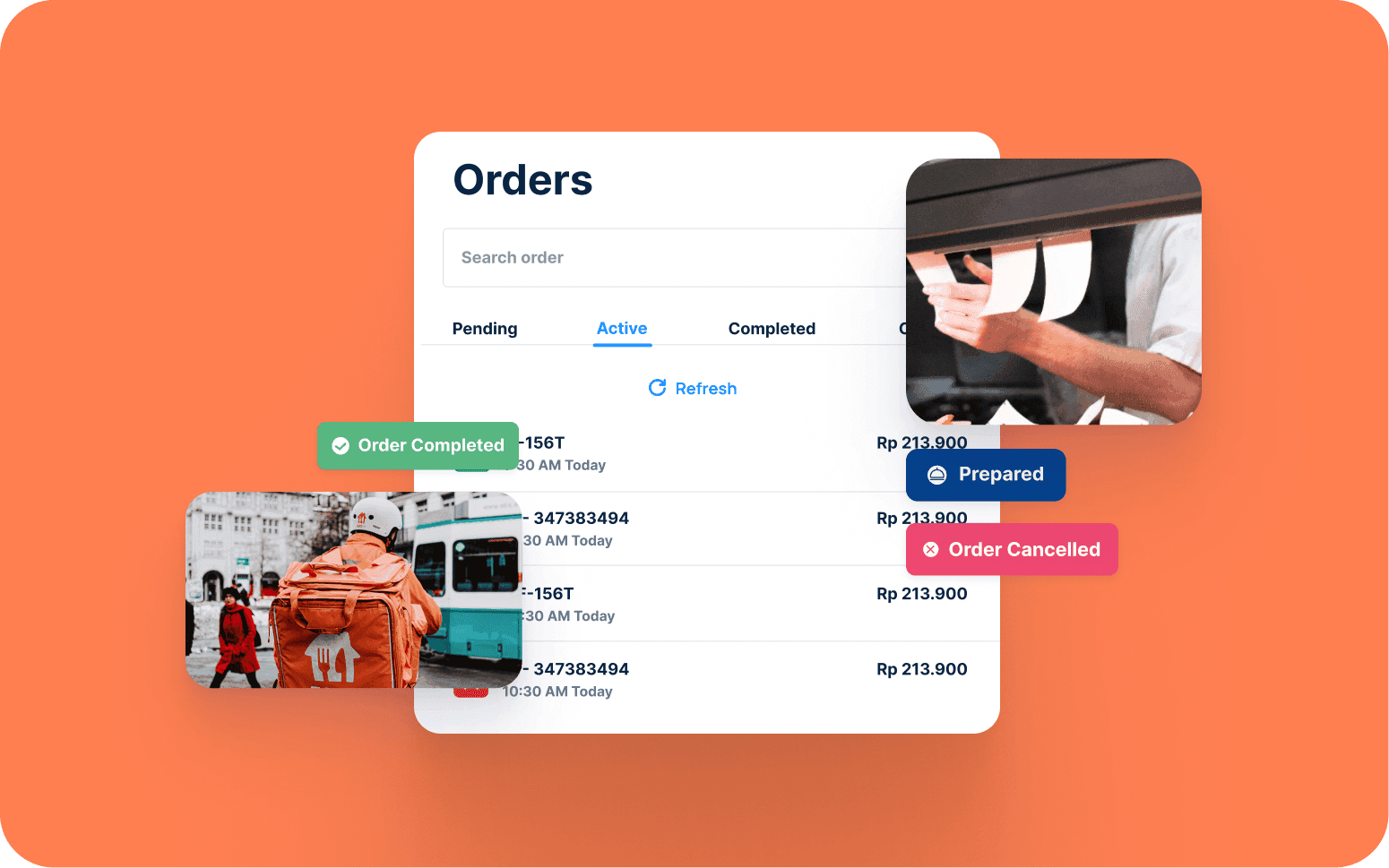
Centralised App for Food Order Management Across Multiple Locations
- 3x
- 12 weeks
RaftLabs builds custom food delivery platforms, customer ordering apps, restaurant dashboards, driver dispatch and tracking, real-time order status, delivery zone and pricing management, and operations reporting.
We build the platform layer that owns the customer relationship and the driver network. No per-order commission to an aggregator. No dispatch logic that cannot handle your delivery zones or restaurant prep time requirements.
Customer ordering app with real-time order tracking
Automated driver dispatch by proximity and delivery zone
Restaurant dashboard with order management and prep time control
Delivery zone and dynamic pricing configuration
Recognition
Running a food delivery marketplace on Uber Eats or Deliveroo where the commission structure makes unit economics unworkable at current order volume and there's no path to owning the customer relationship?
Operating a delivery platform that assigns drivers manually by phone because there's no automated dispatch system matching orders to available drivers by proximity and zone?
In short
Food delivery platform development covers customer ordering apps with real-time order tracking, automated driver dispatch matched by proximity and delivery zone, restaurant dashboards with order management and prep time control, delivery zone and dynamic pricing configuration, and operations analytics, giving operators margin control and customer ownership rather than per-order commission to an aggregator. RaftLabs builds custom food delivery platforms for marketplace operators, restaurant groups, and dark kitchen operators. Most projects deliver in 12 to 16 weeks at a fixed cost.
Companies we've built for





The problem with building a delivery business on Uber Eats or Deliveroo is not the technology. It's the commercial model. A 25 to 30% commission on every order means you're running delivery at a loss or passing the cost to the customer. At low order volume, that's a cost of distribution worth paying. As order volume grows, it becomes the biggest line on the P&L that you can't control. And the customer relationship belongs to the aggregator, not to you.
Operators who build their own delivery platform take on infrastructure cost in exchange for margin control and customer ownership. The platform knows who the customer is, what they order, and how often. Dispatch is automated to your zone logic. Restaurant prep time is factored into order sequencing so drivers don't arrive before the food is ready. The commercial model, delivery fee, service charge, surge pricing, is set by you, not a platform with its own priorities.
We build delivery platforms for marketplace operators, restaurant groups, and dark kitchen operators who have reached the point where owning the infrastructure makes financial sense.
iOS and Android ordering apps and a responsive web ordering flow with restaurant discovery, menu browsing with allergen and dietary filters, basket management, and checkout. Allergen and dietary labelling follows EU FIR 1169/2011 CONTAINS and FREE_FROM classification conventions, displaying the 14 major allergens per item and supporting filters for vegetarian, vegan, gluten-free, and other dietary requirements, both to serve customers with dietary needs and to meet food labelling compliance obligations for operators selling in affected jurisdictions.
Real-time order tracking uses WebSocket push updates from confirmation through kitchen preparation to driver pickup and delivery. Order status changes (confirmed, preparing, ready for pickup, driver en route, delivered) push to the customer in real time with an ETA that recalculates based on actual driver position and traffic rather than the static estimate set at order placement.
Payment processing uses Stripe with fraud scoring, Stripe Radar applies machine learning risk scoring to each payment, flagging high-risk transactions before they are authorised. This reduces chargebacks without requiring manual review of every transaction.
Push notifications at each order status change keep the customer informed without requiring them to keep the app open. Customer account stores order history, saved delivery addresses, payment methods, and dietary preferences. Reorder with one tap applies the previous order to the current restaurant menu, flagging items that are no longer available or have changed price before the customer confirms.
Restaurant-facing dashboard for order acceptance, prep time management, and kitchen status. Incoming orders are displayed with accept, reject, and delay controls, a kitchen that is backed up can delay an incoming order rather than accepting it with an unrealistic prep time that creates a driver wait and a late delivery. Prep time adjustment in real time feeds directly into the dispatch system, which holds driver assignment until the pickup time calculation makes the dispatch viable.
Restaurant POS integration allows orders to flow directly into Toast, Square, or Oracle MICROS via webhook rather than requiring kitchen staff to manually re-enter the order into the POS from a tablet screen. The integration reduces kitchen errors from manual transcription and eliminates the latency between order placement and the kitchen receiving the ticket. POS integration scope depends on the restaurant partner's existing POS system and its webhook or API support.
Menu management covers item availability updates (86ing an item that is sold out pushes to the customer app immediately so customers cannot order unavailable items), price changes, new item creation, and modifier and option group management. All menu changes push live to the customer app within seconds, eliminating the version lag that causes customers to order items at stale prices or select unavailable modifiers.
For dark kitchen operations, food safety temperature monitoring integration logs holding temperature data for each kitchen station against HACCP compliance requirements, maintaining the time-temperature records that food safety audits require and generating alerts when holding temperatures fall outside safe parameters.
Sales reporting shows revenue by day, week, and order type with the per-item and per-modifier data needed for menu engineering decisions.
Driver mobile app for order assignment, navigation, and status updates. Turn-by-turn navigation uses Google Maps or HERE Maps route optimisation, selecting the fastest route given current traffic rather than the shortest distance, which matters most for delivery time accuracy in dense urban environments. Drivers receive a single interface showing their current assignment, the pickup address, the delivery address, and the running earnings for the shift.
Automated dispatch matches each confirmed order to the nearest available driver within the correct delivery zone using a scoring algorithm that combines proximity to the restaurant, estimated travel time factoring in current traffic, and restaurant prep time. The system dispatches the driver at the optimal moment, when the estimated driver arrival coincides with the estimated order ready time, so drivers do not idle at restaurants and food does not cool waiting for driver pickup.
Zone-based batching allows the dispatch system to assign a second nearby order to a driver who is already on a delivery, where the route geometry supports it and both delivery ETAs remain within acceptable bounds. This increases driver utilisation and reduces per-delivery cost without degrading customer experience.
For capacity overflow situations where driver supply is insufficient for demand, DoorDash Drive or Uber Eats integration provides access to gig driver capacity on a per-order basis, with overflow routing triggered automatically when in-house driver coverage falls below a configurable threshold.
Driver status management covers available, on delivery, break, and offline states. Order acceptance and rejection with automatic reassignment on timeout handles the case where a driver does not respond within the acceptance window.
Live order tracking map for the customer showing the driver's real-time location and the estimated delivery time. Driver position updates are transmitted from the driver app over WebSocket and pushed to the customer's tracking view in near real time, the customer sees the driver moving on the map rather than a static pin placed at order assignment. Status updates at each stage, order confirmed, kitchen preparing, driver assigned, driver en route, delivered, are pushed to the customer's app and to the order history record simultaneously.
ETA prediction uses a gradient boosting model trained on historical delivery data: inputs include the distance between restaurant and delivery address, the current time of day (factoring in traffic density patterns by hour and day of week), the restaurant's historical average prep time for the current period, and real-time traffic data from the routing API. This produces a more accurate ETA than a simple distance-divided-by-average-speed calculation, reducing the gap between what the platform promises and what the driver delivers.
SMS fallback for customers who close the app sends a message at driver pickup and at 5 minutes before estimated delivery, keeping customers informed without requiring them to keep the tracking screen open. Push notification fallback covers the same status points for customers who have background notifications enabled.
For operators, the operations view shows all active orders on a map simultaneously, each driver's position, their current assignment, and the ETA for each delivery in progress. This gives the operations team situational awareness across the delivery fleet in real time.
Delivery zone configuration by polygon, radius, or postcode defines the geographic boundaries within which each restaurant or dark kitchen will accept and fulfil orders. Per-zone delivery fee, minimum order value, and estimated delivery time baseline are configured separately for each zone, an inner city zone may have a lower delivery fee and higher driver availability than an outer zone that requires longer drive times and commands a higher fee to remain margin-positive.
Dynamic pricing configuration activates a surge multiplier automatically based on configurable triggers: time of day (Friday evening dinner peak), weather conditions (rain events correlated with order spike), or driver-to-order ratio falling below a configurable threshold. Surge pricing is displayed transparently to the customer in the checkout flow, with the base fee and the surge amount shown separately so customers understand why the delivery fee is higher than the displayed zone baseline.
Zone availability management disables a delivery zone automatically when active driver count falls below the minimum coverage threshold for that zone, rather than accepting orders the platform cannot fulfil within the promised ETA. This is preferable to accepting orders and then delivering them late, which generates refund requests and rating damage.
Multi-restaurant marketplace architecture allows a single platform instance to serve multiple restaurant partners, each with their own menu, pricing, and delivery zone configuration, with the customer ordering from any restaurant in their delivery zone through a single app. Single-brand app architecture limits the platform to one restaurant group's outlets but allows tighter brand integration and a simpler customer experience. Both architectures are supported, the choice is made at project scoping based on the operator's business model.
Operations reporting covers order volume, average delivery time from order confirmation to delivery, driver utilisation rate (percentage of on-shift time spent actively on delivery versus idle), and zone-level performance showing which zones are meeting ETA targets and which are consistently late. These metrics separate operational problems by cause, a zone that is consistently late due to traffic requires a different response from a zone where the problem is driver under-coverage.
Late delivery tracking captures reason codes at the driver or kitchen level: kitchen delay (restaurant prepared the order late relative to the confirmed prep time), driver unavailability (dispatch could not assign a driver within the target time), traffic delay, or customer unavailability at the delivery address. Reason code data over a rolling period identifies which cause is responsible for the most late deliveries, directing improvement effort to the right place.
Customer satisfaction scores are linked at the order level to the restaurant, the driver, and the delivery zone, so a pattern of low ratings associated with a specific restaurant (preparation quality problems) is distinguishable from a pattern associated with a specific driver (service quality problems) or a specific zone (delivery time problems).
Revenue reporting shows gross merchandise value, delivery fee revenue, and per-order margin by zone, restaurant, and time period. For marketplace platforms, restaurant partner performance is reportable in a way that feeds commercial conversations about minimum order values, delivery fee sharing, and exclusivity arrangements.
Driver performance metrics include acceptance rate, on-time delivery rate by zone, average delivery time, and earnings per hour, the data that feeds driver incentive structures and identifies drivers whose performance metrics are below the fleet average.
The crossover point depends on your order volume, average order value, and current commission rate. At 30% commission on a $25 average order, you are paying $7.50 per order to the aggregator. A custom delivery platform with infrastructure cost amortised over 12 months typically becomes cheaper at 150-300 orders per day depending on the platform complexity. The calculation includes platform hosting, maintenance, and driver incentive costs on the custom side versus commissions and promotional spend on the aggregator side.
Beyond the cost calculation, there is a strategic question: the aggregator owns the customer relationship, the order history, the review data, and the reorder behaviour. Building your own platform means those assets belong to your business. You know who your customers are, what they order, and how to reach them directly. That first-party data supports loyalty programme development, targeted promotions, and the customer lifetime value analysis that informs unit economics decisions, none of which you can do when orders flow through a marketplace that owns the customer record.
Many operators start the transition by using DoorDash Drive or Uber Eats for overflow capacity, maintaining aggregator presence for customer acquisition while routing known, returning customers to the owned platform where the economics are better. This dual-channel model is a common transition path and is supported by building overflow API integration into the dispatch system so driver capacity from the third-party network is available when in-house capacity is insufficient.
The dispatch system monitors driver location in real time through the driver app using a position update sent every 5-10 seconds. When an order is confirmed, the system identifies available drivers within the delivery zone and scores them by a composite of proximity to the restaurant (calculated using the routing API rather than straight-line distance), estimated travel time factoring in current traffic, and whether the driver is already completing a delivery that could be batched with this order given the route geometry.
The restaurant's prep time, set by the restaurant in real time through their dashboard or defaulted to the historical average prep time for that restaurant at the current time of day, is included in the dispatch timing calculation. The driver is dispatched at the moment when their estimated arrival at the restaurant coincides with the estimated order ready time: restaurant prep time minus the driver's estimated travel time. A driver 8 minutes away from a restaurant with a 12-minute prep time is dispatched 4 minutes after order confirmation, not at order confirmation.
The system sends the assignment to the highest-scored available driver and waits for acceptance within a configurable timeout (typically 30-60 seconds). If the driver does not accept, the order is reassigned to the next driver in the scored queue automatically. The operator can override automatic dispatch and manually assign an order from the operations dashboard for exceptional cases. Dispatch override events are logged for performance analysis.
Prep time is the variable that most manual dispatch operations get wrong. If the kitchen takes 18 minutes and the driver is 4 minutes away, dispatching the driver on order confirmation means an 11-minute wait at the restaurant, idle driver cost, food cooling, and a late delivery. We build prep time management into the restaurant dashboard so kitchen staff can set a live prep time by service period. The dispatch system holds the driver assignment until the estimated pickup time, restaurant prep time minus driver travel time, so the driver arrives close to when the food is ready. Restaurants can update their prep time in real time when the kitchen is backed up. The dispatch system recalculates in-flight.
An MVP food delivery platform covering customer ordering, driver app with basic dispatch, restaurant dashboard, and real-time order tracking typically runs $25,000 to $60,000. A full platform adding automated dispatch with zone and prep time logic, dynamic pricing, operations reporting, and driver management tools typically runs $50,000 to $120,000. A multi-restaurant marketplace delivery platform covering restaurant partner onboarding, full dispatch automation, zone management, and analytics is typically at the upper end of that range or above, depending on the number of restaurant integrations and the commission and payout logic required. We scope and price every project before development starts.
What clients say
Three-year average engagement. Founders and operators describing the work in their own words. No marketing varnish.

 Indonesia
RaftLabs helped us build a platform that truly transformed how our customers order and engage with our brand across multiple locations.
01 / 02
Tell us your current delivery setup, your order volume, and the dispatch or zone logic that your current system cannot handle. We'll scope a platform built for your delivery model.