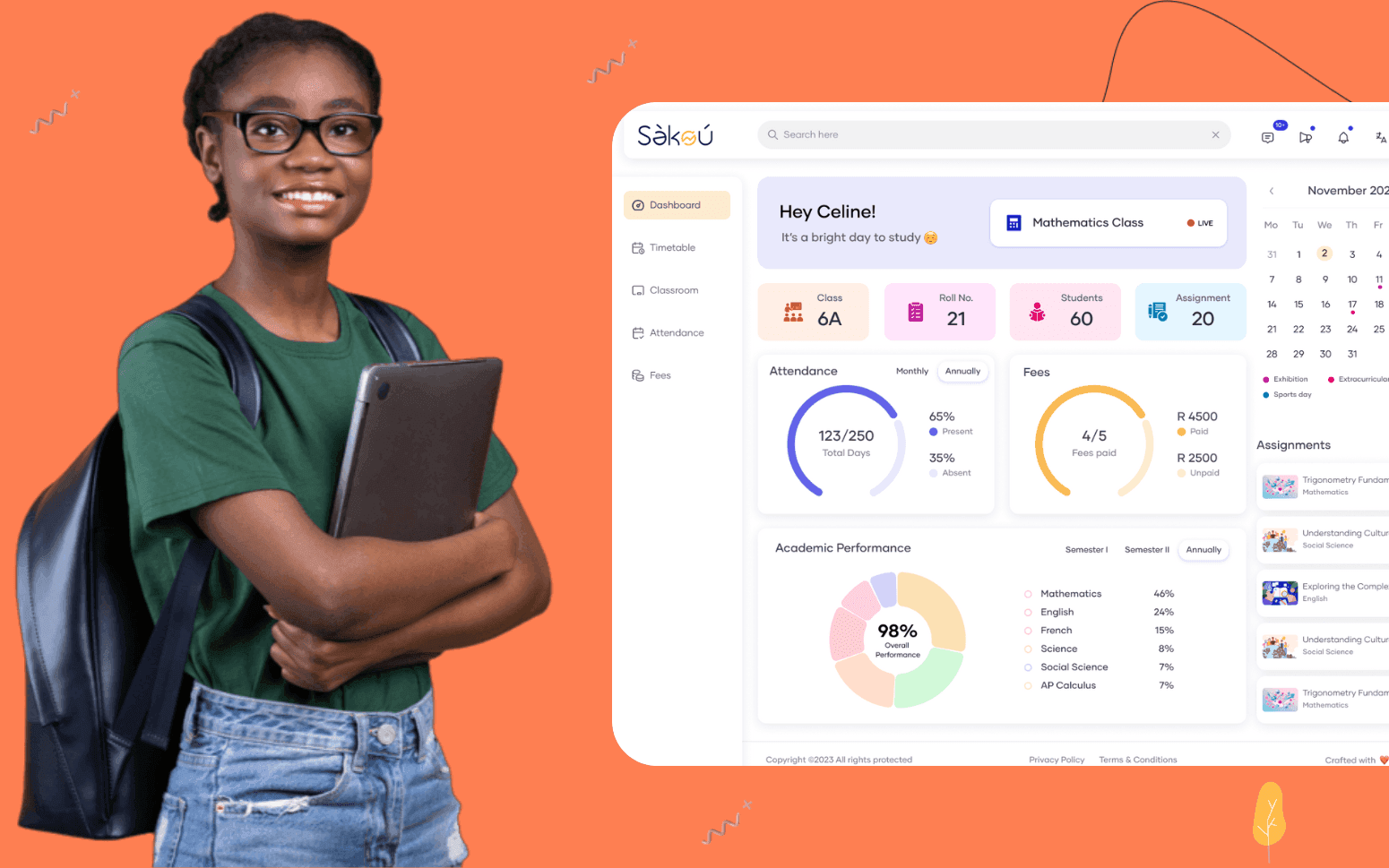
Purpose Built EdTech LMS SaaS Platform Disrupting African K-12 Schools
- 4000+
- 25%
- 16 weeks
Custom LMS platforms built for corporate training, e-learning, and professional certification, with the content management, learner tracking, and assessment capabilities your specific training programme needs.
100+ products shipped since 2019. We've built LMS platforms for corporate training programmes, professional certification bodies, and education providers across multiple industries.
Custom course authoring, SCORM/xAPI content support, and multimedia learning delivery
Learner progress tracking, completion reporting, and certification management
Assessment, quiz, and skills evaluation with configurable pass criteria
Integration with your HRIS, CRM, or enterprise systems
Recognition
Off-the-shelf LMS not supporting your specific content types, assessment workflows, or learner management requirements?
SaaS LMS pricing scaling unsustainably with your learner count or content volume?
In short
RaftLabs builds custom learning management systems for corporate training programmes, higher education institutions, and professional certification bodies. Custom LMS development covers course authoring and management, SCORM and xAPI content support, learner progress tracking, certification management, assessment and quiz engines, and learner analytics dashboards. Custom LMS makes sense when off-the-shelf platforms don't support your content types, learner workflows, or integration requirements. Most LMS projects deliver in 10-16 weeks at a fixed cost with full source code ownership.
Companies we've built for



A corporate compliance training programme has different requirements than a professional certification body, which has different requirements than a university continuing education programme. Generic LMS platforms make design decisions that fit no one particularly well: content types they don't support, learner hierarchies they can't model, assessment workflows they don't enable, and per-seat pricing that becomes unsustainable at enterprise scale.
Custom LMS development builds the platform around your specific learning content, learner structure, and programme requirements.
Course creation and management interfaces for learning administrators, course structure, module and unit organisation, content upload, versioning, and publication workflow with draft and review states. SCORM 1.2 and SCORM 2004 content playback for existing e-learning packages: the SCORM runtime (or SCORM API wrapper) communicates completion, score, bookmark, and interaction data between the content package and the LMS database, so tracking data is captured without the course author modifying their content.
xAPI (Tin Can API) statement tracking supports next-generation learning content and simulation-based learning. xAPI statements sent by content, "learner attempted quiz", "learner completed scenario", "learner scored 85%", are stored in the LRS (Learning Record Store) component of the LMS, enabling richer analytics than SCORM's completion/score model allows. LTI 1.3 (Learning Tools Interoperability) enables third-party tools, virtual labs, assessment platforms, simulation environments, coding environments, to launch from within your LMS with single sign-on and grade passback, so learners don't leave the LMS experience for external tools.
Video delivery uses HLS (HTTP Live Streaming) with adaptive bitrate segmentation: the video is encoded at multiple quality levels (360p through 1080p), and the player switches between quality tiers based on available bandwidth. Learners on mobile data connections with variable connectivity get smooth playback at lower quality rather than buffering. Captions and transcripts are generated or uploaded per video for WCAG 2.1 AA accessibility compliance.
Learner registration, profile management, and enrolment workflows designed for your specific organisational structure. Self-enrolment for open courses, manager-assigned enrolment for compliance training, and automatic enrolment based on HRIS attributes (job role, department, location, hire date) keep learner assignments current as your workforce changes. Role-based learning paths assign the correct training sequence to each job function at onboarding, during role changes, and for annual compliance recertification cycles.
Integration with Canvas, Moodle, and Blackboard is supported for institutions that need a custom learner-facing experience or extended functionality layered on top of an existing LMS infrastructure. LTI 1.3 Deep Linking allows external tool content to be embedded within existing course structures in those platforms while your custom LMS manages the custom learner tracking and analytics layer.
Cohort management supports cohort-based programmes where a group of learners progresses through content together on a fixed schedule, start dates, discussion forums, synchronous session scheduling, and group-level progress visibility for instructors are all part of the cohort model. Waitlist management for instructor-led training with limited physical or virtual seat capacity handles registration, waitlist position notification, cancellation, and automatic promotion from waitlist when a seat opens. Learner self-service profile management, updating contact details, viewing certification status, downloading completion certificates, reduces administrative load on the learning operations team.
Configurable assessment engine built for knowledge checks, formative module quizzes, and high-stakes certification exams. Question types include multiple choice, multi-select, true/false, fill-in-the-blank, short answer, drag-and-drop ordering, hotspot image interaction, and scenario-based branching questions. Question banks with randomised pool selection maintain exam integrity, each learner receives a different question selection drawn from the same competency areas, preventing answer sharing.
Spaced repetition scheduling using the SM-2 algorithm (the Leitner-derived algorithm underlying Anki and SuperMemo) can be applied to knowledge check decks: questions a learner answers correctly are scheduled for review at longer intervals; questions answered incorrectly are reviewed sooner. This improves long-term retention for compliance training and professional certification preparation without extending total study time.
Adaptive learning path adjustments based on assessment performance route learners to remedial content when they score below threshold on a module quiz and advance high-performers past introductory content they've already demonstrated mastery of. Bayesian Knowledge Tracing (BKT) models, which estimate the probability that a learner has mastered each knowledge component based on their response history, can be incorporated for programmes where adaptive sequencing is a core requirement.
Pass mark, attempt limits, retake waiting period, and question exposure rules (preventing the same questions appearing on retakes) are all configurable per assessment. Timed assessments for certification exams display a countdown timer and auto-submit on expiry. Detailed result reporting shows question-level performance across the learner population, identifying questions with low discrimination indices that may need content revision.
Certificate generation and management for course completion and professional certification programmes. Certificates are generated as PDF documents with learner name, course title, completion date, issue date, expiry date, and a unique verification code that can be validated via a public-facing URL, useful for learners who share certificates with employers or professional bodies. Bulk certificate generation for cohort completions and automated email delivery on completion reduce manual processing to near zero.
Expiry date tracking and renewal reminder workflows handle time-limited certifications: configurable reminder emails at 90, 60, and 30 days before expiry, escalation to the learner's manager when renewal is overdue, and automatic certification status changes from active to expired when the date passes. Compliance training completion dashboards give HR, legal, and L&D teams a real-time view of completion status by course, department, location, and individual, the data that a regulatory auditor or employment tribunal will ask for.
WCAG 2.1 AA accessibility compliance is built into the learning interface and certificate delivery: sufficient colour contrast, keyboard navigation for all interactive elements, screen reader compatibility with correct ARIA labelling, captions on all video content, and text alternatives for non-text content. Open Badges 2.0 standard digital badge issuance is supported for competency-based recognition programmes where learners want to display credentials on LinkedIn or professional profiles. The compliance audit trail your legal or HR team needs, who completed which training, on which date, with which score, with which version of the content, is always current and exportable.
Learning analytics dashboards surface the engagement and performance metrics your L&D team needs to improve programmes, not just confirm that training happened. Core engagement metrics include completion rate by course and module, average time-on-task per module, repeat attempt rate (a high repeat rate often signals confusing content rather than learner difficulty), video replay rate, and content drop-off points showing where learners disengage. These metrics are tracked per course and trended over time to show whether content improvements are having the expected effect.
Assessment performance analytics show average score and score distribution per assessment, question-level discrimination analysis (which questions are too easy, too hard, or poorly discriminating between prepared and unprepared learners), and cohort comparison for multi-session delivery. Learner engagement scoring, a composite of completion rate, time-on-task, assessment performance, and recency of activity, identifies learners at risk of course abandonment before they drop out.
Manager dashboards show each manager their direct reports' training status, outstanding requirements, and upcoming certification renewals without requiring an L&D administrator to generate individual reports. Automated compliance reports are scheduled and emailed to training coordinators at the frequency your compliance programme requires, weekly during active training periods, monthly for ongoing certification tracking. xAPI statement data from the LRS is available for export to your BI tool (Power BI, Tableau, Looker) for integration with broader workforce and performance analytics.
Integration with your HRIS, Workday, SAP SuccessFactors, BambooHR, ADP Workforce Now, handles automatic learner provisioning when new employees are hired, role-based learning path assignment when job roles change, and automatic deprovisioning when employment ends. HRIS integration uses REST APIs where available (Workday RaaS reports, SAP SuccessFactors OData API) and SFTP-based file exchange for platforms with limited API access. The learner population in the LMS stays current with HR records without manual administrator intervention.
SSO via SAML 2.0 for enterprise identity providers (Okta, Azure AD, Google Workspace, Ping Identity) and OAuth 2.0 for consumer identity gives learners single sign-on access using their existing corporate or consumer credentials. No separate LMS password to manage or forget. SCIM provisioning via Okta or Azure AD can automate user account creation and deactivation from the identity provider side without a separate HRIS integration.
Moodle, Canvas, and Blackboard integration via LTI 1.3 supports institutions that want custom functionality embedded within their existing LMS infrastructure. CRM integration (Salesforce, HubSpot) for customer training programmes tracks which customers have completed which training, enabling automated customer success actions based on training completion status. A documented REST API covers any custom integration your specific enterprise systems require.
Custom LMS development makes sense in five situations. First, when your content types or learning workflows aren't supported by off-the-shelf platforms, custom simulation content, complex branching scenarios, virtual lab environments requiring LTI 1.3 deep integration, or speciality assessment types (practical skill assessments, performance observations) that generic quiz engines can't handle. Second, when your learner structure is complex, multi-tenant delivery for franchisees or customers with separate branding and administration, deep organisational hierarchies with 10+ levels of role-based path assignment, or learning programmes that span external partners and internal staff in ways that standard platforms don't model cleanly.
Third, when the integration with your Workday, SAP SuccessFactors, or enterprise systems requires custom development that exceeds what the platform's published API supports, and the implementation cost of a well-configured Cornerstone or Docebo equals the cost of a custom build. Fourth, when per-seat SaaS pricing at your learner volume makes perpetual licensing cheaper than ongoing subscription fees, the break-even point is typically around 5,000 to 10,000 active learners depending on the platforms compared. Fifth, when you need white-label delivery with separate branding, administration, and data isolation for each customer, franchise partner, or business unit, which most SaaS platforms either don't support or charge significant premiums for. We assess your requirements during scoping and tell you honestly whether a custom build is the right answer or whether a well-configured off-the-shelf platform covers your needs at lower cost.
SCORM (Sharable Content Object Reference Model) is the industry-standard packaging format for e-learning content. It defines how a content package communicates with the LMS: the SCORM API (a JavaScript object the LMS injects into the page) receives calls from the content for completion status, score, bookmark position, and interaction data. SCORM 1.2 (still the most widely deployed version) uses the CMIDataModel with cmi.core.lesson_status and cmi.score.raw. SCORM 2004 (3rd or 4th edition) adds the sequencing and navigation specification and the completion_status/success_status distinction.
Every custom LMS we build includes a full SCORM runtime that plays both SCORM 1.2 and SCORM 2004 packages without modification to the content. If you have existing SCORM content authored in Articulate Storyline, Adobe Captivate, or Lectora, it will play in your custom LMS with full tracking without the course author needing to republish anything.
xAPI (Tin Can API, or Experience API) is the successor standard with richer tracking capabilities, it sends statements in subject-verb-object format ("learner completed module", "learner scored 85% on assessment") to an LRS (Learning Record Store) rather than through the SCORM API. We build xAPI statement collection and an LRS component when your content or analytics requirements call for it. LTI 1.3 for external tool interoperability is also supported, enabling third-party simulation, lab, or assessment tools to launch from within the LMS with SSO and grade passback.
Mobile-responsive learning interfaces are standard in every LMS we build, the same content renders correctly across desktop, tablet, and smartphone using responsive layouts and touch-optimised controls. HLS adaptive bitrate video streaming adjusts quality to the learner's available bandwidth automatically, so mobile learners on variable data connections get playback without buffering.
For offline access, field technicians, healthcare workers without reliable Wi-Fi, frequent travellers, we implement Progressive Web App (PWA) features: content is cached to the device during a connected session and remains accessible offline. Progress events (SCORM API calls, xAPI statements) are queued locally and synced back to the LMS database when connectivity is restored, so completion and score data isn't lost during an offline session.
Native iOS and Android apps are available when the learning experience requires deeper device integration: camera access for practical skill assessment (photograph a completed task, video a procedure), push notifications for learning reminders and certification expiry alerts via APNs (iOS) and FCM (Android), and biometric authentication for secure exam environments. WCAG 2.1 AA accessibility compliance applies to mobile interfaces as well as desktop: sufficient touch target sizes, screen reader compatibility with VoiceOver (iOS) and TalkBack (Android), and captions on all video content. The mobile approach is chosen based on your learner population's device preferences and connectivity environment during scoping.
A focused custom LMS, course management, learner enrolment, SCORM playback, assessment engine, completion tracking, and a reporting dashboard, typically runs $25,000--$60,000. A full-featured LMS with multi-tenancy for multiple brands or customers, deep HRIS integration, advanced analytics, certification management, and mobile app delivery typically runs $60,000--$150,000. Cost depends on the number of content types, learner management complexity, integrations required, and mobile app scope. We scope every project before pricing it.
What clients say
Three-year average engagement. Founders and operators describing the work in their own words. No marketing varnish.

 Ivory Coast
RaftLabs has been an exceptional partner. From the start, they became more than just a service provider, they embraced our vision with their expertise and dedication.
01 / 02
Tell us your training programme structure, learner volume, content types, and what your current system can't do. We'll scope the right platform and give you a fixed cost.