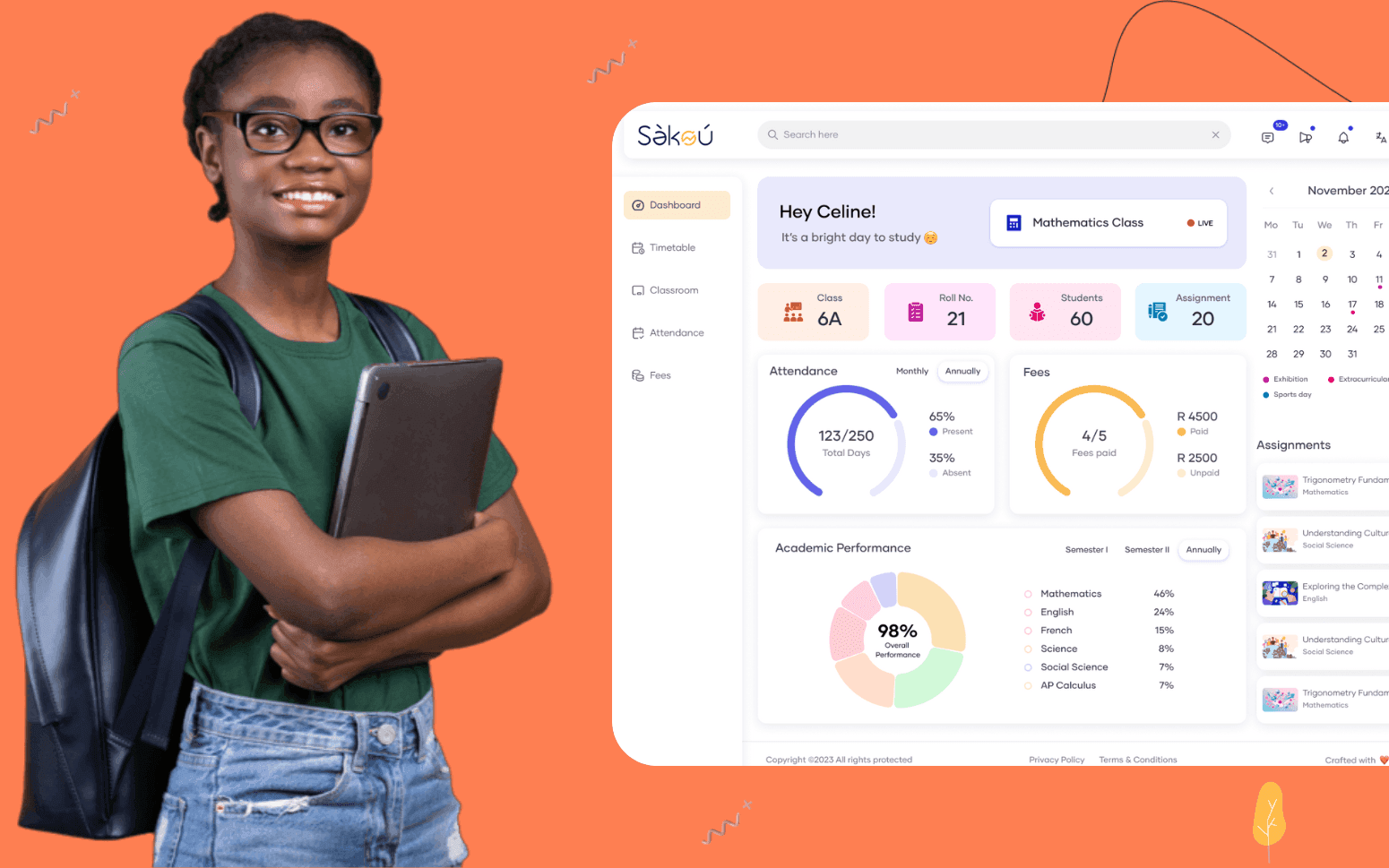
Purpose Built EdTech LMS SaaS Platform Disrupting African K-12 Schools
- 4000+
- 25%
- 16 weeks
Custom AI tutoring platforms that give every learner a 1-to-1 experience: curriculum-specific conversational tutors, adaptive learning paths, automated feedback, and the analytics teachers and parents actually need.
100+ products shipped since 2019. We build AI tutoring platforms for ed-startups, schools, and corporate training providers who need more than a generic chatbot layered on top of their content.
Conversational AI tutors scoped to your curriculum, not a generic chatbot
Adaptive learning paths that adjust difficulty based on real student performance
Automated feedback on written responses, essays, and code submissions
LTI 1.3 integration with your existing LMS and learning infrastructure
Recognition
Building a 1-to-1 tutoring experience at scale but hiring human tutors for every student isn't economically viable?
Your current LMS delivers content but has no way to identify which students are struggling with which specific concepts before the test?
In short
RaftLabs builds custom AI tutoring platforms for ed-startups, schools, and corporate training providers. The work covers conversational AI tutors powered by LLMs, adaptive learning paths that adjust to student performance, automated feedback on written and code submissions, knowledge gap identification, spaced repetition engines, and LMS integration via LTI 1.3. A custom AI tutoring platform differs from a general chatbot because it's curriculum-scoped, tracks learning objectives, and knows when to scaffold a struggling student versus when to challenge a confident one. Most AI tutor projects RaftLabs delivers ship in 10-14 weeks at a fixed cost with full source code ownership.
Companies we've built for




A general-purpose AI chatbot will answer questions. It has no concept of your curriculum, no idea which learning objectives a student has and hasn't mastered, and no mechanism to decide whether a student needs more scaffolding or a harder challenge. It gives answers. A tutor builds understanding. That distinction is the entire product.
Custom AI tutoring platform development builds a system that knows your content, tracks each learner's progress against real learning objectives, asks Socratic questions rather than just giving answers, and surfaces the right information to teachers and parents at the right time. That's a different product from a chatbot with a subject label on it.
LLM-powered subject-specific Q&A scoped to your curriculum. The tutor stays on topic and references your content, not the open internet. We use retrieval-augmented generation (RAG) over your ingested course material so responses are grounded in your actual syllabus. Socratic questioning mode is built via structured prompt chains using GPT-4o or Claude 3.5 Sonnet: instead of handing over an answer, the tutor generates a sequence of leading questions calibrated to the student's last response, nudging them toward the reasoning rather than the result. Configurable persona and tone by age group means a primary school science tutor sounds different from a professional certification prep tutor. Session memory keeps the conversation coherent across a single study session using a windowed message history with summarisation to stay within context limits. Learning objectives from Bloom's taxonomy are mapped to each curriculum topic (remember, understand, apply, analyse, evaluate, create), so the tutor adjusts question depth to match the intended cognitive level rather than asking recall questions when application is the goal.
Performance-based difficulty adjustment that moves students forward when they demonstrate mastery and slows down when they don't, rather than advancing everyone on a fixed schedule. The underlying knowledge tracing uses Bayesian Knowledge Tracing (BKT) for binary skill mastery estimation or Deep Knowledge Tracing (DKT) with LSTM networks for more granular, multi-concept mastery modelling across sequential exercises. Prerequisite mapping built on your curriculum graph fills gaps in foundational concepts before a student is pushed into more advanced material. You can't be routed to quadratic equations without demonstrating proficiency in linear algebra first. Branching content sequences adapt based on assessment results so two students in the same course can follow genuinely different paths through the same material. Adaptive difficulty adjustment operates at item level: the system selects the next question from the content pool to sit just above the student's current estimated mastery, using item difficulty parameters from Item Response Theory (IRT). Spaced repetition scheduling is woven into the path for memorisation-heavy subjects, resurfacing weaker concepts at the optimal interval to prevent decay without over-reviewing mastered material.
Written response scoring with rubric alignment gives students specific, actionable feedback rather than a raw score. Code submission feedback runs student code against a hidden test case suite, surfaces which cases passed and failed, highlights where the logic breaks down, and offers targeted hints generated by an LLM prompt chain without giving the answer away. Essay feedback addresses argument structure, evidence use, and coherence against your assessment criteria, comparing submissions against exemplar answers using embedding similarity rather than keyword matching to catch paraphrased but correct reasoning. Misconception detection is built on Item Response Theory (IRT): by tracking which specific distractors students select on multiple-choice items, the system identifies systematic misunderstandings, not just gaps, and generates corrective explanations targeted at the specific misconception pattern. Feedback is graded in specificity based on student tier: a learner struggling with fundamentals gets more scaffolded guidance, while a high-mastery student gets a challenge question instead. All feedback is logged against the xAPI learning record store (LRS) so teachers can audit the feedback each student received, not just their final scores.
Per-student and per-class analytics that show which learning objectives have low mastery across your cohort, not just which students scored low on the last test. The mastery model draws from the BKT or DKT knowledge tracing layer, giving teachers a probabilistic estimate of each student's mastery per concept rather than a raw percentage score. Teacher dashboards surface actionable gap reports showing the five lowest-mastered objectives in the cohort, with drill-down to the individual student level, so instructors know where to focus live teaching time rather than guessing from end-of-unit tests. Early warning alerts use configurable mastery thresholds: if a student's estimated mastery on a prerequisite concept drops below a set level with N days until the related assessment, the teacher is notified by email or in-app notification, giving time to intervene before the summative evaluation. All progress data is emitted as xAPI statements to your learning record store (LRS), which means full interoperability with any LRS-compatible analytics or reporting tool. WCAG 2.1 AA compliance is applied to all teacher-facing dashboard views, including screen reader support for chart annotations and keyboard-navigable data tables.
Vocabulary and concept decks with SM-2 algorithm scheduling, calculating the optimal next review interval per card per student based on recall accuracy and ease factor. Both student-generated and teacher-generated decks are supported, with teacher decks scoped to specific learning objectives from the curriculum map. Performance-based card scheduling adjusts the ease factor and interval for each card individually: a card answered correctly multiple times in a row is pushed further into the future, while a card that trips a student up is rescheduled within 24 hours regardless of its previous interval. The SM-2 ease factor adapts to each student's recall pattern, so a student who consistently struggles with irregular verb conjugations will see those cards resurface at shorter intervals than a peer who finds them easy. Progress is tracked by deck, subject, and learning objective so the spaced repetition data feeds back into the mastery model. All review activity is emitted as xAPI statements to the LRS, which means the spaced repetition data joins the same longitudinal learning record as quiz results, tutor conversations, and submission feedback, giving teachers one coherent view of each student's progress rather than siloed tool data.
Connects to your existing LMS: Moodle, Canvas, Blackboard, or custom-built, via LTI 1.3 so the AI tutor launches inside your existing learning environment without requiring a separate login. LTI 1.3 uses the Assignment and Grade Services (AGS) extension to write scores back to the LMS gradebook automatically, so teacher reporting isn't fragmented across two systems. Tutor interactions and assessment results are mapped to your learning objectives and emitted as xAPI statements to your learning record store (LRS), giving you a persistent activity record that survives a future LMS migration. The xAPI LRS also makes it straightforward to combine tutor data with data from other tools: video lesson completions, quiz results from your assessment engine, and live session attendance, all in a single longitudinal learner record. SCORM-compatible content rendering is included where your existing content requires it, and SCORM completion events are normalised into the same xAPI schema as native tutor activity. Personalised learning path recommendations are generated from the LRS activity history: the path engine reads the learner's full xAPI event log, identifies the lowest-mastery objectives, and recommends the next content sequence accordingly.
A general-purpose AI chatbot has no curriculum scope, no concept of learning objectives, and no mechanism to track whether a student is actually learning. An AI tutoring platform is scoped to specific content: it knows your syllabus, maps every interaction to Bloom's taxonomy-aligned learning objectives (remember, understand, apply, analyse, evaluate, create), and adjusts its behaviour based on whether a student is mastering material or stuck. It also knows when to give an answer directly and when to generate a Socratic question chain via GPT-4o or Claude 3.5 Sonnet that nudges the student toward working it out themselves. That's a design decision requiring explicit prompt engineering and a knowledge graph, not just a subject label in the system prompt. A chatbot gives answers. A tutor builds understanding. That distinction also shows up in persistence: an AI tutor records every interaction as an xAPI statement in a learning record store (LRS), updating a per-student mastery model in real time. A chatbot forgets everything when the session ends. That difference requires a different architecture, not just a different prompt.
Yes. The AI tutor is built around your specific curriculum, content, and learning objectives, not generic subject knowledge. We use retrieval-augmented generation (RAG) to ground the tutor's responses in your actual course material, textbooks, and assessment criteria. Course content: PDFs, LMS SCORM exports, structured text, video transcripts, is chunked, embedded using an embedding model (OpenAI text-embedding-3-large or equivalent), and stored in a vector database (Pinecone, Weaviate, or pgvector). At query time, the tutor retrieves the most relevant content chunks and injects them into the LLM context window, which means responses are grounded in your material rather than the model's general training data. The tutor will reference your content, stay within the scope of your curriculum, and decline to speculate beyond it. For misconception detection, every distractor in your question bank is mapped during setup so the system can recognise when a student's wrong answer reflects a specific conceptual error, not just a gap. Updates to your curriculum are handled through a content management interface: you upload revised materials, they're re-embedded, and the tutor's knowledge base is updated without a platform deployment.
Adaptive learning combines performance tracking with a content graph. Every piece of content is tagged to learning objectives, and those objectives have prerequisite relationships encoded in a knowledge graph: you can't be routed to Topic B without demonstrating mastery of Topic A. As a student completes activities and assessments, the platform updates a per-student mastery model using Bayesian Knowledge Tracing (BKT) for binary mastery estimation or Deep Knowledge Tracing (DKT) with LSTM networks when finer-grained, multi-concept tracking is needed. BKT models four parameters per skill: the probability of prior knowledge, the probability of learning (transition from unknown to known), the probability of a slip (known concept answered incorrectly), and the probability of a guess (unknown concept answered correctly). Those parameters are fitted to your student population's response data, so the model becomes more accurate over time. The next content recommendation comes from that mastery model: identify the lowest-mastery prerequisite and route the student to the most appropriate content item for that objective. Difficulty within a topic adjusts at item level using IRT difficulty parameters, selecting questions that sit just above the student's current estimated ability. All activity is written to the xAPI LRS as learner statements so the full mastery history is portable and auditable independent of the platform.
A focused AI tutoring platform: conversational AI tutor with curriculum scoping, adaptive learning paths, automated feedback on submissions, and a teacher analytics dashboard, typically runs $30,000-$70,000. A full-featured platform adding spaced repetition engine, LTI 1.3 LMS integration, per-student knowledge gap reporting, early warning alerts, and parent access typically runs $70,000-$150,000. Cost depends on the number of subjects and content depth, the complexity of the adaptive model, integrations required, and whether a mobile app is in scope. We scope every project before pricing it.
What clients say
Three-year average engagement. Founders and operators describing the work in their own words. No marketing varnish.

 Ivory Coast
RaftLabs has been an exceptional partner. From the start, they became more than just a service provider, they embraced our vision with their expertise and dedication.
01 / 02
Tell us your curriculum scope, learner age group, current LMS, and what a human tutor does today that your digital experience can't. We'll scope the right platform and give you a fixed cost.