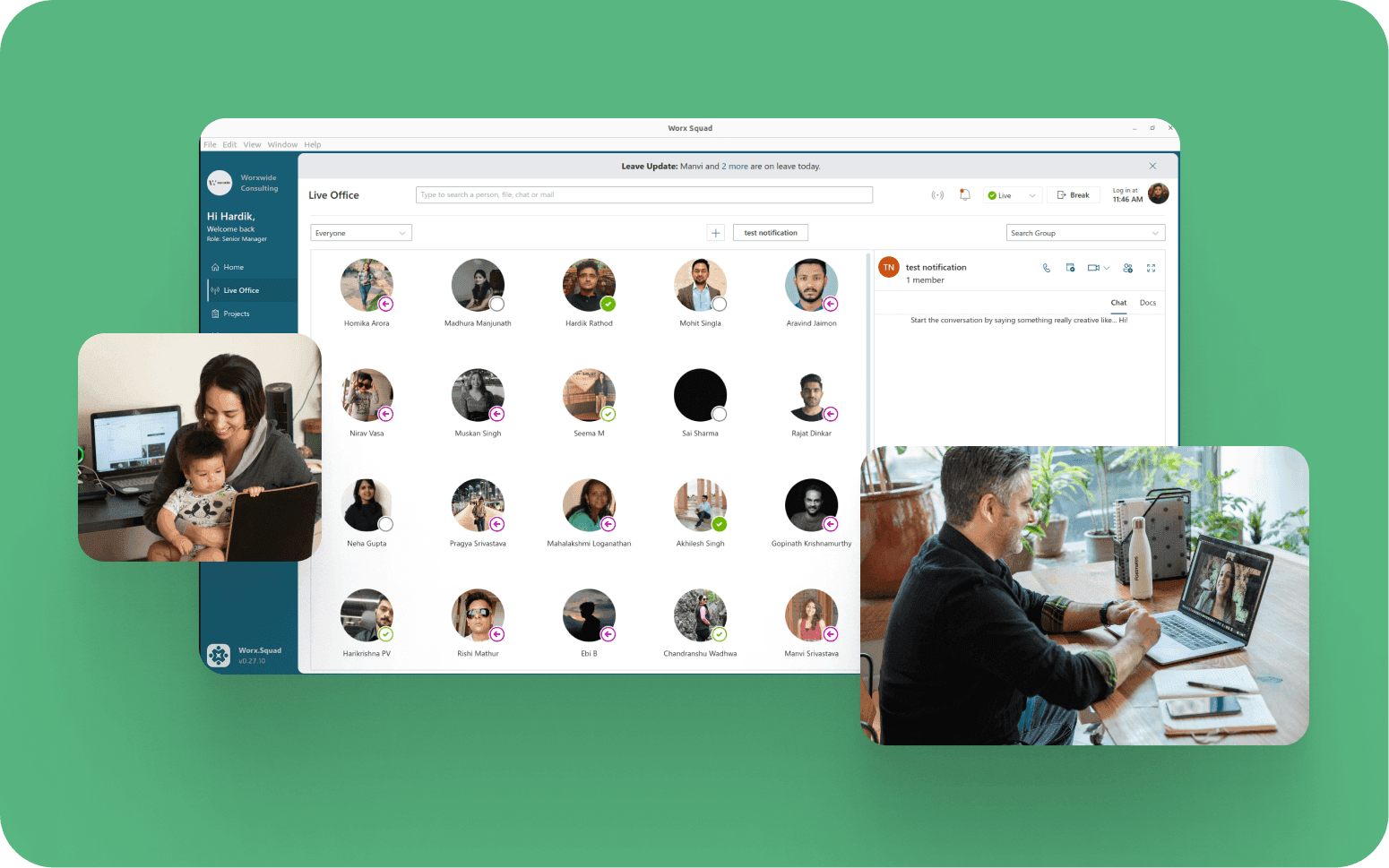
Hybrid Remote Working App That Connects Distributed Teams
- 5K+
- 14 weeks
Custom space management software for coworking operators who need desk and meeting room booking, membership management, access control, and billing in one system, not a combination of spreadsheets and a booking form built on Google Calendar.
Built for how coworking spaces actually operate. Members book their own desks and rooms at any hour, membership billing runs automatically, doors open based on booking status, and utilisation data is there when you need to decide whether to add more hot desks or convert a room.
Self-serve desk and meeting room booking portal
Membership tiers with automated recurring billing
Access control integration for keyless entry
Utilisation reporting and community dashboard
Recognition
Desk and meeting room bookings taken by email and spreadsheet, double-bookings happening weekly and no self-serve option for members who want to book at 8pm for the next morning?
Membership billing done manually each month, invoices sent by hand, payment status tracked in a spreadsheet, and chasing late payers eating admin time that doesn't scale?
In short
RaftLabs builds custom coworking space management software covering self-serve desk and meeting room booking, automated membership billing, access control integration, utilisation reporting, and community tools. Most coworking platforms ship in 12-14 weeks at a fixed cost with full source code ownership.
Companies we've built for






Most coworking spaces start with a shared spreadsheet and an email address for bookings. That works for the first 20 members. By 80 members, someone is double-booked every week, the admin team spends an hour each morning sorting out who sits where, and members who tried to book at 9pm gave up and chose a competitor who had online booking.
Membership billing has the same problem. Sending invoices one by one each month is manageable at 30 members. At 100, it's a part-time job, and that's before chasing the ones who don't pay on time.
Custom coworking space management software puts both problems in one system. Members book their own desks and rooms through a portal that shows real-time availability and respects their membership tier. Billing runs on a schedule. Access to the space is tied to booking and membership status so a member whose payment failed doesn't walk through a door that grants itself open. The operator sees utilisation by day, time slot, and resource type, the data that tells you whether to add more phone booths or convert a meeting room into dedicated desks.
Member self-booking portal for hot desks, dedicated desks, and meeting rooms, real-time availability calendar built on Redis pub/sub so two members can't book the same resource at the same moment. Booking rules are enforced by membership tier: advance booking window (24 hours for hot desk members, 7 days for dedicated desk members), daily hour limits, maximum concurrent meeting room reservations, and guest allowance per month. Instant booking confirmation by email or in-app with a QR code or PIN scoped to the booked slot, valid from five minutes before the booking starts and invalidated the moment the booking ends.
Calendar sync pushes confirmed bookings to Google Calendar or Outlook so members see their workspace alongside other commitments without checking a separate portal. Recurring desk bookings let members reserve the same spot, say, Desk 14 on every Monday and Wednesday, without repeating the action each week. The system auto-generates the recurring series and notifies the member only if a conflict prevents a particular occurrence from being honoured.
Meeting room display panels (compatible with Nexudus and OfficeRnD display integrations) show current and upcoming bookings so walkers-in can see at a glance whether the room is free. Admin override lets the operations team block resources for maintenance, run events that require multiple adjacent spaces, or transfer a booking on behalf of a member. Bulk booking tools allow event coordinators to hold all available desks for a company team day without processing individual reservations.
Membership tiers, hot desk, dedicated desk, private office, virtual, each with its own benefits configuration: booking credits per month, advance booking window, meeting room hours included in the plan, guest pass allowance, and any resource categories the tier can't access. Tier rules are enforced at the point of booking rather than relying on member honour. When a hot desk member tries to book a private office, the system presents an upgrade prompt rather than letting the booking go through.
Member onboarding is a guided workflow: the prospective member signs the membership agreement via DocuSign or Adobe Sign, uploads identity documents if required by your policy, pays the first month's fee, and receives their access credential, all without the operations team processing each step manually. The whole sequence from agreement to access provisioned takes under ten minutes.
Member directory is visible to others in the same space (with opt-out available), showing name, company, role, and skills so members can find each other for collaboration. Membership lifecycle management covers pause, upgrade, downgrade, and cancellation with configurable notice period enforcement and proration calculations for mid-month changes. Full member history, every booking, invoice, access event, and support ticket, appears on a single member record so the operations team has the context they need before a difficult conversation, not during it.
Door access is granted and revoked automatically based on booking status and active membership, no manual permission updates and no expired memberships walking through open doors. The system integrates at the API level with Kisi, Brivo, and Salto, all of which support BLE mobile credentials and NFC tap-to-enter via the member's phone or key card. When a booking is confirmed, an access grant is pushed to the access control platform for the specific door (main entrance, floor-level door, specific meeting room) scoped to the booking window. When the booking ends, the grant expires, members can't linger in paid resources after their time is up.
Membership payment failure triggers an immediate access suspension so a lapsed member doesn't continue to use the space while the billing issue is unresolved. Access is reinstated automatically when payment succeeds. After-hours access for members on 24-hour plans is managed as a persistent access rule tied to membership status rather than individual bookings, so they're never locked out during off-peak hours.
Visitor pass generation lets members pre-register guests with name and visit window. The visitor receives a PIN or QR code valid only for the registered period. The access log records every door event, who entered, which door, timestamp, giving the operations team an audit trail that insurance providers and building managers often require. Meeting room door panels integrated with Nexudus or OfficeRnD can additionally display available time slots and allow ad-hoc booking without opening the member app.
Recurring membership billing runs on a monthly or weekly cycle using Stripe's subscription and direct debit infrastructure. Failed payments trigger Stripe's Smart Retries automatically, which improves recovery rates by retrying at statistically optimal times rather than on a fixed 24-hour cadence. Members receive a payment failure notification with a direct link to update their card details. After a configurable number of failed attempts, membership status changes to suspended and access is revoked until payment succeeds.
Membership tiers are defined in Stripe Products with corresponding prices, so plan changes, upgrade from hot desk to dedicated desk mid-month, automatically prorate correctly using Stripe's built-in proration logic. Meeting room usage above the monthly included allowance is metered through Stripe Metered Billing and settled at the end of each billing period without manual invoice adjustments.
Day passes, printing credits, locker rentals, and event tickets are sold through the member portal as one-off charges. The operator configures which add-ons are available and at what price per tier. Automated invoice generation sends a PDF to the member at each billing cycle with itemised charges. Tax rates are configured per jurisdiction (US sales tax, UK VAT, Australian GST) using Stripe Tax or custom rate tables. Payment history, outstanding balances, and upcoming charges are visible to members and to the operations team in one place, no spreadsheet cross-referencing.
Member directory shows name, company, role, skills, and availability to connect, visible to other members in the same space or, for multi-location operators, across all sites the member's tier permits. Members opt out of specific fields if they prefer not to share. The directory is searchable by skill, industry, or company size so members looking for a collaborator, supplier, or advisor can find them without asking the front desk.
Community noticeboard lets the operations team post announcements, policy updates, and space news. Members can post their own updates if the operator permits it. Event calendar covers workshops, networking sessions, lunch-and-learns, and member meetups. RSVP tracking shows confirmed attendance counts and collects dietary or session preferences. Attendance recorded at check-in gives the operator actual participation data rather than RSVP counts alone.
Direct messaging supports operator-to-member communication targeted by tier (announce a hot desk offer only to hot desk members) or sent individually. Member-to-member messaging is available if the operator enables it, supporting the community aspect that distinguishes a managed coworking space from a serviced office. Feedback submission and support tickets are tracked end-to-end with status visible to the member, open, in progress, resolved, so issues aren't lost in an email inbox and members don't have to chase for updates. The ticket log is searchable by issue type, giving the operations team data on the most common failure points.
Desk and room utilisation is calculated from actual booking data and, where IoT sensors are installed, from real-time occupancy readings via PIR motion sensors, CO2 sensors, or under-desk pressure sensors connected over MQTT. Booking-based utilisation tells you what was reserved; sensor-based utilisation tells you what was actually used, the gap between the two reveals no-shows and ghost bookings that inflate apparent demand. Utilisation is broken down by time of day, day of week, resource type, and membership tier, giving operators the specific data they need to decide whether to add more phone booths, convert a meeting room into two smaller focus rooms, or introduce a peak-hour booking surcharge.
Revenue analytics break down income by product category: hot desk subscriptions, dedicated desks, private offices, meeting room overage, day passes, and add-on sales. Membership analytics cover churn rate by tier, average membership tenure, and upgrade and downgrade patterns. These tell you which tiers retain members and which act as a trial tier before members leave rather than upgrade.
New member source tracking captures acquisition channel at sign-up, website, referral, partnership, walk-in, so the operator knows which marketing activities produce members who actually stay. Capacity planning shows projected utilisation at current growth rates so the operator can see six months out whether the space will be over capacity before it actually is. All reports are exportable to CSV or connected to the operator's finance system for monthly reporting without manual data assembly.
Nexudus and OfficeRnD cover common coworking workflows well and are the right choice for most operators starting out. Both platforms handle standard hot desk booking, meeting room reservations, Stripe billing, and basic Kisi or Salto access control integration without significant configuration effort. Custom software makes sense when your space has a workflow those platforms can't handle without workarounds: unusual membership structures where benefits vary by building floor or by day of week, billing logic that requires variable metering beyond what Stripe's standard subscription model handles, or IoT sensor data integration that needs to feed into your utilisation dashboard in real time.
It also makes sense when your community features are central to the product you're selling, a curated member network with active matchmaking is difficult to bolt onto a platform primarily designed for booking and billing. And it makes sense when you're building a chain: at a certain scale, the recurring per-desk SaaS fee compounds into a meaningful cost relative to owning the software outright. We scope the decision honestly during the initial conversation. If Nexudus or OfficeRnD fits your actual workflow, we will say so rather than pitch a custom build you don't need.
The booking and membership system becomes the single authority for who has access and when, there's no separate permissions list to keep in sync. When a member confirms a booking, the system calls the access control platform API (Kisi REST API, Brivo API, or Salto KS cloud API) and creates a time-scoped unlock event for the relevant door. When the booking ends or a membership payment fails, the grant is revoked via the same API without any manual action.
Kisi and Brivo both expose webhook events so the booking system receives real-time confirmation that access was granted or that the member actually tapped in. Salto BLE and NFC credentials are provisioned to the member's phone through the Salto KS mobile credential flow. Visitor management plugs into the same access control API: a member registers a visitor with a name and visit window, and the system generates a temporary PIN or QR credential valid only for that window.
If you haven't yet chosen access control hardware, the decision matters for integration quality. Kisi has the most complete REST API for booking-driven access automation. Brivo is common in larger commercial buildings where the building already has Brivo hardware. Salto is popular in European markets and newer UK coworking builds. We advise on hardware selection based on your building type, existing infrastructure, and the integration depth you need.
Yes. Multi-location support is a standard part of the architecture for operators running more than one site or planning to grow to multiple locations. The data model separates location-level resources (desks, rooms, access doors) from group-level configuration (membership tiers, billing plans, community features) so each location can have its own floor plan and resource inventory while sharing a common membership and billing structure.
Members can book resources at any location their membership tier permits. A multi-site membership gives access to all locations; a single-site membership restricts booking to the home site with optional day pass upgrades for other sites. Location managers see utilisation and revenue data for their site only, while the operations director sees consolidated reporting across all sites. Access control systems at each location are managed through the same central admin panel, with separate Kisi or Brivo accounts per building linked to the group management layer.
Membership tiers and pricing can be configured identically across all sites or differently per location, useful when sites have significantly different operating costs or market positioning. Billing consolidates at the group level for finance reporting, with per-site revenue breakdowns available for property-level P&L purposes. If you're building toward a franchise model, the multi-location architecture extends naturally to franchisee accounts with central brand control and local configuration autonomy.
A focused coworking space management platform covering member self-booking, membership management, automated Stripe billing, and access control integration with Kisi or Brivo typically ships in 12-14 weeks at a fixed cost. That scope covers the web portal for members and the admin panel for operators, no native mobile apps included in the baseline.
A more complete build adding a native member app (iOS and Android with push notifications, mobile access credentials, and in-app support tickets), community features, multi-location support, IoT occupancy sensor integration, and custom utilisation reporting typically takes 16-20 weeks. The two largest variables are the number of third-party integrations, each access control system, payment provider, or accounting tool adds integration testing time, and the complexity of your membership and billing rules. Unusual proration logic, multiple billing currencies, or metered billing for resource categories beyond meeting rooms each add scope.
We scope the project before pricing it. You receive a fixed cost for an agreed specification before any development begins. We don't start work on a running estimate that grows as the project progresses. If your project falls outside a 12-14 week window, we will tell you why and give you the option to phase the build to get core functionality live sooner.
What clients say
Three-year average engagement. Founders and operators describing the work in their own words. No marketing varnish.

 India
IndiaRaftLabs delivered a platform that genuinely changed how our teams collaborate and manage their work together.
01 / 02
Tell us how your space runs today, the number of members, your current booking and billing tools, and where the admin overhead is highest. We'll scope the right system and give you a fixed cost.