
Coworking space software
Custom coworking space software for operators, flexible office providers, and business centres who need member management, booking, access control, and billing built around how their space actually runs.
Member management for individual, team, and company accounts with plan and entitlement tracking
Desk, room, and pod booking with real-time availability and member self-service
Access control integration for door locks and entry systems linked to membership status
Automated billing with per-member invoicing and end-of-month reconciliation
The problem
Sound familiar?
Managing desk reservations and meeting room bookings across two locations in a spreadsheet while members email you for access updates?
Spending three days at the end of every month manually reconciling what each member owes against their usage and plan?
Short answer
RaftLabs builds custom coworking space software for operators, flexible office providers, and business centre operators. It handles member management, desk and room booking, access control tied to membership status, and automated billing across every location. A validated v1 launches in 12 to 16 weeks at a fixed price, then grows from there.
Trusted by




























Coworking space software built for operators managing members, not just booking desks
Coworking space software has to do more than book a desk. Coworking operators run a layered operation that generic booking tools don't solve. A member might be an individual on a hot-desk plan, part of a company team on a dedicated office contract, or a day-pass visitor. Each has different entitlements, different billing rules, and different access rights. Managing those differences manually, in spreadsheets, email threads, and separate billing tools, turns a growing space into a full-time admin operation.
Access provisioning is where the manual work compounds. When a new member joins, someone has to grant building access, add them to the wifi, set up their booking account, and send the welcome information. When they leave, all of that needs to be reversed. Done manually, it creates gaps: former members with active access credentials, new members waiting two days for a door code.
RaftLabs builds software that handles the member lifecycle from signup to offboarding, with booking, access, billing, and reporting all connected.
01 Diagnosis
Where coworking software usually breaks
- 01Problem
Billing is where a platform earns its keep
SolutionBilling is where a platform earns its keep, because every error lands in a member's inbox. Operators who switched platforms cite double invoicing, invoices that fail to generate, no easy filter for overdue invoices, and monthly payment collection that still needs a person. When members can't see real-time availability and self-book, they call reception. Each call takes five minutes. Multiply that across twenty desks and four meeting rooms at two locations, and reception becomes a full-time phone job. A self-service booking system with live availability cuts that friction and frees staff for work that actually needs them. The outcome is billing the team no longer dreads.
- 02Problem
Nickel and dime extras
SolutionDeployment is difficult without professional paid assistance. Nickel and dime extras. A key integration costs almost as much as the platform itself. When a member's base plan is in one system and their ad hoc usage is tracked in another, month-end reconciliation is a manual exercise. Credits consumed, meeting room overages, and printing charges have to be pulled together before an invoice can be raised. That work takes three days every month and still produces errors. Consolidated billing that pulls all charges into one invoice per member or per company account removes that work entirely. The outcome is month-end as a predictable process, not a recurring fire drill.
- 03Problem
Does it all, if you can figure out how to do any of it
SolutionNexudus is not user-friendly at all. It is overcomplicated and training takes a long time with constant referral to FAQs to get anything done. Members upgrade, downgrade, pause, and cancel. When those changes happen in email or on a Post-it note, the billing system doesn't know. The result: a member on a paused plan gets charged anyway, a downgraded member keeps accessing rooms above their entitlement, and disputes pile up at month end. A platform that ties plan changes directly to billing and entitlement removes that gap. The outcome is plan changes the billing system actually knows about.
- 04Problem
No more chasing former clients down for keys
SolutionWhen a membership lapses or is cancelled, someone has to remember to revoke building access manually. Former members retain active credentials. New members wait for a staff member to issue a door code. Door access and accounting integrations sometimes fail and force manual entry, and when a problem sits between the platform and a partner, each side can point at the other. We build access control integration with one accountable owner: integrating access control with membership status so provisioning and revocation happen automatically, with no manual step. The outcome is no more chasing former clients down for keys.
02 What we ship
Coworking software we build
Member management
Member accounts at individual, team, and company level with plan assignment, entitlement tracking, and billing configuration. Company accounts with a designated administrator who manages their team's seats, access, and spending. Plan management for hot-desk, dedicated desk, private office, and day-pass tiers with different booking allowances and amenity entitlements per plan. Onboarding workflow that provisions access, sends welcome information, and creates the booking account in one flow rather than five separate steps. Membership renewal, upgrade, and cancellation with automated billing adjustments and access changes triggered by the status change. The outcome is members who know what their plan includes.
Desk and room booking
Self-service booking for desks, private offices, meeting rooms, phone booths, and lockers with real-time availability. Member-facing booking interface on web and mobile. Entitlement enforcement so a hot-desk member books within their plan allowance without staff approval for each reservation. Meeting room booking with duration, attendee count, and equipment selection. Recurring booking for members who want the same desk every Tuesday and Thursday. Booking modifications and cancellations with configurable notice period rules. Admin view of all reservations across all spaces. The outcome is reception freed from availability calls.
Access control integration
Integration with physical access control systems, door lock controllers, smart lock platforms, and entry management systems so that a member's digital membership status controls their physical building access. Access provisioned automatically when a membership is activated and revoked when it expires or is cancelled. Time-based access rules for members with restricted-hours plans. Visitor management for guests of members with temporary access codes. Multi-door access profiles for members who need access to specific areas based on their plan. Access event log for security and usage reporting. The outcome is access that always matches account status.
Automated billing and invoicing
Monthly billing generated automatically from each member's plan, usage, and any additional charges: meeting room overages, day passes, printing credits, with no manual reconciliation. Per-member invoice generation with itemised billing breakdown. Payment collection via card on file with automatic retry on failed payments. Company account billing consolidated to a single invoice for the account administrator. Stripe or payment gateway integration with automated reminders for unpaid invoices. Revenue reporting by plan type, location, and time period. The outcome is month-end as a review queue, not a reconciliation.
Community and amenity features
Member directory with opt-in profiles so members can find and connect with others in the space. Event management for community events, workshops, and networking sessions with member RSVP tracking. Amenity booking for shared resources beyond desks and rooms: lockers, storage units, parking spaces, equipment. Member announcements and community updates delivered via the member portal and email. Community engagement metrics for operators: event attendance, directory profile completion, amenity utilisation. The outcome is community features that give members a reason to stay.
Occupancy analytics and multi-location
Real-time occupancy dashboard showing current desk utilisation, room bookings, and capacity across each zone and floor. Historical occupancy reporting by day, week, and month for understanding peak and quiet periods. Revenue per desk and per square metre reporting. Member retention and churn tracking with early warning indicators for accounts approaching cancellation. Multi-location management with a single admin view across all your spaces and per-location drill-down. Plan performance reporting showing which plans generate the most revenue and the most churn. The outcome is space decisions based on data, not memory.
03 Buy, build, or wait
The coworking software decision is usually about the platform: what it charges, what it can't do, and who owns the failure in between.
Stay on the platform
Nexudus, Cobot, OfficeRnD
When the plan structure is standard and the integrations you need are the ones they support.
Build custom
When the extras cost as much as the platform
Nickel and dime extras, paid deployment, a single integration priced like the platform itself.
When the second site reprices the bill
Charged per month per location by active-user band. Owned software doesn't reprice your growth.
When nobody owns the failure
Door access fails, each side points at the other. Build with one accountable owner.
Bottom line
Stay on the platform while it fits. Build when the pricing punishes your growth or the integrations fail without an owner.
04 How we work
How we build coworking software
- 01
Discovery
We map your current operation: membership plan structure, booking rules, access control system, billing workflow, and any multi-location requirements. We find where manual processes create the most admin cost or the most member friction, and agree on the scope that addresses the highest-priority problems first. You get a fixed-price specification before development begins. The risk this retires: the plan the platform can't configure. - 02
Architecture
We design the data model around your actual membership types (individual, team, company account) and your billing rules before writing code. This determines how entitlements attach to plans, how bookings enforce plan limits, how usage charges accumulate to the right invoice, and how access control integrates with membership status. The structure determines everything downstream. The risk this retires: the company account the billing can't attribute. - 03
Build
Development runs in two-week sprints with working software shown at each checkpoint. The member portal, booking system, access control integration, billing engine, and utilisation dashboard are built and tested in parallel where dependencies allow. You review real functionality at each sprint review against your actual membership scenarios. The risk this retires: the integration that fails with nobody owning it. - 04
Launch and support
Go-live is planned to minimise disruption, typically a parallel run for the first billing cycle before switching fully. We provide documentation and onboarding for front-of-house staff and members. Post-launch support covers bug fixes and adjustments from real-world use, with handover to your team or an ongoing arrangement. The risk this retires: the billing cycle that goes live untested.
05 Track record
What you get working with RaftLabs
- Weeks to a validated v1, then grow from there
- 12-16
- Cost, agreed before we build
- Fixed
- Shipping production booking and access software
- Since 2015
We build coworking platforms custom rather than reselling a template, so the honest place to start is the nearest system we have shipped. For City Break Apartments, a serviced-apartment operator in Dublin, we built a branded booking website and a Bluetooth keyless mobile app. The mechanics carry straight over to coworking: book a space, and building access follows the booking automatically, with no front-desk handover and no code emailed out.
06 Case studies
Adjacent proof: booking plus keyless access
08 Why us
Why choose us?
- 01
We've seen your problem before
Across dozens of industries, we recognise your situation fast, then frame the fix around your margin and your operations, not a generic template. - 02
We own the number, not the ticket
We measure success the way you do: hours saved, revenue earned, margin recovered. We stay through launch and growth, so the result is ours to own. - 03
Serious businesses trust us
Vodafone, T-Mobile, Cisco, Energia, Aldi, Nike. Building since 2015. Serious businesses keep coming back because we stay accountable long after launch.
09 Questions
Common questions
Off-the-shelf coworking platforms handle the standard member management and booking workflow well for single-location operations with straightforward plan structures. Custom software is the right choice when your membership model has complexity those platforms can't configure. Examples: company accounts with multiple cost centres billed separately. Access control integration with a system the platform doesn't support. A multi-location setup with shared member records and cross-location booking rules. Or building a coworking software product for other operators. Building custom when a platform configuration would handle the requirement adds ongoing maintenance cost without adding value.
Yes. Integrating physical access control systems with membership status is a common requirement for coworking software projects. The integration approach depends on the access control system in use. Most commercial door lock and entry management systems expose an API or SDK. The result: access provisioning and revocation happen automatically when membership status changes, without a staff member updating two systems manually. We scope the specific integration during discovery because the access control system's API determines the technical approach and timeline.
Yes. Billing for individual members on monthly plans and company accounts with team-level billing consolidated to one invoice requires a data model that handles both correctly. Individual billing is straightforward: one plan, one invoice, one payment method. Company billing adds a layer: multiple members under one account, potentially on different plans, with a company-level invoice that aggregates all charges and a single payment method for the account. Meeting room overage charges, day-pass purchases by team members, and billing adjustments all need to attribute correctly to the right account. We build this data model during the scoping phase before writing code.
A focused coworking space software v1, member management, desk and room booking, and automated billing, launches in 12 to 16 weeks. A full platform adds access control integration, community features, occupancy analytics, and multi-location support. Cost depends on the number of locations, the access control systems that need to be integrated, and the complexity of your membership plan structure. We scope every project before pricing. Fixed cost, agreed before development starts.
Utilisation data from the booking system shows you, by space type, by day, and by hour, what's actually in demand versus what sits empty. Operators commonly discover that their 8-person boardroom is booked for 3-hour blocks twice a week while smaller meeting rooms have queues. That data changes how you configure space: converting the underused boardroom into two 4-person rooms, or adding phone booths because the data shows members booking meeting rooms for solo calls. The reporting dashboard shows occupancy patterns over rolling 4-week periods so seasonal variation is visible. You make layout decisions based on what the data shows rather than what you remember from last month.
That fear is common and honest. The classic complaint is a platform that does it all, if you can figure out how to do any of it, with training that takes a long time and constant referral to FAQs. We design the staff workflows with your front desk: booking management that doesn't need a manual, billing review that takes minutes, and every lever explained once, not re-explained to whoever covers the desk next month. The system ships when your staff can run a full day on it without help.
Coworking software by capability
- 01
Custom software development
Member portals, booking systems, and access control integrations built for your space model
- 02
Business process automation
Membership renewals, booking reminders, and invoice generation automation
- 03
AI chatbot development
Member-facing bots for availability queries and booking assistance
Get a build-vs-Nexudus plan for your coworking space
Tell us the operational challenge: member management, booking, access control, or billing. We'll tell you what we'd build and how.
- Scope and cost agreed before work starts. No surprises. No obligation.
- Working prototype within 3 weeks of kickoff.
- Pay by milestone. You see progress before each invoice.
- 60-day post-launch warranty. Bug fixes, UI tweaks, and deployment support. No retainer.
- All conversations are NDA-protected.
Useful next steps
More on real estate & construction
Service
Service
Hotel Property Management System
See the serviceService
Service
Inspection App Development
See the serviceService
Service
Tenant Screening Workflow Software Development
See the serviceService
Service
Land Surveying Software Development
See the serviceTry it yourself
Try it yourself
Build vs Buy Calculator
The real cost of building in-house (most teams miss 40%).
Open the free tool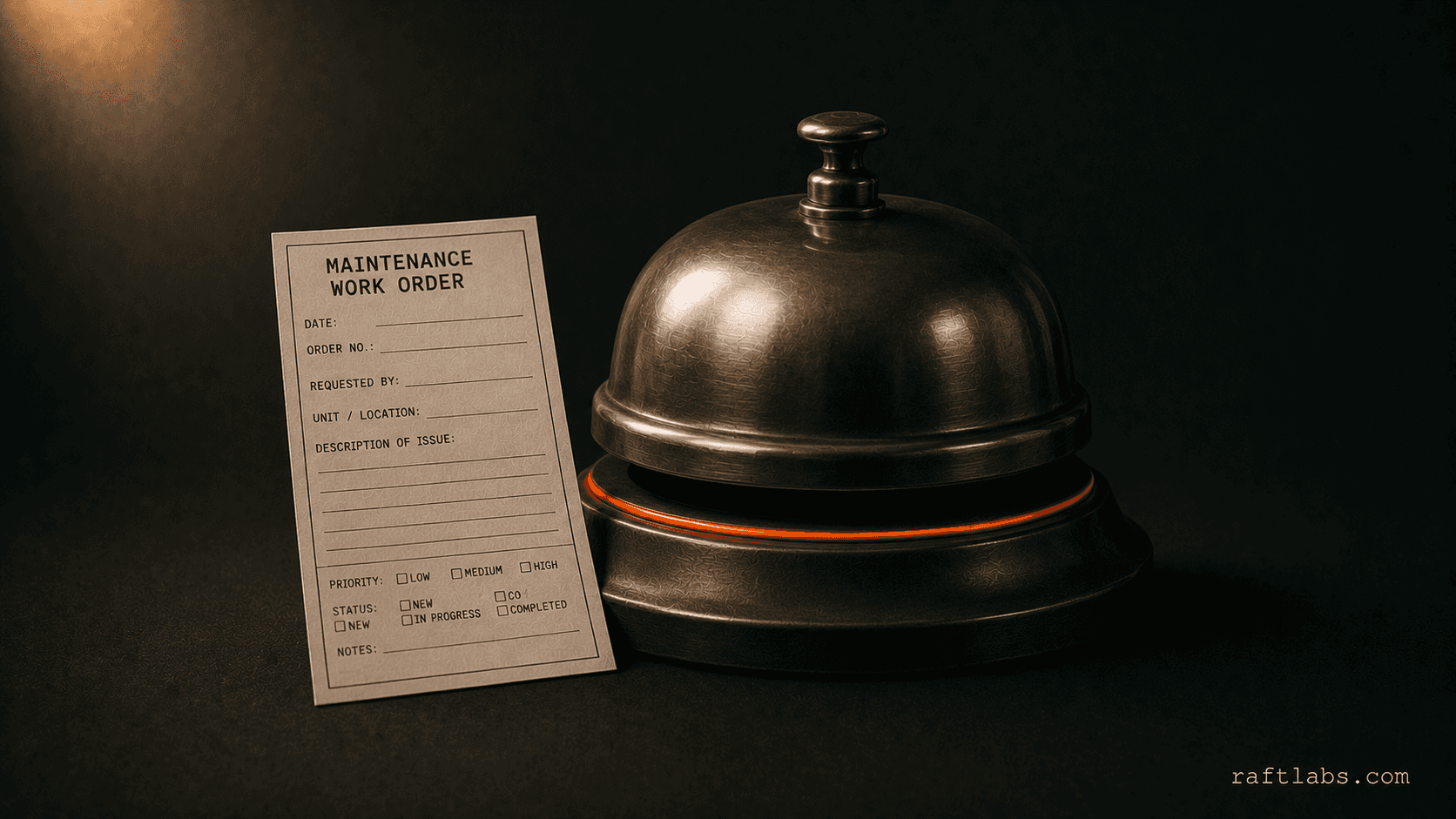
Article
Tenant communication is drowning your property management team
39% of property managers spend 20+ hours per month on maintenance requests alone. Your team answers the same questions 50 times a week while tenants complain about slow responses. Each turnover costs $3,500-$8,000. Here's how to automate the communication that drives tenants away - without losing the personal touch.
Read more